REVIEW 3 major objections 5 minor 158 references
From Tea Leaves to System Maps: A Survey and Framework on Context-aware Machine Learning Monitoring
T0 review · 3 major / 5 minor · reviewed 2026-08-07 · deepseek-v4-flash
Pith's one-line read A systematic review of 94 studies argues that contextual information in ML monitoring can be organized into three dimensions—System, Aspect, Representation—yielding 20 recurring patterns mapped to monitoring activities.
desk verdict A transparent, well-executed mapping study that delivers a useful descriptive vocabulary for context-aware ML monitoring; the main caveat is the unmeasured coding stability behind the 20-triplet count. read the letter →
The pith
A machine-rendered reading of the paper's core claim, the machinery that carries it, and where it could break.
The reading
What carries the argument
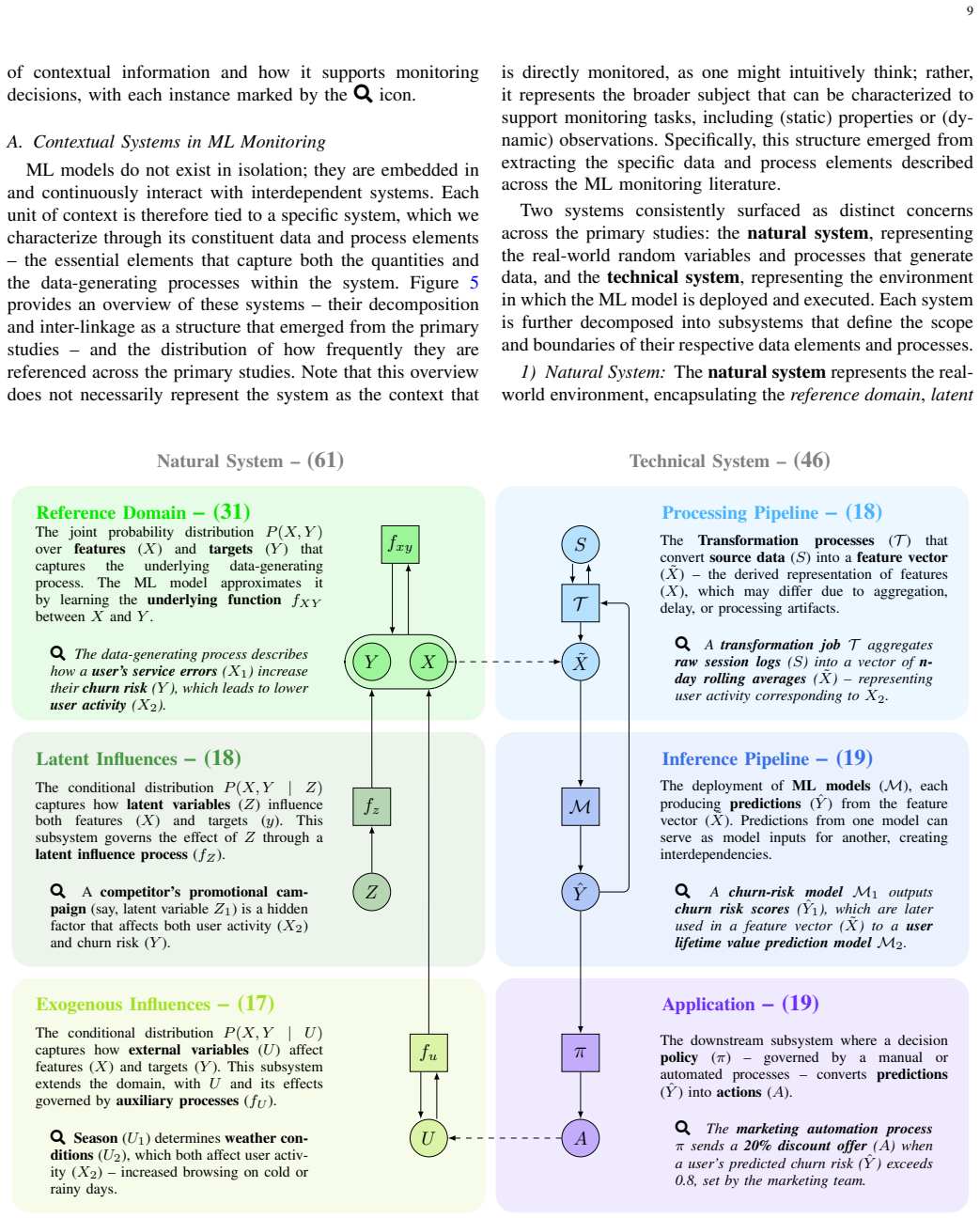
The central object is the C-SAR triplet (System, Aspect, Representation). A piece of context is classified by where it lives (Natural System: reference domain, latent influences, exogenous influences; Technical System: processing pipeline, inference pipeline, application), by what kind of information is captured (State: conditions and evaluations; Structure: entities and relations; Properties: nominal, event, and normative), and by how it is encoded (formal: numerical, probabilistic, logical; informal: graphical, semi-structured). The framework's work is to turn this three-way classification into an analytical vocabulary: each recurring combination becomes a named pattern (e.g., Reference Slices, Exogenous Diagnostics, Latent Projections, Processing Traces), and these patterns are then mapped to five monitoring activities. The catalog of 20 patterns is the carrier of the paper's empirical claim.
What would settle it
Re-code the 94 primary studies with an independent team blind to the C-SAR categories: if inter-rater agreement on (S,A,R) assignments falls below roughly 0.6, or if any primary study's contextual usage cannot be placed in the taxonomy, the claim that C-SAR describes the literature loses support. A second check is to reproduce the selection using an alternative embedding model and openly logged thresholds: if the retained corpus and the 20-pattern catalog change materially, the empirical grounding is unstable.
Extended reading notes
Core claim
The central discovery is that context in ML monitoring is not an unbounded mess but a describable structure. Every usage of contextual information in the reviewed literature can be located along three dimensions: the system element it concerns (the natural, real-world environment that generates data, or the technical infrastructure that processes it, runs inference, and applies predictions); the aspect captured (runtime state, structural relations between elements, or prescriptive properties such as nominal constraints, expected events, and normative limits); and the representation used to encode it (numerical, probabilistic, logical, graphical, or semi-structured). These dimensions combine into (S,A,R) triplets, and 20 such triplets recur often enough—at least three primary studies each—to form a catalog. The paper maps those triplets to the monitoring activities they support, showing, for example, that natural subgroups and specifications feed drift detection and performance monitoring, while technical observations pervade all activities. This is a descriptive unification claim: C-SAR is offered as an organizing vocabulary for a fragmented field, not yet as a validated engineering method.
Load-bearing premise
The load-bearing premise is that the keyword search, semantic filter with hand-set thresholds ($T_0=0.4$, $\theta=0.1$), and the authors' open coding of 94 studies captured a representative picture of ML monitoring research, and that a different screening or coding team would assign the same System, Aspect, and Representation labels.
Editorial extensions
If this is right
- Monitoring setups can be described and compared as collections of (S,A,R) triplets, so a technique from one community (e.g., causal diagrams for drift detection) can be recognized as the same pattern used elsewhere.
- For each monitoring activity, the framework shows which context patterns are already common and which are rare, pointing at gaps—for instance, out-of-distribution detection leans on technical observations and exogenous diagnostics more than on natural specifications.
- Tooling inspired by C-SAR would treat system elements as persistent first-class entities on a graph and store triplets as attributes, making monitors reusable across models that share features or pipelines.
- Practitioners can use the natural and technical system maps as a checklist for what context to record, reducing reliance on individual memory and scattered team knowledge.
Reading between the lines
- A testable extension the paper leaves implicit: if C-SAR triplets are used as a monitor-design checklist in a real deployment, one can measure whether alert rates and mean time to diagnosis improve against a baseline; the authors themselves call for exactly this empirical validation.
- Because the review excludes grey literature and practitioner reports, the 20-pattern catalog may undercount the contextual signals that actually appear in industry practice; including incident write-ups or engineering blogs could add triplet patterns or refine existing ones.
- The natural/technical boundary is agent-relative: in a multi-agent or cyber-physical system, one component's environment is another agent's internals. A future refinement could make the boundary explicit per monitoring perspective, a step the paper acknowledges but does not take.
- The semantic filter depends on a proprietary embedding model and hand-set thresholds, so replication requires either using the same paid service or re-calibrating thresholds on an open model; a reproduction study could test whether the 20 patterns survive the change.
Editorial analysis
A structured set of objections, weighed in public.
Referee Report
Summary. This paper presents a systematic mapping study of context-aware machine learning monitoring, based on 94 primary studies. The authors introduce the Contextual System-Aspect-Representation (C-SAR) framework, which characterizes contextual information along three dimensions: the system element being described (natural vs. technical), the aspect of that element (state, structure, properties), and the representation used (formal vs. informal). They identify 20 recurring (S,A,R) triplets and map them onto monitoring activities such as drift detection, data validation, OOD detection, performance monitoring, and model validation. The study design includes an explicit search protocol, a novel semantic-filtering pipeline, and a replication package. The paper claims to provide a holistic vocabulary for a fragmented research area, moving from isolated 'tea leaves' to holistic 'system maps.'
Significance. If the empirical grounding holds, C-SAR provides a genuinely useful descriptive framework and shared vocabulary for ML monitoring research, which currently lacks a unified structuring of contextual information. The study's strengths include an unusually transparent selection protocol (search-string components, pilot studies, semantic-filter validation, and traceable tables linking every pattern to primary studies), a replication package, and a clear effort to mitigate threats to validity. The paper also offers a credible synthesis of prior work and a concrete research agenda for validating the framework in practice. However, the central empirical claim—the catalog of 20 recurring triplets—depends on the stability of subjective coding and on the representativeness of the selected corpus, and both of these are currently not fully demonstrated.
major comments (3)
- [§IV-D, §VIII-A, Table IV] The open-coding process that produces the C-SAR taxonomy and the 20 triplet patterns is described as iterative and refined by multiple authors, but no inter-rater reliability statistic is reported. This matters directly for the headline claim: several patterns in Table IV have support of exactly three primary studies (Latent Diagrams, Latent Expectations, Processing Traces, Application Diagnostics, Application Comments), so a small shift in coding judgment would change the central count and the catalog. The acknowledgment in §VIII-A that 'qualitative synthesis is inherently subjective' is honest but does not substitute for a quantitative reliability check. I recommend reporting Cohen's kappa or Krippendorff's alpha on a sample of studies coded by independent raters, and making the full codebook and coded data available.
- [§IV-C2, Figure 4] The semantic filter is validated only with a recall of 0.99 on a self-annotated set of 1,500 papers; no precision or false-negative analysis on the final corpus is reported. Since the filter uses hand-set thresholds T0=0.4 and θ=0.1 and a proprietary embedding model (text-embedding-3-large), the representativeness of the 94 primary studies depends on unmeasured exclusions. The paper mentions a manual review of a sample of filtered-out studies but does not quantify the false-negative rate. At minimum, please report precision, the number of relevant studies excluded, and a sensitivity analysis over the threshold parameters to show that the main conclusions are not artifacts of threshold choice.
- [§IV-B, §IV-C] The search strategy is validated against a set of 27 pilot studies, and the relevance criteria and taxonomy are refined iteratively on the same pilot set. One of these pilot studies is the authors' own work (reference [29]), which is not disclosed in the description of the pilot process. This creates a mild circularity risk: the framework categories may be overfitted to the authors' prior terminology. Please state explicitly which pilot studies were authored by the current authors, and ideally demonstrate that the final taxonomy is not dependent on any single pilot study (e.g., by re-running the coding with pilot studies removed from the corpus and showing that the pattern catalog is stable).
minor comments (5)
- [Table IV] The parent pattern 'Technical Observations' is reported with support 25, while its five subpatterns sum to 31 (5+8+5+3+10). If a study can contribute to multiple subpatterns, please state this in the table caption; otherwise the arithmetic should be reconciled.
- [Figure 6] Cells without a number are described as single occurrences, but the visual encoding of pie segments and counts is not fully legible. Please add a legend that clarifies how to read the circle sizes and segment counts, and consider a tabular version of the counts for reproducibility.
- [§VI-A2b] There is a typo: 'sem-structured' should be 'semi-structured' in the paragraph on application comments.
- [§IV-C2] The description of the threshold adaptation in Figure 4 uses the notation T_p^c and formulas for low and high clusters, but the relationship between θ, distance d, and the direction of adjustment would benefit from a textual explanation in the main text, not only in the figure.
- [Abstract and §I] The phrase 'from tea leaves to system maps' is evocative but is not defined until late in the paper; a one-sentence explanation in the introduction would help readers who encounter the metaphor in the abstract.
Circularity Check
No significant circularity: C-SAR is a descriptive taxonomy grounded in open coding of 94 studies; the only self-citation is a non-load-bearing pilot study.
full rationale
The paper makes no quantitative predictions and the C-SAR framework is explicitly descriptive, synthesized from the same 94 primary studies it organizes; this is the declared method of a systematic mapping study, not a circular derivation. The only parameterized component is the semantic filter (T0=0.4, θ=0.1), which is validated on a manually annotated set Dtest with recall 0.99 and used to select the corpus; it is not a fitted parameter renamed as a finding. The 20 recurring triplets come from open coding with traceable support lists, and the authors concede in Section VIII-A that “qualitative synthesis is inherently subjective, and this threat cannot be entirely eliminated,” which is an honest limitation rather than evidence that the taxonomy reduces to its inputs by construction. One pilot study by the authors ([29]) is cited as supporting evidence for a few patterns, but removing it would not change the central catalog (e.g., Latent Scenarios retains support 5, Latent Projections 10), so the self-citation is not load-bearing. The framework was refined iteratively against the corpus, as stated in Section VII-A (“The C-SAR framework emerged through iterative synthesis during our review”), but this is inherent to qualitative synthesis and does not constitute the kind of definitional or fitted-input circularity that would invalidate the contribution. The absence of inter-rater reliability is a reproducibility concern, not a circularity concern.
Assumptions & free parameters
free parameters (3)
- Semantic filter base threshold T0 =
0.4
- Semantic filter threshold adjustment theta =
0.1
- Minimum pattern support =
3 primary studies
assumptions (4)
- domain assumption Context is defined as any auxiliary information beyond a model's features, predictions, and target labels.
- domain assumption The 94 selected primary studies are representative of the ML monitoring literature relevant to context.
- domain assumption The semantic filter's recall of 0.99 on Dtest transfers to the full pool of 34,568 studies.
- domain assumption Open coding by the authors produces stable categories with mutual exclusivity.
Cite this review
Pith. "Pith review of From Tea Leaves to System Maps: A Survey and Framework on Context-aware Machine Learning Monitoring." pith.science (2026). https://pith.science/paper/MDQ3SQFV
@misc{pith2026250610770,
  author       = {Pith},
  title        = {Pith review of: From Tea Leaves to System Maps: A Survey and Framework on Context-aware Machine Learning Monitoring},
  year         = {2026},
  howpublished = {\url{https://pith.science/paper/MDQ3SQFV}},
  note         = {Machine review of arXiv:2506.10770}
}
read the original abstract
Machine learning (ML) models in production fail when their broader systems -- from data pipelines to deployment environments -- deviate from training assumptions, not merely due to statistical anomalies in input data. Despite extensive work on data drift, data validation, and out-of-distribution detection, ML monitoring research remains largely model-centric while neglecting contextual information: auxiliary signals about the system around the model (external factors, data pipelines, downstream applications). Incorporating this context turns statistical anomalies into actionable alerts and structured root-cause analysis. Drawing on a systematic review of 94 primary studies, we identify three dimensions of contextual information for ML monitoring: the system element concerned (natural environment or technical infrastructure); the aspect of that element (runtime states, structural relationships, prescriptive properties); and the representation used (formal constructs or informal formats). This forms the Contextual System-Aspect-Representation (C-SAR) framework, a descriptive model synthesizing our findings. We identify 20 recurring triplets across these dimensions and map them to the monitoring activities they support. This study provides a holistic perspective on ML monitoring: from interpreting "tea leaves" (i.e., isolated data and performance statistics) to constructing and managing "system maps" (i.e., end-to-end views that connect data, models, and operating context).
Figures


Figures from the paper (4 more)



Reference graph
Works this paper leans on
-
[29]
Expert monitoring: Human-centered concept drift de- tection in machine learning operations,
J. Leest, C. Raibulet, I. Gerostathopoulos, and P. Lago, “Expert monitoring: Human-centered concept drift de- tection in machine learning operations,” in Proceedings of the 2024 ACM/IEEE 44th International Conference on Software Engineering: New Ideas and Emerging Results, 2024, pp. 1–5
2024
-
[1]
Temporal quality degradation in ai models,
D. Vela, A. Sharp, R. Zhang, T. Nguyen, A. Hoang, and O. S. Pianykh, “Temporal quality degradation in ai models,” Scientific Reports , vol. 12, no. 1, p. 11654, 2022
2022
-
[2]
” we have no idea how models will behave in production until production
S. Shankar, R. Garcia, J. M. Hellerstein, and A. G. Parameswaran, “” we have no idea how models will behave in production until production”: How engineers operationalize machine learning,” vol. 8, no. CSCW1. ACM New York, NY , USA, 2024, pp. 1–34
2024
-
[3]
How algorithmic confounding in recommendation sys- tems increases homogeneity and decreases utility,
A. J. Chaney, B. M. Stewart, and B. E. Engelhardt, “How algorithmic confounding in recommendation sys- tems increases homogeneity and decreases utility,” in Proceedings of the 12th ACM conference on recom- mender systems, 2018, pp. 224–232
2018
-
[4]
The ml test score: A rubric for ml production readiness and technical debt reduction,
E. Breck, S. Cai, E. Nielsen, M. Salib, and D. Sculley, “The ml test score: A rubric for ml production readiness and technical debt reduction,” in 2017 IEEE interna- tional conference on big data (big data) . IEEE, 2017
2017
-
[5]
A survey on concept drift adaptation,
J. Gama, I. ˇZliobait˙e, A. Bifet, M. Pechenizkiy, and A. Bouchachia, “A survey on concept drift adaptation,” ACM computing surveys (CSUR) , vol. 46, no. 4, pp. 1–37, 2014
2014
-
[6]
Learning under concept drift: A review,
J. Lu, A. Liu, F. Dong, F. Gu, J. Gama, and G. Zhang, “Learning under concept drift: A review,” IEEE Trans- actions on Knowledge and Data Engineering , vol. 31, no. 12, pp. 2346–2363, 2019
2019
-
[7]
No free lunch theorem for concept drift detection in streaming data classification: A review,
H. Hu, M. Kantardzic, and T. S. Sethi, “No free lunch theorem for concept drift detection in streaming data classification: A review,” Wiley Interdisciplinary Re- views: Data Mining and Knowledge Discovery , vol. 10, no. 2, p. e1327, 2020
2020
Show all 158 references
-
[8]
Leveraging unlabeled data to pre- dict out-of-distribution performance,
S. Garg, S. Balakrishnan, Z. C. Lipton, B. Neyshabur, and H. Sedghi, “Leveraging unlabeled data to pre- dict out-of-distribution performance,” arXiv preprint arXiv:2201.04234, 2022
2022 arXiv
-
[9]
Predicting with confidence on unseen distributions,
D. Guillory, V . Shankar, S. Ebrahimi, T. Darrell, and L. Schmidt, “Predicting with confidence on unseen distributions,” in Proceedings of the IEEE/CVF interna- tional conference on computer vision , 2021, pp. 1134– 1144
2021
-
[10]
Agreement-on-the-line: Predicting the performance of neural networks under distribution shift,
C. Baek, Y . Jiang, A. Raghunathan, and J. Z. Kolter, “Agreement-on-the-line: Predicting the performance of neural networks under distribution shift,” Advances in Neural Information Processing Systems , vol. 35, pp. 19 274–19 289, 2022
2022
-
[11]
Data validation for machine learning
E. Breck, N. Polyzotis, S. Roy, S. Whang, and M. Zinkevich, “Data validation for machine learning.” in MLSys, 2019
2019
-
[12]
Automating large-scale data quality verification,
S. Schelter, D. Lange, P. Schmidt, M. Celikel, F. Biess- mann, and A. Grafberger, “Automating large-scale data quality verification,” Proceedings of the VLDB Endow- ment, vol. 11, no. 12, 2018
2018
-
[13]
Automatic and precise data validation for machine learning,
S. Shankar, L. Fawaz, K. Gyllstrom, and A. Parameswaran, “Automatic and precise data validation for machine learning,” in Proceedings of the 32nd ACM International Conference on Information and Knowledge Management , 2023, pp. 2198–2207
2023
-
[14]
Automating data quality validation for dynamic data ingestion
S. Redyuk, Z. Kaoudi, V . Markl, and S. Schelter, “Automating data quality validation for dynamic data ingestion.” in EDBT, 2021, pp. 61–72
2021
-
[15]
A human-centric perspective on model monitoring,
M. N. Shergadwala, H. Lakkaraju, and K. Kenthapadi, “A human-centric perspective on model monitoring,” in Proceedings of the AAAI Conference on Human Computation and Crowdsourcing , vol. 10, 2022, pp. 173–183
2022
-
[16]
Hidden technical debt in machine learn- ing systems,
D. Sculley, G. Holt, D. Golovin, E. Davydov, T. Phillips, D. Ebner, V . Chaudhary, M. Young, J.-F. Crespo, and D. Dennison, “Hidden technical debt in machine learn- ing systems,” Advances in neural information process- ing systems, vol. 28, 2015
2015
-
[17]
150 suc- cessful machine learning models: 6 lessons learned at booking. com,
L. Bernardi, T. Mavridis, and P. Estevez, “150 suc- cessful machine learning models: 6 lessons learned at booking. com,” in Proceedings of the 25th ACM SIGKDD international conference on knowledge discov- ery & data mining , 2019
2019
-
[18]
Software engineering for machine learning: A case study,
S. Amershi, A. Begel, C. Bird, R. DeLine, H. Gall, E. Kamar, N. Nagappan, B. Nushi, and T. Zimmermann, “Software engineering for machine learning: A case study,” in 2019 IEEE/ACM 41st International Confer- ence on Software Engineering: Software Engineering in Practice (ICSE-SE...
2019
-
[19]
Chal- lenges in deploying machine learning: a survey of case studies,
A. Paleyes, R.-G. Urma, and N. D. Lawrence, “Chal- lenges in deploying machine learning: a survey of case studies,” ACM computing surveys , vol. 55, no. 6, pp. 1–29, 2022
2022
-
[20]
On the experiences of adopting automated data valida- tion in an industrial machine learning project,
L. E. Lwakatare, E. R ˚ange, I. Crnkovic, and J. Bosch, “On the experiences of adopting automated data valida- tion in an industrial machine learning project,” in 2021 IEEE/ACM 43rd International Conference on Software Engineering: Software Engineering in Practice (ICSE- SEIP)...
2021
-
[21]
Depen- dency tracking for risk mitigation in machine learning 26 (ml) systems,
X. Xu, C. Wang, Z. Wang, Q. Lu, and L. Zhu, “Depen- dency tracking for risk mitigation in machine learning 26 (ml) systems,” in Proceedings of the 44th International Conference on Software Engineering: Software Engi- neering in Practice , 2022
2022
-
[22]
Practices and infrastructures for machine learning systems: An interview study in finnish organi- zations,
D. Muiruri, L. E. Lwakatare, J. K. Nurminen, and T. Mikkonen, “Practices and infrastructures for machine learning systems: An interview study in finnish organi- zations,” Computer, vol. 55, no. 6, 2022
2022
-
[23]
Huyen, Designing machine learning systems
C. Huyen, Designing machine learning systems . ” O’Reilly Media, Inc.”, 2022
2022
-
[24]
Tensorflow data validation: Data analysis and validation in continuous ml pipelines,
E. Caveness, P. S. GC, Z. Peng, N. Polyzotis, S. Roy, and M. Zinkevich, “Tensorflow data validation: Data analysis and validation in continuous ml pipelines,” in Proceedings of the 2020 ACM SIGMOD International Conference on Management of Data , 2020
2020
-
[25]
Overton: A data system for monitoring and improving machine-learned products,
C. R ´e, F. Niu, P. Gudipati, and C. Srisuwananukorn, “Overton: A data system for monitoring and improving machine-learned products,” in 10th Annual Conference on Innovative Data Systems Research, CIDR 2020 , 2020
2020
-
[26]
Why did the distribution change?
B. Kailash, J. Dominik, B. Patrick, and N. Hoiyi, “Why did the distribution change?” in Proceedings of Machine Learning Research, 2021
2021
-
[27]
Diagnosing failures of fairness transfer across distribution shift in real-world medical settings,
J. Schrouff, N. Harris, S. Koyejo, I. M. Alabdul- mohsin, E. Schnider, K. Opsahl-Ong, A. Brown, S. Roy, D. Mincu, C. Chen et al. , “Diagnosing failures of fairness transfer across distribution shift in real-world medical settings,” Advances in Neural Information Pro- cessing S...
2022
-
[28]
Scr: simulated con- cept recurrence–a non-supervised tool for dealing with shifting concept,
P. Sobolewski and M. Wo ´zniak, “Scr: simulated con- cept recurrence–a non-supervised tool for dealing with shifting concept,” Expert Systems, vol. 34, no. 5, 2017
2017
-
[30]
Monitoring machine learn- ing models: a categorization of challenges and meth- ods,
T. Schr ¨oder and M. Schulz, “Monitoring machine learn- ing models: a categorization of challenges and meth- ods,” Data Science and Management , vol. 5, no. 3, pp. 105–116, 2022
2022
-
[31]
Inferring concept drift without labeled data,
C. F. F. Labs, “Inferring concept drift without labeled data,” 2021
2021
-
[32]
Characterizing concept drift,
G. I. Webb, R. Hyde, H. Cao, H. L. Nguyen, and F. Petitjean, “Characterizing concept drift,”Data Mining and Knowledge Discovery, vol. 30, no. 4, pp. 964–994, 2016
2016
-
[33]
Data smells: categories, causes and consequences, and detection of suspicious data in ai-based systems,
H. Foidl, M. Felderer, and R. Ramler, “Data smells: categories, causes and consequences, and detection of suspicious data in ai-based systems,” in Proceedings of the 1st International Conference on AI Engineering: Software Engineering for AI , 2022, pp. 229–239
2022
-
[34]
Towards observ- ability for machine learning pipelines
S. Shankar and A. G. Parameswaran, “Towards observ- ability for machine learning pipelines.” in CIDR, 2022
2022
-
[35]
Faircanary: Rapid continuous explainable fairness,
A. Ghosh, A. Shanbhag, and C. Wilson, “Faircanary: Rapid continuous explainable fairness,” in Proceedings of the 2022 AAAI/ACM Conference on AI, Ethics, and Society, 2022
2022
-
[36]
A survey of active and passive concept drift handling methods,
M. Han, Z. Chen, M. Li, H. Wu, and X. Zhang, “A survey of active and passive concept drift handling methods,” Computational Intelligence , vol. 38, no. 4, pp. 1492–1535, 2022
2022
-
[37]
Labelless concept drift detection and explanation,
S. Zheng, S. B. van der Zon, M. Pechenizkiy, C. P. de Campos, W. van Ipenburg, H. de Harder, and R. Nederland, “Labelless concept drift detection and explanation,” in NeurIPS 2019 Workshop on Robust AI in Financial Services: Data, Fairness, Explainability, Trustworthiness, and...
2019
-
[38]
A daql to monitor data quality in machine learning applications,
L. Ehrlinger, V . Haunschmid, D. Palazzini, and C. Let- tner, “A daql to monitor data quality in machine learning applications,” 2019
2019
-
[39]
Adversarial machine learning: Attacks from laboratories to the real world,
H.-Y . Lin and B. Biggio, “Adversarial machine learning: Attacks from laboratories to the real world,” Computer, vol. 54, no. 5, pp. 56–60, 2021
2021
-
[40]
Sequential covariate shift detection using classifier two-sample tests,
S. Jang, S. Park, I. Lee, and O. Bastani, “Sequential covariate shift detection using classifier two-sample tests,” in International Conference on Machine Learn- ing. PMLR, 2022, pp. 9845–9880
2022
-
[41]
Contrastive identification of co- variate shift in image data,
M. L. Olson, T.-V . Nguyen, G. Dixit, N. Ratzlaff, W.-K. Wong, and M. Kahng, “Contrastive identification of co- variate shift in image data,” in 2021 IEEE Visualization Conference (VIS). IEEE, 2021, pp. 36–40
2021
-
[42]
Monitoring bias and fairness in machine learning models: A review,
M. Bacelar, “Monitoring bias and fairness in machine learning models: A review,” ScienceOpen Preprints , 2021
2021
-
[43]
Fairness violations and mitigation under covariate shift,
H. Singh, R. Singh, V . Mhasawade, and R. Chunara, “Fairness violations and mitigation under covariate shift,” in Proceedings of the 2021 ACM Conference on Fairness, Accountability, and Transparency , 2021, pp. 3–13
2021
-
[44]
Mandoline: Model evaluation under distri- bution shift,
M. Chen, K. Goel, N. S. Sohoni, F. Poms, K. Fatahalian, and C. R ´e, “Mandoline: Model evaluation under distri- bution shift,” in International conference on machine learning. PMLR, 2021, pp. 1617–1629
2021
-
[45]
Uncertainty wrappers for data-driven models: Increase the transparency of ai/ml- based models through enrichment with dependable situation-aware uncertainty estimates,
M. Kl ¨as and L. Sembach, “Uncertainty wrappers for data-driven models: Increase the transparency of ai/ml- based models through enrichment with dependable situation-aware uncertainty estimates,” 2019
2019
-
[46]
Putting users in the loop: How user research can guide ai development for a consumer- oriented self-service portal,
F. Binder, J. Diels, J. Balling, O. Albrecht, R. Sachun- sky, J. N. Philipp, Y . Scheurer, M. M ¨unsch, M. Otto, A. Niekler et al., “Putting users in the loop: How user research can guide ai development for a consumer- oriented self-service portal,” 2022
2022
-
[47]
On misbehaviour and fault tolerance in machine learning systems,
L. Myllyaho, M. Raatikainen, T. M ¨annist¨o, J. K. Nur- minen, and T. Mikkonen, “On misbehaviour and fault tolerance in machine learning systems,” Journal of Systems and Software , vol. 183, 2022
2022
-
[48]
Runaway feedback loops in predictive policing,
D. Ensign, S. A. Friedler, S. Neville, C. Scheidegger, and S. Venkatasubramanian, “Runaway feedback loops in predictive policing,” in Conference on fairness, ac- countability and transparency. PMLR, 2018, pp. 160– 171
2018
-
[49]
Machine learning models monitoring in mlops context: Metrics and tools
A. Bodor, M. Hnida, and N. Daoudi, “Machine learning models monitoring in mlops context: Metrics and tools.” International Journal of Interactive Mobile Technolo- gies, vol. 17, no. 23, 2023. 27
2023
-
[50]
Catching silent failures: A machine learning model monitoring and explainability survey,
R. Karval and K. N. Singh, “Catching silent failures: A machine learning model monitoring and explainability survey,” in 2023 OITS International Conference on Information Technology (OCIT). IEEE, 2023, pp. 526– 532
2023
-
[51]
Machine learning operations (mlops): Overview, definition, and architecture,
D. Kreuzberger, N. K ¨uhl, and S. Hirschl, “Machine learning operations (mlops): Overview, definition, and architecture,” IEEE Access, 2023
2023
-
[52]
Machine learning testing: Survey, landscapes and horizons,
J. M. Zhang, M. Harman, L. Ma, and Y . Liu, “Machine learning testing: Survey, landscapes and horizons,” IEEE Transactions on Software Engineering , vol. 48, no. 1, pp. 1–36, 2020
2020
-
[53]
Test & evaluation best practices for machine learning-enabled systems,
J. Chandrasekaran, T. Cody, N. McCarthy, E. Lanus, and L. Freeman, “Test & evaluation best practices for machine learning-enabled systems,” arXiv preprint arXiv:2310.06800, 2023
2023 arXiv
-
[54]
Harnessing prior knowledge for explainable machine learning: An overview,
K. Beckh, S. M ¨uller, M. Jakobs, V . Toborek, H. Tan, R. Fischer, P. Welke, S. Houben, and L. von Rueden, “Harnessing prior knowledge for explainable machine learning: An overview,” in 2023 IEEE Conference on Secure and Trustworthy Machine Learning (SaTML) . IEEE, 2023, pp. 450–463
2023
-
[55]
Perspectives on incorporating expert feedback into model updates,
V . Chen, U. Bhatt, H. Heidari, A. Weller, and A. Tal- walkar, “Perspectives on incorporating expert feedback into model updates,” Patterns, vol. 4, no. 7, 2023
2023
-
[56]
Context: The missing piece in the machine learning lifecycle
R. Garcia, V . Sreekanti, N. Yadwadkar, D. Crankshaw, J. E. Gonzalez, and J. M. Hellerstein, “Context: The missing piece in the machine learning lifecycle.”
-
[57]
The need for a system view to regulate artificial in- telligence/machine learning-based software as medical device,
S. Gerke, B. Babic, T. Evgeniou, and I. G. Cohen, “The need for a system view to regulate artificial in- telligence/machine learning-based software as medical device,” NPJ digital medicine, vol. 3, no. 1, p. 53, 2020
2020
-
[58]
A concep- tual framework and a toolkit for supporting the rapid prototyping of context-aware applications,
A. K. Dey, G. D. Abowd, and D. Salber, “A concep- tual framework and a toolkit for supporting the rapid prototyping of context-aware applications,” Human– Computer Interaction , vol. 16, no. 2-4, pp. 97–166, 2001
2001
-
[59]
A survey on context-aware systems,
M. Baldauf, S. Dustdar, and F. Rosenberg, “A survey on context-aware systems,” International Journal of ad Hoc and ubiquitous Computing , vol. 2, no. 4, pp. 263– 277, 2007
2007
-
[60]
Modeling context-aware systems: A conceptualized framework
A. Elyasaf and A. Sturm, “Modeling context-aware systems: A conceptualized framework.” in MODEL- SWARD, 2022, pp. 26–35
2022
-
[61]
Modeling context with an architecture viewpoint,
A. Bedjeti, P. Lago, G. A. Lewis, R. D. De Boer, and R. Hilliard, “Modeling context with an architecture viewpoint,” in 2017 IEEE International Conference on Software Architecture (ICSA) . IEEE, 2017, pp. 117– 120
2017
-
[62]
Enhancing context specifications for dependable adaptive systems: A data mining approach,
A. Rodrigues, G. N. Rodrigues, A. Knauss, R. Ali, and H. Andrade, “Enhancing context specifications for dependable adaptive systems: A data mining approach,” Information and software technology, vol. 112, pp. 115– 131, 2019
2019
-
[63]
Ontology-based context modeling in service-oriented computing: A sys- tematic mapping,
O. Cabrera, X. Franch, and J. Marco, “Ontology-based context modeling in service-oriented computing: A sys- tematic mapping,” Data & Knowledge Engineering, vol. 110, pp. 24–53, 2017
2017
-
[64]
Modeling concept drift: A probabilistic graphical model based approach,
H. Borchani, A. M. Mart ´ınez, A. R. Masegosa, H. Langseth, T. D. Nielsen, A. Salmer´on, A. Fern´andez, A. L. Madsen, and R. S ´aez, “Modeling concept drift: A probabilistic graphical model based approach,” 2015
2015
-
[65]
Analyz- ing concept drift: A case study in the financial sector,
A. R. Masegosa, A. M. Mart ´ınez, D. Ramos-L ´opez, H. Langseth, T. D. Nielsen, and A. Salmer ´on, “Analyz- ing concept drift: A case study in the financial sector,” Intelligent Data Analysis , vol. 24, no. 3, pp. 665–688, 2020
2020
-
[66]
A lazy man’s approach to benchmarking: Semisupervised classifier evaluation and recalibration,
P. Welinder, M. Welling, and P. Perona, “A lazy man’s approach to benchmarking: Semisupervised classifier evaluation and recalibration,” in Proceedings of the IEEE Conference on Computer Vision and Pattern Recognition, 2013
2013
-
[67]
Data validation utilizing expert knowledge and shape constraints,
F. Bachinger, L. Ehrlinger, G. Kronberger, and W. W¨oss, “Data validation utilizing expert knowledge and shape constraints,” ACM Journal of Data and Information Quality, vol. 16, no. 2, pp. 1–27, 2024
2024
-
[68]
Designing monitoring strate- gies for deployed machine learning algorithms: navi- gating performativity through a causal lens,
J. Feng, A. Subbaswamy, A. Gossmann, H. Singh, B. Sahiner, M.-O. Kim, G. A. Pennello, N. Petrick, R. Pirracchio, and F. Xia, “Designing monitoring strate- gies for deployed machine learning algorithms: navi- gating performativity through a causal lens,” in Causal Learning and ...
2024
-
[69]
Out of distri- bution detection via domain-informed gaussian process state space models,
A. Marco, E. Morley, and C. J. Tomlin, “Out of distri- bution detection via domain-informed gaussian process state space models,” in 2023 62nd IEEE Conference on Decision and Control (CDC) . IEEE, 2023
2023
-
[70]
Context-aware drift de- tection,
O. Cobb and A. Van Looveren, “Context-aware drift de- tection,” in International conference on machine learn- ing. PMLR, 2022, pp. 4087–4111
2022
-
[71]
Lewis, S
G. Lewis, S. Echeverrıa, L. Pons, and J. Chrabaszcz, “Augur: A step towards realistic drift detection in pro- duction ml systems. in 2022 ieee/acm 1st international workshop on software engineering for responsible arti- ficial intelligence (se4rai)(pp. 37-44).” IEEE, 2022
2022
-
[72]
Automatically resolving data source dependency hell in large scale data science projects,
L. Bou ´e, P. Kunireddy, and P. Suboti ´c, “Automatically resolving data source dependency hell in large scale data science projects,” in 2023 IEEE/ACM 2nd International Conference on AI Engineering–Software Engineering for AI (CAIN) . IEEE, 2023
2023
-
[73]
Enhancing perfor- mance of operationalized machine learning models by analyzing user feedback,
H. Jayalath and L. Ramaswamy, “Enhancing perfor- mance of operationalized machine learning models by analyzing user feedback,” in Proceedings of the 2022 4th International Conference on Image, Video and Sig- nal Processing, 2022
2022
-
[74]
Bayesian network conflict detection for normative monitoring of black-box systems,
A. Onnes, M. Dastani, and S. Renooij, “Bayesian network conflict detection for normative monitoring of black-box systems,” in The International FLAIRS Conference Proceedings, vol. 36, 2023
2023
-
[75]
Causal fault locali- sation in dataflow systems,
A. Paleyes and N. D. Lawrence, “Causal fault locali- sation in dataflow systems,” in Proceedings of the 3rd Workshop on Machine Learning and Systems , 2023
2023
-
[76]
A framework to monitor machine learning systems using concept drift detection,
X. Zhou, W. Lo Faro, X. Zhang, and R. S. Arvapally, “A framework to monitor machine learning systems using concept drift detection,” pp. 218–231, 2019
2019
-
[77]
Mining recurring concepts in a dynamic feature 28 space,
J. B. Gomes, M. M. Gaber, P. A. Sousa, and E. Menasal- vas, “Mining recurring concepts in a dynamic feature 28 space,” IEEE Transactions on Neural Networks and Learning Systems, vol. 25, no. 1, 2013
2013
-
[78]
Machine learning model drift detection via weak data slices,
S. Ackerman, P. Dube, E. Farchi, O. Raz, and M. Zal- manovici, “Machine learning model drift detection via weak data slices,” in 2021 IEEE/ACM Third Interna- tional Workshop on Deep Learning for Testing and Testing for Deep Learning (DeepTest) . IEEE, 2021
2021
-
[79]
“why did the model fail?
H. Zhang, H. Singh, M. Ghassemi, and S. Joshi, ““why did the model fail?”: Attributing model performance changes to distribution shifts,” in Proceedings of Ma- chine Learning Research , 2023
2023
-
[80]
Using word embed- ding to enable semantic queries in relational databases,
R. Bordawekar and O. Shmueli, “Using word embed- ding to enable semantic queries in relational databases,” in Proceedings of the 1st workshop on data management for end-to-end machine learning , 2017, pp. 1–4
2017
-
[81]
The power of noise: Redefining retrieval for rag systems,
F. Cuconasu, G. Trappolini, F. Siciliano, S. Filice, C. Campagnano, Y . Maarek, N. Tonellotto, and F. Sil- vestri, “The power of noise: Redefining retrieval for rag systems,” in Proceedings of the 47th International ACM SIGIR Conference on Research and Development in Informati...
2024
-
[82]
https://openai.com/api/
“https://openai.com/api/.”
-
[83]
Bge m3-embedding: Multi-lingual, multi-functionality, multi-granularity text embeddings through self-knowledge distillation,
J. Chen, S. Xiao, P. Zhang, K. Luo, D. Lian, and Z. Liu, “Bge m3-embedding: Multi-lingual, multi-functionality, multi-granularity text embeddings through self-knowledge distillation,” arXiv preprint arXiv:2402.03216, 2024
2024 arXiv
-
[84]
Miss intensified customer churn prediction: Connec- tivity with weighted multi-layer perceptron and en- hanced multipath back propagation: Englsih,
S. A. Panimalar, A. Krishnakumar, and S. S. Kumar, “Miss intensified customer churn prediction: Connec- tivity with weighted multi-layer perceptron and en- hanced multipath back propagation: Englsih,” Inter- national Journal of Advanced Science and Computer Applications, vol. ...
2025
-
[85]
A decade of churn prediction techniques in the telco domain: a survey,
A. Barsotti, G. Gianini, C. Mio, J. Lin, H. Babbar, A. Singh, F. Taher, and E. Damiani, “A decade of churn prediction techniques in the telco domain: a survey,” SN Computer Science, vol. 5, no. 4, p. 404, 2024
2024
-
[86]
End-to-end blueprint for customer churn modeling and prediction – part 1
N. D. Blog, “End-to-end blueprint for customer churn modeling and prediction – part 1.” [Online]. Available: https://developer.nvidia.com/blog/
-
[87]
Data pipeline architecture for churn prediction: Automating data flow with aws services
B. Analytics, “Data pipeline architecture for churn prediction: Automating data flow with aws services.” [Online]. Available: https://bscanalytics.com/insights/
-
[88]
Churn prediction for game developers using google analytics 4 (ga4) and bigquery ml
G. C. Developers and P. Blog, “Churn prediction for game developers using google analytics 4 (ga4) and bigquery ml.” [Online]. Available: https://cloud.google. com/blog/topics/developers-practitioners/
-
[89]
Subscriber churn prediction and retention on aws
A. W. Services, “Subscriber churn prediction and retention on aws.” [Online]. Available: https://aws. amazon.com/solutions/guidance/
-
[90]
Contrack: A scalable method for tracking multiple concepts in large scale multidimensional data,
A. Zonoozi, Q. Ho, S. Krishnaswamy, and G. Cong, “Contrack: A scalable method for tracking multiple concepts in large scale multidimensional data,” in 2016 IEEE 16th International Conference on Data Mining (ICDM). IEEE, 2016
2016
-
[91]
Feedbacklogs: Recording and incorporating stake- holder feedback into machine learning pipelines,
M. Barker, E. Kallina, D. Ashok, K. Collins, A. Caso- van, A. Weller, A. Talwalkar, V . Chen, and U. Bhatt, “Feedbacklogs: Recording and incorporating stake- holder feedback into machine learning pipelines,” in Proceedings of the 3rd ACM Conference on Equity and Access in Algo...
2023
-
[92]
From data to models and back,
M. Dreves, G. Huang, Z. Peng, N. Polyzotis, E. Rosen, and G. Paul Suganthan, “From data to models and back,” in Proceedings of the Fourth International Work- shop on Data Management for End-to-End Machine Learning, 2020
2020
-
[93]
Out-of-distribution detection as support for autonomous driving safety lifecycle,
J. Henriksson, S. Ursing, M. Erdogan, F. Warg, A. Thors ´en, J. Jaxing, O. ¨Orsmark, and M. ¨O. Toft˚as, “Out-of-distribution detection as support for autonomous driving safety lifecycle,” 2023
2023
-
[94]
Runtime monitoring of dynamic fairness properties,
T. Henzinger, M. Karimi, K. Kueffner, and K. Mallik, “Runtime monitoring of dynamic fairness properties,” in Proceedings of the 2023 ACM Conference on Fairness, Accountability, and Transparency, 2023
2023
-
[95]
Towards hybrid human-ai workflows for unknown unknown detection,
A. Liu, S. Guerra, I. Fung, G. Matute, E. Kamar, and W. Lasecki, “Towards hybrid human-ai workflows for unknown unknown detection,” in Proceedings of The Web Conference 2020, 2020
2020
-
[96]
On the (in) feasibility of ml backdoor detection as an hypothesis testing problem,
G. Pichler, M. Romanelli, D. P. Manivannan, P. Krish- namurthy, S. Garg et al., “On the (in) feasibility of ml backdoor detection as an hypothesis testing problem,” in International Conference on Artificial Intelligence and Statistics. PMLR, 2024
2024
-
[97]
Data sentinel: A declarative production-scale data validation platform,
A. Swami, S. Vasudevan, and J. Huyn, “Data sentinel: A declarative production-scale data validation platform,” in 2020 IEEE 36th International Conference on Data Engineering (ICDE). IEEE, 2020
2020
-
[98]
Moni- toring algorithmic fairness under partial observations,
T. A. Henzinger, K. Kueffner, and K. Mallik, “Moni- toring algorithmic fairness under partial observations,” 2023
2023
-
[99]
The altai check- list as a tool to assess ethical and legal implications for a trustworthy ai development in education,
A. Fedele, C. Punzi, and S. Tramacere, “The altai check- list as a tool to assess ethical and legal implications for a trustworthy ai development in education,” Computer Law & Security Review , vol. 53, 2024
2024
-
[100]
Biastrap: Runtime detection of biased prediction in machine learning systems,
H. Mamman, S. Basri, A. O. Balogun, A. Abubakar, G. K. Imam, and L. F. Capretz, “Biastrap: Runtime detection of biased prediction in machine learning systems,” Journal of Advanced Research in Applied Sciences and Engineering Technology , vol. 40, no. 2, pp. 127–139, 2024
2024
-
[101]
Human-in-the-loop handling of knowledge drift,
A. Bontempelli, F. Giunchiglia, A. Passerini, and S. Teso, “Human-in-the-loop handling of knowledge drift,” Data Mining and Knowledge Discovery , vol. 36, no. 5, 2022
2022
-
[102]
Estimating and explaining model performance when both covariates and labels shift,
L. Chen, M. Zaharia, and J. Y . Zou, “Estimating and explaining model performance when both covariates and labels shift,” Advances in Neural Information Pro- cessing Systems, vol. 35, 2022
2022
-
[103]
Two-stage modeling for prediction with con- fidence,
D. Chen, “Two-stage modeling for prediction with con- fidence,” in 2022 IEEE 34th International Conference on Tools with Artificial Intelligence (ICTAI) . IEEE, 2022
2022
-
[104]
Data-based model maintenance in the era of in- dustry 4.0: A methodology,
P.-A. Dreyfus, A. P ´elissier, F. Psarommatis, and D. Kir- itsis, “Data-based model maintenance in the era of in- dustry 4.0: A methodology,” Journal of Manufacturing 29 Systems, vol. 63, 2022
2022
-
[105]
Ml model change detection and versioning service,
S. Asthana, S. Kwatra, and S. Pandit, “Ml model change detection and versioning service,” in 2021 IEEE Inter- national Conference on Smart Data Services (SMDS) . IEEE, 2021
2021
-
[106]
Mlops fmea: A proactive & structured approach to mitigate failures and ensure success for machine learning oper- ations,
A. Paul, R. Y . Son, S. A. Balodi, and K. Crooks, “Mlops fmea: A proactive & structured approach to mitigate failures and ensure success for machine learning oper- ations,” in 2024 Annual Reliability and Maintainability Symposium (RAMS). IEEE, 2024
2024
-
[107]
Clinical artifi- cial intelligence quality improvement: towards continual monitoring and updating of ai algorithms in healthcare,
J. Feng, R. V . Phillips, I. Malenica, A. Bishara, A. E. Hubbard, L. A. Celi, and R. Pirracchio, “Clinical artifi- cial intelligence quality improvement: towards continual monitoring and updating of ai algorithms in healthcare,” NPJ digital medicine , 2022
2022
-
[108]
Domain shifts in reinforcement learn- ing: Identifying disturbances in environments
T. Haider, F. S. Roza, D. Eilers, K. Roscher, and S. G ¨unnemann, “Domain shifts in reinforcement learn- ing: Identifying disturbances in environments.” in AISafety@ IJCAI, 2021
2021
-
[109]
Alertiger: Deep learning for ai model health monitoring at linkedin,
Z. Xu, R. Wang, G. Balaji, M. Bundele, X. Liu, L. Liu, and T. Wang, “Alertiger: Deep learning for ai model health monitoring at linkedin,” in Proceedings of the 29th ACM SIGKDD Conference on Knowledge Discov- ery and Data Mining , 2023
2023
-
[110]
Monitoring machine learning-based risk prediction algorithms in the pres- ence of performativity,
J. Feng, A. Gossmann, G. A. Pennello, N. Petrick, B. Sahiner, and R. Pirracchio, “Monitoring machine learning-based risk prediction algorithms in the pres- ence of performativity,” in International Conference on Artificial Intelligence and Statistics . PMLR, 2024
2024
-
[111]
Deployment of image analysis algorithms under preva- lence shifts,
P. Godau, P. Kalinowski, E. Christodoulou, A. Reinke, M. Tizabi, L. Ferrer, P. F. J ¨ager, and L. Maier-Hein, “Deployment of image analysis algorithms under preva- lence shifts,” 2023
2023
-
[112]
Master your metrics with calibration,
W. Siblini, J. Fr ´ery, L. He-Guelton, F. Obl ´e, and Y .-Q. Wang, “Master your metrics with calibration,” 2020
2020
-
[113]
Bayesian nonparametric unsupervised concept drift detection for data stream mining,
J. Xuan, J. Lu, and G. Zhang, “Bayesian nonparametric unsupervised concept drift detection for data stream mining,” ACM Transactions on Intelligent Systems and Technology (TIST), vol. 12, no. 1, 2020
2020
-
[114]
An introduction to causal inference,
J. Pearl, “An introduction to causal inference,” The international journal of biostatistics, vol. 6, no. 2, 2010
2010
-
[115]
Continuous en- gineering for trustworthy learning-enabled autonomous systems,
S. Bensalem, P. Katsaros, D. Ni ˇckovi´c, B. H.-C. Liao, R. R. Nolasco, M. A. E. S. Ahmed, T. A. Beyene, F. Cano, A. Delacourt, H. Esen et al., “Continuous en- gineering for trustworthy learning-enabled autonomous systems,” 2023
2023
-
[116]
Towards fairness through time,
A. Castelnovo, L. Malandri, F. Mercorio, M. Mezzan- zanica, and A. Cosentini, “Towards fairness through time,” 2021
2021
-
[117]
Calds: context-aware learning from data streams,
J. B. Gomes, E. Menasalvas, and P. A. Sousa, “Calds: context-aware learning from data streams,” in Proceed- ings of the First International Workshop on Novel Data Stream Pattern Mining Techniques, 2010
2010
-
[118]
The impact of bias on drift detection in ai health software,
A. Khoshravan Azar, B. Draghi, Y . Rotalinti, P. Myles, and A. Tucker, “The impact of bias on drift detection in ai health software,” 2023
2023
-
[119]
Towards deep anomaly detection with structured knowledge representations,
K. Kirchheim, “Towards deep anomaly detection with structured knowledge representations,” 2023
2023
-
[120]
Out- of-distribution detection with logical reasoning,
K. Kirchheim, T. Gonschorek, and F. Ortmeier, “Out- of-distribution detection with logical reasoning,” in Proceedings of the IEEE/CVF Winter Conference on Applications of Computer Vision , 2024
2024
-
[121]
Modalas: addressing assurance for learning-enabled autonomous systems in the face of uncertainty,
M. A. Langford, K. H. Chan, J. E. Fleck, P. K. McKin- ley, and B. H. Cheng, “Modalas: addressing assurance for learning-enabled autonomous systems in the face of uncertainty,” Software and Systems Modeling , vol. 22, no. 5, 2023
2023
-
[122]
On- line fairness auditing through iterative refinement,
P. Maneriker, C. Burley, and S. Parthasarathy, “On- line fairness auditing through iterative refinement,” in Proceedings of the 29th ACM SIGKDD Conference on Knowledge Discovery and Data Mining , 2023
2023
-
[123]
Learning monitorable operational design domains for assured autonomy,
H. Torfah, C. Xie, S. Junges, M. Vazquez-Chanlatte, and S. A. Seshia, “Learning monitorable operational design domains for assured autonomy,” 2022
2022
-
[124]
Lift: A scalable framework for measuring fairness in ml applications,
S. Vasudevan and K. Kenthapadi, “Lift: A scalable framework for measuring fairness in ml applications,” in Proceedings of the 29th ACM international conference on information & knowledge management , 2020
2020
-
[125]
Biasrv: Uncovering biased sentiment predictions at runtime,
Z. Yang, M. H. Asyrofi, and D. Lo, “Biasrv: Uncovering biased sentiment predictions at runtime,” in Proceedings of the 29th ACM Joint Meeting on European Software Engineering Conference and Symposium on the Foun- dations of Software Engineering , 2021
2021
-
[126]
Risk-based data validation in machine learning-based software systems,
H. Foidl and M. Felderer, “Risk-based data validation in machine learning-based software systems,” in proceed- ings of the 3rd ACM SIGSOFT international workshop on machine learning techniques for software quality evaluation, 2019
2019
-
[127]
Vamsa: Automated provenance tracking in data science scripts,
M. H. Namaki, A. Floratou, F. Psallidas, S. Krishnan, A. Agrawal, Y . Wu, Y . Zhu, and M. Weimer, “Vamsa: Automated provenance tracking in data science scripts,” in Proceedings of the 26th ACM SIGKDD international conference on knowledge discovery & data mining , 2020
2020
-
[128]
Novel contract-based runtime explainability frame- work for end-to-end ensemble machine learning serv- ing,
M.-T. Nguyen, H.-L. Truong, and T. Truong-Huu, “Novel contract-based runtime explainability frame- work for end-to-end ensemble machine learning serv- ing,” in Proceedings of the IEEE/ACM 3rd International Conference on AI Engineering-Software Engineering for AI, 2024, pp. 234–244
2024
-
[129]
Jenga - a framework to study the impact of data errors on the predictions of machine learning models,
S. Schelter, T. Rukat, and F. Biessmann, “Jenga - a framework to study the impact of data errors on the predictions of machine learning models,” Advances in Database Technology - EDBT , 2021
2021
-
[130]
Learning to validate the predictions of black box classifiers on unseen data,
S. Schelter, T. Rukat, and F. Bießmann, “Learning to validate the predictions of black box classifiers on unseen data,” in Proceedings of the 2020 ACM SIGMOD International Conference on Management of Data, 2020
2020
-
[131]
Ai model selection and monitoring for beam management in 5g-advanced,
C. Sun, L. Zhao, T. Cui, H. Li, Y . Bai, S. Wu, and Q. Tong, “Ai model selection and monitoring for beam management in 5g-advanced,” IEEE Open Journal of the Communications Society , vol. 5, 2023
2023
-
[132]
Detect adversarial attacks against deep neural networks with gpu monitoring,
T. Zoppi and A. Ceccarelli, “Detect adversarial attacks against deep neural networks with gpu monitoring,” IEEE Access, vol. 9, 2021. 30
2021
-
[133]
A new lightweight in situ adversarial sample detector for edge deep neural network,
S. Wang, W. Liu, and C.-H. Chang, “A new lightweight in situ adversarial sample detector for edge deep neural network,” IEEE Journal on Emerging and Selected Topics in Circuits and Systems , vol. 11, no. 2, 2021
2021
-
[134]
Concept drift detection for distributed multi-model machine learning systems,
B. A. Quon and J.-L. Gaudiot, “Concept drift detection for distributed multi-model machine learning systems,” in 2022 IEEE 46th Annual Computers, Software, and Applications Conference (COMPSAC) . IEEE, 2022
2022
-
[135]
Mldemon: De- ployment monitoring for machine learning systems,
T. Ginart, M. J. Zhang, and J. Zou, “Mldemon: De- ployment monitoring for machine learning systems,” in International conference on artificial intelligence and statistics. PMLR, 2022, pp. 3962–3997
2022
-
[136]
Fila: Online auditing of machine learning model accuracy under finite labelling budget,
N. Guan and N. Koudas, “Fila: Online auditing of machine learning model accuracy under finite labelling budget,” in Proceedings of the 2022 International Con- ference on Management of Data , 2022
2022
-
[137]
Ml-on-rails: Safeguarding machine learning models in software systems—a case study,
H. Abdelkader, M. Abdelrazek, S. Barnett, J.-G. Schnei- der, P. Rani, and R. Vasa, “Ml-on-rails: Safeguarding machine learning models in software systems—a case study,” in Proceedings of the IEEE/ACM 3rd Interna- tional Conference on AI Engineering-Software Engi- neering for A...
2024
-
[138]
Data management for ml-based analytics and beyond,
D. Kang, J. Guibas, P. Bailis, T. Hashimoto, Y . Sun, and M. Zaharia, “Data management for ml-based analytics and beyond,” ACM/JMS Journal of Data Science, 2024
2024
-
[139]
Claims fraud detection with uncertain labels,
F. Vandervorst, W. Verbeke, and T. Verdonck, “Claims fraud detection with uncertain labels,” Advances in Data Analysis and Classification , vol. 18, no. 1, 2024
2024
-
[140]
Taming false positives in out-of-distribution detection with hu- man feedback,
H. Vishwakarma, H. Lin, and R. K. Vinayak, “Taming false positives in out-of-distribution detection with hu- man feedback,” in International Conference on Artificial Intelligence and Statistics . PMLR, 2024
2024
-
[141]
Evaluation and real-world performance mon- itoring of artificial intelligence models in clinical prac- tice: try it, buy it, check it,
B. Allen, K. Dreyer, R. Stibolt Jr, S. Agarwal, L. Coombs, C. Treml, M. Elkholy, L. Brink, and C. Wald, “Evaluation and real-world performance mon- itoring of artificial intelligence models in clinical prac- tice: try it, buy it, check it,” Journal of the American College of R...
2021
-
[142]
Monitoring ai systems: a problem analysis, framework and outlook,
A. Onnes, “Monitoring ai systems: a problem analysis, framework and outlook,” pp. 238–240, 2022
2022
-
[143]
Discovering and validating ai errors with crowdsourced failure reports,
´A. A. Cabrera, A. J. Druck, J. I. Hong, and A. Perer, “Discovering and validating ai errors with crowdsourced failure reports,” vol. 5, no. CSCW2. ACM New York, NY , USA, 2021
2021
-
[144]
Understand- ing development process of machine learning systems: Challenges and solutions,
E. de Souza Nascimento, I. Ahmed, E. Oliveira, M. P. Palheta, I. Steinmacher, and T. Conte, “Understand- ing development process of machine learning systems: Challenges and solutions,” in 2019 acm/IEEE interna- tional symposium on empirical software engineering and measurement...
2019
-
[145]
Machine-assisted error discovery in conversational ai systems,
M. F. Hanafi, F. Reiss, Y . Katsis, R. Moore, D. Wood, M. H. Falakmasir, and C. Liu, “Machine-assisted error discovery in conversational ai systems,” in Extended Abstracts of the CHI Conference on Human Factors in Computing Systems, 2024
2024
-
[146]
Continual optimization of in-production machine learning systems through semantic analysis of user feedback
H. Jayalath, G. I. Yassin, L. Ramaswamy, and S. Li, “Continual optimization of in-production machine learning systems through semantic analysis of user feedback.” in ICAART (3), 2023, pp. 285–292
2023
-
[147]
Accelerating sys- tematic reviews with large language models: Current practices and recommendations
B. Hua, L. Genga, and L. Geng, “Accelerating sys- tematic reviews with large language models: Current practices and recommendations.”
-
[148]
What is systems thinking?
D. Cabrera and L. Cabrera, “What is systems thinking?” in Learning, design, and technology: An international compendium of theory, research, practice, and policy . Springer, 2023, pp. 1495–1522
2023
-
[149]
Tensorflow extended (tfx),
Google, “Tensorflow extended (tfx),” 2024. [Online]. Available: https://www.tensorflow.org/tfx
2024
-
[150]
Mlflow: An open source platform for the machine learning lifecycle,
Databricks, “Mlflow: An open source platform for the machine learning lifecycle,” 2024. [Online]. Available: https://mlflow.org
2024
-
[151]
Apache airflow,
A. S. Foundation, “Apache airflow,” 2024. [Online]. Available: https://airflow.apache.org
2024
-
[152]
Amundsen - data discovery and metadata platform,
Lyft, “Amundsen - data discovery and metadata platform,” 2024. [Online]. Available: https://www. amundsen.io
2024
-
[153]
Datahub - metadata platform for the modern data stack,
LinkedIn, “Datahub - metadata platform for the modern data stack,” 2024. [Online]. Available: https: //datahubproject.io
2024
-
[154]
Threats to validity in software engineering– hypocritical paper section or essential analysis?
P. Lago, P. Runeson, Q. Song, and R. Verdec- chia, “Threats to validity in software engineering– hypocritical paper section or essential analysis?” in Proceedings of the 18th ACM/IEEE International Sym- posium on Empirical Software Engineering and Mea- surement, 2024, pp. 314–324
2024
-
[155]
Identifying, categorizing and mitigating threats to validity in software engineering secondary studies,
A. Ampatzoglou, S. Bibi, P. Avgeriou, M. Verbeek, and A. Chatzigeorgiou, “Identifying, categorizing and mitigating threats to validity in software engineering secondary studies,” Information and software technol- ogy, vol. 106, pp. 201–230, 2019
2019
-
[156]
Embedding leaderboard,
Huggingface, “Embedding leaderboard,” 2025. [Online]. Available: https://huggingface.co/spaces/mteb/ leaderboard
2025
-
[157]
Simulation metamodel- ing with dynamic bayesian networks,
J. Poropudas and K. Virtanen, “Simulation metamodel- ing with dynamic bayesian networks,” European Jour- nal of Operational Research , vol. 214, no. 3, pp. 644– 655, 2011
2011
-
[158]
Fair preprocessing: towards understanding compositional fairness of data transform- ers in machine learning pipeline,
S. Biswas and H. Rajan, “Fair preprocessing: towards understanding compositional fairness of data transform- ers in machine learning pipeline,” in Proceedings of the 29th ACM Joint Meeting on European Software Engi- neering Conference and Symposium on the Foundations of Softwa...
2021
Reviewed August 7, 2026 · model on record in the stance chip above.
Discussion (0). Sign in to comment.