REVIEW 3 major objections 6 minor 60 references
Solving Package Management via Hypergraph Dependency Resolution
T0 review · 3 major / 6 minor · reviewed 2026-08-07 · deepseek-v4-flash
Pith's one-line read The paper claims that all versioned dependency resolution can be captured in one hypergraph formalism, and that a single SAT pass over that hypergraph can resolve projects spanning OCaml, Rust, Python, and Debian together.
desk verdict HyperRes is a sound formal proposal with a genuinely useful survey, but its cross-ecosystem demonstration and its acyclicity encoding do not yet hold up; send it to review with requests for artifacts and fixes. read the letter →
The pith
A machine-rendered reading of the paper's core claim, the machinery that carries it, and where it could break.
The reading
What carries the argument
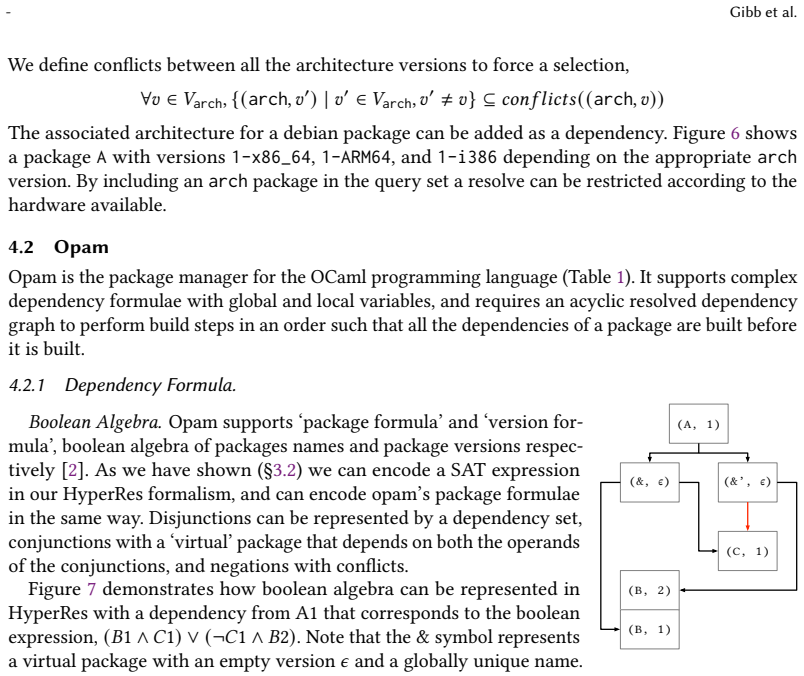
The central object is the resolution hypergraph: a directed hypergraph whose vertices are package name-version pairs, with hyperedges labelled $\delta$ (dependency), $\sigma$ (optional dependency), or $\gamma$ (conflict), together with the SAT encoding that turns any such hypergraph and query set into a CNF instance. The hypergraph carries the whole argument because it gives a single place where versioned constraints from different ecosystems can coexist, and the SAT encoding is what makes resolution mechanical; the paper also shows how to absorb features into versions, architecture into packages, and boolean package formulae into virtual packages, so the one mechanism covers APT, opam, Cargo, and Nix semantics.
What would settle it
Resolve a specific real multi-ecosystem project, such as the paper's polars example, twice: once with HyperRes and once with the native package managers (opam, Cargo, APT) running separately; if the HyperRes result contains a version the native tools reject, omits a version the native tools require, or fails to find a solution when the native tools succeed, the faithfulness claim is falsified. A sharper check is to translate a known opam package with a complex version formula into HyperRes and verify that the set of satisfying assignments equals the set of native-resolver selections.
Extended reading notes
Core claim
The central discovery is that the shared essence of package managers is a hyperedge-labelled directed hypergraph. Vertices are packages as name-version pairs; hyperedges carry one of three labels—dependency (one package needs at least one of a set), optional dependency (used only if already present), or conflict (cannot coexist). Dependency resolution is defined as mapping a query set and hypergraph to a resolved graph satisfying four conditions: the query packages are present, every dependency is satisfied by exactly one chosen package, optional dependencies are honoured when their partner is present, and no conflicts are included. The paper proves the DependencyResolution decision problem is NP-complete by a polynomial reduction from SAT, and also supplies the reverse encoding, showing any instance can be handed to a SAT solver. Adding an ecosystem labelling to the hypergraph lets one resolution span multiple package ecosystems, with translations 'on-ramping' metadata into the graph and 'off-ramping' selected packages to native installers; the paper reports translations covering just over 1.7 million packages across APK, Cabal, Cargo, CentOS, Debian, Fedora, Homebrew, opam, OpenSUSE, and Pacman, and demonstrates a resolved subgraph for opam's polars library pulling in Cargo and Debian packages.
Load-bearing premise
The load-bearing premise is that translating each ecosystem's metadata into HyperRes—especially expanding version formulas such as 'ocaml >= 4.14.0 & < 5.0.0' into explicit version sets—preserves exactly the set of valid package selections the native package manager would compute, since HyperRes itself attaches no semantics or ordering to versions.
Editorial extensions
If this is right
- If HyperRes is correct, one SAT-based resolution over a cross-ecosystem hypergraph yields a consistent, deployable package set for a mixed-language project, without switching users away from their existing package managers.
- Package metadata becomes bidirectionally translatable between ecosystems, so a Debian binary package could be produced mechanically from OCaml, Rust, or Python metadata, reusing packaging knowledge instead of repeating per-distribution labour.
- System and hardware dependencies—kernel versions, GPU drivers, CPU architectures—can be expressed as versioned cross-ecosystem packages, making deployments reproducible instead of relying on ad-hoc and unversioned assumptions.
- The same hypergraph can serve as a common layer for generating software bills of materials and reasoning about supply-chain security across language and OS ecosystems.
- Because DependencyResolution is NP-complete yet solvable by the given SAT encoding, solver performance is the practical bottleneck, and the paper reports that it scales with the dependency cone rather than the full repository.
Reading between the lines
- The paper's deliberate decision to attach no ordering or semantics to versions pushes all faithfulness onto the translation layer; a natural testable extension is to fuzz-compare HyperRes resolutions against native resolvers on random dependency cones to check that the expanded version sets exactly match native selections.
- If the 1.7-million-package translation were released and validated, HyperRes would effectively be a common interchange format for package metadata, which could push package managers toward a shared 'protocol'—the paper sketches this possibility but does not implement it.
- Encoding features as extra versioned packages (Section 4.3.2) may create a combinatorial explosion for packages with many feature combinations; the paper does not analyze this blow-up, so a practical extension would be to measure vertex growth on real Cargo packages.
- The cross-ecosystem resolution idea suggests a benchmark for reproducibility: take the same multi-language project, resolve it with HyperRes and with the union of native managers, and check whether the resulting filesystem trees are binary-compatible; the paper's Debian-dependencies note admits these are currently ad-hoc and unversioned.
Signed reviews
Editorial analysis
A structured set of objections, weighed in public.
Referee Report
Summary. The paper introduces HyperRes, a hypergraph-based formalism for dependency resolution in which vertices are package name-version pairs and labelled hyperedges represent strong dependencies, optional dependencies, and conflicts. It defines the DependencyResolution decision problem, proves it NP-complete via a reduction from SAT, gives a CNF-SAT encoding for solving it, and sketches encodings of APT, opam, Cargo, and Nix features. It then claims to bridge ecosystems by translating metadata from many package managers into HyperRes and resolving dependencies across ecosystems in one pass, supported by a prototype covering roughly 1.7 million packages and one cross-ecosystem resolved example involving opam, Cargo, and Debian. The paper also outlines a vision for bidirectional metadata translation between ecosystems.
Significance. If the formal core is correct, HyperRes offers a clean and useful common abstraction for comparing and combining package managers, and the NP-completeness proof and SAT encoding are straightforward but serviceable. The survey of 36 package managers and the classification of their properties into a common pipeline is a useful contribution. However, the central cross-ecosystem claim currently rests on unverified translations and a single example whose Debian dependencies are admitted to be ad-hoc and unversioned. The paper ships no code, data, or fidelity checks against native resolvers, so the empirical part is a demonstration sketch rather than a validated system. The formalization of opam's acyclic-resolved-graph requirement in §4.2.2 is also incorrect as written, which weakens the claim that HyperRes can faithfully model opam. The paper is honest about some of these limitations, but they are load-bearing for the main claims.
major comments (3)
- [§4.2.2] The formal condition for opam's acyclic resolved graph is not acyclicity. The text states that for any sequence of edges e1,...,en in G where ei = (pi, ei), it holds that pi != p_{i+1}; even if we charitably read this as edges (pi, e_i) with e_i the head, a two-edge cycle (A,B),(B,A) satisfies p1=A != p2=B and yet is cyclic. The condition is also ill-formed because ei is used both as an edge and as a package. Moreover, the SAT encoding in §3.3 contains no acyclicity constraint at all, so the paper does not establish that HyperRes, as formally defined and encoded, can enforce the opam resolved-graph requirement or the 'post' exception mentioned in the same section.
- [§5.2] The claim in the abstract that HyperRes can 'solve dependency constraints across' ecosystems is supported only by one resolved graph (Figure 11). The authors state that in this example the Debian dependencies are 'ad-hoc and unversioned', and no comparison against native resolvers (opam, cargo, apt) is reported, no translator code or data are released, and no fidelity measurement is given for the claimed 1.7-million-package translation corpus. As it stands, the cross-ecosystem resolution result is not reproducible and cannot substantiate the asserted ability to produce binary-compatible, deployable package sets. The authors should provide the translators, a validation protocol that compares HyperRes solutions with native resolver outputs on a meaningful sample, or at minimum a precise statement of which translations were actually exercised.
- [§1.1.1 and §3.1] HyperRes deliberately attaches no semantics or ordering to versions, but the translation of a version formula such as 'ocaml >= 4.14.0 & < 5.0.0' into an explicit set of version vertices is an external, unverified step. If that expansion does not exactly match the version-comparison and range semantics of the native package manager, a HyperRes solution may select packages the native resolver would reject, or miss valid ones. The paper does not specify the expansion algorithm for any ecosystem or provide evidence that its expansions agree with native behavior. Since the faithfulness of these translations is the premise for the cross-ecosystem validity claim, this gap needs to be addressed either by formal proofs of translation equivalence or by empirical validation against native resolvers.
minor comments (6)
- [§3.3] The clause '∀(p,d)∈D, ∀e∈d, ∃X_(p,e)' uses an undefined symbol D; it should range over the dependency relation, e.g., over all pairs (p,d) with d∈deps(p).
- [§3.3] In the at-most-one clause for optional dependencies, the quantifier ranges over e1,e2∈d; it should range over e1,e2∈o, since o is the optional dependency set.
- [§4.1.4] The text says both openssh-server and dropbear-bin provide the virtual package openssh-server, but the running example in §1.1.6 uses the virtual package ssh-server. The example is inconsistent and should be corrected.
- [§4.3.2] The definition of FV_n uses an undefined variable s: 'FV_n = {(v,s) | f∈F(n,v), v∈V_n}' should presumably be '{(v,f) | f∈F(n,v), v∈V_n}'.
- [§4.3.2] The sentence 'Not that we omit separators between versions and features for the sake of brevity' should be 'Note that we omit separators...'.
- [§3.1] The word 'Similarity' appears where 'Similarly' is intended.
Circularity Check
No significant circularity: the formal core is anchored to external SAT semantics, and the Section 5.2 implementation is self-referential only as an unvalidated demonstration, not as a derivational circle.
full rationale
The paper's derivation chain is self-contained at the formal level. Section 3.1 defines the resolution hypergraph, resolved graph, and the four resolution criteria independently of any implementation or fitted parameter. Section 3.2 gives a direct polynomial reduction from SAT, constructing conflict packages for variables and clause packages for disjunctions, and the argument that a satisfying package set corresponds exactly to a satisfying truth assignment is a standard external reduction. Section 3.3 provides the reverse SAT encoding with explicit soundness and completeness arguments; the SAT clauses are direct transcriptions of the definitions in Section 3.1, so the equivalence is proved rather than assumed. Section 4 models APT, opam, Cargo, and Nix by encoding their features (single-version conflicts, version ordering, virtual packages, boolean algebra, feature versions, acyclic graphs) into the formalism; these are modelling choices, not fitted inputs renamed as predictions. No self-citation is load-bearing: the references are to external prior work on SAT-based package resolution, not to the authors' own theorems, and there is no imported uniqueness claim. The only self-referential element is Section 5.2, where the authors' own translators build the hypergraph used to demonstrate the authors' own resolver. The paper itself notes, 'In the current state these Rust dependencies are vendored into the projects source repository, and Debian dependencies are ad-hoc and unversioned,' and it ships no artifacts or fidelity checks against native resolvers. This is a real validation gap for the cross-ecosystem deployment claim, but it is not a case of a conclusion being equivalent to its inputs by construction: the translation and resolution steps are independent procedures, and the formal results do not depend on them. The NP-completeness and SAT-encoding results would stand even if every translator were removed. Accordingly, the circularity score is 0.
Assumptions & free parameters
assumptions (7)
- standard math SAT is NP-complete (Cook-Levin)
- standard math Berge hypergraph definitions
- domain assumption Dependency, optional-dependency, and conflict relations suffice to model the surveyed package managers
- domain assumption Versions carry no inherent ordering or semantics; ordering and preference are external to the formalism
- domain assumption Exactly-one semantics for each dependency set (exists! in Sec. 3.1 condition 2)
- domain assumption Ecosystem labelling L_e is well-defined over the union of namespaces
- ad hoc to paper The sequence condition in Sec. 4.2.2 captures opam's acyclic-resolved-graph requirement
invented entities (3)
-
Virtual packages with empty version epsilon, e.g., (&, epsilon) and (q, epsilon)
-
Feature-version packages (n, (v, f))
-
Parameter packages such as (arch, x86_64), (os-distribution, debian), (linux-kernel, 5.10.7)
independent evidence
Cite this review
Pith. "Pith review of Solving Package Management via Hypergraph Dependency Resolution." pith.science (2026). https://pith.science/paper/PKNWSCBY
@misc{pith2026250610803,
  author       = {Pith},
  title        = {Pith review of: Solving Package Management via Hypergraph Dependency Resolution},
  year         = {2026},
  howpublished = {\url{https://pith.science/paper/PKNWSCBY}},
  note         = {Machine review of arXiv:2506.10803}
}
read the original abstract
Package managers are everywhere, with seemingly every language and operating system implementing their own solution. The lack of interoperability between these systems means that multi-lingual projects are unable to express precise dependencies across language ecosystems, and external system and hardware dependencies are typically implicit and unversioned. We define HyperRes, a formal system for describing versioned dependency resolution using a hypergraph that is expressive enough to model many ecosystems and solve dependency constraints across them. We define translations from dozens of existing package managers to HyperRes and comprehensively demonstrate that dependency resolution can work across ecosystems that are currently distinct. This does not require users to shift their choice of package managers; instead, HyperRes allows for the translation of packaging metadata between ecosystems, and for solving to be precisely specialised to a particular deployment environment.
Figures


Figures from the paper (8 more)




Reference graph
Works this paper leans on
-
[1]
2012. Slackware Package Management. https://docs.slackware.com/slackware:package_management
work page 2012
-
[2]
OCaml Package Manager, The opam manual
2013. OCaml Package Manager, The opam manual. https://opam.ocaml.org/doc/Manual.html
work page 2013
-
[3]
Linux Standard Base specification
2015. Linux Standard Base specification. https://refspecs.linuxfoundation.org/lsb.shtml
work page 2015
- [4]
-
[5]
2024. Cargo Resolver. https://github.com/rust-lang/cargo/blob/15fbd2f607d4defc87053b8b76bf5038f2483cf4/src/cargo/ core/resolver/mod.rs
work page 2024
-
[6]
Debian Policy Manual: Chapter 5 - Control files and their fields
2024. Debian Policy Manual: Chapter 5 - Control files and their fields. https://www.debian.org/doc/debian-policy/ch- controlfields.html
work page 2024
-
[7]
Debian Policy Manual: Chapter 7 - Declaring relationships between packages
2024. Debian Policy Manual: Chapter 7 - Declaring relationships between packages. https://www.debian.org/doc/ debian-policy/ch-relationships.html
work page 2024
- [8]
Show all 60 references
-
[9]
The Haskell Cabal
2024. The Haskell Cabal. https://www.haskell.org/cabal/
2024
-
[10]
npm Docs Scripts
2024. npm Docs Scripts. https://docs.npmjs.com/cli/v10/using-npm/scripts
2024
-
[11]
Pietro Abate, Roberto Di Cosmo, Georgios Gousios, and Stefano Zacchiroli. 2020. Dependency Solving Is Still Hard, but We Are Getting Better at It. In2020 IEEE 27th International Conference on Software Analysis, Evolution and Reengineering (SANER). 547–551. doi:10.1109/SANER482...
2020
-
[12]
Pietro Abate, Roberto DiCosmo, Ralf Treinen, and Stefano Zacchiroli. 2011. MPM: a modular package manager. In Proceedings of the 14th International ACM Sigsoft Symposium on Component Based Software Engineering (Boulder, Colorado, USA) (CBSE ’11). Association for Computing Mach...
2011 doi
-
[13]
Jean-François Abramatic, Roberto Di Cosmo, and Stefano Zacchiroli. 2018. Building the universal archive of source code. Commun. ACM 61, 10 (Sept. 2018), 29–31. doi:10.1145/3183558
2018 doi
-
[14]
Snorri Agnarsson and M. S. Krishnamoorthy. 1985. Towards a theory of packages. ACM SIGPLAN Notices 20, 7 (June 1985), 117–130. doi:10.1145/17919.806833
1985
-
[15]
Mahmoud Alfadel, Diego Elias Costa, and Emad Shihab. 2023. Empirical analysis of security vulnerabilities in Python packages. Empirical Software Engineering 28, 3 (March 2023). doi:10.1007/s10664-022-10278-4
2023 doi
-
[16]
Mahmoud Alfadel, Diego Elias Costa, Emad Shihab, and Bram Adams. 2023. On the Discoverability of npm Vulnerabil- ities in Node.js Projects. ACM Trans. Softw. Eng. Methodol. 32, 4, Article 91 (May 2023), 27 pages. doi:10.1145/3571848
2023 doi
-
[17]
Cyrille Artho, Kuniyasu Suzaki, Roberto Di Cosmo, Ralf Treinen, and Stefano Zacchiroli. 2012. Why do software packages conflict?. In 2012 9th IEEE Working Conference on Mining Software Repositories (MSR) . 141–150. doi:10.1109/ MSR.2012.6224274
2012
-
[18]
Benedikt Becker, Nicolas Jeannerod, Claude Marché, Yann Régis-Gianas, Mihaela Sighireanu, and Ralf Treinen. 2022. The CoLiS platform for the analysis of maintainer scripts in Debian software packages. International Journal on Software Tools for Technology Transfer 24, 5 (Sept....
2022 doi
-
[19]
Jon Bentley. 1986. Programming pearls: little languages. Commun. ACM 29, 8 (Aug. 1986), 711–721. doi:10.1145/6424. 315691
1986 doi
-
[20]
Claude Berge. 1970. Graphes et hypergraphes. Dunod, Paris, France
1970
- [21]
-
[22]
Justin Cappos, Justin Samuel, Scott Baker, and John H. Hartman. 2008. A look in the mirror: attacks on package managers. In Proceedings of the 15th ACM Conference on Computer and Communications Security (Alexandria, Virginia, USA) (CCS ’08). Association for Computing Machinery...
2008
- [23]
-
[24]
Stephen A. Cook. 1971. The complexity of theorem-proving procedures. In Proceedings of the Third Annual ACM Symposium on Theory of Computing (Shaker Heights, Ohio, USA) (STOC ’71). Association for Computing Machinery, New York, NY, USA, 151–158. doi:10.1145/800157.805047
1971
-
[25]
Ludovic Courtès. 2013. Functional package management with guix. arXiv preprint arXiv:1305.4584 (2013)
2013 arXiv
-
[26]
Russ Cox. 2018. Go & Versioning: Minimal Version Selection. https://research.swtch.com/vgo-mvs
2018
-
[27]
Andres Diaz Pace, Antonela Tommasel, and Hernan Ceferino Vazquez. 2024. The JavaScript Package Selection Task: A Comparative Experiment Using an LLM-based Approach. CLEI Electronic Journal 27, 2 (July 2024). doi:10.19153/cleiej. 27.2.4
2024 doi
-
[28]
Eelco Dolstra, Merijn de Jonge, and Eelco Visser. 2004. Nix: A Safe and Policy-Free System for Software Deployment. In Proceedings of the 18th USENIX Conference on System Administration (Atlanta, GA) (LISA ’04). USENIX Association, USA, 79–92
2004
-
[29]
Eelco Dolstra and Andres Löh. 2008. NixOS: a purely functional Linux distribution. In Proceedings of the 13th ACM SIGPLAN International Conference on Functional Programming (Victoria, BC, Canada) (ICFP ’08) . Association for Solving Package Management via Hypergraph Dependency...
2008
-
[30]
Todd Gamblin, Massimiliano Culpo, Gregory Becker, and Sergei Shudler. 2022. Using Answer Set Programming for HPC Dependency Solving. In SC22: International Conference for High Performance Computing, Networking, Storage and Analysis. IEEE, 1–15. doi:10.1109/SC41404.2022.00040
2022 arXiv
-
[31]
Collette, Gregory L
Todd Gamblin, Matthew LeGendre, Michael R. Collette, Gregory L. Lee, Adam Moody, Bronis R. de Supinski, and Scott Futral. 2015. The Spack package manager: bringing order to HPC software chaos. In Proceedings of the International Conference for High Performance Computing, Netwo...
2015
-
[32]
Martin Gebser, Roland Kaminski, Benjamin Kaufmann, and Torsten Schaub. 2011. Multi-Criteria Optimization in Answer Set Programming. In Technical Communications of the 27th International Conference on Logic Programming (ICLP’11) (Leibniz International Proceedings in Informatics...
2011 doi
-
[33]
Wenbo Guo, Chengwei Liu, Limin Wang, Jiahui Wu, Zhengzi Xu, Cheng Huang, Yong Fang, and Yang Liu. 2024. PackageIntel: Leveraging Large Language Models for Automated Intelligence Extraction in Package Ecosystems. arXiv preprint arXiv:2409.15049 (2024)
2024
-
[34]
Jordan Henkel, Denini Silva, Leopoldo Teixeira, Marcelo d’Amorim, and Thomas Reps. 2021. Shipwright: A Human-in- the-Loop System for Dockerfile Repair. In 2021 IEEE/ACM 43rd International Conference on Software Engineering (ICSE) . 1148–1160. doi:10.1109/ICSE43902.2021.00106
2021
-
[35]
Paul Hudak. 1996. Building domain-specific embedded languages. ACM Comput. Surv. 28, 4es (Dec. 1996), 196–es. doi:10.1145/242224.242477
1996
-
[36]
Alexey Ignatiev, Mikoláš Janota, and Joao Marques-Silva. 2014. Towards efficient optimization in package management systems. In Proceedings of the 36th International Conference on Software Engineering (Hyderabad, India) (ICSE 2014). Association for Computing Machinery, New Yor...
2014
-
[37]
Peter Ivie and Douglas Thain. 2018. Reproducibility in Scientific Computing. ACM Comput. Surv. 51, 3, Article 63 (July 2018), 36 pages. doi:10.1145/3186266
2018 doi
-
[38]
Chris Lamb and Stefano Zacchiroli. 2021. Reproducible Builds: Increasing the Integrity of Software Supply Chains. CoRR abs/2104.06020 (2021). arXiv:2104.06020 https://arxiv.org/abs/2104.06020
2021 arXiv
-
[39]
Nandor Licker and Andrew Rice. 2019. Detecting Incorrect Build Rules. In 2019 IEEE/ACM 41st International Conference on Software Engineering (ICSE) . 1234–1244. doi:10.1109/ICSE.2019.00125
2019
-
[40]
Jiahuei Lin, Haoxiang Zhang, Bram Adams, and Ahmed E. Hassan. 2023. Vulnerability management in Linux distributions: An empirical study on Debian and Fedora. Empirical Software Engineering 28, 2 (Feb. 2023). doi:10.1007/ s10664-022-10267-7
2023
-
[41]
Christian Macho, Fabian Oraze, and Martin Pinzger. 2024. DValidator: An approach for validating dependencies in build configurations. Journal of Systems and Software 209 (2024), 111916. doi:10.1016/j.jss.2023.111916
2024
-
[42]
Fabio Mancinelli, Jaap Boender, Roberto di Cosmo, Jerome Vouillon, Berke Durak, Xavier Leroy, and Ralf Treinen. 2006. Managing the Complexity of Large Free and Open Source Package-Based Software Distributions. In 21st IEEE/ACM International Conference on Automated Software Eng...
2006 doi
-
[43]
André Miranda and João Pimentel. 2018. On the use of package managers by the C++ open-source community. In Proceedings of the 33rd Annual ACM Symposium on Applied Computing (Pau, France) (SAC ’18). Association for Computing Machinery, New York, NY, USA, 1483–1491. doi:10.1145/...
2018
-
[44]
Andrey Mokhov, Neil Mitchell, and Simon Peyton Jones. 2018. Build systems a la carte. In International Conference on Functional Programming (ICFP’18). ACM. https://www.microsoft.com/en-us/research/publication/build-systems-la- carte/
2018
-
[45]
Villa Real, and Michael Homer
Hisham Muhammad, Lucas C. Villa Real, and Michael Homer. 2019. Taxonomy of Package Management in Programming Languages and Operating Systems. In Proceedings of the 10th Workshop on Programming Languages and Operating Systems (Huntsville, ON, Canada) (PLOS ’19). Association for...
2019
-
[46]
Moses Openja, Forough Majidi, Foutse Khomh, Bhagya Chembakottu, and Heng Li. 2022. Studying the Practices of Deploying Machine Learning Projects on Docker. In Proceedings of the 26th International Conference on Evaluation and Assessment in Software Engineering (Gothenburg, Swe...
2022
-
[47]
Pardis Pashakhanloo, Aravind Machiry, Hyonyoung Choi, Anthony Canino, Kihong Heo, Insup Lee, and Mayur Naik
-
[48]
Donald Pinckney, Federico Cassano, Arjun Guha, Jonathan Bell, Massimiliano Culpo, and Todd Gamblin. 2023. Flexible and Optimal Dependency Management via Max-SMT. In 2023 IEEE/ACM 45th International Conference on Software - Gibb et al. Engineering (ICSE). IEEE, 1418–1429. doi:1...
2023
-
[49]
Tom Preston-Werner. 2023. Semantic Versioning 2.0.0. https://semver.org/
2023
-
[50]
Giuseppe Primiero and Jaap Boender. 2018. Negative trust for conflict resolution in software management. In Web Intelligence, Vol. 16. IOS Press, 251–271
2018
-
[51]
Md Fazle Rabbi, Arifa Islam Champa, Costain Nachuma, and Minhaz Fahim Zibran. 2024. SBOM Generation Tools Under Microscope: A Focus on The npm Ecosystem. In Proceedings of the 39th ACM/SIGAPP Symposium on Applied Computing (Avila, Spain) (SAC ’24). Association for Computing Ma...
2024
-
[52]
Kristiina Rahkema and Dietmar Pfahl. 2022. Analysing the Relationship Between Dependency Definition and Updating Practice When Using Third-Party Libraries. In Product-Focused Software Process Improvement, Davide Taibi, Marco Kuhrmann, Tommi Mikkonen, Jil Klünder, and Pekka Abr...
2022
-
[53]
Martin Schwaighofer, Michael Roland, and René Mayrhofer. 2024. Extending Cloud Build Systems to Eliminate Transitive Trust. In ACM Workshop on Software Supply Chain Offensive Research and Ecosystem Defenses (SCORED24) (Salt Lake City, Utah, USA). ACM
2024
-
[54]
Manuel Serrano and Erick Gallesio. 2007. An adaptive package management system for scheme. In Proceedings of the 2007 Symposium on Dynamic Languages (Montreal, Quebec, Canada) (DLS ’07). Association for Computing Machinery, New York, NY, USA, 65–76. doi:10.1145/1297081.1297093
2007
-
[55]
Jacob Stringer, Amjed Tahir, Kelly Blincoe, and Jens Dietrich. 2020. Technical Lag of Dependencies in Major Package Managers. In 2020 27th Asia-Pacific Software Engineering Conference (APSEC) . 228–237. doi:10.1109/APSEC51365.2020. 00031
2020
-
[56]
Ralf Treinen and Stefano Zacchiroli. 2009. Common Upgradeability Description Format (CUDF) 2.0. The Mancoosi project (FP7) 3 (2009). https://www.mancoosi.org/reports/tr3.pdf
2009
-
[57]
Oliveira
Paulo Trezentos, Inês Lynce, and Arlindo L. Oliveira. 2010. Apt-pbo: solving the software dependency problem using pseudo-boolean optimization. In Proceedings of the 25th IEEE/ACM International Conference on Automated Software Engineering (Antwerp, Belgium) (ASE ’10). Associat...
2010
-
[58]
Chris Tucker, David Shuffelton, Ranjit Jhala, and Sorin Lerner. 2007. Opium: Optimal package install/uninstall manager. In 29th International Conference on Software Engineering (ICSE’07) . IEEE, ACM, Minneapolis, MN, USA, 178–188
2007
-
[59]
Lyuye Zhang, Chengwei Liu, Sen Chen, Zhengzi Xu, Lingling Fan, Lida Zhao, Yiran Zhang, and Yang Liu. 2023. Mitigating Persistence of Open-Source Vulnerabilities in Maven Ecosystem. In 2023 38th IEEE/ACM International Conference on Automated Software Engineering (ASE) . ACM/IEE...
2023
-
[2022]
In Proceedings of the 2022 ACM on Asia Conference on Computer and Communications Security (Nagasaki, Japan) (ASIA CCS ’22)
PacJam: Securing Dependencies Continuously via Package-Oriented Debloating. In Proceedings of the 2022 ACM on Asia Conference on Computer and Communications Security (Nagasaki, Japan) (ASIA CCS ’22). Association for Computing Machinery, New York, NY, USA, 903–916. doi:10.1145/...
2022
Reviewed August 7, 2026 · model on record in the stance chip above.
Discussion (0). Continue with ORCID to comment.