REVIEW 4 major objections 5 minor 6 cited by
CreatiPoster: Towards Editable and Controllable Multi-Layer Graphic Design Generation
T0 review · 4 major / 5 minor · reviewed 2026-08-07 · deepseek-v4-flash
Pith's one-line read The paper claims that a two-model pipeline—a protocol model that writes an editable JSON layer list and a background model that paints beneath it—generates multi-layer posters that beat open-source and commercial tools on its benchmark.
desk verdict A genuinely useful two-stage system for editable, asset-aware poster generation, but the paper's 'surpasses' claim is not backed by its own small, statistically ungrounded evaluation. read the letter →
The pith
A machine-rendered reading of the paper's core claim, the machinery that carries it, and where it could break.
The reading
What carries the argument
The load-bearing object is the JSON protocol produced by the protocol model: it is the complete editable specification of the composition, and because it is rendered rather than diffused, text and assets stay crisp and separable. The background model is the second half: a diffusion-transformer generator, fine-tuned through LoRA with the backbone frozen, that takes the RGBA foreground and a short background caption and generates a matching background, reusing the noisy image's positional encoding to keep foreground slots aligned. The combination means the final output is the pair (background image, layer list), not a flattened image—that pair is what makes later editing possible.
What would settle it
Ask, say, 50 professional designers to blind-rank outputs from CreatiPoster-S against the best commercial tool on 200 fresh prompts, with and without assets, and compare their rankings with the GPT-4.1 scores; if the model does not win by a comparable margin, or if human and GPT rankings diverge on a substantial share of cases, the headline superiority claim would be overturned.
Extended reading notes
Core claim
On the paper's own terms, the central discovery is that multi-layer graphic design generation does not need a monolithic text-to-image model. Instead, a large multimodal model can be trained to emit an exact, structured layer protocol—JSON with positions, sizes, fonts, contents, colors, and z-order for every text and asset layer—that a rendering engine draws losslessly into an RGBA foreground, and a separate conditional background model can be trained to produce a background that harmonizes with that foreground, using the same positional encoding as the noisy image so element slots stay aligned. The paper reports that this design achieves first or near-first scores in nearly all evaluation dimensions against leading open-source and proprietary commercial systems, with human raters agreeing on overall quality.
Load-bearing premise
The benchmark's 90 hand-collected or generated cases, scored by GPT-4.1 majority voting and ten volunteers, are a valid and representative measure of graphic design quality; if this small set is biased toward the method's strengths, the paper's comparative superiority claim would collapse.
Editorial extensions
If this is right
- Users can edit any generated poster by changing JSON fields—content, position, font, color, or z-order—rather than re-prompting or inpainting.
- The pipeline directly supports text overlay onto uploaded assets without invoking the background model.
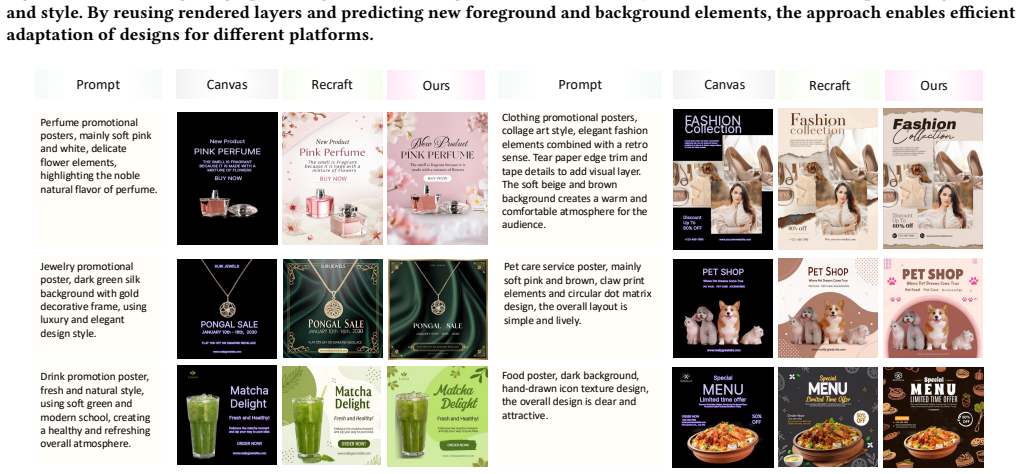
- Re-layout and responsive resizing work by reusing rendered layers and asking the protocol model to predict a new foreground at a new size.
- The protocol model generalizes to languages beyond its training data, producing Japanese, French, Arabic, and Korean outputs.
- Because the background is separate, image-to-video models can animate it while the text layers remain sharp, yielding animated posters.
Reading between the lines
- The protocol/background split suggests progress on layout reasoning and background aesthetics can be made independently: swapping in a stronger layout-focused multimodal model or a higher-fidelity background generator should improve the pipeline without retraining it end to end.
- If the released 100,000-design corpus covers the reported failure modes—small icon distortion and layer misalignment—it could be used to train targeted fixes, such as a font-aware layout loss, which the paper leaves open.
- The near-universal low layout scores across all tested methods hint that layout quality is the field's current bottleneck; a system that materially raises layout scores would likely separate itself from the rest of the pack.
- The evaluation's dependence on GPT-4.1 majority voting suggests a natural next experiment: a large-scale human-preference study on the released corpus to see whether the GPT rankings transfer to real users.
Editorial analysis
A structured set of objections, weighed in public.
Referee Report
Summary. CreatiPoster is a two-stage generative system for editable multi-layer graphic design. A protocol model, based on the same RGBA-LMM architecture as CreatiGraphist, takes a prompt, optional assets, and canvas size, and outputs a JSON specification of text and asset layers plus a background caption. A frozen diffusion backbone (FLUX-dev or Seedream3) with LoRA and AdaLN is then conditioned on the rendered foreground to generate a matching background. The paper reports evaluations on a self-constructed benchmark of 90 cases (84 used for comparison), with GPT-4.1 majority-vote scores on four dimensions and overall human ratings from 10 volunteers, and claims CreatiPoster surpasses OpenCOLE, Microsoft Designer, Canva, and Recraft. The paper also announces a 100,000-sample corpus and demonstrates applications including text overlay, re-layout, canvas editing, multilingual generation, and animated posters.
Significance. CreatiPoster addresses a real gap: most generative design systems produce flat images, while the JSON protocol approach is genuinely editable and supports user-provided assets. The two-stage design is reasonable, and conditioning the background on the rendered foreground with position-aligned positional embeddings is technically sound. If the dataset and code are released as stated, they are potentially valuable community resources. However, the paper's central comparative claim is not yet supported: the benchmark is small, self-constructed, scored by an unvalidated LLM judge, and reported without uncertainty quantification or significance tests. The strengths of the system and the dataset deserve consideration, but the evidence in Tables 2 and 3 does not support the abstract's 'surpasses' wording.
major comments (4)
- [§4.3, §4.4, Tables 2 and 3] The comparative claim rests on 84 self-constructed cases and GPT-4.1 majority-vote scores, but no variance, confidence interval, or paired significance test is reported. The margins that support the claim are small: in Table 2, CreatiPoster-S leads Layout by 0.04 over Canva (2.89 vs 2.85), while OpenCOLE leads Color (4.57 vs 4.33/4.36); in Table 3, CreatiPoster-S trails Canva on Layout (2.41 vs 2.84). With 10 sampled votes per case, one or two case-level changes could easily move an aggregate score by more than 0.04. Please report per-case score distributions, confidence intervals, and paired tests (or an equivalent analysis) before claiming superiority.
- [§4.3 (Metrics), §4.4 (Human Evaluate)] GPT-4.1 is used as the primary judge without any validation against human aesthetic judgments. The only human evaluation is a single overall 1-5 score from 10 volunteers, reported as means with no inter-rater reliability, no per-dimension ratings, and no statistical analysis. Because the paper draws conclusions about Layout, Color, Graphic Style, and Compliance separately, the GPT-4.1 scores need to be calibrated against human ratings on those dimensions, or replaced or augmented with human per-dimension evaluation.
- [§3.2, §4.4] The evaluation does not include the underlying diffusion backbones without CreatiPoster's background model, nor any ablation of the protocol model. Since CreatiPoster-F and CreatiPoster-S are LoRA-adapted FLUX-dev and Seedream3, comparing against those base models is necessary to attribute gains to the proposed conditioning mechanism; likewise, ablating the protocol model (e.g., fixed templates vs predicted JSON) would show its contribution. The paper also cites LayerDiffuse and ART as related systems but does not compare against them, so 'surpasses leading open-source approaches' is not demonstrated for that class of methods.
- [§1, §4.3] The introduction defines text accuracy and asset fidelity as two of the four core criteria, but the benchmark dimensions in Table 1 do not directly measure either. 'Compliance' is prompt adherence, not spelling fidelity or asset preservation, and the human score is a single overall number. The paper should add quantitative or human per-dimension measurements of text accuracy (e.g., OCR-based character error rate) and asset fidelity (e.g., identity preservation) to substantiate the claim that CreatiPoster meets its stated requirements.
minor comments (5)
- [§3.1.1, §3.1.3, §4.1] Please clarify the novelty of the protocol model relative to CreatiGraphist (Cheng et al. 2025): §3.1.1 states it adopts the same architecture, and §4.1 states it follows the same multi-stage training approach.
- [§1, §3.1.3, abstract] There are several typographical and grammatical errors: 'Training Stragy' in §3.1.3, 'a open system' in §1, 'impractical for replicate' in the abstract, and 'antithetical graphic compositions' in §1 should be corrected.
- [§4.2] The construction of the test set uses an undisclosed LMM to generate captions and prompts; please identify the model and provide the prompts or a sample of the cases to allow reproducibility.
- [§6 and dataset release] The release of the 100,000-sample corpus is announced as 'copyright-free', but no license, provenance, or screening procedure is described; please specify this information.
- [Figure 3] Figure 3 is very dense and the annotations are hard to read at print size; consider splitting it into multiple figures or increasing the font size of the annotations.
Circularity Check
No circularity: the system's components and benchmark comparisons are independent of the superiority claim they support.
full rationale
This paper contains no mathematical derivation whose output equals its input, and no fitted parameter is renamed as a prediction. The protocol model reuses the architecture of CreatiGraphist [Cheng et al. 2025], which is a self-citation by overlapping authors, but this is an engineering design choice rather than a load-bearing proof step: the reported superiority of CreatiPoster is supported by an external comparative evaluation against OpenCOLE, Microsoft Designer, Canva, and Adobe Express, scored by GPT-4.1 majority vote and human raters. The benchmark is self-constructed, which raises concerns about representativeness and statistical significance (small margins, no confidence intervals), but those are correctness and evaluation risks, not circularity. No step in the paper reduces a claimed result to a prior self-citation or to the benchmark construction itself.
Assumptions & free parameters
free parameters (3)
- LoRA rank =
256
- Vision token count per image =
64
- Lognormal noise schedule parameters =
mean=0.5, std=1.0
assumptions (4)
- domain assumption The four evaluation dimensions (Layout, Color, Graphic Style, Compliance) are sufficient to capture graphic design quality.
- domain assumption GPT-4.1 scoring correlates with human aesthetic judgment.
- domain assumption The 90-case test set is representative of graphic design tasks.
- domain assumption The protocol model's JSON output can be faithfully rendered by Skia and composited with the generated background without quality loss.
Cite this review
Pith. "Pith review of CreatiPoster: Towards Editable and Controllable Multi-Layer Graphic Design Generation." pith.science (2026). https://pith.science/paper/3TFUHGKN
@misc{pith2026250610890,
  author       = {Pith},
  title        = {Pith review of: CreatiPoster: Towards Editable and Controllable Multi-Layer Graphic Design Generation},
  year         = {2026},
  howpublished = {\url{https://pith.science/paper/3TFUHGKN}},
  note         = {Machine review of arXiv:2506.10890}
}
read the original abstract
Graphic design plays a crucial role in both commercial and personal contexts, yet creating high-quality, editable, and aesthetically pleasing graphic compositions remains a time-consuming and skill-intensive task, especially for beginners. Current AI tools automate parts of the workflow, but struggle to accurately incorporate user-supplied assets, maintain editability, and achieve professional visual appeal. Commercial systems, like Canva Magic Design, rely on vast template libraries, which are impractical for replicate. In this paper, we introduce CreatiPoster, a framework that generates editable, multi-layer compositions from optional natural-language instructions or assets. A protocol model, an RGBA large multimodal model, first produces a JSON specification detailing every layer (text or asset) with precise layout, hierarchy, content and style, plus a concise background prompt. A conditional background model then synthesizes a coherent background conditioned on this rendered foreground layers. We construct a benchmark with automated metrics for graphic-design generation and show that CreatiPoster surpasses leading open-source approaches and proprietary commercial systems. To catalyze further research, we release a copyright-free corpus of 100,000 multi-layer designs. CreatiPoster supports diverse applications such as canvas editing, text overlay, responsive resizing, multilingual adaptation, and animated posters, advancing the democratization of AI-assisted graphic design. Project homepage: https://github.com/graphic-design-ai/creatiposter
Figures


Figures from the paper (9 more)




Forward citations
Cited by 6 Pith papers
-
Graphic-Design-Bench: A Comprehensive Benchmark for Evaluating AI on Graphic Design Tasks
A 49-task layered-design benchmark shows frontier AI models leave most precision-heavy graphic design tasks unsolved, with only two tasks mostly solved.
-
WeEdit: A Dataset, Benchmark and Glyph-Guided Framework for Text-centric Image Editing
WeEdit trains a glyph-guided, RL-optimized image editor on a 330K-pair synthetic multilingual dataset and reports open-source SOTA on its own bilingual and multilingual text-editing benchmarks.
-
DesignLab: Designing Slides Through Iterative Detection and Correction
A fine-tuned reviewer/contributor pair that iteratively detects and fixes slide design flaws outperforms single-step and template-based baselines.
-
Geometry-aware Gaussian Prior and Axial Attention for Cervical Cytology Image Classification
Geometry-aware Gaussian expert priors injected into axial self-attention improve cervical cytology classification to 99.48% and 96.08% accuracy on two public datasets.
-
EmoStyle: Affective Conditioning of Style-Specialist Experts for Emotional Image Generation
EmoStyle injects LLM-inferred valence-arousal and emotion labels into Z-Image via AdaLN-style residual modulation over style-bucket LoRA experts, plus VLM candidate ranking, and ranked first on AffectiveArt Track 1.
-
Text-Conditioned Background Generation for Editable Multi-Layer Documents
A training-free system combines soft latent masking, WCAG-contrast-optimized semi-transparent text backings, and recursive LLM summaries to generate readable, style-consistent backgrounds for multi-page documents.
Reference graph
Works this paper leans on
-
[4]
In Proceedings of the IEEE/CVF Conference on Computer Vision and Pattern Recognition
Retrieval-augmented layout transformer for content-aware layout genera- tion. In Proceedings of the IEEE/CVF Conference on Computer Vision and Pattern Recognition. 67–76. Hsiao Yuan Hsu, Xiangteng He, Yuxin Peng, Hao Kong, and Qing Zhang. 2023. Poster- Layout: A New Benchmark and Approach for Content-aware Visual-Textual Pre- sentation Layout. In CVPR. 60...
work page 2023
-
[5]
Towards Flexible Multi-modal Document Models. In CVPR. 14287–14296. Naoto Inoue, Kento Masui, Wataru Shimoda, and Kota Yamaguchi. 2024. OpenCOLE: Towards Reproducible Automatic Graphic Design Generation. InProceedings of the IEEE/CVF Conference on Computer Vision and Pattern Recognition. 8131–8135. Ali Jahanian, Jerry Liu, Qian Lin, Daniel Tretter, Eamonn...
arXiv 2023
-
[2023]
arXiv preprint arXiv:2303.03378 (2023)
PaLM-E: An embodied multimodal language model. arXiv preprint arXiv:2303.03378 (2023). Patrick Esser, Sumith Kulal, Andreas Blattmann, Rahim Entezari, Jonas Müller, Harry Saini, Yam Levi, Dominik Lorenz, Axel Sauer, Frederic Boesel, et al. 2024. Scaling rectified flow transformers for high-resolution image synthesis. arXiv preprint arXiv:2403.03206 (2024)...
arXiv 2023
-
[2024]
arXiv preprint arXiv:2401.00988 (2024)
Holistic Autonomous Driving Understanding by Bird’s-Eye-View Injected Multi-Modal Large Models. arXiv preprint arXiv:2401.00988 (2024). DC Dowson and BV666017 Landau. 1982. The Fréchet distance between multivariate normal distributions. Journal of multivariate analysis 12, 3 (1982), 450–455. Danny Driess, Fei Xia, Mehdi SM Sajjadi, Corey Lynch, Aakanksha ...
arXiv 2024
-
[2025]
https://github.com/HiDream-ai/HiDream-I1
HiDream-I1. https://github.com/HiDream-ai/HiDream-I1. Michael Bauerly and Yili Liu. 2006. Computational modeling and experimental inves- tigation of effects of compositional elements on interface and design aesthetics. International journal of human-computer studies 64, 8 (2006), 670–682. Anthony Brohan, Noah Brown, Justice Carbajal, Yevgen Chebotar, Xi C...
arXiv 2006
Reviewed August 7, 2026 · model on record in the stance chip above.
Discussion (0). Sign in to comment.