REVIEW 5 major objections 7 minor 26 references
ChemHGNN: A Hierarchical Hypergraph Neural Network for Reaction Virtual Screening and Discovery
T0 review · 5 major / 7 minor · reviewed 2026-08-07 · deepseek-v4-flash
Pith's one-line read ChemHGNN, a hierarchical hypergraph neural network, claims to represent multi-reactant reactions more expressively than graph neural networks, avoiding model collapse and extrapolating to reaction templates absent from training.
desk verdict The headline F1 gains are likely inflated by WLN pretraining leakage from the full USPTO-410k into the test subsets, but the hypergraph-plus-reaction-center-negative-sampling idea has real substance and deserves a careful look. read the letter →
The pith
A machine-rendered reading of the paper's core claim, the machinery that carries it, and where it could break.
The reading
What carries the argument
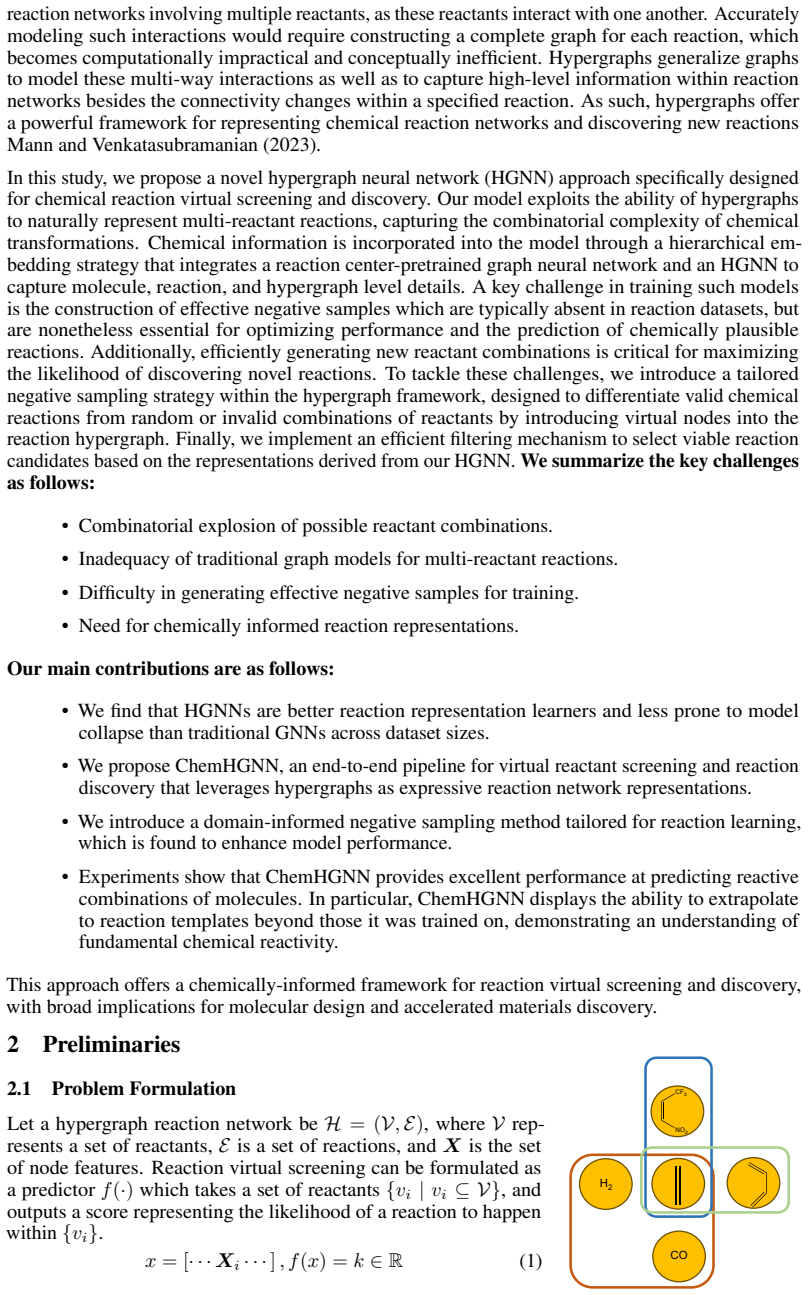
The load-bearing object is the reaction hypergraph $H=(V,E)$, with molecules as nodes and each reaction as a hyperedge that encloses all its reactants, so multi-reactant interactions are encoded without constructing complete graphs. On this hypergraph, the model applies normalized hypergraph convolution, a WLN pretrained to predict reaction centers, a cross-attention step that fuses molecular and hypergraph-level embeddings, and a zero-sum MSE loss that encodes the intuition that bond changes within a reaction are complementary. Negative training examples come from four samplers, including the new RCNS, which modifies bonds around the reaction center and introduces virtual nodes for the resulting non-reactive molecules. A simulated annealing search over the learned representations supplies candidate reactant combinations.
What would settle it
Audit the RCNS-generated negative molecules with standard chemical validity checks (valence, aromaticity, sanitization) and compare ChemHGNN's performance trained on RCNS negatives versus negatives drawn from experimentally confirmed non-reactive reactant pairs; if a large share of RCNS negatives are invalid, or if performance collapses when the negatives are replaced with real failed reactions, the central claim that the model learns genuine reactivity rather than artifact detection fails.
Extended reading notes
Core claim
On the paper's own terms, the central discovery is that hypergraph neural networks trained on reaction networks learn representations that separate reactive from non-reactive reactant combinations, where graph neural networks fail. The paper demonstrates this by building a reaction hypergraph with molecules as nodes and reactions as hyperedges, adding a hierarchical embedding that combines molecular fingerprints, a WLN pretrained on reaction-center prediction, and hypergraph-level attention. An ablation shows the full combination is essential: removing all three components drops F1 from 0.9468 to 0.1371 on the 10k dataset with SNS negatives. The paper also introduces reaction-center negative sampling (RCNS), which generates non-reactive combinations by modifying bonds at the identified reaction center, and shows it improves specificity and F1 at larger scales. The authors interpret the results as showing that HGNNs are a superior alternative to GNNs for reaction virtual screening and discovery.
Load-bearing premise
The method assumes that the negative samples generated by modifying bonds at the reaction center are chemically valid and representative of true non-reactions, so that the trained model separates reactive from non-reactive chemistry rather than valid from invalid molecules.
Editorial extensions
If this is right
- Training ChemHGNN on larger curated reaction datasets should continue to raise F1 (from 0.87 at 1k to 0.9468 at 10k on SNS negatives) instead of collapsing into degenerate predictions.
- The model can serve as a virtual pre-screen for reaction discovery: holding out a reaction template still lets the model identify 72–87 percent of positive reactions from that template.
- RCNS is a data-level improvement that transfers across architectures: including it raised F1 by 7.75 percentage points on USPTO-10k while improving specificity.
- The simulated annealing sort-out block offers a concrete candidate-generation loop, finding higher-scoring reactant combinations than random selection and improving with more iterations.
- The ablation identifies the WLN, sum aggregator, and MSE loss as jointly load-bearing, so future reaction-screening models should keep hierarchical, chemistry-informed components rather than a plain hypergraph or graph backbone.
Reading between the lines
- Editorial inference: If RCNS-generated negatives are not chemically valid in a non-negligible fraction of cases—the appendix concedes some reaction centers cannot be modified without producing invalid molecules—part of the reported classification gap may be distinguishing valid from invalid molecules rather than reactive from non-reactive ones; this can be tested by auditing the generated negative
- Editorial inference: The zero-sum MSE constraint on bond-change embeddings is a transferable inductive bias; applying it to other reaction-representation tasks such as retrosynthesis or yield prediction is a direct extension the paper leaves untested.
- Editorial inference: The template-holdout results suggest the model learns general reactivity rather than template memorization; holding out entire reaction families or functional-group classes, rather than individual templates, would sharpen this conclusion.
- Editorial inference: Because the 10k model already proposes high-scoring unseen combinations, pairing the simulated annealing search with experimental validation on a small set of top-ranked candidates would test whether the model's ranking transfers to the laboratory.
Editorial analysis
A structured set of objections, weighed in public.
Referee Report
Summary. The paper proposes ChemHGNN, a hypergraph neural network framework for reaction virtual screening and discovery. The model combines a two-layer HGNN with a WLN pretrained on reaction-center prediction, a cross-attention module, and a hierarchical embedding that integrates molecule-, reaction-, and hypergraph-level features. To generate negatives, the authors introduce RCNS, a reaction-center-aware sampling strategy, and they use simulated annealing (SA) to search for promising reactant combinations. Experiments on random subsets of USPTO-410k (1k, 5k, 10k) compare ChemHGNN with HGNN, GCN, GAT, and NOCD baselines. The paper reports that ChemHGNN outperforms these baselines, is less prone to model collapse, extrapolates to held-out reaction templates (RT 274, 586, 672), and benefits from RCNS, especially at larger scales. The central claim is that hypergraph models are superior to graph models for reaction virtual screening, and that the proposed chemically informed modules improve accuracy and specificity.
Significance. If the central claims were established, the paper would be a useful contribution to reaction virtual screening, an underexplored but practically important problem. The strengths are the domain-informed negative sampling idea, the combination of pretrained reaction-center features with hypergraph structure, and the explicit attention to model collapse. However, the empirical validation has several load-bearing confounds: the WLN pretraining corpus overlaps the evaluation sets, the ablation attributes the entire gain to the pretrained WLN and zero-sum loss rather than to the hypergraph architecture, the SA discovery objective is the same as the training loss, and the RCNS procedure is underspecified. The experimental comparison also lacks modern baselines and a WLN-only control. The claimed extrapolation to unseen templates is not credible given the pretraining overlap. The contribution is potentially valuable but the current evidence is insufficient to support the claims.
major comments (5)
- [§3.1, §4.1, §4.3] The WLN module is pretrained on the full USPTO-410k (Section 3.1), while all evaluation datasets (USPTO-1k/5k/10k) are randomly curated subsets of that same USPTO-410k (Section 4.1). Consequently, the test positives and the 'left-out' templates used in Section 4.3 (Fig. 6) are present in the WLN pretraining corpus, so the claims that ChemHGNN 'extrapolates to reaction templates not seen during training' are not supported. The F1 gap between ChemHGNN and the baselines (e.g., 0.9468 vs. 0.1371 on USPTO-10k-SNS, Table 7) may be due to the WLN's memorization of reaction-center patterns rather than to hypergraph expressiveness. The authors must either pretrain WLN only on the training split of each evaluation set, or provide a controlled comparison in which all models receive the same pretrained WLN features; the overlap must be disclosed.
- [§4.7, Table 13] The ablation in Table 13 shows that removing the WLN module, the SUM aggregator, and the MSE loss reduces ChemHGNN to exactly the baseline HGNN numbers (e.g., F1 = 0.1371 on SNS, identical to Table 7's HGNN row). This indicates that the entire performance advantage over the HGNN baseline comes from the pretrained WLN and the zero-sum objective, not from the hypergraph architecture itself. Therefore the paper's central claim that 'HGNNs are better reaction representation learners' is not established by the current comparison. A critical missing experiment is a GNN baseline (e.g., NOCD) augmented with the same WLN embeddings and the same MSE loss; without it, the comparison conflates architecture choice with pretraining.
- [§3.3, §4.5, Algorithm 2] The simulated-annealing objective in Eq. (13) is the Euclidean norm of the sum of molecular embeddings, which is exactly the quantity minimized by the MSE loss in Eq. (12). Thus the 'sort out block' optimizes the same criterion that the model was trained to minimize, and the reported 'best scores' in Table 11 (0.577–0.586) are scores on the model's own training objective, not measures of chemical validity or novelty. The advantage of SA over random selection is small (e.g., 0.577 vs. 0.575 at 1M iterations on USPTO-1k) and no external chemical validation is provided. The discovery claims require evaluation against a chemically meaningful oracle (e.g., an independent reactivity predictor or experimental validation) or at least a demonstration that the selected combinations are novel and chemically plausible.
- [§3.2, Appendix A.4.1] The RCNS algorithm is underspecified and its output quality is unmeasured. Algorithm 1 says only 'identify reaction center atoms using set operations on reactants and products' and 'modify bonds surrounding C_i to destroy reactivity,' without specifying which atom-mapping or bond-editing procedure is used (e.g., RDKit sanitization, valence checks). Figure 3d concedes that some reaction centers cannot be modified without producing invalid molecules, but the paper does not report the frequency of such failures or how they are handled. If RCNS negatives are often invalid or are generated by a rule that leaves a detectable artifact, the reported specificity gains (e.g., SNS specificity 0.9984 in Table 12) may reflect the model distinguishing artificial negatives rather than genuine non-reactions. The authors should provide a precise, testable definition of the algorithm and report the percentage of reactions for which no valid negative can be generated.
- [§4.2–4.3] The baseline comparison is too narrow to support the paper's general claim that hypergraph models are superior to graph models for reaction virtual screening. Only GCN, GAT, NOCD, and a plain HGNN are included; there is no comparison to state-of-the-art reaction classification/retrosynthesis models (e.g., WLN-based classifiers or Molecular Transformer fingerprints) or to other hypergraph reaction models. More importantly, the baselines do not receive the pretrained WLN embeddings, so the comparison is not controlled for the effect of pretraining. The claim 'HGNNs are a superior alternative to GNNs' requires at least a matched GNN baseline with the same pretrained features and the same training objective.
minor comments (7)
- [§3.1, Eq. (10)] Equation (10) computes the final score from X_attn, whereas Eq. (9) defines X_react as the aggregated reaction embedding; clarify which representation is actually fed to the MLP.
- [§4, Tables 2–5] The paper uses 'USPTO-1000', 'USPTO-1k', and 'USPTO-10000' inconsistently across the text and tables; standardize the dataset naming.
- [Table 4] The caption contains a duplicated phrase 'include include'; fix the typo.
- [§3.1, Eq. (12)] Equation (12) writes '∥ri−0∥2' and then '∥ri∥2' with an ambiguous subscript/superscript; define the norm and exponent clearly.
- [§4.1, A.5] The experimental setup omits hyperparameters (learning rate, number of HGNN/WLN layers, hidden dimensions, batch size, number of seeds) and no code is released; these are necessary for reproducibility.
- [§4.5, Table 11] Observation (8) refers to 'Table 11 a)' but the table has no explicit panel labels; add subtable labels.
- [§4.4, Figures 7, 12, 13] The t-SNE comparison is qualitative; quantitative cluster-separation metrics (e.g., silhouette score or AUROC on a held-out set) would strengthen the claim of better label separation.
Circularity Check
Two headline claims are self-confirming: the simulated-annealing discovery objective is exactly the training MSE loss, and the WLN pretraining corpus contains the reactions and templates later presented as 'unseen' evaluation data.
-
self definitional
[Section 3.1, Eq. 12 and Section 3.3, Eq. 13; Section 4.5, Table 11]
"Therefore, we expect the sum of the molecular embeddings to be close to ⃗0, resulting inthe following MSE loss: L_MSE = 1/N Σ ||r_i||^2 (12) ... Here we use the Euclidean norm of sum of vectors as the objective function to measure solution quality: f(x) = ∥x∥2 (13) ... We use the molecular representations learned from the USPTO-1k, 5k, 10k to virtual screen possible reactant combinations using Simulated Annealing and Random Selection, and score them with the MLP modules."
The simulated-annealing 'sort out' block searches over combinations of molecular embeddings by minimizing f(x)=||x||2, where x is the sum of the selected molecular representations. This is precisely the quantity L_MSE minimized during training (Eq. 12), which explicitly encourages the sum of molecular embeddings to be close to ⃗0. Consequently, the claimed ability of SA to 'better target suitable reactant combinations' than random selection (Table 11) is guaranteed by construction: SA directly minimizes the training objective while random selection does not. The 'discovery' scores are therefore a re-optimization of the model's own loss on the learned embedding space, not an independent screen for chemically novel reactions.
-
fitted input called prediction
[Section 3.1 (WLN pretraining) and Section 4.1/4.3 (dataset construction and template left-out evaluation), with scoring via Eqs. 8-10]
"The WLN module in Fig 2 c) was pretrained on the USPTO-410k dataset to enable the model to learn intermolecular bond changes at the reaction level. ... The datasets for the following experiments are subsets of the USPTO-410k dataset Lowe (2017). We randomly curate datasets of 1k, 5k, and 10k datapoints ... We also curate three additional datasets from USPTO-10k by leaving one reaction template out to serve as the testing dataset to investigate the extrapolation capability of the model."
Because the 1k/5k/10k evaluation sets are random subsets of USPTO-410k, and the 'left-out' template test sets are subsets of USPTO-10k, every reaction and template used for evaluation, including RT 274, RT 586, and RT 672, was present in the corpus on which the WLN component was pretrained. The WLN reaction embeddings X_GNN enter the cross-attention module (Eq. 8) and contribute to the final reaction score (Eqs. 9-10), so the model's prediction for an 'unseen' template is not a prediction from unseen data; it is scored with features fitted on that exact reaction class. The comparison with HGNN and NOCD baselines, which have no such pretraining, is therefore uncontrolled, and the claimed extrapolation (Fig. 6) is partly a fitted-input result presented as generalization.
full rationale
Two headline claims reduce, at least in part, by construction. First, the simulated-annealing discovery phase uses f(x)=||sum of molecular embeddings||2 as its objective, which is identical to the MSE training loss of Eq. 12; 'SA outperforms random selection' is therefore a tautology, and the best-score results in Table 11 do not demonstrate independent chemical discovery. Second, the WLN module is pretrained on all of USPTO-410k, while the USPTO-1k/5k/10k evaluation sets and the template-left-out test sets are subsets of that same 410k; because the WLN embeddings are fed into the attention-based scorer, the 'extrapolation to reaction templates beyond those it was trained on' (Fig. 6) is not a clean held-out evaluation. The supervised classification results, ablation study, and RCNS analysis are not themselves circular, and there is no load-bearing self-citation chain. The Limitations section (A.9) lists scalability, iteration count, and chemical-space definition but never acknowledges the pretraining/evaluation overlap. A corrected evaluation with WLN pretrained only on the training split, and a discovery objective independent of the training loss, would be needed to render these claims non-circular; as reported, the score is 6.
Assumptions & free parameters
free parameters (3)
- MSE loss weight =
not reported
- Simulated annealing temperature, cooling rate, and iterations =
not reported
- Number of HGNN layers and hidden dimensions =
not reported
assumptions (4)
- ad hoc to paper Bond changes in a reaction are complementary, so the sum of molecular embeddings should be near zero
- ad hoc to paper Reaction center atoms can be identified via set operations on reactants and products, and modifying bonds around them eliminates reactivity
- domain assumption ECFP6 fingerprints preserve sufficient chemical information for the node features
- domain assumption WLN pretrained on USPTO-410k reaction center prediction transfers to the virtual screening task
Cite this review
Pith. "Pith review of ChemHGNN: A Hierarchical Hypergraph Neural Network for Reaction Virtual Screening and Discovery." pith.science (2026). https://pith.science/paper/Y4VJZ2SH
@misc{pith2026250611041,
  author       = {Pith},
  title        = {Pith review of: ChemHGNN: A Hierarchical Hypergraph Neural Network for Reaction Virtual Screening and Discovery},
  year         = {2026},
  howpublished = {\url{https://pith.science/paper/Y4VJZ2SH}},
  note         = {Machine review of arXiv:2506.11041}
}
read the original abstract
Reaction virtual screening and discovery are fundamental challenges in chemistry and materials science, where traditional graph neural networks (GNNs) struggle to model multi-reactant interactions. In this work, we propose ChemHGNN, a hypergraph neural network (HGNN) framework that effectively captures high-order relationships in reaction networks. Unlike GNNs, which require constructing complete graphs for multi-reactant reactions, ChemHGNN naturally models multi-reactant reactions through hyperedges, enabling more expressive reaction representations. To address key challenges, such as combinatorial explosion, model collapse, and chemically invalid negative samples, we introduce a reaction center-aware negative sampling strategy (RCNS) and a hierarchical embedding approach combining molecule, reaction and hypergraph level features. Experiments on the USPTO dataset demonstrate that ChemHGNN significantly outperforms HGNN and GNN baselines, particularly in large-scale settings, while maintaining interpretability and chemical plausibility. Our work establishes HGNNs as a superior alternative to GNNs for reaction virtual screening and discovery, offering a chemically informed framework for accelerating reaction discovery.
Figures


Figures from the paper (10 more)


Reference graph
Works this paper leans on
-
[1]
A survey on hypergraph representation learning
Alessia Antelmi, Gennaro Cordasco, Mirko Polato, Vittorio Scarano, Carmine Spagnuolo, and Dingqi Yang. A survey on hypergraph representation learning. ACM Computing Surveys, 56 0 (1): 0 1--38, 2023
work page 2023
-
[2]
Hypergraph: A Unified and Uniform Definition with Application to Chemical Hypergraph and More
Daniel T Chang. Hypergraph: A unified and uniform definition with application to chemical hypergraph and more. arXiv preprint arXiv:2405.12235, 2024
work page Pith review arXiv 2024
-
[3]
A survey on hyperlink prediction
Can Chen and Yang-Yu Liu. A survey on hyperlink prediction. IEEE Transactions on Neural Networks and Learning Systems, 2023
work page 2023
-
[4]
Molecular hypergraph neural networks
Junwu Chen and Philippe Schwaller. Molecular hypergraph neural networks. The Journal of Chemical Physics, 160 0 (14), 2024
work page 2024
-
[5]
Simulated Annealing, pages 59--79
Bastien Chopard and Marco Tomassini. Simulated Annealing, pages 59--79. Springer International Publishing, Cham, 2018. ISBN 978-3-319-93073-2. doi:10.1007/978-3-319-93073-2_4. URL https://doi.org/10.1007/978-3-319-93073-2_4
-
[6]
Prediction of organic reaction outcomes using machine learning
Connor W Coley, Regina Barzilay, Tommi S Jaakkola, William H Green, and Klavs F Jensen. Prediction of organic reaction outcomes using machine learning. ACS central science, 3 0 (5): 0 434--443, 2017
work page 2017
-
[7]
A graph-convolutional neural network model for the prediction of chemical reactivity
Connor W Coley, Wengong Jin, Luke Rogers, Timothy F Jamison, Tommi S Jaakkola, William H Green, Regina Barzilay, and Klavs F Jensen. A graph-convolutional neural network model for the prediction of chemical reactivity. Chemical science, 10 0 (2): 0 370--377, 2019
work page 2019
-
[8]
Hypergraph neural networks
Yifan Feng, Haoxuan You, Zizhao Zhang, Rongrong Ji, and Yue Gao. Hypergraph neural networks. In Proceedings of the AAAI conference on artificial intelligence, volume 33, pages 3558--3565, 2019
2019
Show all 26 references
-
[9]
Neural message passing for quantum chemistry
Justin Gilmer, Samuel S Schoenholz, Patrick F Riley, Oriol Vinyals, and George E Dahl. Neural message passing for quantum chemistry. In International conference on machine learning, pages 1263--1272. PMLR, 2017
2017
-
[10]
Graph-based molecular representation learning
Zhichun Guo, Kehan Guo, Bozhao Nan, Yijun Tian, Roshni G Iyer, Yihong Ma, Olaf Wiest, Xiangliang Zhang, Wei Wang, Chuxu Zhang, et al. Graph-based molecular representation learning. In Proceedings of the Thirty-Second International Joint Conference on Artificial Intelligence, p...
2023
-
[11]
Multi-hgnn: Multi-modal hypergraph neural networks for predicting missing reactions in metabolic networks
Yamei Huang, Xudong Liang, Tao Lin, and Jingping Liu. Multi-hgnn: Multi-modal hypergraph neural networks for predicting missing reactions in metabolic networks. Information Sciences, page 121960, 2025
2025
-
[12]
Ahp: Learning to negative sample for hyperedge prediction
Hyunjin Hwang, Seungwoo Lee, Chanyoung Park, and Kijung Shin. Ahp: Learning to negative sample for hyperedge prediction. In Proceedings of the 45th international ACM SIGIR conference on research and development in information retrieval, pages 2237--2242, 2022
2022
-
[13]
Predicting organic reaction outcomes with weisfeiler-lehman network
Wengong Jin, Connor Coley, Regina Barzilay, and Tommi Jaakkola. Predicting organic reaction outcomes with weisfeiler-lehman network. In I. Guyon, U. Von Luxburg, S. Bengio, H. Wallach, R. Fergus, S. Vishwanathan, and R. Garnett, editors, Advances in Neural Information Processi...
2017
-
[14]
Semi-supervised classification with graph convolutional networks
Thomas N Kipf and Max Welling. Semi-supervised classification with graph convolutional networks. arXiv preprint arXiv:1609.02907, 2016
2016 arXiv
-
[15]
Chemical reactions from us patents (1976-sep2016)
Daniel Lowe. Chemical reactions from us patents (1976-sep2016). https://doi.org/10.6084/m9.figshare.5104873.v1, 2017. figshare. Dataset
1976 doi
-
[16]
Are we making much progress? revisiting chemical reaction yield prediction from an imbalanced regression perspective
Yihong Ma, Xiaobao Huang, Bozhao Nan, Nuno Moniz, Xiangliang Zhang, Olaf Wiest, and Nitesh V Chawla. Are we making much progress? revisiting chemical reaction yield prediction from an imbalanced regression perspective. In Companion Proceedings of the ACM Web Conference 2024, p...
2024
-
[17]
Ai-driven hypergraph network of organic chemistry: network statistics and applications in reaction classification
Vipul Mann and Venkat Venkatasubramanian. Ai-driven hypergraph network of organic chemistry: network statistics and applications in reaction classification. Reaction Chemistry & Engineering, 8 0 (3): 0 619--635, 2023
2023
-
[18]
Extended-connectivity fingerprints
David Rogers and Mathew Hahn. Extended-connectivity fingerprints. Journal of Chemical Information and Modeling, 50 0 (5): 0 742--754, 2010. doi:10.1021/ci100050t. URL https://doi.org/10.1021/ci100050t. PMID: 20426451
2010 doi
-
[19]
Self-supervised graph transformer on large-scale molecular data
Yu Rong, Yatao Bian, Tingyang Xu, Weiyang Xie, Ying Wei, Wenbing Huang, and Junzhou Huang. Self-supervised graph transformer on large-scale molecular data. In Proceedings of the 34th International Conference on Neural Information Processing Systems, pages 12559--12571, 2020
2020
-
[20]
Enumeration of 166 billion organic small molecules in the chemical universe database gdb-17
Lars Ruddigkeit, Ruud Van Deursen, Lorenz C Blum, and Jean-Louis Reymond. Enumeration of 166 billion organic small molecules in the chemical universe database gdb-17. Journal of chemical information and modeling, 52 0 (11): 0 2864--2875, 2012
2012
-
[21]
Mapping the space of chemical reactions using attention-based neural networks
Philippe Schwaller, Daniel Probst, Alain C Vaucher, Vishnu H Nair, David Kreutter, Teodoro Laino, and Jean-Louis Reymond. Mapping the space of chemical reactions using attention-based neural networks. Nature Machine Intelligence, 3 0 (2): 0 144--152, 2021
2021
-
[22]
Overlapping community detection with graph neural networks
Oleksandr Shchur and Stephan G \"u nnemann. Overlapping community detection with graph neural networks. arXiv preprint arXiv:1909.12201, 2019
1909 arXiv
-
[23]
Graph attention networks
Petar Veli c kovi \'c , Guillem Cucurull, Arantxa Casanova, Adriana Romero, Pietro Lio, and Yoshua Bengio. Graph attention networks. arXiv preprint arXiv:1710.10903, 2017
2017 arXiv
-
[24]
Scientific discovery in the age of artificial intelligence
Hanchen Wang, Tianfan Fu, Yuanqi Du, Wenhao Gao, Kexin Huang, Ziming Liu, Payal Chandak, Shengchao Liu, Peter Van Katwyk, Andreea Deac, et al. Scientific discovery in the age of artificial intelligence. Nature, 620 0 (7972): 0 47--60, 2023
2023
-
[25]
Nhp: Neural hypergraph link prediction
Naganand Yadati, Vikram Nitin, Madhav Nimishakavi, Prateek Yadav, Anand Louis, and Partha Talukdar. Nhp: Neural hypergraph link prediction. In Proceedings of the 29th ACM international conference on information & knowledge management, pages 1705--1714, 2020
2020
-
[26]
Double-ended synthesis planning with goal-constrained bidirectional search
Kevin Yu, Jihye Roh, Ziang Li, Wenhao Gao, Runzhong Wang, and Connor Coley. Double-ended synthesis planning with goal-constrained bidirectional search. In A. Globerson, L. Mackey, D. Belgrave, A. Fan, U. Paquet, J. Tomczak, and C. Zhang, editors, Advances in Neural Information...
2024
Reviewed August 7, 2026 · model on record in the stance chip above.
Discussion (0). Continue with ORCID to comment.