REVIEW 3 major objections 4 minor 47 references
Evaluating Multimodal Large Language Models on Video Captioning via Monte Carlo Tree Search
T0 review · 3 major / 4 minor · reviewed 2026-08-07 · deepseek-v4-flash
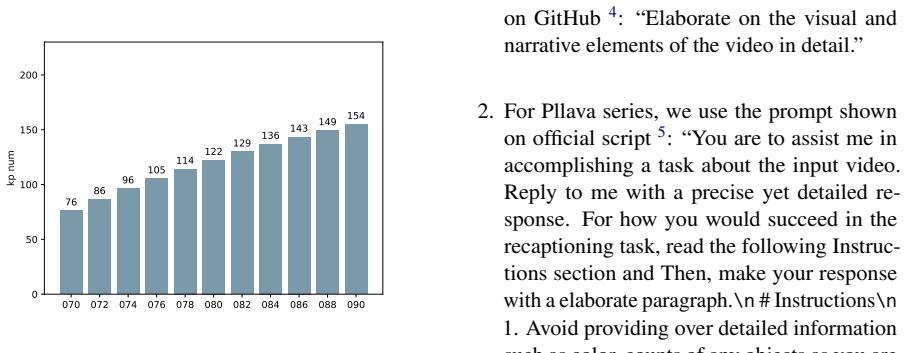
Pith's one-line read An automatic MCTS framework, AutoCaption, builds a fine-grained video captioning benchmark with 122.3 key points per video and uses the same generated data to fine-tune MLLMs.
desk verdict MCTS-based video caption benchmark with a solid core and a ground-truth audit hole that needs closing before the rankings can be trusted. read the letter →
The pith
A machine-rendered reading of the paper's core claim, the machinery that carries it, and where it could break.
The reading
What carries the argument
The load-bearing object is the MCTS search tree over six description actions, with each node scored by the state value $Q(s,a)=0.5^{1-MC(s)}\cdot 0.5^{SM(s)}$, where $MC(s)$ is the fraction of the node's atomic key points that pass verification by two multimodal models answering yes/no questions, and $SM(s)$ is the average similarity of the node to earlier nodes on its path. High correctness and low redundancy give a node a high value, so the search keeps expanding into new video details. Post-processing filters, deduplicates at a similarity threshold of 0.8, paraphrases, and human-checks the surviving key points to form the final benchmark.
What would settle it
Take a random sample of the final key points produced at the official 0.8 similarity threshold, have independent human annotators judge each one against the original video, and compare the pass rate with the reported 94.7% (measured at the stricter 0.9 threshold); a large drop, or a systematic disagreement between the two verifier models, would show that the ground truth and the model rankings built on it are not anchored to reality.
Extended reading notes
Core claim
The central claim is that Monte Carlo Tree Search, a planning method from game AI, can be repurposed to enumerate the many details of a video that a good caption should mention. AutoCaption treats captioning as a search tree in which six actions (overall, detail, temporal, spatial, background, and camera-movement description) generate candidate sentences, each sentence is decomposed into atomic key points, and each key point must pass a two-model yes/no verification before it contributes to the node's score. A similarity penalty suppresses repetition, and backpropagation drives the search toward unexplored details. The verified key points become a benchmark that ranks 21 models, and the same search output, converted into thought-process-guided captions, serves as fine-tuning data that lifts a mid-size model on both the new benchmark and the existing DREAM-1K benchmark.
Load-bearing premise
The whole framework rests on the assumption that two multimodal models' yes/no answers about whether a generated detail actually appears in the video are reliable enough to serve as ground truth, and that the small human-checked subset is representative of the final key point set.
Editorial extensions
If this is right
- Manual key-point annotation can be replaced by an automatic MCTS search, lowering the cost of building fine-grained captioning benchmarks.
- MCTS-VCB separates 21 MLLMs by five key-point dimensions and ten video genres, exposing category-specific weaknesses, with Gemini-1.5-Pro leading at an overall F1 of 71.2.
- AutoCaption-generated data, without human annotation, improves InternVL2.5-8B by 25.0% on MCTS-VCB and 16.3% on DREAM-1K.
- The fine-tuned model also improves on out-of-domain benchmarks such as Video-MME and MMBench-Video, suggesting the synthetic captions teach transferable video description skill.
- On samples of MCTS-VCB, the benchmark's scoring correlates with human judgment more closely than existing metrics such as CLAIR, AutoDQ, BertScore, and ROUGE.
Reading between the lines
- The same tree-search coverage mechanism could transfer to other structured perception tasks where detail coverage is the bottleneck, such as dense image captioning, spatial grounding, or long-video question answering.
- Because the reward signal comes from two MLLM verifiers, the benchmark's granularity is capped by what those verifiers can perceive; a detail that both verifiers systematically miss would be excluded from the ground truth.
- A natural next experiment is a self-improvement loop: fine-tune the small generator on AutoCaption data, rerun the search with the improved generator, and measure whether key points become denser and more accurate per iteration.
- The reported human verification rate of 94.7% was collected at a stricter 0.9 similarity threshold while all evaluation results use 0.8, so an independent check of the 0.8-threshold key point set would clarify whether the final ground truth is as clean as the human-checked subset.
Editorial analysis
A structured set of objections, weighed in public.
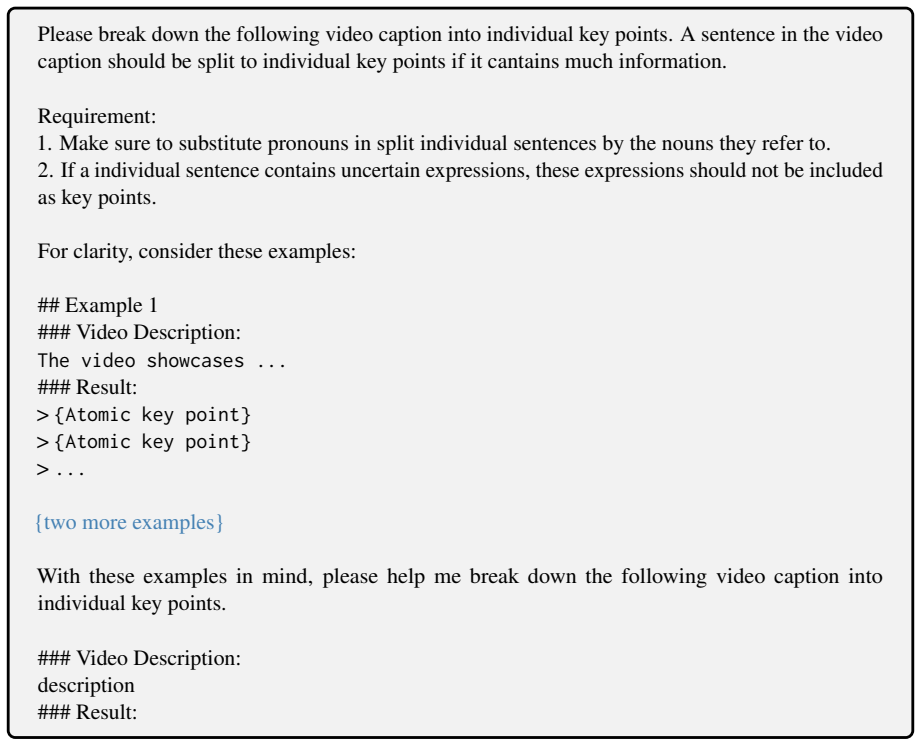
Referee Report
Summary. The paper introduces AutoCaption, an automated framework that uses Monte Carlo Tree Search (MCTS) to iteratively generate fine-grained descriptive key points from videos, and applies it to build MCTS-VCB, a video captioning benchmark containing 1,765 videos with on average 122.3 key points per video. The authors evaluate 21 open- and closed-source MLLMs on MCTS-VCB, report human-consistency correlations for a subset of models and videos, and show that fine-tuning InternVL2.5-8B on AutoCaption-generated data improves its F1 by 25.0% on MCTS-VCB and 16.3% on DREAM-1K, surpassing fine-tuning directly on GPT-4o-generated captions.
Significance. If the claimed results hold, MCTS-VCB would provide a much denser and more diverse key-point resource than prior video captioning benchmarks such as DREAM-1K, and AutoCaption would offer a scalable and relatively low-cost way to build both evaluation benchmarks and training data. The paper is also valuable for releasing code and data, and for reporting human-consistency correlations that go beyond simple n-gram metrics. However, the benchmark's validity depends critically on the reliability of the automated key-point verification pipeline and on the consistency between the human-checked data and the data actually used in the experiments; these points are currently not established in the manuscript.
major comments (3)
- [Appendix A.4 and Appendix B.3] The human-check pass rate of 94.7% is reported for key points generated under a similarity threshold of 0.9, yet all experimental results, including Tables 1, 2, 4 and Figure 4, are stated in Appendix B.3 to be based on a similarity threshold of 0.8. The paper never demonstrates that the 0.8-threshold key points used in the evaluation are identical to, or directly derived from, the 0.9-threshold set that annotators checked. If the 0.8 set was not human-verified, its only quality filter is the automated two-MLLM yes/no verification, and ground-truth errors could distort every model ranking and the fine-tuning gains reported in Section 6.2. The authors should either human-check a random sample of the final 0.8-threshold key points, or explicitly prove that the human-checked 0.9 set covers the 0.8 set, and report the verification results for the actual evaluation set.
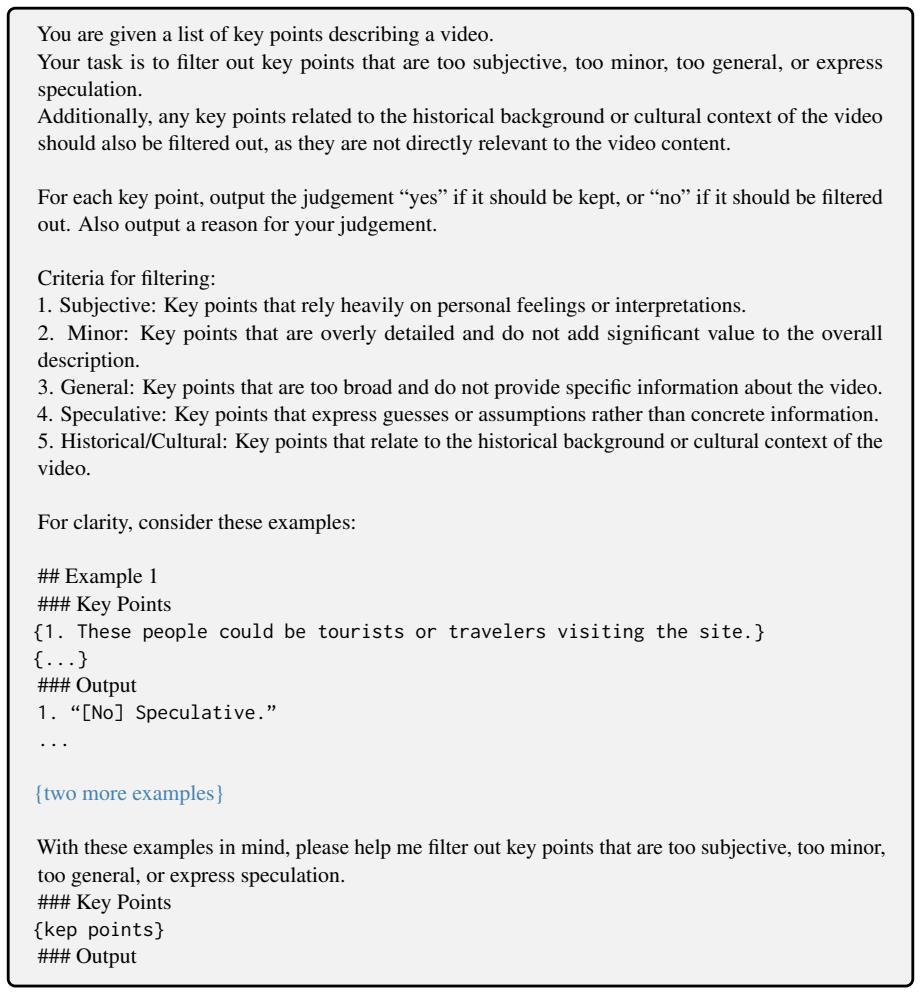
- [Section 4.1 and Section 6.1 / Table 1] The verification pipeline is potentially circular: GPT-4o and Qwen2-VL-72B are used as the two verifiers that admit key points into MCTS-VCB, and both models are themselves evaluated on MCTS-VCB (Table 1). In addition, Gemini-1.5-Pro generates the initial Overall Description that seeds the search tree, and it is also evaluated and ranks first overall. This creates a concrete correctness risk: if a verifier systematically over-accepts statements that match its own captioning tendencies, the benchmark ground truth becomes biased toward that verifier's style, inflating its score and potentially affecting rankings of the other models. I am not claiming deliberate bias, but the paper should address this by reporting per-verifier pass rates and disagreement statistics, and by showing that rankings remain stable after removing key points that are admitted by only one of the two verifiers or when using a third, unevaluated verifier.
- [Section 4.1 vs. Appendix A.3] There is a direct inconsistency in the description of the key-point extraction step. Section 4.1 states that key points are extracted from a node by Qwen2-VL-72B under the prompt in Figure 13, while Appendix A.3 states that GPT-4 is used to extract key points from the node's action results with the same Figure 13 prompt. This matters because the same extraction prompt is later used in Section 6.1 to obtain KP_model from model-generated captions. Without knowing which model actually extracted key points during benchmark construction, the pipeline cannot be fully audited, and the potential for Qwen-family bias in the benchmark cannot be assessed. The authors should unify the description and clearly specify which model was used at each stage.
minor comments (4)
- [Section 6.1] In the paragraph 'Performance on different frame numbers', the text refers to 'Figure 3' when reporting the frame-number results; the relevant results appear in Table 3, not in Figure 3 (which illustrates key-point verification). Please correct the cross-reference.
- [Throughout] There are numerous typographical and grammatical errors, including 'tranditional', 'excuating', 'MMLM', 'cantains', and 'defination'. A thorough language edit would improve readability.
- [Section 4.1, Eq. (2)] The values of alpha and beta in Q(s,a) are set to 0.5 based on the claim that MC(s) and SM(s) are 'same important', but no sensitivity analysis is provided for these weighting parameters or for the PUCT constant c. Since these hyperparameters affect which nodes are expanded, a small robustness study would strengthen the claim that the benchmark is stable to design choices.
- [Appendix A.3] The appendix section heading is 'A.3 MCTS Evaluation Phase Details', but the first sentence of the final paragraph says 'Ultimately, our method improves upon Method 2...' without numbering the proposed method as Method 3. Minor renumbering would make the comparison clearer.
Circularity Check
MCTS-VCB's reference key points are partly generated and verified by GPT-4o and Gemini-1.5-Pro, the same models the benchmark then ranks; the reported human check covers only the 0.9-threshold set while all experiments use 0.8, so the rankings embed a construction-level circularity.
-
self definitional
[Section 4.1 Expansion/Evaluation; Section 6.1 Table 1; Appendix A.4; Appendix B.3]
"To give MCTS iteration a good initialization, the Overall Description action is executed by GPT-4o (OpenAI, 2024) and Gemini-1.5-Pro (Team et al., 2024). ... we utilize GPT-4 ... to construct a 'yes/no' question ... and then use two verifiers (i.e., GPT-4o and Qwen2-VL-72B) to answer them. If all yes/no questions derived from a key point are shown to be 'yes' for both verifiers, we consider the key point passing the verification. ... we let annotators check the key points generated under a similarity threshold of 0.9 ... with a human verification pass rate of 94.7%. ..."
The reference key points (KPref) are constructed by a pipeline in which GPT-4o and Gemini-1.5-Pro generate the root Overall Description and GPT-4o is a required verifier for every key point; the same two models are then ranked against KPref in Table 1. The human check that would break the self-reference is reported only for the 0.9-threshold set, while Appendix B.3 states that all experimental results use threshold 0.8. Thus the final benchmark used for rankings and fine-tuning comparisons is, for the unevaluated threshold, defined by automated GPT-4o-inclusive verification. Consequently GPT-4o and Gemini-1.5-Pro scores partly measure agreement with text those models themselves produced or approved, not an independent ground truth.
full rationale
The core MCTS search, key-point extraction, verification, and post-processing equations (Q(s,a), MC(s), SM(s), and the evaluation metric) are not themselves circular: the search value is computed from verifier responses and similarity, and the benchmark scores are computed from an external judge (Qwen2.5-72B-Instruct) against the reference key points. The central circularity risk is benchmark self-reference: GPT-4o and Gemini-1.5-Pro are used to seed and verify the very key points against which their video captioning is scored. This is aggravated by the threshold mismatch: the reported 94.7% human verification pass rate applies to the 0.9-similarity set, while all experiments use the 0.8 set, so the final reference is not shown to be human-checked. The paper does contain independent evidence: the fine-tuning gain on the external DREAM-1K benchmark (16.3%) and the human-consistency correlation study do not reduce to the AutoCaption construction. No load-bearing self-citation chain appears; citations to the authors' prior work are confined to related work. Overall, the benchmark's absolute rankings and the 25.0% in-domain MCTS-VCB fine-tuning gain are partially contaminated by construction, but the central claims retain independent support, so the circularity score is moderate rather than extreme.
Assumptions & free parameters
free parameters (4)
- Alpha and Beta in Q(s,a) =
0.5 each
- PUCT exploration constant c =
0.125
- Number of MCTS iterations =
25
- Deduplication similarity threshold =
0.8
assumptions (4)
- domain assumption The two-MLLM verification process (GPT-4o and Qwen2-VL-72B) reliably determines whether a generated key point is present in the video.
- domain assumption Qwen2-VL-72B accurately extracts atomic key points from both generated descriptions and model captions.
- ad hoc to paper The six predefined action types (Overall, Detail, Temporal, Spatial, Background, Camera) comprehensively cover video content for captions.
- domain assumption Qwen2.5-72B-Instruct's entailment judgments align with human judgments.
Cite this review
Pith. "Pith review of Evaluating Multimodal Large Language Models on Video Captioning via Monte Carlo Tree Search." pith.science (2026). https://pith.science/paper/GDXKQ4C5
@misc{pith2026250611155,
  author       = {Pith},
  title        = {Pith review of: Evaluating Multimodal Large Language Models on Video Captioning via Monte Carlo Tree Search},
  year         = {2026},
  howpublished = {\url{https://pith.science/paper/GDXKQ4C5}},
  note         = {Machine review of arXiv:2506.11155}
}
read the original abstract
Video captioning can be used to assess the video understanding capabilities of Multimodal Large Language Models (MLLMs). However, existing benchmarks and evaluation protocols suffer from crucial issues, such as inadequate or homogeneous creation of key points, exorbitant cost of data creation, and limited evaluation scopes. To address these issues, we propose an automatic framework, named AutoCaption, which leverages Monte Carlo Tree Search (MCTS) to construct numerous and diverse descriptive sentences (\textit{i.e.}, key points) that thoroughly represent video content in an iterative way. This iterative captioning strategy enables the continuous enhancement of video details such as actions, objects' attributes, environment details, etc. We apply AutoCaption to curate MCTS-VCB, a fine-grained video caption benchmark covering video details, thereby enabling a comprehensive evaluation of MLLMs on the video captioning task. We evaluate more than 20 open- and closed-source MLLMs of varying sizes on MCTS-VCB. Results show that MCTS-VCB can effectively and comprehensively evaluate the video captioning capability, with Gemini-1.5-Pro achieving the highest F1 score of 71.2. Interestingly, we fine-tune InternVL2.5-8B with the AutoCaption-generated data, which helps the model achieve an overall improvement of 25.0% on MCTS-VCB and 16.3% on DREAM-1K, further demonstrating the effectiveness of AutoCaption. The code and data are available at https://github.com/tjunlp-lab/MCTS-VCB.
Figures


Figures from the paper (17 more)








Reference graph
Works this paper leans on
-
[1]
The Verifier we used is Qwen2-VL-72B
Paraphrase + Multi-V erify: We initially cre- ate three paraphrased versions of each key point extracted from the video and employed a Verifier to ascertain if each paraphrased point is indeed present in the video. The Verifier we used is Qwen2-VL-72B. However, during our experiments, it becomes evident that the Verifier has issues with misclassification....
-
[2]
Key-Info as Answer : In this approach, we first use GPT-4 to identify key information and then formulate three questions with the key information as the answer. We then use GPT-4o to answer these three questions, con- sidering the key point correct if at least two out of the three answers matched the key infor- mation. However, most of the generated ques-...
-
[3]
The defination and examples of each category is described in Figure 10
Environment Description, 5) Object Descrip- tion, and 6) Camera Movement and Composition. The defination and examples of each category is described in Figure 10. Additionally, Figure 9 shows the distribution of different keypoint categories in an average video. It can be observed that Environment Description keypoint type is the most prevalent among the k...
-
[4]
Fashion and Beauty, 5) Home and Living, 6) Travel and Adventure, 7) Nature and Wildlife, 8) Technology and Science, 9) Arts and Creativity, and 10) Food and Drink. As shown in Figure 6, the Nature and Wildlife category has the highest number of videos, reaching 382, while the Arts and Creativity category has the fewest, with 57 videos. Additionally, the a...
-
[5]
For clarity, consider these examples: ## Example 1 ### Key Points {1
Historical/Cultural: Key points that relate to the historical background or cultural context of the video. For clarity, consider these examples: ## Example 1 ### Key Points {1. These people could be tourists or travelers visiting the site.} {...} ### Output
-
[6]
Advances in Neural Information Processing Systems (NeurIPS)
Tree of thoughts: Deliberate problem solving with large language models. Advances in Neural Information Processing Systems (NeurIPS). Linhao Yu, Yongqi Leng, Yufei Huang, Shang Wu, Haixin Liu, Xinmeng Ji, Jiahui Zhao, Jinwang Song, Tingting Cui, Xiaoqing Cheng, Liutao Liutao, and Deyi Xiong. 2024. Cmoraleval: A moral evaluation benchmark for chinese large...
arXiv 2024
-
[11]
Appearance Description, 2) Action Description,
-
[13]
Elaborate on the visual and narrative elements of the video in detail
For VILA series, we use the prompt displayed on GitHub 4: “Elaborate on the visual and narrative elements of the video in detail.”
Show all 47 references
-
[14]
Reply to me with a precise yet detailed re- sponse
For Pllava series, we use the prompt shown on official script 5: “You are to assist me in accomplishing a task about the input video. Reply to me with a precise yet detailed re- sponse. For how you would succeed in the recaptioning task, read the following Instruc- tions secti...
-
[15]
Avoid providing over detailed information such as color, counts of any objects as you are terrible regarding observing these details \n
-
[16]
If you are not sure about something, do not include it in you response.\n # Task\n Describe the background, characters and the actions in the provided video.\n”
Instead, you should carefully go over the provided video and reason about key infor- mation about the overall video \n 3. If you are not sure about something, do not include it in you response.\n # Task\n Describe the background, characters and the actions in the provided video.\n”
-
[17]
Please describe the video in detail
For all other MLLMs, we use “Please describe the video in detail.” B.3 Supplementary Experiment Results As shown in Figure 11, it is interesting to note that as the similarity threshold increases, the eval- uation scores of the models also increase. This phenomenon is reasonab...
-
[18]
A young boy is wearing a white shirt
-
[19]
Action Description Action description focuses on the specific behavior or activity that takes place in the video
This girl possesses curly hair. Action Description Action description focuses on the specific behavior or activity that takes place in the video. Task states associated with actions can also fall into this category
-
[20]
The young boy returns the flask to the table
-
[21]
Environment DescriptionEnvironment description covers the background and environmental features of the scene in the video
The actions of the young boy are careful and well- measured. Environment DescriptionEnvironment description covers the background and environmental features of the scene in the video
-
[22]
The background is kept tidy and orderly
-
[23]
Object Description Describes the features, characteristics, or details of inanimate objects or items present in the scene
The room fosters an educational and orderly atmosphere. Object Description Describes the features, characteristics, or details of inanimate objects or items present in the scene
-
[24]
The artwork includes various colors like blue, red, and yellow
-
[25]
Camera Movement Describes the camera angles, movements, framing, or other cinematographic techniques used in the scene
The glassware items include beakers, test tubes, and flasks. Camera Movement Describes the camera angles, movements, framing, or other cinematographic techniques used in the scene
-
[26]
Overall Description
The camera is fixed, providing a consistent and clear view of the activity. Example Video Frames KP Category Explanation Figure 10: Illustration of key points categories. InternVL2_5-8BInternVL2_5-26BInternVL2_5-38BInternVL2_5-78B LLaVa_OV_Qwen2_7BLLaVa_OV_Qwen2_72BLLaVa_Video...
-
[27]
The video must have a clear subject (e.g., person, animal, object, etc.)
-
[28]
The video should not contain a lot of special effects
-
[29]
The video cannot contain long still clips
-
[30]
Judgment: [yes/no] Reason: [Brief explanation]
The video must not be confused, unclear meaning. If the video meets all the criteria, output [yes]; if it fails to meet any of the criteria, output [no]. The input format is: “Judgment: [yes/no] Reason: [Brief explanation]” Please provide your judgment and briefly explain the ...
-
[31]
Make sure to substitute pronouns in split individual sentences by the nouns they refer to
-
[32]
For clarity, consider these examples: ## Example 1 ### Video Description: The video showcases
If a individual sentence contains uncertain expressions, these expressions should not be included as key points. For clarity, consider these examples: ## Example 1 ### Video Description: The video showcases ... ### Result: >{Atomic key point} >{Atomic key point} >... {two more...
-
[33]
entailment
“entailment ” means that the breakdown point is accurately reflected within one or more of the human-generated key points
-
[34]
contradiction
“contradiction ” means that breakdown point some detail in the breakdown point contradicts with the infomation mentioned human-generated key points
-
[35]
neutral
“neutral ” means that the relationship is neither “entailment ” nor “contradiction ”. For each breakdown point, provide a brief analysis explaining the reasoning behind your judgment. Please present the result in a JSON dict format: {“ breakdown_point_1”: {“ judgement”: judgem...
-
[36]
Subjective: Key points that rely heavily on personal feelings or interpretations
-
[37]
Minor: Key points that are overly detailed and do not add significant value to the overall description
-
[38]
General: Key points that are too broad and do not provide specific information about the video
-
[39]
Speculative: Key points that express guesses or assumptions rather than concrete information
-
[41]
[No] Speculative
“[No] Speculative.” ... {two more examples} With these examples in mind, please help me filter out key points that are too subjective, too minor, too general, or express speculation. ### Key Points {kep points} ### Output Figure 18: The prompt used for GPT-4 to filter too subj...
-
[42]
</thought> tags
Your thought process should be enclosed within<thought> ... </thought> tags
-
[43]
Overall Description
Your thought should contain the provided “Overall Description” and all (Observation,Key Point) pairs
-
[44]
## Example Input and Output: ### Input: Overall Description: {overall_description} Observation: Vehicles Key Point: There is no existence of any vehicles in the video
The reasoning should be sequential and structured, mimicking a natural process of observation and refinement. ## Example Input and Output: ### Input: Overall Description: {overall_description} Observation: Vehicles Key Point: There is no existence of any vehicles in the video....
-
[45]
The mountain peaks stand tall against a backdrop of a sea of clouds
-
[46]
The mountains appear in various shapes and sizes
-
[47]
Precision / Recall / F1 Score
The mountains create a dynamic and picturesque landscape. ... {more Observation-Key Point pairs} ### Expected Output: <thought>{thought process}</thought> Remember the above example and requirements. Now, please help me integrate the following ’Overall Description’ and multipl...
-
[2013]
Transactions of the Association for Computational Linguistics, 1:25–36
Grounding action descriptions in videos. Transactions of the Association for Computational Linguistics, 1:25–36. Anna Rohrbach, Marcus Rohrbach, Niket Tandon, and Bernt Schiele. 2015. A dataset for movie descrip- tion. In Proceedings of the IEEE/CVF Conference on Computer Visi...
2015 arXiv
-
[2018]
In Proceedings of the Conference on Empirical Methods in Natural Language Processing (EMNLP)
A dataset for telling the stories of social me- dia videos. In Proceedings of the Conference on Empirical Methods in Natural Language Processing (EMNLP). Shibo Hao, Yi Gu, Haodi Ma, Joshua Jiahua Hong, Zhen Wang, Daisy Zhe Wang, and Zhiting Hu. 2023. Reasoning with language mo...
2023 arXiv
-
[2020]
Please describe the video in detail
OpenReview.net. Zhu Zhang, Zhou Zhao, Yang Zhao, Qi Wang, Huasheng Liu, and Lianli Gao. 2020b. Where does it exist: Spatio-temporal video grounding for multi- form sentences. In Proceedings of the IEEE/CVF Conference on Computer Vision and Pattern Recog- nition (CVPR). Luowei ...
2018 arXiv
-
[2023]
arXiv preprint abs:2302.13007
Chataug: Leveraging chatgpt for text data augmentation. arXiv preprint abs:2302.13007. Lisa Dunlap, Alyssa Umino, Han Zhang, Jiezhi Yang, Joseph E. Gonzalez, and Trevor Darrell. 2023. Di- versify your vision datasets with automatic diffusion- based augmentation. In Advances in...
2023 arXiv
-
[2024]
arXiv preprint arXiv:2403.05530
Gemini 1.5: Unlocking multimodal under- standing across millions of tokens of context. arXiv preprint arXiv:2403.05530. OpenAI Team. 2024a. Gpt-4 technical report. arXiv preprint arXiv:2303.08774. Qwen Team. 2024b. Qwen2.5: A party of foundation models. Qwen Team. 2025. Qwen2....
2025 arXiv
-
[2025]
Preprint, arXiv:2407.03884
Chatsop: An sop-guided mcts planning frame- work for controllable llm dialogue agents. Preprint, arXiv:2407.03884. Chin-Yew Lin. 2004. ROUGE: A package for auto- matic evaluation of summaries. In Text Summariza- tion Branches Out, pages 74–81, Barcelona, Spain. Association for...
2004 arXiv
Reviewed August 7, 2026 · model on record in the stance chip above.
Discussion (0). Sign in to comment.