REVIEW 4 major objections 5 minor 13 references
DiffPR: Diffusion-Based Phase Reconstruction via Frequency-Decoupled Learning
T0 review · 4 major / 5 minor · reviewed 2026-08-07 · deepseek-v4-flash
Pith's one-line read The paper claims that phase reconstruction in off-axis quantitative phase imaging is best split into two frequency-decoupled stages: a U-Net with its deepest skip connections removed predicts a low-frequency quarter-scale phase map, and…
desk verdict The pipeline is worth a look, but the paper's own frequency-decoupling mechanism is backwards; empirics need major support. read the letter →
The pith
A machine-rendered reading of the paper's core claim, the machinery that carries it, and where it could break.
The reading
What carries the argument
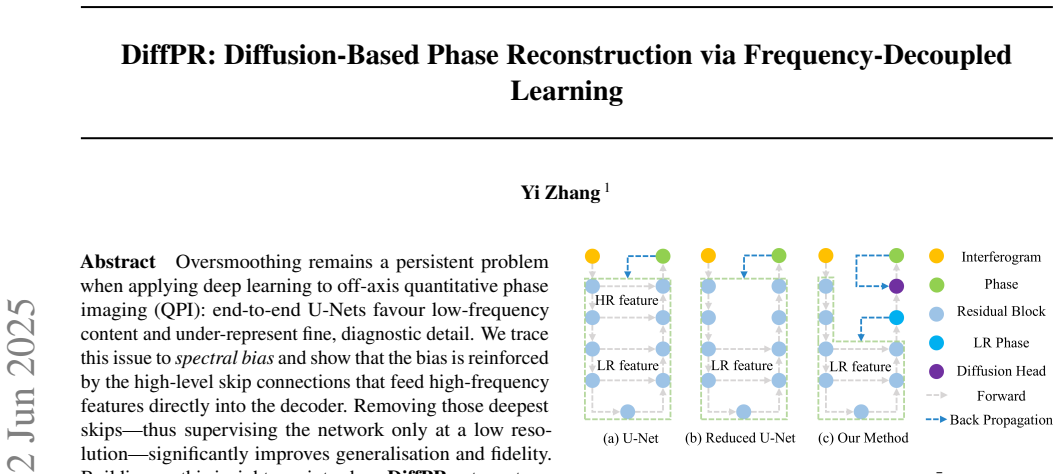
The machinery is a two-stage frequency decoupling. Stage 1 is an asymmetric U-Net $f_\theta$ with four downsampling blocks and only two upsampling blocks, so its output is a $1/4$-scale phase map $\hat\phi_{LR}$; crucially it omits the deepest skip connections, which the paper says feed high-frequency features to the decoder. Stage 2 is an unconditional diffusion prior $\epsilon_\omega$, a full-resolution symmetric U-Net trained with the denoising score-matching loss; at inference the upsampled prediction is corrupted by Gaussian noise to a timestep $t_{\mathrm{corrupt}}$ and then integrated with a reverse SDE solver. The diffusion model's bias toward high-frequency detail recovery is what lets it fill in the residuals that Stage 1 cannot produce.
What would settle it
Measure the spectral content of the features in each skip connection of a trained U-Net on these datasets (e.g., radially averaged power spectra of the encoder features at each level). If the deepest skip carries predominantly low-frequency energy while the early, high-resolution skips carry high-frequency energy, the paper's stated mechanism is falsified; the same test would also separate the contribution of the asymmetric decoder from the claimed frequency-decoupling effect.
Extended reading notes
Core claim
The central claim is that spectral bias in deep networks is actively reinforced by a U-Net's deepest skip connections, which the paper identifies as carrying high-frequency features into the decoder; removing them (the 'Reduced U-Net') suppresses direct high-frequency supervision, avoids a background-dominated local minimum, and improves fidelity. On top of this, the paper claims that an unconditional diffusion model, applied to a lightly noise-perturbed upsampled low-resolution prediction, acts as a high-frequency prior: the reverse denoising process progressively refines spectral content and synthesises the residuals that deterministic decoders miss. Together these two stages form DiffPR, which the paper reports as achieving the highest PSNR on all four QPI datasets (B-Cell, WBC, HeLa, 3T3), with up to +1.1 dB over the Reduced U-Net and up to 11% lower MAE, and visibly sharper ridges and speckle patterns.
Load-bearing premise
The explanation depends on the claim that the deepest, highest-level skip connections of a U-Net are the ones carrying high-frequency detail, so cutting them removes the network's shortcut to low-frequency collapse; in ordinary convolutional feature hierarchies high-frequency detail sits in the early, high-resolution layers, so if this direction is wrong the proposed mechanism would collapse even if the empirical gains remain.
Editorial extensions
If this is right
- U-Nets used for phase reconstruction should drop their deepest skip connections; doing so prevents the background-dominated collapse observed on B-Cell and WBC and improves PSNR by itself.
- Diffusion refinement of a low-frequency prediction can replace end-to-end high-frequency supervision, removing the need for the network to learn fine detail directly from the interferogram.
- The frequency-decoupled design should generalise to other cell types and imaging conditions because the diffusion prior is unconditional and only needs the low-frequency structure as a starting point.
- DiffPR's improvements are largest on noise- and texture-rich samples (WBC, 3T3), suggesting the method is most valuable where the signal's fine structure is hardest for deterministic decoders.
Reading between the lines
- A direct extension is to measure the spectral content of activations at each skip level to test whether the deepest skips really carry high-frequency information, which the paper asserts but does not directly verify.
- The two-stage recipe should transfer to other imaging inverse problems with strong spectral bias, such as MRI or CT reconstruction, where a fast low-frequency predictor plus a diffusion prior could substitute for end-to-end high-frequency supervision.
- Replacing the diffusion prior with a flow-matching or consistency model would test whether the high-frequency benefit is specific to diffusion's spectral autoregression or shared by generative priors in general.
Editorial analysis
A structured set of objections, weighed in public.
Referee Report
Summary. The paper proposes DiffPR, a two-stage pipeline for off-axis quantitative phase imaging: an asymmetric U-Net predicts a quarter-resolution phase map from an interferogram, and an unconditional diffusion model refines an upsampled, noise-perturbed version of this map into a full-resolution phase. The authors argue that this architecture decouples low- and high-frequency learning because (i) removing certain U-Net skip connections suppresses spectral bias and (ii) diffusion models preferentially recover high-frequency detail. Experiments on four QPI datasets (B-Cell, WBC, HeLa, 3T3) report that DiffPR improves PSNR by up to 1.1 dB and lowers MAE by up to 11% relative to a 'Reduced U-Net' baseline.
Significance. If the reported results are reproducible, the two-stage predictor-plus-diffusion-refinement pipeline is a plausible and practical contribution to deep-learning-based QPI, and the quantitative gains (e.g., +1.1 dB PSNR on WBC, SSIM 0.935 vs. 0.914) are nontrivial. The paper provides a clear algorithmic description and makes a falsifiable architectural claim about skip connections. However, the stated mechanism—that 'deepest' skips carry high-frequency features and that removing them suppresses spectral bias—is internally inconsistent with the architecture described in Section 4.1, and no spectral analysis is provided. As written, the paper does not establish the proposed frequency-decoupling interpretation; what remains is an empirical study of a particular two-stage pipeline whose underlying explanation needs substantial revision and additional evidence.
major comments (4)
- [Abstract; §1; §6; Fig. 1; §4.1] The paper is internally inconsistent about which skip connections are removed. The abstract and Section 6 refer to 'deepest skips' and 'eliminating the deepest skip connection,' while Fig. 1(b) says the Reduced U-Net 'removes top-level skips,' and Section 4.1 describes an encoder with four down-sampling blocks and a decoder with only two up-sampling blocks. In a standard convolutional feature hierarchy, early, high-resolution layers carry high-frequency detail and deep, low-resolution layers carry low-frequency semantic content. The decoder of the asymmetric U-Net can only receive skips at 1/4 and 1/8 resolution, so the high-resolution skip path is dropped by construction and the retained skips are the deep, low-resolution ones. The claim that 'eliminating the deepest skip connection' suppresses high-frequency supervision is therefore architecturally backwards. This is load-bearing: the frequency-decoupling explanation depends on this step. Please correct the terminology, state exactly which connections are dropped, and reconcile Fig. 1 with Section 4.1.
- [§7; §3.3] No spectral evidence supports the central mechanism. The conclusion that 'DiffPR synthesises the missing high-frequency residuals' and the interpretation of the Reduced U-Net's behaviour as suppression of spectral bias are not backed by any Fourier analysis of the features, residuals, or outputs. Please provide frequency-domain measurements (e.g., power spectra of the error maps of U-Net vs. Reduced U-Net, spectra of the residual that the diffusion stage adds, and a comparison with a U-Net that removes only deep skips rather than high-resolution skips) to test the frequency-decoupling claim. Without such evidence, the paper's main interpretative contribution remains an unsupported assertion.
- [Algorithm 1; §5.2] The corruption timestep t_corrupt, which controls the noise level of the perturbation and therefore the balance between preserving the predictor's low-frequency content and allowing the diffusion model to synthesize detail, is a key free parameter and is never reported. Without its value, and ideally a sensitivity analysis over t_corrupt, the method is not reproducible and the claim that the prediction is only 'lightly perturbed' cannot be evaluated. This parameter should be specified in the implementation details and, if possible, ablated.
- [§4.2] The diffusion model is described as unconditional, yet the reverse SDE is initialized from a noisy version of the upsampled prediction. Nothing in the sampling procedure explicitly prevents the reverse process from drifting away from the predicted structure; the qualitative similarity to the ground truth does not by itself establish that the conditioning content is preserved. Please explain why the reverse SDE should preserve the predictor's output, or add a data-consistency or conditioning mechanism, and report the relevant experimental evidence.
minor comments (5)
- [§6] The sentence 'MAE decreases by 13%' on B-Cell is not computable from Table 1 because the vanilla U-Net is marked '×' (failed to converge); please state the baseline used for this comparison.
- [§5.1] The test sets are small (about 28–38 images per dataset given the 80/10/10 split), yet no standard deviations or confidence intervals are reported; this limits the strength of the comparative claims.
- [§4.2] The reverse-time SDE is written with t flowing 'forward from T to 0'; this should be clarified as a backward-in-time integration, and the summation index n in the denoising score matching loss should be defined.
- [Throughout] There are numerous typos and artifacts, e.g., 'reveral serveral', '1Institude', duplicated 'Introduction' headings, and 'U ¯/Net'; a careful proofread is needed.
- [§3.2–3.3] The claim that diffusion models are biased toward high-frequency recovery is supported mainly by blog posts (Dieleman 2024; Russo 2025); please cite peer-reviewed analyses or provide a direct empirical demonstration in this setting.
Circularity Check
No significant circularity: DiffPR's two-stage cascade is evaluated on held-out test splits, and the diffusion prior is trained on the same domain but not on the test outputs; self-citations are related-work only.
full rationale
DiffPR's derivation is not circular. Stage 1 fits an asymmetric U-Net to map interferograms to quarter-scale phase maps (Eq. 1), and Stage 2 trains an unconditional diffusion model on ground-truth phase maps; at inference the diffusion prior denoises an upsampled, noise-perturbed Stage-1 prediction (Algorithm 1). Both components are trained on training splits and evaluated on held-out test splits (Section 5.1), so the reported PSNR/SSIM/MAE gains are not forced by construction. The diffusion model never sees the interferogram or the test-time target, and its 'high-frequency residual' role is a qualitative interpretation, not a fitted quantity. The claimed spectral-bias mechanism is under-supported and internally inconsistent (the text calls the removed connections both 'deepest' and 'top-level', and the asymmetric decoder with four encoder and two decoder downsamplings retains only low-resolution skips), but that is an evidence/correctness concern, not circularity. The self-citation to Zhang et al. 2021 PhaseGAN appears only in related work and does not carry the derivation. No equation in the paper reduces to its own input, and no fitted parameter is renamed as a prediction. Score 1 reflects minor self-citation and no structural circularity.
Assumptions & free parameters
free parameters (2)
- t_corrupt (diffusion corruption timestep) =
not reported
- diffusion noise schedule (variance-preserving) =
standard DDPM schedule, exact beta values not reported
assumptions (4)
- domain assumption Neural networks exhibit spectral bias: low frequencies are learned before high frequencies (Rahaman et al. 2019; Xu et al. 2019).
- domain assumption Diffusion models reconstruct high-frequency content in a coarse-to-fine spectral progression (Dieleman 2024; Russo 2025).
- ad hoc to paper In a U-Net, higher-level (deeper) skip connections carry high-frequency information; removing them suppresses high-frequency supervision.
- domain assumption The four datasets are representative and correctly generated (interferogram-to-phase pairs).
Cite this review
Pith. "Pith review of DiffPR: Diffusion-Based Phase Reconstruction via Frequency-Decoupled Learning." pith.science (2026). https://pith.science/paper/CSQZBOMI
@misc{pith2026250611183,
  author       = {Pith},
  title        = {Pith review of: DiffPR: Diffusion-Based Phase Reconstruction via Frequency-Decoupled Learning},
  year         = {2026},
  howpublished = {\url{https://pith.science/paper/CSQZBOMI}},
  note         = {Machine review of arXiv:2506.11183}
}
read the original abstract
Oversmoothing remains a persistent problem when applying deep learning to off-axis quantitative phase imaging (QPI). End-to-end U-Nets favour low-frequency content and under-represent fine, diagnostic detail. We trace this issue to spectral bias and show that the bias is reinforced by high-level skip connections that feed high-frequency features directly into the decoder. Removing those deepest skips thus supervising the network only at a low resolution significantly improves generalisation and fidelity. Building on this insight, we introduce DiffPR, a two-stage frequency-decoupled framework. Stage 1: an asymmetric U-Net with cancelled high-frequency skips predicts a quarter-scale phase map from the interferogram, capturing reliable low-frequency structure while avoiding spectral bias. Stage 2: the upsampled prediction, lightly perturbed with Gaussian noise, is refined by an unconditional diffusion model that iteratively recovers the missing high-frequency residuals through reverse denoising. Experiments on four QPI datasets (B-Cell, WBC, HeLa, 3T3) show that DiffPR outperforms strong U-Net baselines, boosting PSNR by up to 1.1 dB and reducing MAE by 11 percent, while delivering markedly sharper membrane ridges and speckle patterns. The results demonstrate that cancelling high-level skips and delegating detail synthesis to a diffusion prior is an effective remedy for the spectral bias that limits conventional phase-retrieval networks.
Figures

Reference graph
Works this paper leans on
-
[4]
Lai, X., Xiao, S., Xu, C., Fan, S., and Wei, K
arXiv:2107.00630. Lai, X., Xiao, S., Xu, C., Fan, S., and Wei, K. Aberration-free digital holographic phase imaging us- ing the derivative-based principal component analysis. Journal of Biomedical Optics, 26(4):046501,
-
[5]
Flow straight and fast: Learning to generate and transfer data with rec- tified flow
Liu, X., Gong, C., and qiang liu. Flow straight and fast: Learning to generate and transfer data with rec- tified flow. In The Eleventh International Conference on Learning Representations , 2023a. URL https: //openreview.net/forum?id=XVjTT1nw5z. Liu, X., Zhang, X., Ma, J., Peng, J., et al. Instaflow: One step is enough for high-quality diffusion-based te...
-
[9]
Saharia, C., Chan, W., Chang, H., Lee, C., Ho, J., Salimans, T., Fleet, D. J., and Norouzi, M. Palette: Image-to-image diffusion models. In ACM SIGGRAPH Conference Pro- ceedings, 2022a. arXiv:2111.05826. Saharia, C., Ho, J., Chan, W., Salimans, T., Fleet, D. J., and Norouzi, M. Image super-resolution via iterative refine- ment. In IEEE/CVF Conference on C...
-
[14]
doi: 10.1364/OE. 26.019388. URL https://opg.optica.org/oe/ abstract.cfm?URI=oe-26-15-19388 . Zhang, Y ., Noack, M. A., Vagovic, P., Fezzaa, K., Garcia-Moreno, F., Ritschel, T., and Villanueva-Perez, P. Phasegan: a deep-learning phase-retrieval approach for unpaired datasets. Optics express, 29(13):19593–19604,
-
[1982]
A., Zhai, S., Hu, S., Zheng, D., Talbott, W., and Gu, E
Berthelot, D., Autef, A., Lin, J., Yap, D. A., Zhai, S., Hu, S., Zheng, D., Talbott, W., and Gu, E. Tract: Denoising diffusion models with transitive closure time-distillation. arXiv preprint arXiv:2303.04248,
-
[2006]
doi: 10.1364/OE.14. 008263. URL https://opg.optica.org/oe/ abstract.cfm?URI=oe-14-18-8263 . Park, Y ., Depeursinge, C., and Popescu, G. Quantitative phase imaging in biomedicine. Nature photonics, 12(10): 578–589,
-
[2019]
Yao, Y ., Shu, X., and Zhou, R
URL https://arxiv.org/abs/1901.06523. Yao, Y ., Shu, X., and Zhou, R. Deep learning based phase retrieval in quantitative phase microscopy. In Uncon- ventional Optical Imaging II , volume 11351, pp. 76–80. SPIE,
arXiv 1901
-
[2020]
Wang, H., Lyu, M., and Situ, G
URL https://arxiv.org/abs/2006.10739. Wang, H., Lyu, M., and Situ, G. eholonet: a learning-based end-to-end approach for in-line dig- ital holographic reconstruction. Opt. Express , 26 (18):22603–22614, Sep
arXiv 2006
Show all 13 references
- [2021]
-
[2022]
Ronneberger, O., Fischer, P., and Brox, T
arXiv:2112.10752. Ronneberger, O., Fischer, P., and Brox, T. U-net: Convolu- tional networks for biomedical image segmentation. InIn- ternational Conference on Medical image computing and computer-assisted intervention, pp. 234–241. Springer,
-
[2023]
Tancik, M., Srinivasan, P
URL https://arxiv.org/ abs/2303.01469. Tancik, M., Srinivasan, P. P., Mildenhall, B., Fridovich-Keil, S., Raghavan, N., Singhal, U., Ramamoorthi, R., Barron, J. T., and Ng, R. Fourier features let networks learn high frequency functions in low dimensional domains. In Ad- vance...
-
[2024]
Ac- cessed: 2025-06-12
URL https://sander.ai/2024/ 09/02/spectral-autoregression.html. Ac- cessed: 2025-06-12. Ho, J., Jain, A., and Abbeel, P. Denoising diffusion proba- bilistic models. Advances in neural information process- ing systems, 33:6840–6851, 2020a. Ho, J., Jain, A., and Abbeel, P. Denoi...
2024 arXiv
-
[2025]
Accessed: 2025-06-12
URL https://gianluca.ai/ 6 DiffPR: Diffusion-Based Phase Reconstruction via Frequency-Decoupled Learning diffusion-is-frequency-autoregression/ . Accessed: 2025-06-12. Ryu, D., Kim, J., Lim, D., Min, H.-S., Yoo, I. Y ., Cho, D., and Park, Y . Label-free white blood cell classi...
2025
Reviewed August 7, 2026 · model on record in the stance chip above.
Discussion (0). Sign in to comment.