REVIEW 3 major objections 4 minor 31 references
Configuration design of multimode Gaussian operations on continuous-variable quad-rail lattice cluster states
T0 review · 3 major / 4 minor · reviewed 2026-08-07 · deepseek-v4-flash
Pith's one-line read The paper shows how to implement any $N$-mode beamsplitter network, and any multimode Gaussian unitary via the Bloch–Messiah reduction, on a quad-rail lattice cluster state using a triangular cascade of $N(N-1)/2$ macronode beamsplitter…
desk verdict A clean algebraic decomposition of beamsplitter networks into QRL macronode gates, but the physical wiring on the time-multiplexed lattice is never shown, so the efficiency claim overreaches. read the letter →
The pith
A machine-rendered reading of the paper's core claim, the machinery that carries it, and where it could break.
The reading
What carries the argument
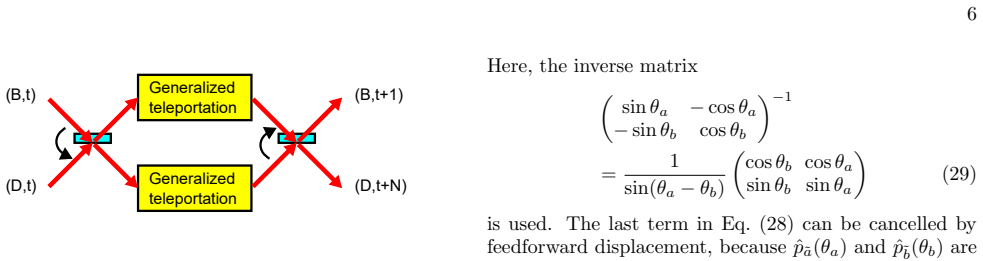
The load-bearing object is the macronode operation $T_{jk}=R_j(\phi)R_k(\phi)B'_{jk}(\tau)$, which one QRL macronode applies by teleporting two inputs through a Mach–Zehnder-like step and mixing them on a beamsplitter with a common output phase. The common phase is why the standard triangular cells cannot be used directly: a single $T$ cannot cancel an arbitrary off-diagonal matrix element, because the phase it supplies is the same on both modes. The paper's technical work is the conversion chain from $\hat B\hat R$ cells to $\hat T$ cells, in which each phase shift is moved from before the beamsplitter to after it, and the compensation phases generated by passing through neighboring beamsplitters are absorbed into the next phase-shift macronode via identities such as $\hat B_{jk}(\tau)\hat R_k(\phi)=\hat R_k(\phi)\hat R_j(\phi)\hat B_{jk}(\tau)\hat R_j(-\phi)$. This keeps the number of macronodes exactly equal to the number of beamsplitters in the underlying decomposition.
What would settle it
For a small case such as $N=4$, write out the cascade of Eq. (51) with explicit distributed-mode labels for every $T_{jk}$, and check that the $(B,t+1)$ and $(D,t+N)$ outputs of each macronode coincide with the required input modes of the next macronode in the triangular pattern; any mismatch, or any required extra swap, would mean the claimed $N(N-1)/2$ macronode count is not attainable as drawn.
Extended reading notes
Core claim
The central claim is that the only two-mode interaction needed for arbitrary linear optics on the QRL cluster state is the single-macronode operation $T_{jk}=R_j(\phi)R_k(\phi)B'_{jk}(\tau)$: a beamsplitter with reflectivity set by $\tau$ followed by a common phase shift $\phi$ on both output modes. Arranged in the triangular pattern of Eq. (51), $\hat U=\hat R_1(\hat T_{2,1}\hat R_2)(\hat T_{3,1}\hat T_{3,2}\hat R_3)\cdots(\hat T_{N,1}\cdots\hat T_{N,N-1}\hat R_N)$, these operations implement an arbitrary $N$-mode beamsplitter network with no redundant macronodes. The paper reaches this form by first decomposing the network into cells consisting of a beamsplitter with a single input phase shift, then re-pairing each phase with the neighboring beamsplitter, and finally converting each cell to the common-phase form while pushing compensation phases through the array using commutation identities. It further shows a rectangular arrangement with uniform teleportation path lengths, and a Bloch–Messiah configuration in which two triangular networks sandwich single-mode squeezing macronodes to implement an arbitrary multimode Gaussian unitary. A separate result identifies multimode shear operations, which implement symmetric quadratic phase Hamiltonians $\hat H(K)=\exp(\frac{i}{2}\sum_{j,k}K_{jk}\hat x_j\hat x_k)$, as a Gaussian subgroup that fits in one triangular network.
Load-bearing premise
The resource savings rest on the routing assumption that the triangular and rectangular arrays can be embedded in the QRL macronode graph exactly as drawn, with each macronode's two outputs feeding the correct inputs of the next macronode without extra swap or routing teleportations; the paper does not give an explicit time-indexed placement supporting that wiring.
Editorial extensions
If this is right
- Any $N$-mode beamsplitter network can be run on a QRL cluster state with $N(N-1)/2$ beamsplitter macronodes plus $N$ phase-shift macronodes, roughly half the teleportations of the previous measurement-based linear-optics design.
- Any multimode Gaussian unitary can be implemented by two triangular beamsplitter networks sandwiching $N$ single-mode squeezing macronodes, giving a guaranteed maximum resource size for Gaussian subroutines.
- Multimode shear operations — symmetric quadratic phase Hamiltonians — can be implemented with a single triangular network, the same size as the beamsplitter network and much cheaper than the Bloch–Messiah layout.
- The rectangular layout has more uniform teleportation path lengths, which can equalize losses at finite squeezing, at the cost of denser input arrangement.
- Pairing these configurations with injected non-Gaussian states gives a concrete resource blueprint for universal measurement-based quantum computation on QRL cluster states.
Reading between the lines
- A next step not taken in the paper is an explicit time-indexed placement of the drawn triangular and rectangular arrays onto the lattice's $(B,t+1)$ and $(D,t+N)$ edges; the algebraic decompositions alone do not certify that no extra swap or routing teleportations are needed.
- The phase re-pairing trick that converts single-input-phase cells into common-phase cells is generic, so it may transfer to other measurement-based architectures whose native two-mode gate carries a common output phase.
- For routines built on quadratic cost functions, such as continuous-variable quantum approximate optimization, the shear result suggests the relevant cost is $O(N^2)$ macronodes rather than roughly twice that, a difference that matters at finite squeezing because every teleportation adds noise.
- If the dense inputs of the rectangular layout become a practical bottleneck, hybrid layouts that alternate triangular blocks could trade uniformity against input accessibility; the paper does not explore this.
Editorial analysis
A structured set of objections, weighed in public.
Referee Report
Summary. The paper proposes concrete configuration designs for implementing multimode beamsplitter networks and general Gaussian unitaries on continuous-variable quad-rail lattice (QRL) cluster states. Starting from the macronode operation G_BD,t, which implements a Mach-Zehnder-like two-mode transformation, the authors convert the Reck et al. decomposition into a triangular array of T_jk = R_j R_k B_jk macronodes (Eq. (51)) and also propose a rectangular Clements-type variant (Fig. 8). They then use the Bloch-Messiah reduction to sandwich single-mode squeezing macronodes between two beamsplitter networks (Fig. 9), and identify multimode shear operations as a more efficient special case (Fig. 10). The central claim is that these layouts reduce the number of teleportations by about half compared to the previous design in Ref. [14].
Significance. If the proposed layouts can be physically realized on the time-multiplexed QRL lattice, the paper provides a resource-efficient blueprint for Gaussian subroutines in measurement-based continuous-variable quantum computation. The algebraic derivation of the phase-compensation conversion from the Reck decomposition to the T-node form is explicit and internally consistent (Eqs. (45)-(51)), and the shear-operation construction in Eq. (55) is a useful contribution. The paper is also appropriately cautious about the optimality of the Bloch-Messiah configuration. However, the physical wiring of the layouts on the QRL macronode graph is the load-bearing step, and it is currently supported only by schematic figures and a phase-degree-of-freedom count, not by a time-indexed placement.
major comments (3)
- [Sec. V, Eq. (51), Figs. 7 and 10] The central efficiency claim—that the triangular beamsplitter network can be wired on the QRL lattice without additional routing teleportations—is not established. Each macronode operation G_BD,t teleports (B,t) to (B,t+1) and (D,t) to (D,t+N), so every T node has one short-delay output and one long-delay output. Section V derives the operator identity (51) algebraically, but an operator identity does not by itself determine a time-indexed placement of macronodes on the graph of Fig. 2. No explicit schedule is given showing which macronode (which time index t) plays which node in Fig. 7, or how the outputs of one node connect to the inputs of the next without waiting (identity) teleportations. The same absence of a schedule applies to the shear configuration in Fig. 10. Without such a schedule, the claimed halving of the teleportation count relative to Ref. [14] is unsupported.
- [Sec. V, Fig. 8] The rectangular (Clements-type) configuration is validated only by counting phase degrees of freedom in the paragraph beginning 'We can validate the configuration in Fig. 8...'. A phase-count argument certifies that the decomposition has enough tunable parameters; it does not certify that the graph connectivity of the QRL lattice can host the oblique layout. In particular, in the Clements layering both outputs of each beamsplitter must continue to the next layer; the one-versus-N delay asymmetry of the macronode outputs must exactly cancel in the oblique alignment for no identity teleportation to be needed. This is asserted by the figure but not demonstrated. The rectangular design is therefore not yet shown to achieve the claimed resource count.
- [Sec. VI, Fig. 9] The Bloch-Messiah configuration is presented as a schematic with no internal routing specification. The text states that this configuration 'guarantees the maximum required size' for a general Gaussian unitary, but this guarantee depends on the two triangular beamsplitter networks being physically connected to a line of squeezing macronodes without extra routing teleportations. Since the triangular layouts themselves lack a time-indexed placement (see the first major comment), the size guarantee for Fig. 9 inherits the same gap. The paper's explicit disclaimer that it 'does not claim the efficiency' of Fig. 9 is appropriate, but the paper still asserts a concrete size bound, and that bound is not proven.
minor comments (4)
- [References] Reference [3] contains a typo: 'Universsal' should be 'Universal'; Reference [28] contains 'Reserach' for 'Research'.
- [Sec. V, Fig. 8] The caption and surrounding text would benefit from a precise statement of which macronode time indices correspond to the 'oblique alignment' and to the phase-shift nodes with two inputs; currently this information is only in the drawing.
- [Sec. IV C 1] The single-mode phase-shift operation is stated to be obtained by (θd, θc, θb, θa) = (θ+π/2, θ, θ+π/2, θ), yielding a phase shift of 2θ, but the factor of 2 is not derived in the text; a one-line clarification would help.
- [Introduction] The claim that the proposed designs 'decrease the number of teleportations by half' relative to Ref. [14] is informal; a quantitative comparison, specifying the exact teleportation counts for N modes in each layout, would make the claim precise and verifiable.
Circularity Check
No significant circularity; the derivation chain is self-contained.
full rationale
The paper's central claims are algebraic decompositions built from explicitly derived macronode operations. The generalized teleportation transformation V(theta_b, theta_a) is derived directly from homodyne measurement formulas (Eqs. 26-30), and the macronode operation G_BD,t is defined in Eq. (24) from that derived V. The beamsplitter-network decomposition starts from the external Reck/Clements decompositions and converts their C_jk/S_jk components into the available T_jk macronode operations using explicit operator identities (Eqs. 45-50); the final triangular decomposition in Eq. (51) is not assumed or fitted but obtained by these conversions. The Bloch-Messiah reduction is cited from Braunstein [17] as an external theorem, and the shear-operation result is derived by direct computation (Eqs. 53-55). Self-citations appear (Refs. [14], [23], [24]) but none is load-bearing: Ref. [14] is used only for comparison and for a remark about loss symmetry, and Refs. [23,24] support a peripheral statement about single-mode Gaussian operations that is not needed for the main construction. The routing concern about time-indexed placement in Figs. 7-9 is a physical realizability question, not a circularity: the algebra of Eq. (51) is independent of whether the layout can be scheduled without extra teleportations. Thus no step reduces by construction to its own input, and no fitted parameter is renamed as a prediction.
Assumptions & free parameters
assumptions (5)
- domain assumption Ideal infinite-squeezing limit: the QRL cluster state nullifiers exactly vanish (Eq. (17)), and generalized teleportation is exact with perfect feedforward.
- domain assumption A macronode operation G_BD,t has the form B^dagger V_D V_B B (Eq. (24)) and implements the derived two-mode transformations exactly for all measurement angles.
- standard math Reck et al. and Clements et al. decompositions of arbitrary unitary matrices are valid (Refs [15,16]).
- standard math Bloch-Messiah reduction: any Gaussian unitary factorizes as G = U S V^dagger (Eq. (7), Ref [17]).
- domain assumption The QRL cluster state can be locally phase-shifted without changing computational capability; the adopted definition differs from Ref [6] only by local phase redefinitions.
Cite this review
Pith. "Pith review of Configuration design of multimode Gaussian operations on continuous-variable quad-rail lattice cluster states." pith.science (2026). https://pith.science/paper/IWY5VE6A
@misc{pith2026250611236,
  author       = {Pith},
  title        = {Pith review of: Configuration design of multimode Gaussian operations on continuous-variable quad-rail lattice cluster states},
  year         = {2026},
  howpublished = {\url{https://pith.science/paper/IWY5VE6A}},
  note         = {Machine review of arXiv:2506.11236}
}
read the original abstract
Continuous-variable quad-rail lattice cluster states enable flexible quantum circuit design on their two-dimensional structure. However, how to combine basic operations on the quad-rail lattice cluster state to realize multimode operations has not been deeply discussed. Here we show a concrete configuration design to efficiently implement beamsplitter network operations on the cluster state. Furthermore, combining the beamsplitter networks, a configuration design of multimode Gaussian unitary operations is also shown. It is theoretically known that the Gaussian operations are sufficient for universal quantum computation if appropriate non-Gaussian states are injected. Our results are fundamentally important for utilizing the flexible quad-rail lattice cluster states for computations.
Figures


Figures from the paper (5 more)


Reference graph
Works this paper leans on
-
[14]
W. Asavanant, Y. Shiozawa, S. Yokoyama, B. Charoen- sombutamon, H. Emura, R. N. Alexander, S. Takeda, J. Yoshikawa, N. C. Menicucci, H. Yonezawa, and A. Furusawa, Generation of time-domain-multiplexed two- dimensional cluster state, Science 366, 373 (2019)
work page 2019
-
[1]
Single-mode operation A single-mode operation achievable by ˆV (θb, θa) can be simultaneously applied to ( B, t) and ( D, t), because of commutability between a beamsplitter operation and common single-mode Gaussian operations (without dis- placements) [6], ˆGBD,t (θb, θa, θb, θa) = ˆB† BD,t ˆVD,t(θb, θa) ˆVB,t(θb, θa) ˆBBD,t = ˆB† BD,t ˆBBD,t ˆVD,t(θb, θ...
-
[2]
Swapping of outputs The input states in ( B, t) and ( D, t) are teleported to ( B, t+ 1), ( D, t+ N ) after the conversion by ˆGBD,t (θd, θc, θb, θa); however, the destinations can be swapped by swapping θb and θa. Eq. (33) shows that the swapping of measurement phases result in a π phase shift, which acts as a sign flip of the annihilation opera- tor. Th...
-
[3]
BS” in Fig. 8) in the l-th layer, together with additional phase shifts at turning macron- odes (“P
Beamsplitter interaction As an example of two-mode operations, beamsplit- ter interactions are fundamentally important. They are photon-number conserving operations, and thus obtained by restricting ˆV (θb, θa) to photon-number conserving op- erations, that is, phase shifts. By setting ( θd, θc, θb, θa) = (θ2 + π/2, θ2, θ1 + π/2, θ1), we obtain, ˆG† BD,t ...
-
[4]
Raussendorf and H
R. Raussendorf and H. J. Briegel, A one-way quantum computer, Phys. Rev. Lett. 86, 5188 (2001)
2001
-
[5]
H. J. Briegel, D. E. Browne, W. D ur, R. Raussendorf, and M. Van den Nest, Measurement-based quantum com- putation, Nat. Phys. 5, 19 (2009)
work page 2009
-
[6]
N. C. Menicucci, P. van Loock, M. Gu, C. Weedbrook, T. C. Ralph, and M. A. Nielsen, Universsal quantum com- putation with continuous-variable cluster states, Phys. Rev. Lett. 97, 110501 (2006). 13
work page 2006
-
[7]
N. C. Menicucci, Temporal-mode continuous-variable cluster states using linear optics, Phys. Rev. A83, 062314 (2011)
2011
Show all 31 references
-
[8]
N. C. Menicucci, S. T. Flammia, and O. Pfister, One- way quantum computing in the optical frequency comb, Phys. Rev. Lett. 101, 130501 (2008)
2008
-
[9]
R. N. Alexander and N. C. Menicucci, Flexible quantum circuits using scalable continuous-variable cluster states, Phys. Rev. A 93, 062326 (2016)
2016
-
[10]
Yokoyama, R
S. Yokoyama, R. Ukai, S. C. Armstrong, C. Sornphipat- phong, T. Kaji, S. Suzuki, J. Yoshikawa, H. Yonezawa, N. C. Menicucci, and A. Furusawa, Ultra-large-scale continuous-variable cluster states multiplexed in the time domain, Nat. Photon. 7, 982 (2013)
2013
-
[11]
M. Chen, N. C. Menicucci, and O. Pfister, Experimental realization of multipartile entanglement of 60 modes of a quantum optical frequency comb, Phys. Rev. Lett. 112, 120505 (2014)
2014
-
[12]
Roslund, R
J. Roslund, R. M. de Ara´ ujo, S. Jiang, C. Fabre, and N. Treps, Wavelength-multiplexed quantum networks with ultrafast frequency combs, Nat. Photon. 8, 109 (2014)
2014
-
[13]
Yoshikawa, S
J. Yoshikawa, S. Yokoyama, T. Kaji, C. Sornphiphat- phong, Y. Shiozawa, K. Makino, and A. Furusawa, Gen- eration of one-million-mode continuous-variable cluster state by unlimited time-domain multiplexing, APL Pho- tonics, 1, 060801 (2016)
2016
-
[15]
M. V. Larsen, X. Guo, C. R. Breum, J. S. Neergaard- Nielsen, and U. L. Andersen, Deterministic generation of a two-dimensional cluster state, Science 366, 369 (2019)
2019
-
[16]
Asavanant, B
W. Asavanant, B. Charoensombutamon, S. Yokoyama, T. Ebihara, T. Nakamura, R. N. Alexander, M. Endo, J. Yoshikawa, N. C. Menicucci, H. Yonezawa, and A. Furusawa, Time-domain-multiplexed measurement- based quantum operations with 25-MHz clock frequency, Phys. Rev. Appl. 16, 0340...
2021
-
[17]
R. N. Alexander, N. C. Gabay, P. P. Rohde, and N. C. Menicucci, Measurement-based linear optics, Phys. Rev. Lett. 118, 110503 (2017)
2017
-
[18]
M. Reck, A. Zeilinger, H. J. Bernstein, and P. Bertani, Experimental realization of any discrete unitary opera- tor, Phys. Rev. Lett. 73, 58 (1994)
1994
-
[19]
W. R. Clements, P. C. Humphreys, B. J. Metcalf, W. S. Kolthammer, and I. A. Walmsley, Optimal design for uni- versal multiport interferometers, Optica 3, 1460 (2016)
2016
-
[20]
S. L. Braunstein, Squeezing as an irreducible resource, Phys. Rev. A 71, 055801 (2005)
2005
-
[21]
Gottesman, A
D. Gottesman, A. Kitaev, and J. Preskill, Encoding a qubit in an oscillator, Phys. Rev. A 64, 012310 (2001)
2001
-
[22]
B. Q. Baragiola, G. Pantaleoni, R. N. Alexander, A. Karanjai, and N. C. Menicucci, All-Gaussian universality and fault tolerance with the Gottesman-Kitaev-Preskill code, Phys. Rev. Lett. 123, 200502 (2019)
2019
-
[23]
Konno, W
S. Konno, W. Asavanant, K. Fukui, A. Sakaguchi, F. Hanamura, P. Marek, R. Filip, J. Yoshikawa, and A. Fu- rusawa, Non-Clifford gate on optical qubits by nonlinear feedforward, Phys. Rev. Research 3, 043026 (2021)
2021
-
[24]
Asavanant, K
W. Asavanant, K. Fukui, A. Sakaguchi, and A. Furu- sawa, Switching-free time-domain optical quantum com- putation with quantum teleportation, Phys. Rev. A 107, 032412 (2023)
2023
-
[25]
Einstein, B
A. Einstein, B. Podolsky, and N. Rosen, Can quantum- mechanical description of physical reality be considered complete?, Phys. Rev. 47, 777 (1935)
1935
-
[26]
R. Ukai, J. Yoshikawa, N. Iwata, P. van Loock, and A. Furusawa, Universal linear Bogoliubov transformations through one-way quantum computation, Phys. Rev. A 81, 032315 (2010)
2010
-
[27]
R. N. Alexander, S. C. Armstrong, R. Ukai, and N. C. Menicucci, Noise analysis of single-mode Gaussian opera- tions using continuous-variable cluster states, Phys. Rev. A 90, 062324 (2014)
2014
-
[28]
Aaronson, and A
S. Aaronson, and A. Arkhipov, The computational com- plexity of linear optics, Theory of Computing, 9, 143 (2013)
2013
-
[29]
Y. Miwa, J. Yoshikawa, P. van Loock, and A. Furusawa, Demonstration of a universal one-way quantum quadratic phase gate, Phys. Rev. A 80, 050303(R) (2009)
2009
-
[30]
Verdon, J
G. Verdon, J. M. Arrazola, K. Br´ adler, and N. Kiloran, A quantum approximate optimization algorithm for con- tinuous problems, arXiv:1902.00409 [quant-ph] (2019)
2019 arXiv
-
[31]
Enomoto, K
Y. Enomoto, K. Anai, K. Udagawa, and S. Takeda, Continuous-variable quantum approximate optimization on a programmable photonic quantum processor, Phys. Rev. Reserach 5, 043005 (2023)
2023
Reviewed August 7, 2026 · model on record in the stance chip above.
Discussion (0). Continue with ORCID to comment.