REVIEW 4 major objections 4 minor 1 cited by
Dynamic Sparse Training of Diagonally Sparse Networks
T0 review · 4 major / 4 minor · reviewed 2026-08-07 · deepseek-v4-flash
Pith's one-line read A sparse training method confined to diagonal weight patterns matches unstructured accuracy at moderate sparsity and converts the structure into real GPU speedups in both training and inference.
desk verdict Genuinely new diagonal-sparsity DST method with real hardware speedups, but the abstract's 'par with unstructured' claim overreaches at high sparsity — the paper's own tables show significant gaps vs RigL at 95% ViT-B/16 and 90% GPT-2. read the letter →
The pith
A machine-rendered reading of the paper's core claim, the machinery that carries it, and where it could break.
The reading
What carries the argument
The central machinery is the diagonal-sparse factorization of a weight matrix as a sum of permutation matrices times diagonal value vectors, gated by a learnable importance vector passed through a temperature-controlled softmax TopK. Transposition invariance of the pseudo-diagonal mask is what carries training acceleration: the transposed weight used in backpropagation remains diagonal, so sparse gradients can be formed without a dense pass. The final hardware step converts the selected diagonals to Block Compressed Sparse Row (BCSR) format, using a Jaccard-plus-proximity heuristic to cluster rows from nearby diagonals into dense blocks that map onto GPU tensor-core operations. These pieces together turn an abstract sparsity pattern into a method that is differentiable, dynamic, and hardware-aware.
What would settle it
Train ViT-B/16 on ImageNet-1K at 95% sparsity with DynaDiag and with unstructured DST over multiple seeds and compare Top-1 accuracy with a paired McNemar test: the paper's own Table 1 and Appendix Table 10 already report a significant gap (69.54 vs 71.68 for CHT and 71.50 for RigL, p=0.0352), which would refute the parity claim in the high-sparsity regime unless the LoRA-FA adapters are counted as part of the sparse model.
Extended reading notes
Core claim
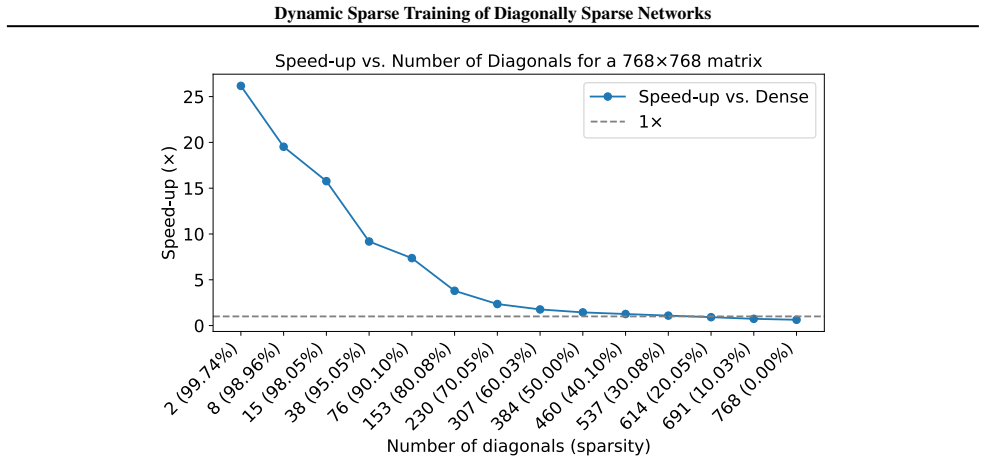
The discovery is that a transposable structured sparsity pattern—full diagonals of a weight matrix—is expressive enough to make sparse-to-sparse training competitive with unstructured DST while remaining computationally sparse end-to-end. The paper represents a layer as $W_K = \sum_{j=1}^K \tilde\alpha_j P_j \operatorname{diag}(V_j)$, where each $P_j$ places a $V_j$ vector on a diagonal and $\tilde\alpha = \operatorname{TopK}(\alpha)$ masks in the $K = (1-S)MN/\min(M,N)$ diagonals that a sparsity budget $S$ allows. The importance scores $\alpha$ are trained with a temperature-annealed softmax TopK, so diagonal positions are learned rather than fixed. The authors prove that a pseudo-diagonal mask stays pseudo-diagonal under transposition, which lets the backward pass multiply by the transposed sparse weight without breaking the pattern; the diagonals are then reordered into dense blocks (BCSR) and executed on GPU tensor cores. On this basis the paper reports accuracy statistically indistinguishable from unstructured baselines such as RigL at 60–80% sparsity on ImageNet-1K, and the speedups above.
Load-bearing premise
The load-bearing premise is that limiting every layer to a small set of full diagonals—about $(1-S)MN/\min(M,N)$ of them—preserves enough expressivity to match the accuracy of unconstrained sparse masks at the same sparsity budget, particularly at the high sparsities the paper emphasizes.
Editorial extensions
If this is right
- Structured DST no longer has to sacrifice training speed: DynaDiag keeps sparsity in both forward and backward passes, so sparse-to-sparse training converts directly into GPU time saved.
- At 60–80% sparsity the diagonal mask is statistically at parity with unstructured DST methods, making structured sparsity a drop-in replacement in the regime where unstructured masks give no hardware benefit anyway.
- At 90% sparsity on ViT models, the reported wall-clock numbers mean a practitioner can get a 3.13× faster online inference and 1.59× faster training while staying within measurement error of the unstructured baseline's accuracy.
- At extreme sparsity (99–99.9%) DynaDiag outperforms unstructured RigL, suggesting the fixed full-row and full-column coverage of diagonal masks prevents the layer-collapse failure mode that hurts unstructured DST.
- The high-sparsity accuracy gap is shown to be recoverable: adding rank-6 LoRA-FA adapters (about 1.67% more parameters) lets DynaDiag exceed RigL accuracy, indicating the diagonal pattern captures most but not all of the needed connectivity.
Reading between the lines
- A natural next experiment the paper does not run: replacing the diagonal pattern with any other transpose-closed family (e.g., anti-diagonals or symmetric band patterns) would isolate whether the gains come from diagonals per se or from transposability combined with block packing.
- The reported speedups are tied to custom CUDA kernels and BCSR packing measured on A100 GPUs; porting the same diagonal pattern to standard sparse libraries or consumer hardware could shrink or erase the 3.13×/1.59× figures, so the speedup is a property of the implementation as much as the pattern.
- The LoRA-FA fix points to a general hybrid recipe—a structured diagonal backbone for most weights plus a small unstructured residual—that could be trained jointly rather than post-hoc; the paper does not claim this.
- The small-world interpretation suggests a scaling prediction: as matrices widen, the number of diagonals needed for a given accuracy should grow more slowly than the number of unstructured nonzeros, so diagonal sparsity should become increasingly attractive for very large layers.
Editorial analysis
A structured set of objections, weighed in public.
Referee Report
Summary. The paper proposes DynaDiag, a dynamic sparse training (DST) method that restricts non-zero weights to a set of learnable diagonals. Diagonals are selected through a differentiable TopK mechanism on a trainable importance vector, and the resulting matrices are converted to Block CSR (BCSR) format to enable GPU acceleration in both forward and backward passes. The authors evaluate DynaDiag on ImageNet-1K with ViT-B/L/H and MLP-Mixer and on WikiText-103 with GPT-2 Small/Medium, comparing against unstructured DST baselines (RigL, SET, MEST, CHT, CHTs) and structured baselines (SRigL, DSB, PixelatedBFly, and a DiagHeur variant). They report that DynaDiag matches unstructured sparsity accuracy while achieving up to 3.13x inference and 1.59x training speedups, and they provide ablations on temperature schedules, sparsity schedules, sparsity distributions, and a check that BCSR conversion does not change accuracy.
Significance. If the central claims held, this would be a valuable contribution: a structured DST method that preserves sparse computation in both forward and backward passes, converts diagonal structure into real GPU speedups, and matches the accuracy of unstructured DST. The experimental breadth is a genuine strength, including multiple model families, sparsity levels, paired statistical tests, ablations, and a BCSR-vs-direct accuracy check in Table 8. However, the headline parity claim is contradicted by the paper's own results at the high sparsity levels it emphasizes, and the speedup comparison baseline is stated inconsistently. The significance is therefore contingent on a substantial reframing of the claims rather than on the current abstract.
major comments (4)
- [Abstract; §4.2.1, Table 1; §4.2.2, Table 2; §4.3.1; Table 10] The abstract's claim that DynaDiag 'performs at par with unstructured sparsity' and achieves 90%-sparse ViT accuracy 'without sacrificing model performance' is not supported at high sparsity. In Table 1, ViT-B/16 at 95% sparsity gives 69.54 for DynaDiag versus 71.50 for RigL and 71.68 for CHT, and Table 10 reports p=0.0352 versus RigL, i.e., significantly worse. In Table 2, GPT2-S at 90% sparsity gives perplexity 56.33 versus RigL's 53.76 (p=0.0401 in Table 11), and GPT2-M gives 54.87 versus 51.76 (p=0.0136). Section 4.3.1 explicitly concedes a 'performance gap between RigL and DynaDiag at sparsities ≥ 80%' and closes that gap only by adding unstructured LoRA-FA parameters outside the diagonal mask (Fig. 5). The parity claim must be narrowed to the regimes where the data actually support it, or the paper must provide a version of DynaDiag that achieves parity without unstructured extras.
- [Abstract; §4.2.3; Fig. 4] The training-speedup baseline is stated inconsistently. The abstract says '1.59x speedup in training on a GPU compared to equivalent unstructured layers,' while §4.2.3 says 'training speedup of 1.59× compared to the dense equivalent at 90% sparsity.' Fig. 4's caption, in turn, says the diagonal-sparse kernel is compared to 'standard sparse kernels.' These are different comparisons. The paper should specify the exact baseline used for each reported speedup; if the 1.59x figure is versus dense, then the abstract's comparison to unstructured sparse layers is not supported by the reported measurements.
- [§4.1; Appendix E, Tables 9-11] The statistical testing procedure is reported inconsistently. Section 4.1 says McNemar tests compare the top-performing method at each sparsity level against all others, with bolding indicating no significant difference from the best. However, Tables 9-11 report p-values comparing each method specifically with RigL, not with the column best. For example, in Table 1 at ViT-B/16 60%, the best method is CHTs (79.88), but DynaDiag's p=0.0654 in Table 10 is versus RigL, not versus CHTs, so the bolding in Table 1 cannot be interpreted as the caption states. Additionally, for language experiments, Table 11 reports McNemar p-values for perplexity comparisons without defining the paired binary outcomes that McNemar's test requires. Please clarify the testing protocol or replace it with tests that support the stated bolding decisions.
- [Appendix B, Theorem 2] The claimed universal-approximation justification is not a valid proof. Lemma 1 establishes that each diagonal mask has at least one active entry per row and column, but Theorem 2 then concludes that universal approximation is retained because 'the assumptions required for universal approximation remain valid.' Full input-output coverage is neither necessary nor sufficient for the universal approximation property, and the subsequent rank-preservation argument does not repair the gap. If this appendix is intended as theoretical support for the method, it needs to be rewritten or stated explicitly as intuition; as written, it overstates what is proven.
minor comments (4)
- [§3.1, Eq. (1)] The notation is confusing: N is used both for the original column dimension of W ∈ R^{M×N} and then redefined as N = min(M,N). Please use a distinct symbol such as N_min for the smaller dimension.
- [Table 1; Table 16; §4.2.1] There are small typos: 'SRigl' in Table 1 should be 'SRigL', 'blocks.8.mlp.fc2.linear.weigh' in Table 16 is missing a 't', and §4.2.1 uses the phrase 'To the best of our knowledge, we are the first to show a DST method's performance training large and huge variants' which should be reworded for clarity.
- [§4.3.1, Fig. 5] The claim that LoRA-FA parameters are 'distributed across the weight matrix in an unstructured pattern' would be strengthened by a quantitative comparison with a random or diagonal baseline; the current figure alone does not establish that the pattern is the cause of the accuracy recovery.
- [§4.2.3] The text says 'Our PyTorch implementation does not exploit CUDA kernel optimizations' immediately after describing custom CUDA kernels; please clarify which components are implemented in PyTorch and which use the custom kernels, since this affects how the reported speedups should be interpreted.
Circularity Check
No load-bearing circularity: DynaDiag's accuracy and speedup claims are empirical measurements against external baselines; the diagonal parameterization (Eqs. 2-5) is learned from data labels, and no fitted parameter is renamed as a prediction.
full rationale
The paper's core claims are empirical rather than derived. Eq. 2-3 define a diagonal parameterization, Eq. 4-5 define a learnable TopK gate over diagonal offsets, and the reported accuracies/perplexities are measured on held-out test sets and compared with independently published baselines (RigL, SET, MEST, CHT, CHTs, SRigL, DSB, PixelatedBFly). No equation in the paper defines the target accuracy in terms of the fitted parameters, so the 'at par with unstructured sparsity' claim is not an identity or a fit renamed as a prediction. The closest thing to a self-referential move is Appendix I.1, where the authors compute the small-world factor sigma of their own trained networks and treat sigma >= 1 as confirmation of the small-world inspiration; this is a post-hoc diagnostic, not a load-bearing step in the argument, and it does not determine the accuracy or speedup results. Appendix B's universal-approximation and rank-preservation arguments are heuristic and contain a real mathematical gap (a sum of K diagonals has rank at most K, not min(m,n)), but invalid proof is a soundness concern, not a circularity. The paper also discloses the regime where the parity claim weakens (Table 1: ViT-B/16 at 95% sparsity, 69.54 vs RigL 71.50, p=0.0352 in Table 10; GPT2-M at 90%, p=0.0136) and Sec. 4.3.1 concedes a performance gap at sparsities >=80% that is closed only with unstructured LoRA-FA parameters; that concession undercuts the strength of the abstract's parity claim but does not make the derivation circular.
Assumptions & free parameters
free parameters (4)
- TopK temperature T schedule =
cosine schedule, start/end values not reported
- Blocking similarity weight alpha =
alpha < 0.5 (exact value not reported)
- l1 coefficient on alpha =
not reported
- LoRA-FA rank =
rank 6 for ViT-B/16 at 80% sparsity
assumptions (4)
- domain assumption Softmax-based TopK (Eq. 5) provides a faithful, optimizable relaxation of hard TopK diagonal selection.
- standard math Diagonal masks with k >= 1 cover every row and every column (Lemma 1).
- ad hoc to paper Universal approximation is retained by diagonally sparse layers given full coverage and enough width and depth (Theorem 2).
- ad hoc to paper Jaccard-plus-proximity BCSR reordering yields dense-enough blocks for GPU acceleration.
Cite this review
Pith. "Pith review of Dynamic Sparse Training of Diagonally Sparse Networks." pith.science (2026). https://pith.science/paper/Q2ERSVSM
@misc{pith2026250611449,
  author       = {Pith},
  title        = {Pith review of: Dynamic Sparse Training of Diagonally Sparse Networks},
  year         = {2026},
  howpublished = {\url{https://pith.science/paper/Q2ERSVSM}},
  note         = {Machine review of arXiv:2506.11449}
}
read the original abstract
Recent advances in Dynamic Sparse Training (DST) have pushed the frontier of sparse neural network training in structured and unstructured contexts, matching dense-model performance while drastically reducing parameter counts to facilitate model scaling. However, unstructured sparsity often fails to translate into practical speedups on modern hardware. To address this shortcoming, we propose DynaDiag, a novel structured sparse-to-sparse DST method that performs at par with unstructured sparsity. DynaDiag enforces a diagonal sparsity pattern throughout training and preserves sparse computation in forward and backward passes. We further leverage the diagonal structure to accelerate computation via a custom CUDA kernel, rendering the method hardware-friendly. Empirical evaluations on diverse neural architectures demonstrate that our method maintains accuracy on par with unstructured counterparts while benefiting from tangible computational gains. Notably, with 90% sparse linear layers in ViTs, we observe up to a 3.13x speedup in online inference without sacrificing model performance and a 1.59x speedup in training on a GPU compared to equivalent unstructured layers. Our source code is available at https://github.com/horizon-research/DynaDiag/.
Figures


Figures from the paper (5 more)




Forward citations
Cited by 1 Pith paper
-
SHUFFLESPARSE: Learned Shuffles for Structured Sparse Networks
Learned per-layer permutations bring structured sparse training (block, N:M, diagonal) close to unstructured sparse-training accuracy at 90-95% sparsity, with inference speedups up to 2.9x.
Reference graph
Works this paper leans on
-
[1]
and Albert, R
Barab \'a si, A.-L. and Albert, R. Emergence of scaling in random networks. science, 286 0 (5439): 0 509--512, 1999
1999
-
[2]
J., Frankle, J., and Guttag, J
Blalock, D., Gonzalez Ortiz, J. J., Frankle, J., and Guttag, J. What is the state of neural network pruning? Proceedings of machine learning and systems, 2: 0 129--146, 2020
work page 2020
-
[3]
Structured Pruning is All You Need for Pruning CNNs at Initialization
Cai, Y., Hua, W., Chen, H., Suh, G. E., De Sa, C., and Zhang, Z. Structured pruning is all you need for pruning cnns at initialization. arXiv preprint arXiv:2203.02549, 2022
work page Pith review arXiv 2022
-
[4]
Sparsity Winning Twice: Better Robust Generalization from More Efficient Training
Chen, T., Zhang, Z., Wang, P., Balachandra, S., Ma, H., Wang, Z., and Wang, Z. Sparsity winning twice: Better robust generalization from more efficient training. arXiv preprint arXiv:2202.09844, 2022
work page Pith review arXiv 2022
-
[5]
Chen, Y., Yuille, A., and Zhou, Z. Which layer is learning faster? a systematic exploration of layer-wise convergence rate for deep neural networks. In The Eleventh International Conference on Learning Representations, 2023
work page 2023
-
[6]
Trends in the dollar training cost of machine learning systems
Cottier, B. Trends in the dollar training cost of machine learning systems. Epoch. January, 31: 0 2023, 2023
work page 2023
-
[7]
Pixelated Butterfly: Simple and Efficient Sparse training for Neural Network Models
Dao, T., Chen, B., Liang, K., Yang, J., Song, Z., Rudra, A., and Re, C. Pixelated butterfly: Simple and efficient sparse training for neural network models. arXiv preprint arXiv:2112.00029, 2021
work page Pith review arXiv 2021
-
[8]
Imagenet: A large-scale hierarchical image database
Deng, J., Dong, W., Socher, R., Li, L.-J., Li, K., and Fei-Fei, L. Imagenet: A large-scale hierarchical image database. In 2009 IEEE conference on computer vision and pattern recognition, pp.\ 248--255. Ieee, 2009
2009
Show all 57 references
-
[9]
An image is worth 16x16 words: Transformers for image recognition at scale
Dosovitskiy, A. An image is worth 16x16 words: Transformers for image recognition at scale. arXiv preprint arXiv:2010.11929, 2020
2010 arXiv
-
[10]
S., and Elsen, E
Evci, U., Gale, T., Menick, J., Castro, P. S., and Elsen, E. Rigging the lottery: Making all tickets winners. In International conference on machine learning, pp.\ 2943--2952. PMLR, 2020
2020
-
[11]
and Carbin, M
Frankle, J. and Carbin, M. The lottery ticket hypothesis: Finding sparse, trainable neural networks. arXiv preprint arXiv:1803.03635, 2018
2018 arXiv
-
[12]
Learning both weights and connections for efficient neural network
Han, S., Pool, J., Tran, J., and Dally, W. Learning both weights and connections for efficient neural network. Advances in neural information processing systems, 28, 2015
2015
-
[13]
Accelerating transformer pre-training with 2: 4 sparsity
Hu, Y., Zhao, K., Huang, W., Chen, J., and Zhu, J. Accelerating transformer pre-training with 2: 4 sparsity. arXiv preprint arXiv:2404.01847, 2024
2024 arXiv
-
[14]
Accelerated sparse neural training: A provable and efficient method to find n: m transposable masks
Hubara, I., Chmiel, B., Island, M., Banner, R., Naor, J., and Soudry, D. Accelerated sparse neural training: A provable and efficient method to find n: m transposable masks. Advances in neural information processing systems, 34: 0 21099--21111, 2021
2021
-
[15]
K., Ma, H., Chen, T., Ding, Y., and Wang, Z
Jaiswal, A. K., Ma, H., Chen, T., Ding, Y., and Wang, Z. Training your sparse neural network better with any mask. In International Conference on Machine Learning, pp.\ 9833--9844. PMLR, 2022
2022
-
[16]
Top-kast: Top-k always sparse training
Jayakumar, S., Pascanu, R., Rae, J., Osindero, S., and Elsen, E. Top-kast: Top-k always sparse training. Advances in Neural Information Processing Systems, 33: 0 20744--20754, 2020
2020
-
[17]
Advancing dynamic sparse training by exploring optimization opportunities
Ji, J., Li, G., Yin, L., Qin, M., Yuan, G., Guo, L., Liu, S., and Ma, X. Advancing dynamic sparse training by exploring optimization opportunities. In Forty-First International Conference on Machine Learning, 2024
2024
-
[18]
Exposing and exploiting fine-grained block structures for fast and accurate sparse training
Jiang, P., Hu, L., and Song, S. Exposing and exploiting fine-grained block structures for fast and accurate sparse training. Advances in Neural Information Processing Systems, 35: 0 38345--38357, 2022
2022
-
[19]
and Hinton, G
Krizhevsky, A. and Hinton, G. Learning multiple layers of features from tiny images. Technical Report TR-2009, University of Toronto, 2009
2009
-
[20]
Accurate neural network pruning requires rethinking sparse optimization
Kuznedelev, D., Kurtic, E., Iofinova, E., Frantar, E., Peste, A., and Alistarh, D. Accurate neural network pruning requires rethinking sparse optimization. arXiv preprint arXiv:2308.02060, 2023
2023 arXiv
-
[21]
S., Bernaschi, M., Nutt, W., Silvestri, F., and Vella, F
Labini, P. S., Bernaschi, M., Nutt, W., Silvestri, F., and Vella, F. Blocking sparse matrices to leverage dense-specific multiplication. In 2022 IEEE/ACM Workshop on Irregular Applications: Architectures and Algorithms (IA3), pp.\ 19--24. IEEE, 2022
2022
-
[22]
Crafting papers on machine learning
Langley, P. Crafting papers on machine learning. In Langley, P. (ed.), Proceedings of the 17th International Conference on Machine Learning (ICML 2000), pp.\ 1207--1216, Stanford, CA, 2000. Morgan Kaufmann
2000
-
[23]
Dynamic sparse training with structured sparsity
Lasby, M., Golubeva, A., Evci, U., Nica, M., and Ioannou, Y. Dynamic sparse training with structured sparsity. arXiv preprint arXiv:2305.02299, 2023
2023 arXiv
-
[24]
Lee, N., Ajanthan, T., and Torr, P. H. Snip: Single-shot network pruning based on connection sensitivity. arXiv preprint arXiv:1810.02340, 2018
2018 arXiv
-
[25]
Towards optimal structured cnn pruning via generative adversarial learning
Lin, S., Ji, R., Yan, C., Zhang, B., Cao, L., Ye, Q., Huang, F., and Doermann, D. Towards optimal structured cnn pruning via generative adversarial learning. In Proceedings of the IEEE/CVF conference on computer vision and pattern recognition, pp.\ 2790--2799, 2019
2019
-
[26]
and Wang, Z
Liu, S. and Wang, Z. Ten lessons we have learned in the new" sparseland. A short handbook for sparse neural network researchers, 2023
2023
-
[27]
C., and Pechenizkiy, M
Liu, S., Mocanu, D. C., and Pechenizkiy, M. On improving deep learning generalization with adaptive sparse connectivity. arXiv preprint arXiv:1906.11626, 2019
1906 arXiv
-
[28]
W., and Yang, Y
Lu, H., Zhou, Y., Liu, S., Wang, Z., Mahoney, M. W., and Yang, Y. Alphapruning: Using heavy-tailed self regularization theory for improved layer-wise pruning of large language models. arXiv preprint arXiv:2410.10912, 2024
2024 arXiv
-
[29]
Ai beats humans for the first time in physical skill game
Lykiardopoulou, I. Ai beats humans for the first time in physical skill game. https://www.newscientist.com/article/2402645, 12 2023. Accessed: 20 01 2025
2023
-
[30]
Marcus, M., Santorini, B., and Marcinkiewicz, M. A. Building a large annotated corpus of english: The penn treebank. Computational linguistics, 19 0 (2): 0 313--330, 1993
1993
-
[31]
Pointer sentinel mixture models
Merity, S., Xiong, C., Bradbury, J., and Socher, R. Pointer sentinel mixture models. arXiv preprint arXiv:1609.07843, 2016
2016 arXiv
-
[32]
A., Pool, J., Stosic, D., Stosic, D., Venkatesh, G., Yu, C., and Micikevicius, P
Mishra, A., Latorre, J. A., Pool, J., Stosic, D., Stosic, D., Venkatesh, G., Yu, C., and Micikevicius, P. Accelerating sparse deep neural networks. arXiv preprint arXiv:2104.08378, 2021
2021 arXiv
-
[33]
C., Mocanu, E., Stone, P., Nguyen, P
Mocanu, D. C., Mocanu, E., Stone, P., Nguyen, P. H., Gibescu, M., and Liotta, A. Scalable training of artificial neural networks with adaptive sparse connectivity inspired by network science. Nature communications, 9 0 (1): 0 2383, 2018
2018
-
[34]
Variational dropout sparsifies deep neural networks
Molchanov, D., Ashukha, A., and Vetrov, D. Variational dropout sparsifies deep neural networks. In International conference on machine learning, pp.\ 2498--2507. PMLR, 2017
2017
-
[35]
Pruning convolutional neural networks for resource efficient inference
Molchanov, P., Tyree, S., Karras, T., Aila, T., and Kautz, J. Pruning convolutional neural networks for resource efficient inference. arXiv preprint arXiv:1611.06440, 2016
2016 arXiv
-
[36]
Importance estimation for neural network pruning
Molchanov, P., Mallya, A., Tyree, S., Frosio, I., and Kautz, J. Importance estimation for neural network pruning. In Proceedings of the IEEE/CVF conference on computer vision and pattern recognition, pp.\ 11264--11272, 2019
2019
-
[37]
and Wang, X
Mostafa, H. and Wang, X. Parameter efficient training of deep convolutional neural networks by dynamic sparse reparameterization. In International Conference on Machine Learning, pp.\ 4646--4655. PMLR, 2019
2019
-
[38]
S., Besta, M., Vella, F., and Hoefler, T
Okanovic, P., Kwasniewski, G., Labini, P. S., Besta, M., Vella, F., and Hoefler, T. High performance unstructured spmm computation using tensor cores. In SC24: International Conference for High Performance Computing, Networking, Storage and Analysis, pp.\ 1--14. IEEE, 2024
2024
-
[39]
Language models are unsupervised multitask learners
Radford, A., Wu, J., Child, R., Luan, D., Amodei, D., Sutskever, I., et al. Language models are unsupervised multitask learners. OpenAI blog, 1 0 (8): 0 9, 2019
2019
-
[40]
E., Puigcerver, J., Djolonga, J., Peyr \'e , G., and Blondel, M
Sander, M. E., Puigcerver, J., Djolonga, J., Peyr \'e , G., and Blondel, M. Fast, differentiable and sparse top-k: a convex analysis perspective. In International Conference on Machine Learning, pp.\ 29919--29936. PMLR, 2023
2023
-
[41]
Game-playing deepmind ai can beat top humans at chess, go and poker
Sparkes, M. Game-playing deepmind ai can beat top humans at chess, go and poker. https://thenextweb.com/news/, 11 2023. Accessed: 20 01 2025
2023
-
[42]
Sun, M., Liu, Z., Bair, A., and Kolter, J. Z. A simple and effective pruning approach for large language models. arXiv preprint arXiv:2306.11695, 2023
2023 arXiv
-
[43]
L., and Ganguli, S
Tanaka, H., Kunin, D., Yamins, D. L., and Ganguli, S. Pruning neural networks without any data by iteratively conserving synaptic flow. Advances in neural information processing systems, 33: 0 6377--6389, 2020
2020
-
[44]
K., Joyce, K
Telesford, Q. K., Joyce, K. E., Hayasaka, S., Burdette, J. H., and Laurienti, P. J. The ubiquity of small-world networks. Brain connectivity, 1 0 (5): 0 367--375, 2011
2011
-
[45]
O., Houlsby, N., Kolesnikov, A., Beyer, L., Zhai, X., Unterthiner, T., Yung, J., Steiner, A., Keysers, D., Uszkoreit, J., et al
Tolstikhin, I. O., Houlsby, N., Kolesnikov, A., Beyer, L., Zhai, X., Unterthiner, T., Yung, J., Steiner, A., Keysers, D., Uszkoreit, J., et al. Mlp-mixer: An all-mlp architecture for vision. Advances in neural information processing systems, 34: 0 24261--24272, 2021
2021
-
[46]
Picking winning tickets before training by preserving gradient flow
Wang, C., Zhang, G., and Grosse, R. Picking winning tickets before training by preserving gradient flow. arXiv preprint arXiv:2002.07376, 2020
2002 arXiv
-
[47]
Watts, D. J. and Strogatz, S. H. Collective dynamics of `small-world' networks. nature, 393 0 (6684): 0 440--442, 1998
1998
-
[48]
and Busato, F
Yamaguchi, T. and Busato, F. Accelerating matrix multiplication with block sparse format and nvidia tensor cores. NVIDIA Developer Technical Blog, https://developer. nvidia. com/blog/accelerating-matrixmultiplication-with-block-sparse-format-and-nvidia-tensor-cores, 2021
2021
-
[49]
Pruning before training may improve generalization, provably
Yang, H., Liang, Y., Guo, X., Wu, L., and Wang, Z. Pruning before training may improve generalization, provably. arXiv preprint arXiv:2301.00335, 2023 a
2023 arXiv
-
[50]
Global vision transformer pruning with hessian-aware saliency
Yang, H., Yin, H., Shen, M., Molchanov, P., Li, H., and Kautz, J. Global vision transformer pruning with hessian-aware saliency. In Proceedings of the IEEE/CVF conference on computer vision and pattern recognition, pp.\ 18547--18557, 2023 b
2023
-
[51]
Width & depth pruning for vision transformers
Yu, F., Huang, K., Wang, M., Cheng, Y., Chu, W., and Cui, L. Width & depth pruning for vision transformers. In Proceedings of the AAAI Conference on Artificial Intelligence, volume 36, pp.\ 3143--3151, 2022
2022
-
[52]
Mest: Accurate and fast memory-economic sparse training framework on the edge
Yuan, G., Ma, X., Niu, W., Li, Z., Kong, Z., Liu, N., Gong, Y., Zhan, Z., He, C., Jin, Q., et al. Mest: Accurate and fast memory-economic sparse training framework on the edge. Advances in Neural Information Processing Systems, 34: 0 20838--20850, 2021
2021
-
[53]
Lora-fa: Memory-efficient low-rank adaptation for large language models fine-tuning
Zhang, L., Zhang, L., Shi, S., Chu, X., and Li, B. Lora-fa: Memory-efficient low-rank adaptation for large language models fine-tuning. arXiv preprint arXiv:2308.03303, 2023 a
2023 arXiv
-
[54]
M., Yan, G., and Li, X
Zhang, X.-J., Moore, J. M., Yan, G., and Li, X. Universal structural patterns in sparse recurrent neural networks. Communications Physics, 6 0 (1): 0 243, 2023 b
2023
-
[55]
Zhang, Y., Zhao, J., Wu, W., Muscoloni, A., and Cannistraci, C. V. Epitopological learning and cannistraci-hebb network shape intelligence brain-inspired theory for ultra-sparse advantage in deep learning. In The Twelfth International Conference on Learning Representations, 2024
2024
-
[56]
Zhang, Y., Zhao, J., Wu, W., Liao, Z., Michieli, U., and Cannistraci, C. V. Brain-inspired sparse training enables transformers and llms to perform as fully connected. arXiv preprint arXiv:2501.19107, 2025
2025
-
[57]
write newline
" write newline "" before.all 'output.state := FUNCTION n.dashify 't := "" t empty not t #1 #1 substring "-" = t #1 #2 substring "--" = not "--" * t #2 global.max substring 't := t #1 #1 substring "-" = "-" * t #2 global.max substring 't := while if t #1 #1 substring * t #2 gl...
Reviewed August 7, 2026 · model on record in the stance chip above.
Discussion (0). Sign in to comment.