On scattering for NLS: rigidity properties and numerical simulations via the lens transform
Pith reviewed 2026-05-19 09:50 UTC · model grok-4.3
The pith
The lens transform compactifies space-time to enable efficient and reliable numerical computation of the NLS scattering operator.
A machine-rendered reading of the paper's core claim, the machinery that carries it, and where it could break.
Core claim
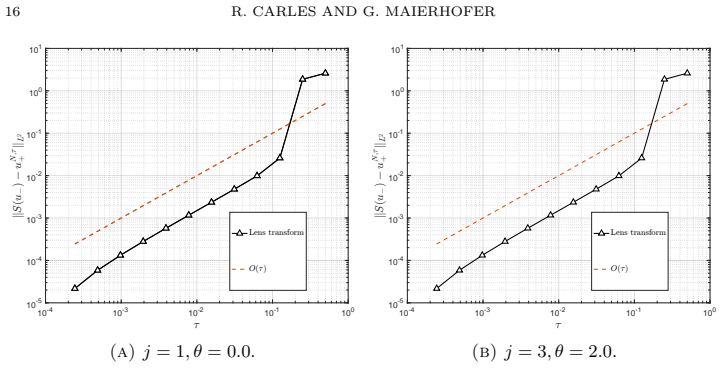
By exploiting the space-time compactification provided by the lens transform, the paper develops a highly efficient and reliable methodology for computing the scattering operator associated with the defocusing nonlinear Schrödinger equation. Several new identities and theoretical properties of the scattering operator are introduced and proved, with numerical experiments validating the approach against known analytics and addressing long-range scattering for the one-dimensional cubic case, while formulating conjectures on fixed and rotating points and existence in long-range defocusing and focusing settings.
What carries the argument
The lens transform, which compactifies the infinite time interval into a bounded domain for simulating the scattering behavior of NLS solutions.
If this is right
- The scattering operator can be computed numerically in regimes previously inaccessible due to infinite time.
- Numerical results agree with known analytical properties of the scattering operator.
- Long-range scattering in one-dimensional cubic NLS is simulated successfully.
- Conjectures are proposed for fixed and rotating points of the operator and its existence in long-range focusing cases.
Where Pith is reading between the lines
- Similar compactification techniques could apply to scattering problems in other nonlinear wave equations.
- The conjectures might motivate rigorous proofs if the numerical evidence is strong enough.
- This numerical method provides a tool to test theoretical predictions and explore parameter spaces in scattering theory.
Load-bearing premise
The lens transform preserves the essential asymptotic information of solutions without introducing significant numerical artifacts or altering the scattering behavior in the regimes studied.
What would settle it
A computation showing that the numerical scattering operator does not preserve quantities like the L2 norm or fails to match known scattering data in the defocusing case would disprove the method's validity.
Figures




read the original abstract
We analyse the scattering operator associated with the defocusing nonlinear Schr{\"o}dinger equation which captures the evolution of solutions over an infinite time-interval under the nonlinear flow of this equation. The asymptotic nature of the scattering operator (involving unbounded time) makes its computation particularly challenging. We overcome this by exploiting the space-time compactification provided by the lens transform, marking the first use of this technique in numerical simulations. This results in a highly efficient and reliable methodology for computing the scattering operator in various regimes. In developing this approach we introduce and prove several new identities and theoretical properties of the scattering operator. We support our construction with several numerical experiments which we show to agree with known analytical properties of the scattering operator, and also address the case of long-range scattering for the one-dimensional cubic Schr{\"o}dinger equation. Our simulations permit us to further explore regimes beyond current analytical understanding, and lead us to formulate new conjectures concerning fixed and rotating points of the operator, as well as its existence in the long-range setting for both defocusing and focusing cases.
Editorial analysis
A structured set of objections, weighed in public.
Referee Report
Summary. This paper introduces the use of the lens transform for numerical computation of the scattering operator associated with the defocusing nonlinear Schrödinger equation. By compactifying space-time, the method allows efficient simulation over infinite time intervals. New theoretical identities are proved, numerical experiments validate against known analytical results including long-range 1D cubic scattering, and new conjectures on fixed/rotating points and long-range existence are proposed.
Significance. The significance lies in bridging analytical and numerical approaches to scattering problems in NLS. If the lens transform preserves asymptotic behavior without artifacts, this could become a standard tool for exploring scattering in various regimes. The paper's strength is in providing both proofs of new properties and numerical support for conjectures, with validation against independent analytical knowledge rather than circular fitting.
major comments (1)
- Numerical experiments section: the central claim of a 'highly efficient and reliable methodology' for the scattering operator rests on the lens transform introducing no significant artifacts, yet the manuscript provides no quantitative convergence studies, error bars, or comparisons to alternative discretizations to confirm preservation of asymptotic information in the long-range 1D cubic regime.
minor comments (2)
- The abstract and introduction would benefit from explicit mention of the spatial dimensions and power nonlinearities considered in the main numerical tests beyond the general defocusing case.
- Notation for the transformed variables in the theoretical identities section could be clarified with a short table or diagram to aid readers unfamiliar with the lens transform.
Simulated Author's Rebuttal
We thank the referee for their positive assessment of the manuscript and for the constructive comment, which we address below. We agree that additional quantitative validation will strengthen the presentation of the numerical methodology.
read point-by-point responses
-
Referee: Numerical experiments section: the central claim of a 'highly efficient and reliable methodology' for the scattering operator rests on the lens transform introducing no significant artifacts, yet the manuscript provides no quantitative convergence studies, error bars, or comparisons to alternative discretizations to confirm preservation of asymptotic information in the long-range 1D cubic regime.
Authors: We thank the referee for highlighting this point. The current numerical experiments are validated by direct agreement with known analytical results for long-range scattering in the 1D cubic case, providing independent confirmation that the lens transform preserves the relevant asymptotic information. We nevertheless acknowledge that quantitative convergence studies, error bars, and comparisons to alternative discretizations would offer stronger support for the absence of artifacts. In the revised manuscript we will add such studies, including mesh-refinement tests and error estimates focused on the long-range 1D cubic regime. revision: yes
Circularity Check
No significant circularity
full rationale
The paper derives new theoretical identities and proves preservation properties of the scattering operator under the lens transform in a self-contained manner. Numerical experiments recover known external analytical features (including long-range 1D cubic cases) and generate new conjectures, rather than fitting parameters or redefining inputs by construction. No load-bearing step reduces to the paper's own outputs or unverified self-citations; the methodology is validated against independent benchmarks.
Axiom & Free-Parameter Ledger
Reference graph
Works this paper leans on
-
[1]
J. E. Barab. Nonexistence of asymptotically free solutions for nonlinear Schr¨ odinger equation. J. Math. Phys. , 25:3270–3273, 1984
work page 1984
-
[2]
N. Ben Abdallah, F. Castella, and F. M´ ehats. Time averaging for the strongly confined nonlin- ear Schr¨ odinger equation, using almost periodicity.J. Differential Equations, 245(1):154–200, 2008
work page 2008
-
[3]
B. F. Bunck. A fast algorithm for evaluation of normalized hermite functions. BIT Numerical Mathematics, 49(2):281–295, 2009
work page 2009
-
[4]
N. Burq, V. Georgiev, N. Tzvetkov, and N. Visciglia. H 1 scattering for mass-subcritical NLS with short-range nonlinearity and initial data in Σ. Ann. Henri Poincar´ e, 24(4):1355–1376, 2023
work page 2023
-
[5]
N. Burq and L. Thomann. Almost sure scattering for the one dimensional nonlinear Schr¨ odinger equation, volume 1480 of Mem. Am. Math. Soc. Providence, RI: American Math- ematical Society (AMS), 2024
work page 2024
-
[6]
N. Burq, L. Thomann, and N. Tzvetkov. Long time dynamics for the one dimensional non linear Schr¨ odinger equation.Ann. Inst. Fourier, 63(6):2137–2198, 2013
work page 2013
-
[7]
R. Carles. Geometric optics and long range scattering for one-dimensional nonlinear Schr¨ odinger equations.Comm. Math. Phys. , 220(1):41–67, 2001
work page 2001
-
[8]
R. Carles. Critical nonlinear Schr¨ odinger equations with and without harmonic potential. Math. Models Methods Appl. Sci. , 12(10):1513–1523, 2002
work page 2002
-
[9]
R. Carles. Remarks on nonlinear Schr¨ odinger equations with harmonic potential.Ann. Henri Poincar´ e, 3(4):757–772, 2002
work page 2002
-
[10]
R. Carles. Rotating points for the conformal NLS scattering operator. Dyn. Partial Differ. Equ., 6(1):35–51, 2009
work page 2009
-
[11]
R. Carles. Time splitting and error estimates for nonlinear Schr¨ odinger equations with a potential. Preprint, archived at https://hal.science/hal-04677959, 2024
work page 2024
-
[12]
R. Carles and I. Gallagher. Analyticity of the scattering operator for semilinear dispersive equations. Comm. Math. Phys. , 286(3):1181–1209, 2009
work page 2009
-
[13]
R. Carles and L. Gosse. Numerical aspects of nonlinear Schr¨ odinger equations in the presence of caustics. Math. Models Methods Appl. Sci. , 17(10):1531–1553, 2007
work page 2007
-
[14]
R. Carles and T. Ozawa. On the wave operators for the critical nonlinear Schr¨ odinger equation critical nonlinear Schr¨ odinger equation.Math. Res. Lett., 15(1):185–195, 2008
work page 2008
-
[15]
R. Carles and C. Su. Numerical study of the logarithmic Schr¨ odinger equation with repulsive harmonic potential. Discrete Contin. Dyn. Syst., Ser. B , 28(5):3136–3159, 2023
work page 2023
- [16]
-
[17]
T. Cazenave and F. Weissler. Rapidly decaying solutions of the nonlinear Schr¨ odinger equa- tion. Comm. Math. Phys. , 147:75–100, 1992
work page 1992
-
[18]
G. Chen and J. Murphy. Recovery of the nonlinearity from the modified scattering map. Int. Math. Res. Not. , 2024(8):6632–6655, 2024
work page 2024
-
[19]
J. Cronin. Fixed points and topological degree in nonlinear analysis . Mathematical Surveys, No. 11. American Mathematical Society, Providence, RI, 1964
work page 1964
-
[20]
https://dlmf.nist.gov/, Release 1.2.4 of 2025-03-15
NIST Digital Library of Mathematical Functions . https://dlmf.nist.gov/, Release 1.2.4 of 2025-03-15. F. W. J. Olver, A. B. Olde Daalhuis, D. W. Lozier, B. I. Schneider, R. F. Boisvert, C. W. Clark, B. R. Miller, B. V. Saunders, H. S. Cohl, and M. A. McClain, eds
work page 2025
-
[21]
T. Duyckaerts, F. Merle, and S. Roudenko. Maximizers for the Strichartz norm for small solutions of mass-critical NLS. Ann. Sc. Norm. Super. Pisa Cl. Sci. (5) , 10(2):427–476, 2011
work page 2011
- [22]
- [23]
-
[24]
J. Ginibre. Introduction aux ´ equations de Schr¨ odinger non lin´ eaires. In French. Cours de DEA,
-
[25]
Archived at http://sites.mathdoc.fr/PMO/PDF/G_GINIBRE-48
Paris Onze ´Edition. Archived at http://sites.mathdoc.fr/PMO/PDF/G_GINIBRE-48. pdf
-
[26]
J. Ginibre and G. Velo. On a class of nonlinear Schr¨ odinger equations. I The Cauchy problem, general case. J. Funct. Anal., 32:1–32, 1979
work page 1979
-
[27]
J. Ginibre and G. Velo. On a class of nonlinear Schr¨ odinger equations. II Scattering theory, general case. J. Funct. Anal., 32:33–71, 1979
work page 1979
-
[28]
N. Hayashi and P. Naumkin. Asymptotics for large time of solutions to the nonlinear Schr¨ odinger and Hartree equations.Amer. J. Math. , 120(2):369–389, 1998. RIGIDITY PROPERTIES AND NUMERICS FOR NLS SCATTERING 27
work page 1998
-
[29]
N. Hayashi and P. Naumkin. Domain and range of the modified wave operator for Schr¨ odinger equations with a critical nonlinearity. Comm. Math. Phys. , 267(2):477–492, 2006
work page 2006
-
[30]
N. Hayashi and Y. Tsutsumi. Remarks on the scattering problem for nonlinear Schr¨ odinger equations. In Differential equations and mathematical physics (Birmingham, Ala., 1986) , volume 1285 of Lectures Notes in Math. , page 162–168. Springer, Berlin, 1987
work page 1986
-
[31]
B. Helffer. Th´ eorie spectrale pour des op´ erateurs globalement elliptiques, volume 112 of Ast´ erisque. Soci´ et´ e Math´ ematique de France, Paris, 1984. With an English summary
work page 1984
-
[32]
J. Kato and F. Pusateri. A new proof of long-range scattering for critical nonlinear Schr¨ odinger equations.Differ. Integral Equ., 24(9-10):923–940, 2011
work page 2011
-
[33]
O. Kavian and F. Weissler. Self-similar solutions of the pseudo-conformally invariant nonlinear Schr¨ odinger equation.Michigan Math. J. , 41(1):151–173, 1994
work page 1994
-
[34]
M. Kawamoto and H. Mizutani. Modified wave operators for the defocusing cubic nonlinear Schr¨ odinger equation in one space dimension with large scattering data. Preprint, archived at https://arxiv.org/abs/2506.01871, 2025
work page internal anchor Pith review Pith/arXiv arXiv 2025
- [35]
- [36]
-
[37]
G. Maierhofer and M. Webb. A note on stable Hermite transforms, 2025. In preparation
work page 2025
-
[38]
J. Mawhin. Topological degree methods in nonlinear boundary value problems , volume 40 of Reg. Conf. Ser. Math. American Mathematical Society (AMS), Providence, RI, 1979
work page 1979
-
[39]
K. Nakanishi and T. Ozawa. Remarks on scattering for nonlinear Schr¨ odinger equations. NoDEA Nonlinear Differential Equations Appl. , 9(1):45–68, 2002
work page 2002
-
[40]
T. Ozawa. Long range scattering for nonlinear Schr¨ odinger equations in one space dimension. Comm. Math. Phys. , 139:479–493, 1991
work page 1991
- [41]
-
[42]
J. Rauch. Partial Differential Equations , volume 128 of Graduate Texts in Math. Springer- Verlag, New York, 1991
work page 1991
-
[43]
A. V. Rybin, G. G. Varzugin, M. Lindberg, J. Timonen, and R. K. Bullough. Similarity solutions and collapse in the attractive Gross-Pitaevskii equation. Phys. Rev. E (3) , 62(5, part A):6224–6228, 2000
work page 2000
-
[44]
H. Sasaki. The inverse scattering problem for Schr¨ odinger and Klein-Gordon equations with a nonlocal nonlinearity. Nonlinear Anal., Theory Methods Appl., Ser. A, Theory Methods , 66(8):1770–1781, 2007
work page 2007
-
[45]
R. M. Slevinsky, S. Olver, et al. Fasttransforms.jl. https://github.com/ JuliaApproximation/FastTransforms.jl, 2025. Version 0.17.0
work page 2025
-
[46]
T. Tao. A pseudoconformal compactification of the nonlinear Schr¨ odinger equation and ap- plications. New York J. Math. , 15:265–282, 2009
work page 2009
-
[47]
M. Thalhammer, M. Caliari, and C. Neuhauser. High-order time-splitting Hermite and Fourier spectral methods. J. Comput. Phys. , 228(3):822–832, 2009
work page 2009
-
[48]
A. Townsend, S. Olver, et al. Fastgaussquadrature.jl. https://github.com/ JuliaApproximation/FastGaussQuadrature.jl, 2024. Version 1.0.2
work page 2024
- [49]
-
[50]
Y. Tsutsumi and K. Yajima. The asymptotic behavior of nonlinear Schr¨ odinger equations. Bull. Amer. Math. Soc. (N.S.) , 11(1):186–188, 1984
work page 1984
-
[51]
M. Webb. Quantumtimesteppers.jl. https://github.com/marcusdavidwebb/ QuantumTimeSteppers.jl, 2025. Accessed on 07/05/2025. (R. Carles) CNRS, IRMAR - UMR 6625, Rennes, France Email address: Remi.Carles@math.cnrs.fr (G. Maierhofer) Department of Applied Mathematics and Theoretical Physics, Uni- versity of Cambridge, United Kingdom Email address: gam37@cam.ac.uk
work page 2025
discussion (0)
Sign in with ORCID, Apple, or X to comment. Anyone can read and Pith papers without signing in.