REVIEW 4 major objections 5 minor 11 references
Robot Context Protocol (RCP): A Runtime-Agnostic Interface for Agent-Aware Robot Control
T0 review · 4 major / 5 minor · reviewed 2026-08-07 · deepseek-v4-flash
Pith's one-line read RCP proposes a middleware-agnostic protocol that turns any robot into a schema-validated set of read, write, execute, and subscribe operations over HTTP, WebSocket, and SSE.
desk verdict Plausible architecture sketch for agent-to-robot integration, but the protocol it claims to provide is under-specified and unverified. read the letter →
The pith
A machine-rendered reading of the paper's core claim, the machinery that carries it, and where it could break.
The reading
What carries the argument
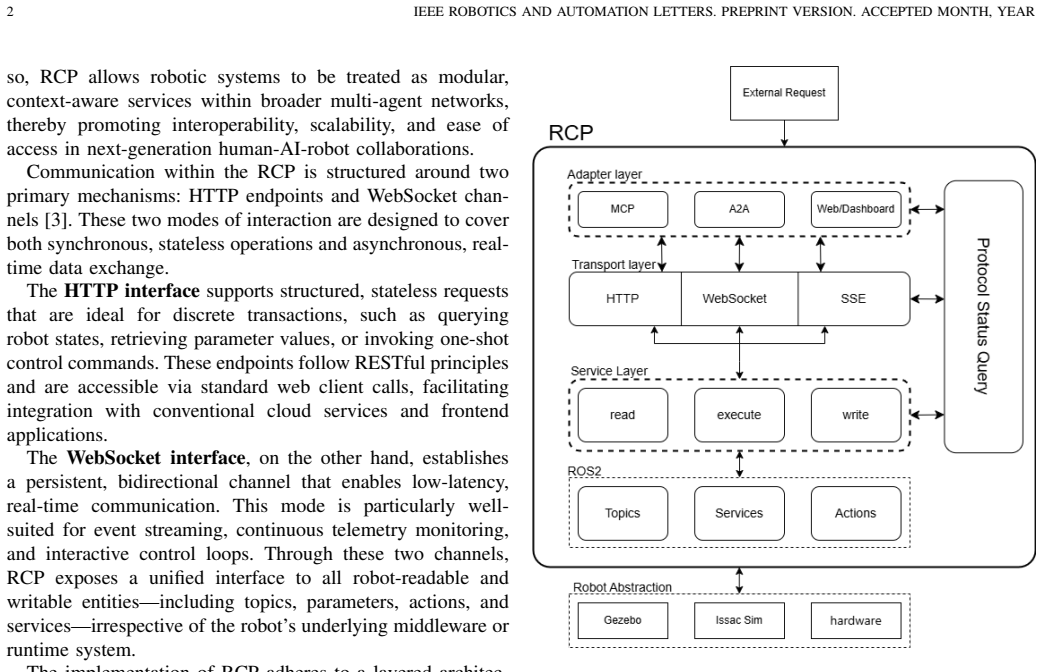
The unified context model with namespace paths and schema types, exposed through the four-operation interface read, write, execute, subscribe. A path-based schema registry defines each resource's type signature and supported operations, so clients can discover, validate, and invoke capabilities without hardcoding internal names. The layered Message Transformation Layer—Adapter, Transport, Service, and ROS2 Interface layers, plus a status and monitoring module—is what carries the argument: it cleanly separates client-facing semantics from backend execution, and the ROS2 interface layer binds RCP operations to native middleware constructs.
What would settle it
Run two tenant clients concurrently against the same robot, with one tenant attempting to read paths outside its namespaces and send malformed payloads; if any out-of-namespace data or malformed message reaches the backend, the multi-tenant and schema-enforcement claims are falsified. A companion load test measuring the protocol's throughput and latency under many simultaneous subscriptions would test the scalability claim.
Extended reading notes
Core claim
The central claim is that a semantically organized context model can serve as a runtime-agnostic control surface for robots. In RCP, every robot resource—sensor streams, actuators, high-level actions, parameters, events—is assigned a namespace path and a schema type, and is accessible through exactly four operations: read, write, execute, and subscribe. A layered stack carries this abstraction: adapters normalize inputs from LLM, agent, and dashboard clients; HTTP, WebSocket, and Server-Sent Events handle transport; RCP operations define the service surface; and a ROS2 interface layer maps those operations onto native topics, services, actions, and parameters. The paper's discovery is that this particular decomposition lets physical robots, simulators, and cloud-hosted platforms expose the same external API, making the robot appear as a set of discoverable, type-checked services.
Load-bearing premise
The whole design relies on the idea that the layered architecture, schema checks, and tenant separation are enough to make RCP safe and reliable; no proof, security analysis, or stress test is provided to show this.
Editorial extensions
If this is right
- A single client implementation works across physical robots, simulators such as Gazebo or Isaac Sim, and cloud-hosted platforms, because the external API does not depend on backend details.
- LLM-driven agents can issue commands through the MCP adapter and receive the same structured, schema-validated status feedback as any other client, so natural-language control becomes a thin layer over RCP operations.
- Multi-tenant namespaces such as /tenant/alpha and /tenant/beta allow several agents to share one robot while keeping each tenant's parameters, state, and actions logically separate.
- Dynamic discovery lets clients enumerate all available paths, their supported operations, and their schemas at runtime, removing the need to pre-hardcode topic or service names.
- Structured asynchronous status messages (accepted, in_progress, completed, failed) give agents enough information to retry, fall back, or request human oversight automatically.
Reading between the lines
- A direct extension is to apply the same four-operation, namespace-addressable surface to non-ROS backends such as industrial controllers or legacy robot APIs; the paper only details a ROS2 backend adapter, so the breadth of the runtime-agnostic claim remains to be established.
- If RCP's schema registry were standardized across vendors, the registry itself would become the coordinating artifact for generating clients, validators, and simulator stubs automatically—a future direction the paper lists but does not develop.
- The security and isolation claims are best tested adversarially: running a red-team exercise where one tenant tries to access another tenant's paths or inject malformed payloads would separate the design's promises from its enforcement.
- Because no benchmarks or reference implementations accompany the design, a concrete stress test of concurrent multi-agent subscriptions and command execution on one robot would clarify whether the claimed scalability is an architectural property or an implementation challenge.
Editorial analysis
A structured set of objections, weighed in public.
Referee Report
Summary. The paper introduces the Robot Context Protocol (RCP), a proposed middleware-agnostic communication protocol intended to unify interaction between robots and external clients such as users, cloud services, and autonomous agents. It describes a layered architecture (Adapter, Transport, Service, and ROS2 Interface layers), a schema-driven message format with read, write, execute, and subscribe operations, namespace-based multi-tenancy, asynchronous feedback, and robustness features such as schema validation, session tracking, and access control. The presentation is in prose with illustrative JSON examples and several figures; no formal protocol specification, implementation, benchmarks, or security analysis is included.
Significance. If fully specified and validated, RCP could be a useful standardization direction for agent-robot communication, building on prior work such as rosbridge and ROS2. The architectural separation of concerns and the concept of a unified context model are sensible. However, the manuscript as submitted is an architecture sketch: it contains no formal interface contract, no actual schemas, no discovery API definition, no security model, and no experimental validation. The central claims of robustness, scalability, and security are therefore unsupported, and the paper cannot serve as a reference implementation or a normative standard. It does not meet the technical validation bar of a robotics letters journal.
major comments (4)
- [Section IV.B and IV.D] The claim that RCP enforces strict schema validation for every addressable path (Section IV.B) and that a discovery API returns a complete catalog with input/output schemas (Section IV.D) is not backed by any actual JSON schema definitions, schema registry, or request/response formats for the discovery endpoint. Without these normative artifacts, an independent implementer cannot construct a conforming client or server, and the central 'schema-driven' property cannot be tested or falsified.
- [Section IV.E and IV.F] The asynchronous feedback semantics (Section IV.E) are described only as status strings ('accepted', 'in_progress', 'completed', 'failed'), and the security model (Section IV.F) is described only as 'ACLs and authentication at the transport layer.' No wire format, message schema, correlation rule, authentication flow, ACL syntax, or enforcement point is specified. These omissions are load-bearing because the paper's value proposition explicitly depends on reliable asynchronous feedback and secure multi-tenant isolation.
- [Section V.A] The paper asserts that features such as schema validation, session tracking, and endpoint-level security 'collectively enhance reliability, security, and efficiency' (Section V.A), but it provides no implementation, benchmarks, stress tests, or threat analysis. The claims of robustness and scalability are therefore conjectural rather than demonstrated. For a systems paper, the absence of any evaluation is a fundamental gap.
- [Section VI] The paper itself defers formalization of the schema registry and message introspection standards to future work (Section VI, second future direction). This is an explicit admission that the normative contract that the protocol claims to provide is not contained in the present manuscript, which undercuts the central claim that RCP already 'provides a unified and semantically meaningful interface.'
minor comments (5)
- [Section III, Fig. 1] The figure caption lists operations as 'read, execute, and write,' omitting the 'subscribe' operation that is described in the text; please make the caption consistent with the text.
- [Section II] The cross-references appear as 'Section2', 'Section3', etc., with missing spaces; please correct the formatting throughout.
- [Section III.c] There are mismatched quotation marks in the list of status messages (e.g., 'command accepted,' is opened with a straight quote but closed with a curly quote); please standardize the quoting.
- [Reference [5]] The GitHub repository URL for the rosbridge suite contains a space; it should be 'https://github.com/RobotWebTools/rosbridge_suite'.
- [Section IV.B] The example JSON response for /sensor/pose is split across lines in a way that may confuse readers; consider formatting it as a distinct code block.
Circularity Check
No circularity found: RCP is a protocol-architecture description with no fitted parameters, derivations, or load-bearing self-citations.
full rationale
This paper does not present an empirical derivation chain, predictive model, or fitted-parameter argument. Its claims are architectural and definitional: it describes a layered protocol design and states intended features such as schema validation, namespacing, and transport abstraction. The cited prior work (rosbridge, ROS2, DDS, WebSocket RFC, cloud robotics surveys) is external and is used as background or as a stated source of inspiration, not as a self-referential justification of RCP's validity. There are no equations whose outputs are equivalent to their inputs, no parameters fitted to data and then renamed as predictions, and no uniqueness theorem imported from the authors' own prior work. The strongest concern raised by the reader—that the normative protocol contract is under-specified and therefore not independently implementable from the text—is a completeness or correctness risk, not a circularity risk. Under the review rules, absence of a derivation or benchmark is not itself circularity. Accordingly, the appropriate finding is no significant circularity, with score 0.
Assumptions & free parameters
assumptions (3)
- domain assumption HTTP, WebSocket, and SSE provide adequate transport semantics for real-time robot control, including low-latency and bidirectional streaming.
- ad hoc to paper Schema-based validation and namespacing alone ensure security, multi-tenant isolation, and robustness.
- domain assumption The adapter approach (MCP, A2A, Web/Dashboard) can be implemented without performance degradation or semantic loss.
Cite this review
Pith. "Pith review of Robot Context Protocol (RCP): A Runtime-Agnostic Interface for Agent-Aware Robot Control." pith.science (2026). https://pith.science/paper/Q7B525DD
@misc{pith2026250611650,
  author       = {Pith},
  title        = {Pith review of: Robot Context Protocol (RCP): A Runtime-Agnostic Interface for Agent-Aware Robot Control},
  year         = {2026},
  howpublished = {\url{https://pith.science/paper/Q7B525DD}},
  note         = {Machine review of arXiv:2506.11650}
}
read the original abstract
The Robot Context Protocol (RCP) is a lightweight, middleware-agnostic communication protocol designed to simplify the complexity of robotic systems and enable seamless interaction between robots, users, and autonomous agents. RCP provides a unified and semantically meaningful interface that decouples client-facing operations from backend implementations, supporting a wide range of deployment environments including physical robots, cloud-based orchestrators, and simulated platforms. Built on HTTP and WebSocket transport layers, the protocol defines a schema-driven message format with structured operations such as read, write, execute, and subscribe. It integrates features such as runtime introspection, asynchronous feedback, multi-tenant namespace isolation, and strict type validation to ensure robustness, scalability, and security. The architecture, message structure, interface model, and adapter-based backend integration strategy of RCP are described, along with deployment practices and applicability across industries including manufacturing, logistics, and healthcare. RCP enables intelligent, resilient, and safe robotic operations in complex, multi-agent ecosystems.
Figures

Reference graph
Works this paper leans on
-
[1]
Foundation Models in Robotics: Applications, Chal- lenges, and the Future,
R. Firoozi et al. , “Foundation Models in Robotics: Applications, Chal- lenges, and the Future,” arXiv preprint arXiv:2312.07843 , 2023
arXiv 2023
-
[2]
Rosbridge: ROS for Non-ROS Users,
C. Crick, G. Jay, S. Osentoski, B. Pitzer, and O. C. Jenkins, “Rosbridge: ROS for Non-ROS Users,” in Proc. 15th Int. Symp. Experimental Robotics (ISER) , Qu ´ebec City, Canada, Jun. 2012
work page 2012
-
[3]
I. Fette and A. Melnikov, “The WebSocket Protocol,” RFC 6455, Internet Engineering Task Force (IETF), Dec. 2011. [Online]. Available: https: //www.rfc-editor.org/rfc/rfc6455.html
work page 2011
-
[4]
Robot Operating System 2: Design, Architecture, and Uses in the Wild,
S. Macenski, T. Foote, B. Gerkey, C. Lalancette, and W. Woodall, “Robot Operating System 2: Design, Architecture, and Uses in the Wild,” Science Robotics , vol. 7, no. 66, pp. eabm6074, May 2022. [Online]. Available: https://www.science.org/doi/10.1126/scirobotics.abm6074
-
[5]
Robot Web Tools, “rosbridge suite,” GitHub repository, 2024. [Online]. Available: https://github.com/RobotWebTools/rosbridge suite
work page 2024
-
[6]
ROS: an Open-Source Robot Operating System,
M. Quigley et al., “ROS: an Open-Source Robot Operating System,” in ICRA Workshop on Open Source Software , Kobe, Japan, 2009
work page 2009
-
[7]
Data Distribution Service (DDS), Version 1.4,
Object Management Group, “Data Distribution Service (DDS), Version 1.4,” OMG Specification formal/2015-04-10, Apr. 2015. [Online]. Avail- able: https://www.omg.org/spec/DDS/1.4
work page 2015
-
[8]
NVIDIA, “Isaac Sim,” NVIDIA Omniverse Documentation, 2025. [On- line]. Available: https://docs.omniverse.nvidia.com/isaacsim
work page 2025
Show all 11 references
-
[9]
A Survey of Research on Cloud Robotics and Automation,
B. Kehoe, S. Patil, P. Abbeel, and K. Goldberg, “A Survey of Research on Cloud Robotics and Automation,” IEEE Transactions on Automation Science and Engineering , vol. 12, no. 2, pp. 398–409, Apr. 2015
2015
-
[10]
Rapyuta: A Cloud Robotics Platform,
G. Mohanarajah, D. Hunziker, R. D’Andrea, and M. Waibel, “Rapyuta: A Cloud Robotics Platform,” IEEE Transactions on Automation Science and Engineering , vol. 12, no. 2, pp. 481–493, Apr. 2015
2015
-
[11]
Exploring the Performance of ROS2,
Y . Maruyama, S. Kato, and T. Azumi, “Exploring the Performance of ROS2,” in Proc. 13th ACM SIGBED Int. Conf. Embedded Software (EMSOFT), 2016
2016
Reviewed August 7, 2026 · model on record in the stance chip above.
Discussion (0). Continue with ORCID to comment.