REVIEW 2 major objections 6 minor 300 references
The mutual influence of disequilibrium composition and temperature in exoplanet atmospheres
T0 review · 2 major / 6 minor · reviewed 2026-08-07 · deepseek-v4-flash
Pith's one-line read For irradiated gas giants, disequilibrium chemistry moves dayside temperatures by at most 100 K, with TiO photodestruction and CH4- or O2-dominated secondary atmospheres as the exceptions.
desk verdict A transparent, well-benchmarked 1D chemistry-temperature model whose main gas-giant result is credible, but the headline TiO exception rests on a guessed photodissociation cross section that needs a sensitivity test. read the letter →
The pith
A machine-rendered reading of the paper's core claim, the machinery that carries it, and where it could break.
The reading
What carries the argument
The central object is the coupled 1D model named PACT (Planetary Atmosphere Chemistry and Temperature), a code that solves the vertical distribution of temperature and chemical composition as a function of time using a time-dependent chemistry module and a radiative-convective module that are re-evaluated together. The chemistry module integrates a continuity-transport equation for 164 neutral species connected by 2352 forward reactions, with reverse rates set by detailed balance, photolysis rates from UV radiative transfer, and vertical mixing via eddy and molecular diffusion. The radiative-convective module computes the temperature from two-stream radiative transfer using k-tables built from line lists, and returns to the chemistry module at logarithmically spaced intermediate times so that the composition feels the temperature changes it has caused. Comparing the self-consistent steady state against a run with the initial chemical-equilibrium temperature held fixed isolates the mutual influence in each direction.
What would settle it
Measure the UV photodissociation cross section of TiO over roughly 100–250 nm, along with its branching ratio against photoionization, in the laboratory. If the cross section is more than an order of magnitude below the assumed value of about $10^{-18}\ \mathrm{cm}^2$ at wavelengths that reach hot-Jupiter upper atmospheres, the predicted TiO depletion above about 1 mbar and the associated temperature change of hundreds of kelvin would not occur.
Extended reading notes
Core claim
The paper's central claim is that the mutual feedback between disequilibrium composition and temperature is weak for the most commonly observed class of exoplanets, irradiated gas giants with solar or supersolar metallicity. Across the five modeled giants, the self-consistent steady-state dayside temperature differs from the chemical-equilibrium profile by less than about 100 K, even where the composition deviates strongly from equilibrium, because the opacity-controlling species H2O, CO2, CO, and CH4 keep their abundances near equilibrium values under photochemical and kinetic processing. The single large effect found is TiO: the model predicts that stellar UV photons photodissociate TiO in hot Jupiters above pressures of about 1 mbar, removing a strong visible-wavelength absorber and altering the temperature by several hundred K, while atomic titanium released by the destruction can warm the uppermost layers. The author stresses that this TiO-driven excursion is not secure, because the adopted photodissociation cross section is a guess, the ionization threshold lies below the dissociation threshold so photoionization probably competes, and TiO chemistry itself is poorly known. For secondary atmospheres, the same opacity logic applies: H2O- and CO2-dominated atmospheres keep their temperature structure, while CH4-dominated reducing and O2-dominated oxidizing atmospheres undergo serious temperature changes because disequilibrium chemistry heavily reprocesses their composition.
Load-bearing premise
The load-bearing premise is that the photodissociation cross section used to deplete TiO in hot Jupiters is correct, yet the paper states this cross section is an educated guess that is not known, and photoionization likely competes with it, so a smaller or differently shaped real cross section would erase the several-hundred-kelvin temperature effect attributed to TiO.
Editorial extensions
If this is right
- Retrievals that assume chemical equilibrium should recover accurate dayside temperature structures for solar-metallicity irradiated gas giants, since the opacity carriers H2O, CO2, CO, and CH4 are stable against disequilibrium; the under-100-K errors are typically within retrieval uncertainties.
- Hot Jupiters with observable TiO may be the exception: if UV photodestruction depletes TiO above about 1 mbar, the temperature profile there changes by several hundred K, so these planets need coupled chemistry–temperature modeling rather than equilibrium retrievals.
- Secondary atmospheres dominated by CH4 (reducing) or O2 (oxidizing) are the regimes where the feedback matters most; trace photochemical products like nitrogen oxides can set the opacity and dominate the thermal structure even when the bulk gas is infrared-transparent.
- For the five gas giants studied, the reverse direction — temperature feedback altering composition — is small: abundances change by at most a factor of a few when the temperature is allowed to evolve self-consistently, so standard fixed-temperature chemistry models remain adequate for composition.
- The conclusions generalize to any ultrahot Jupiter: at dayside temperatures above about 3000 K the composition is pinned to chemical equilibrium, so disequilibrium chemistry does not perturb temperature there.
Reading between the lines
- Editorial extension: the small-correction conclusion is conditional on which metals are gaseous; the network omits Fe, Mg, Al, Na, and K species, so at metallicities where those metal oxides become significant visible absorbers, the TiO exception could become a class of exceptions.
- Editorial extension: the N2/O2 result implies that trace photochemical products (nitrogen oxides) can set the opacity and reshape the thermal profile of an otherwise infrared-transparent atmosphere, which matters for climate and habitability assessments of rocky exoplanets around UV-active M dwarfs.
- Editorial extension: the model predicts a sharp TiO abundance drop near 1 mbar in hot Jupiters, a vertical gradient that high-resolution visible spectroscopy of transmission or dayside spectra could directly test against condensation or horizontal-transport explanations.
- Editorial extension: the intermediate-time temperature updating scheme could be carried into 3D circulation models, where dayside–nightside compositional asymmetry and chemical heating from H2 dissociation or CO↔CH4 conversion might produce larger feedback than the vertical 1D result.
Editorial analysis
A structured set of objections, weighed in public.
Referee Report
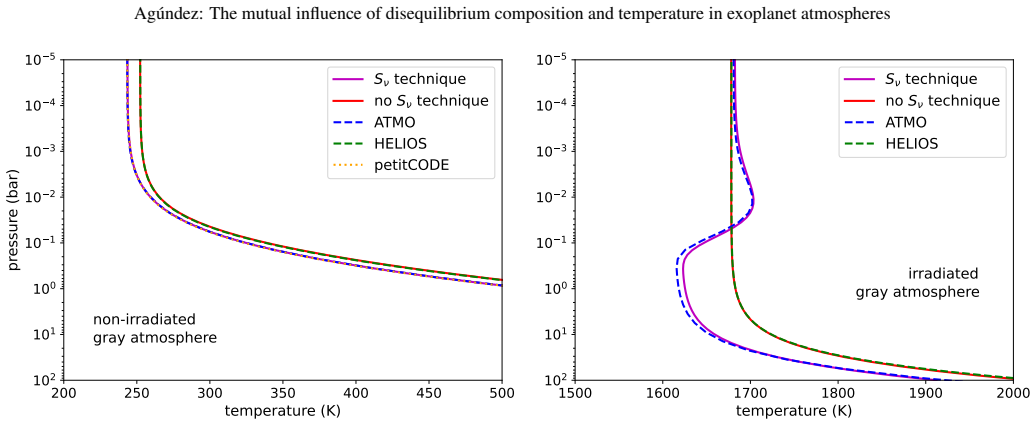
Summary. The paper presents PACT, a new 1D model coupling radiative-convective temperature structure with disequilibrium chemistry (thermochemical kinetics, photochemistry, and vertical mixing) for exoplanet atmospheres. The reaction network contains 164 neutral species and 2352 forward reactions, with rate coefficients and UV cross sections assigned to explicit uncertainty categories. The radiative-convective module is benchmarked against ATMO, HELIOS, and petitCODE for gray atmospheres. The model is applied to five gas giants (WASP-33b, HD 209458b, HD 189733b, GJ 436b, GJ 1214b) and to five idealized secondary atmospheres. The central finding is that for irradiated gas giants with solar or supersolar metallicity, disequilibrium chemistry changes temperatures by at most about 100 K, except that photodestruction of TiO in hot Jupiters can induce larger changes (~300 K cooling in HD 209458b and ~150 K warming in HD 189733b). For secondary atmospheres, H2O- and CO2-dominated cases are thermally robust, whereas CH4- and O2-dominated cases are seriously affected. The authors acknowledge explicitly that the TiO photodissociation cross section is an educated guess and that photoionization may compete.
Significance. If the results hold, the paper gives a practically useful rule: for most irradiated gas giants, retrievals that assume chemical equilibrium temperature structures are safe, while TiO-bearing hot Jupiters and CH4- or O2-dominated secondary atmospheres require coupled chemistry-temperature modeling. The study is strengthened by its public code (PACT and ACE), the benchmarking of the radiative-convective module against established codes, the large and carefully documented reaction network, and the authors' transparent uncertainty categories for rate coefficients and cross sections. The main significance caveat is that the single largest quantitative effect, the TiO-driven temperature change, rests on an admittedly guessed photodissociation cross section; no sensitivity analysis is provided to show how this effect responds to plausible variations, so the robustness of the headline exception is not yet established.
major comments (2)
- [Sect. 5; Sect. 2.1.2; Table A.1] The >100 K temperature exception attributed to TiO photodestruction in HD 209458b and HD 189733b (Sect. 4) is the only quantitative counterexample to the paper's headline claim that disequilibrium corrections are at most about 100 K for irradiated gas giants. That exception is driven entirely by the adopted TiO photodissociation cross section of 1 Mb over 100-250 nm (Sect. 2.1.2; Table A.1, reference 55), which the manuscript classifies as category C (>10x uncertainty) and, in Sect. 5, describes as "just an educated guess", noting that photoionization probably competes or dominates. Because a plausible reduction, spectral shift, or ionization channel for this cross section could reduce TiO depletion and bring the temperature change below 100 K, the robustness of the central claim is not established. Please add a sensitivity study that varies the TiO photodissociation cross section within the category-C range (for example 0.1, 1, and 10 Mb, plus a red-shifted or ionization-only case) and report the resulting steady-state temperature profiles and maximum differences for HD 209458b and HD 189733b. If the >100 K effect is not robust across this range, the abstract and conclusions should be revised accordingly.
- [Sect. 2.1.1-2.1.2; Sect. 6; Fig. 4] The conclusions for secondary atmospheres dominated by CH4 and O2 (Sect. 6, Fig. 4) rest on a reaction network and UV cross-section set in which many key processes are category-C estimates, including photolysis of hydrocarbons and the nitrogen-oxide interconversion pathways. The paper presents these results as qualitative ("seriously affected"), but the magnitude of the temperature changes shown in Fig. 4 depends on these guessed inputs. To support the generality of the claim, please include at least two bounding calculations (for example, scaling all category-C rate coefficients and cross sections by factors of 0.1 and 10, or targeted variations of the reactions that dominate CH4 processing and NO/NO2 production) and show that the qualitative conclusion is unchanged.
minor comments (6)
- [Sect. 3] The text "GJ 12143b" should read "GJ 1214b".
- [Sect. 2.1.2] The text "1 Mb is equal to 10−18 cm−2" has the wrong units; it should be "10−18 cm2".
- [Sect. 3] The citation "(Chakrabarty & Sengupta 1999)" for the equilibrium temperature of WASP-33b appears to be a typo; the reference list gives Chakrabarty & Sengupta (2019).
- [Sect. 4] The statement "the only molecule responsible for the temperature modification seen in Fig. 2 is TiO" should be qualified to HD 209458b, since the following paragraph for HD 189733b also identifies atomic Ti as an important visible absorber.
- [Fig. 2 caption] The caption defines solid and dotted lines, but the line styles are not shown in the figure legend; adding a legend or explicit line-style labels would improve readability.
- [Abstract and Sect. 6] The phrase "on the order of 100 K at most" sits in some tension with the reported ~300 K and ~150 K changes for HD 209458b and HD 189733b; consider phrasing the main claim as "at most about 100 K, with the exception of TiO photodestruction" to avoid misreading.
Circularity Check
No significant circularity: the temperature and composition outputs are emergent model results, not fitted quantities; the TiO caveat is an input-uncertainty limitation rather than a self-referential reduction.
full rationale
The derivation chain (continuity-transport equation, thermal-energy equation, radiative transfer, and the coupled chemistry module) is solved forward using rate coefficients and cross sections compiled from the literature; no term is fitted to the paper's target claims about ≤100 K corrections or about TiO-driven changes. The temperature corrections are differences between a self-consistent steady-state run and an initial chemical-equilibrium run (Figs. 2 and 4), so they are emergent by construction and not defined by the claims. The radiative-convective module is benchmarked against the independent codes ATMO, HELIOS, and petitCODE (Fig. 1, Sect. 2.3). The gas-giant agreement claim is supported by Drummond et al. (2016) and Mukherjee et al. (2023, 2024), not only by the author's earlier GJ 436b iteration (Agúndez et al. 2014a); self-citations for code heritage (Agúndez et al. 2014b) and reaction-rate sources are not used as a uniqueness constraint or as proof of the central result. The one genuinely load-bearing uncertainty is the TiO photodissociation cross section, explicitly labelled in Sect. 2.1.2 and Table A.1 (ref. 55) as a category-C 1 Mb guess, with Sect. 5 stating that the cross section is 'just an educated guess' and that photoionization probably competes or dominates. That is an input-assumption sensitivity, not circularity, because varying the input changes the prediction rather than reproducing it by definition. No equation reduces to a fitted parameter, no prior result by the same author is invoked to forbid alternatives, and no known result is merely renamed. I therefore find no significant circularity.
Assumptions & free parameters
free parameters (5)
- Kzz eddy diffusion coefficient =
5e8 * p^{-0.5} * (H1/620) * (Teff/1450)^4 cm2/s (Eq. 9)
- Heat redistribution factor f_i =
1.0 for WASP-33b, 0.5 for the other four gas giants
- Internal temperature T_int =
300 K for the five gas giants, 50 K for the secondary atmospheres
- TiO photodissociation cross section =
Guessed, type C, about 1 Mb over 100-250 nm
- Initial composition of secondary atmospheres =
Equal mixing ratios of the initial gases (e.g., 1:1 for CO2:N2)
assumptions (6)
- domain assumption The 1D vertical column represents the dayside and horizontal heat redistribution is parameterized by f_i.
- domain assumption Only neutral gaseous species are included; ions, clouds, and hazes are neglected.
- domain assumption The 164-species, 2352-reaction network is complete enough for the modeled atmospheres.
- standard math Reverse rate coefficients are computed by detailed balance using NASA polynomial thermochemical data.
- ad hoc to paper The TiO photodissociation cross section is assumed to be about 1 Mb over 100-250 nm.
- ad hoc to paper Empirical formulas (Eq. 6, termolecular upper limits, collision efficiencies) fill missing kinetics data.
Cite this review
Pith. "Pith review of The mutual influence of disequilibrium composition and temperature in exoplanet atmospheres." pith.science (2026). https://pith.science/paper/DXAEOGRW
@misc{pith2026250611658,
  author       = {Pith},
  title        = {Pith review of: The mutual influence of disequilibrium composition and temperature in exoplanet atmospheres},
  year         = {2026},
  howpublished = {\url{https://pith.science/paper/DXAEOGRW}},
  note         = {Machine review of arXiv:2506.11658}
}
read the original abstract
We have developed a 1D planetary atmosphere model that solves in a self-consistent manner the evolution of temperature and disequilibrium chemistry in the vertical direction. Thermochemical kinetics is based on a reaction network built from scratch that includes 164 gaseous species composed of H, C, N, O, S, Si, P, Ti, He, and Ar, connected by 2352 forward reactions. The model is applied to the well-known gas giant exoplanets WASP-33b, HD209458b, HD189733b, GJ436b, and GJ1214b, and to secondary atmospheres that exoplanets characterized in the future may plausibly have. For irradiated gas giants with solar or supersolar metallicity, the corrections to the temperature due to disequilibrium chemistry are relatively small, on the order of 100 K at most, in agreement with previous studies. Although the atmospheric composition of some of these planets deviates significantly from chemical equilibrium, the impact on the temperature is moderate because the abundances of the main atmospheric species that provide opacity, such as H2O, CO2, CO, and/or CH4, are not seriously modified by disequilibrium chemistry. An impact on the temperature greater than 100 K appears in hot Jupiters due to TiO, which is predicted to be seriously depleted by UV photons in the upper layers. However, the extent of this depletion, and thus of its impact on the temperature, is uncertain due to the lack of knowledge about TiO photodestruction. In secondary atmospheres, the impact of disequilibrium chemistry on the temperature depends on the composition. In atmospheres dominated by H2O and/or CO2 the temperature is not affected to an important extent. However, reducing atmospheres dominated by CH4 and oxidizing atmospheres dominated by O2 see their temperature being seriously affected due to the important processing of the atmospheric composition induced by disequilibrium chemistry.
Figures


Figures from the paper (1 more)

Reference graph
Works this paper leans on
-
[1]
Abeysekera, C., Joalland, B., Ariyasingha, N., et al. 2015, J. Phys. Chem. Lett., 6, 1599
2015
-
[2]
1994, Can
Abgrall, H., Roueff, E., Launay, F., & Roncin, J.-Y . 1994, Can. J. Phys., 72, 856
1994
-
[3]
U., & Glarborg, P
Abian, M., Alzueta, M. U., & Glarborg, P. 2015, Int. J. Chem. Kinet., 47, 518
2015
-
[4]
Ackerman, A. S. & Marley, M. S. 2001, ApJ, 556, 872
2001
-
[5]
Adachi, H., Basco, N., & James, D. G. L. 1981, Int. J. Chem. Kinet., 13, 1251
1981
-
[6]
& Wagner, H
Aders, W.-K. & Wagner, H. Gg. 1973, Ber. Bunsenges. Phys. Chem., 77, 712
1973
-
[7]
Adusei, G. Y . & Fontijn, A. 1993, J. Phys. Chem., 97, 1406
1993
-
[8]
Adusei, G. Y . & Fontijn, A. 1994, J. Phys. Chem., 98, 3732
1994
Show all 300 references
-
[9]
Y ., Blue, A
Adusei, G. Y ., Blue, A. S., & Fontijn, A. 1996, J. Phys. Chem., 100, 16921 Agúndez, M. & Cernicharo, J. 2006, ApJ, 650, 374 Agúndez, M., Cernicharo, J., & Guélin, M. 2007, ApJ, 662, L91 Agúndez, M., Venot, O., Iro, N., et al. 2012, A&A, 548, A73 Agúndez, M., Venot, O., Selsis...
1996
-
[10]
A., Ren, Z., & da Silva, G
Alam, M. A., Ren, Z., & da Silva, G. 2019, Int. J. Chem. Kinet., 51, 723
2019
-
[11]
Alarcon, J. F. & Mebel, A. M. 2022, Int. J. Chem. Kinet., 54, 203
2022
-
[12]
Albadalejo, J., Jiménez, E., Notario, A., et al. 2002, J. Phys. Chem. A, 106, 2512
2002
-
[13]
R., Alam, M
Alderson, L., Wakeford, H. R., Alam, M. K., et al. 2023, Nature, 614, 664
2023
-
[14]
N., Bedeneev, V
Aleksandrov, E. N., Bedeneev, V . I., Kozlov, S. N., & Pryakhin, G. A. 1989, Bull. Acad. Sci. USSR Div. Chem. Sci., 38, 674
1989
-
[15]
N., Bedeneev, V
Aleksandrov, E. N., Bedeneev, V . I., Kozlov, S. N., & Pryakhin, G. A. 1989, Bull. Acad. Sci. USSR Div. Chem. Sci., 37, 2170
1989
-
[16]
N., Basevich, V
Aleksandrov, E. N., Basevich, V . Y ., & Vedeneev, V . I. 1994, Khim. Fiz., 13, 90
1994
-
[17]
Ali, M. A. & Barker, J. R. 2015, J. Phys. Chem. A, 119, 7578
2015
-
[18]
A., Sonk, J
Ali, M. A., Sonk, J. A., & Barker, J. R. 2016, J. Phys. Chem. A, 120, 7060
2016
-
[19]
F., Changeat, Q., Waldmann, I
Al-Refaie, A. F., Changeat, Q., Waldmann, I. P., & Tinetti, G., 2021, ApJ, 917, 37
2021
-
[20]
F., Venot, O., Changeat, Q., & Edwards, B
Al-Refaie, A. F., Venot, O., Changeat, Q., & Edwards, B. 2024, ApJ, 967, 132
2024
-
[21]
& McDonald, R
Altinay, G. & McDonald, R. G. 2015, J. Phys. Chem. A, 119, 7593
2015
-
[22]
U., Glarborg, P., & Dam-Johansen, K
Alzueta, M. U., Glarborg, P., & Dam-Johansen, K. 2000, Int. J. Chem. Kinet., 32, 498
2000
-
[23]
U., Guerrero, M., Millera, Á., et al
Alzueta, M. U., Guerrero, M., Millera, Á., et al. 2021, Proc. Comb. Inst., 38, 575
2021
-
[24]
S., Baraffe, I., Tremblin, P., et al
Amundsen, D. S., Baraffe, I., Tremblin, P., et al. 2014, A&A, 564, A59
2014
-
[25]
S., Tremblin, P., Manners, J., et al
Amundsen, D. S., Tremblin, P., Manners, J., et al. 2017, A&A, 598, A97
2017
-
[26]
& Hancock, D
Anastasi, C. & Hancock, D. U. 1984, J. Chem. Soc. Faraday Trans., 80, 935
1984
-
[27]
& Hancock, D
Anastasi, C. & Hancock, D. U. 1988, J. Chem. Soc. Faraday Trans. 2, 84, 1697
1988
-
[28]
Anastasi, C., Simpson, V ., Munk, J., & Pagsberg, P. 1990, J. Phys. Chem., 94, 6327
1990
-
[29]
T., Hass, S
Andersen, S. T., Hass, S. A., Frederickson, L., B., & Nielsen, O. J. 2018, J. Phys. Chem. A, 122, 5983
2018
-
[30]
Anglada, J. M. 2004, J. Am. Chem. Soc., 126, 9809
2004
-
[31]
M., Crehuet, R., Adhikari, S., et al
Anglada, J. M., Crehuet, R., Adhikari, S., et al. 2018, PCCP, 20, 4793
2018
-
[32]
1981, Radiat
Arai, H., Nagai, S., & Hatada, M. 1981, Radiat. Phys. Chem., 17, 211
1981
-
[33]
Arathala, P., Katz, M., & Musah, R. A. 2020, PCCP, 22, 10027
2020
-
[34]
& Arthur, N
Arican, H. & Arthur, N. L. 1983, Aust. J. Chem., 36, 2195
1983
-
[35]
Armitage, J. W. & Cullis, C. F. 1971, Comb. Flame, 16, 125
1971
-
[36]
Arthur, N. L. & Bell, T. N. 1978, Rev. Chem. Interm., 2, 37
1978
-
[37]
Arthur, N. L. 1986, J. Chem. Soc. Faraday Trans. 2, 82, 331
1986
-
[38]
Arthur, N. L. & Miles, L. A. 1997, J. Chem. Soc. Faraday Trans., 93, 4259 Article number, page 13 of 29 A&A proofs: manuscript no. pact
1997
-
[39]
Arthur, N. L. & Cooper, I. A. 1997, J. Chem. Soc. Faraday Trans., 93, 521
1997
-
[40]
& Fujii, N
Asaba, T. & Fujii, N. 1971, Proc. Int. Symp. Shock Tubes Waves, 8, 1
1971
-
[41]
& Vahedpour, M
Asgharzadeh, S. & Vahedpour, M. 2018, Chem. Phys. Lett., 702, 57
2018
-
[42]
Ashmore, P. G. & Burnett, M. G. 1962, Trans. Faraday Soc., 58, 253
1962
-
[43]
J., & Scott, P
Asplund, M., Grevesse, N., Sauval, A. J., & Scott, P. 2009, ARA&A, 47, 481
2009
-
[44]
2018, PCCP, 20, 10660
Assaf, E., Schoemaecker, C., Vereecken, L., & Fittschen, C. 2018, PCCP, 20, 10660
2018
-
[45]
1992, Symp
Atakan, B., Kocis, D., & Wolfrum, J. 1992, Symp. (Int.) Comb., 24, 691
1992
-
[46]
J., & Pitts Jr., J
Atkinson, R., Finlayson, B. J., & Pitts Jr., J. N. 1973, J. Am. Chem. Soc., 95, 7592
1973
-
[47]
L., Cox, R
Atkinson, R., Baulch, D. L., Cox, R. A., et al. 1989, Int. J. Chem. Kinet., 21, 115
1989
-
[48]
L., Cox, R
Atkinson, R., Baulch, D. L., Cox, R. A., et al. 1997, J. Phys. Chem. Ref. Data, 26, 1329
1997
-
[49]
L., Cox, R
Atkinson, R., Baulch, D. L., Cox, R. A., et al. 2004, Atmos. Chem. Phys., 4, 1461
2004
-
[50]
L., Cox, R
Atkinson, R., Baulch, D. L., Cox, R. A., et al. 2006, Atmos. Chem. Phys., 6, 3625
2006
-
[51]
W., Cooper, G., Burton, G
Au, J. W., Cooper, G., Burton, G. R., et al. 1993, Chem. Phys., 173, 209
1993
-
[52]
Au, J. W. & Brion, C. E. 1997, Chem. Phys., 218, 109
1997
-
[53]
Bacskay, G. B. & Mackie, J. C. 2001, PCCP, 3, 2467
2001
-
[54]
F., & Farooq, A
Badra, J., Nasir, E. F., & Farooq, A. 2014, J. Phys. Chem. A, 118, 4652
2014
-
[55]
2021, MNRAS, 505, 5603
Baeyens, R., Decin, L., Carone, L., et al. 2021, MNRAS, 505, 5603
2021
-
[56]
2022, MNRAS, 512, 4877
Baeyens, R., Konings, T., Venot, O., et al. 2022, MNRAS, 512, 4877
2022
-
[57]
E., Frey, H
Baggott, J. E., Frey, H. M., Lightfoot, P. D., & Walsh, R. 1987, J. Phys. Chem., 91, 3386
1987
-
[58]
A., Biggs, P., Canosa-Mas, C., et al
Bagley, J. A., Biggs, P., Canosa-Mas, C., et al. 1990, J. Chem. Soc. Faraday Trans., 86, 2109
1990
-
[59]
2021, Comb
Bai, J., Zhou, C.-W., & Yang, L. 2021, Comb. Flame, 232, 111502
2021
-
[60]
A., Ranjan, S., et al
Bains, W., Pasek, M. A., Ranjan, S., et al. 2023, ACS Earth Space Chem., 7, 1219
2023
-
[61]
& Shaw, R
Baker, G. & Shaw, R. 1965, J. Chem. Soc., 6965
1965
-
[62]
Baklanov, A. V . & Krasnoperov, L. N. 2001, J. Phys. Chem. A, 105, 4917
2001
-
[63]
Ballester, M. Y . & Varandas, A. J. C. 2008, Int. J. Chem. Kinet., 40, 527
2008
-
[64]
Ballester, M. Y . & Varandas, A. J. C. 2009, Int. J. Chem. Kinet., 41, 449
2009
-
[65]
2015, Chem
Balucani, N., Leonori, F., Petrucci, R., et al. 2015, Chem. Phys., 449, 34
2015
-
[66]
& de Almeida, A
Baptista, L. & de Almeida, A. A. 2023, J. Phys. Chem. A, 127, 1000
2023
-
[67]
J., Strange, J
Barber, R. J., Strange, J. K., Hill, C., et al. 2014, MNRAS, 437, 1828
2014
-
[68]
1991, Symp
Bartels, M., Edelbüttel-Einhaus, J., & Hoyermann, K. 1991, Symp. (Int.) Comb., 23, 131
1991
-
[69]
2020, PCCP, 22, 4699
Baroncelli, M., Mao, Q., Galle, S., et al. 2020, PCCP, 22, 4699
2020
-
[70]
Basevich, V . Ya. & Vedeneev, V . I. 1988, Khim. Fiz., 7, 1552
1988
-
[71]
Basu, S. C. & Husain, D. 1988, J. Photochem. Photobiol. A, 42, 1
1988
-
[72]
2011, Theor
Batiha, M., Altarawneh, M., Alsofi, A., et al. 2011, Theor. Chem. Acc., 129, 823
2011
-
[73]
2017, ApJ, 850, 150
Baudino, J.-L., Mollière, P., Venot, O., et al. 2017, ApJ, 850, 150
2017
-
[74]
H., Jeffers, P., Lifshitz, A., & Yadava, B
Bauer, S. H., Jeffers, P., Lifshitz, A., & Yadava, B. P. 1971, Symp. (Int.) Comb., 13, 417
1971
-
[75]
Bauer, S. J. 1973, Physics of Planetary Ionospheres (Berlin: Springer-Verlag)
1973
-
[76]
H., & Meuser, R
Bauer, W., Becker, K. H., & Meuser, R. 1985, Ber. Bunsenges. Phys. Chem., 89, 340
1985
-
[77]
L., Cobos, C
Baulch, D. L., Cobos, C. J., Cox, R. A., et al. 1992, J. Phys. Chem. Ref. Data, 21, 411
1992
-
[78]
L., Cobos, C
Baulch, D. L., Cobos, C. J., Cox, R. A., et al. 1994, J. Phys. Chem. Ref. Data, 23, 847
1994
-
[79]
L., Bowman, C
Baulch, D. L., Bowman, C. T., Cobos, C. J., et al. 2005, J. Phys. Chem. Ref. Data, 34, 757
2005
-
[80]
2021, A&A, 648, A127 Bayratçeken, F., Telayar, Z., Arı, F., et al
Baxter, C., Désert, J.-M., Tsai, S.-M., et al. 2021, A&A, 648, A127 Bayratçeken, F., Telayar, Z., Arı, F., et al. 2006, Spectrochim. Acta A: Mol. Biomol. Spectr., 65, 143
2021
-
[81]
G., Welbanks, L., Schlawin, E., et al
Beatty, T. G., Welbanks, L., Schlawin, E., et al. 2024, ApJ, 970, L10
2024
-
[82]
H., Engelhardt, B., Geiger, H., et al
Becker, K. H., Engelhardt, B., Geiger, H., et al. 1993, Chem. Phys. Lett., 210, 135
1993
-
[83]
H., Kurtenbach, R., Schmidt, F., & Wiesen, P
Becker, K. H., Kurtenbach, R., Schmidt, F., & Wiesen, P. 1995, Chem. Phys. Lett., 235, 230
1995
-
[84]
H., Kurtenbach, R., Schmidt, F., & Wiesen, P
Becker, K. H., Kurtenbach, R., Schmidt, F., & Wiesen, P. 1997, Ber. Bunsenges. Phys. Chem., 101, 128
1997
-
[85]
H., Geiger, H., Schmidt, F., & Wiesen, P
Becker, K. H., Geiger, H., Schmidt, F., & Wiesen, P. 1999, PCCP, 1, 5305
1999
-
[86]
H., Kurtenbach, R., Schmidt, F., & Wiesen, P
Becker, K. H., Kurtenbach, R., Schmidt, F., & Wiesen, P. 2000, Comb. Flame, 120, 570
2000
-
[87]
& Morin, J
Bedjanian, Y . & Morin, J. 2017, J. Phys. Chem. A, 121, 1553
2017
-
[88]
Bedjanian, Y . 2022, J. Phys. Chem. A, 126, 4080
2022
-
[89]
R., France, K., Brown, A., et al
Behr, P. R., France, K., Brown, A., et al. 2023, AJ, 166, 35
2023
-
[90]
Bell, T. J. & Cowan, N. B. 2018, ApJ, 857, L20
2018
-
[91]
J., Crouzet, N., Cubillos, P
Bell, T. J., Crouzet, N., Cubillos, P. E., et al. 2024, Nature Astron., 8, 879
2024
-
[92]
A., et al
Bello-Arufe, A., Damiano, M., Bennett, K. A., et al. 2025, ApJ, 980, L26
2025
-
[93]
Benson, S. W. 1994, Int. J. Chem. Kinet., 26, 997
1994
-
[94]
R., Hippler, H., et al
Bentz, T., Giri, B. R., Hippler, H., et al. 2007, J. Phys. Chem. A, 111, 3812
2007
-
[95]
E., Safarik, I., Strausz, O
Berkley, R. E., Safarik, I., Strausz, O. P., & Gunning, H. E. 1973, J. Phys. Chem., 77, 1741
1973
-
[96]
Bergeat, A., Calvo, T., Dorthe, G., & Loison, J.-C. 1999, J. Phys. Chem., 103, 6360
1999
-
[97]
& Loison, J.-C
Bergeat, A. & Loison, J.-C. 2001, PCCP, 3, 2038 Berteloite, c., Le Picard, S. D., Birza, P., et al. 2008, Icarus, 194, 746
2001
-
[98]
M., Daugey, N., et al
Bergeat, A., Hickson, K. M., Daugey, N., et al. 2009, PCCP, 11, 8149
2009
-
[99]
Bernath, P. 2020, J. Quant. Spectr. Radiat. Transfer, 240, 106687
2020
-
[100]
& Black, R
Betts, J. & Black, R. A. 1965, Can. J. Phys., 43, 2678
1965
-
[101]
2019, Int
Bian, H., Xu, B., Zhang, H., et al. 2019, Int. J. Quantum Chem., 119, e25822
2019
-
[102]
Biehl, H., & Stuhl, F. 1991, J. Photochem. Photobiol. A: Chem., 59, 135
1991
-
[103]
E., Fracheboud, J.-M., et al
Biggs, P., Canosa-Mas, C. E., Fracheboud, J.-M., et al. 1994, J. Chem. Soc. Fara- day Trans., 90, 1197
1994
-
[104]
E., Fracheboud, J.-M., et al
Biggs, P., Canosa-Mas, C. E., Fracheboud, J.-M., et al. 1995, J. Chem. Soc. Fara- day Trans., 91, 817
1995
-
[105]
N., Smith, R
Birrell, R. N., Smith, R. F., Trotman-Dickenson, A. F., & Wilkie, H. 1957, J. Chem. Soc., 2807 Blázquez, S., González, D., Neeman, E. M., et al. 2020, PCCP, 22, 20562
1957
-
[106]
A., McKee, K
Blitz, M. A., McKee, K. W., & Pilling, M. J. 2000, Symp. (Int.) Comb., 28, 2491
2000
-
[107]
A., Hughes, K
Blitz, M. A., Hughes, K. J., & Pilling, M. J. 2003, J. Phys. Chem. A, 107, 1971
2003
-
[108]
A., Dillon, T
Blitz, M. A., Dillon, T. J., Heard, D. E., et al. 2004, PCCP, 6, 2162
2004
-
[109]
A., Hughes, K
Blitz, M. A., Hughes, K. J., Pilling, M. J., & Robertson, S. H. 2006, J. Phys. Chem. A, 110, 2996
2006
-
[110]
A., Shannon, R
Blitz, M. A., Shannon, R. J., Marshall, P., & Pilling, M. J. 2010, Z. Phys. Chem., 224, 1009
2010
-
[111]
A., Kappler, C., Pilling, M
Blitz, M. A., Kappler, C., Pilling, M. J., & Seakins, P. W. 2011, Z. Phys. Chem., 225, 957
2011
-
[112]
A., Talbi, D., Seakins, P
Blitz, M. A., Talbi, D., Seakins, P. W., & Smith, I. W. M. 2012, J. Phys. Chem. A, 116, 5877
2012
-
[113]
D., Mandell, A
Blumenthal, S. D., Mandell, A. M., Hébrard, E., et al. 2018, ApJ, 853, 138
2018
-
[114]
B., Rowe, B
Bocherel, P., Herbert, L. B., Rowe, B. R., et al. 1996, J. Phys. Chem., 1996, 100, 3063
1996
-
[115]
M., Rocco, M
Boechat-Roberty, H. M., Rocco, M. L. M., Lucas, C. A., & de Souza, G. G. B. 2004, J. Phys. B: At. Mol. Opt. Phys., 37, 1467
2004
-
[116]
A., Baklanov, A
Bogdanchikov, G. A., Baklanov, A. V ., & Parker, D. H. 2004, Chem. Phys. Lett., 385, 486 Böhland, T., Dóbé, S., Temps, F., & Wagner, H. Gg. 1985, Ber. Bunsenges. Phys. Chem., 89, 1110
2004
-
[117]
Bohland, T., Temps, F., & Wagner, H. Gg. 1988, Symp. (Int.) Comb., 21, 841
1988
-
[118]
B., Hall, I
Boodaghians, R. B., Hall, I. W., Toby, F. S., & Wayne, R. P. 1987, J. Chem. Soc. Faraday Trans. 2, 83, 2073
1987
-
[119]
R., Brobst, W
Bosco, S. R., Brobst, W. D., Nava, D. F., & Stief, L. J. 1983, J. Geophys. Res., 88, 8543
1983
-
[120]
W., Kristyan, S., & lin, M
Boughton, J. W., Kristyan, S., & lin, M. C. 1997, Chem. Phys., 214, 219
1997
-
[121]
R., & Wilson, K
Bouwman, J., Goulay, F., Leone, S. R., & Wilson, K. R. 2012, J. Phys. Chem. A, 116, 3907
2012
-
[122]
R., et al
Bouwman, J., Fournier, M., Sims, I. R., et al. 2013, J. Phys. Chem. A, 117, 5093
2013
-
[123]
Bourgalais, J., Capron, M., Kailasanathan, R. K. A., et al. 2015, ApJ, 812, 106
2015
-
[124]
L., Durif, O., et al
Bourgalais, J., Caster, K. L., Durif, O., et al. 2019, J. Phys. Chem. A, 123, 2178
2019
-
[125]
2020, ApJ, 895, 77
Bourgalais, J., Carrasco, N., Changeat, Q., et al. 2020, ApJ, 895, 77
2020
-
[126]
2019, MNRAS, 489, 4890
Boulangier, J., Gobrecht, D., Decin, L., et al. 2019, MNRAS, 489, 4890
2019
-
[127]
Boulanouar, M., Mouna, C., Rayenne, D., & Addine, K. D. 2023, Turkish Comp. Theor. Chem., 7, 1
2023
-
[128]
C., Burke, A
Bowman, M. C., Burke, A. D., Turney, J. M., & Schaefer III, H. F. 2018, J. Phys. Chem. A, 122, 9498
2018
-
[129]
C., Burke, A
Bowman, M. C., Burke, A. D., Turney, J. M., & Schaefer III, H. F. 2020, Mol. Phys., 118, 1769214
2020
-
[130]
A., et al
Boyajian, T., von Braun, K., Feiden, G. A., et al. 2015, MNRAS, 447, 846
2015
-
[131]
Bozzelli, J. W. & Dean, A. M. 1990, J. Phys. Chem., 94, 3313
1990
-
[132]
Bozzelli, J. W. & Dean, A. M. 1995, Int. J. Chem. Kinet., 27, 1097
1995
-
[133]
P., Yurchenko, S
Brady, R. P., Yurchenko, S. N., Tennyson, J., & Kim, G.-S. 2024, MNRAS, 527, 6675
2024
-
[134]
R., & Bass, A
Braun, W., McNesby, J. R., & Bass, A. M. 1967, J. Chem. Phys., 46, 2071 Bravo-Pérez, G., Alvarez-Idaboy, J. R., Cruz-Torres, A., & Ruiz, Ma. E. 2002, J. Phys. Chem. A, 106, 4645
1967
-
[135]
Brown, R. L. 1973, Int. J. Chem. Kinet., 5, 663
1973
-
[136]
J., Beunker, R
Bruna, P. J., Beunker, R. J., & Peyerimhoff, S. D. 1976, J. Mol. Struct., 32, 217
1976
-
[137]
& Liuti, G
Brunetti, B. & Liuti, G. 1975, Z. Phys. Chem., 94, 19
1975
-
[138]
H., Schwab, J
Brune, Wm. H., Schwab, J. J., & Anderson, J. G. 1983, J. Phys. Chem., 87, 4503
1983
-
[139]
Brudnik, K., Wójcik-Pastuszka, D., & Jodkowski, J. T. 2009, Polish J. Chem., 83, 1203
2009
-
[140]
G., Kacharov, A
Bryukov, M. G., Kacharov, A. A., Timonnen, R., et al. 1993, Chem. Phys. Lett., 208, 392
1993
-
[141]
Buchan, N. I. & Jasinski, J. M. 1990, J. Crystal Growth, 106, 227
1990
-
[142]
Buchta, Chr., Stucken, D.-V ., V ollmer, J.-T., & Wagner, H. Gg. 1994, Z. Phys. Chem., 185, 153 Article number, page 14 of 29 Agúndez: The mutual influence of disequilibrium composition and temperature in exoplanet atmospheres
1994
-
[143]
& Roscoe, J
Budge, S. & Roscoe, J. M. 1995, Can. J. Chem., 73, 666
1995
-
[144]
D., Dilday, B
Buettner, A. D., Dilday, B. J., Craigmile, R. A., et al. 2020, PCCP, 22, 24583
2020
-
[145]
2021, A&A, 646, A5
Bulut, N., Roncero, O., Aguado, A., et al. 2021, A&A, 646, A5
2021
-
[146]
Bunkan, A. J. C., Tang, Y ., Sellevåg, S. R., & Nielsen, C. J. 2004, J. Phys. Chem. A, 118, 5279
2004
-
[147]
J., Chu, T.-C., Jamal, A., et al
Buras, Z. J., Chu, T.-C., Jamal, A., et al. 2018, PCCP, 20, 13191
2018
-
[148]
B., Sander, S
Burkholder, J. B., Sander, S. P. J., Abbatt, J. R., et al. 2015, JPL Publication 15-10
2015
-
[149]
B., Sander, S
Burkholder, J. B., Sander, S. P., Abbatt, J. P. D., et al. 2020, JPL Publication 19-5
2020
-
[150]
R., Chan, W
Burton, G. R., Chan, W. F., Cooper, G., & Brion, C. E. 1993, Chem. Phys., 177, 217
1993
-
[151]
E., Fleming, J
Butler, J. E., Fleming, J. W., Goss, L. P., & Lin, M. C. 1981, Chem. Phys., 56, 355
1981
-
[152]
I., Kukui, A., Pouvesle, N., & Le Bras, G
Butkovskaya, N. I., Kukui, A., Pouvesle, N., & Le Bras, G. 2005, J. Phys. Chem. A, 109, 6509
2005
-
[153]
J., & Crowley, J
Cameron, M., Sivakumaran, V ., Dillon, T. J., & Crowley, J. N. 2002, PCCP, 4, 3628
2002
-
[154]
Campbell, I. M. & Gray, C. N. 1973, Chem. Phys. Lett., 18, 607
1973
-
[155]
Campbell, M. L. & McLean, R. E. 1993, J. Phys. Chem., 97, 7942
1993
-
[156]
Campomanes, P., Menéndez, I., & Sordo, T. L. 2001, J. Phys. Chem. A, 105, 229
2001
-
[157]
R., Mendoza, E., Silva, M
Campanha, D. R., Mendoza, E., Silva, M. X., et al. 2022, MNRAS, 515, 369
2022
-
[158]
J., Toby, S., & Wayne, R
Canosa-Mas, C., Smith, S. J., Toby, S., & Wayne, R. P. 1988, J. Chem. Soc. Faraday Trans. 2, 84, 263
1988
-
[159]
E., Smith, S
Canosa-Mas, C. E., Smith, S. J., Waygood, S. J., & Wayne, R. P. 1991, J. Chem. Soc. Faraday Trans., 87, 3473
1991
-
[160]
R., Travers, D., et al
Canosa, A., Sims, I. R., Travers, D., et al. 1997, A&A, 323, 644
1997
-
[161]
D., Gougeon, S., et al
Canosa, A., Le Picard, S. D., Gougeon, S., et al. 2001, J. Chem. Phys., 115, 6495
2001
-
[162]
H., Moore, C
Cardelino, B. H., Moore, C. E., Cardelino, C. A., et al. 2003, J. Phys. Chem. A, 107, 3708
2003
-
[163]
Cardoso, D. V . V ., Ferrão, L. F. de A., spada, R. F. K., et al. 2012, Int. J. Quantum Chem., 112, 3269
2012
-
[164]
Caridade, P. J. S. B., Rodrigues, S. P. J., Sousa, F., & Varandas, A. J. C. 2005, J. Phys. Chem. A, 109, 2356
2005
-
[165]
A., Sun, Q., & Peeters, J
Carl, S. A., Sun, Q., & Peeters, J. 2001, J. Chem. Phys., 114, 10332
2001
-
[166]
A., Sun, Q., Vereecken, L., & Peeters, J
Carl, S. A., Sun, Q., Vereecken, L., & Peeters, J. 2002, J. Phys. Chem. A, 106, 12242
2002
-
[167]
A., Nguyen, H
Carl, S. A., Nguyen, H. M. T., Elsamra, R. M. I., et al. 2005, J. Chem. Phys., 122, 114307
2005
-
[168]
A., Still, T
Carr, S. A., Still, T. J., Blitz, M. A., et al. 2013, J. Phys. Chem. A, 117, 11142
2013
-
[169]
& Cacelli, I
Carravetta, V . & Cacelli, I. 1999, Chem. Phys., 243, 77
1999
-
[170]
& Dean, A
Carstensen, H.-H. & Dean, A. M. 2005, Proc. Comb. Inst., 30, 995
2005
-
[171]
M., & Deutschmann, O
Carstensen, H.-H., Dean, A. M., & Deutschmann, O. 2007, Proc. Comb. Inst., 31, 149
2007
-
[172]
R., & Smith, I
Carty, D., Le Page, V ., Sims, I. R., & Smith, I. W. M. 2001, Chem. Phys. Lett., 344, 310
2001
-
[173]
Carty, D., Goddard, A., Köhler, S. P. K., et al. 2006, J. Phys. Chem. A, 110, 3101
2006
- [174]
-
[175]
L., Donnellan, Z
Caster, K. L., Donnellan, Z. N., Selby, T. M., & Goulay, F. 2019, J. Phys. Chem. A, 123, 5692
2019
-
[176]
L., Selby, T
Caster, K. L., Selby, T. M., Osborn, D. L., et al. 2021, J. Phys. Chem. A, 125, 6927
2021
-
[177]
Catling, D. C. & Kasting, J. F. 2017, Atmospheric Evolution of Inhabited and Lifeless Worlds (Cambridge University Press)
2017
-
[178]
I., et al
Cernicharo, J., Agúndez, M., Kaiser, R. I., et al. 2021, A&A, 652, L9
2021
-
[179]
Fuentetaja, R., Agúndez, M., et al
Cernicharo, J. Fuentetaja, R., Agúndez, M., et al. 2022, A&A, 663, L9
2022
-
[180]
& Heicklen, J
Chanmugathas, C. & Heicklen, J. 1986, Int. J. Chem. Kinet., 18, 701
1986
-
[181]
& Goldsmith, C
Chai, J. & Goldsmith, C. F. 2017, Proc. Comb. Inst., 36, 617
2017
-
[182]
& Sengupta, S
Chakrabarty, A. & Sengupta, S. 2019, AJ, 158, 39
2019
-
[183]
& Lin, M
Chakraborty, D. & Lin, M. C. 1999, J. Phys. Chem. A, 103, 601
1999
-
[184]
F., Cooper, G., & Brion, C
Chan, W. F., Cooper, G., & Brion, C. E. 1994, Chem. Phys., 180, 77
1994
-
[185]
M., & Pritchard, H
Chan, W.-T., Heck, S. M., & Pritchard, H. O. 2001, PCCP, 3, 56
2001
-
[186]
& Kurucz, R
Chance, K. & Kurucz, R. L. 2010, J. Quant. Spectr. Radiat. Transfer, 111, 1289
2010
-
[187]
& Wang, N
Chang, Y .-W. & Wang, N. S. 1995, Chem. Phys., 200, 431
1995
-
[188]
Chang, J.-G., Chen, H.-T., Xu, S., & Lin, M. C. 2007, J. Phys. Chem. A, 111, 6789
2007
-
[189]
K., Irwin, J., et al
Charbonneau, D., Berta, Z. K., Irwin, J., et al. 2009, Nature, 462, 891
2009
-
[190]
L., Sims, I
Chastaing, D., James, P. L., Sims, I. R., & Smith, I. W. M. 1998, Faraday Dis- cuss., 109, 165
1998
-
[191]
J., Sims, I
Chastaing, D., James, P. J., Sims, I. R., & Smith, I. W. M. 1999, PCCP, 1, 2247
1999
-
[192]
D., Sims, I
Chastaing, D., Le Picard, S. D., Sims, I. R., et al. 2000, Chem. Phys. Lett., 331, 170
2000
-
[193]
2012, A&A, 545, A12
Cherchneff, I. 2012, A&A, 545, A12
2012
-
[194]
Z., Judge, D
Chen, F. Z., Judge, D. L., & Wu, C. Y . R. 2000, Chem. Phys., 260, 215
2000
-
[195]
2016, Comput
Chen, C., Song, J., Song, C., et al. 2016, Comput. Theor. Chem., 1075, 63
2016
-
[196]
V ., & Lin, M
Chen, H.-T., Pham, T. V ., & Lin, M. C. 2019, J. Phys. Chem. A, 123, 8358
2019
-
[197]
M., Xia, W
Choi, Y . M., Xia, W. S., Park, J., & Lin, M. C. 2000, J. Phys. Chem. A, 104, 7030
2000
-
[198]
Choi, Y . M. & Lin, M. C. 2005, Int. J. Chem. Kinet., 37, 261
2005
-
[199]
& Konnov, A
Christensen, M. & Konnov, A. A. 2017, Comb. Flame, 178, 97
2017
-
[200]
G., Doner, A
Christianson, M. G., Doner, A. C., Koritzke, A. L., et al. 2021, J. Quant. Spectr. Radiat. Transfer, 258, 107274
2021
-
[201]
J., Eyob, B., et al
Chu, T.-C., Buras, Z. J., Eyob, B., et al. 2020, J. Phys. Chem. A, 124, 2352
2020
-
[202]
L., Rocchetto, M., Yurchenko, S
Chubb, K. L., Rocchetto, M., Yurchenko, S. N., et al. 2021, A&A, 646, A21
2021
-
[203]
L., Robert, S., Sousa-Silva, C., et al
Chubb, K. L., Robert, S., Sousa-Silva, C., et al. 2024, RAS Techn. & Instrum., 3, 636
2024
-
[204]
G., & Bottenheim, J
Chung, K., Calvert, J. G., & Bottenheim, J. W. 1975, Int. J. Chem. Kinet., 7, 161
1975
-
[205]
Chupka, W. A. & Lifshitz, C. 1968, J. Chem. Phys., 48, 1109
1968
-
[206]
& Largo, A
Cimas, A. & Largo, A. 2006, J. Phys. Chem. A, 110, 10912
2006
-
[207]
A., Kneizys, F
Clough, S. A., Kneizys, F. X., & Davies, R. W. 1989, Atmos. Res., 23, 229
1989
-
[208]
2021, AJ, 162, 174
Cloutier, R., Charbonneau, D., Deming, D., et al. 2021, AJ, 162, 174
2021
-
[209]
Clyne, M. A. A. & Stedman, D. H. 1967, J. Phys. Chem., 71, 3071
1967
-
[210]
Clyne, M. A. A. & Ono, Y . 1982, J. Chem. Soc. Faraday Trans. 2, 78, 1149
1982
-
[211]
J., Hippler, H., & Troe, J
Cobos, C. J., Hippler, H., & Troe, J. 1985, J. Phys. Chem., 89, 1778
1985
-
[212]
J., Glarborg, P., Marshall, P., & Troe, J
Cobos, C. J., Glarborg, P., Marshall, P., & Troe, J. 2023, Comb. Flame, 257, 112374
2023
-
[213]
& Westberg, K
Cohen, N. & Westberg, K. R. 1991, J. Phys. Chem. Ref. Data, 20, 1211 Colket III, M. B., Seery, D. J., & Palmer, H. B. 1989, Comb. Flame, 75, 343 Collier Cameron, A., Guenther, E., Smalley, B., et al. 2010, MNRAS, 407, 507 Colom-Díaz, J. M., Abián, M., Ballester, M. Y ., et al....
1991
-
[214]
2021, A&A, 651, A33
Cont, D., Yan, F., Reiners, A., et al. 2021, A&A, 651, A33
2021
-
[215]
2022, A&A, 668, A53
Cont, D., Yan, F., Reiners, A., et al. 2022, A&A, 668, A53
2022
-
[216]
E., & Brion, C
Cooper, G., Anderson, J. E., & Brion, C. E. 1996, Chem. Phys., 209, 61
1996
-
[217]
Cooper, C. S. & Showman, A. P. 2006, ApJ, 649, 1048
2006
-
[218]
L., Collins, M
Coote, M. L., Collins, M. A., & Radom, L. 2003, Mol. Phys., 101, 1329
2003
-
[219]
Cowan, N. B. & Agol, E. 2011, ApJ, 729, 54
2011
-
[220]
A., Ammann, M., Crowley, J
Cox, R. A., Ammann, M., Crowley, J. N., et al. 2020, Atm. Chem. Phys., 20, 13497
2020
-
[221]
2001, Chem
Cremer, D., Kraka, E., Crehuet, R., et al. 2001, Chem. Phys. Lett., 347, 268
2001
-
[222]
1989, A&A, 213, 459
Crovisier, J. 1989, A&A, 213, 459
1989
-
[223]
Curran, H. J. 2006, Int. J. Chem. Kinet., 38, 250 da Silva, G., Bozzelli, J. W., Liang, L., & Farrell, J. T. 2009, J. Phys. Chem. A, 113, 8923 da Silva, G. 2013, Environ. Sci. Tech., 47, 7766 Daële, V ., Laverdet, G., Le Bras, G., & Poulet, G. 1995, J. Phys. Chem., 99, 1470
2006
-
[224]
2020, Comb
Dai, L., Gersen, S., Glarborg, P., et al. 2020, Comb. Flame, 215, 134
2020
-
[225]
2007, PCCP, 9, 4177
Dammeier, J., Colberg, M., & Friedrichs, G. 2007, PCCP, 9, 4177
2007
-
[226]
Dames, E. E. 2014, Int. J. Chem. Kinet., 46, 176 D’Anna, B., Langer, S., Ljungström, E., et al. 2001, PCCP, 3, 1631
2014
-
[227]
G., Moore III, K
Dana, A. G., Moore III, K. B., Jasper, A. W., & Green, W. H. 2019, J. Phys. Chem. A, 123, 4679
2019
-
[228]
J., Shu, Y
Dang, L., Bell, T. J., Shu, Y . (Z.), et al. 2025, AJ, 169, 32
2025
-
[229]
Danilack, A. D. & Goldsmith, C. F. 2019, Proc. Comb. Inst., 37, 687
2019
-
[230]
Darwin, D. C. & Moore, C. B. 1995, J. Phys. Chem., 99, 13467
1995
-
[231]
2013, PCCP, 15, 13888
Daranlot, J., Hu, X., Xie, C., et al. 2013, PCCP, 15, 13888
2013
-
[232]
2005, PCCP, 7, 2921
Daugey, N., Caubet, P., Retail, B., et al. 2005, PCCP, 7, 2921
2005
-
[233]
Daugey, N., Caubet, P., Bergeat, A. et al. 2008, PCCP, 10, 729
2008
-
[234]
F., Kohse-Höinghaus, K., Chang, A
Davidson, D. F., Kohse-Höinghaus, K., Chang, A. Y ., & Hanson, R. K. 1990, Int. J. Chem. Kinet., 22, 513
1990
-
[235]
Davidson, D. F. & Hanson, R. K. 1991, Symp. (Int.) Comb., 23, 267
1991
-
[236]
Davies, J. H. & Davies, D. R. 2010, Solid Earth, 1, 5
2010
-
[237]
G., Law, C
Davis, S. G., Law, C. K., & Wang, H. 1999, J. Phys. Chem., 103, 5889
1999
-
[238]
Dean, A. J. & Hanson, R. K. 1992, Int. J. Chem. Kinet., 24, 517
1992
-
[239]
Dean, A. M. & Bozzelli, J. W. 2000, Gas-Phase Combustion Chemistry, p 125, Springer
2000
-
[240]
Decker, B. K. & Macdonald, R. G. 2001, J. Phys. Chem. A, 105, 6817
2001
-
[241]
Decker, B. K. & MacDonald, R. G. 2003, J. Phys. Chem. A, 107, 9137
2003
-
[242]
Deeyamulla, M. P. & Husain, D. 2006, J. Photochem. Photobiol. A: Chem, 184, 347 Article number, page 15 of 29 A&A proofs: manuscript no. pact
2006
-
[243]
& Lesclaux, R
Demissy, M. & Lesclaux, R. 1980, J. Am. Chem. Soc., 102, 2897
1980
-
[244]
& Lesclaux, R
Demissy, M. & Lesclaux, R. 1982, Int. J. Chem. Kinet., 14, 1
1982
-
[245]
B., Sander, S
DeMore, W. B., Sander, S. P., Golden, D. M., et al. 1997, JPL Publication, 97-4
1997
-
[246]
Denisov, E. T. 2008, Russ. J. Phys. Chem. B, 2, 58
2008
-
[247]
1998, Ber
Deppe, J., Friedrichs, G., Ibrahim, A., et al. 1998, Ber. Bunsenges. Phys. Chem., 102, 1474
1998
-
[248]
D., Klippenstein, S
DeSain, J. D., Klippenstein, S. J., Miller, J. A., & Taatjes, C. A. 2003, J. Phys. Chem. A, 107, 4415
2003
-
[249]
W., Lin, M
Diau, E. W., Lin, M. C., & Melius, C. F. 1994, J. Chem. Phys., 101, 3923
1994
-
[250]
W., Halbgewachs, M
Diau, E. W., Halbgewachs, M. J., Smith, A. R., & Lin, M. C. 1995, Int. J. Chem. Kinet., 27, 867
1995
-
[251]
& Benson, S
Dobis, O. & Benson, S. W. 1993, J. Am. Chem. Soc., 115, 8798
1993
-
[252]
Dobrijevic, M., Hébrard, E., Loison, J.-C., & Hickson, K. M. 2014, Icarus, 228, 324
2014
-
[253]
M., & Gronoff, G
Dobrijevic, M., Loison, J.-C., Hickson, K. M., & Gronoff, G. 2016, Icarus, 313, 339
2016
-
[254]
J., et al
Doddipatla, S., He, C., Goettl, S. J., et al. 2021, Sci. Adv., 7, eabg7003
2021
-
[255]
& de Persis, S
Dollet, A. & de Persis, S. 2007, J. Anal. Appl. Pyrolysis, 80, 460
2007
-
[256]
C., Moran, H
Doner, A. C., Moran, H. A., Webb, A. R., et al. 2023, J. Quant. Spectr. Radiat. Transfer, 297, 108438
2023
-
[257]
Dong, H., Ding, Y .-h., & Sun, C.-c. 2005, J. Chem. Phys., 122, 204321
2005
-
[258]
A., Feng, W., et al
Douglas, K., Blitz, M. A., Feng, W., et al. 2018, Icarus, 303, 10
2018
-
[259]
M., Blitz, M
Douglas, K. M., Blitz, M. A., Mangan, T. P., et al. 2020, J. Phys. Chem. A, 124, 7911
2020
-
[260]
M., Gobrecht, D., & Plane, J
Douglas, K. M., Gobrecht, D., & Plane, J. M. C. 2022, MNRAS, 515, 99
2022
-
[261]
1985, Symp
Dransfeld, P., Hack, W., Kurzke, H., et al. 1985, Symp. (Int.) Comb., 20, 655
1985
-
[262]
Driscoll, J. N. & Warneck, P. 1968, J. Phys. Chem., 72, 3736
1968
-
[263]
2016, A&A, 594, A69
Drummond, B., Tremblin, P., Baraffe, I., et al. 2016, A&A, 594, A69
2016
-
[264]
J., et al
Drummond, B., Hébrard, E., Mayne, N. J., et al. 2020, A&A, 636, A68
2020
-
[265]
Du, B., Zhang, W., Feng, C., & Zhou, Z. 2004, J. Mol. Struct.: Theochem, 712, 101
2004
-
[266]
Du, B., Zhang, W., Feng, C., & Zhou, Z. 2005, J. Mol. Struct., 713, 71
2005
-
[267]
S., Shepler, B
Du, S., Francisco, J. S., Shepler, B. C., & Peterson, K. A. 2008, J. Chem. Phys., 128, 204306
2008
-
[268]
& Carl, S
Du, L. & Carl, S. A. 2012, J. Phys. Chem. A, 116, 10074
2012
-
[269]
X., Li, W
Duan, Z. X., Li, W. L., Xu, W. W., & Lv, S. J. 2013, J. Chem. Phys., 139, 094307
2013
-
[270]
A., Johnson, G
Durei, R. A., Johnson, G. M., & Smith, M. Y . 1971, Comb. Flame, 17, 197 Durán, R. P., Amorebieta, V . T., & Colussi, A. J. 1988, J. Phys. Chem., 92, 636 Durán, R. P., Amorebieta, V . T., & Colussi, A. J. 1989, Int. J. Chem. Kinet., 21, 847 Dürrstein, S. H., Olzmann, M., Aguil...
1971
-
[271]
2013, ApJS, 204, 20
Dutuit, O., Carrasco, N., Thissen, R., et al. 2013, ApJS, 204, 20
2013
-
[272]
2023, Nature, 625, 51 Edelbüttel-Einhaus, J., Hoyermann, K., Rohde, G., & Seeba, J
Dyrek, A., Min, M., Decin, L., et al. 2023, Nature, 625, 51 Edelbüttel-Einhaus, J., Hoyermann, K., Rohde, G., & Seeba, J. 1992, Symp. (Int.) Comb., 24, 661
2023
-
[273]
2003, Eur
Eden, S., Limão-Vieira, P., Kendall, P., et al. 2003, Eur. Phys. J. D, 26, 201
2003
-
[274]
Edvardsson, D., Battzer, P., Karlsson, L., et al. 1999, J. Phys. B: At. Mol. Opt. Phys., 32, 2583
1999
-
[275]
A., Kerr, J
Edwards, D. A., Kerr, J. A., Lloyd, A. C. & Trotman-Dickenson, A. F. 1966, J. Chem. Soc. A, 1500
1966
-
[276]
Edwards, M. A. & Hershberger, J. F. 1998, Chem. Phys., 234, 231
1998
-
[277]
Ehbrecht, J., Hack, W., Rouveirolles, P., & Wagner, H. Gg. 1987, Ber. Bunsen- ges. Phys. Chem., 91, 700
1987
-
[278]
& Corcoran, W
England, C. & Corcoran, W. H. 1975, Ind. Eng. Chem. Fundam., 14, 55
1975
-
[279]
J., Pekkanen, T
Eskola, A. J., Pekkanen, T. J., Joshi, S. P., et al. 2019, Proc. Comb. Inst., 37, 291
2019
-
[280]
Es-sebbar, E.-t., Khaled, F., Elwardany, A., & Farooq, A. 2016, J. Phys. Chem. A, 120, 7998
2016
-
[281]
Faedi, F., Barros, S. C. C., Anderson, D. R., et al. 2011, A&A, 531, A40 Fagerström, K., Lund, A., Mahmoud, G., et al. 1993, Chem. Phys. Lett., 208, 321
2011
-
[282]
& Laufer, A
Fahr, A. & Laufer, A. H. 1990, J. Phys. Chem., 94, 726
1990
-
[283]
Fahr, A., Laufer, A., Klein, R., & Braun, W. 1991, J. Phys. Chem., 95, 3218
1991
-
[284]
& Nayak, A
Fahr, A. & Nayak, A. 1996, Chem. Phys., 189, 725
1996
-
[285]
& Nayak, A
Fahr, A. & Nayak, A. 1996, Chem. Phys., 203, 351
1996
-
[286]
Fairbairn, A. R. 1969, Proc. Roy. Soc. A, 312, 207
1969
-
[287]
2000, Symp
Faravelli, T., Goldaniga, A., Zappella, L., et al. 2000, Symp. (Int.) Comb., 28, 2601
2000
-
[288]
2013, Chem
Farnia, S., Vahedpour, M., Abedi, M., & Farrokhpour, H. 2013, Chem. Phys. Lett., 583, 190
2013
-
[289]
2014, Venus
Fegley, B. 2014, Venus. In Treatise on Geochemistry, ed. H. D. Holand and K. K. Turekian, New York: Elsevier, p. 127
2014
-
[290]
Feng, R., Cooper, G., & Brion, C. E. 2002, J. Electron Spectrosc. Relat. Phenom., 123, 199
2002
-
[291]
P., & Hershberger, J
Feng, W., Meyer, J. P., & Hershberger, J. F. 2006, J. Phys. Chem. A, 110, 4458
2006
-
[292]
& Hershberger, J
Feng, W. & Hershberger, J. F. 2007, J. Phys. Chem. A, 111, 3831
2007
-
[293]
& Hershberger, J
Feng, W. & Hershberger, J. F. 2008, Chem. Phys. Lett., 457, 307
2008
-
[294]
& Hershberger, J
Feng, W. & Hershberger, J. F. 2011, J. Phys. Chem. A, 115, 286
2011
-
[295]
& Hershberger, J
Feng, W. & Hershberger, J. F. 2013, J. Phys. Chem. A, 117, 3585
2013
-
[296]
Fernandez, A., Goumri, A., & Fontijn, A. 1998, J. Phys. Chem. A, 102, 168
1998
-
[297]
& Fontijn, A
Fernandez, A. & Fontijn, A. 2001, Int. J. Chem. Kinet., 33, 343
2001
-
[298]
X., Luther, K., & Troe, J
Fernandes, R. X., Luther, K., & Troe, J. 2006, J. Phys. Chem. A, 110, 4442
2006
-
[299]
2009, Planet
Ferradaz, T., Bénilan, Y ., Fray, N., et al. 2009, Planet. Space Sci., 57, 10
2009
-
[300]
Fifer, R. A. 1975, Proc. Int. Shock Tube Symp. Shock Tube Res. Soc., 613
1975
Reviewed August 7, 2026 · model on record in the stance chip above.
Discussion (0). Continue with ORCID to comment.