REVIEW 4 major objections 6 minor 15 references
Dynamic Collaborative Material Distribution System for Intelligent Robots In Smart Manufacturing
T0 review · 4 major / 6 minor · reviewed 2026-08-07 · deepseek-v4-flash
Pith's one-line read The paper claims that a single shared reinforcement-learning policy, guided by a centroid-based reward, computes each robot's next move in milliseconds and up to 100 times faster than enumerated planners.
desk verdict A clean DRL recipe for multi-robot rendezvous, but the optimality claim is circular and the speedup is unmeasured, so the paper needs major rework before it supports its own abstract. read the letter →
The pith
A machine-rendered reading of the paper's core claim, the machinery that carries it, and where it could break.
The reading
What carries the argument
The load-bearing object is the target-guided potential-based reward function. The potential $\phi(s_t)$ is the shortest obstacle-avoiding path distance from a robot to the instant target, defined by the centroid of all robots' positions. The shaped reward $F(s_{t-1}, s_t)$ returns a positive value when $\phi(s_{t-1})-\phi(s_t)<0$, a strong negative value when the potential increases, and a small negative value when it is unchanged, so the dense signal tells the agent exactly whether its last action moved it closer to the dynamic target. Around this reward sit three supporting mechanisms that make the claim workable: one PPO policy shared by all robots, zero padding to generalize to 2 through $n_p$ robots, and an invalid-action mask that removes obstacle-directed moves from the action distribution.
What would settle it
Take a small obstacle grid, compute for every candidate cell $c$ the exact value $\sum_i d(p_i,c)$ using shortest-path distances on the grid with robots at positions $p_i$, and compare the minimum over $c$ with the value at the centroid $\bar{p}$; if any configured map has $\sum_i d(p_i,\bar{p})$ strictly larger than the true minimum, then the centroid-based target used by the reward function is not the optimal solution to the stated problem.
Extended reading notes
Core claim
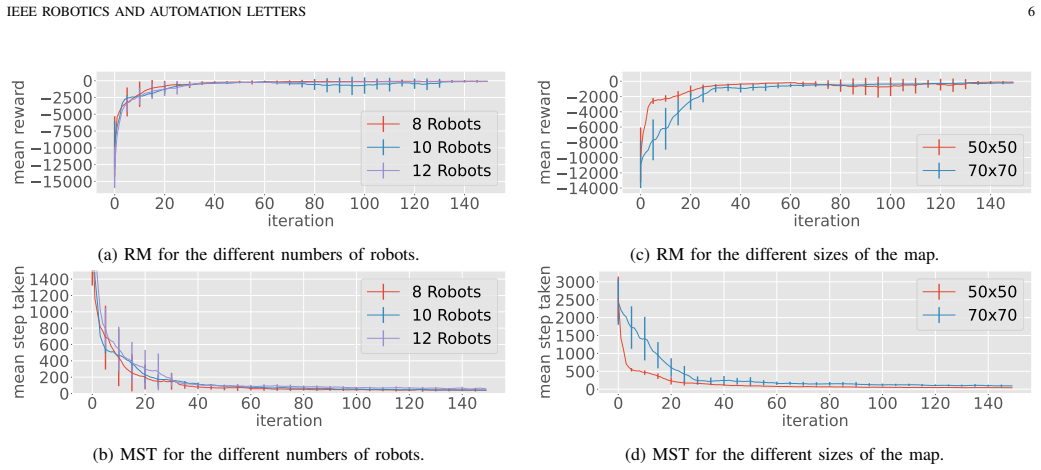
The paper claims that the DMS-SD problem can be solved in real time by learning a single shared policy rather than enumerating candidate solutions. At every step the target destination is the centroid of all robots' positions; the potential of a state is the shortest obstacle-avoiding path distance to that centroid; and the reward is the signed change in this potential, with a positive terminal reward when all robots arrive. With action masking, this reward structure makes the policy converge to near-optimal paths: on 50x50 to 70x70 maps with 2 to 12 robots, mean steps to meet drop below about 40, the gap to the computed optimum is mostly fewer than 5 steps, and inference time is about 30 ms on a desktop and under 100 ms on a Raspberry Pi 4, up to 100 times faster than the enumerated baseline.
Load-bearing premise
The load-bearing premise is that steering every robot toward the current centroid of all robots' positions yields an optimal solution to the stated minimize-total-travel-cost objective, a property the paper asserts without proof and which generally fails on obstacle-filled grids where the true minimizer is a median-type point.
Editorial extensions
If this is right
- A factory controller can change the rendezvous point while robots are moving, and each robot can recompute its next step in milliseconds, making dynamic re-routing practical in production.
- The same trained model serves teams of different sizes: zero padding lets a model trained with up to 12 robots control any team from 2 to 12 robots without retraining.
- Executing the policy needs only a Raspberry Pi-class device, so robots can run locally and avoid frequent message exchanges with a central server during operation.
- Reward functions designed for static-goal multi-agent navigation fail or converge slowly when the goal moves, whereas the potential-based centroid reward converges in roughly 100 to 150 iterations.
- Because inference speed depends on the state vector, not the map size, larger factory maps do not slow down the deployed policy even though training time increases.
Reading between the lines
- The paper asserts, but does not prove, that steering every robot toward the centroid of all robots minimizes the total travel cost of the DMS-SD problem; on an obstacle grid the true cost-minimizing meeting point is generally a median-type point, not the mean, so the claimed optimality should be read as closeness to a centroid-guided heuristic rather than proven global optimality.
- A direct test of the paper's optimality claim would replace the centroid with the 1-median under the grid shortest-path metric, retrain with the same reward scheme, and compare mean steps; if the median-guided policy consistently beats the centroid-guided one, the reward target is the weak link.
- The method's speedup is stated relative to enumerated baselines on the tested map sizes; extrapolating to much larger maps or many more robots should be treated as an open question until the same ratio is measured there.
- The shared-policy design assumes all robots move with the same speed and action set; heterogeneous robots would likely need speed- or capability-conditioned state features to keep the single-policy advantage.
Editorial analysis
A structured set of objections, weighed in public.
Referee Report
Summary. The paper addresses the Dynamic Multiple Sources to Single Destination (DMS-SD) navigation problem for multi-robot material distribution in smart manufacturing. The authors propose a deep reinforcement learning (DRL) method based on Proximal Policy Optimisation (PPO) with action masking, a potential-based reward function, and a shared policy network across robots. The instant target is defined as the centroid of all robots' positions, and the reward guides robots toward this centroid. Experiments on randomly generated grid maps report training convergence in terms of mean steps taken and mean reward, a small gap to an 'optimal' baseline, and millisecond-level inference times, leading to a claimed speedup of up to 100 times over enumerated solvers.
Significance. If the central claims were established, the paper would offer a practical, lightweight real-time planner for multi-robot rendezvous in dynamic factory environments, a relevant problem in smart manufacturing. The shared-policy architecture with zero-padding for variable robot counts, the use of action masking, and the potential-based reward are reasonable engineering ideas. However, the optimality claim is not supported: the method optimizes movement toward the centroid of current robot positions, while the stated DMS-SD objective is to minimize total travel distance/time to a rendezvous point, and no proof or experiment connects the centroid to that objective. The speedup claim is also unsupported because no runtimes for the enumerated baseline methods are reported. As a result, the paper's main contributions as stated are not substantiated.
major comments (4)
- [Section III and Section IV-A-b] The problem definition in Section III states that the objective is to select a rendezvous position minimizing overall travel time and distance. The method, however, defines the instant target as the coordinate-wise centroid of all robots' positions and shapes the reward (Eqs. 1-2) toward that centroid. The paper never proves that the centroid minimizes the sum of shortest-path distances on a grid with obstacles; in general, the minimizer is a 1-median of the geodesic distance field, not the mean. Consequently, the trained policy optimizes a surrogate objective, and the claim that the method 'rapidly converges to the optimal solution' for DMS-SD is not supported.
- [Section IV-A-b and Fig. 4] The reward function is defined via the potential difference to the dynamically recomputed centroid, and the 'optimal' reference in Fig. 4 is the initial centroid target. Since the target and the reward are both defined by the same centroid, converging to the target is by construction, not a demonstration of optimality with respect to the stated cost. Remark 2(iii) further admits that the final destination can differ from the initial target, which makes the 'gap to optimal' in Fig. 4 not meaningful as a measure of DMS-SD optimality. The paper would need an independent computation of the true optimal rendezvous point and optimal paths to validate the optimality claim.
- [Section V-b, Remark 1] The speedup claim of 'up to 100 times' is not supported by any comparative measurement. Remark 1 reports only the DRL inference time (~30 ms on desktop, <100 ms on Raspberry Pi) and states that methods [1,2] 'can even increase to many seconds,' but no runtimes, hardware details, or code for the enumerated solvers are provided. Without a direct runtime comparison on the same maps and hardware, the headline efficiency improvement is unverified.
- [Section V, evaluation design] The experimental evaluation does not compare the proposed method against the prior DMS-SD solvers [1,2] in terms of solution quality or computation time. The only comparison is to alternative reward functions from [5,7,11] using the same PPO framework. As a result, the paper does not demonstrate that the method outperforms existing DMS-SD algorithms, only that one reward design converges faster in the authors' training setup than three other reward designs.
minor comments (6)
- [Section IV-A-b, Eq. (1)] There is a duplicated and incomplete sentence: 'r is a positive value rewarded r is a positive value rewarded only if all guided robots have reached the goal.' This should be rewritten.
- [Section IV-A-b, Eq. (2)] The sign convention in Eq. (2) should be clarified: the cases are written in terms of ϕ(s_{t-1}) − ϕ(s_t), but the bullet points describe 'positive difference of the two potentials' without specifying whether the potential decreases or increases when approaching the target.
- [Section IV-A-c] The sentence 'Note that there is only one action is assigned to a robot using this strategy' is grammatically unclear and should be rephrased to explain how the shared policy is applied to multiple robots during deployment.
- [Section IV-A-d] The state description mentions 'the sum distance from the currently selected robot to all other robots,' but it is not explained how this is computed under the zero-padding strategy when fewer than np robots are present. A brief clarification would help reproducibility.
- [Fig. 4] The y-axis label is 'steps' while the legend says 'step taken'; please unify the terminology and specify how the 'initial optimal' values were computed (e.g., breadth-first search on the grid).
- [Section V-d, Remark 3] The phrase 'we can arguably calculate the value of DRL training time' is awkward; consider 'we can estimate the DRL training time'.
Circularity Check
Optimality claim is circular: the reward and the 'optimal' baseline are both defined by the centroid, which is never shown to minimize the DMS-SD travel-cost objective.
-
self definitional
[Section IV-A, b) Reward Function (Eqs. 1-2)]
"rt indicates if the training robot is approaching an optimal solution defined by the centroid of robots’ positions. ... The potential ϕ(st) is defined as the optimal path (excluding obstacles) distance to an instant target, which can be dynamically changed every step. The target is calculated by the centroid of all robots’ positions."
The paper defines 'optimal solution' as the centroid of robots' positions and simultaneously shapes the reward toward that same centroid. Section III, however, defines the DMS-SD objective as selecting a rendezvous position that minimizes overall time and travelling distance. No proof is given that the coordinate-wise centroid minimizes the sum of shortest grid-path distances to a common meeting point; on an obstacle grid the true minimizer is generally a geodesic 1-median, not the mean. Therefore, the agent is trained to maximize reward toward a target that is asserted to be optimal, and its convergence to that target is thus optimal by definition, not by derivation from the stated cost.
-
fitted input called prediction
[Section V-C, Remark 2 (Optimality), Fig. 4]
"Fig. 4 shows the model test results of the time steps taken by a trained agent from the Remark 0 and the optimal step to the initial goal on a 50x50 size map with 10 robots. ... Notably, the optimal target uses the initial target that is calculated based on the initial positions of robots."
The evaluation's 'optimal' baseline is the initial centroid target, which is exactly the quantity used to define the reward and the done condition. The policy is rewarded for reducing distance to a dynamically recomputed centroid and is then compared against that same initial centroid. The reported small optimality gap does not measure proximity to the Section III rendezvous optimum, since the paper itself acknowledges that the final destination can differ from the initial target even when every movement is optimal. Thus the gap in Fig. 4 is an internal self-comparison, not an independent benchmark against the stated DMS-SD cost.
full rationale
The paper's training-time, computation-time, and convergence-speed results are largely self-contained and are not circular: they report measurements of the proposed PPO agent on its own simulated environment. The circularity is confined to the optimality claim. The reward function's potential is defined as distance to the centroid of all robots' positions, and this same centroid is called the 'optimal solution' in the method section and used as the 'initial optimal' target in Fig. 4. Section III's actual objective, minimizing overall traveling time and distance to a rendezvous point, is never shown to be solved by the centroid, especially on obstacle-filled grids. Because the training signal, the done condition, and the evaluation baseline all reduce to the same centroid quantity, the statement that the DRL method 'rapidly converges to the optimal solution' is partially circular: it verifies convergence to the reward-defining target rather than to an independently computed optimum of the stated problem. The self-citations [1] and [2] are used as baselines but are not load-bearing for this circularity; the central problem is the definitional identification of the centroid with the optimum.
Assumptions & free parameters
free parameters (3)
- Reward weights r1, r2, r3 =
1, -10, -5
- Static and dynamic obstacle densities =
5% static, 2% dynamic per grid node
- PPO hyperparameters =
gamma=0.99, lambda=0.92, clip=0.2, lr=0.001, entropy=0.001
assumptions (4)
- ad hoc to paper The centroid of all robots' positions is the optimal rendezvous point.
- domain assumption The potential function phi(s) can be computed as the optimal obstacle-free path distance at each step.
- domain assumption A single shared policy with zero padding generalizes to any number of robots from 2 to np.
- domain assumption Randomly generated maps with 5% static and 2% dynamic obstacles represent factory floors.
Cite this review
Pith. "Pith review of Dynamic Collaborative Material Distribution System for Intelligent Robots In Smart Manufacturing." pith.science (2026). https://pith.science/paper/VHIK5AH4
@misc{pith2026250611723,
  author       = {Pith},
  title        = {Pith review of: Dynamic Collaborative Material Distribution System for Intelligent Robots In Smart Manufacturing},
  year         = {2026},
  howpublished = {\url{https://pith.science/paper/VHIK5AH4}},
  note         = {Machine review of arXiv:2506.11723}
}
read the original abstract
The collaboration and interaction of multiple robots have become integral aspects of smart manufacturing. Effective planning and management play a crucial role in achieving energy savings and minimising overall costs. This paper addresses the real-time Dynamic Multiple Sources to Single Destination (DMS-SD) navigation problem, particularly with a material distribution case for multiple intelligent robots in smart manufacturing. Enumerated solutions, such as in \cite{xiao2022efficient}, tackle the problem by generating as many optimal or near-optimal solutions as possible but do not learn patterns from the previous experience, whereas the method in \cite{xiao2023collaborative} only uses limited information from the earlier trajectories. Consequently, these methods may take a considerable amount of time to compute results on large maps, rendering real-time operations impractical. To overcome this challenge, we propose a lightweight Deep Reinforcement Learning (DRL) method to address the DMS-SD problem. The proposed DRL method can be efficiently trained and rapidly converges to the optimal solution using the designed target-guided reward function. A well-trained DRL model significantly reduces the computation time for the next movement to a millisecond level, which improves the time up to 100 times in our experiments compared to the enumerated solutions. Moreover, the trained DRL model can be easily deployed on lightweight devices in smart manufacturing, such as Internet of Things devices and mobile phones, which only require limited computational resources.
Figures


Figures from the paper (2 more)


Reference graph
Works this paper leans on
-
[1]
Z. Xiao, R. Xiao, C. Liu, H. Gao, X. Xu, S. Luo, and X. Wang, “An efficient dynamic multi-sources to single-destination (dms-sd) algorithm in smart city nav- igation using adjacent matrix,” in Proceedings of In- ternational Conference On Human-Centered Cognitive Systems (HCCS), 2022
work page 2022
-
[2]
A collaborative and dynamic multi- source single-destination navigation algorithm for smart cities,
Z. Xiao, C. Liu, S. Luo, K. Huang, H. Gao, X. Xu, and X. Wang, “A collaborative and dynamic multi- source single-destination navigation algorithm for smart cities,” Sustainable Energy Technologies and Assess- ments, vol. 56, p. 103032, 2023
work page 2023
-
[3]
Proximal policy optimization algorithms,
J. Schulman, F. Wolski, P. Dhariwal, A. Radford, and O. Klimov, “Proximal policy optimization algorithms,” arXiv preprint arXiv:1707.06347 , 2017
arXiv 2017
-
[4]
A closer look at invalid action masking in policy gradient algorithms,
S. Huang and S. Onta ˜n´on, “A closer look at invalid action masking in policy gradient algorithms,” arXiv preprint arXiv:2006.14171, 2020
arXiv 2006
-
[5]
Cooperative multi-robot navigation in dynamic environment with deep reinforce- ment learning,
R. Han, S. Chen, and Q. Hao, “Cooperative multi-robot navigation in dynamic environment with deep reinforce- ment learning,” in 2020 IEEE International Conference on Robotics and Automation (ICRA) . IEEE, 2020, pp. 448–454
work page 2020
-
[6]
Towards optimally decentralized multi-robot collision avoidance via deep reinforcement learning,
P. Long, T. Fan, X. Liao, W. Liu, H. Zhang, and J. Pan, “Towards optimally decentralized multi-robot collision avoidance via deep reinforcement learning,” in 2018 IEEE international conference on robotics and automa- tion (ICRA). IEEE, 2018, pp. 6252–6259
work page 2018
-
[7]
Visuomotor reinforcement learning for multirobot cooperative navigation,
Z. Liu, Q. Liu, L. Tang, K. Jin, H. Wang, M. Liu, and H. Wang, “Visuomotor reinforcement learning for multirobot cooperative navigation,” IEEE Transactions on Automation Science and Engineering , vol. 19, no. 4, pp. 3234–3245, 2021
work page 2021
-
[8]
Interaction-aware multi-agent reinforcement learning for mobile agents with individual goals,
A. Mohseni-Kabir, D. Isele, and K. Fujimura, “Interaction-aware multi-agent reinforcement learning for mobile agents with individual goals,” in 2019 International Conference on Robotics and Automation (ICRA). IEEE, 2019, pp. 3370–3376
work page 2019
Show all 15 references
-
[9]
Decentralized motion planning for multi-robot naviga- tion using deep reinforcement learning,
K. Sivanathan, B. Vinayagam, T. Samak, and C. Samak, “Decentralized motion planning for multi-robot naviga- tion using deep reinforcement learning,” in 2020 3rd International Conference on Intelligent Sustainable Sys- tems (ICISS). IEEE, 2020, pp. 709–716
2020
-
[10]
Multi-agent deep reinforcement learning for uavs navigation in unknown complex en- vironment,
Y . Xue and W. Chen, “Multi-agent deep reinforcement learning for uavs navigation in unknown complex en- vironment,” IEEE Transactions on Intelligent Vehicles , 2023
2023
-
[11]
Autonomous uav navigation in dynamic environments with double deep q-networks,
Y . Yang, K. Zhang, D. Liu, and H. Song, “Autonomous uav navigation in dynamic environments with double deep q-networks,” in 2020 AIAA/IEEE 39th Digital Avionics Systems Conference (DASC). IEEE, 2020, pp. 1–7
2020
-
[12]
Deep reinforcement learning multi-uav trajec- tory control for target tracking,
J. Moon, S. Papaioannou, C. Laoudias, P. Kolios, and S. Kim, “Deep reinforcement learning multi-uav trajec- tory control for target tracking,” IEEE Internet of Things Journal, vol. 8, no. 20, pp. 15 441–15 455, 2021
2021
-
[13]
Vision-based distributed multi-uav collision avoidance via deep reinforcement learning for navigation,
H. Huang, G. Zhu, Z. Fan, H. Zhai, Y . Cai, Z. Shi, Z. Dong, and Z. Hao, “Vision-based distributed multi-uav collision avoidance via deep reinforcement learning for navigation,” in 2022 IEEE/RSJ International Conference on Intelligent Robots and Systems (IROS) . IEEE, 2022, pp...
2022
-
[14]
Stable-baselines3: Reliable reinforce- ment learning implementations,
A. Raffin, A. Hill, A. Gleave, A. Kanervisto, M. Ernestus, and N. Dormann, “Stable-baselines3: Reliable reinforce- ment learning implementations,” Journal of Machine Learning Research, vol. 22, no. 268, pp. 1–8, 2021
2021
-
[15]
Adam: A method for stochastic optimization,
D. P. Kingma and J. Ba, “Adam: A method for stochastic optimization,” arXiv preprint arXiv:1412.6980 , 2014
2014 arXiv
Reviewed August 7, 2026 · model on record in the stance chip above.
Discussion (0). Sign in to comment.