REVIEW 3 major objections 5 minor 42 references
Unsupervised Learning for Optimal Transport plan prediction between unbalanced graphs
T0 review · 3 major / 5 minor · reviewed 2026-08-07 · deepseek-v4-flash
Pith's one-line read A neural network trained on the FUGW loss predicts optimal transport plans between graphs in quadratic time, up to 100x faster than classical solvers.
desk verdict A credible amortized FUGW plan predictor with a real warm-start payoff, but the real-data generalization claim is not yet established because the IBC split leaks endpoint graphs between training and test. read the letter →
The pith
A machine-rendered reading of the paper's core claim, the machinery that carries it, and where it could break.
The reading
What carries the argument
The load-bearing object is the predicted transport plan $P^{\rho,\alpha}_{\theta}(G_1,G_2)$, produced by a graph neural network with cross-attention layers that exchange information between the two graphs, concatenate the FUGW weight $\rho$ and a Fourier positional encoding of $\alpha$ into node features at every layer, and finish with a softmax-based attention layer scaled by learned per-node weights. This construction separates cross-graph interaction from per-node mass imbalance, so the network can output unbalanced plans. The training objective is the amortized minimization of the expected FUGW loss itself; because the plan is a differentiable function of the graphs and of $(\alpha,\rho)$, gradients flow to graphs, features, and hyperparameters alike.
What would settle it
Measure the relative FUGW loss gap between the ULOT plan and a converged classical solver on pairs drawn from the training distribution but with graph sizes or parameter values at the edge of the training support; if the gap is large while a classical solver converges quickly, the competitive-loss claim would be contradicted. A direct out-of-distribution test on graph sizes larger than those seen in training would settle whether the quadratic-complexity amortization holds.
Extended reading notes
Core claim
The paper claims that FUGW transport plan prediction can be learned without ground-truth plans: one draws graph pairs and FUGW parameters $(\alpha, \rho)$, and minimizes the expected FUGW loss of the plan produced by a parameterized, cross-attention graph neural network. The predicted plan is an unbalanced transport plan built from row and column attention softmax matrices scaled by learned per-node weights, giving a quadratic-complexity forward pass. On stochastic block model graphs and on fMRI-derived cortical surface graphs, ULOT achieves FUGW loss competitive with iterative solvers while being up to two orders of magnitude faster; its plan also serves as a warm start that accelerates solver convergence, and its differentiability enables hyperparameter optimization and graph optimization.
Load-bearing premise
The method assumes that a network trained on a sampled distribution of graph pairs and parameter values produces near-optimal transport plans for unseen pairs and parameters from that same distribution, so the fast forward pass is a valid approximation rather than an uncontrolled guess.
Editorial extensions
If this is right
- Quadratic-time prediction makes FUGW alignment practical for many graph pairs, including parameter validation across a grid of $(\alpha,\rho)$ values.
- The predicted plan can warm-start classical solvers, cutting the number of iterations needed for high-precision solutions.
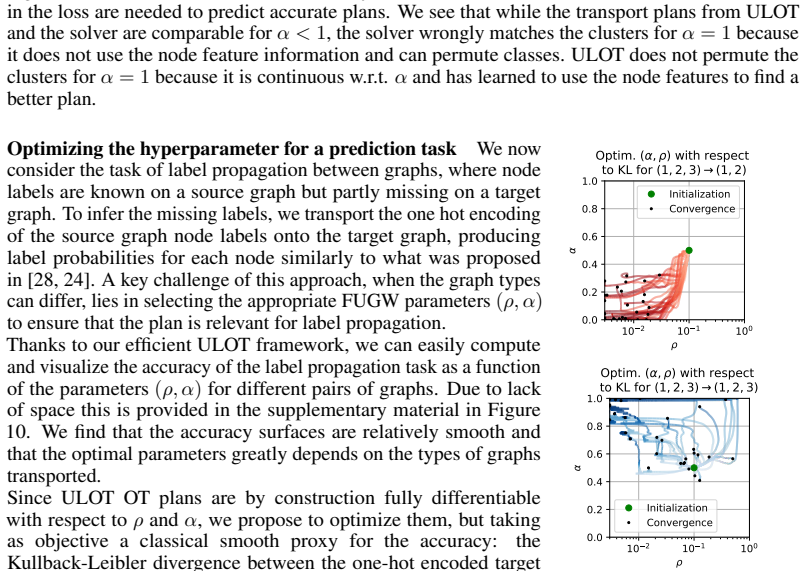
- Because the plan is differentiable with respect to the graphs, functionals of the plan can be minimized by gradient descent, as the paper demonstrates for label propagation and graph deformation problems.
- The total mass of the predicted unbalanced plan provides a cheap graph similarity measure that groups graphs by cluster structure.
- Unsupervised training means no optimal plans need to be precomputed, removing a major bottleneck for applying FUGW to new datasets.
Reading between the lines
- Editorial inference: if the amortized network generalizes beyond its training distribution, ULOT could scale to much larger graphs than the GPU-memory-limited experiments shown here, for instance via memory-efficient attention, which the paper lists as future work.
- Editorial inference: the parameter-conditioned network suggests a cheap surrogate for bi-level optimization, replacing an inner FUGW solve with a single differentiable forward pass whenever the outer task needs hyperparameter or graph gradients.
- Editorial inference: a direct test of the method's robustness would be to train on a mixture of graph families and evaluate whether a single network interpolates between geometries rather than memorizing the cluster patterns of the synthetic SBM data.
Editorial analysis
A structured set of objections, weighed in public.
Referee Report
Summary. The paper introduces ULOT, an unsupervised neural approach for predicting fused unbalanced Gromov-Wasserstein (FUGW) transport plans between graphs. The model is trained by minimizing the expected FUGW loss on sampled graph pairs and hyperparameters (α, ρ), using a GCN plus cross-attention architecture that is conditioned on the FUGW parameters and outputs an unbalanced plan via row/column softmax similarities and learned node weights. Experiments on stochastic block model graphs and the IBC fMRI dataset compare ULOT to classical solvers (IBPP, MM, L-BFGS-B, entropic Sinkhorn), reporting competitive FUGW loss with up to two orders of magnitude faster prediction, a warm-start benefit, and differentiability that enables hyperparameter and graph optimization.
Significance. If the generalization claims hold, ULOT is a valuable amortized solver for an expensive non-convex OT problem: it removes per-pair iteration, conditions on (α, ρ), and produces differentiable plans with O(n^2) inference. The unsupervised training formulation is clean, and the warm-start and graph-similarity applications demonstrate genuine utility. The manuscript also honestly discusses memory limitations and intends to release code and pretrained weights. However, the real-data competitive-loss claim is currently supported only by a random pair split that does not separate graphs, and the speed comparison excludes training cost; these gaps must be closed before the central claims are fully established.
major comments (3)
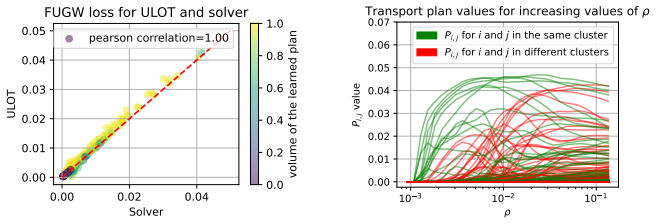
- [Section 3.2 and Appendix C] A random split of the 14,400 graph pairs into 60/20/20 does not produce a graph-disjoint test set: the endpoint graphs are 12 subjects × 10 Ward parcellations, i.e., only 120 graphs, and almost every test pair shares at least one endpoint graph with training pairs. Because node features include 3D positions and fMRI activation averages, the network has seen the same node embeddings during training, and the cross-attention layers can exploit familiarity with a parcellation rather than learning a transport rule that generalizes to new parcellated brains. The Pearson correlation of 0.99 in Figure 7 (left) is therefore not evidence for the abstract's claim of competitive loss on unseen real graphs. Please reevaluate with a split that separates graphs (e.g., by subject or by parcellation), or clearly restrict the real-data claim to interpolation over known brain graphs. The dataset also appears to include self-pairs (120 × 120 = 14,400), which are trivial alignment problems and should be excluded or analyzed separately.
- [Figures 7-8 and Appendix A] The speed comparison compares only the inference/prediction time of ULOT with per-pair solver time. Appendix A states that the IBC model was trained for 100 hours on a V100 GPU; adding this one-time cost is essential to assess the amortization claim. If the intended use is hyperparameter validation over many pairs, the break-even number of queries should be quantified, and the hardware used for inference versus solver runs should be reported. Without this, 'up to two orders of magnitude faster' overstates the practical saving for small test sets.
- [Equation (4) and Section 3.2] The evaluation metric is the same FUGW loss that ULOT is trained on. While this is not circular with respect to the independent solvers, it means the 'competitive loss' result is a statement about training-objective optimization rather than about downstream plan quality. I suggest complementing the loss comparison with a task-based metric (for example, label-propagation accuracy or transported-activation correlation) on held-out graph pairs and reporting whether the conclusion is stable under the graph-disjoint split requested above.
minor comments (5)
- [Section 2.3, Eq. (8)] The notation 'S1 = softmax_row(a2S)' and 'S2 = softmax_column(a2S)' is ambiguous because S1 and S2 are n1×n2 matrices obtained by different normalizations; please state explicitly whether rows or columns sum to one, since this matters for the mass-balance interpretation in Eq. (12).
- [Appendix A] The text says 'all the MLP and GMN have one hidden layer', but GMN is not defined in the main text; please use GCN consistently or define the abbreviation.
- [Figure 5] The caption lists gradient descent steps 'step 0, step 200, step 300, step 1000, step 3000' but does not specify what is being visualized (node positions, features, or adjacency); please clarify.
- [Abstract and Figure 7] The abstract says 'two orders of magnitude faster', while Figure 7 (right) shows speedups of about 10× for some solvers and up to 100× for others; please state the specific comparison baseline in the abstract.
- [Section 4] The limitation statement mentions graphs of size 'n ≤ 10000', but the IBC graphs have n = 1000 and the scaling experiment in Figure 8 goes up to 10^4 nodes; please check the intended notation for graph size.
Circularity Check
No significant circularity: ULOT's training objective, evaluation metric, and baselines are distinct, and the only self-citations are not load-bearing.
full rationale
The paper's claimed derivation is not circular. ULOT is trained by minimizing the expected FUGW loss, Eq. (4): min_theta E[L_{alpha,rho}(G1,G2,P_theta(G1,G2))], with (rho,alpha) sampled from fixed distributions (log-uniform for rho, Beta(0.5,0.5) for alpha), not fitted to the evaluation data. Evaluation then independently computes the same FUGW loss for the predicted plan and for plans returned by classical solvers (IBPP, MM, LBFGSB, Sinkhorn) on held-out graph pairs, and reports error relative to the best solver together with wall-clock times. Because the metric is the objective the network is trained on, the comparison is favorable by design, but it is not forced by construction: the network could fail to minimize the loss, and the solver baselines are external optimizers of the same objective. The (alpha,rho) values are inputs to the architecture (Eqs. 5 and 10-12), not fitted parameters renamed as predictions. The one shared-author citation that could be load-bearing, [30] for FUGW and brain alignment, is not load-bearing here because the FUGW loss is defined explicitly in Eqs. (1)-(3), and the Ward parcellation is an external algorithm. The random-pair split over all possible IBC graph pairs (Section C: 'The final dataset is constructed from all possible graph pairs, which we randomly split into 60% training, 20% validation, and 20% test sets') is a legitimate generalization concern because endpoint graphs can appear in both training and test pairs, but it concerns external validity, not circularity. No step in the paper reduces to its own inputs or to a self-citation chain.
Assumptions & free parameters
free parameters (7)
- Attention temperature a =
3 (simulated), 5 (IBC)
- Number of embedding layers N =
5 (simulated), 3 (IBC)
- Fourier encoding dimension d =
10
- Learning rate =
0.001 (simulated), 0.0001 (IBC)
- Network widths =
MLP hidden 64/256, GCN hidden 16/128, final 256
- Training parameter distribution Pρ, Pα =
Pρ log-uniform in [1e-7, 1]; Pα Beta(0.5, 0.5)
- Ward parcellation augmentation fraction =
20%-40% of tasks
assumptions (6)
- domain assumption The FUGW loss L_{α,ρ} is the correct objective for graph alignment and its minimizers provide meaningful correspondences.
- domain assumption Node weights are uniform (ω_i = 1/n_k).
- domain assumption Classical solvers (IBPP, MM, L-BFGS-B, Sinkhorn) are adequate reference solutions for FUGW minima.
- standard math Backpropagation through the FUGW loss and through the transport-plan parameterization is numerically valid and stable in practice.
- domain assumption The training distribution of graph pairs and (α, ρ) covers the test-time distribution.
- domain assumption The cross-attention plus GCN parameterization can express sufficiently good transport plans.
Cite this review
Pith. "Pith review of Unsupervised Learning for Optimal Transport plan prediction between unbalanced graphs." pith.science (2026). https://pith.science/paper/2JFWFWLZ
@misc{pith2026250612025,
  author       = {Pith},
  title        = {Pith review of: Unsupervised Learning for Optimal Transport plan prediction between unbalanced graphs},
  year         = {2026},
  howpublished = {\url{https://pith.science/paper/2JFWFWLZ}},
  note         = {Machine review of arXiv:2506.12025}
}
read the original abstract
Optimal transport between graphs, based on Gromov-Wasserstein and other extensions, is a powerful tool for comparing and aligning graph structures. However, solving the associated non-convex optimization problems is computationally expensive, which limits the scalability of these methods to large graphs. In this work, we present Unbalanced Learning of Optimal Transport (ULOT), a deep learning method that predicts optimal transport plans between two graphs. Our method is trained by minimizing the fused unbalanced Gromov-Wasserstein (FUGW) loss. We propose a novel neural architecture with cross-attention that is conditioned on the FUGW tradeoff hyperparameters. We evaluate ULOT on synthetic stochastic block model (SBM) graphs and on real cortical surface data obtained from fMRI. ULOT predicts transport plans with competitive loss up to two orders of magnitude faster than classical solvers. Furthermore, the predicted plan can be used as a warm start for classical solvers to accelerate their convergence. Finally, the predicted transport plan is fully differentiable with respect to the graph inputs and FUGW hyperparameters, enabling the optimization of functionals of the ULOT plan.
Figures


Figures from the paper (8 more)





Reference graph
Works this paper leans on
-
[1]
Op- tuna: A next-generation hyperparameter optimization framework
Takuya Akiba, Shotaro Sano, Toshihiko Yanase, Takeru Ohta, and Masanori Koyama. Op- tuna: A next-generation hyperparameter optimization framework. In The 25th ACM SIGKDD International Conference on Knowledge Discovery & Data Mining, pages 2623–2631, 2019
work page 2019
-
[2]
Brandon Amos, Samuel Cohen, Giulia Luise, and Ievgen Redko. Meta optimal transport. arXiv preprint arXiv:2206.05262, 2022
arXiv 2022
-
[3]
Tutorial on amortized optimization
Brandon Amos et al. Tutorial on amortized optimization. Foundations and Trends® in Machine Learning, 16(5):592–732, 2023
work page 2023
-
[4]
A limited memory algorithm for bound constrained optimization
Richard H Byrd, Peihuang Lu, Jorge Nocedal, and Ciyou Zhu. A limited memory algorithm for bound constrained optimization. SIAM Journal on scientific computing, 16(5):1190–1208, 1995
1995
-
[5]
Partial gromov-wasserstein with appli- cations on positive-unlabeled learning
Laetitia Chapel, Mokhtar Z Alaya, and Gilles Gasso. Partial gromov-wasserstein with appli- cations on positive-unlabeled learning. Advances in Neural Information Processing Systems, 2020
work page 2020
-
[6]
Unbalanced opti- mal transport through non-negative penalized linear regression
Laetitia Chapel, Rémi Flamary, Haoran Wu, Cédric Févotte, and Gilles Gasso. Unbalanced opti- mal transport through non-negative penalized linear regression. Advances in Neural Information Processing Systems, 34:23270–23282, 2021
work page 2021
-
[7]
Kernel operations on the gpu, with autodiff, without memory overflows
Benjamin Charlier, Jean Feydy, Joan Alexis Glaunes, François-David Collin, and Ghislain Durif. Kernel operations on the gpu, with autodiff, without memory overflows. Journal of Machine Learning Research, 22(74):1–6, 2021
work page 2021
-
[8]
Unbalanced optimal transport: Dynamic and kantorovich formulations
Lenaic Chizat, Gabriel Peyré, Bernhard Schmitzer, and François-Xavier Vialard. Unbalanced optimal transport: Dynamic and kantorovich formulations. Journal of Functional Analysis, 274(11):3090–3123, 2018
work page 2018
Show all 42 references
-
[9]
Alaya, Aurélie Boisbunon, Stanislas Chambon, Laetitia Chapel, Adrien Corenflos, Kilian Fatras, Nemo Fournier, Léo Gautheron, Nathalie T.H
Rémi Flamary, Nicolas Courty, Alexandre Gramfort, Mokhtar Z. Alaya, Aurélie Boisbunon, Stanislas Chambon, Laetitia Chapel, Adrien Corenflos, Kilian Fatras, Nemo Fournier, Léo Gautheron, Nathalie T.H. Gayraud, Hicham Janati, Alain Rakotomamonjy, Ievgen Redko, Antoine Rolet, Ant...
2021
-
[10]
Graph- context attention networks for size-varied deep graph matching
Zheheng Jiang, Hossein Rahmani, Plamen Angelov, Sue Black, and Bryan M Williams. Graph- context attention networks for size-varied deep graph matching. InProceedings of the IEEE/CVF Conference on Computer Vision and Pattern Recognition, pages 2343–2352, 2022
2022
-
[11]
Neural optimal transport
Alexander Korotin, Daniil Selikhanovych, and Evgeny Burnaev. Neural optimal transport. arXiv preprint arXiv:2201.12220, 2022. 10
2022 arXiv
-
[12]
Sigma: Semantic-complete graph matching for domain adaptive object detection
Wuyang Li, Xinyu Liu, and Yixuan Yuan. Sigma: Semantic-complete graph matching for domain adaptive object detection. In Proceedings of the IEEE/CVF conference on computer vision and pattern recognition, pages 5291–5300, 2022
2022
-
[13]
Graph matching networks for learning the similarity of graph structured objects
Yujia Li, Chenjie Gu, Thomas Dullien, Oriol Vinyals, and Pushmeet Kohli. Graph matching networks for learning the similarity of graph structured objects. In International conference on machine learning, pages 3835–3845. PMLR, 2019
2019
-
[14]
Multilevel graph matching networks for deep graph similarity learning
Xiang Ling, Lingfei Wu, Saizhuo Wang, Tengfei Ma, Fangli Xu, Alex X Liu, Chunming Wu, and Shouling Ji. Multilevel graph matching networks for deep graph similarity learning. IEEE Transactions on Neural Networks and Learning Systems, 34(2):799–813, 2021
2021
-
[15]
Self-supervised learning of visual graph matching
Chang Liu, Shaofeng Zhang, Xiaokang Yang, and Junchi Yan. Self-supervised learning of visual graph matching. In European Conference on Computer Vision, pages 370–388. Springer, 2022
2022
-
[16]
A survey for the quadratic assignment problem
Eliane Maria Loiola, Nair Maria Maia De Abreu, Paulo Oswaldo Boaventura-Netto, Peter Hahn, and Tania Querido. A survey for the quadratic assignment problem. European journal of operational research, 176(2):657–690, 2007
2007
-
[17]
Gromov–wasserstein distances and the metric approach to object matching
Facundo Mémoli. Gromov–wasserstein distances and the metric approach to object matching. Foundations of computational mathematics, 11:417–487, 2011
2011
-
[18]
Graph node matching for edit distance
Aldo Moscatelli, Jason Piquenot, Maxime Bérar, Pierre Héroux, and Sébastien Adam. Graph node matching for edit distance. Pattern Recognition Letters, 184:14–20, 2024
2024
-
[19]
Neural gromov-wasserstein optimal transport
Maksim Nekrashevich, Alexander Korotin, and Evgeny Burnaev. Neural gromov-wasserstein optimal transport. arXiv e-prints, pages arXiv–2303, 2023
2023
-
[20]
Functional maps: a flexible representation of maps between shapes
Maks Ovsjanikov, Mirela Ben-Chen, Justin Solomon, Adrian Butscher, and Leonidas Guibas. Functional maps: a flexible representation of maps between shapes. ACM Transactions on Graphics (ToG), 31(4):1–11, 2012
2012
-
[21]
Gromov-wasserstein averaging of kernel and distance matrices
Gabriel Peyré, Marco Cuturi, and Justin Solomon. Gromov-wasserstein averaging of kernel and distance matrices. In International conference on machine learning, pages 2664–2672. PMLR, 2016
2016
-
[22]
Computing graph edit distance via neural graph matching.Proceedings of the VLDB Endowment, 16(8):1817–1829, 2023
Chengzhi Piao, Tingyang Xu, Xiangguo Sun, Yu Rong, Kangfei Zhao, and Hong Cheng. Computing graph edit distance via neural graph matching.Proceedings of the VLDB Endowment, 16(8):1817–1829, 2023
2023
-
[23]
Individual brain charting, a high-resolution fmri dataset for cognitive mapping
Ana Luísa Pinho, Alexis Amadon, Torsten Ruest, Murielle Fabre, Elvis Dohmatob, Isabelle Denghien, Chantal Ginisty, Séverine Becuwe-Desmidt, Séverine Roger, Laurence Laurier, et al. Individual brain charting, a high-resolution fmri dataset for cognitive mapping. Scientific data...
2018
-
[24]
Optimal transport for multi- source domain adaptation under target shift
Ievgen Redko, Nicolas Courty, Rémi Flamary, and Devis Tuia. Optimal transport for multi- source domain adaptation under target shift. In The 22nd International Conference on artificial intelligence and statistics, pages 849–858. PMLR, 2019
2019
-
[25]
Superglue: Learning feature matching with graph neural networks
Paul-Edouard Sarlin, Daniel DeTone, Tomasz Malisiewicz, and Andrew Rabinovich. Superglue: Learning feature matching with graph neural networks. In Proceedings of the IEEE/CVF conference on computer vision and pattern recognition, pages 4938–4947, 2020
2020
-
[26]
Large-scale optimal transport and mapping estimation
Vivien Seguy, Bharath Bhushan Damodaran, Rémi Flamary, Nicolas Courty, Antoine Rolet, and Mathieu Blondel. Large-scale optimal transport and mapping estimation. arXiv preprint arXiv:1711.02283, 2017
2017 arXiv
-
[27]
The unbalanced gromov wasserstein distance: Conic formulation and relaxation
Thibault Séjourné, François-Xavier Vialard, and Gabriel Peyré. The unbalanced gromov wasserstein distance: Conic formulation and relaxation. Advances in Neural Information Processing Systems, 34:8766–8779, 2021
2021
-
[28]
Wasserstein propa- gation for semi-supervised learning
Justin Solomon, Raif Rustamov, Leonidas Guibas, and Adrian Butscher. Wasserstein propa- gation for semi-supervised learning. In International Conference on machine learning, pages 306–314. PMLR, 2014. 11
2014
-
[29]
Which fmri clustering gives good brain parcellations? Frontiers in neuroscience, 8:167, 2014
Bertrand Thirion, Gaël Varoquaux, Elvis Dohmatob, and Jean-Baptiste Poline. Which fmri clustering gives good brain parcellations? Frontiers in neuroscience, 8:167, 2014
2014
-
[30]
Aligning individual brains with fused unbalanced gromov wasserstein
Alexis Thual, Quang Huy Tran, Tatiana Zemskova, Nicolas Courty, Rémi Flamary, Stanislas Dehaene, and Bertrand Thirion. Aligning individual brains with fused unbalanced gromov wasserstein. Advances in neural information processing systems, 35:21792–21804, 2022
2022
-
[31]
Optimal transport for structured data with application on graphs
Vayer Titouan, Nicolas Courty, Romain Tavenard, and Rémi Flamary. Optimal transport for structured data with application on graphs. In International Conference on Machine Learning, pages 6275–6284. PMLR, 2019
2019
-
[32]
Improving and generalizing flow-based generative models with minibatch optimal transport
Alexander Tong, Kilian Fatras, Nikolay Malkin, Guillaume Huguet, Yanlei Zhang, Jarrid Rector- Brooks, Guy Wolf, and Yoshua Bengio. Improving and generalizing flow-based generative models with minibatch optimal transport. arXiv preprint arXiv:2302.00482, 2023
2023 arXiv
-
[33]
Discrete cycle-consistency based unsupervised deep graph matching
Siddharth Tourani, Muhammad Haris Khan, Carsten Rother, and Bogdan Savchynskyy. Discrete cycle-consistency based unsupervised deep graph matching. In Proceedings of the AAAI Conference on Artificial Intelligence, volume 38, pages 5252–5260, 2024
2024
-
[34]
Fused gromov-wasserstein distance for structured objects
Titouan Vayer, Laetitia Chapel, Rémi Flamary, Romain Tavenard, and Nicolas Courty. Fused gromov-wasserstein distance for structured objects. Algorithms, 13(9):212, 2020
2020
-
[35]
Deep learning of partial graph matching via differentiable top-k
Runzhong Wang, Ziao Guo, Shaofei Jiang, Xiaokang Yang, and Junchi Yan. Deep learning of partial graph matching via differentiable top-k. In Proceedings of the IEEE/CVF conference on computer vision and pattern recognition, pages 6272–6281, 2023
2023
-
[36]
Learning combinatorial embedding networks for deep graph matching
Runzhong Wang, Junchi Yan, and Xiaokang Yang. Learning combinatorial embedding networks for deep graph matching. InProceedings of the IEEE/CVF international conference on computer vision, pages 3056–3065, 2019
2019
-
[37]
Graduated assignment for joint multi-graph matching and clustering with application to unsupervised graph matching network learning
Runzhong Wang, Junchi Yan, and Xiaokang Yang. Graduated assignment for joint multi-graph matching and clustering with application to unsupervised graph matching network learning. Advances in neural information processing systems, 33:19908–19919, 2020
2020
-
[38]
Neural entropic gromov-wasserstein alignment
Tao Wang and Ziv Goldfeld. Neural entropic gromov-wasserstein alignment. arXiv preprint arXiv:2312.07397, 2023
2023
-
[39]
A fast proximal point method for computing exact wasserstein distance
Yujia Xie, Xiangfeng Wang, Ruijia Wang, and Hongyuan Zha. A fast proximal point method for computing exact wasserstein distance. In Uncertainty in artificial intelligence, pages 433–453. PMLR, 2020
2020
-
[40]
Gromov-wasserstein learning for graph matching and node embedding
Hongteng Xu, Dixin Luo, Hongyuan Zha, and Lawrence Carin Duke. Gromov-wasserstein learning for graph matching and node embedding. In International conference on machine learning, pages 6932–6941. PMLR, 2019
2019
-
[41]
Deep learning of graph matching
Andrei Zanfir and Cristian Sminchisescu. Deep learning of graph matching. In Proceedings of the IEEE conference on computer vision and pattern recognition, pages 2684–2693, 2018
2018
-
[42]
Gromov– wasserstein distances: Entropic regularization, duality and sample complexity
Zhengxin Zhang, Ziv Goldfeld, Youssef Mroueh, and Bharath K Sriperumbudur. Gromov– wasserstein distances: Entropic regularization, duality and sample complexity. The Annals of Statistics, 52(4):1616–1645, 2024. 12 0.00 0.02 0.04 Solver 0.00 0.01 0.02 0.03 0.04 0.05ULOT FUGW lo...
2024
Reviewed August 7, 2026 · model on record in the stance chip above.
Discussion (0). Continue with ORCID to comment.