REVIEW 3 major objections 6 minor 50 references
GUST: Quantifying Free-Form Geometric Uncertainty of Metamaterials Using Small Data
T0 review · 3 major / 6 minor · reviewed 2026-08-07 · deepseek-v4-flash
Pith's one-line read A pretrained diffusion model learns real 3D-print geometry uncertainty from about a thousand cells.
desk verdict A useful transfer-learning recipe for geometric UQ, with real-world evidence that's promising but not yet quantitatively established. read the letter →
The pith
A machine-rendered reading of the paper's core claim, the machinery that carries it, and where it could break.
The reading
What carries the argument
The load-bearing object is a conditional DDPM with a U-Net backbone that takes the noisy as-fabricated geometry $x_{\mathrm{fab},t}$ together with the nominal geometry $x_{\mathrm{nom}}$ as a spatial condition, injected by input concatenation and by SPADE (spatially-adaptive normalization) layers, and is trained to predict the noise added in the forward diffusion process. The two-stage recipe carries the argument: first, self-supervised pretraining on synthetic pairs $(x_{\mathrm{nom}}, x_{\mathrm{fab}})$ generated by stochastic geometric operators, free-form deformation with Gaussian control-point perturbations and a random-hole operator, learns the structure of geometric variability; second, transfer-learning fine-tuning on small real pairs shifts the conditional distribution toward the actual manufacturing process. Monte Carlo sampling from the fine-tuned model then yields as-fabricated geometries whose homogenized elastic properties quantify property uncertainty.
What would settle it
Falsify by applying GUST to a real process whose dominant defects cannot be produced by free-form deformation or random-hole operators, for example anisotropic shrinkage along the build direction, delamination, or support-material remnants, under the same small-data budget; the central claim fails if the fine-tuned model's homogenized property distributions are no closer to ground truth than direct training, or if generated samples retain source-domain hole patterns absent from the real parts.
Extended reading notes
Core claim
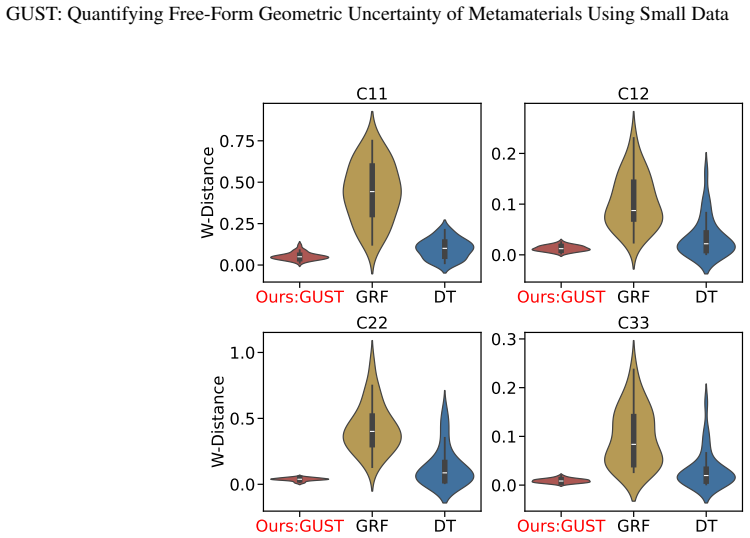
The central claim is that GUST, a conditional denoising diffusion model, can learn the full high-dimensional conditional distribution of as-fabricated unit-cell geometries given a nominal design without the large real datasets normally required. The paper argues this by first pretraining the model on 60,000 synthetic geometries obtained by applying free-form deformation (FFD) with control-point noise $\sigma=6$ to 3,000 nominal designs, then fine-tuning on a small real dataset of stereolithography-printed unit cells (about a thousand retained cells from 17 designs, printed in two passes). Across two experiments, a synthetic target with FFD $\sigma=13$ plus random holes and a real SLA target, GUST's generated geometries and their homogenized elastic-tensor components $C_{11}, C_{12}, C_{22}, C_{33}$ are closer to ground truth than direct training, dilation-erosion with maximum-likelihood scales, and Gaussian random field baselines, as measured by density, coverage, and Wasserstein distance. The paper takes this as evidence that the synthetic-to-real transfer recipe makes free-form geometric UQ feasible with small real data.
Load-bearing premise
The load-bearing premise is that the hand-chosen synthetic pretraining distribution, free-form deformation with control-point noise $\sigma=6$ and no holes, lies close enough to a real manufacturing process that fine-tuning on about a thousand real cells moves the conditional distribution to the true one instead of anchoring it near the source.
Editorial extensions
If this is right
- With roughly a thousand real unit cells, GUST beats direct training, dilation-erosion, and Gaussian random field baselines on geometry and property metrics, making generative geometric UQ practical where physical fabrication and imaging limit data collection.
- The learned conditional distribution $p_\theta(x_{\mathrm{fab}} \mid x_{\mathrm{nom}})$ enables Monte Carlo sampling for design optimization under uncertainty, using homogenization to map geometry samples to elastic-property statistics.
- The near-identical results across transfer-learning freezing strategies suggest the fine-tuning step is insensitive to which U-Net layers are transferred, so the pretraining distribution rather than layer choice is the main determinant of success.
- Augmenting the small real dataset directly narrows the learned distribution, whereas GUST's pretraining-then-fine-tuning sequence preserves closer alignment with ground truth.
- Because the recipe is modular, replacing the image-conditioned U-Net with point-cloud, voxel, or mesh diffusion extends the same pretrain-fine-tune-sample pipeline to 3D and vectorized representations.
Reading between the lines
- Editorial inference: if transfer-strategy insensitivity is general, the key design choice in applying GUST to a new process is the pretraining operator family, so the paper's recipe invites a controlled study of how $\sigma$, hole statistics, and operator diversity affect convergence after fine-tuning.
- Editorial inference: for processes whose dominant defects are outside the FFD-plus-holes family, such as anisotropic shrinkage, delamination, or support-material artifacts, the pretraining prior could mislead; users should tailor the synthetic operator set to known defect physics before trusting the fine-tuned distribution.
- Editorial inference: the paper's geometric metrics are pixel-distance based and sensitive to misalignment, so a topology- or signed-distance-aware evaluation might make real-world geometry comparisons more decisive than density and coverage in raw pixel space.
- Editorial inference: the same conditional generative recipe could be tested on wear or erosion of aerodynamic surfaces or microfluidic devices, with the synthetic pretraining operators chosen to mimic the relevant degradation mechanisms and a small field dataset for fine-tuning.
Editorial analysis
A structured set of objections, weighed in public.
Referee Report
Summary. The paper proposes GUST, a conditional diffusion model that first pretrains on a large synthetic dataset of unit-cell geometries perturbed by free-form deformation (FFD) and random hole nucleation, then fine-tunes on a small set of real stereolithography (SLA) fabricated unit cells. The goal is to quantify the full conditional distribution of as-fabricated geometry given a nominal design, and to propagate that uncertainty to homogenized elastic properties. GUST is compared with three baselines (direct training, dilation-erosion, Gaussian random field) plus an augmented direct training baseline in the appendix. The paper reports quantitative gains for GUST in a synthetic experiment (density, coverage, Wasserstein distances over 30 designs) and qualitative gains in a real-world experiment with two test designs.
Significance. If the central claim is substantiated, GUST is a meaningful contribution: it combines self-supervised synthetic pretraining with transfer learning to reduce real-world data requirements for free-form geometric UQ, and it provides a new real fabrication dataset (SLA-printed unit cells) that is valuable to the community. The synthetic experiment is extensive, uses multiple eval designs and samples, and shows clear quantitative advantages over direct training and GRF baselines. The authors are also transparent about several limitations, including the difficulty of computing density/coverage on real data and the source-target gap. However, the evidence for the real-world claim is currently weaker than the abstract and conclusion suggest, and the geometric evaluation metric has a free parameter that is not fully robust.
major comments (3)
- [Sec. 5.2, Figs. 13 and 15] The central real-world claim is not quantitatively supported. The paper states that density and coverage cannot be reliably computed on real samples (Sec. 5.2, paragraph 3), and no alternative geometry distance is reported. The property comparison is limited to two test designs with no Wasserstein distances, confidence intervals, or significance tests, so the statement that "the property distribution produced by GUST most closely approximates the ground truth compared to the three baselines" rests on visual KDE inspection. With only two test designs, this could be chance; the real-world evaluation needs either a quantitative property metric with bootstrap intervals, a robust geometric distance, or at minimum an explicit caveat that the real-world conclusion is qualitative.
- [Sec. 4.5, Fig. 10] The density and coverage metrics are computed in a 3D t-SNE embedding whose perplexity was selected post hoc (perplexity 10) because it "led to the most reasonable representation" of the data. This introduces a tunable parameter directly into the evaluation metric. No sensitivity analysis over perplexity is provided, and no independent criterion is given for why this embedding is the right space for computing neighborhood-based fidelity and diversity metrics. The synthetic geometry comparison (Fig. 10) should report metrics across a range of perplexities, or justify the choice with a principled procedure.
- [Sec. 5.1 and Sec. 4.1] The synthetic experiment is partly self-referential: pretraining data (FFD with sigma=6), fine-tuning data (FFD with sigma=13 plus random holes), and ground truth are all generated by the same family of geometric operators. This demonstrates that GUST can adapt within a known transformation family, but it does not test adaptation to a qualitatively different manufacturing process. The paper acknowledges in Sec. 5.1 that source-target closeness facilitates transfer, and it correctly uses the real-world experiment as the out-of-family test; however, since that real-world experiment lacks quantitative metrics (see major comment above), the generalizability claim is not yet established. A concrete test would be to apply GUST to a distinct process (or to synthetic data generated by a different perturbation family, such as anisotropic shrinkage) and measure whether the pretraining prior helps or hurts.
minor comments (6)
- [Abstract vs. Sec. 4.1] The abstract says 960 unit cells were additively manufactured, while Sec. 4.1 states that 17 designs with 64 unit cells each (1,088 cells) were retained after filtering. Please reconcile these numbers and clarify whether the 960 figure refers to an earlier stage of the pipeline.
- [Sec. 4.4, GRF baseline] The GRF baseline hyperparameters (sigma, ell_1, ell_2, and truncation rank M) are not reported or fitted. Since the comparison depends on the strength of the GRF perturbation, please specify the values used and, ideally, a sensitivity study.
- [Sec. 5.1, Table 1] The p-values in Table 1 are reported without stating which statistical test was used or whether the comparisons are paired across the 30 nominal designs. Please name the test (e.g., Welch's t-test) and report effect sizes or confidence intervals.
- [Figures 8 and 13] The KDE plots are based on a limited number of ground-truth samples (64 per design in the real experiment) and generated samples; the captions do not state sample sizes or kernel bandwidths. Please add these details so the visual comparisons can be interpreted quantitatively.
- [Sec. 4.4 and Appendix D] The Augmented DT baseline is introduced only in Appendix D but is a natural alternative to GUST; consider moving it to the main text (or at least referencing it in Sec. 4.4) because it directly addresses the question of whether synthetic generation is better used as pretraining versus as data augmentation.
- [Eq. (6)] The notation "FFFD" in Eq. (6) is inconsistent with the description "FFD" elsewhere; please unify the symbol. Also, the left-hand side uses x but the right-hand side only depends on parametric coordinates (u,v) and control points, so the definition of the deformed geometry should be stated more explicitly.
Circularity Check
No significant circularity: GUST's synthetic pretraining, real-data fine-tuning, and held-out evaluation are distinct, and the weak real-world evidence is a support gap, not a definitional reduction.
full rationale
GUST's derivation chain is not circular. The model is pretrained on synthetic FFD-deformed geometries (Sec 4.1), fine-tuned on either a synthetic or a real as-fabricated dataset, and evaluated against held-out ground-truth distributions using density, coverage, and Wasserstein distance (Sec 4.5, 5.1). No parameter entering the central claim is fitted to the test data and then reported as a prediction: the pretraining noise level (sigma=6) is fixed before real-data fine-tuning, and the MLE-fitted dilation/erosion scales are explicitly presented as point-estimate baselines rather than GUST predictions. The load-bearing real-world experiment uses independently printed unit cells from 17 designs not contained in the pretraining data (Sec 4.1, 5.2). The genuine weakness is evaluation support, not circularity: Sec 5.2 states that density and coverage 'cannot be reliably computed' on real samples due to misalignment sensitivity, and property KDE comparisons are shown for only two test designs, so the real-world claim of closest alignment rests partly on visual inspection. That is an evidence limitation and a correctness risk, not a definitional equivalence. The paper also acknowledges the remaining source-target discrepancy and calls for larger, more diverse pretraining data (Sec 6). The one mildly self-referential aspect is that the synthetic validation target is generated from the same FFD/hole operator family used to create the pretraining data (Sec 4.1), making that part of the demonstration a controlled transfer benchmark within a hand-coded transformation family; however, it does not force the real-world result by construction, and no load-bearing self-citation chain is present.
Assumptions & free parameters
free parameters (7)
- pretraining_FFD_sigma =
6
- FFD_control_lattice_size_m =
Not reported
- synthetic_finetune_FFD_sigma =
13
- random_hole_parameters =
Not fully specified
- tSNE_perplexity =
10
- GRF_baseline_parameters =
Not reported
- dilation_erosion_scales =
alpha=2,beta=1 (synthetic); alpha=5,beta=1 (real)
assumptions (5)
- domain assumption Manufacturing uncertainty in metamaterial unit cells can be represented as a conditional distribution p(x_fab | x_nom) over 64x64 binary pixel images.
- ad hoc to paper The synthetic pretraining distribution generated by FFD and hole nucleation provides a useful prior for real manufacturing uncertainty.
- domain assumption The excluded unit cells (non-penetrating holes) and the retained inner 3x3 grid are not needed to characterize the uncertainty distribution.
- standard math The homogenization procedure [38] accurately maps binary geometry to effective elastic tensor components.
- domain assumption Density and coverage computed in a 3D t-SNE embedding preserve the neighbor structure needed for k-NN based metrics.
Cite this review
Pith. "Pith review of GUST: Quantifying Free-Form Geometric Uncertainty of Metamaterials Using Small Data." pith.science (2026). https://pith.science/paper/A6SG73QJ
@misc{pith2026250612051,
  author       = {Pith},
  title        = {Pith review of: GUST: Quantifying Free-Form Geometric Uncertainty of Metamaterials Using Small Data},
  year         = {2026},
  howpublished = {\url{https://pith.science/paper/A6SG73QJ}},
  note         = {Machine review of arXiv:2506.12051}
}
read the original abstract
This paper introduces GUST (Generative Uncertainty learning via Self-supervised pretraining and Transfer learning), a framework for quantifying free-form geometric uncertainties inherent in the manufacturing of metamaterials. GUST leverages the representational power of deep generative models to learn a high-dimensional conditional distribution of as-fabricated unit cell geometries given nominal designs, thereby enabling uncertainty quantification. To address the scarcity of real-world manufacturing data, GUST employs a two-stage learning process. First, it leverages self-supervised pretraining on a large-scale synthetic dataset to capture the structure variability inherent in metamaterial geometries and an approximated distribution of as-fabricated geometries given nominal designs. Subsequently, GUST employs transfer learning by fine-tuning the pretrained model on limited real-world manufacturing data, allowing it to adapt to specific manufacturing processes and nominal designs. With only 960 unit cells additively manufactured in only two passes, GUST can capture the variability in geometry and effective material properties. In contrast, directly training a generative model on the same amount of real-world data proves insufficient, as demonstrated through both qualitative and quantitative comparisons. This scalable and cost-effective approach significantly reduces data requirements while maintaining the effectiveness in learning complex, real-world geometric uncertainties, offering an affordable method for free-form geometric uncertainty quantification in the manufacturing of metamaterials. The capabilities of GUST hold significant promise for high-precision industries such as aerospace and biomedical engineering, where understanding and mitigating manufacturing uncertainties are critical.
Figures


Figures from the paper (14 more)




Reference graph
Works this paper leans on
-
[1]
Paromita Nath, Joseph D Olson, Sankaran Mahadevan, and Yung-Tsun Tina Lee. Optimization of fused filament fabrication process parameters under uncertainty to maximize part geometry accuracy. Additive manufacturing, 35:101331, 2020
work page 2020
-
[2]
Clinton Morris, Logan Bekker, Michael R. Haberman, and Carolyn C. Seepersad. Design Exploration of Reliably Manufacturable Materials and Structures With Applications to Negative Stiffness Metamaterials and Microstereolithography. Journal of Mechanical Design, 140(11):111415, 09 2018
work page 2018
- [3]
-
[4]
Level set based robust shape and topology optimization under random field uncertainties
Shikui Chen, Wei Chen, and Sang-Hoon Lee. Level set based robust shape and topology optimization under random field uncertainties. Structural and Multidisciplinary Optimization, 41:507–524, 04 2010
work page 2010
-
[5]
A new level-set based approach to shape and topology optimization under geometric uncertainty
Shikui Chen and Wei Chen. A new level-set based approach to shape and topology optimization under geometric uncertainty. Structural and Multidisciplinary Optimization, 44:1–18, 07 2011
work page 2011
-
[6]
Wang, David Sell, Thaibao Phan, and Jonathan A
Evan W. Wang, David Sell, Thaibao Phan, and Jonathan A. Fan. Robust design of topology-optimized metasurfaces. Opt. Mater. Express, 9(2):469–482, Feb 2019
work page 2019
-
[7]
Nina Korshunova, Iason Papaioannou, Stefan Kollmannsberger, Daninel Straub, and Ernst Rank. Uncertainty quantification of microstructure variability and mechanical behavior of additively manufactured lattice structures. Computer Methods in Applied Mechanics and Engineering, 385:114049, 2021
work page 2021
-
[8]
GAN-DUF: Hierarchical Deep Generative Models for Design Under Free-Form Geometric Uncertainty
Wei (Wayne) Chen, Doksoo Lee, Oluwaseyi Balogun, and Wei Chen. GAN-DUF: Hierarchical Deep Generative Models for Design Under Free-Form Geometric Uncertainty. Journal of Mechanical Design, 145(1):011703, 10 2022
work page 2022
Show all 50 references
-
[9]
Generative adversarial nets
Ian Goodfellow, Jean Pouget-Abadie, Mehdi Mirza, Bing Xu, David Warde-Farley, Sherjil Ozair, Aaron Courville, and Yoshua Bengio. Generative adversarial nets. In Z. Ghahramani, M. Welling, C. Cortes, N. Lawrence, and 18 GUST: Quantifying Free-Form Geometric Uncertainty of Metam...
2014
-
[10]
Denoising diffusion probabilistic models
Jonathan Ho, Ajay Jain, and Pieter Abbeel. Denoising diffusion probabilistic models. In H. Larochelle, M. Ranzato, R. Hadsell, M.F. Balcan, and H. Lin, editors, Advances in Neural Information Processing Systems, volume 33, pages 6840–6851. Curran Associates, Inc., 2020
2020
-
[11]
Maximum likelihood training of score-based diffusion models
Yang Song, Conor Durkan, Iain Murray, and Stefano Ermon. Maximum likelihood training of score-based diffusion models. In Neural Information Processing Systems, 2021
2021
-
[12]
Elucidating the design space of diffusion-based generative models
Tero Karras, Miika Aittala, Timo Aila, and Samuli Laine. Elucidating the design space of diffusion-based generative models. In S. Koyejo, S. Mohamed, A. Agarwal, D. Belgrave, K. Cho, and A. Oh, editors, Advances in Neural Information Processing Systems, volume 35, pages 26565–...
2022
-
[13]
Diffusion models beat gans on image synthesis
Prafulla Dhariwal and Alexander Nichol. Diffusion models beat gans on image synthesis. In M. Ranzato, A. Beygelzimer, Y . Dauphin, P.S. Liang, and J. Wortman Vaughan, editors, Advances in Neural Information Processing Systems, volume 34, pages 8780–8794. Curran Associates, Inc., 2021
2021
-
[14]
Deep unsupervised learning using nonequilibrium thermodynamics
Jascha Sohl-Dickstein, Eric Weiss, Niru Maheswaranathan, and Surya Ganguli. Deep unsupervised learning using nonequilibrium thermodynamics. In Francis Bach and David Blei, editors, Proceedings of the 32nd International Conference on Machine Learning, volume 37 of Proceedings o...
2015
-
[15]
High-resolution image synthesis with latent diffusion models
Robin Rombach, Andreas Blattmann, Dominik Lorenz, Patrick Esser, and Björn Ommer. High-resolution image synthesis with latent diffusion models. In 2022 IEEE/CVF Conference on Computer Vision and Pattern Recognition (CVPR), pages 10674–10685, 2022
2022
-
[16]
Palette: Image-to-image diffusion models
Chitwan Saharia, William Chan, Huiwen Chang, Chris Lee, Jonathan Ho, Tim Salimans, David Fleet, and Mo- hammad Norouzi. Palette: Image-to-image diffusion models. In ACM SIGGRAPH 2022 conference proceedings, pages 1–10, 2022
2022
-
[17]
Cnn features off-the-shelf: an astounding baseline for recognition
Ali Sharif Razavian, Hossein Azizpour, Josephine Sullivan, and Stefan Carlsson. Cnn features off-the-shelf: an astounding baseline for recognition. In Proceedings of the IEEE conference on computer vision and pattern recognition workshops, pages 806–813, 2014
2014
-
[18]
How transferable are features in deep neural networks? Advances in neural information processing systems, 27, 2014
Jason Yosinski, Jeff Clune, Yoshua Bengio, and Hod Lipson. How transferable are features in deep neural networks? Advances in neural information processing systems, 27, 2014
2014
-
[19]
Transfer learning for diffusion models
Yidong Ouyang, Liyan Xie, Hongyuan Zha, and Guang Cheng. Transfer learning for diffusion models. arXiv preprint arXiv:2405.16876, 2024
2024 arXiv
-
[20]
Fine-tuning diffusion models with limited data
Taehong Moon, Moonseok Choi, Gayoung Lee, Jung-Woo Ha, and Juho Lee. Fine-tuning diffusion models with limited data. In NeurIPS 2022 Workshop on Score-Based Methods, 2022
2022
-
[21]
Difffit: Unlocking transferability of large diffusion models via simple parameter-efficient fine-tuning
Enze Xie, Lewei Yao, Han Shi, Zhili Liu, Daquan Zhou, Zhaoqiang Liu, Jiawei Li, and Zhenguo Li. Difffit: Unlocking transferability of large diffusion models via simple parameter-efficient fine-tuning. In Proceedings of the IEEE/CVF International Conference on Computer Vision, ...
2023
-
[22]
One-shot generative domain adaptation
Ceyuan Yang, Yujun Shen, Zhiyi Zhang, Yinghao Xu, Jiapeng Zhu, Zhirong Wu, and Bolei Zhou. One-shot generative domain adaptation. In Proceedings of the ieee/cvf international conference on computer vision, pages 7733–7742, 2023
2023
-
[23]
Few-shot image generation with diffusion models
Jingyuan Zhu, Huimin Ma, Jiansheng Chen, and Jian Yuan. Few-shot image generation with diffusion models. arXiv preprint arXiv:2211.03264, 2022
2022 arXiv
-
[24]
Generalized one-shot domain adaptation of generative adversarial networks
Zicheng Zhang, Yinglu Liu, Congying Han, Tiande Guo, Ting Yao, and Tao Mei. Generalized one-shot domain adaptation of generative adversarial networks. In S. Koyejo, S. Mohamed, A. Agarwal, D. Belgrave, K. Cho, and A. Oh, editors, Advances in Neural Information Processing Syste...
2022
-
[25]
A closer look at few-shot image generation
Yunqing Zhao, Henghui Ding, Houjing Huang, and Ngai-Man Cheung. A closer look at few-shot image generation. In Proceedings of the IEEE/CVF conference on computer vision and pattern recognition, pages 9140–9150, 2022
2022
-
[26]
Explicit inductive bias for transfer learning with convolutional networks
LI Xuhong, Yves Grandvalet, and Franck Davoine. Explicit inductive bias for transfer learning with convolutional networks. In International conference on machine learning, pages 2825–2834. PMLR, 2018
2018
-
[27]
Provable sample-efficient transfer learning conditional diffusion models via representation learning
Ziheng Cheng, Tianyu Xie, Shiyue Zhang, and Cheng Zhang. Provable sample-efficient transfer learning conditional diffusion models via representation learning. arXiv preprint arXiv:2502.04491, 2025
2025
-
[28]
Transfer learning for diffusion models
Yidong Ouyang, Liyan Xie, Hongyuan Zha, and Guang Cheng. Transfer learning for diffusion models. In A. Globerson, L. Mackey, D. Belgrave, A. Fan, U. Paquet, J. Tomczak, and C. Zhang, editors,Advances in Neural Information Processing Systems, volume 37, pages 136962–136989. Cur...
2024
-
[29]
Denoising diffusion probabilistic models for addressing data limitations in chest x-ray classification
Evi MC Huijben, Josien PW Pluim, and Maureen AJM van Eijnatten. Denoising diffusion probabilistic models for addressing data limitations in chest x-ray classification. Informatics in Medicine Unlocked, 50:101575, 2024
2024
-
[30]
Semantic image synthesis with spatially-adaptive normalization
Taesung Park, Ming-Yu Liu, Ting-Chun Wang, and Jun-Yan Zhu. Semantic image synthesis with spatially-adaptive normalization. In Proceedings of the IEEE/CVF conference on computer vision and pattern recognition, pages 2337–2346, 2019
2019
-
[31]
Mechanical cloak via data- driven aperiodic metamaterial design
Liwei Wang, Jagannadh Boddapati, Ke Liu, Ping Zhu, Chiara Daraio, and Wei Chen. Mechanical cloak via data- driven aperiodic metamaterial design. Proceedings of the National Academy of Sciences, 119(13):e2122185119, 2022
2022
-
[32]
Freeu: Free lunch in diffusion u-net
Chenyang Si, Ziqi Huang, Yuming Jiang, and Ziwei Liu. Freeu: Free lunch in diffusion u-net. In Proceedings of the IEEE/CVF Conference on Computer Vision and Pattern Recognition (CVPR), pages 4733–4743, June 2024
2024
-
[33]
Kingma and Jimmy Ba
Diederik P. Kingma and Jimmy Ba. Adam: A method for stochastic optimization, 2017
2017
-
[34]
Differential evolution–a simple and efficient heuristic for global optimization over continuous spaces
Rainer Storn and Kenneth Price. Differential evolution–a simple and efficient heuristic for global optimization over continuous spaces. Journal of global optimization, 11:341–359, 1997
1997
-
[35]
Statistical modeling of images with fields of gaussian scale mixtures
Siwei Lyu and Eero Simoncelli. Statistical modeling of images with fields of gaussian scale mixtures. Advances in Neural Information Processing Systems, 19, 2006
2006
-
[36]
Improved precision and recall metric for assessing generative models
Tuomas Kynkäänniemi, Tero Karras, Samuli Laine, Jaakko Lehtinen, and Timo Aila. Improved precision and recall metric for assessing generative models. In H. Wallach, H. Larochelle, A. Beygelzimer, F. d'Alché-Buc, E. Fox, and R. Garnett, editors, Advances in Neural Information P...
2019
-
[37]
Reliable fidelity and diversity metrics for generative models
Muhammad Ferjad Naeem, Seong Joon Oh, Youngjung Uh, Yunjey Choi, and Jaejun Yoo. Reliable fidelity and diversity metrics for generative models. In International conference on machine learning , pages 7176–7185. PMLR, 2020
2020
-
[38]
Design of materials using topology optimization and energy-based homogenization approach in matlab
Liang Xia and Piotr Breitkopf. Design of materials using topology optimization and energy-based homogenization approach in matlab. Structural and multidisciplinary optimization, 52(6):1229–1241, 2015
2015
-
[39]
Optimal transport: old and new, volume 338
Cédric Villani et al. Optimal transport: old and new, volume 338. Springer, 2009
2009
-
[40]
A scaling law for synthetic-to-real transfer: How much is your pre-training effective? arXiv preprint arXiv:2108.11018, 2021
Hiroaki Mikami, Kenji Fukumizu, Shogo Murai, Shuji Suzuki, Yuta Kikuchi, Taiji Suzuki, Shin-ichi Maeda, and Kohei Hayashi. A scaling law for synthetic-to-real transfer: How much is your pre-training effective? arXiv preprint arXiv:2108.11018, 2021
2021 arXiv
-
[41]
An empirical study of scaling laws for transfer
Matthew Barnett. An empirical study of scaling laws for transfer. arXiv preprint arXiv:2408.16947, 2024
2024 arXiv
-
[42]
Scaling laws for transfer
Danny Hernandez, Jared Kaplan, Tom Henighan, and Sam McCandlish. Scaling laws for transfer. arXiv preprint arXiv:2102.01293, 2021
2021 arXiv
-
[43]
Big transfer (bit): General visual representation learning
Alexander Kolesnikov, Lucas Beyer, Xiaohua Zhai, Joan Puigcerver, Jessica Yung, Sylvain Gelly, and Neil Houlsby. Big transfer (bit): General visual representation learning. In European conference on computer vision, pages 491–507. Springer, 2020
2020
-
[44]
Revisiting unreasonable effectiveness of data in deep learning era
Chen Sun, Abhinav Shrivastava, Saurabh Singh, and Abhinav Gupta. Revisiting unreasonable effectiveness of data in deep learning era. In Proceedings of the IEEE international conference on computer vision, pages 843–852, 2017
2017
-
[45]
What makes imagenet good for transfer learning? arXiv preprint arXiv:1608.08614, 2016
Minyoung Huh, Pulkit Agrawal, and Alexei A Efros. What makes imagenet good for transfer learning? arXiv preprint arXiv:1608.08614, 2016
2016 arXiv
-
[46]
Lora: Low-rank adaptation of large language models
Edward J Hu, Yelong Shen, Phillip Wallis, Zeyuan Allen-Zhu, Yuanzhi Li, Shean Wang, Lu Wang, Weizhu Chen, et al. Lora: Low-rank adaptation of large language models. ICLR, 1(2):3, 2022
2022
-
[47]
Parameter-efficient fine-tuning of 3d ddpm for mri image generation using tensor networks
Binghua Li, Ziqing Chang, Tong Liang, Chao Li, Toshihisa Tanaka, Shigeki Aoki, Qibin Zhao, and Zhe Sun. Parameter-efficient fine-tuning of 3d ddpm for mri image generation using tensor networks. arXiv preprint arXiv:2507.18112, 2025
2025 arXiv
-
[49]
One-shot generative domain adaptation
Ceyuan Yang, Yujun Shen, Zhiyi Zhang, Yinghao Xu, Jiapeng Zhu, Zhirong Wu, and Bolei Zhou. One-shot generative domain adaptation. In Proceedings of the IEEE/CVF International Conference on Computer Vision (ICCV), pages 7733–7742, October 2023
2023
-
[50]
Image synthesis under limited data: A survey and taxonomy
Mengping Yang and Zhe Wang. Image synthesis under limited data: A survey and taxonomy. International Journal of Computer Vision, pages 1–38, 2025
2025
-
[51]
as-fabricated
Karen K Yuen. The two-sample trimmed t for unequal population variances. Biometrika, 61(1):165–170, 1974. 20 GUST: Quantifying Free-Form Geometric Uncertainty of Metamaterials Using Small Data A Additional Results on Property Distributions In this section, we provide more resu...
1974
Reviewed August 7, 2026 · model on record in the stance chip above.
Discussion (0). Sign in to comment.