REVIEW 3 major objections 5 minor 1 cited by
New model of spontaneous scalarization of black holes induced by curvature and matter
T0 review · 3 major / 5 minor · reviewed 2026-08-07 · deepseek-v4-flash
Pith's one-line read Pairing a curvature coupling with a matter coupling lets black holes acquire scalar hair at much smaller charges than either mechanism alone, and some of the resulting black holes exceed the extremal charge limit.
desk verdict A well-motivated two-coupling scalarization model with a solid linearized threshold analysis, but the abstract's negative-eta expansion claim outruns the nonlinear results actually in the paper. read the letter →
The pith
A machine-rendered reading of the paper's core claim, the machinery that carries it, and where it could break.
The reading
What carries the argument
The machinery is the zero-mode analysis of the scalar perturbation equation on a fixed Reissner-Nordström background supplemented by the branch-direction stability criterion. The linearized Klein-Gordon equation for $\ell=0$, written in dimensionless variables as $\rho^6((q^2+(-2+\rho)\rho)u''+2(-1+\rho)u') = (q^2\rho^4\alpha - 2(5q^4-12q^2\rho+6\rho^2)\gamma)u$, is integrated from the horizon outward, and the threshold for scalarization is the curve of $(\gamma,\alpha,q)$ for which the solution $u$ vanishes at infinity. A second ingredient is the near-horizon series expansion that requires $\Delta\ge 0$ to select the regular branch, and the Wald–Iyer entropy formula $S_H = A_H/4 + 4\pi f(\phi_0)$, which encodes the Gauss-Bonnet contribution to the thermodynamics.
What would settle it
Construct the $\eta<0$ nonlinear scalarized solutions starting from the bifurcation points in Fig. 1: if, for instance, no regular asymptotically flat solution exists at $\alpha=-40$, $q\approx 0.3$, then the claimed widening of the negative-coupling window is an artifact of the linear approximation. Alternatively, compute the radial perturbation spectrum of a branch that the direction criterion labels stable; an unstable mode would overturn the stabilization claim.
Extended reading notes
Core claim
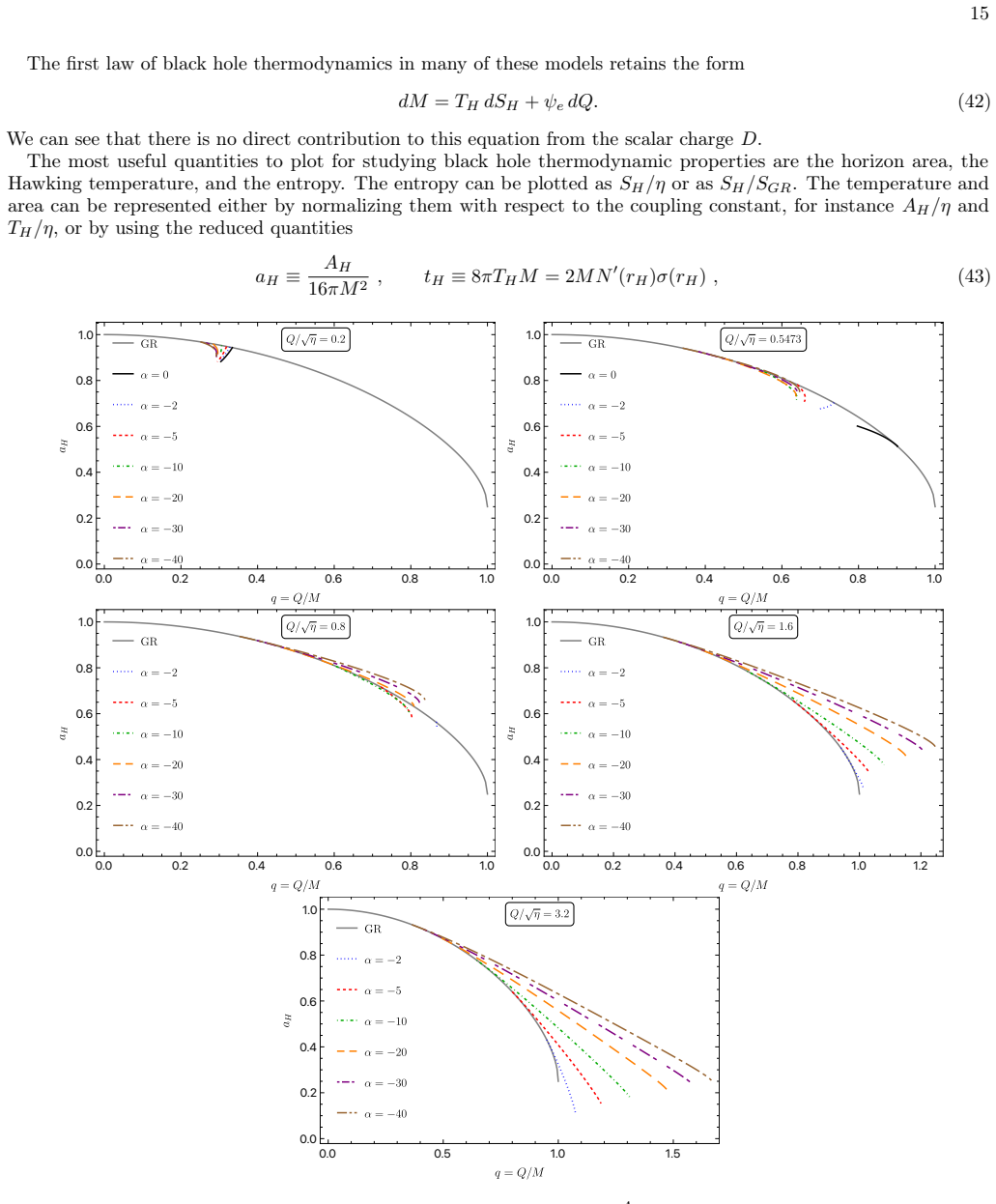
The central claim is that the action $S = \frac{1}{16\pi}\int d^4x \sqrt{-g}\, [R - 2\nabla_\mu\phi\nabla^\mu\phi + \frac{\eta}{2}\phi^2 \mathcal{G} - (1-\alpha\phi^2) F_{\mu\nu}F^{\mu\nu}]$ supports scalarized Reissner-Nordström black holes over a much wider parameter range than single-coupling models. On the fixed Reissner-Nordström background the linearized scalar equation gives $\mu_{\mathrm{eff}}^2 = -2\eta(6M^2r^2 - 12Q^2Mr + 5Q^4)/r^8 + \alpha Q^2/r^4$; the Maxwell term can make the total effective mass squared negative even when $\eta<0$, so the GB$_-$ window that earlier work located only near $q\approx 0.957$ moves to $q\gtrsim 0.2$ as $\alpha$ becomes more negative. The scalarized branches bifurcate at $\alpha$- and $Q$-dependent mass thresholds (spread over a factor of three to four), form new excited-state branches, and, for positive $\eta$ with negative $\alpha$, the solutions have higher entropy than Reissner-Nordström black holes and, once $Q/\sqrt{\eta}\gtrsim 1.6$, charge-to-mass ratios exceeding the extremal $q=1$ limit.
Load-bearing premise
The load-bearing premise is that the linearized scalar perturbation equation on the fixed Reissner-Nordström background, with the boundary condition $u\to 0$ at infinity, correctly identifies the scalarization thresholds, and that the branches whose direction suggests stability are indeed stable under perturbations.
Editorial extensions
If this is right
- Spontaneous scalarization with negative Gauss-Bonnet coupling no longer requires near-extremal charge: for $\alpha=-40$ the threshold drops to $q\approx 0.2$.
- The bifurcation mass depends on the matter coupling $\alpha$, so the same theory can scalarize low-mass and high-mass black holes at different strengths, unlike pure EsGB or EsGBR models.
- Scalarized branches that extend toward lower masses after bifurcation, found for large $|\alpha|$, are expected to be radially stable according to the branch-direction criterion.
- At $Q/\sqrt{\eta} \gtrsim 1.6$ the hairy solutions are overcharged ($q>1$) and have higher entropy than their Reissner-Nordström counterparts, making them thermodynamically preferred.
- New excited scalar-cloud branches ($n=1,2,3$) appear at intermediate $\alpha$, providing additional bifurcation lines that were absent in single-coupling models.
Reading between the lines
- If the negative-$\eta$ branches survive nonlinear backreaction, the dark-photon interpretation becomes testable: overcharged hairy black holes would carry a hidden charge that evades astrophysical discharge, potentially producing distinct gravitational-wave or shadow signatures.
- The stabilization suggested by the branch directions could be made quantitative by computing radial and axial quasinormal modes of the $\alpha\neq 0$ solutions; the paper's identification of a Maxwell-Horndeski subclass offers a ready framework for that analysis.
- Because the two couplings contribute to the effective mass with opposite signs, one could tune $\alpha$ and $\eta$ to make the scalarization threshold nearly charge-independent, a regime worth mapping explicitly in future work.
- The apparent convergence of scalar-charge curves toward similar endpoints hints that different couplings may share a common attractor; if confirmed, a universal endpoint mass and charge would simplify observational constraints.
Signed reviews
Editorial analysis
A structured set of objections, weighed in public.
Referee Report
Summary. The paper proposes an Einstein-Maxwell-scalar-Gauss-Bonnet model with quadratic couplings f(φ)=ηφ²/2 and g(φ)=1−αφ², and studies spontaneous scalarization of charged, spherically symmetric black holes. Section II.E derives the linearized scalar perturbation equation on a fixed Reissner-Nordström background (Eq. (36)) and maps, in Fig. 1, the threshold value of γ=η/M² as a function of q=Q/M for α=0,−2,...,−40. Section III reports numerical solutions of the full nonlinear equations for η>0 and α<0, obtained by shooting from the horizon, and presents scalar charge, area, temperature, and entropy, including branches that bifurcate at different masses and, for Q/√η≳1.6, overcharged solutions with q>1. The paper claims that the matter coupling broadens the scalarization window to negative η and moderate charges, that the branches with decreasing mass are likely stable following Refs. [90,91], and that the solutions have larger entropy than their Reissner-Nordström counterparts.
Significance. The model is a natural two-channel generalization of existing scalarization mechanisms, and the threshold analysis is a useful contribution: it reproduces the known α=0 case, introduces a clean dimensionless scaling (Eqs. (17) and (35)), and maps a previously unexplored parameter space. The paper's strengths are the explicit field equations, the transparent separation of the linearized threshold analysis from the nonlinear construction, and the clear identification of the free couplings (η and α) that are scanned rather than fitted. If the nonlinear η<0 solutions were constructed and the stability of the η>0 branches were checked by perturbation theory, the claimed enlargement of the scalarization window and the thermodynamic properties would be of broad interest for scalarization phenomenology. As it stands, however, the main advertised claims exceed what is demonstrated: the negative-η expansion rests on linearized zero-mode solutions, and the stability statement is a heuristic inference from branch direction.
major comments (3)
- [II.E, Eq. (36), Fig. 1, Sec. IV] The abstract and conclusions state that negative Gauss-Bonnet couplings now trigger scalarization for much broader charge intervals, but the only evidence is the existence of zero-mode solutions of the linearized scalar equation (36) on a fixed RN background. The paper explicitly says in Sec. II.E that back-reaction is neglected, and Sec. IV states that deriving η<0 black hole solutions is "one first step" for future work. Back-reaction can shift the thresholds and can alter the regularity condition Δ≥0 in Eq. (13); therefore the negative-η expansion claim is an extrapolation, not a demonstrated result. The authors should either construct the η<0 nonlinear solutions or restrict the abstract and conclusions to the linearized threshold analysis.
- [III.B] The stability inference is based on the direction of the scalar-charge branches after bifurcation, citing Refs. [90,91], rather than on a perturbation analysis of the model. The paper itself emphasizes that pure quadratic EsGB scalarized solutions are radially unstable, so the claim that adding matter coupling "appears to stabilize" the solutions is not established without computing radial and angular perturbations. At minimum, the text should label this as a conjecture and the abstract should not present stabilization as a result, or the authors should provide a perturbation calculation.
- [III.A, Figs. 2-6] The numerical results are presented without convergence tests, error estimates, or code availability. The branch-direction statements in Sec. III.B, including the turning point claimed for α=−10 in Fig. 3, depend on fine details of the shooting procedure; a small systematic error could change the inferred stability pattern. The authors should report the residual error as a function of integration domain and step size, provide a table of representative solutions, and ideally release the code used for the shooting method.
minor comments (5)
- [Throughout] There are typographical artifacts: "theU (1) charge" in Sec. I, "T op-left" and "F unctions" in Sec. II.E, and several missing spaces around parentheses and equations.
- [Fig. 1 caption] The caption says the curve is the "lower limit of the dimensionless Gauss-Bonnet coupling constant γ, which is necessary to guarantee the instability"; the plotted lines are thresholds for the appearance of a zero mode, not a guarantee of instability for all parameters above the line. Please rephrase to avoid overclaiming.
- [II.E] The text says "we neglect back-reaction" but then uses the stability analysis as motivation for the existence of scalarized solutions; please make the logical status explicit at the point where Eq. (36) is introduced.
- [III.B] The phrase "very close and almost identical (small difference)" is redundant; please clarify the precise statement for the α=0 case.
- [References] Several references have formatting issues (e.g., Ref. [16] and some "et al." entries); a careful copyediting pass is needed.
Circularity Check
No significant circularity: the couplings are scanned, not fitted; the threshold condition comes from a genuine linearized perturbation equation; and the deferred negative-eta solutions are an acknowledged limitation, not a circular step.
full rationale
The paper's claimed derivation chain is self-contained rather than circular. The central threshold analysis solves the linearized Klein-Gordon equation (36) on a fixed Reissner-Nordström background; Eq. (36) is obtained from the action (1) by standard perturbation theory, and the bifurcation curves in Fig. 1 are zero-mode solutions of that equation, not quantities fitted to the later nonlinear results. The coupling functions f(phi)=eta phi^2/2 and g(phi)=1-alpha phi^2 are chosen by stated simplicity (Sec. II E) and their parameters are scanned, not inferred from the target predictions. The nonlinear scalarized solutions of Sec. III are constructed by a shooting method from stated horizon and infinity boundary conditions, with no parameter extracted from the entropy, scalar-charge, or overcharging claims. The stability inference uses the external branch-direction criterion of Refs. [90,91] as a heuristic, which is an unverified analogy rather than a self-referential argument. The main caveat is explicit in the paper itself: Sec. IV states 'One first step should derive the black hole solutions for eta<0 (GB-)', conceding that the negative-eta claims rest on the linear analysis of Fig. 1, with nonlinear solutions not yet constructed. This is an incompleteness or over-claim, per the reader's take, but it is not circularity: nothing in the negative-eta threshold is defined in terms of the claimed result. Self-citations (e.g., Refs. [35], [71], [102]) are contextual motivation and are not load-bearing for the paper's original predictions. Therefore the appropriate circularity score is 0.
Assumptions & free parameters
free parameters (2)
- eta (Gauss-Bonnet coupling strength)
- alpha (Maxwell coupling strength)
assumptions (4)
- domain assumption The RN metric with phi=0 is a solution when f'(0)=g'(0)=0, and the tachyonic instability criterion mu_eff^2 < 0 signals the onset of scalarization.
- domain assumption The linearized perturbation equation on the fixed RN background, with u vanishing at infinity, gives the bifurcation thresholds of the full nonlinear problem.
- ad hoc to paper Branches that extend toward smaller masses after bifurcation are stable, following the criterion suggested in Refs. [90,91].
- ad hoc to paper The quadratic coupling functions f=eta/2 phi^2 and g=1-alpha phi^2 are representative for scalarization thresholds.
Cite this review
Pith. "Pith review of New model of spontaneous scalarization of black holes induced by curvature and matter." pith.science (2026). https://pith.science/paper/YORLA4S6
@misc{pith2026250612137,
  author       = {Pith},
  title        = {Pith review of: New model of spontaneous scalarization of black holes induced by curvature and matter},
  year         = {2026},
  howpublished = {\url{https://pith.science/paper/YORLA4S6}},
  note         = {Machine review of arXiv:2506.12137}
}
abstract
We propose a new model of black hole spontaneous scalarization that combines a scalar--Gauss--Bonnet interaction with a non--minimal coupling to a U(1) gauge field (a dark photon or an electromagnetic field). This construction generalizes earlier single-coupling setups and allows both curvature--induced and matter--induced scalarization within one framework, which allows us to overcome the limitations of each mechanism alone. We focus on charged, spherically symmetric black holes and demonstrate that our model substantially expands the range of black hole masses and charges that permit scalar hair. Negative Gauss--Bonnet couplings, previously associated only with near--extremal charges or rapidly spinning black holes, now trigger scalarization for much broader charge intervals. We develop a numerical procedure to solve the field equations, and investigate the various properties of these black holes. This results in new branches emerging at distinct mass thresholds, a behavior not seen in the pure Einstein--scalar--Gauss--Bonnet or Einstein--scalar--Gauss--Bonnet--Ricci models. The scalar charge depends sensitively on the coupling parameters and on the $U(1)$ charge. Our analysis also shows that these black holes have larger entropy than their Reissner--Nordstr\"om counterparts and can become overcharged, surpassing the usual extremal limit of charge-to-mass ratio. Analyzing the scalar charge behavior suggests that adding matter-coupling appears to stabilize solutions that were previously prone to higher-order instabilities in pure Gauss--Bonnet models with quadratic coupling and broadens the range of possible configurations, making this model a promising candidate for further studies in strong gravity.
Figures


Figures from the paper (3 more)


Forward citations
Cited by 1 Pith paper
-
Curvature-induced scalarization of charged AdS black holes
The Breitenlohner-Freedman bound restricts Gauss-Bonnet scalarization of RN-AdS black holes to a single fundamental branch for 0<η<2.25, with a separate single branch for η<0.
Reference graph
Works this paper leans on
-
[1]
B. P. Abbott, R. Abbott, T. Abbott, M. Abernathy, F. Acernese, K. Ackley, C. Adams, T. Adams, P. Addesso, R. Adhikari, et al., Observation of gravitational waves from a binary black hole merger, Physical review letters116, 061102 (2016)
2016
-
[2]
Ball, C.-k
D. Ball, C.-k. Chan, P. Christian, B. T. Jannuzi, J. Kim, D. P. Marrone, L. Medeiros, F. Ozel, D. Psaltis, M. Rose,et al., First m87 event horizon telescope results. i. the shadow of the supermassive black hole, IOP PUBLISHING LTD (2019)
2019
-
[3]
η β2 (1 − 1 cosh(β ϕ) )
-
[4]
ηϕ2 2 (1+β2 ϕ2) F unctions for g(ϕ) [45, 69, 72]:
-
[5]
(27) we get the metric of the RN black hole, which has an event horizon located at rH = M + p M 2 − Q2
1 1+αϕ2 For smallϕ they all have the same behavior, so for simplicity here we adopt the simplest quadratic form : f (ϕ) = η 2 ϕ2, g (ϕ) = 1 − αϕ2 (26) where α is a dimensionless coupling constant.4 If we take the ansatz (9) and put N (r) = 1 − 2M r + Q2 r2 , σ (r) = 1, V (r) = Q r . (27) we get the metric of the RN black hole, which has an event horizon l...
-
[6]
Akiyama, A
K. Akiyama, A. Alberdi, W. Alef, J. C. Algaba, R. Anantua, K. Asada, R. Azulay, U. Bach, A.-K. Baczko, D. Ball,et al., First sagittarius a* event horizon telescope results. i. the shadow of the supermassive black hole in the center of the milky way, The Astrophysical Journal Letters930, L12 (2022)
2022
-
[7]
C. A. Herdeiro, Black holes: on the universality of the kerr hypothesis, inModified and Quantum Gravity: From Theory to Experimental Searches on All Scales(Springer, 2023) pp. 315–331
2023
-
[8]
Barausse, E
E. Barausse, E. Berti, T. Hertog, S. A. Hughes, P. Jetzer, P. Pani, T. P. Sotiriou, N. Tamanini, H. Witek, K. Yagi,et al., Prospects for fundamental physics with lisa, General Relativity and Gravitation52, 1 (2020)
2020
Show all 166 references
-
[9]
K. Arun, E. Belgacem, R. Benkel, L. Bernard, E. Berti, G. Bertone, M. Besancon, D. Blas, C. G. Böhmer, R. Brito,et al., New horizons for fundamental physics with lisa, Living Reviews in Relativity25, 4 (2022)
2022
-
[10]
Auclair, D
P. Auclair, D. Bacon, T. Baker, T. Barreiro, N. Bartolo, E. Belgacem, N. Bellomo, I. Ben-Dayan, D. Bertacca, M. Besancon, et al., Cosmology with the laser interferometer space antenna, Living Reviews in Relativity26, 5 (2023)
2023
-
[11]
A. Abac, R. Abramo, S. Albanesi, A. Albertini, A. Agapito, M. Agathos, C. Albertus, N. Andersson, T. Andrade, I. Andreoni,et al., The science of the einstein telescope, arXiv preprint arXiv:2503.12263 (2025)
2025 arXiv
-
[12]
Maggiore, C
M. Maggiore, C. Van Den Broeck, N. Bartolo, E. Belgacem, D. Bertacca, M. A. Bizouard, M. Branchesi, S. Clesse, S. Foffa, J. García-Bellido,et al., Science case for the einstein telescope, Journal of Cosmology and Astroparticle Physics2020 (03), 050
-
[13]
Hawking, Black holes in the brans-dicke: Theory of gravitation, Communications in Mathematical Physics25, 167 (1972)
S. Hawking, Black holes in the brans-dicke: Theory of gravitation, Communications in Mathematical Physics25, 167 (1972)
1972
-
[14]
J. D. Bekenstein, Transcendence of the law of baryon-number conservation in black-hole physics, Physical Review Letters 28, 452 (1972)
1972
-
[15]
no-scalar-hair
J. D. Bekenstein, Novel “no-scalar-hair”theorem for black holes, Physical Review D51, R6608 (1995)
1995
-
[16]
Bocharova, K
N. Bocharova, K. Bronnikov, and V. Melnikov, An exact solution of the system of einstein equations and mass-free scalar field, Vestn. Mosk. Univ. Fiz. Astro6, 706 (1970)
1970
-
[17]
J. D. Bekenstein, Exact solutions of einstein-conformal scalar equations, Annals of Physics82, 535 (1974)
1974
-
[18]
Clifton, P
T. Clifton, P. G. Ferreira, A. Padilla, and C. Skordis, Modified gravity and cosmology, Physics reports513, 1 (2012)
2012
-
[19]
T. P. Sotiriou and V. Faraoni, Black holes in scalar-tensor gravity, Physical Review Letters108, 081103 (2012)
2012
-
[20]
Heisenberg, A systematic approach to generalisations of general relativity and their cosmological implications, Physics Reports 796, 1 (2019)
L. Heisenberg, A systematic approach to generalisations of general relativity and their cosmological implications, Physics Reports 796, 1 (2019)
2019
-
[21]
E. N. Saridakis, R. Lazkoz, V. Salzano, P. V. Moniz, S. Capozziello, J. B. Jiménez, M. De Laurentis, and G. J. Olmo, Modified gravity and cosmology, Tech. Rep. (Springer, 2021)
2021
-
[22]
Charmousis, Higher order gravity theories and their black hole solutions, inPhysics of Black Holes: A Guided Tour (Springer, 2009) pp
C. Charmousis, Higher order gravity theories and their black hole solutions, inPhysics of Black Holes: A Guided Tour (Springer, 2009) pp. 299–346
2009
-
[23]
Brans and R
C. Brans and R. H. Dicke, Mach’s principle and a relativistic theory of gravitation, Physical review124, 925 (1961)
1961
-
[24]
G. W. Horndeski, Second-order scalar-tensor field equations in a four-dimensional space, International Journal of Theoretical Physics 10, 363 (1974). 20
1974
-
[25]
Deffayet, X
C. Deffayet, X. Gao, D. A. Steer, and G. Zahariade, From k-essence to generalized galileons, Physical Review D—Particles, Fields, Gravitation, and Cosmology84, 064039 (2011)
2011
-
[26]
Kobayashi, M
T. Kobayashi, M. Yamaguchi, and J. Yokoyama, Generalized g-inflation: —inflation with the most general second-order field equations—, Progress of Theoretical Physics126, 511 (2011)
2011
-
[27]
Deffayet and D
C. Deffayet and D. A. Steer, A formal introduction to horndeski and galileon theories and their generalizations, Classical and Quantum Gravity30, 214006 (2013)
2013
-
[28]
Kobayashi, Horndeski theory and beyond: a review, Reports on Progress in Physics82, 086901 (2019)
T. Kobayashi, Horndeski theory and beyond: a review, Reports on Progress in Physics82, 086901 (2019)
2019
-
[29]
Hui and A
L. Hui and A. Nicolis, No-hair theorem for the galileon, Physical Review Letters110, 241104 (2013)
2013
-
[30]
T. P. Sotiriou and S.-Y. Zhou, Black hole hair in generalized scalar-tensor gravity, Physical Review Letters112, 251102 (2014)
2014
-
[31]
Zwiebach, Curvature squared terms and string theories, Physics Letters B156, 315 (1985)
B. Zwiebach, Curvature squared terms and string theories, Physics Letters B156, 315 (1985)
1985
-
[32]
R. I. Nepomechie, Low-energy limit of strings, Physical Review D32, 3201 (1985)
1985
-
[33]
Candelas, G
P. Candelas, G. T. Horowitz, A. Strominger, and E. Witten, Vacuum configurations for superstrings, Nuclear Physics B 258, 46 (1985)
1985
-
[34]
C. G. Callan, I. R. Klebanov, and M. Perry, String theory effective actions, Nuclear Physics B278, 78 (1986)
1986
-
[35]
D. J. Gross and J. H. Sloan, The quartic effective action for the heterotic string, Nuclear Physics B291, 41 (1987)
1987
-
[36]
Lovelock, Divergence-free tensorial concomitants, Aequationes mathematicae4, 127 (1970)
D. Lovelock, Divergence-free tensorial concomitants, Aequationes mathematicae4, 127 (1970)
1970
-
[37]
Lovelock, The einstein tensor and its generalizations, Journal of Mathematical Physics12, 498 (1971)
D. Lovelock, The einstein tensor and its generalizations, Journal of Mathematical Physics12, 498 (1971)
1971
-
[38]
Mignemi and N
S. Mignemi and N. Stewart, Charged black holes in effective string theory, Physical Review D47, 5259 (1993)
1993
-
[39]
Kanti, N
P. Kanti, N. E. Mavromatos, J. Rizos, K. Tamvakis, and E. Winstanley, Dilatonic black holes in higher curvature string gravity, Physical Review D54, 5049 (1996)
1996
-
[40]
Antoniou, A
G. Antoniou, A. Bakopoulos, and P. Kanti, Evasion of no-hair theorems and novel black-hole solutions in gauss-bonnet theories, Physical review letters120, 131102 (2018)
2018
-
[41]
Antoniou, A
G. Antoniou, A. Bakopoulos, and P. Kanti, Black-hole solutions with scalar hair in einstein-scalar-gauss-bonnet theories, Physical Review D97, 084037 (2018)
2018
-
[42]
G. W. Gibbons and K.-i. Maeda, Black holes and membranes in higher-dimensional theories with dilaton fields, Nuclear Physics B 298, 741 (1988)
1988
-
[43]
Garfinkle, G
D. Garfinkle, G. T. Horowitz, and A. Strominger, Charged black holes in string theory, Physical Review D43, 3140 (1991)
1991
-
[44]
D. D. Doneva, F. M. Ramazanoğlu, H. O. Silva, T. P. Sotiriou, and S. S. Yazadjiev, Spontaneous scalarization, Reviews of Modern Physics 96, 015004 (2024)
2024
-
[45]
Damour and G
T. Damour and G. Esposito-Farese, Nonperturbative strong-field effects in tensor-scalar theories of gravitation, Physical Review Letters 70, 2220 (1993)
1993
-
[46]
D. D. Doneva and S. S. Yazadjiev, New gauss-bonnet black holes with curvature-induced scalarization in extended scalar-tensor theories, Physical review letters120, 131103 (2018)
2018
-
[47]
H. O. Silva, J. Sakstein, L. Gualtieri, T. P. Sotiriou, and E. Berti, Spontaneous scalarization of black holes and compact stars from a Gauss-Bonnet coupling, Physical Review Letters120, 10.1103/PhysRevLett.120.131104 (2018)
2018 doi
-
[48]
C. A. Herdeiro, E. Radu, N. Sanchis-Gual, and J. A. Font, Spontaneous scalarization of charged black holes, Physical review letters 121, 101102 (2018)
2018
-
[49]
Y. S. Myung and D.-C. Zou, Instability of reissner–nordström black hole in einstein-maxwell-scalar theory, The European Physical Journal C79, 1 (2019)
2019
-
[50]
D. D. Doneva and S. S. Yazadjiev, Spontaneously scalarized black holes in dynamical chern-simons gravity: dynamics and equilibrium solutions, Physical Review D103, 083007 (2021)
2021
-
[51]
Y.-X. Gao, Y. Huang, and D.-J. Liu, Scalar perturbations on the background of kerr black holes in the quadratic dynamical chern-simons gravity, Physical Review D99, 044020 (2019)
2019
-
[52]
Y. S. Myung and D.-C. Zou, Onset of rotating scalarized black holes in einstein-chern-simons-scalar theory, Physics Letters B 814, 136081 (2021)
2021
-
[53]
Minamitsuji and T
M. Minamitsuji and T. Ikeda, Scalarized black holes in the presence of the coupling to gauss-bonnet gravity, Physical Review D 99, 044017 (2019)
2019
-
[54]
H. O. Silva, H. Witek, M. Elley, and N. Yunes, Dynamical descalarization in binary black hole mergers, Physical review letters 127, 031101 (2021)
2021
-
[55]
Andreou, N
N. Andreou, N. Franchini, G. Ventagli, and T. P. Sotiriou, Spontaneous scalarization in generalized scalar-tensor theory, Physical Review D99, 124022 (2019)
2019
-
[56]
D. D. Doneva, K. V. Staykov, and S. S. Yazadjiev, Gauss-bonnet black holes with a massive scalar field, Physical Review D 99, 104045 (2019)
2019
-
[57]
J. L. Blázquez-Salcedo, D. D. Doneva, S. Kahlen, J. Kunz, P. Nedkova, and S. S. Yazadjiev, Axial perturbations of the scalarized einstein-gauss-bonnet black holes, Physical Review D101, 104006 (2020)
2020
-
[58]
J. L. Blázquez-Salcedo, D. D. Doneva, S. Kahlen, J. Kunz, P. Nedkova, and S. S. Yazadjiev, Polar quasinormal modes of the scalarized einstein-gauss-bonnet black holes, Physical Review D102, 024086 (2020)
2020
-
[59]
Brihaye and L
Y. Brihaye and L. Ducobu, Hairy black holes, boson stars and non-minimal coupling to curvature invariants, Physics Letters B 795, 135 (2019)
2019
-
[60]
Julié, H
F.-L. Julié, H. O. Silva, E. Berti, and N. Yunes, Black hole sensitivities in einstein-scalar-gauss-bonnet gravity, Physical Review D 105, 124031 (2022)
2022
-
[61]
D. D. Doneva, A. Vañó-Viñuales, and S. S. Yazadjiev, Dynamical descalarization with a jump during a black hole merger, Physical Review D106, L061502 (2022). 21
2022
-
[62]
Minamitsuji and T
M. Minamitsuji and T. Ikeda, Spontaneous scalarization of black holes in the horndeski theory, Physical Review D99, 104069 (2019)
2019
-
[63]
L. K. Wong, C. A. Herdeiro, and E. Radu, Constraining spontaneous black hole scalarization in scalar-tensor-gauss-bonnet theories with current gravitational-wave data, Physical Review D106, 024008 (2022)
2022
-
[64]
Brihaye, C
Y. Brihaye, C. Herdeiro, and E. Radu, Black hole spontaneous scalarisation with a positive cosmological constant, Physics Letters B 802, 135269 (2020)
2020
-
[65]
D. D. Doneva and S. S. Yazadjiev, Beyond the spontaneous scalarization: New fully nonlinear mechanism for the formation of scalarized black holes and its dynamical development, Physical Review D105, L041502 (2022)
2022
-
[66]
Antoniou, L
G. Antoniou, L. Bordin, and T. P. Sotiriou, Compact object scalarization with general relativity as a cosmic attractor, Physical Review D103, 024012 (2021)
2021
-
[67]
Ventagli, A
G. Ventagli, A. Lehébel, and T. P. Sotiriou, Onset of spontaneous scalarization in generalized scalar-tensor theories, Physical Review D102, 024050 (2020)
2020
-
[68]
P. V. Cunha, C. A. Herdeiro, and E. Radu, Spontaneously scalarized kerr black holes in extended scalar-tensor–gauss-bonnet gravity, Physical Review Letters123, 011101 (2019)
2019
-
[69]
L. G. Collodel, B. Kleihaus, J. Kunz, and E. Berti, Spinning and excited black holes in einstein-scalar-gauss–bonnet theory, Classical and Quantum Gravity37, 075018 (2020)
2020
-
[70]
H.-J. Kuan, D. D. Doneva, and S. S. Yazadjiev, Dynamical formation of scalarized black holes and neutron stars through stellar core collapse, Physical Review Letters127, 161103 (2021)
2021
-
[71]
V. I. Danchev, D. D. Doneva, and S. S. Yazadjiev, Constraining scalarization in scalar-gauss-bonnet gravity through binary pulsars, Physical Review D106, 124001 (2022)
2022
-
[72]
P. G. Fernandes, C. A. Herdeiro, A. M. Pombo, E. Radu, and N. Sanchis-Gual, Spontaneous scalarisation of charged black holes: coupling dependence and dynamical features, Classical and Quantum Gravity36, 134002 (2019)
2019
-
[73]
Astefanesei, C
D. Astefanesei, C. Herdeiro, A. Pombo, and E. Radu, Einstein-maxwell-scalar black holes: classes of solutions, dyons and extremality, Journal of High Energy Physics2019, 1 (2019)
2019
-
[74]
Belkhadria and A
Z. Belkhadria and A. M. Pombo, Mixed scalarization of charged black holes: From spontaneous to nonlinear scalarization, Physical Review D110, 044014 (2024)
2024
-
[75]
Konoplya and A
R. Konoplya and A. Zhidenko, Analytical representation for metrics of scalarized einstein-maxwell black holes and their shadows, Physical Review D100, 044015 (2019)
2019
-
[76]
Q. Gan, P. Wang, H. Wu, and H. Yang, Photon ring and observational appearance of a hairy black hole, Physical Review D 104, 044049 (2021)
2021
-
[77]
Y. S. Myung and D.-C. Zou, Quasinormal modes of scalarized black holes in the einstein–maxwell–scalar theory, Physics Letters B 790, 400 (2019)
2019
-
[78]
Y. S. Myung and D.-C. Zou, Stability of scalarized charged black holes in the einstein–maxwell–scalar theory, The European Physical Journal C79, 1 (2019)
2019
-
[79]
Zou and Y
D.-C. Zou and Y. S. Myung, Scalarized charged black holes with scalar mass term, Physical Review D100, 124055 (2019)
2019
-
[80]
J. L. Blázquez-Salcedo, C. A. Herdeiro, J. Kunz, A. M. Pombo, and E. Radu, Einstein-maxwell-scalar black holes: the hot, the cold and the bald, Physics Letters B806, 135493 (2020)
2020
-
[81]
J. L. Blázquez-Salcedo, C. A. Herdeiro, S. Kahlen, J. Kunz, A. M. Pombo, and E. Radu, Quasinormal modes of hot, cold and bald einstein–maxwell-scalar black holes, The European Physical Journal C81, 1 (2021)
2021
-
[82]
G. Guo, P. Wang, H. Wu, and H. Yang, Quasinormal modes of black holes with multiple photon spheres, Journal of High Energy Physics 2022, 1 (2022)
2022
-
[83]
P. G. Fernandes, Einstein–maxwell-scalar black holes with massive and self-interacting scalar hair, Physics of the Dark Universe 30, 100716 (2020)
2020
-
[84]
Zhang, Q
C.-Y. Zhang, Q. Chen, Y. Liu, W.-K. Luo, Y. Tian, and B. Wang, Critical phenomena in dynamical scalarization of charged black holes, Physical Review Letters128, 161105 (2022)
2022
-
[85]
Zhang, P
C.-Y. Zhang, P. Liu, Y.-Q. Liu, C. Niu, and B. Wang, Dynamical charged black hole spontaneous scalarization in anti–de sitter spacetimes, Physical Review D104, 084089 (2021)
2021
-
[86]
Khalil, N
M. Khalil, N. Sennett, J. Steinhoff, and A. Buonanno, Theory-agnostic framework for dynamical scalarization of compact binaries, Physical Review D100, 124013 (2019)
2019
-
[87]
D. D. Doneva, S. Kiorpelidi, P. G. Nedkova, E. Papantonopoulos, and S. S. Yazadjiev, Charged gauss-bonnet black holes with curvature induced scalarization in the extended scalar-tensor theories, Physical Review D98, 104056 (2018)
2018
-
[88]
Brihaye and B
Y. Brihaye and B. Hartmann, Spontaneous scalarization of charged black holes at the approach to extremality, Physics Letters B 792, 244 (2019)
2019
-
[89]
C. A. Herdeiro, A. M. Pombo, and E. Radu, Aspects of gauss-bonnet scalarisation of charged black holes, Universe7, 483 (2021)
2021
-
[90]
J. L. Blázquez-Salcedo, B. Kleihaus, and J. Kunz, Instabilities of black holes in einstein-scalar–gauss–bonnet theories, General Relativity and Gravitation56, 99 (2024)
2024
-
[91]
J. L. Blázquez-Salcedo, D. D. Doneva, J. Kunz, and S. S. Yazadjiev, Radial perturbations of the scalarized einstein-gauss- bonnet black holes, Physical Review D98, 084011 (2018)
2018
-
[92]
H. O. Silva, C. F. Macedo, T. P. Sotiriou, L. Gualtieri, J. Sakstein, and E. Berti, Stability of scalarized black hole solutions in scalar-gauss-bonnet gravity, Physical Review D99, 064011 (2019)
2019
-
[93]
C. F. Macedo, J. Sakstein, E. Berti, L. Gualtieri, H. O. Silva, and T. P. Sotiriou, Self-interactions and spontaneous black hole scalarization, Physical Review D99, 104041 (2019). 22
2019
-
[94]
Antoniou, A
G. Antoniou, A. Lehébel, G. Ventagli, and T. P. Sotiriou, Black hole scalarization with gauss-bonnet and ricci scalar couplings, Physical Review D104, 044002 (2021)
2021
-
[95]
Antoniou, C
G. Antoniou, C. F. Macedo, R. McManus, and T. P. Sotiriou, Stable spontaneously-scalarized black holes in generalized scalar-tensor theories, Physical Review D106, 024029 (2022)
2022
-
[96]
Kleihaus, J
B. Kleihaus, J. Kunz, T. Utermöhlen, and E. Berti, Quadrupole instability of static scalarized black holes, Physical Review D 107, L081501 (2023)
2023
-
[97]
Minamitsuji and S
M. Minamitsuji and S. Mukohyama, Instability of scalarized compact objects in einstein-scalar-gauss-bonnet theories, Physical Review D108, 024029 (2023)
2023
-
[98]
Minamitsuji, S
M. Minamitsuji, S. Mukohyama, and S. Tsujikawa, Angular and radial stabilities of spontaneously scalarized black holes in the presence of scalar-gauss-bonnet couplings, Physical Review D109, 104057 (2024)
2024
-
[99]
W. E. East and J. L. Ripley, Dynamics of spontaneous black hole scalarization and mergers in einstein-scalar-gauss-bonnet gravity, Physical Review Letters127, 101102 (2021)
2021
-
[100]
D. D. Doneva, L. A. Saló, K. Clough, P. Figueras, and S. S. Yazadjiev, Testing the limits of scalar-gauss-bonnet gravity through nonlinear evolutions of spin-induced scalarization, Physical Review D108, 084017 (2023)
2023
-
[101]
D. D. Doneva, L. A. Saló, and S. S. Yazadjiev, 3+ 1 nonlinear evolution of ricci-coupled scalar-gauss-bonnet gravity, Physical Review D110, 024040 (2024)
2024
-
[102]
Hegade KR, J
A. Hegade KR, J. L. Ripley, and N. Yunes, Where and why does einstein-scalar-gauss-bonnet theory break down?, Physical Review D 107, 044044 (2023)
2023
-
[103]
Thaalba, M
F. Thaalba, M. Bezares, N. Franchini, and T. P. Sotiriou, Spherical collapse in scalar-gauss-bonnet gravity: Taming ill-posedness with a ricci coupling, Physical Review D109, L041503 (2024)
2024
-
[104]
Franchini, M
N. Franchini, M. Bezares, E. Barausse, and L. Lehner, Fixing the dynamical evolution in scalar-gauss-bonnet gravity, Physical Review D106, 064061 (2022)
2022
-
[105]
Mignemi, Dyonic black holes in effective string theory, Physical Review D51, 934 (1995)
S. Mignemi, Dyonic black holes in effective string theory, Physical Review D51, 934 (1995)
1995
-
[106]
Torii, H
T. Torii, H. Yajima, and K.-i. Maeda, Dilatonic black holes with a gauss-bonnet term, Physical Review D55, 739 (1997)
1997
-
[107]
Alexeyev and M
S. Alexeyev and M. Pomazanov, Singular regions in black hole solutions in higher order curvature gravity, arXiv preprint gr-qc/9706066 (1997)
1997 arXiv
-
[108]
Torii and K.-i
T. Torii and K.-i. Maeda, Stability of a dilatonic black hole with a gauss-bonnet term, Physical Review D58, 084004 (1998)
1998
-
[109]
Kase and S
R. Kase and S. Tsujikawa, Black hole perturbations in maxwell-horndeski theories, Physical Review D107, 104045 (2023)
2023
-
[110]
Y. Bai, J. Berger, M. Korwar, and N. Orlofsky, Phenomenology of magnetic black holes with electroweak-symmetric coronas, Journal of High Energy Physics2020, 1 (2020)
2020
-
[111]
Ghosh, A
D. Ghosh, A. Thalapillil, and F. Ullah, Astrophysical hints for magnetic black holes, Physical Review D103, 023006 (2021)
2021
-
[112]
M. D. Diamond and D. E. Kaplan, Constraints on relic magnetic black holes, Journal of High Energy Physics2022, 1 (2022)
2022
-
[113]
Gervalle and M
R. Gervalle and M. S. Volkov, Black holes with electroweak hair, Physical Review Letters133, 171402 (2024)
2024
-
[114]
Pereñiguez, M
D. Pereñiguez, M. de Amicis, R. Brito, and R. P. Macedo, Superradiant instability of magnetic black holes, Physical Review D 110, 104001 (2024)
2024
-
[115]
Dyson and D
C. Dyson and D. Pereñiguez, Magnetic black holes: From thomson dipoles to the penrose process and cosmic censorship, Physical Review D108, 084064 (2023)
2023
-
[116]
Maldacena, Comments on magnetic black holes, Journal of High Energy Physics2021, 1 (2021)
J. Maldacena, Comments on magnetic black holes, Journal of High Energy Physics2021, 1 (2021)
2021
-
[117]
Alexander, M
J. Alexander, M. Battaglieri, B. Echenard, R. Essig, M. Graham, E. Izaguirre, J. Jaros, G. Krnjaic, J. Mardon, D. Morrissey, et al., Dark sectors 2016 workshop: community report, arXiv preprint arXiv:1608.08632 (2016)
2016 arXiv
-
[118]
Ackerman, M
L. Ackerman, M. R. Buckley, S. M. Carroll, and M. Kamionkowski, Dark matter and dark radiation, Physical Review D—Particles, Fields, Gravitation, and Cosmology79, 023519 (2009)
2009
-
[119]
A. E. Nelson and J. Scholtz, Dark light, dark matter, and the misalignment mechanism, Physical Review D—Particles, Fields, Gravitation, and Cosmology84, 103501 (2011)
2011
-
[120]
Fabbrichesi, E
M. Fabbrichesi, E. Gabrielli, and G. Lanfranchi,The physics of the dark photon: a primer(Springer, 2021)
2021
-
[121]
Curtin, R
D. Curtin, R. Essig, S. Gori, and J. Shelton, Illuminating dark photons with high-energy colliders, Journal of High Energy Physics 2015, 1 (2015)
2015
-
[122]
S. A. Abel, M. D. Goodsell, J. Jaeckel, V. Khoze, and A. Ringwald, Kinetic mixing of the photon with hidden u (1) s in string phenomenology, Journal of High Energy Physics2008, 124 (2008)
2008
-
[123]
Foot and S
R. Foot and S. Vagnozzi, Dissipative hidden sector dark matter, Physical Review D91, 023512 (2015)
2015
-
[124]
H. An, M. Pospelov, and J. Pradler, New stellar constraints on dark photons, Physics Letters B725, 190 (2013)
2013
-
[125]
Caputo, A
A. Caputo, A. J. Millar, C. A. O’Hare, and E. Vitagliano, Dark photon limits: A handbook, Physical Review D104, 095029 (2021)
2021
-
[126]
Agrawal, N
P. Agrawal, N. Kitajima, M. Reece, T. Sekiguchi, and F. Takahashi, Relic abundance of dark photon dark matter, Physics Letters B 801, 135136 (2020)
2020
-
[127]
Chaudhuri, P
S. Chaudhuri, P. W. Graham, K. Irwin, J. Mardon, S. Rajendran, and Y. Zhao, Radio for hidden-photon dark matter detection, Physical Review D92, 075012 (2015)
2015
-
[128]
Mirizzi, J
A. Mirizzi, J. Redondo, and G. Sigl, Microwave background constraints on mixing of photons with hidden photons, Journal of Cosmology and Astroparticle Physics2009 (03), 026
-
[129]
H. An, M. Pospelov, and J. Pradler, Dark matter detectors as dark photon helioscopes, Physical review letters111, 041302 (2013). 23
2013
-
[130]
Pierce, K
A. Pierce, K. Riles, and Y. Zhao, Searching for dark photon dark matter with gravitational-wave detectors, Physical review letters 121, 061102 (2018)
2018
-
[131]
Caputo, H
A. Caputo, H. Liu, S. Mishra-Sharma, and J. T. Ruderman, Dark photon oscillations in our inhomogeneous universe, Physical Review Letters125, 221303 (2020)
2020
-
[132]
J. L. Feng, J. Smolinsky, and P. Tanedo, Detecting dark matter through dark photons from the sun: Charged particle signatures, Physical Review D93, 115036 (2016)
2016
-
[133]
C. J. Villas-Boas, C. E. Máximo, P. J. Paulino, R. P. Bachelard, and G. Rempe, Bright and dark states of light: The quantum origin of classical interference, Physical Review Letters134, 133603 (2025)
2025
-
[134]
H. An, S. Ge, J. Liu, and M. Liu, In situ measurements of dark photon dark matter using parker solar probe: Going beyond the radio window, Physical Review Letters134, 171001 (2025)
2025
-
[135]
A. J. Long and L.-T. Wang, Dark photon dark matter from a network of cosmic strings, Physical Review D99, 063529 (2019)
2019
-
[136]
Cardoso, C
V. Cardoso, C. F. Macedo, P. Pani, and V. Ferrari, Black holes and gravitational waves in models of minicharged dark matter, Journal of Cosmology and Astroparticle Physics2016 (05), 054
-
[137]
Cardoso, P
V. Cardoso, P. Pani, and T.-T. Yu, Superradiance in rotating stars and pulsar-timing constraints on dark photons, Physical Review D 95, 124056 (2017)
2017
-
[138]
Cardoso, Ó
V. Cardoso, Ó. J. Dias, G. S. Hartnett, M. Middleton, P. Pani, and J. E. Santos, Constraining the mass of dark photons and axion-like particles through black-hole superradiance, Journal of Cosmology and Astroparticle Physics2018 (03), 043
-
[139]
Alexander, E
S. Alexander, E. McDonough, R. Sims, and N. Yunes, Hidden-sector modifications to gravitational waves from binary inspirals, Classical and Quantum Gravity35, 235012 (2018)
2018
-
[140]
Caputo, S
A. Caputo, S. J. Witte, D. Blas, and P. Pani, Electromagnetic signatures of dark photon superradiance, Physical Review D 104, 043006 (2021)
2021
-
[141]
P. K. Gupta, T. F. Spieksma, P. T. Pang, G. Koekoek, and C. Van Den Broeck, Bounding dark charges on binary black holes using gravitational waves, Physical Review D104, 063041 (2021)
2021
-
[142]
W. E. East and J. Huang, Dark photon vortex formation and dynamics, Journal of High Energy Physics2022, 1 (2022)
2022
-
[143]
Cannizzaro, L
E. Cannizzaro, L. Sberna, A. Caputo, and P. Pani, Dark photon superradiance quenched by dark matter, Physical Review D 106, 083019 (2022)
2022
-
[144]
W. E. East, Vortex string formation in black hole superradiance of a dark photon with the higgs mechanism, Physical Review Letters 129, 141103 (2022)
2022
-
[145]
Siemonsen, C
N. Siemonsen, C. Mondino, D. Egana-Ugrinovic, J. Huang, M. Baryakhtar, and W. E. East, Dark photon superradiance: Electrodynamics and multimessenger signals, Physical Review D107, 075025 (2023)
2023
-
[146]
Xin and E
S. Xin and E. R. Most, Dark magnetohydrodynamics: Black hole accretion in superradiant dark photon clouds, Physical Review D 111, 063050 (2025)
2025
-
[147]
Övgün and R
A. Övgün and R. C. Pantig, Black hole solutions in dark photon models with higher order corrections, arXiv preprint arXiv:2505.01649 (2025)
2025 arXiv
-
[148]
Bhattacharyya, S
A. Bhattacharyya, S. Ghosh, and S. Pal, Worldline effective field theory of inspiralling black hole binaries in presence of dark photon and axionic dark matter, Journal of High Energy Physics2023, 1 (2023)
2023
-
[149]
Zilhao, V
M. Zilhao, V. Cardoso, C. Herdeiro, L. Lehner, and U. Sperhake, Collisions of charged black holes, Physical Review D—Particles, Fields, Gravitation, and Cosmology85, 124062 (2012)
2012
-
[150]
S. D. Majumdar, A class of exact solutions of einstein’s field equations, Physical Review72, 390 (1947)
1947
-
[151]
Papapetrou, Einstein’s theory of gravitation and flat space, inProceedings of the Royal Irish Academy
A. Papapetrou, Einstein’s theory of gravitation and flat space, inProceedings of the Royal Irish Academy. Section A: Mathematical and Physical Sciences, Vol. 52 (JSTOR, 1948) pp. 11–23
1948
-
[152]
Gibbons and C
G. Gibbons and C. Hull, A bogomolny bound for general relativity and solitons in n= 2 supergravity, Physics Letters B 109, 190 (1982)
1982
-
[153]
Tod, All metrics admitting super-covariantly constant spinors, Physics Letters B121, 241 (1983)
K. Tod, All metrics admitting super-covariantly constant spinors, Physics Letters B121, 241 (1983)
1983
-
[154]
C. W. Misner and D. H. Sharp, Relativistic equations for adiabatic, spherically symmetric gravitational collapse, Physical Review 136, B571 (1964)
1964
-
[155]
A. Dima, E. Barausse, N. Franchini, and T. P. Sotiriou, Spin-induced black hole spontaneous scalarization, Physical Review Letters 125, 231101 (2020)
2020
-
[156]
C. A. Herdeiro, E. Radu, H. O. Silva, T. P. Sotiriou, and N. Yunes, Spin-induced scalarized black holes, Physical review letters 126, 011103 (2021)
2021
-
[157]
Berti, L
E. Berti, L. G. Collodel, B. Kleihaus, and J. Kunz, Spin-induced black hole scalarization in einstein-scalar-gauss-bonnet theory, Physical Review Letters126, 011104 (2021)
2021
-
[158]
R. M. Wald, Black hole entropy is the noether charge, Physical Review D48, R3427 (1993)
1993
-
[159]
Iyer and R
V. Iyer and R. M. Wald, Some properties of the noether charge and a proposal for dynamical black hole entropy, Physical review D 50, 846 (1994)
1994
-
[160]
Liberati and C
S. Liberati and C. Pacilio, Smarr formula for lovelock black holes: A lagrangian approach, Physical Review D93, 084044 (2016)
2016
-
[161]
P. G. Fernandes, D. J. Mulryne, and J. F. Delgado, Exploring the small mass limit of stationary black holes in theories with gauss–bonnet terms, Classical and Quantum Gravity39, 235015 (2022)
2022
-
[162]
B. P. Abbott, R. Abbott, T. Abbott, F. Acernese, K. Ackley, C. Adams, T. Adams, P. Addesso, R. X. Adhikari, V. B. Adya, et al., Gw170817: observation of gravitational waves from a binary neutron star inspiral, Physical review letters 119, 161101 (2017). 24
2017
-
[163]
J. M. Ezquiaga and M. Zumalacárregui, Dark energy after gw170817: dead ends and the road ahead, Physical review letters 119, 251304 (2017)
2017
-
[164]
Creminelli and F
P. Creminelli and F. Vernizzi, Dark energy after gw170817 and grb170817a, Physical review letters119, 251302 (2017)
2017
-
[165]
Baker, E
T. Baker, E. Bellini, P. G. Ferreira, M. Lagos, J. Noller, and I. Sawicki, Strong constraints on cosmological gravity from gw170817 and grb 170817a, Physical review letters119, 251301 (2017)
2017
-
[166]
Sakstein and B
J. Sakstein and B. Jain, Implications of the neutron star merger gw170817 for cosmological scalar-tensor theories, Physical review letters 119, 251303 (2017)
2017
Reviewed August 7, 2026 · model on record in the stance chip above.
Discussion (0). Continue with ORCID to comment.