REVIEW 3 major objections 5 minor 41 references
Maximally-Informative Retrieval for State Space Model Generation
T0 review · 3 major / 5 minor · reviewed 2026-08-07 · deepseek-v4-flash
Pith's one-line read RICO shows that a language model's own loss gradient with respect to its hidden state is enough to rerank retrieved documents, often matching or beating fine-tuned dense retrievers on answer quality without any fine-tuning.
desk verdict RICO's gradient-based retrieval is a genuinely new and cleanly derived mechanism, but the load-bearing claim rests on a proxy loss that the authors themselves show can fail, and the current evidence is thin (1k subsets, no error bars, no code). read the letter →
The pith
A machine-rendered reading of the paper's core claim, the machinery that carries it, and where it could break.
The reading
What carries the argument
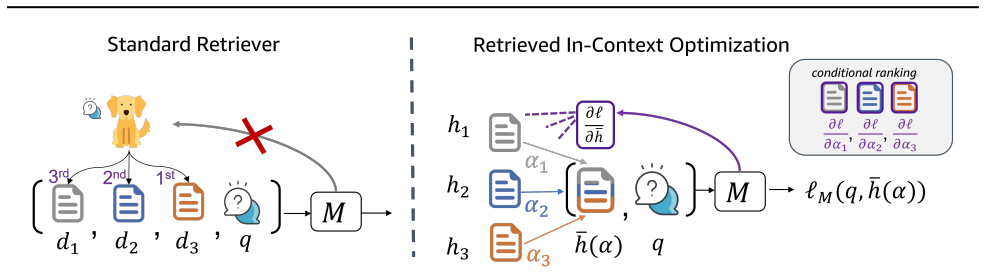
The load-bearing object is the separability of state space model dynamics: for a query sequence, the output depends on the context only through the accumulated hidden state $h_c$, and for Mamba-style models with scalar transition matrices this becomes $y_t = C_t(\sum_i \alpha_i h_{d_i} + h_q)$. Replacing the discrete choice of which documents to include with continuous weights $\alpha_i$ turns the combinatorial RAG objective into a continuous loss minimization. One gradient step with uniform initialization gives $\alpha'_i = \alpha_i - \eta \langle h_{d_i}, \partial L/\partial \bar{h}\rangle$, so the ranking score is the negative gradient–state inner product. The paper also connects this score to the leave-one-out loss via a Jensen/convexity argument.
What would settle it
On a reranking benchmark with ground-truth answers, count how often the document that best reduces question perplexity is not the document that best reduces answer perplexity; if this happens for a substantial share of queries, the proxy assumption fails and the method's gains should disappear.
Extended reading notes
Core claim
The central claim is that top-$k$ retrieval by $\langle h_{d_i}, -\partial L/\partial \bar{h}\rangle$ — the inner product of a document's hidden state with the negative loss gradient with respect to the combined document state — approximates one step of gradient descent on a continuous relaxation of the optimal-context objective. For state space models, the output for a query is a linear function of the context hidden state, so choosing a mixture of documents reduces to choosing scalar weights on precomputed states; updating those weights by gradient descent gives each document a score, and the largest scores are exactly the documents whose inclusion most lowers the loss. Using the sum of question-token log-probabilities as the loss (the SGPT proxy), this yields an unsupervised reranker. A convexity argument (Proposition 3.1) bounds the leave-one-out loss above by this inner-product score, and experiments across five QA datasets show that contexts reranked this way improve generation F1, in some cases surpassing both BM25 and fine-tuned dense retrievers.
Load-bearing premise
The method assumes that making the question tokens easier to predict is the same thing as making the answer tokens easier to generate; when those come apart, RICO can prefer a document that repeats the question over the document containing the answer.
Editorial extensions
If this is right
- Retrieval can be closed-loop: the generating model's own gradients rerank documents at test time, so there is no separate retriever to fine-tune when the model or task changes.
- The ranking cost is independent of the document store size — only a few forward and backward passes (typically $T=10$) are needed per query, because document states are precomputed.
- For long-context tasks where concatenating full articles exceeds the model's training context, feeding the learned state mixture $\bar{h}(\alpha)$ directly into generation improves TriviaQA F1 by about 97% relative to the next-best retriever.
- Ordering matters: the learned reranking places the most relevant document immediately before the question, which lowers answer loss compared with placing it first.
- With the oracle answer loss, training the document weights consistently improves F1 across all tested models, indicating that the current question-loss proxy is the main bottleneck rather than the gradient machinery.
Reading between the lines
- The paper leaves implicit that the same inner-product score could double as a stopping criterion for retrieval: when no remaining document has a large negative gradient inner product, additional context is unlikely to help, suggesting a principled way to vary test-time compute.
- If the proxy misalignment shown in the 'repeated question' failure is frequent, replacing question perplexity with a small set of sampled candidate-answer losses should improve RICO; this is directly testable with the paper's own oracle-loss experiments as a ceiling.
- Because the method only needs precomputed states and gradients with respect to the input, it should transfer beyond SSMs to any architecture with a linear state-like decomposition, such as linear attention, as the paper hints with its attention-mask experiment.
- The leave-one-out loss connection suggests RICO could be used to measure the marginal informativeness of individual documents, which might help detect redundant or hallucination-inducing context in RAG pipelines.
Editorial analysis
A structured set of objections, weighed in public.
Referee Report
Summary. The paper introduces RICO (Retrieval In-Context Optimization), a retrieval method for state space models (SSMs) that uses the model's own gradients with respect to document hidden states to rerank documents at inference time. The method exploits the separability of SSM dynamics to formulate a continuous relaxation of the combinatorial RAG objective, and shows that top-k retrieval by inner products between document states and the negative loss gradient approximates one step of gradient descent (Eq. 11). The unsupervised variant minimizes question-token perplexity as a proxy for answer likelihood. The authors evaluate RICO on MS MARCO, HotpotQA, MuSiQue, 2WikiMultihopQA, and TriviaQA, reporting retrieval metrics and Ragchecker generation F1 scores, and claim that the learned reranking often outperforms fine-tuned dense retrievers such as E5, especially in long-context settings.
Significance. If the central claims hold, RICO is a genuinely interesting contribution: it provides a principled, model-aware retrieval signal that requires no retriever fine-tuning, reuses precomputed document states, and scales with the number of optimization steps rather than the document store size. The paper is commendably honest about its limitations, including a concrete failure case of the question-loss proxy (§C.3) and the fact that the full-model application is empirical. The derivation for a single SSM layer is clean, and the connection between gradient-based top-k retrieval and a gradient step on a relaxed loss is clearly presented. The main unresolved risks are the frequency of proxy-loss misalignment, the lack of statistical rigor in the empirical claims, and the unverified convexity assumption behind Proposition 3.1.
major comments (3)
- [§3.3, §C.3] The unsupervised version of RICO is only as good as the alignment between question-token perplexity P_M(q | mixture) and answer likelihood. The paper's own Figure 9 documents a concrete violation: for q='In what year was President Obama born?', minimizing question loss selects the repeated question d2=q, while answer loss selects d1='President Obama was born in 1961'. Figure 6 reports only the average question-loss reduction when adding supporting documents on HotpotQA, which does not bound the fraction of queries for which a spurious document outranks a useful one. Please quantify the frequency of proxy/answer misalignment across the benchmark suites, for example by reporting the fraction of queries where the top question-loss-ranked document decreases answer loss compared to a random or BM25-selected document, or the per-query gap between oracle-loss ranking and question-loss ranking. Without such a measurement, the central empirical claim that unsupervised RICO 'often outperforms fine-tuned dense retrievers such as E5' is not established.
- [Tables 1–3, Figure 3] All retrieval and generation results are point estimates computed on 1k-sample subsets, with no error bars, confidence intervals, or significance tests. For example, the headline generation gain in Table 2 (Mamba2-1.3b learned reranking average 38.6 vs 34.1 for E5) is an average over four datasets and could plausibly be driven by a subset of queries or by high-variance evaluation. Please report bootstrap or per-query standard errors and paired significance tests (e.g., Wilcoxon signed-rank on per-query Ragchecker F1) for the key comparisons against BM25, E5, and BGE-M3. This is needed to support the 'often outperforms' claim.
- [§3.4, Proposition 3.1] The proof of Proposition 3.1 relies on convexity of the loss in the direction of each document hidden state. The manuscript states in §3.4 that this is 'not the exact case in practice' and supports the assumption only with the illustrative landscapes in Figure 2 and §C.3. Because the proposition is the theoretical bridge between the inner-product retrieval score and the leave-one-out loss, please either qualify the statement of the proposition to make the conditional nature explicit in the main text, or provide quantitative checks (e.g., compare the inner-product ranking with the actual leave-one-out loss on a sample of queries) to demonstrate that the convexity approximation is adequate in the regimes used in the experiments.
minor comments (5)
- [Abstract] The abstract contains the typo 'withno finetuning' and should read 'with no finetuning'.
- [§B.1, §C.3] There are several typos: 'cummulative' should be 'cumulative' in §B.1; 'repersent' and 'quetion' should be 'represent' and 'question' in §C.3.
- [Figure 3] Figure 3 would benefit from error bars or shaded confidence bands, especially given that all curves are computed on the same 1k-sample subset without uncertainty quantification.
- [Table 4] The caption of Table 4 says 'TriviaQA (↓)' but the table lists multiple datasets; please clarify that the loss values are lower-is-better for all columns, or adjust the caption to match the table body.
- [§4.2] The generation procedure for 'learned state' is underspecified: it is not described how an SSM generates from a weighted mixture of document hidden states rather than from a token concatenation. A short algorithmic description or a reference to the implementation would resolve this ambiguity.
Circularity Check
No circularity: the gradient top-k derivation is an algebraic identity for any chosen loss, and the question-perplexity proxy is an explicit external assumption that the paper itself stress-tests and acknowledges as imperfect.
full rationale
The paper's central derivation (Eqs. 10-11) is not an empirical prediction but a chain-rule identity: for the continuous relaxation defined in Eq. 10, one gradient step in document-weight space ranks documents by inner product with the (negative) loss gradient. This holds for whatever loss L is chosen and is not fitted to the evaluation data. The choice of L as question perplexity is imported from SGPT (Muennighoff 2022) as a stated proxy, and the paper never claims this proxy is derived from first principles; it explicitly documents misalignment in Section C.3 ("Example Failure Case") and in Section 5 ("there are times when the question loss does not align with the true answer loss"), and it reports an oracle-loss experiment (Table 4) showing that answer loss would do better. These are correctness risks, not circularity. Retrieval metrics use external ground-truth relevance labels and generation F1 comes from Ragchecker, so there is no target leakage and no fitted parameter renamed as a prediction. The only overlapping-author citation that is load-adjacent is Liu et al. (2025) in Section 3.3, cited for the observation that reordering documents changes the A_{t:tau} factors; this observation is already visible in Eq. 8 and is a testable architectural property of Mamba2, not an unverified conclusion used to force the result. No uniqueness theorem is imported from the authors' prior work, and no ansatz is smuggled in via citation. The paper is therefore self-contained against external benchmarks on the evaluative side, and its theoretical claim is an algebraic reduction rather than a circular prediction.
Assumptions & free parameters
free parameters (3)
- AdamW learning rate eta =
1e-1
- Number of optimization steps T =
10
- Layer subset sizes for state compression =
4/24, 8/48, 10/64 layers
assumptions (6)
- domain assumption For a fixed query, output depends on context only through the context hidden state h_c (Eq 3-4).
- domain assumption Mamba2 dynamics allow document contributions to be reweighted by scalar alpha_i (Eq 9).
- ad hoc to paper The combinatorial permutation objective (Eq 7) can be relaxed to continuous weights alpha_i in [0,1] (Eq 10).
- domain assumption Minimizing question-token perplexity is a good proxy for maximizing answer likelihood.
- ad hoc to paper The marginal loss landscape is approximately convex in document directions.
- ad hoc to paper A learned weighted mixture of document hidden states can be used directly as model context for generation.
Cite this review
Pith. "Pith review of Maximally-Informative Retrieval for State Space Model Generation." pith.science (2026). https://pith.science/paper/2X55UJCS
@misc{pith2026250612149,
  author       = {Pith},
  title        = {Pith review of: Maximally-Informative Retrieval for State Space Model Generation},
  year         = {2026},
  howpublished = {\url{https://pith.science/paper/2X55UJCS}},
  note         = {Machine review of arXiv:2506.12149}
}
abstract
Given a query and dataset, the optimal way of answering the query is to make use all the information available. Modern LLMs exhibit impressive ability to memorize training data, but data not deemed important during training is forgotten, and information outside that training set cannot be made use of. Processing an entire dataset at inference time is infeasible due to the bounded nature of model resources (e.g. context size in transformers or states in state space models), meaning we must resort to external memory. This constraint naturally leads to the following problem: How can we decide based on the present query and model, what among a virtually unbounded set of known data matters for inference? To minimize model uncertainty for a particular query at test-time, we introduce Retrieval In-Context Optimization (RICO), a retrieval method that uses gradients from the LLM itself to learn the optimal mixture of documents for answer generation. Unlike traditional retrieval-augmented generation (RAG), which relies on external heuristics for document retrieval, our approach leverages direct feedback from the model. Theoretically, we show that standard top-$k$ retrieval with model gradients can approximate our optimization procedure, and provide connections to the leave-one-out loss. We demonstrate empirically that by minimizing an unsupervised loss objective in the form of question perplexity, we can achieve comparable retriever metric performance to BM25 with \emph{no finetuning}. Furthermore, when evaluated on quality of the final prediction, our method often outperforms fine-tuned dense retrievers such as E5.
Figures


Figures from the paper (5 more)


Reference graph
Works this paper leans on
-
[1]
Then R= 2 and the MAP would be calulated as(P@1 +P@2)/2 = (1 + 2/3)/2 = 5/6. For our generation-side metrics we use the F1 scores produced by the Ragchecker evaluation framework (Ru et al., 2024), which uses an external LLM to determine whether claims made in the prediction are entailed by the ground-truth answer. As the external model we use Claude3-Haik...
work page 2024
-
[4]
Simple example of ”learning” attention mask blocks for the Phi-3.5-instruct transformer model. Each sentence of the context is considered a separate ‘document’, and we attempt to learn the attention mask which maximizes the model’s likelihood of outputing ”Therefore Paris is a city in France” (left) and ”Therefore the sky is blue.” (right). Intuitively, t...
work page 2022
- [7]
-
[8]
A survey on in-context learning.arXiv preprint arXiv:2301.00234,
Dong, Q., Li, L., Dai, D., Zheng, C., Ma, J., Li, R., Xia, H., Xu, J., Wu, Z., Liu, T., et al. A survey on in-context learning.arXiv preprint arXiv:2301.00234,
-
[9]
Duan, J., Cheng, H., Wang, S., Wang, C., Zavalny, A., Xu, R., Kailkhura, B., and Xu, K. Shifting attention to rele- vance: Towards the uncertainty estimation of large lan- guage models.arXiv preprint arXiv:2307.01379,
-
[10]
Precise zero-shot dense retrieval without relevance labels.arXiv preprint arXiv:2212.10496,
Gao, L., Ma, X., Lin, J., and Callan, J. Precise zero-shot dense retrieval without relevance labels.arXiv preprint arXiv:2212.10496,
-
[11]
Retrieval-augmented generation for large language models: A survey.arXiv preprint arXiv:2312.10997,
Gao, Y ., Xiong, Y ., Gao, X., Jia, K., Pan, J., Bi, Y ., Dai, Y ., Sun, J., Wang, M., and Wang, H. Retrieval-augmented generation for large language models: A survey.arXiv preprint arXiv:2312.10997,
-
[12]
Gu, A. and Dao, T. Mamba: Linear-time sequence modeling with selective state spaces.arXiv preprint arXiv:2312.00752,
Show all 41 references
-
[13]
D., Sugawara, S., and Aizawa, A
Ho, X., Nguyen, A.-K. D., Sugawara, S., and Aizawa, A. Constructing a multi-hop qa dataset for compre- hensive evaluation of reasoning steps.arXiv preprint arXiv:2011.01060,
2011 arXiv
-
[15]
Jin, B., Yoon, J., Han, J., and Arik, S. O. Long-context llms meet rag: Overcoming challenges for long inputs in rag. arXiv preprint arXiv:2410.05983,
-
[16]
Backpropagated gradient representations for anomaly detection
Kwon, G., Prabhushankar, M., Temel, D., and AlRegib, G. Backpropagated gradient representations for anomaly detection. InComputer Vision–ECCV 2020: 16th Eu- ropean Conference, Glasgow, UK, August 23–28, 2020, Proceedings, Part XXI 16, pp. 206–226. Springer,
2020
-
[17]
Nv-embed: Improved techniques for training llms as generalist embedding models.arXiv preprint arXiv:2405.17428,
Lee, C., Roy, R., Xu, M., Raiman, J., Shoeybi, M., Catan- zaro, B., and Ping, W. Nv-embed: Improved techniques for training llms as generalist embedding models.arXiv preprint arXiv:2405.17428,
-
[18]
Making text embedders few-shot learners
Li, C., Qin, M., Xiao, S., Chen, J., Luo, K., Shao, Y ., Lian, D., and Liu, Z. Making text embedders few-shot learners. arXiv preprint arXiv:2409.15700, 2024a. Li, Z., Li, C., Zhang, M., Mei, Q., and Bendersky, M. Re- trieval augmented generation or long-context llms? a compre...
-
[20]
Sgpt: Gpt sentence embeddings for se- mantic search.arXiv preprint arXiv:2202.08904,
Muennighoff, N. Sgpt: Gpt sentence embeddings for se- mantic search.arXiv preprint arXiv:2202.08904,
-
[21]
Mteb: Massive text embedding benchmark.arXiv preprint arXiv:2210.07316,
Muennighoff, N., Tazi, N., Magne, L., and Reimers, N. Mteb: Massive text embedding benchmark.arXiv preprint arXiv:2210.07316,
-
[22]
Generative representational in- struction tuning.arXiv preprint arXiv:2402.09906,
Muennighoff, N., Su, H., Wang, L., Yang, N., Wei, F., Yu, T., Singh, A., and Kiela, D. Generative representational in- struction tuning.arXiv preprint arXiv:2402.09906,
-
[23]
Fine- tuning or retrieval? comparing knowledge injection in llms.arXiv preprint arXiv:2312.05934,
Ovadia, O., Brief, M., Mishaeli, M., and Elisha, O. Fine- tuning or retrieval? comparing knowledge injection in llms.arXiv preprint arXiv:2312.05934,
-
[25]
Learning to re- trieve prompts for in-context learning.arXiv preprint arXiv:2112.08633,
Rubin, O., Herzig, J., and Berant, J. Learning to re- trieve prompts for in-context learning.arXiv preprint arXiv:2112.08633,
-
[26]
Replug: Retrieval- augmented black-box language models.arXiv preprint arXiv:2301.12652,
Shi, W., Min, S., Yasunaga, M., Seo, M., James, R., Lewis, M., Zettlemoyer, L., and Yih, W.-t. Replug: Retrieval- augmented black-box language models.arXiv preprint arXiv:2301.12652,
-
[27]
Dragin: Dynamic retrieval augmented generation based on the real-time information needs of large language models
Su, W., Tang, Y ., Ai, Q., Wu, Z., and Liu, Y . Dragin: Dynamic retrieval augmented generation based on the real-time information needs of large language models. arXiv preprint arXiv:2403.10081,
-
[28]
Interleaving retrieval with chain-of-thought reason- ing for knowledge-intensive multi-step questions.arXiv preprint arXiv:2212.10509, 2022a
Trivedi, H., Balasubramanian, N., Khot, T., and Sabharwal, A. Interleaving retrieval with chain-of-thought reason- ing for knowledge-intensive multi-step questions.arXiv preprint arXiv:2212.10509, 2022a. Trivedi, H., Balasubramanian, N., Khot, T., and Sabharwal, A. Musique: Mu...
-
[30]
Llm2vec: Large lan- guage models are secretly powerful text encoders.arXiv preprint arXiv:2404.05961,
BehnamGhader, P., Adlakha, V ., Mosbach, M., Bahdanau, D., Chapados, N., and Reddy, S. Llm2vec: Large lan- guage models are secretly powerful text encoders.arXiv preprint arXiv:2404.05961,
-
[31]
Improving text embeddings with large language models.arXiv preprint arXiv:2401.00368, 2023a
Wang, L., Yang, N., Huang, X., Yang, L., Majumder, R., and Wei, F. Improving text embeddings with large language models.arXiv preprint arXiv:2401.00368, 2023a. Wang, Y ., Li, P., Sun, M., and Liu, Y . Self-knowledge guided retrieval augmentation for large language models. arXi...
-
[32]
Recomp: Improving retrieval- augmented lms with compression and selective augmen- tation.arXiv preprint arXiv:2310.04408,
Xu, F., Shi, W., and Choi, E. Recomp: Improving retrieval- augmented lms with compression and selective augmen- tation.arXiv preprint arXiv:2310.04408,
-
[33]
Gated linear attention transformers with hardware-efficient train- ing.arXiv preprint arXiv:2312.06635,
Yang, S., Wang, B., Shen, Y ., Panda, R., and Kim, Y . Gated linear attention transformers with hardware-efficient train- ing.arXiv preprint arXiv:2312.06635,
-
[34]
W., Salakhutdinov, R., and Manning, C
Yang, Z., Qi, P., Zhang, S., Bengio, Y ., Cohen, W. W., Salakhutdinov, R., and Manning, C. D. Hotpotqa: A dataset for diverse, explainable multi-hop question an- swering.arXiv preprint arXiv:1809.09600,
-
[35]
Improving language models via plug-and-play retrieval feedback.arXiv preprint arXiv:2305.14002,
Yu, W., Zhang, Z., Liang, Z., Jiang, M., and Sabharwal, A. Improving language models via plug-and-play retrieval feedback.arXiv preprint arXiv:2305.14002,
-
[36]
B’mojo: Hybrid state space realizations of foundation models with eidetic and fading memory.arXiv preprint arXiv:2407.06324,
Zancato, L., Seshadri, A., Dukler, Y ., Golatkar, A., Shen, Y ., Bowman, B., Trager, M., Achille, A., and Soatto, S. B’mojo: Hybrid state space realizations of foundation models with eidetic and fading memory.arXiv preprint arXiv:2407.06324,
-
[37]
As explored in previous works, the Mamba2 architecture can be interpreted as linear attention with alearnedcausal mask (Yang et al., 2023; Dao & Gu, 2024; Bick et al., 2024)
is defined as a map from for the query, key and value matricesQ, K∈R (t,n), K∈R (t,p) to output sequenceY∈R (t,p): Y=M V=softmax(L◦(QK ⊺))V.(13) Here the sequence transformation matrix M∈R (t,t) is made autoregressive by masking the query, key product with a lower triangular m...
2023
-
[40]
the input state (forward+backward pass through the model) across benchmarks for Mamba2 models
(Left) Average time to compute gradients w.r.t. the input state (forward+backward pass through the model) across benchmarks for Mamba2 models. (Right) Average time of retrieval over benchmarks using document stores of size 1-2k. C.2. State Compression and Warm Start Retrieval ...
2024
-
[41]
The red dots represent a gradient optimization trajectory over the question loss landscape starting from the mean context state (green)
Token cross entropy loss for question (left) and ground-truth answer (right) conditioned on combinations of two contexts. The red dots represent a gradient optimization trajectory over the question loss landscape starting from the mean context state (green). Example Failure Ca...
1961
-
[2005]
Bge m3-embedding: Multi-lingual, multi-functionality, multi-granularity text embeddings through self-knowledge distillation.arXiv preprint arXiv:2402.03216,
Chen, J., Xiao, S., Zhang, P., Luo, K., Lian, D., and Liu, Z. Bge m3-embedding: Multi-lingual, multi-functionality, multi-granularity text embeddings through self-knowledge distillation.arXiv preprint arXiv:2402.03216,
-
[2009]
doi: 10.1561/ 1500000019
ISSN 1554-0669. doi: 10.1561/ 1500000019. URL https://doi.org/10.1561/ 1500000019. Ru, D., Qiu, L., Hu, X., Zhang, T., Shi, P., Chang, S., Jiayang, C., Wang, C., Sun, S., Li, H., et al. Ragchecker: A fine-grained framework for diagnos- ing retrieval-augmented generation.arXiv ...
-
[2017]
Text embeddings by weakly-supervised contrastive pre-training.arXiv preprint arXiv:2212.03533,
Wang, L., Yang, N., Huang, X., Jiao, B., Yang, L., Jiang, D., Majumder, R., and Wei, F. Text embeddings by weakly-supervised contrastive pre-training.arXiv preprint arXiv:2212.03533,
-
[2018]
Seakr: Self-aware knowledge retrieval for adaptive retrieval augmented generation.arXiv preprint arXiv:2406.19215,
Yao, Z., Qi, W., Pan, L., Cao, S., Hu, L., Liu, W., Hou, L., and Li, J. Seakr: Self-aware knowledge retrieval for adaptive retrieval augmented generation.arXiv preprint arXiv:2406.19215,
-
[2019]
Self- rag: Learning to retrieve, generate, and critique through self-reflection.arXiv preprint arXiv:2310.11511,
Asai, A., Wu, Z., Wang, Y ., Sil, A., and Hajishirzi, H. Self- rag: Learning to retrieve, generate, and critique through self-reflection.arXiv preprint arXiv:2310.11511,
-
[2020]
F., Gao, L., Sun, Z., Liu, Q., Dwivedi-Yu, J., Yang, Y ., Callan, J., and Neubig, G
Jiang, Z., Xu, F. F., Gao, L., Sun, Z., Liu, Q., Dwivedi-Yu, J., Yang, Y ., Callan, J., and Neubig, G. Active retrieval augmented generation.arXiv preprint arXiv:2305.06983,
-
[2022]
doi: 10.1007/978-3-030-99739-7\
-
[2023]
Ms marco: A human generated machine reading comprehension dataset.arXiv preprint arXiv:1611.09268,
Bajaj, P., Campos, D., Craswell, N., Deng, L., Gao, J., Liu, X., Majumder, R., McNamara, A., Mitra, B., Nguyen, T., et al. Ms marco: A human generated machine reading comprehension dataset.arXiv preprint arXiv:1611.09268,
-
[2024]
Y ., Xing, E
Bick, A., Li, K. Y ., Xing, E. P., Kolter, J. Z., and Gu, A. Transformers to ssms: Distilling quadratic knowledge to subquadratic models.arXiv preprint arXiv:2408.10189,
-
[2025]
Gradients as features for deep representation learning.arXiv preprint arXiv:2004.05529,
9 Mu, F., Liang, Y ., and Li, Y . Gradients as features for deep representation learning.arXiv preprint arXiv:2004.05529,
2004 arXiv
Reviewed August 7, 2026 · model on record in the stance chip above.
Discussion (0). Sign in to comment.