REVIEW 4 major objections 5 minor 113 references
Characterizing Neural Manifolds' Properties and Curvatures using Normalizing Flows
T0 review · 4 major / 5 minor · reviewed 2026-08-07 · deepseek-v4-flash
Pith's one-line read Neural population activity in macaque visual cortex can be described as curved, non-Gaussian manifolds, and the paper introduces a normalizing-flow method that extracts both geometry and higher-order statistics from the same quadratic…
desk verdict A useful analytic bridge from normalizing flows to neural-manifold statistics and curvature; the empirical claims need error bars and a quantitative check of the quadratic surrogate. read the letter →
The pith
A machine-rendered reading of the paper's core claim, the machinery that carries it, and where it could break.
The reading
What carries the argument
The load-bearing object is the component-wise quadratic approximation of the inverse flow, $x = q(z) = c^\alpha + B^\alpha_i z_i + \tfrac12 A^\alpha_{ij} z_i z_j$ (Eq. 10). This approximation is what converts an uninterpretable deep network into a characteristic function whose log expansion yields all cumulants, and into a set of coordinate charts whose metric tensor $g_{ij} = e^\alpha_i e^\alpha_j$ yields the Riemannian, sectional, and scalar curvature. The accompanying training machinery is the reconstruction-error loss that orders latent dimensions by relevance and the Gaussian-mixture latent space that separates behavioral states into components.
What would settle it
Sample many latent points from one fitted component, pass them through the full trained inverse flow, and estimate the fourth-order cumulant tensor empirically; compare it entrywise with the closed-form quadratic prediction. If the off-diagonal relative error is large for the most curved component (C4), the quadratic approximation, and all curvature numbers derived from it, cannot be trusted. A cleaner variant is to build synthetic data with known third-order cumulants and known scalar curvature, run the pipeline, and require quantitative recovery within a stated tolerance.
Extended reading notes
Core claim
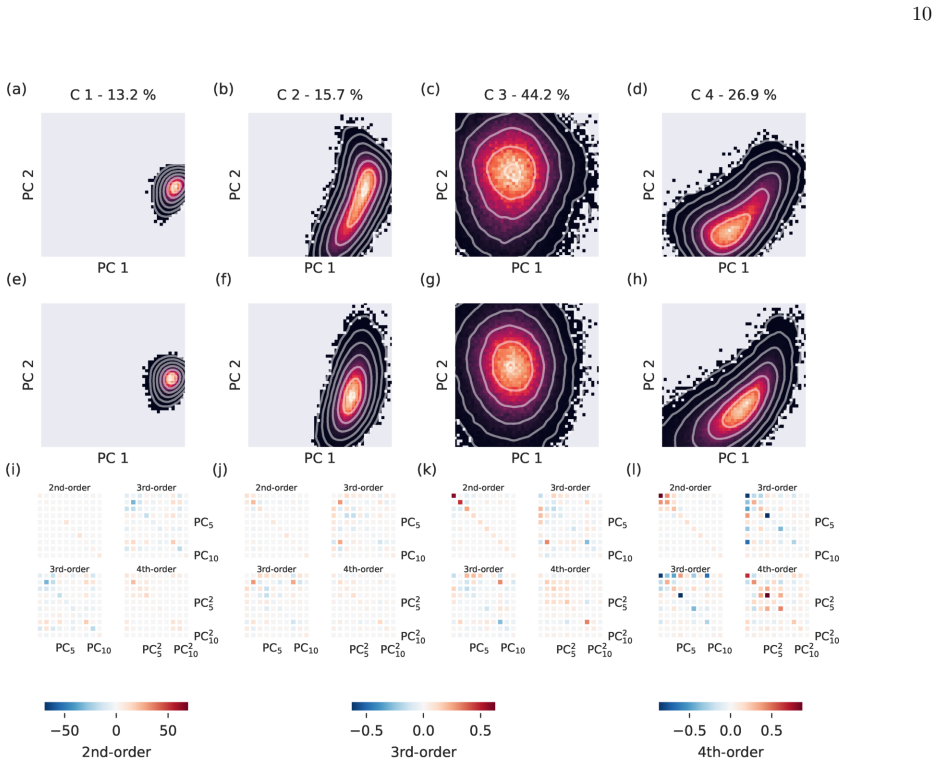
The central claim is that a normalizing flow trained with a reconstruction-error loss and a Gaussian-mixture latent space yields, after a component-wise quadratic approximation of its inverse map, an analytical handle on the geometry and statistics of neural manifolds. For each mixture component the quadratic mapping $x^\alpha = c^\alpha + \sum_i B^\alpha_i z_i + \tfrac12 \sum_{ij} A^\alpha_{ij} z_i z_j$ leads to a closed-form moment-generating function $Z(j) = e^{j^T c} e^{\frac12 j^T B (I-\sum_\alpha A^\alpha j_\alpha)^{-1} B^T j} \det(I-\sum_\alpha A^\alpha j_\alpha)^{-1/2}$, from which cumulants of any order follow by differentiation, and to explicit formulas for sectional curvature $K(e_i,e_j)$ and scalar curvature $R$ in terms of $A$, $B$, and the induced metric. On roughly 800-channel macaque V1/V4 recordings, four latent components suffice; two components align with the eyes-open and eyes-closed states, and the analysis reports predominantly negative scalar curvature, down to $-0.097$ for component C4, together with pronounced third- and fourth-order cumulants, linking the most curved component to the strongest non-Gaussianity.
Load-bearing premise
The load-bearing premise is that the trained inverse network is well approximated, for each mixture component, by one fixed quadratic function; all computed cumulants and curvatures inherit any error of that fit, and the paper's quantitative validation is correlation-based rather than a guaranteed error bound.
Editorial extensions
If this is right
- Unsupervised mixture components can track behavioral states: components C3 and C4 align with eyes-closed and eyes-open periods, so behavioral labels can be recovered from the recordings without supervision.
- Third- and fourth-order cumulants and scalar curvature quantify within-component structure, and the component with the strongest non-Gaussianity (C4) is also the most curved, linking statistical complexity to geometric structure.
- The quadratic approximation gives closed-form cumulants of arbitrary order and curvature from the same representation, so both descriptors can be compared across components and recording sessions on equal footing.
- Normalizing flows saturate in likelihood with only three to four latent components and outperform linear Gaussian mixture models, indicating that the curved representation captures the non-elliptical, triangular shape of the observed density.
- The pipeline scales to roughly 800 simultaneously recorded channels and, by design, the same quadratic-approximation step could be reused in other latent-variable models that admit an analytic decoder approximation.
Reading between the lines
- Editorial inference: the same quadratic-approximation recipe should transfer to any smooth decoder-based generative model, so the closed-form cumulant and curvature machinery is not tied to normalizing flows.
- Editorial inference: the model's truncation at quadratic order implies that cumulants beyond fourth order should be small; computing fifth- and sixth-order cumulants from the full flow would provide a sharp, sample-based test of the truncation.
- Editorial inference: tracking the scalar curvature of each mixture component over time, rather than treating components as static, could expose slow drifts in manifold structure in multi-day recordings.
Editorial analysis
A structured set of objections, weighed in public.
Referee Report
Summary. The paper introduces a normalizing-flow-based pipeline for characterizing neural population activity. A volume-preserving normalizing flow is trained with a log-likelihood loss augmented by a reconstruction-error term, and a Gaussian mixture model is used as the latent distribution. For each mixture component, the inverse mapping is approximated by a quadratic function (Eq. 10), from which the paper derives a closed-form moment-generating function and cumulants up to fourth order (App. E) and expressions for sectional and scalar curvature (App. F). The method is applied to macaque V1/V4 resting-state recordings, and the paper reports that some latent mixture components align with eyes-open/eyes-closed behavioral states, that components exhibit nonzero third- and fourth-order cumulants, and that the corresponding manifolds have predominantly negative scalar curvature. The analytic derivations in Apps. E and F are coherent, and the manuscript provides cross-session consistency checks in App. G. The main weaknesses are empirical: the quadratic approximation is validated only qualitatively, the curvature evaluation point is not fully specified, the behavioral-state alignment lacks a statistical test, and no uncertainty estimates are provided for the reported cumulants and curvatures.
Significance. If the results hold, the paper offers a notable methodological contribution: it combines unsupervised latent-variable discovery, analytical higher-order statistics, and differential-geometric descriptors in a single framework, and it applies this framework to a large-scale electrophysiological dataset. The claimed finding that state-dependent neural manifolds are curved and exhibit non-Gaussian statistics is potentially of broad interest. Strengths of the manuscript include the explicit analytic derivations in Apps. E and F, the use of publicly available data, and the consistency checks across three recording sessions. The method is not circular in the sense that the cumulants and curvatures are computed from a fitted quadratic to a network trained only on likelihood and reconstruction losses, not on the target quantities. However, the quantitative claims rest on the adequacy of the quadratic approximation and on a clear specification of where curvature is evaluated; the current evidence for both is incomplete.
major comments (4)
- [Sec. VIII, Eq. (10); App. D] The quadratic approximation of the inverse mapping is load-bearing for all quantitative results: the cumulants of Sec. IX and the curvatures of Sec. X, including Tables I-III and Figs. 8-10, are computed from the fitted quadratic coefficients A^alpha, B^alpha, and c^alpha. The validation in App. D is qualitative: it presents correlation plots between cumulants of the full inverse map and of the quadratic approximation and states that deviations appear, especially for higher-order off-diagonal components, but it reports no quantitative error metric, no R^2 or relative-error value, and no direct validation of the curvature. Because a failure of this approximation would invalidate both the statistical and geometric conclusions, the manuscript needs a quantitative accuracy assessment, for example the relative error of each cumulant order and a comparison of curvature computed from the full flow versus the quadratic approximation.
- [App. F; Table I and Fig. 10] The curvature derivation in App. F performs a Taylor expansion around z = 0 and states that this is without loss of generality, but the scalar curvature reported in Table I is a single number per component. Since App. E standardizes each latent component to zero mean and identity covariance before applying the quadratic approximation, it is unclear whether the reported curvature is evaluated at z = 0 in the standardized coordinates (which corresponds to the component mean in the original latent coordinates after the parameter redefinition) or at z = 0 in the original coordinates. These choices generally yield different curvatures unless the quadratic coefficients vanish. The manuscript should state explicitly the evaluation point used for Tables I-III and Figs. 10 and justify why this point is the appropriate 'point of maximum likelihood' mentioned in Sec. X.
- [Sec. VII, Fig. 7] The claim that latent mixture components correlate with behavioral states is based on visual comparison of smoothed posterior probabilities and histograms in Fig. 7. No statistical test is reported for this alignment, and the statement in the abstract that the method 'demonstrate[s]' state-dependent structure is therefore stronger than the evidence. The authors should provide a quantitative measure of alignment (for example, area under the ROC curve, mutual information, or a permutation test against shuffled state labels) with uncertainty, for each component and session, to support the behavioral-alignment claim.
- [Secs. IX-X and App. G] All numerical descriptors (cumulants, sectional curvatures, scalar curvatures) are reported for a single trained network per session, and the cross-session tables report only point values. Without training-seed variation, bootstrap resampling, or repeated fitting of the quadratic approximation, the reader cannot assess whether the differences between components (e.g., C4 with R = -0.097 versus C2 with R = -0.011 in Table I) are meaningful or within noise. The manuscript should include error bars or confidence intervals for at least the headline quantities in Tables I-III, ideally from multiple training runs or resampling of the data.
minor comments (5)
- [Fig. 3 caption] The caption contains the duplicated phrase 'effect of of adding'; it should read 'effect of adding'.
- [Sec. VIII, Eq. (10)] The text introducing Eq. (10) refers to the parameters as c^alpha, b^alpha_i, and A^alpha_ij, but the displayed equation uses B^alpha_i for the linear term; the notation should be made consistent.
- [Fig. 5 caption] The sentence 'we show the negative log-likelihood per dimension for both train and test data is shown' contains a redundant 'is shown' and should be rephrased.
- [App. E] The standardization step is described as 'without loss of generality' and replaces the parameters with tilde variables, but the subsequent cumulant expressions use the same symbols A, B, c; it would help the reader to explicitly state that all reported cumulants are computed in the standardized coordinates and to define the mapping back to the original data-space cumulants, if any.
- [Sec. VI] The choice of N_l = 10 latent dimensions with differing means and covariances is motivated only by display clarity; a brief justification of why this value is sufficient to capture the relevant manifold structure would strengthen the presentation.
Circularity Check
No circularity: cumulants and curvature are post-hoc analytical functions of a quadratic surrogate fitted after training, and none of these targets enters the loss or model selection.
full rationale
The paper's derivation chain is: train an invertible Normalizing Flow with log-likelihood (Eq. 4), reconstruction error (Eq. 7), and a Gaussian-mixture latent space; fit a per-component quadratic map q(z) (Eq. 10) to the trained inverse flow; then compute cumulants from the characteristic function (Eq. 11, App. E) and curvature from the metric built on tangent vectors e = B + A z (Eqs. 12-16, App. F). Neither the cumulants nor the curvature enter the loss function, the component-count selection (Sec. VI, driven by log-likelihood), or the quadratic fit itself (a linear regression on samples of the inverse map, App. D). The reported descriptors are therefore derived quantities, not quantities fitted as targets. The claim that state-dependent manifolds are curved is a data-dependent statement about the normal quadratic components of the fitted map (R = g^{jl}g^{cm}P^{alpha beta}(A^alpha_{jl}A^beta_{mc} - A^alpha_{cj}A^beta_{ml})), not an identity with any training objective. The only self-citation, [80] for the volume-preserving property that the number of modes is preserved, is also supported by the external reference [75], and it is not load-bearing for the numerical results. The quadratic approximation itself is an acknowledged validity limitation (Sec. VIII, App. D), not a circular step: App. D validates the surrogate against cumulants of the original inverse map rather than treating the surrogate's outputs as ground truth. There is no fitted parameter renamed as a prediction, no imported uniqueness theorem, and no ansatz smuggled in via self-citation. The derivation is self-contained; any concern belongs to approximation quality and correctness risk, not circularity. Score 0.
Assumptions & free parameters
free parameters (6)
- gamma_rec =
0.02
- Nl =
10
- Nn =
70
- Nr =
10
- num_latent_components =
4
- temporal_smoothing_sigma =
3 s
assumptions (6)
- domain assumption The data lie on a low-dimensional manifold whose intrinsic dimension is at most Nl=10.
- domain assumption A quadratic function accurately approximates the inverse flow locally.
- domain assumption The curvature at the mode point z=0 characterizes the manifold.
- domain assumption Gaussian mixture components in latent space correspond to distinct behavioral or transition states.
- standard math Volume-preserving normalizing flows preserve the number of modes between latent and data space.
- domain assumption MUAe z-scoring and PCA normalization do not destroy relevant higher-order structure.
Cite this review
Pith. "Pith review of Characterizing Neural Manifolds' Properties and Curvatures using Normalizing Flows." pith.science (2026). https://pith.science/paper/ND5BSF7E
@misc{pith2026250612187,
  author       = {Pith},
  title        = {Pith review of: Characterizing Neural Manifolds' Properties and Curvatures using Normalizing Flows},
  year         = {2026},
  howpublished = {\url{https://pith.science/paper/ND5BSF7E}},
  note         = {Machine review of arXiv:2506.12187}
}
read the original abstract
Neuronal activity is found to lie on low-dimensional manifolds embedded within the high-dimensional neuron space. Variants of principal component analysis are frequently employed to assess these manifolds. These methods are, however, limited by assuming a Gaussian data distribution and a flat manifold. In this study, we introduce a method designed to satisfy three core objectives: (1) extract coordinated activity across neurons, described either statistically as correlations or geometrically as manifolds; (2) identify a small number of latent variables capturing these structures; and (3) offer an analytical and interpretable framework characterizing statistical properties by a characteristic function and describing manifold geometry through a collection of charts. To this end, we employ Normalizing Flows (NFs), which learn an underlying probability distribution of data by an invertible mapping between data and latent space. Their simplicity and ability to compute exact likelihoods distinguish them from other generative networks. We adjust the NF's training objective to distinguish between relevant (in manifold) and noise dimensions (out of manifold). Additionally, we find that different behavioral states align with the components of the latent Gaussian mixture model, enabling their treatment as distinct curved manifolds. Subsequently, we approximate the network for each mixture component with a quadratic mapping, allowing us to characterize both neural manifold curvature and non-Gaussian correlations among recording channels. Applying the method to recordings in macaque visual cortex, we demonstrate that state-dependent manifolds are curved and exhibit complex statistical dependencies. Our approach thus enables an expressive description of neural population activity, uncovering non-linear interactions among groups of neurons.
Figures


Figures from the paper (19 more)




Reference graph
Works this paper leans on
-
[1]
A. P. Georgopoulos, A. B. Schwartz, and R. E. Kettner, Neuronal population coding of movement direction, Sci- ence 233, 1416 (1986)
1986
-
[2]
H. S. Seung and H. Sompolinsky, Simple models for reading neuronal population codes, Proc. Natl. Acad. Sci. USA 90, 10749 (1993)
1993
-
[3]
B. A. Olshausen and D. J. Field, Emergence of simple- cell receptive field properties by learning a sparse code for natural images, Nature 381, 607 (1996)
1996
-
[4]
T. D. Sanger, Probability density estimation for the in- terpretation of neural population codes, J. Neurophys- iol. 76, 2790 (1996)
1996
-
[5]
Gerstner, A
W. Gerstner, A. K. Kreiter, H. Markram, and V. M. Herz, Neural codes: Firing rates and beyond, Proc. Natl. Acad. Sci. USA 94, 12740 (1997)
1997
-
[6]
Knill and A
D. Knill and A. Pouget, The Bayesian brain: the role of uncertainty in neural coding and computation, Trends Neurosci. 27, 712 (2004)
2004
-
[7]
W. J. Ma, J. M. Beck, P. E. Latham, and A. Pouget, Bayesian inference with probabilistic population codes, Nat. Neurosci. 9, 1432 (2006)
2006
-
[8]
Doya, Bayesian brain: Probabilistic approaches to neural coding (MIT press, 2007)
K. Doya, Bayesian brain: Probabilistic approaches to neural coding (MIT press, 2007)
2007
Show all 113 references
-
[9]
J. J. DiCarlo, D. Zoccolan, and N. C. Rust, How does the brain solve visual object recognition?, Neuron 73, 415 (2012)
2012
-
[10]
Saxena and J
S. Saxena and J. P. Cunningham, Towards the neu- ral population doctrine, Curr. Opin. Neurobiol. 55, 103 (2019)
2019
-
[11]
Jazayeri and S
M. Jazayeri and S. Ostojic, Interpreting neural compu- tations by examining intrinsic and embedding dimen- sionality of neural activity, Curr. Opin. Neurobiol. 70, 113 (2021)
2021
-
[12]
Recanatesi, M
S. Recanatesi, M. Farrell, G. Lajoie, S. Deneve, M. Rig- otti, and E. Shea-Brown, Predictive learning as a net- work mechanism for extracting low-dimensional latent space representations, Nat. Commun. 12, 1417 (2021)
2021
-
[13]
M. M. Churchland, J. P. Cunningham, M. T. Kauf- man, J. D. Foster, P. Nuyujukian, S. I. Ryu, and K. V. Shenoy, Neural population dynamics during reaching, Nature 487, 51 (2012)
2012
-
[14]
M. T. Kaufman, M. M. Churchland, S. I. Ryu, and K. V. Shenoy, Cortical activity in the null space: permitting preparation without movement, Nat. Neurosci. 17, 440 (2014)
2014
-
[15]
Sussillo, M
D. Sussillo, M. M. Churchland, M. T. Kaufman, and K. V. Shenoy, A neural network that finds a naturalis- tic solution for the production of muscle activity, Nat. Neurosci. 18, 1025 (2015)
2015
-
[16]
T.-C. Kao, M. S. Sadabadi, and G. Hennequin, Opti- mal anticipatory control as a theory of motor prepa- ration: A thalamo-cortical circuit model, Neuron 109, 1567 (2021)
2021
-
[17]
Mante, D
V. Mante, D. Sussillo, K. V. Shenoy, and W. T. New- some, Context-dependent computation by recurrent dy- namics in prefrontal cortex, Nature 503, 78 (2013)
2013
-
[18]
Stringer, M
C. Stringer, M. Pachitariu, N. Steinmetz, M. Caran- dini, and K. D. Harris, High-dimensional geometry of population responses in visual cortex, Nature 571, 361 (2019)
2019
-
[19]
T. D. Kim, T. Z. Luo, J. W. Pillow, and C. D. Brody, Inferring latent dynamics underlying neural population activity via neural differential equations, in Interna- tional Conference on Machine Learning (PMLR, 2021) pp. 5551–5561
2021
-
[20]
Steinemann, G
N. Steinemann, G. M. Stine, E. Trautmann, A. Zylber- berg, D. M. Wolpert, and M. N. Shadlen, Direct obser- vation of the neural computations underlying a single decision, eLife 12, RP90859 (2024)
2024
-
[21]
Langdon and T
C. Langdon and T. A. Engel, Latent circuit inference from heterogeneous neural responses during cognitive tasks, Nat. Neurosci. 28, 665 (2025)
2025
-
[22]
Pandarinath, D
C. Pandarinath, D. J. O’Shea, J. Collins, R. Jozefowicz, S. D. Stavisky, J. C. Kao, E. M. Trautmann, M. T. Kaufman, S. I. Ryu, L. R. Hochberg, J. M. Henderson, K. V. Shenoy, L. F. Abbott, and D. Sussillo, Inferring single-trial neural population dynamics using sequential auto-...
2018
-
[23]
M. R. Whiteway and D. A. Butts, The quest for in- terpretable models of neural population activity, Curr. Opin. Neurobiol. 58, 86 (2019)
2019
-
[24]
J. A. Gallego, M. G. Perich, L. E. Miller, and S. A. Solla, Neural manifolds for the control of movement, Neuron 94, 978 (2017)
2017
-
[25]
J. A. Gallego, M. G. Perich, S. N. Naufel, C. Ethier, S. A. Solla, and L. E. Miller, Cortical population activity within a preserved neural manifold underlies multiple motor behaviors, Nat. Commun. 9, 1 (2018)
2018
-
[26]
J. A. Gallego, M. G. Perich, R. H. Chowdhury, S. A. Solla, and L. E. Miller, Long-term stability of corti- cal population dynamics underlying consistent behav- ior, Nat. Neurosci. 23, 260 (2020). 16
2020
-
[27]
Altan, S
E. Altan, S. A. Solla, L. E. Miller, and E. J. Perreault, Estimating the dimensionality of the manifold underly- ing multi-electrode neural recordings, PLOS Comput. Biol. 17, e1008591 (2021)
2021
-
[28]
Altan, X
E. Altan, X. Ma, L. E. Miller, E. J. Perreault, and S. A. Solla, Low-dimensional neural manifolds for the control of constrained and unconstrained movements, BioRxiv (2023)
2023
-
[29]
Langdon, M
C. Langdon, M. Genkin, and T. A. Engel, A unifying perspective on neural manifolds and circuits for cogni- tion, Nat. Rev. Neurosci. 24, 363 (2023)
2023
-
[30]
Safaie, J
M. Safaie, J. C. Chang, J. Park, L. E. Miller, J. T. Dud- man, M. G. Perich, and J. A. Gallego, Preserved neural dynamics across animals performing similar behaviour, Nature 623, 765 (2023)
2023
-
[31]
Fortunato, J
C. Fortunato, J. Bennasar-V´ azquez, J. Park, J. C. Chang, L. E. Miller, J. T. Dudman, M. G. Perich, and J. A. Gallego, Nonlinear manifolds underlie neural pop- ulation activity during behaviour, BioRxiv (2024)
2024
-
[32]
Morales-Gregorio, A
A. Morales-Gregorio, A. C. Kurth, J. Ito, A. Kleinjo- hann, F. V. Barth´ elemy, T. Brochier, S. Gr¨ un, and S. J. van Albada, Neural manifolds in v1 change with top- down signals from v4 targeting the foveal region, Cell Rep. 43 (2024)
2024
-
[33]
P. Gao, E. Trautmann, B. Yu, G. Santhanam, S. Ryu, K. Shenoy, and S. Ganguli, A theory of multineuronal dimensionality, dynamics and measurement, BioRxiv , 214262 (2017)
2017
-
[34]
Druckmann and D
S. Druckmann and D. B. Chklovskii, Neuronal circuits underlying persistent representations despite time vary- ing activity, Curr. Biol. 22, 2095 (2012)
2012
-
[35]
Kobak, W
D. Kobak, W. Brendel, C. Constantinidis, C. E. Feier- stein, A. Kepecs, Z. F. Mainen, X.-L. Qi, R. Romo, N. Uchida, and C. K. Machens, Demixed principal com- ponent analysis of neural population data, eLife 5, e10989 (2016)
2016
-
[36]
R. J. Gardner, E. Hermansen, M. Pachitariu, Y. Burak, N. A. Baas, B. A. Dunn, M.-B. Moser, and E. I. Moser, Toroidal topology of population activity in grid cells, Nature 602, 123 (2022)
2022
-
[37]
Schneider, J
S. Schneider, J. H. Lee, and M. W. Mathis, Learnable latent embeddings for joint behavioural and neural anal- ysis, Nature 617, 360 (2023)
2023
-
[38]
Pearson, LIII
K. Pearson, LIII. on lines and planes of closest fit to systems of points in space, Philos. Mag. 2, 559 (1901)
1901
-
[39]
Hotelling, Analysis of a complex of statistical vari- ables into principal components., J
H. Hotelling, Analysis of a complex of statistical vari- ables into principal components., J. Educ. Psychol. 24, 417 (1933)
1933
-
[40]
Mitchell-Heggs, S
R. Mitchell-Heggs, S. Prado, G. P. Gava, M. A. Go, and S. R. Schultz, Neural manifold analysis of brain circuit dynamics in health and disease, J. Comput. Neurosci. 51, 1 (2023)
2023
-
[41]
Bishop, Bayesian pca, Adv
C. Bishop, Bayesian pca, Adv. Neural Inf. Process. Syst. 11 (1998)
1998
-
[42]
H. Zou, T. Hastie, and R. Tibshirani, Sparse principal component analysis, J. Comput. Graph. Stat. 15, 265 (2006)
2006
-
[43]
A. H. Williams, T. H. Kim, F. Wang, S. Vyas, S. I. Ryu, K. V. Shenoy, M. Schnitzer, T. G. Kolda, and S. Ganguli, Unsupervised discovery of demixed, low- dimensional neural dynamics across multiple timescales through tensor component analysis, Neuron 98, 1099 (2018)
2018
-
[44]
Pellegrino, H
A. Pellegrino, H. Stein, and N. A. Cayco-Gajic, Dimen- sionality reduction beyond neural subspaces with slice tensor component analysis, Nat. Neurosci. , 1 (2024)
2024
-
[45]
Duncker and M
L. Duncker and M. Sahani, Dynamics on the manifold: Identifying computational dynamical activity from neu- ral population recordings, Curr. Opin. Neurobiol. 70, 163 (2021)
2021
-
[46]
Abbaspourazad, E
H. Abbaspourazad, E. Erturk, B. Pesaran, and M. M. Shanechi, Dynamical flexible inference of nonlinear la- tent factors and structures in neural population activity, Nat. Biomed. Eng. 8, 85 (2024)
2024
-
[47]
D. P. Kingma and J. L. Ba, Adam: A method for stochastic gradient descent, in International Conference on Learning Representations (2015) pp. 1–15
2015
-
[48]
K. Han, H. Wen, J. Shi, K.-H. Lu, Y. Zhang, D. Fu, and Z. Liu, Variational autoencoder: An unsupervised model for encoding and decoding fmri activity in visual cortex, Neuroimage 198, 125 (2019)
2019
-
[49]
Zhou and X.-X
D. Zhou and X.-X. Wei, Learning identifiable and inter- pretable latent models of high-dimensional neural ac- tivity using pi-vae, Adv. Neural Inf. Process. Syst. 33, 7234 (2020)
2020
-
[50]
Schimel, T.-C
M. Schimel, T.-C. Kao, K. T. Jensen, and G. Hen- nequin, ilqr-vae: control-based learning of input-driven dynamics with applications to neural data, BioRxiv (2021)
2021
-
[51]
Ahmed and L
T. Ahmed and L. Longo, Examining the size of the latent space of convolutional variational autoencoders trained with spectral topographic maps of eeg frequency bands, IEEE Access 10, 107575 (2022)
2022
-
[52]
J. B. Tenenbaum, V. d. Silva, and J. C. Langford, A Global Geometric Framework for Nonlinear Dimension- ality Reduction, Science 290, 2319 (2000)
2000
-
[53]
S. T. Roweis and L. K. Saul, Nonlinear dimensional- ity reduction by locally linear embedding, Science 290, 2323 (2000)
2000
-
[54]
Belkin and P
M. Belkin and P. Niyogi, Laplacian eigenmaps for di- mensionality reduction and data representation, Neural Comput. 15, 1373 (2003)
2003
-
[55]
Van der Maaten and G
L. Van der Maaten and G. Hinton, Visualizing data us- ing t-sne., J. Mach. Learn. Res. 9 (2008)
2008
-
[56]
McInnes, J
L. McInnes, J. Healy, and J. Melville, Umap: Uniform manifold approximation and projection for dimension reduction, arXiv preprint arXiv:1802.03426 (2018)
2018 arXiv
-
[57]
Lindenbaum, J
O. Lindenbaum, J. Stanley, G. Wolf, and S. Krish- naswamy, Geometry based data generation, Adv. Neural Inf. Process. Syst. 31 (2018)
2018
-
[58]
M. C. Gemici, D. Rezende, and S. Mohamed, Nor- malizing flows on riemannian manifolds, arXiv preprint arXiv:1611.02304 (2016)
2016 arXiv
-
[59]
L. A. P. Rey, V. Menkovski, and J. W. Porte- gies, Diffusion variational autoencoders, arXiv preprint arXiv:1901.08991 (2019)
2019 arXiv
-
[60]
Brehmer and K
J. Brehmer and K. Cranmer, Flows for simultaneous manifold learning and density estimation, Adv. Neural Inf. Process. Syst. 33, 442 (2020)
2020
-
[61]
H. Kim, H. Lee, W. H. Kang, J. Y. Lee, and N. S. Kim, Softflow: Probabilistic framework for normalizing flow on manifolds, Adv. Neural Inf. Process. Syst. 33, 16388 (2020)
2020
-
[62]
A. L. Caterini, G. Loaiza-Ganem, G. Pleiss, and J. P. Cunningham, Rectangular flows for manifold learning, Adv. Neural Inf. Process. Syst. 34, 30228 (2021)
2021
-
[63]
Horvat and J.-P
C. Horvat and J.-P. Pfister, Denoising normalizing flow, Adv. Neural Inf. Process. Syst. 34, 9099 (2021). 17
2021
-
[64]
Koehler, V
F. Koehler, V. Mehta, C. Zhou, and A. Risteski, Varia- tional autoencoders in the presence of low-dimensional data: landscape and implicit bias, arXiv preprint arXiv:2112.06868 (2021)
2021 arXiv
-
[65]
Connor, G
M. Connor, G. Canal, and C. Rozell, Variational au- toencoder with learned latent structure, in Interna- tional Conference on Artificial Intelligence and Statis- tics (PMLR, 2021) pp. 2359–2367
2021
-
[66]
Cunningham, A
E. Cunningham, A. D. Cobb, and S. Jha, Principal com- ponent flows, in International Conference on Machine Learning (PMLR, 2022) pp. 4492–4519
2022
-
[67]
Cramer, F
E. Cramer, F. Rauh, A. Mitsos, R. Tempone, and M. Dahmen, Nonlinear isometric manifold learn- ing for injective normalizing flows, arXiv preprint arXiv:2203.03934 (2022)
2022 arXiv
-
[68]
Postels, M
J. Postels, M. Danelljan, L. Van Gool, and F. Tombari, Maniflow: Implicitly representing manifolds with nor- malizing flows, in 2022 International Conference on 3D Vision (3DV) (IEEE, 2022) pp. 84–93
2022
-
[69]
Horvat and J.-P
C. Horvat and J.-P. Pfister, Intrinsic dimensionality es- timation using normalizing flows, Adv. Neural Inf. Pro- cess. Syst. 35, 12225 (2022)
2022
-
[70]
Loaiza-Ganem, B
G. Loaiza-Ganem, B. L. Ross, J. C. Cresswell, and A. L. Caterini, Diagnosing and fixing manifold over- fitting in deep generative models, arXiv preprint arXiv:2204.07172 (2022)
2022 arXiv
-
[71]
Horvat and J.-P
C. Horvat and J.-P. Pfister, Density estimation on low- dimensional manifolds: an inflation-deflation approach, J. Mach. Learn. Res. 24, 1 (2023)
2023
-
[72]
Flouris and E
K. Flouris and E. Konukoglu, Canonical normalizing flows for manifold learning, Adv. Neural Inf. Process. Syst. 36 (2024)
2024
-
[73]
G. S. Alberti, J. Hertrich, M. Santacesaria, and S. Sci- utto, Manifold learning by mixture models of vaes for inverse problems, J. Mach. Learn. Res. 25, 1 (2024)
2024
-
[74]
L. Dinh, D. Krueger, and Y. Bengio, Nice: Non-linear independent components estimation, arXiv preprint arXiv:1410.8516 (2014)
2014 arXiv
-
[75]
L. Dinh, J. Sohl-Dickstein, and S. Bengio, Density esti- mation using real nvp, arXiv preprint arXiv:1605.08803 (2016)
2016 arXiv
-
[76]
D. P. Kingma and P. Dhariwal, Glow: Generative flow with invertible 1x1 convolutions, Adv. Neural Inf. Pro- cess. Syst. 31 (2018)
2018
-
[77]
Bekasov and I
A. Bekasov and I. Murray, Ordering dimensions with nested dropout normalizing flows, arXiv preprint arXiv:2006.08777 (2020)
2020 arXiv
-
[78]
X. Chen, A. Morales-Gregorio, J. Sprenger, A. Kleinjo- hann, S. Sridhar, S. J. van Albada, S. Gr¨ un, and P. R. Roelfsema, 1024-channel electrophysiological recordings in macaque V1 and V4 during resting state, Sci. Data 9, 77 (2022)
2022
-
[79]
Draxler, S
F. Draxler, S. Wahl, C. Schn¨ orr, and U. K¨ othe, On the universality of volume-preserving and coupling-based normalizing flows, arXiv preprint arXiv:2402.06578 (2024)
2024 arXiv
-
[80]
Merger, A
C. Merger, A. Ren´ e, K. Fischer, P. Bouss, S. Nestler, D. Dahmen, C. Honerkamp, and M. Helias, Learning interacting theories from data, Phys. Rev. X 13, 041033 (2023)
2023
-
[81]
Izmailov, P
P. Izmailov, P. Kirichenko, M. Finzi, and A. G. Wilson, Semi-supervised learning with normalizing flows, in In- ternational Conference on Machine Learning (PMLR,
-
[82]
Montani, R
F. Montani, R. A. Ince, R. Senatore, E. Arabzadeh, M. E. Diamond, and S. Panzeri, The impact of high- order interactions on the rate of synchronous discharge and information transmission in somatosensory cortex, Philos. Trans. R. Soc. A 367, 3297 (2009)
2009
-
[83]
Ganmor, R
E. Ganmor, R. Segev, and E. Schneidman, Sparse low- order interaction network underlies a highly correlated and learnable neural population code, Proc. Natl. Acad. Sci. USA 108, 9679 (2011)
2011
-
[84]
Gardiner, Stochastic Methods: A Handbook for the Natural and Social Sciences , 4th ed
C. Gardiner, Stochastic Methods: A Handbook for the Natural and Social Sciences , 4th ed. (Springer, Berlin, Heidelberg, 2009)
2009
-
[85]
Helias and D
M. Helias and D. Dahmen, Statistical Field Theory for Neural Networks (Springer International Publishing, 2020)
2020
-
[86]
J. M. Lee, Introduction to Smooth manifolds , Vol. 2 (Springer, 2012)
2012
-
[87]
J. M. Lee, Introduction to Riemannian manifolds, Vol. 2 (Springer, 2018)
2018
-
[88]
B¨ ar,Elementary Differential Geometry (Cambridge University Press, 2010)
C. B¨ ar,Elementary Differential Geometry (Cambridge University Press, 2010)
2010
-
[89]
J. W. Robbin and D. A. Salamon, Introduction to Dif- ferential Geometry (Springer Nature, 2022)
2022
-
[90]
D. P. Kingma and M. Welling, Auto-encoding varia- tional bayes, arXiv preprint arXiv:1312.6114 (2013)
2013 arXiv
-
[91]
Jones, Manifold diffusion geometry: Curva- ture, tangent spaces, and dimension, arXiv preprint arXiv:2411.04100 (2024)
I. Jones, Manifold diffusion geometry: Curva- ture, tangent spaces, and dimension, arXiv preprint arXiv:2411.04100 (2024)
2024
-
[92]
H. Shao, A. Kumar, and P. Thomas Fletcher, The rie- mannian geometry of deep generative models, in Pro- ceedings of the IEEE Conference on Computer Vision and Pattern Recognition Workshops (2018) pp. 315–323
2018
-
[93]
Acosta, S
F. Acosta, S. Sanborn, K. D. Duc, M. Madhav, and N. Miolane, Quantifying extrinsic curvature in neural manifolds, in Proceedings of the IEEE/CVF Conference on Computer Vision and Pattern Recognition (2023) pp. 610–619
2023
-
[94]
Farooq, Y
H. Farooq, Y. Chen, T. T. Georgiou, A. Tannenbaum, and C. Lenglet, Network curvature as a hallmark of brain structural connectivity, Nat. Commun. 10, 4937 (2019)
2019
-
[95]
Weber, J
M. Weber, J. Stelzer, E. Saucan, A. Naitsat, G. Lohmann, and J. Jost, Curvature-based methods for brain network analysis, arXiv preprint arXiv:1707.00180 (2017)
2017 arXiv
-
[96]
P. T. Fletcher, S. Venkatasubramanian, and S. Joshi, The geometric median on riemannian manifolds with application to robust atlas estimation, Neuroimage 45, S143 (2009)
2009
-
[97]
A. C. Gilbert and K. O’Neill, Ca-pca: Manifold dimen- sion estimation, adapted for curvature, arXiv preprint arXiv:2309.13478 (2023)
2023 arXiv
-
[98]
Azeredo da Silveira and F
R. Azeredo da Silveira and F. Rieke, The geometry of information coding in correlated neural populations, Annu. Rev. Neurosci. 44, 403 (2021)
2021
-
[99]
Moreno-Bote, J
R. Moreno-Bote, J. Beck, I. Kanitscheider, X. Pitkow, P. Latham, and A. Pouget, Information-limiting corre- lations, Nat. Neurosci. 17, 1410 (2014)
2014
-
[100]
A. Kohn, R. Coen-Cagli, I. Kanitscheider, and A. Pouget, Correlations and neuronal population infor- mation, Annu. Rev. Neurosci. 39, 237 (2016)
2016
-
[101]
Pouget, P
A. Pouget, P. Dayan, and R. S. Zemel, Inference and computation with population codes, Annu. Rev. Neu- rosci. 26, 381 (2003). 18
2003
-
[102]
Chung and L
S. Chung and L. F. Abbott, Neural population geome- try: An approach for understanding biological and ar- tificial neural networks, Curr. Opin. Neurobiol. 70, 137 (2021)
2021
-
[103]
C.-N. Chou, R. Kim, L. A. Arend, Y.-Y. Yang, B. D. Mensh, W. M. Shim, M. G. Perich, and S. Chung, Ge- ometry linked to untangling efficiency reveals structure and computation in neural populations, BioRxiv , 2024 (2025)
2025
-
[104]
A. E. Urai, B. Doiron, A. M. Leifer, and A. K. Church- land, Large-scale neural recordings call for new insights to link brain and behavior, Nat. Neurosci.25, 11 (2022)
2022
-
[105]
Cramer, A
E. Cramer, A. Mitsos, R. Tempone, and M. Dahmen, Principal component density estimation for scenario generation using normalizing flows, Data-Cent. Eng. 3, e7 (2022)
2022
-
[106]
Behrmann, P
J. Behrmann, P. Vicol, K.-C. Wang, R. Grosse, and J.-H. Jacobsen, Understanding and mitigating explod- ing inverses in invertible neural networks, in Interna- tional Conference on Artificial Intelligence and Statis- tics (PMLR, 2021) pp. 1792–1800
2021
-
[107]
Higgins, L
I. Higgins, L. Matthey, A. Pal, C. Burgess, X. Glorot, M. Botvinick, S. Mohamed, and A. Lerchner, beta-vae: Learning basic visual concepts with a constrained varia- tional framework, in International Conference on Learn- ing Representations (2017)
2017
-
[108]
W.-N. Hsu, Y. Zhang, and J. Glass, Unsupervised learn- ing of disentangled and interpretable representations from sequential sata, Adv. Neural Inf. Process. Syst. 30 (2017)
2017
-
[109]
Kim and A
H. Kim and A. Mnih, Disentangling by factorising, in International Conference on Machine Learning (PMLR,
-
[110]
R. T. Chen, X. Li, R. B. Grosse, and D. K. Duvenaud, Isolating sources of disentanglement in variational au- toencoders, Adv. Neural Inf. Process. Syst. 31 (2018)
2018
-
[111]
M. H. Sarhan, A. Eslami, N. Navab, and S. Albar- qouni, Learning interpretable disentangled representa- tions using adversarial vaes, in Domain Adaptation and Representation Transfer and Medical Image Learning with Less Labels and Imperfect Data: First MICCAI Workshop, DART 20...
2019
-
[112]
X. Zhu, C. Xu, and D. Tao, Learning disentangled repre- sentations with latent variation predictability, in Com- puter Vision–ECCV 2020: 16th European Conference, Glasgow, UK, August 23–28, 2020, Proceedings, Part X 16 (Springer, 2020) pp. 684–700
2020
-
[113]
X. Zhu, C. Xu, and D. Tao, Where and what? exam- ining interpretable disentangled representations, in Pro- ceedings of the IEEE/CVF Conference on Computer Vi- sion and Pattern Recognition (2021) pp. 5861–5870. Appendix A: Preprocessing of Data We used publicly available 1024-c...
2021
Reviewed August 7, 2026 · model on record in the stance chip above.
Discussion (0). Continue with ORCID to comment.