REVIEW 5 major objections 5 minor 41 references
A Collaborative Process Parameter Recommender System for Fleets of Networked Manufacturing Machines -- with Application to 3D Printing
T0 review · 5 major / 5 minor · reviewed 2026-08-07 · deepseek-v4-flash
Pith's one-line read Sharing print data across a fleet lets each 3D printer find its optimal speed and acceleration in roughly 40 percent fewer trials.
desk verdict A genuine new problem framing with real experimental data, but the headline trial-reduction claims rest on evaluation choices that need to be hardened before they are credible. read the letter →
The pith
A machine-rendered reading of the paper's core claim, the machinery that carries it, and where it could break.
The reading
What carries the argument
The central object is the collaborative utility matrix built by stacking each machine's vectorized utility tensor as one row, so the fleet becomes a single sparse matrix $U \in \mathbb{R}^{K \times l}$ with one column per process parameter combination. Its low-rank factorization $U = AB^T + E$ is the mechanism that lets one machine's observations fill in another machine's missing entries. The algorithm alternates ridge-regression steps to estimate $A$ and $B$, then uses the completed matrix to choose the next experiment: equation (4) picks the column of maximum predicted utility for each machine, and equation (5) first picks the $c$ most promising machines before choosing their argmax columns. The rank $r$ is not fixed in advance; it is estimated from the sparsely observed matrix by mean imputation followed by spectral clustering of machines into behavioral groups.
What would settle it
Run the same algorithm on a fleet of printers, or a synthetic surrogate, whose per-machine utility surfaces are deliberately generated to be nearly independent, so the true matrix is high-rank rather than rank 3; if the collaborative sequential completion no longer beats independent matrix completion on trials-to-optimal and cumulative regret, then the low-rank assumption, not the acquisition rule or the ALS solver, is what carried the reported reductions.
Extended reading notes
Core claim
The central claim is that collaborative sequential matrix completion can exploit machine-to-machine variability instead of being defeated by it. The authors assume the utility matrix $U$ is generated as $U = AB^T + E$ with low rank $r$, where $A$ encodes machine-specific coefficients and $B$ a shared basis over process parameters; alternating least squares recovers the missing entries from sparse observations, and a greedy acquisition rule then selects, for each machine, the parameter column with maximal predicted utility, or under limited participation the top $c$ machines by predicted maximum before choosing their argmax columns. On the ten-printer farm, with 45% of each printer's 35 speed-acceleration combinations observed initially and a budget of 19 further rounds, this procedure finds the true optimal settings in 5.7 trials on average versus 9.8 for per-machine non-collaborative completion, a 41.8% reduction, and 9.2 versus 15.2 when only 5 of 10 printers can run experiments each round, a 39.5% reduction. The paper also reports lower cumulative regret for most printers, meaning the intermediate choices were closer to optimal, not just the final recommendation.
Load-bearing premise
The entire gain rests on the assumption that the fleet's utility matrix is approximately low-rank with rank $r=3$, meaning the printers' quality-and-speed surfaces share enough latent structure that one printer's tested settings genuinely inform another printer's untested ones.
Editorial extensions
If this is right
- Under full fleet participation, the collaborative method reaches each printer's true optimal speed and acceleration in 5.7 trials on average, a 41.8% reduction over the 9.8 trials needed by non-collaborative matrix completion.
- Under partial participation, with only 5 of 10 printers able to test in each round, the collaborative method still needs 9.2 trials on average versus 15.2 for the baseline, a 39.5% reduction.
- Cumulative regret is lower for most printers, so the settings tried along the way are also closer to optimal, which the authors interpret as fewer discarded parts during tuning.
- The framework is presented as broadly applicable beyond 3D printing to any manufacturing domain where process parameter tuning is black-box and expensive.
Reading between the lines
- A natural extension the paper does not take is to replace the greedy argmax acquisition with an uncertainty-aware rule, such as selecting the parameter with the largest upper confidence bound derived from the matrix completion residuals, which would balance exploration against exploitation.
- The rank-estimation step could be tested in isolation: running the same mean-imputation-plus-spectral-clustering procedure on synthetic utility matrices of known rank would show whether the estimated rank matches the true rank before the sequential trials begin.
- If the low-rank assumption transfers, the same row-stacked collaborative completion could apply to other fleets with per-unit utility surfaces, such as CNC machine tools, robot calibrations, or sensor networks, although the paper only demonstrates 3D printers.
- The limited-participation rule prioritizes machines with the highest predicted utility; an information-gain alternative that prioritizes machines with the most uncertain rows would be a different design choice with testably different which-machines-get-tested behavior.
Editorial analysis
A structured set of objections, weighed in public.
Referee Report
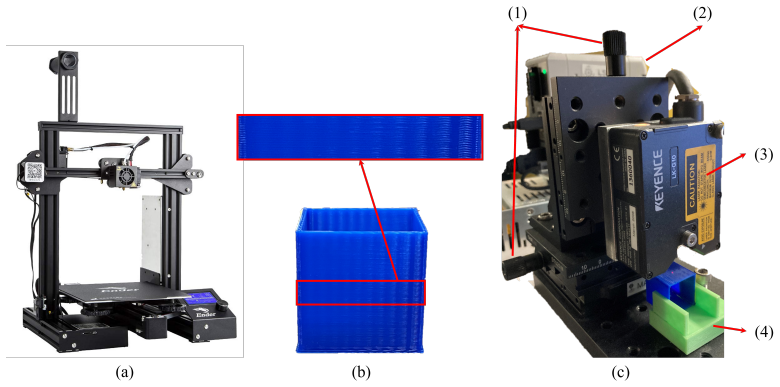
Summary. The paper proposes a collaborative process-parameter recommender for fleets of identical manufacturing machines. It represents each machine's utility over discrete parameter settings as a row of a matrix U, assumes U ≈ AB^T with rank r=3, and alternates ALS matrix completion with greedy selection of the argmax predicted utility. The method is tested on a 10-printer FFF 3D-printing farm: 35 speed/acceleration configurations are printed and scanned, a 55% random mask simulates initial sparsity, and the algorithm is compared with a non-collaborative matrix-completion baseline under full and partial fleet participation. The reported central result is a 41.8% reduction in the average number of trials to reach the machine-specific optimum under full participation and a 39.5% reduction under partial participation; the paper also reports lower cumulative regret.
Significance. If the trial reductions were established, this would be a useful practical contribution to parameter tuning in 3D printing farms and similar equipment fleets. The experimental data collection is real and detailed, involving 350 printed cubes and laser surface scans, and the sequential matrix-completion formulation is natural for the problem. However, the claimed reductions rest on a single masked realization, an unvalidated rank-3 assumption, and an underspecified non-collaborative baseline; as presented, the quantitative headline is not yet supported. The paper does not provide code or data and offers no theoretical guarantees, so the contribution is an empirical demonstration that needs substantially stronger validation before the claimed reductions can be accepted.
major comments (5)
- [§4, Tables 1 and 2] The headline reductions (41.8% and 39.5%) are computed from a single random 55% mask, and in Case 2 the non-collaborative baseline also uses a single random selection of c=5 machines per round. Per-printer trial counts vary widely, with values in Table 1 ranging from 1 to 18 and many censored entries in Table 2, so the central comparison is not statistically supported. Please rerun the experiment over multiple masks, report paired per-printer differences with means and confidence intervals, and use a significance test, or explicitly present the numbers as a single illustrative run rather than as established reductions.
- [§2.4 and Eq. (2)] The rank r=3 is estimated from the masked U using mean imputation and spectral clustering, but the text gives no validation of this estimate and no sensitivity analysis. Because the entire collaborative mechanism and the matrix completions driving Eqs. (4)-(5) rely on U being approximately rank 3, this assumption is load-bearing. Since the authors have the complete 10x35 utility matrix from their own experiments, please report its singular-value spectrum or reconstruction error for ranks 1-5 and repeat the main experiments for at least r=2,3,4,5. Using observed data to choose a rank is not in itself circular, but the current procedure is unvalidated and the conclusions depend on it.
- [§3.3, non-collaborative baseline] The baseline is underspecified: 'each machine independently estimates its utility matrix using only its own observed entries by matrix completion' does not state the rank, solver, regularization, or initialization. With 35 entries per machine and about 16 observed on average, a low-rank completion of a single machine's 5x7 matrix is not obviously identifiable, and the implementation details can dominate the comparison. Please specify the baseline completely and consider adding a standard per-machine optimizer, such as a Gaussian-process bandit, to verify that the improvement is due to collaboration rather than to a particular failure mode of the chosen baseline.
- [§4, cumulative regret definition] The displayed equation for regret(t)_k equates the true utility gap |u_k(x^(t)) - u_k(x*_k)| with |\hat U^(t)_{k,j*_k} - U_{k,j_true_k}|. The right-hand side uses the model's predicted utility at the selected entry, not the actual utility of that entry, so it does not measure regret as defined by the first equality. If the figures use actual utilities, the formula should be corrected; if they use predictions, the regret claim does not reflect real decision costs. This needs to be fixed and the figures checked against the corrected definition.
- [§4, Case 2 metric and Table 2] In the limited-participation scenario, t*_k is defined as a global round index rather than the number of experiments actually performed on printer k. Because only c=5 of the 10 printers are selected each round, a printer that is not selected for ten rounds accumulates no data yet receives a larger t*; the 'average number of trials needed' in Table 2 therefore mixes waiting time with experimentation cost. Please report the number of selections per printer or the fleet-level experimental cost, and adapt the Kaplan-Meier estimator in Sec. 4 to that quantity.
minor comments (5)
- [§3.3 and Algorithm 1] M is called the total experimental budget, but in Case 1 the budget is 190 new experiments (19 rounds x 10 printers). Please clarify whether M denotes rounds or total experiments, because the interpretation of trial counts and the Kaplan-Meier estimator depends on this distinction.
- [§4, definition of t*] If the true optimum for a printer is already contained in the initially observed 45% of entries, the definition of t* should count it as zero trials; the tables report no zero values, so please clarify the convention used for initially known optima.
- [§4, Figs. 5 and 6] The captions should state what the y-axis represents (utility units), and in Fig. 6 the red crosses and the interpolation across rounds in which a printer was not selected should be explained; connecting points across unselected rounds can overstate the apparent trajectory.
- [§3.2, Eq. (9)] The constants 0.78 and 0.82 are described as illustrative, but the utility definition drives all reported results; a brief sensitivity analysis on these weights would help the reader judge robustness.
- [Abstract and §5] The text uses 'significantly faster' and 'significantly lower' without statistical testing; please qualify this language or add confidence intervals to support it.
Circularity Check
No significant circularity: the trial-reduction claims are evaluated on held-out masked entries against the fully measured utility matrix, and no prediction reduces by construction to a fitted parameter.
full rationale
The paper's central derivation is a sequential matrix completion pipeline (Eqs. 2-5, Algorithm 1) applied to a fully measured 10x35 utility matrix U, of which 55% of entries are intentionally masked for evaluation. The reported quantities -- trials to reach x*_k and cumulative regret -- are computed against the complete U (Sec. 4: 'x*_k is known, since we have access to the complete utility matrix U but intentionally masked 55% of its entries for evaluation purposes'). The masked entries are not used to fit the model at the time of evaluation, so the predictions are not equal to their inputs by construction. The rank r=3 is estimated from the observed (unmasked) entries via mean imputation and spectral clustering (Sec. 2.4 and Sec. 3.3), and lambda=0.05 is fixed a priori; these are standard model-selection choices rather than fitted values renamed as predictions. The only overlapping-author citations ([19], [20], [37]) support background statements about distributed manufacturing and matrix factorization; they do not carry the load of the empirical claim. The unvalidated rank estimation is a legitimate robustness concern, but it does not make the derivation circular: the evaluation would be invalid if the low-rank assumption fails, yet the argument's validity is not assumed by its own construction.
Assumptions & free parameters
free parameters (4)
- Matrix rank r =
3
- Regularization coefficient lambda =
0.05
- Utility weight constants (0.78, 0.82) =
0.78, 0.82
- Masking fraction =
55% (192 of 350 entries)
assumptions (5)
- domain assumption The fleet utility matrix U is approximately low-rank (U = AB^T + E with small r)
- domain assumption Spectral clustering on a mean-imputed matrix yields a valid estimate of the rank r
- ad hoc to paper Greedy selection of the argmax predicted utility is an effective sequential exploration strategy
- domain assumption The utility function in Eqs (9)-(10) captures the desired quality-productivity tradeoff
- ad hoc to paper Random masking 55% of a fully observed matrix simulates the realistic initial data-collection scenario
Cite this review
Pith. "Pith review of A Collaborative Process Parameter Recommender System for Fleets of Networked Manufacturing Machines -- with Application to 3D Printing." pith.science (2026). https://pith.science/paper/3MTPJU3J
@misc{pith2026250612252,
  author       = {Pith},
  title        = {Pith review of: A Collaborative Process Parameter Recommender System for Fleets of Networked Manufacturing Machines -- with Application to 3D Printing},
  year         = {2026},
  howpublished = {\url{https://pith.science/paper/3MTPJU3J}},
  note         = {Machine review of arXiv:2506.12252}
}
read the original abstract
Fleets of networked manufacturing machines of the same type, that are collocated or geographically distributed, are growing in popularity. An excellent example is the rise of 3D printing farms, which consist of multiple networked 3D printers operating in parallel, enabling faster production and efficient mass customization. However, optimizing process parameters across a fleet of manufacturing machines, even of the same type, remains a challenge due to machine-to-machine variability. Traditional trial-and-error approaches are inefficient, requiring extensive testing to determine optimal process parameters for an entire fleet. In this work, we introduce a machine learning-based collaborative recommender system that optimizes process parameters for each machine in a fleet by modeling the problem as a sequential matrix completion task. Our approach leverages spectral clustering and alternating least squares to iteratively refine parameter predictions, enabling real-time collaboration among the machines in a fleet while minimizing the number of experimental trials. We validate our method using a mini 3D printing farm consisting of ten 3D printers for which we optimize acceleration and speed settings to maximize print quality and productivity. Our approach achieves significantly faster convergence to optimal process parameters compared to non-collaborative matrix completion.
Figures


Figures from the paper (3 more)


Reference graph
Works this paper leans on
-
[1]
K.-E. Michelsen, M. Collan, J. Savolainen, P. Ritala, Changing man- ufacturing landscape: From a factory to a network, in: Handbook of Smart Materials, Technologies, and Devices: Applications of Industry 4.0, Springer, 2021, pp. 1–21
work page 2021
-
[2]
P. Skawiński, P. Siemiński, The 3d printer farm – function and technol- ogy requirements and didactic use, Mechanik 90 (2017) 796–800. 22
work page 2017
- [3]
-
[4]
All3DP, 3d printing farm: Great showcases, All3DP (2024). Accessed: 2025-03-16
work page 2024
-
[5]
Schwaar, Inside china’s largest 3d print farm, All3DP (2024)
C. Schwaar, Inside china’s largest 3d print farm, All3DP (2024). Ac- cessed: 2025-03-16
work page 2024
-
[6]
Ultimaker, Bridge manufacturing with the ultimaker 3,https://yout u.be/3_9h928y1ig?si=FM6hqRD7fyu5xx0F, 2016
work page 2016
-
[7]
E. C. Balta, D. M. Tilbury, K. Barton, A centralized framework for system-level control and management of additive manufacturing fleets, in: 2018 IEEE 14th International Conference on Automation Science and Engineering (CASE), 2018, pp. 1071–1078
work page 2018
- [8]
Show all 41 references
-
[9]
Stoop, J
F. Stoop, J. Mayr, C. Sulz, P. Kaftan, F. Bleicher, K. Yamazaki, K. We- gener, Cloud-based thermal error compensation with a federated learn- ing approach, Precision Engineering 79 (2023) 135–145
2023
-
[10]
Santana, J
L. Santana, J. Lino Alves, A. da Costa Sabino Netto, A study of para- metric calibration for low cost 3d printing: Seeking improvement in dimensional quality, Materials & Design 135 (2017) 159–172
2017
-
[11]
C. Wang, X. Tan, E. Liu, S. B. Tor, Process parameter optimization and mechanical properties for additively manufactured stainless steel 316l parts by selective electron beam melting, Materials & Design 147 (2018) 157–166
2018
-
[12]
M. A. Mahmood, A. I. Visan, C. Ristoscu, I. N. Mihailescu, Artificial neural network algorithms for 3d printing, Materials 14 (2021)
2021
-
[13]
C. Wang, X. Tan, S. Tor, C. Lim, Machine learning in additive man- ufacturing: State-of-the-art and perspectives, Additive Manufacturing 36 (2020) 101538. 23
2020
-
[14]
Dharmadhikari, N
S. Dharmadhikari, N. Menon, A. Basak, A reinforcement learning ap- proach for process parameter optimization in additive manufacturing, Additive Manufacturing 71 (2023) 103556
2023
-
[15]
H. Chen, Y. F. Zhao, Learning algorithm based modeling and process parameters recommendation system for binder jetting additive manufac- turing process, in: Proceedings of the ASME 2015 International Design Engineering Technical Conferences and Computers and Information in Eng...
2015
-
[16]
C. B. Toprak, C. U. Dogruer, Optimal process parameter determina- tion in selective laser melting via machine learning-guided sequential quadratic programing, Proceedings of the Institution of Mechanical En- gineers, Part C 239 (2025) 807–820
2025
-
[17]
P. Wu, Y. He, Y. Li, J. He, X. Liu, Y. Wang, Multi-objective optimi- sation of machining process parameters using deep learning-based data- driven genetic algorithm and topsis, Journal of Manufacturing Systems 64 (2022) 40–52
2022
-
[18]
Zhang, G
Y. Zhang, G. Du, H. Li, Y. Yang, H. Zhang, X. Xu, Y. Gong, Multi- objective optimization of machining parameters based on an improved hopfield neural network for step-nc manufacturing, Journal of Manufac- turing Systems 74 (2024) 222–232
2024
-
[19]
C. E. Okwudire, H. V. Madhyastha, Distributed manufacturing for and by the masses, Science 372 (2021) 341–342
2021
-
[20]
Kontar, N
R. Kontar, N. Shi, X. Yue, S. Chung, E. Byon, M. Chowdhury, J. Jin, W. Kontar, N. Masoud, M. Nouiehed, et al., The internet of federated things (ioft), IEEE Access 9 (2021) 156071–156113
2021
-
[21]
O. F. Valilai, M. Houshmand, A collaborative and integrated platform to support distributed manufacturing system using a service-oriented approach based on cloud computing paradigm, Robotics and Computer- Integrated Manufacturing 29 (2013) 110–127
2013
-
[22]
W. Shen, Q. Hao, S. Wang, Y. Li, H. Ghenniwa, An agent-based service- oriented integration architecture for collaborative intelligent manufac- turing, Robotics and Computer-Integrated Manufacturing 23 (2007) 24 315–325. International Manufacturing Leaders Forum 2005: Global Co...
2007
-
[23]
Bootaki, G
B. Bootaki, G. Zhang, A location-production-routing problem for dis- tributed manufacturing platforms: A neural genetic algorithm solution methodology, International Journal of Production Economics 275 (2024) 109325
2024
-
[24]
Y. G. Kim, S. Lee, J. Son, H. Bae, B. D. Chung, Multi-agent system and reinforcement learning approach for distributed intelligence in a flexible smart manufacturing system, Journal of Manufacturing Systems 57 (2020) 440–450
2020
-
[25]
Bahrpeyma, D
F. Bahrpeyma, D. Reichelt, A review of the applications of multi-agent reinforcement learning in smart factories, Frontiers in Robotics and AI 9 (2022)
2022
-
[26]
P. Guo, J. Xiong, Y. Wang, X. Meng, L. Qian, Intelligent schedul- ing for group distributed manufacturing systems: Harnessing deep re- inforcement learning in cloud-edge cooperation, IEEE Transactions on Emerging Topics in Computational Intelligence 8 (2024) 1687–1698
2024
-
[27]
Yuwono, A
S. Yuwono, A. K. Hussain, D. Schwung, A. Schwung, Self-optimization in distributed manufacturing systems using modular state-based stack- elberg games, arXiv preprint arXiv:2410.22912 (2024)
2024 arXiv
-
[28]
Mehta, M
M. Mehta, M. V. Bimrose, D. J. McGregor, W. P. King, C. Shao, Fed- erated learning enables privacy-preserving and data-efficient dimension prediction and part qualification across additive manufacturing facto- ries, Journal of Manufacturing Systems 74 (2024) 752–761
2024
-
[29]
X. Chen, R. Jin, Adapipe: A recommender system for adaptive com- putation pipelines in cyber-manufacturing computation services, IEEE Transactions on Industrial Informatics 17 (2021) 6221–6229
2021
-
[30]
Simeone, Y
A. Simeone, Y. Zeng, A. Caggiano, Intelligent decision-making support system for manufacturing solution recommendation in a cloud frame- work, TheInternationalJournalofAdvancedManufacturingTechnology 112 (2021) 1035–1050. 25
2021
-
[31]
J. Liu, Y. Chen, Q. Liu, B. Tekinerdogan, A similarity-enhanced hy- brid group recommendation approach in cloud manufacturing systems, Computers and Industrial Engineering 178 (2023) 109128
2023
-
[32]
Koren, R
Y. Koren, R. Bell, C. Volinsky, Matrix factorization techniques for recommender systems, Computer 42 (2009) 30–37
2009
-
[33]
L. T. Nguyen, J. Kim, B. Shim, Low-rank matrix completion: A con- temporary survey, IEEE Access 7 (2019) 94215–94237
2019
-
[34]
Y. Zhou, D. Wilkinson, R. Schreiber, R. Pan, Large-scale parallel col- laborative filtering for the netflix prize, in: Algorithmic Aspects in In- formation and Management: 4th International Conference, AAIM 2008, Shanghai, China, June 23-25, 2008. Proceedings 4, Springer, 2008...
2008
-
[35]
A. R. T. Donders, G. J. Van Der Heijden, T. Stijnen, K. G. Moons, A gentle introduction to imputation of missing values, Journal of clinical epidemiology 59 (2006) 1087–1091
2006
-
[36]
Van Buuren, K
S. Van Buuren, K. Groothuis-Oudshoorn, mice: Multivariate imputa- tion by chained equations in r, Journal of statistical software 45 (2011) 1–67
2011
-
[37]
N. Shi, R. A. Kontar, S. Fattahi, Heterogeneous matrix factoriza- tion: When features differ by datasets, arXiv preprint arXiv:2305.17744 (2023)
2023 arXiv
-
[38]
Von Luxburg, A tutorial on spectral clustering, Statistics and com- puting 17 (2007) 395–416
U. Von Luxburg, A tutorial on spectral clustering, Statistics and com- puting 17 (2007) 395–416
2007
-
[39]
M. Duan, D. Yoon, C. E. Okwudire, A limited-preview filtered b-spline approach to tracking control–with application to vibration-induced error compensation of a 3d printer, Mechatronics 56 (2018) 287–296
2018
-
[40]
G. Neu, A. Antos, A. György, C. Szepesvári, Online markov decision processes under bandit feedback, Advances in Neural Information Pro- cessing Systems 23 (2010)
2010
-
[41]
E. L. Kaplan, P. Meier, Nonparametric estimation from incomplete observations, Journal of the American Statistical Association 53 (1958) 457–481. 26
1958
Reviewed August 7, 2026 · model on record in the stance chip above.
Discussion (0). Continue with ORCID to comment.