REVIEW 4 major objections 5 minor
Deep Fictitious Play-Based Potential Differential Games for Learning Human-Like Interaction at Unsignalized Intersections
T0 review · 4 major / 5 minor · reviewed 2026-08-07 · deepseek-v4-flash
Pith's one-line read This paper argues that training a deep policy with Deep Fictitious Play inside a weighted potential differential game yields human-like, collision-free interaction policies at unsignalized intersections, with a proof that the training…
desk verdict The scalar-weight argument is correct: learned w_i cancel in exact best responses, so the paper's interpretability claim does not follow, though the empirical planning results are credible. read the letter →
The pith
A machine-rendered reading of the paper's core claim, the machinery that carries it, and where it could break.
The reading
What carries the argument
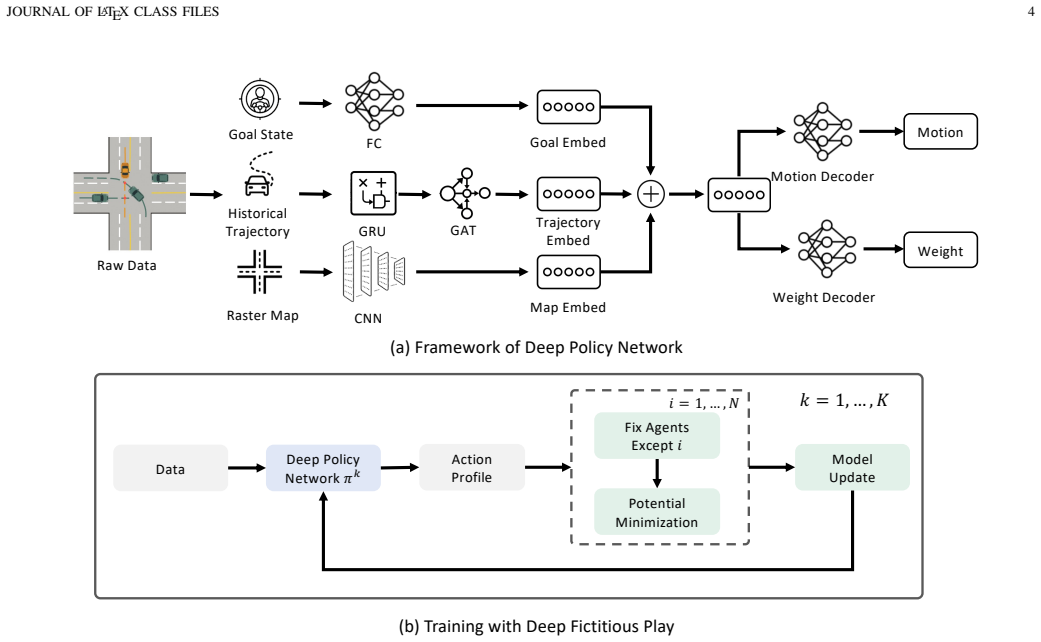
The load-bearing object is the weighted potential differential game: a global potential function $\Phi$ assembled from four terms (terminal goal error, control smoothness, travel efficiency, and pairwise safety distance) together with the identity $J_i(a_i,a_{-i}) - J_i(a'_i,a_{-i}) = w_i[\Phi(a_i,a_{-i}) - \Phi(a'_i,a_{-i})]$. This identity is what the proof uses to show that Algorithm 1's one-at-a-time best responses make $\Phi$ monotonically decrease, so that any cluster point is a Nash equilibrium. A deep policy network proposes initial motions and weights, and a differentiable nonlinear optimization layer refines the motion under the potential; the whole pipeline is trained end-to-end with the Deep Fictitious Play update rule.
What would settle it
Take the trained network on a held-out scene and numerically test the weighted-potential identity: change one driver's planned action sequence, measure that driver's cost change and the shared potential change, and check whether the ratio equals the predicted $w_i$ across many perturbations. If the ratio is not constant, the weighted-potential representation that the convergence proof relies on is falsified for the learned model.
Extended reading notes
Core claim
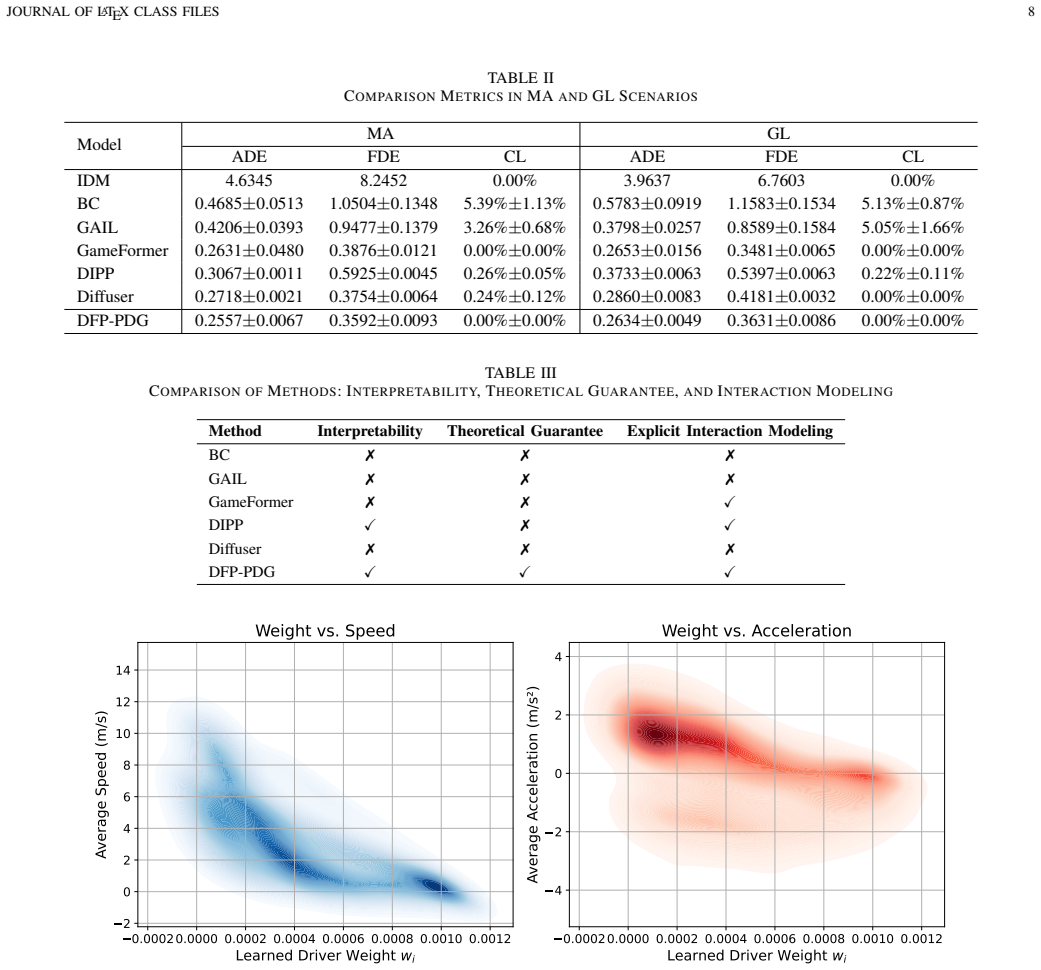
The central claim is that multi-vehicle driving at an unsignalized intersection can be cast as a weighted potential differential game, and that training a deep policy within that game by Deep Fictitious Play yields human-like, collision-free interactive plans with an equilibrium guarantee. The construction is a shared potential $\Phi$ built from goal attraction, smoothness, efficiency, and pairwise safety terms, and a per-driver weight $w_i > 0$ such that each driver's cost difference equals $w_i$ times the corresponding potential difference. Proposition 1 asserts this is an exact potential game; Theorem 1 asserts that the alternating best-response updates of Algorithm 1 descend $\Phi$ monotonically and converge to a Nash equilibrium, with Corollary 1 covering approximate best responses. Empirically, DFP-PDG achieves ADE/FDE of 0.2557/0.3592 on the MA scenario and 0.2634/0.3631 on GL, matching the best compared methods, with a zero collision rate, and the learned weights vary with speed and acceleration in the intended direction.
Load-bearing premise
The load-bearing premise is that real intersection interactions can be represented by one shared potential function multiplied by a single scalar per driver; if different drivers' preferences cannot be aligned in that proportional way, the Nash-convergence guarantee proven for the weighted potential game does not apply to the actual system.
Editorial extensions
If this is right
- DFP-PDG reaches ADE/FDE of 0.2557/0.3592 on the MA scenario and 0.2634/0.3631 on GL, matching the best compared interactive planners while keeping a 0% collision rate, so the method is competitive as a motion planner.
- The learned individual weights vary with speed and acceleration in the expected direction, giving an interpretable, per-driver aggressiveness signal rather than a black-box policy.
- Ablation shows the individualized weights carry most of the accuracy: removing them raises MA ADE from 0.2557 to 0.5509, indicating personalization is central to the reported human-likeness.
- The framework also functions as a trajectory predictor when goal information is removed, still with zero collisions, so the same potential-game structure serves both planning and prediction.
- Theorem 1 and Corollary 1 extend the convergence guarantee to approximate best responses with decaying error, so the training can use approximate optimizers without losing the equilibrium guarantee.
Reading between the lines
- If the weighted-potential assumption holds, the same DFP training loop should transfer directly to other interactive traffic scenarios such as roundabouts, merges, and lane changes, because the convergence proof uses only compact convex action sets, continuity, a bounded-below potential, and the weighted-potential identity.
- The safety term in Eq. (6) sums over all ordered pairs, and the proof rewrites it as $2\sum_{i<j}$, so the effective pairwise safety weight in the potential is twice the nominal $\lambda_{\mathrm{safety}}$; readers should interpret the global weights with that factor in mind.
- A natural next experiment would be to make the four global weights context-dependent, for example conditioned on road geometry, traffic density, or time pressure, and to test whether the Nash structure survives that extension.
- The reported zero collision rate is an empirical result on two test splits, not a certified property of the learned potential; coupling the differentiable optimizer with hard safety constraints would turn the observed safety into a verifiable guarantee.
Signed reviews
Editorial analysis
A structured set of objections, weighed in public.
Referee Report
Summary. The paper proposes DFP-PDG, a framework for interactive motion planning and prediction at unsignalized intersections. Vehicle interaction is modeled as a differential game, reformulated as a weighted potential game whose global potential is given in Eq. (6), with per-driver scalar weights w_i introduced in Eq. (7). A deep policy network predicts accelerations and weights from raster maps, historical trajectories, and goal states; a differentiable Levenberg-Marquardt optimization layer refines the predicted motions; training alternates best responses in the style of Algorithm 1. The authors claim a convergence guarantee to a Nash equilibrium (Theorem 1), interpretable per-driver aggressiveness weights, and state-of-the-art or comparable ADE/FDE with zero collisions on the INTERACTION MA and GL scenarios.
Significance. If the theoretical claims were correct, DFP-PDG would be a valuable contribution: it combines a learnable potential-game structure with deep policies and differentiable optimization, and its evaluation protocol on a public dataset is sound in design (held-out split, three runs, several baselines, collision-rate reporting). The empirical results are encouraging, and the ablation study is informative. However, the paper's central selling points—the weighted-potential-based convergence guarantee and the interpretation of w_i as capturing heterogeneous driving styles—are not supported by the equations as written. The scalar-weight invariance issue in Eq. (7) directly invalidates the heterogeneity claim, and the proof of the potential-game representation is asserted rather than derived. These are load-bearing deficiencies that require substantive revision; the empirical results alone do not establish the paper's advertised contributions.
major comments (4)
- [Section III-C, Eq. (7); Algorithm 1; Theorem 1] The scalar-weight mechanism is incompatible with the claimed behavioral heterogeneity. Equation (7) implies that for fixed a_{-i}, J_i(a_i,a_{-i}) = w_i Phi(a_i,a_{-i}) + g_i(a_{-i}), so argmin over a_i of J_i equals argmin over a_i of Phi for any w_i > 0. Consequently, under the exact best responses assumed in Algorithm 1 and Theorem 1, the learned w_i cannot change any trajectory or equilibrium selection. This contradicts the interpretation in Section IV-E and the large performance gap between DFP-PDG and DFP-PDG-IW in Table V. If w_i enters the implemented differentiable optimization in some other way, then the exact-best-response assumption of Theorem 1 is violated, and the convergence guarantee does not apply to the system actually trained. The authors must state explicitly which objective is minimized and reconcile the theoretical claim with the empirical weight effect.
- [Section III-B, Proposition 1; Eq. (6)] The potential-game representation is asserted, not derived. Proposition 1 states that nabla_{a_i} J_i(a) = nabla_{a_i} Phi(a) for all i, but J_i is never explicitly constructed after the generic differential-game cost in Eq. (3). The proof only analyzes the four terms of Phi and claims that each 'contributes directly' to nabla_{a_i} J_i without giving J_i. In particular, the safety term in Eq. (6) counts each unordered pair twice, and the proof acknowledges this by rewriting it as 2 * sum_{i<j} (...); one cannot verify the claimed gradient equality without an explicit definition of J_i, including how the pair costs enter each agent's individual cost. This missing construction is load-bearing because the convergence result depends entirely on the weighted-potential equality in Eq. (7).
- [Section III-E, Assumption 2; Section IV-B] The convergence guarantee is not tied to the implemented optimizer. Theorem 1 assumes exact best responses, but Section IV-B states that the refinement step uses the Theseus library with the Levenberg-Marquardt algorithm, which is an approximate solver. The paper introduces Assumption 2 (sum_k Delta_k < infinity) and Corollary 1 for the approximate case, but no bound, estimate, or empirical monitoring of Delta_k is provided. Moreover, because of the scalar-weight issue, it is unclear what objective the solver is approximating. The claim that the trained framework 'provides a theoretical guarantee of convergence' is therefore not established for the actual system; at best it holds for an idealized exact-optimization version under an unverified summability condition.
- [Section III-E, Algorithm 1] Algorithm 1 is not Deep Fictitious Play as the term is standardly used. Fictitious play prescribes best responses to the empirical frequency of opponents' past actions, whereas Algorithm 1 performs alternating (Gauss-Seidel) best responses to the other players' current actions. The convergence result proved in Lemmas 1-3 is a standard descent property of potential-game best-response dynamics, not a fictitious-play convergence theorem. The paper's claim to be the first to train interactive driving policies using Deep Fictitious Play is therefore misleading and should be corrected or the algorithm redefined and the terminology justified.
minor comments (5)
- [Section IV-B] The paper reports means and standard deviations over three runs, but the differences between DFP-PDG and GameFormer in Table II are small; please add a statistical comparison or explicitly state that the differences are within noise.
- [Section IV-E, Fig. 5] Please state explicitly whether the learned driver weights are computed on the held-out test split or on the training data; as written, the correlation analysis in Fig. 5 appears to use the same data used to fit the model, which would make the interpretability claim circular.
- [Eq. (6)] The nested summation in the efficiency term is difficult to parse; please add brackets or a clearer definition of the cumulative displacement so that the term is unambiguous.
- [Algorithm 1, line 6] The instruction 'Update theta^k with gradient descent' is vague; please specify the loss function (presumably Eq. (15)) and how the differentiable optimization layer contributes to the gradient.
- [Throughout] There are several minor typographical issues, including 'CA Vs' in Section I, 'u^infty' instead of 'a^infty' in Lemma 3, and an inconsistent terminal-cost symbol between Eq. (3) and its surrounding text; these should be cleaned up.
Circularity Check
Held-out trajectory accuracy is genuinely predictive, but the driver-heterogeneity mechanism is defined into Eq. (7) rather than derived: a positive scalar weight cancels in best responses, so the learned w_i cannot produce the claimed diversity, and the potential-game reformulation is asserted rather than shown to follow from the original J_i.
-
self definitional
[Section III-C, Eq. (7), and Section IV-E]
"Ji(ai,a−i)−Ji(a′i,a−i)=wi[Φ(ai,a−i)−Φ(a′i,a−i)] ... The weight wi>0 can be interpreted as the sensitivity of vehicle i to the global cost: a larger wi indicates a more conservative vehicle, as it is more responsive to cost changes, whereas a smaller wi reflects a more aggressive driving style."
For fixed a_-i, Eq. (7) implies J_i(a_i,a_-i)=w_i Phi(a_i,a_-i)+g_i(a_-i), so argmin over a_i of J_i equals argmin over a_i of Phi for every positive scalar w_i. Thus the learned per-driver weights cannot affect any best response in Algorithm 1 or any equilibrium characterized by Theorem 1; the claimed driver heterogeneity is a positive constant multiplier relabeled as a driving-style sensitivity. The later claim that higher speeds and accelerations are associated with lower weights is therefore a post-hoc correlation with a parameter that is inert by construction in the exact-best-response regime, not a prediction or a derived property of the model.
-
self definitional
[Section III-B, Proposition 1 proof]
"Since every component of Φ is either (i) an individual term that depends solely on a_i or (ii) a symmetric pair-wise term whose contribution is shared equally by the two agents it couples, we obtain ∇_{a_i}Φ=∇_{a_i}J_i(a)∀i. Consequently, the game induced by this cost structure is an exact potential game."
The proof of Proposition 1 never uses the individual cost J_i defined in Eq. (3), whose concrete form is never given. The gradient equality is effectively an assertion that defines J_i in terms of Φ, rather than a derivation showing the original differential-game cost has the potential structure. Consequently, Theorem 1's Nash-equilibrium guarantee is for the game the authors construct from Φ, not for the general differential game or for human interaction costs; the 'reformulation' step is circular because the potential function is assumed to be the individual cost instead of being shown to be equivalent to it.
full rationale
The empirical trajectory predictions are not circular: DFP-PDG is evaluated on a held-out 30% test split of the INTERACTION dataset against external baselines (IDM, BC, GAIL, GameFormer, DIPP, Diffuser), and the reported ADE/FDE values do not reduce to the fitted weights or to a reused training target. The convergence proof is also a standard descent argument for the weighted potential game the paper defines; if that game is accepted, Theorem 1 is internally valid. The circularity that exists is confined to the interpretability and reformulation claims: Eq. (7) makes w_i a definitional sensitivity that is mathematically inert under exact best responses, and Proposition 1 effectively defines J_i to equal the chosen Φ without deriving it from Eq. (3). These are load-bearing for the paper's 'diverse driving styles' and 'theoretical guarantee' framing, but they do not undermine the independent held-out empirical comparison, so the overall score is moderate rather than severe.
Assumptions & free parameters
free parameters (4)
- global potential weights lambda_goal, lambda_smooth, lambda_efficiency, lambda_safety =
MA: 0.9919, 1.0102, 0.9914, 0.9951; GL: 0.9947, 1.0058, 0.9940, 0.9963 (Table IV)
- per-driver weight w_i =
Small values around 0.0000 to 0.0012 (Fig. 5)
- safe distance d_safe =
3 m
- training and optimizer hyperparameters =
hidden dim 64, learning rate 1e-4, LM step size 3e-1, initial global weights 1
assumptions (5)
- domain assumption Each feasible action set A_i is non-empty, compact, and convex; all cost functions are continuous; the potential Phi is bounded below and minima are attained (Assumption 1).
- ad hoc to paper The multi-vehicle interaction game is a weighted potential game: Eq. (7) holds with a single scalar w_i > 0 per driver.
- ad hoc to paper The best-response suboptimality errors are summable, i.e. Assumption 2: sum_k Delta_k < infinity.
- domain assumption A unicycle or kinematic bicycle model adequately represents vehicle motion.
- domain assumption A Nash equilibrium of the learned potential game corresponds to human-like interaction.
Cite this review
Pith. "Pith review of Deep Fictitious Play-Based Potential Differential Games for Learning Human-Like Interaction at Unsignalized Intersections." pith.science (2026). https://pith.science/paper/HKOCO52D
@misc{pith2026250612283,
  author       = {Pith},
  title        = {Pith review of: Deep Fictitious Play-Based Potential Differential Games for Learning Human-Like Interaction at Unsignalized Intersections},
  year         = {2026},
  howpublished = {\url{https://pith.science/paper/HKOCO52D}},
  note         = {Machine review of arXiv:2506.12283}
}
read the original abstract
Modeling vehicle interactions at unsignalized intersections is a challenging task due to the complexity of the underlying game-theoretic processes. Although prior studies have attempted to capture interactive driving behaviors, most approaches relied solely on game-theoretic formulations and did not leverage naturalistic driving datasets. In this study, we learn human-like interactive driving policies at unsignalized intersections using Deep Fictitious Play. Specifically, we first model vehicle interactions as a Differential Game, which is then reformulated as a Potential Differential Game. The weights in the cost function are learned from the dataset and capture diverse driving styles. We also demonstrate that our framework provides a theoretical guarantee of convergence to a Nash equilibrium. To the best of our knowledge, this is the first study to train interactive driving policies using Deep Fictitious Play. We validate the effectiveness of our Deep Fictitious Play-Based Potential Differential Game (DFP-PDG) framework using the INTERACTION dataset. The results demonstrate that the proposed framework achieves satisfactory performance in learning human-like driving policies. The learned individual weights effectively capture variations in driver aggressiveness and preferences. Furthermore, the ablation study highlights the importance of each component within our model. Code is available at https://github.com/zeonchen/DFP-PDG.
Figures


Figures from the paper (3 more)


Reviewed August 7, 2026 · model on record in the stance chip above.
Discussion (0). Continue with ORCID to comment.