REVIEW 3 major objections 5 minor 34 references
SPIRE: Conditional Personalization for Federated Diffusion Generative Models
T0 review · 3 major / 5 minor · reviewed 2026-08-07 · deepseek-v4-flash
Pith's one-line read A shared diffusion backbone plus per-client identity embeddings lets new clients personalize by updating under 0.01 percent of weights.
desk verdict SPIRE's empirical idea is plausible, but the theory has a sign/chain-rule error that invalidates the dimension-free bound, so the current version overclaims. read the letter →
The pith
A machine-rendered reading of the paper's core claim, the machinery that carries it, and where it could break.
The reading
What carries the argument
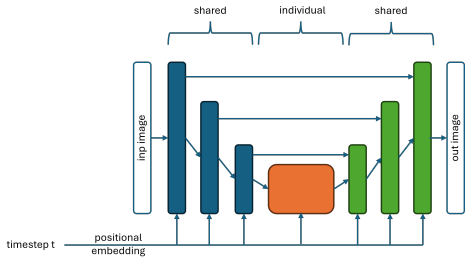
The central objects are the identity embedding and the one-layer score function of Lemma 4.1. The embedding is a low-dimensional vector, indexed by client id, that is injected into a U-Net backbone as conditioning; it carries all client-specific information while the backbone weights stay shared. The lemma shows that the exact score of a two-component symmetric Gaussian mixture is $\tanh(\mu_t^\top x-\tfrac12\log((1-w)/w))\mu_t-x$, which is a single tanh neuron with a residual connection, where the mixing weight $w$ appears only as a bias in the pre-activation. That makes $w$ the “embedding” of the theoretical model, and it lets the authors relate the stationary point of the DDPM loss to the EM algorithm's M-step, transferring standard GMM learning guarantees to conditional diffusion training. For the practical method, the same mechanism—a per-client bias steering a shared network—is what Algorithm 1 and Algorithm 2 implement.
What would settle it
Train a two-component symmetric Gaussian mixture with known means and mixing weight $w$, then run gradient descent on the DDPM loss in the one-layer parameterization of Lemma 4.1 and check whether the converged $w$ satisfies the critical-point condition $\mathbb{E}[\tanh(\mu_t^\top X_t-\frac12\log((1-w)/w))]=-\mu_t^\top\mathbb{E}[X_t]/\|\mu_t\|^2$; a systematic mismatch between the converged weight and the moment-matching value would invalidate the claimed link between DDPM training and maximum likelihood.
Extended reading notes
Core claim
On the paper's own terms, per-client diffusion modeling is a conditional generation problem, not a fine-tuning problem. The authors claim that factorizing the score network into a high-capacity shared backbone plus per-client embeddings makes personalization sample-efficient: the embeddings encode client data statistics, and for a client joining after pretraining, the only learned parameters are those embeddings. The theory they offer is that in a symmetric two-component Gaussian mixture where clients share the means but differ in the component mixing weight, the score has the closed form $$\nabla_x \log q_t(x)=\tanh\!\left(\mu_t^\top x-\tfrac12\log\!\tfrac{1-w}{w}\right)\mu_t-x,$$ and gradient descent on the DDPM objective with respect to $w$ reaches a point satisfying first-order moment matching, so the sample-based estimate obeys $$\mathbb{E}[(w-\hat w)^2]\le \frac{w(1-w)}{n}+\frac{d}{4\|\mu_t\|^2 n}.$$ The claim is that this bound is dimension-free in the sense that both terms scale the same way with dimension, and that it explains why a tiny conditioning signal can steer a shared score network toward a personalized distribution.
Load-bearing premise
The load-bearing assumption is that the learned score function has exactly the one-layer tanh form of Lemma 4.1, so that wherever the DDPM training loss levels off, the client parameter sits at the first-order moment matching point; if real U-Net scores deviate from that form, the dimension-free bound in Theorem 4.2 does not directly apply.
Editorial extensions
If this is right
- New clients can be personalized on-device after a single model download, since only their embedding is updated and no gradients need to be sent back.
- Because the personalized part is tiny, fine-tuning is robust to learning-rate and epoch choices and does not catastrophically forget the shared backbone.
- The theory predicts that clients with very few samples can estimate their own mixing weight reliably in high dimension, as long as the shared mean or backbone is well estimated.
- Score-estimation error is dominated by the global mean estimate until the number of clients is very large (on the order of $d^6B^8$), after which the client's local sample size takes over (Theorem 4.3).
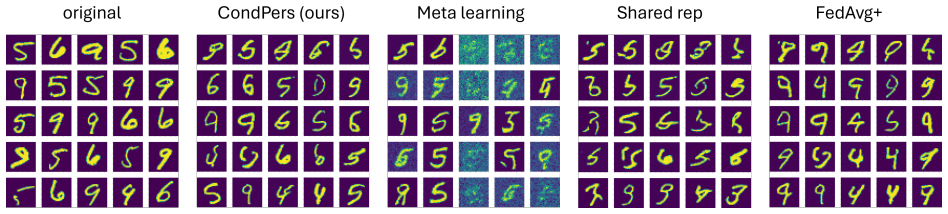
- The same architecture achieves lower Kernel Inception Distance than whole-model fine-tuning or per-client bottleneck fine-tuning on all three tested datasets for new-client adaptation.
Reading between the lines
- Beyond the paper's claims: if the embedding is read as a learned log-odds term, then any conditioning interface that biases a score network's pre-activations—class labels, text prompts, style tokens—could inherit a similar sample-efficiency argument, not just client IDs.
- Beyond the paper's claims: the dimension-free weight bound suggests that the main bottleneck for personalization is the quality of the shared backbone rather than the client's local data size; this could be tested by fixing the client distribution and varying only the pretraining corpus.
- Beyond the paper's claims: the paper states the limitation that SPIRE requires pretraining with client conditioning from scratch, which points to a direct extension—add a small trainable conditioning adapter to a publicly pretrained unconditional diffusion model and check whether new-client gains survive while the backbone stays frozen.
- Beyond the paper's claims: since the theory is built on the exact tanh score form, a natural stress test is whether real U-Net embeddings actually behave like learned log-odds, for example by training SPIRE on a synthetic two-component GMM and comparing the inferred weight against the moment-matching value.
Editorial analysis
A structured set of objections, weighed in public.
Referee Report
Summary. This paper proposes SPIRE, a federated learning method for personalized diffusion models in which a shared U-Net backbone is trained together with per-client identity embeddings, and only the embedding is fine-tuned for unseen clients. The paper pairs the method with a theoretical analysis: for a symmetric two-component Gaussian mixture model with a shared mean and per-client mixing weight, it claims that gradient descent on the DDPM objective with respect to the mixing weight recovers the optimal weight with a dimension-free error bound (Theorem 4.2), and that a two-stage estimation procedure yields a score-error bound (Theorem 4.3). Empirically, SPIRE is compared with FedAvg plus fine-tuning, a shared-representation baseline, and a meta-learning baseline on MNIST, CIFAR-10, and CelebA, reporting KID values for both collaborative pretraining and new-client fine-tuning.
Significance. If the theoretical claims were valid, the paper would make a useful contribution: it would connect conditional diffusion training to Gaussian-mixture estimation, provide a principled explanation of embedding-based conditioning, and show a parameter-efficient path to federated personalization for generative models. The paper has clear strengths: the architectural idea is simple and practically motivated, the new-client adaptation scenario is a real federated learning problem, and the authors use KID rather than FID for small datasets and explicitly state a limitation of their approach. However, the central theorem's proof is invalid: the chain-rule computation drops a positive correlated factor and has an inconsistent sign, and the theorem statement claims a gradient-descent result while the proof actually bounds a different moment estimator. The headline empirical claims also rest on single KID values without error bars or multiple seeds. Because the advertised contributions depend on the invalid theorem and the empirical evidence is not statistically grounded, the paper is not acceptable in its current form.
major comments (3)
- [Section 4.2, proof of Theorem 4.2, Eq. (12)] The derivative of the DDPM loss (11) with respect to w is computed incorrectly. The correct chain rule gives the stationarity condition E[tanh'(u_t)(||μ_t||^2 tanh(u_t) + μ_t^T X_t)] = 0, where u_t = μ_t^T X_t - 1/2 log((1-w)/w). The proof replaces this by Eq. (12), E[tanh(u_t)] = - μ_t^T E[X_t] / ||μ_t||^2, thereby removing the strictly positive and correlated factor tanh'(u_t) and changing the sign. The resulting condition is inconsistent with the data: for the true mixing weight, E[tanh(u_t)] = 2w - 1 and μ_t^T E[X_t] / ||μ_t||^2 = 2w - 1, so Eq. (12) forces w = 1/2. Consequently, the estimator \w defined from Eq. (12) targets 1-w rather than w whenever w ≠ 1/2, and the dimension-free bound stated in Theorem 4.2 is not established.
- [Section 4.2, Theorem 4.2 statement versus proof] The theorem states that a gradient method on the DDPM loss with respect to the mixing weight recovers the optimal mixing weight with the displayed mean-squared error, but the proof never analyzes a gradient trajectory. Instead, it defines \w as the first-order moment estimator obtained from Eq. (12) and computes the variance of that estimator. No argument shows that gradient descent on the objective (11) converges to this \w, nor that the empirical minimizer of the DDPM loss is close to the moment estimator. Thus even a corrected stationarity computation would not support the theorem as stated. Since Theorem 4.3 (Eq. (13)) uses the dimension-free mixing-weight bound from Theorem 4.2, its O(1/n) term is also unsupported.
- [Section 5, Table 1] The paper's central empirical claim that SPIRE 'vastly outperforms' baselines on new clients rests on single KID values with no error bars, no number of seeds, and no significance test. KID estimates are stochastic and depend on the choice of reference batches, so the reported margins (e.g., 0.012 versus 0.017 on MNIST, or 0.038 versus 0.048 on CIFAR-10) are not interpretable without variance information. The absence of code and of a precise experimental configuration further limits verification of the empirical findings.
minor comments (5)
- [Section 3] The sentence beginning 'F orm of θ_j' at the start of Section 3 contains a formatting artifact and should read 'Form of θ_j'.
- [Lemma 4.1 and its proof] The lemma and its proof disagree on the sign of the log-odds term: the lemma writes tanh(μ_t^T x - 1/2 log(w/(1-w))), while the proof derives tanh(μ_t^T x + 1/2 log(w/(1-w))) = tanh(μ_t^T x - 1/2 log((1-w)/w)); this notation needs to be made consistent throughout the paper.
- [Equations (2), (9), and the proof of Theorem 4.3] The noise variance is written inconsistently as β_t in Eq. (2), as sqrt(1-e^{-2t}) in Eq. (9), and as both in the proof of Theorem 4.3; the relationship between these notations should be stated explicitly.
- [Proof of Theorem 4.2] The derivative computation in the proof contains duplicated lines and a sign error in the final expression, which suggests an editing mistake; the entire derivation should be rewritten and checked.
- [Experimental details] The paper does not state how many random seeds or runs produced the reported KID values, nor does it provide code; this information is essential for evaluating the robustness claims.
Circularity Check
No significant circularity: the theoretical bounds are computed for explicitly defined estimators; the central proof flaw is an algebraic error, not a circular reduction.
full rationale
SPIRE's derivation chain is self-contained: Theorem 4.2's bound is computed for the explicitly defined estimator \hat w = 1/2(1 - \mu_t^T \hat X_t / \|\mu_t\|^2), and the MSE calculation is a standard variance bound for a first-order moment estimator; no fitted parameter is renamed as a prediction, and no load-bearing assertion rests on the authors' own prior work ([25,26,27] appear only as background, while the mean-estimation result used in Theorem 4.3 is imported from the external reference [29]). The most serious problem in Section 4.2 is an algebraic error, not circularity: the stationarity condition in Eq. (12) drops the positive weight tanh'(u_t) and uses an incorrect sign, so the claimed link between gradient descent on the DDPM objective and the sample-moment estimator is not established; this is a soundness or correctness defect, not a circular reduction. The paper also candidly lists its main limitation (conditioned pretraining prevents direct integration with pretrained StableDiffusion), which is not circular. Therefore no circular step is present.
Assumptions & free parameters
free parameters (3)
- client embedding dimension d_emb
- fine-tuning learning rate for SPIRE =
0.01
- number of local fine-tuning epochs =
not exactly stated
assumptions (5)
- domain assumption Client data distributions are exactly q^(j)(x|phi, gamma_j), a two-component symmetric GMM with shared +/- mu, unit covariance, and client-specific mixing weight w_j.
- domain assumption The learned score network has the exact parametric form s_t(x) = tanh(mu_t^T x - 0.5 log((1-w)/w)) mu_t - x.
- ad hoc to paper The critical point of the DDPM loss with respect to w coincides with the EM fixed point.
- domain assumption The mean estimation convergence bound from [29] transfers to the federated setting with mn pooled samples.
- standard math The OU forward process with X_t = e^{-t} X_0 + sqrt(1 - e^{-2t}) Z_t.
invented entities (1)
-
Per-client identity embedding e_j (identity token)
independent evidence
Cite this review
Pith. "Pith review of SPIRE: Conditional Personalization for Federated Diffusion Generative Models." pith.science (2026). https://pith.science/paper/NYBK4VUC
@misc{pith2026250612303,
  author       = {Pith},
  title        = {Pith review of: SPIRE: Conditional Personalization for Federated Diffusion Generative Models},
  year         = {2026},
  howpublished = {\url{https://pith.science/paper/NYBK4VUC}},
  note         = {Machine review of arXiv:2506.12303}
}
abstract
Recent advances in diffusion models have revolutionized generative AI, but their sheer size makes on device personalization, and thus effective federated learning (FL), infeasible. We propose Shared Backbone Personal Identity Representation Embeddings (SPIRE), a framework that casts per client diffusion based generation as conditional generation in FL. SPIRE factorizes the network into (i) a high capacity global backbone that learns a population level score function and (ii) lightweight, learnable client embeddings that encode local data statistics. This separation enables parameter efficient finetuning that touches $\leq 0.01\%$ of weights. We provide the first theoretical bridge between conditional diffusion training and maximum likelihood estimation in Gaussian mixture models. For a two component mixture we prove that gradient descent on the DDPM with respect to mixing weights loss recovers the optimal mixing weights and enjoys dimension free error bounds. Our analysis also hints at how client embeddings act as biases that steer a shared score network toward personalized distributions. Empirically, SPIRE matches or surpasses strong baselines during collaborative pretraining, and vastly outperforms them when adapting to unseen clients, reducing Kernel Inception Distance while updating only hundreds of parameters. SPIRE further mitigates catastrophic forgetting and remains robust across finetuning learning rate and epoch choices.
Figures


Figures from the paper (3 more)


Reference graph
Works this paper leans on
-
[1]
Debiasing model updates for improving personalized federated training
Durmus Alp Emre Acar, Yue Zhao, Ruizhao Zhu, Ramon Matas, Matthew Mattina, Paul Whatmough, and Venkatesh Saligrama. Debiasing model updates for improving personalized federated training. In International Conference on Machine Learning, pages 21–31. PMLR, 2021
work page 2021
-
[2]
Sutherland, Michael Arbel, and Arthur Gretton
Miko laj Bi´ nkowski, Dougal J. Sutherland, Michael Arbel, and Arthur Gretton. Demystifying MMD GANs. InInternational Conference on Learning Representations, 2018
work page 2018
-
[3]
Self-aware personalized federated learning
Huili Chen, Jie Ding, Eric William Tramel, Shuang Wu, Anit Kumar Sahu, Salman Avestimehr, and Tao Zhang. Self-aware personalized federated learning. In Alice H. Oh, Alekh Agarwal, Danielle Belgrave, and Kyunghyun Cho, editors,Advances in Neural Information Processing Systems, 2022
work page 2022
-
[4]
Sampling is as easy as learning the score: theory for diffusion models with minimal data assumptions
Sitan Chen, Sinho Chewi, Jerry Li, Yuanzhi Li, Adil Salim, and Anru Zhang. Sampling is as easy as learning the score: theory for diffusion models with minimal data assumptions. InThe Eleventh International Conference on Learning Representations, 2023
2023
-
[5]
Learning general gaussian mixtures with efficient score matching, 2024
Sitan Chen, Vasilis Kontonis, and Kulin Shah. Learning general gaussian mixtures with efficient score matching, 2024
work page 2024
-
[6]
Exploiting shared represen- tations for personalized federated learning
Liam Collins, Hamed Hassani, Aryan Mokhtari, and Sanjay Shakkottai. Exploiting shared represen- tations for personalized federated learning. In Marina Meila and Tong Zhang, editors,International Conference on Machine Learning (ICML), volume 139 ofProceedings of Machine Learning Research, pages 2089–2099. PMLR, 2021
work page 2021
-
[7]
Ten steps of em suffice for mixtures of two gaussians
Constantinos Daskalakis, Christos Tzamos, and Manolis Zampetakis. Ten steps of em suffice for mixtures of two gaussians. InProceedings of the 2017 Conference on Learning Theory, volume 65 ofProceedings of Machine Learning Research, pages 704–710, 2017
work page 2017
-
[8]
Adaptive personalized federated learning.arXiv preprint arXiv:2003.13461, 2020
Yuyang Deng, Mohammad Mahdi Kamani, and Mehrdad Mahdavi. Adaptive personalized federated learning.arXiv preprint arXiv:2003.13461, 2020
arXiv 2003
Show all 34 references
-
[9]
Diffusion models beat GANs on image synthesis
Prafulla Dhariwal and Alexander Quinn Nichol. Diffusion models beat GANs on image synthesis. In A. Beygelzimer, Y. Dauphin, P. Liang, and J. Wortman Vaughan, editors,Advances in Neural Information Processing Systems, 2021
2021
-
[10]
Dinh, Nguyen H
Canh T. Dinh, Nguyen H. Tran, and Tuan Dung Nguyen. Personalized federated learning with moreau envelopes. InAdvances in Neural Information Processing Systems, 2020
2020
-
[11]
Kakade, Jason D
Simon Shaolei Du, Wei Hu, Sham M. Kakade, Jason D. Lee, and Qi Lei. Few-shot learning via learning the representation, provably. InInternational Conference on Learning Representations, 2021
2021
-
[12]
Personalized federated learning: A meta- learning approach
Alireza Fallah, Aryan Mokhtari, and Asuman Ozdaglar. Personalized federated learning: A meta- learning approach. InAdvances in Neural Information Processing Systems, 2020
2020
-
[13]
An efficient framework for clustered federated learning
Avishek Ghosh, Jichan Chung, Dong Yin, and Kannan Ramchandran. An efficient framework for clustered federated learning. InAdvances in Neural Information Processing Systems, 2020
2020
-
[14]
Federated learning of a mixture of global and local models.arXiv preprint arXiv:2002.05516, 2020
Filip Hanzely and Peter Richt´ arik. Federated learning of a mixture of global and local models.arXiv preprint arXiv:2002.05516, 2020
2002 arXiv
-
[15]
Gans trained by a two time-scale update rule converge to a local nash equilibrium.Advances in neural information processing systems, 30, 2017
Martin Heusel, Hubert Ramsauer, Thomas Unterthiner, Bernhard Nessler, and Sepp Hochreiter. Gans trained by a two time-scale update rule converge to a local nash equilibrium.Advances in neural information processing systems, 30, 2017
2017
-
[16]
Adaptive gradient-based meta- learning methods
Mikhail Khodak, Maria-Florina F Balcan, and Ameet S Talwalkar. Adaptive gradient-based meta- learning methods. InAdvances in Neural Information Processing Systems, 2019
2019
-
[17]
Fedpop: A bayesian approach for personalised federated learning
Nikita Yurevich Kotelevskii, Maxime Vono, Alain Durmus, and Eric Moulines. Fedpop: A bayesian approach for personalised federated learning. In Alice H. Oh, Alekh Agarwal, Danielle Belgrave, and Kyunghyun Cho, editors,Advances in Neural Information Processing Systems, 2022. 13
2022
-
[18]
The em algorithm gives sample-optimality for learning mixtures of well-separated gaussians, 2020
Jeongyeol Kwon and Constantine Caramanis. The em algorithm gives sample-optimality for learning mixtures of well-separated gaussians, 2020
2020
-
[19]
Federated optimization in heterogeneous networks
Tian Li, Anit Kumar Sahu, Manzil Zaheer, Maziar Sanjabi, Ameet Talwalkar, and Virginia Smith. Federated optimization in heterogeneous networks. InProceedings of Machine Learning and Systems 2020, MLSys, 2020
2020
-
[20]
Stich, and Martin Jaggi
Tao Lin, Lingjing Kong, Sebastian U. Stich, and Martin Jaggi. Ensemble distillation for robust model fusion in federated learning. InAdvances in Neural Information Processing Systems, 2020
2020
-
[21]
Deep learning face attributes in the wild
Ziwei Liu, Ping Luo, Xiaogang Wang, and Xiaoou Tang. Deep learning face attributes in the wild. In Proceedings of International Conference on Computer Vision (ICCV), December 2015
2015
-
[22]
Decoupled weight decay regularization
Ilya Loshchilov and Frank Hutter. Decoupled weight decay regularization. InInternational Conference on Learning Representations, 2019
2019
-
[23]
Three approaches for person- alization with applications to federated learning.arXiv preprint arXiv:2002.10619, 2020
Yishay Mansour, Mehryar Mohri, Jae Ro, and Ananda Theertha Suresh. Three approaches for person- alization with applications to federated learning.arXiv preprint arXiv:2002.10619, 2020
2002 arXiv
-
[24]
Federated multi-task learning under a mixture of distributions.Advances in Neural Information Processing Sys- tems, 34, 2021
Othmane Marfoq, Giovanni Neglia, Aur´ elien Bellet, Laetitia Kameni, and Richard Vidal. Federated multi-task learning under a mixture of distributions.Advances in Neural Information Processing Sys- tems, 34, 2021
2021
-
[25]
A statistical framework for person- alized federated learning and estimation: Theory, algorithms, and privacy
Kaan Ozkara, Antonious Girgis, Deepesh Data, and Suhas Diggavi. A statistical framework for person- alized federated learning and estimation: Theory, algorithms, and privacy. InInternational Conference on Learning Representations, 2023
2023
-
[26]
ADEPT: Hierarchical bayes approach to personalized federated unsupervised learning
Kaan Ozkara, Bruce Huang, Ruida Zhou, and Suhas Diggavi. ADEPT: Hierarchical bayes approach to personalized federated unsupervised learning. InThe 28th International Conference on Artificial Intelligence and Statistics, 2025
2025
-
[27]
Quped: Quantized personalization via distillation with applications to federated learning.Advances in Neural Information Processing Systems, 34, 2021
Kaan Ozkara, Navjot Singh, Deepesh Data, and Suhas Diggavi. Quped: Quantized personalization via distillation with applications to federated learning.Advances in Neural Information Processing Systems, 34, 2021
2021
-
[28]
High- resolution image synthesis with latent diffusion models, 2022
Robin Rombach, Andreas Blattmann, Dominik Lorenz, Patrick Esser, and Bj¨ orn Ommer. High- resolution image synthesis with latent diffusion models, 2022
2022
-
[29]
Learning mixtures of gaussians using the DDPM objective
Kulin Shah, Sitan Chen, and Adam Klivans. Learning mixtures of gaussians using the DDPM objective. InThirty-seventh Conference on Neural Information Processing Systems, 2023
2023
-
[30]
Talwalkar
Virginia Smith, Chao-Kai Chiang, Maziar Sanjabi, and Ameet S. Talwalkar. Federated multi-task learning. InAdvances in Neural Information Processing Systems, pages 4424–4434, 2017
2017
-
[31]
Rethinking few- shot image classification: a good embedding is all you need? InEuropean Conference on Computer Vision, pages 266–282
Yonglong Tian, Yue Wang, Dilip Krishnan, Joshua B Tenenbaum, and Phillip Isola. Rethinking few- shot image classification: a good embedding is all you need? InEuropean Conference on Computer Vision, pages 266–282. Springer, 2020
2020
-
[32]
Decentralized collaborative learning of personalized models over networks
Paul Vanhaesebrouck, Aur´ elien Bellet, and Marc Tommasi. Decentralized collaborative learning of personalized models over networks. InArtificial Intelligence and Statistics, pages 509–517. PMLR, 2017
2017
-
[33]
Fully decentralized joint learning of per- sonalized models and collaboration graphs
Valentina Zantedeschi, Aur´ elien Bellet, and Marc Tommasi. Fully decentralized joint learning of per- sonalized models and collaboration graphs. InInternational Conference on Artificial Intelligence and Statistics, pages 864–874. PMLR, 2020
2020
-
[34]
+µ”.IfX 0 ∼ N(µ,I), then Xt =e −tX0 + p 1−e −2t Zt ∼ N e−tµ, e−2tI+ (1−e −2t)I =N e−tµ,I . Component “−µ
Michael Zhang, Karan Sapra, Sanja Fidler, Serena Yeung, and Jose M. Alvarez. Personalized federated learning with first order model optimization. InInternational Conference on Learning Representations, 2021. 14 A Proofs and other details for theoretical results A.1 Diffusion m...
2021
Reviewed August 7, 2026 · model on record in the stance chip above.
Discussion (0). Sign in to comment.