REVIEW 3 major objections 5 minor 39 references
IndoorWorld: Integrating Physical Task Solving and Social Simulation in A Heterogeneous Multi-Agent Environment
T0 review · 3 major / 5 minor · reviewed 2026-08-07 · deepseek-v4-flash
Pith's one-line read IndoorWorld claims that physical task solving and social simulation can be integrated in one world-state engine, and demonstrates the integration through office-task collaboration, resource competition, and spatial-layout experiments.
desk verdict Genuine environment contribution with a solid task-solving ablation, but the resource/layout claims rest on single unreplicated runs and need major revision before the architectural conclusions can be taken seriously. read the letter →
The pith
A machine-rendered reading of the paper's core claim, the machinery that carries it, and where it could break.
The reading
What carries the argument
The load-bearing mechanism is an object-oriented world state, with agents, objects, and locations as stateful entities whose actions have preconditions and effects, wrapped in a five-module agent architecture (perception, memory, planning, action, task prioritization). Heterogeneity enters at four levels—profile, action space, capability, and knowledge—so the same world state yields different admissible actions and efficiencies across agents. Conversations are treated as actions anchored to a shared location, which is what physically grounds social behavior. The task-prioritization module is the third piece: it re-reminds agents of incomplete tasks and objects, counteracting LLM agents' tendency to switch tasks mid-way, and the paper shows that removing it degrades completion rates.
What would settle it
Run the two spatial-layout scenarios and compare the simulated agents' location-presence, movement, and unmet-need time series against measured activity data from two comparable real office layouts. If the layout that looks worse in simulation does not also shift real occupants' presence and well-being in the predicted direction, the occupant-simulation claim would be falsified even though the environment might still work as an LLM-agent benchmark.
Extended reading notes
Core claim
On the paper's own terms, the discovery is that a world-state engine can hold task solving and social simulation together without letting either collapse into the other. Every object, location, and agent carries explicit state variables; admissible actions are gated by role and capability; conversation is itself a location-bound action that updates internal state and task progress. The result is that agents negotiate labor division, request help for tasks beyond their strength, share passwords to book rooms, and compete for limited water and coffee, while their physiological needs decay and pull them toward resources. The paper interprets these dynamics as evidence that IndoorWorld is a testbed for heterogeneous LLM agents and a potential tool for studying occupant behavior in architectural design.
Load-bearing premise
The load-bearing premise is that LLM-driven behavior in this text-based office is a valid proxy for how real office occupants use space, so layout and resource differences in the simulation predict human behavior.
Editorial extensions
If this is right
- The five-task event-preparation benchmark provides a reproducible setting for decentralized labor division, task prioritization, and coordination among heterogeneous LLM agents.
- Resource competition experiments show that adding water dispensers or coffee machines shortens the time until all agents are hydrated, while adding agents lengthens it.
- Spatial-layout experiments show that moving the same functional areas changes where agents spend time, how much they move, and how often their needs go unmet; Design 1 yielded more balanced area occupancy than Design 2.
- Removing the task-prioritization module lowered task completion rates across Llama 3.3, Gemma 3, and GPT-4o, with the largest drops for the open-weights models.
- Architect surveys rated multi-level heterogeneity as more realistic and important, with spatial-layout simulation rated especially helpful for understanding occupant behavior.
Reading between the lines
- A natural test is to compare IndoorWorld's spatial-layout predictions against sensor or diary data from a real office; if simulated presence and movement match human traces, the architectural-design use case is substantially strengthened.
- The role-gated action space is a generic pattern, so the same JSON-defined engine could be adapted to hospitals, labs, or classrooms where access rights and capacity constraints shape behavior.
- The task-prioritization results suggest a testable hypothesis: weaker open-weights planners benefit most from external memory scaffolding, implying that structured progress reminders may be a broadly useful design for LLM multi-agent systems.
Editorial analysis
A structured set of objections, weighed in public.
Referee Report
Summary. The paper presents IndoorWorld, a text-based multi-agent environment for LLM-driven agents that integrates physical object manipulation with social interactions, using heterogeneous agents that differ in role, action space, capability, and knowledge. The environment supports task-solving sessions with hierarchical multi-step tasks and simulation sessions without explicit objectives. The authors evaluate three LLMs on a collaborative office-event benchmark with ablations of the task-prioritization and semantic-map/task-progress modules, run resource-competition and spatial-layout simulations, and collect surveys from 20 and 9 architects to support claims about heterogeneity realism and design relevance. The central claims are that IndoorWorld 'seamlessly integrates' physical task solving and social simulation and that it is a promising tool for LLM-based building occupant simulation for architectural design.
Significance. If the results hold, IndoorWorld is a genuinely useful testbed: it is one of the few environments that couples grounded object-state changes with free-form multi-agent dialogue, and the explicit multi-level heterogeneity (profile, action space, capability, knowledge) goes beyond the homogeneous action spaces common in task-solving benchmarks. The task-prioritization module is a simple, plausible mechanism for improving LLM task focus, and the ablation across three models suggests it helps, especially for open-source models. The architect surveys are a welcome attempt to ground design choices in professional practice. I found no circular reasoning: no parameters are fitted, and the task-prioritization module is an engineered addition evaluated by ablation. However, the central experimental demonstrations of resource competition and spatial layout currently rest on unreplicated simulations, and the task-solving results are reported without variance, so the strength of the current evidence is lower than the conclusions in Section 4.3 suggest.
major comments (3)
- [§4.2, §4.3, Table 3, Figures 3–6] The resource-management and spatial-layout experiments report a single simulation per condition. Section 4.2 describes running 'simulation with different availability' without mentioning multiple seeds, Table 3 lists single scalar values for each cell, and Figures 3–6 show no error bars or per-run bands. The Limitations section acknowledges that LLM results fluctuate and explicitly states that three independent runs were conducted only 'for each task-solving experiment.' With temperature 0.6 and coupled multi-agent decisions, the observed differences (e.g., Design 2's pantry concentration or the hydration times in Table 3) could reflect run-to-run noise. The conclusions in Section 4.3 that 'spatial design significantly influences resource accessibility, social interactions, and agent efficiency and well-being' and that the simulation 'can effectively reflect the impact of different resource allocation strategies' therefore outrun the evidence. The authors should rerun each resource and layout condition multiple times and report distributions, per-run values, or error bars, and where possible a statistical comparison.
- [§4.1, Table 2, Limitations] Table 2 reports a single instance-level and attribute-level completion value per model and ablation condition, yet the Limitations state that three independent runs were conducted for every task-solving experiment. No variance, standard error, confidence intervals, or per-run values are given, so the reader cannot assess whether the reported differences (e.g., GPT-4o Full Model IS 79.3 vs. Full Model w/o TP 74.7, or Llama 3.3 Full Model IS 55.2 vs. 31.0) are larger than run-to-run variability. The qualitative examples in Section 4.3 are illustrative but not a substitute. Please report per-run results and dispersion measures, and supplement the qualitative examples with quantitative evidence that the task-prioritization gains are stable across runs.
- [§1, §4.3, Table 6] The architectural-design application rests on the assumption that LLM-generated agent behavior is a valid proxy for real office occupant behavior. The only supporting evidence is the architect surveys, and Table 6 shows that the surveyed architects are neutral on exactly this point: q5 (actionable insights from resource-competition simulation) has a mean of 3.1 and q8 (agent behavior reflects realistic office usage patterns) has a mean of 3.0. The paper should either temper the conclusion that IndoorWorld is a 'promising tool for architectural design' or add a validation component, such as a qualitative or quantitative comparison with real occupancy data, established occupant-behavior models, or prior occupant-simulation literature. Without such grounding, the architectural claim is an aspiration rather than a demonstrated result.
minor comments (5)
- [Figure 2] The labels in Figure 2 are garbled (for example 'Design Showcase are Open area' and 'Pantr'); please regenerate the figure with clean labels.
- [Table 2] The header 'A VG' and the inconsistent row spacing make the table difficult to read; please use clear column labels for the five tasks, Average IS, and Average AS.
- [Table 3] The caption should clearly explain the triple notation (water drinkers / coffee drinkers / total hydration time) and what '1/1' and '2/2' mean; the current sentence about the 'second row' is confusing.
- [References] Several references are incomplete: 'Wang et al.' in the introduction and 'Miller' in the Limitations lack publication years, and some entries do not include full bibliographic details.
- [Appendix F] The appendix notes that the code examples are simplified and may not match the actual source. Since code is only promised after acceptance, please consider releasing a minimal runnable example or anonymized repository with the paper to support reproducibility.
Circularity Check
No circularity: the paper's contributions are an environment design, an ablation study, and external architect surveys; no predictive claim reduces to a fitted input or to a self-citation.
full rationale
Walking the derivation chain, IndoorWorld makes no fitted-parameter prediction and no formal derivation whose conclusion is equivalent to its inputs. The environment's capabilities are described directly (Section 3), and its experimental claims are evaluated by (i) task-completion ablations in Table 2, (ii) resource-competition and spatial-layout simulations whose outputs are observed agent traces (Section 4.2 and 4.3), and (iii) two independent human surveys of 20 and 9 architects (Appendices B and C). The task-prioritization module is an engineered component whose contribution is measured by removing it, not a parameter fitted to the outcome it later 'predicts'. The architect ratings are external human judgments, not results derived from the environment, so the architectural-design claims are not established by self-citation. The only self-references (e.g., the authors' prior mystery-game paper cited as related work) are not load-bearing for any central claim. The Limitations section candidly notes LLM-driven variability and reports three runs only for task-solving experiments; that is a reproducibility or statistical-evidence concern about the resource/layout conclusions, not a circularity of reasoning. Because no prediction, theorem, or fitted quantity is built from the data it claims to explain, the analysis finds no significant circularity.
Assumptions & free parameters
assumptions (3)
- domain assumption LLM-generated agent behavior in the text-based environment is a valid proxy for real building occupant behavior.
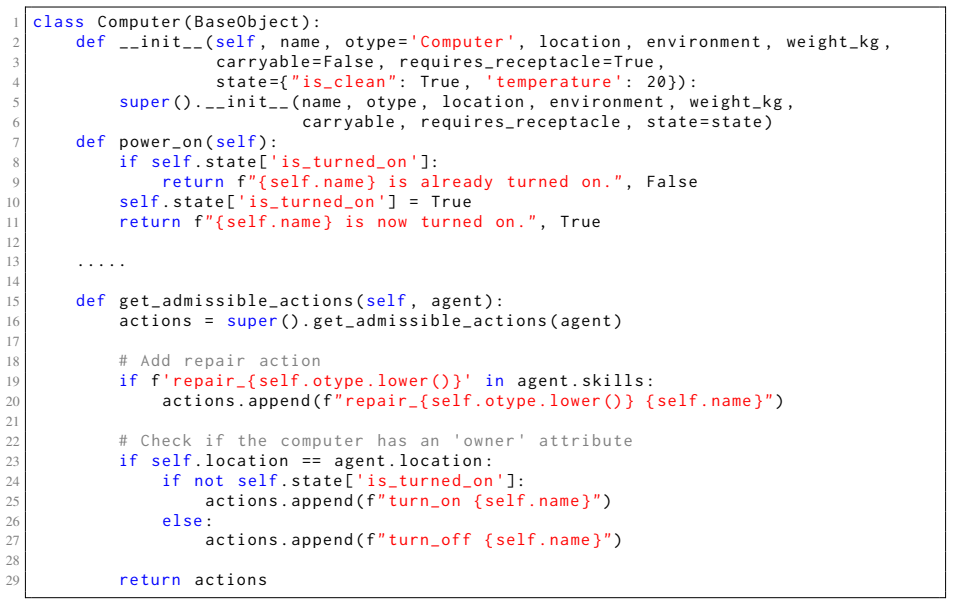
- domain assumption The hand-defined object states, action preconditions, and JSON scenario configurations are complete and correct enough to model office physics and social constraints.
- domain assumption The architect survey samples (20 and 9 participants) are representative and their Likert responses provide meaningful evidence of realism and usefulness.
Cite this review
Pith. "Pith review of IndoorWorld: Integrating Physical Task Solving and Social Simulation in A Heterogeneous Multi-Agent Environment." pith.science (2026). https://pith.science/paper/ACUCOFJW
@misc{pith2026250612331,
  author       = {Pith},
  title        = {Pith review of: IndoorWorld: Integrating Physical Task Solving and Social Simulation in A Heterogeneous Multi-Agent Environment},
  year         = {2026},
  howpublished = {\url{https://pith.science/paper/ACUCOFJW}},
  note         = {Machine review of arXiv:2506.12331}
}
read the original abstract
Virtual environments are essential to AI agent research. Existing environments for LLM agent research typically focus on either physical task solving or social simulation, with the former oversimplifying agent individuality and social dynamics, and the latter lacking physical grounding of social behaviors. We introduce IndoorWorld, a heterogeneous multi-agent environment that tightly integrates physical and social dynamics. By introducing novel challenges for LLM-driven agents in orchestrating social dynamics to influence physical environments and anchoring social interactions within world states, IndoorWorld opens up possibilities of LLM-based building occupant simulation for architectural design. We demonstrate the potential with a series of experiments within an office setting to examine the impact of multi-agent collaboration, resource competition, and spatial layout on agent behavior.
Figures


Figures from the paper (8 more)




Reference graph
Works this paper leans on
-
[1]
Hongru Cai, Yongqi Li, Wenjie Wang, Fengbin Zhu, Xiaoyu Shen, Wenjie Li, and Tat-Seng Chua. 2024. https://arxiv.org/abs/2410.17236 Large language models empowered personalized web agents . Preprint, arXiv:2410.17236
arXiv 2024
-
[2]
Hyungjoo Chae, Namyoung Kim, Kai Tzu iunn Ong, Minju Gwak, Gwanwoo Song, Jihoon Kim, Sunghwan Kim, Dongha Lee, and Jinyoung Yeo. 2024. https://arxiv.org/abs/2410.13232 Web agents with world models: Learning and leveraging environment dynamics in web navigation . Preprint, arXiv:2410.13232
arXiv 2024
-
[3]
DeepSeek-AI, Daya Guo, Dejian Yang, Haowei Zhang, Junxiao Song, Ruoyu Zhang, Runxin Xu, Qihao Zhu, Shirong Ma, Peiyi Wang, Xiao Bi, Xiaokang Zhang, Xingkai Yu, Yu Wu, Z. F. Wu, Zhibin Gou, Zhihong Shao, Zhuoshu Li, Ziyi Gao, Aixin Liu, Bing Xue, Bingxuan Wang, Bochao Wu, Bei Feng, Chengda Lu, Chenggang Zhao, Chengqi Deng, Chenyu Zhang, Chong Ruan, Damai D...
arXiv 2025
-
[4]
Xiaohang Feng, Da Yan, and Tianzhen Hong. 2015. Simulation of occupancy in buildings. Energy and Buildings, 87:348--359
work page 2015
-
[5]
Bear, Dan Gutfreund, David Cox, Antonio Torralba, James J
Chuang Gan, Jeremy Schwartz, Seth Alter, Damian Mrowca, Martin Schrimpf, James Traer, Julian De Freitas, Jonas Kubilius, Abhishek Bhandwaldar, Nick Haber, Megumi Sano, Kuno Kim, Elias Wang, Michael Lingelbach, Aidan Curtis, Kevin Feigelis, Daniel M. Bear, Dan Gutfreund, David Cox, Antonio Torralba, James J. DiCarlo, Joshua B. Tenenbaum, Josh H. McDermott,...
arXiv 2021
-
[6]
Zhenyu Guan, Xiangyu Kong, Fangwei Zhong, and Yizhou Wang. 2025. Richelieu: Self-evolving llm-based agents for ai diplomacy. Advances in Neural Information Processing Systems, 37:123471--123497
work page 2025
-
[7]
Sirui Hong, Mingchen Zhuge, Jonathan Chen, Xiawu Zheng, Yuheng Cheng, Jinlin Wang, Ceyao Zhang, Zili Wang, Steven Ka Shing Yau, Zijuan Lin, Liyang Zhou, Chenyu Ran, Lingfeng Xiao, Chenglin Wu, and J \"u rgen Schmidhuber. 2024. https://openreview.net/forum?id=VtmBAGCN7o Meta GPT : Meta programming for a multi-agent collaborative framework . In The Twelfth ...
2024
-
[8]
Zhang, Michael Luck, Qingwen Bu, Yuhao Qing, and Heming Cui
Dong Huang, Jie M. Zhang, Michael Luck, Qingwen Bu, Yuhao Qing, and Heming Cui. 2024. https://arxiv.org/abs/2312.13010 Agentcoder: Multi-agent-based code generation with iterative testing and optimisation . Preprint, arXiv:2312.13010
arXiv 2024
Show all 39 references
-
[9]
Yizhe Huang, Xingbo Wang, Hao Liu, Fanqi Kong, Aoyang Qin, Min Tang, Song-Chun Zhu, Mingjie Bi, Siyuan Qi, and Xue Feng. 2025. https://arxiv.org/abs/2411.03865 Adasociety: An adaptive environment with social structures for multi-agent decision-making . Preprint, arXiv:2411.03865
2025 arXiv
-
[10]
Bokyung Lee, Michael Lee, Jeremy Mogk, Rhys Goldstein, Jacobo Bibliowicz, Frederik Brudy, and Alexander Tessier. 2021. https://doi.org/10.1145/3461778.3462030 Designing a multi-agent occupant simulation system to support facility planning and analysis for covid-19 . In Proceed...
2021
-
[11]
Sicong Leng, Yang Zhou, Mohammed Haroon Dupty, Wee Sun Lee, Sam Joyce, and Wei Lu. 2023. https://doi.org/10.18653/v1/2023.acl-long.820 T ell2 D esign: A dataset for language-guided floor plan generation . In Proceedings of the 61st Annual Meeting of the Association for Computa...
2023 doi
-
[12]
Chengyuan Li, Tianyu Zhang, Xusheng Du, Ye Zhang, and Haoran Xie. 2025. https://doi.org/10.1016/j.foar.2024.10.001 Generative ai models for different steps in architectural design: A literature review . Frontiers of Architectural Research
2025 doi
-
[13]
Nian Li, Chen Gao, Mingyu Li, Yong Li, and Qingmin Liao. 2024. Econagent: large language model-empowered agents for simulating macroeconomic activities. In Proceedings of the 62nd Annual Meeting of the Association for Computational Linguistics (Volume 1: Long Papers), pages 15...
2024
-
[14]
Yuanyuan Liu, Ying Zhou, Le Yang, and Yangpeng Xin. 2024. Simulating staff activities in healthcare environments: An empirical multi-agent modeling approach. Journal of Building Engineering
2024
-
[15]
Pattie Maes. 1995. Artificial life meets entertainment: lifelike autonomous agents. Communications of the ACM, 38(11):108--114
1995
-
[16]
George A. Miller. Wordnet: a lexical database for english. Commun. ACM
-
[17]
Ahmed, Puneet Mathur, Seunghyun Yoon, Lina Yao, Branislav Kveton, Thien Huu Nguyen, Trung Bui, Tianyi Zhou, Ryan A
Dang Nguyen, Jian Chen, Yu Wang, Gang Wu, Namyong Park, Zhengmian Hu, Hanjia Lyu, Junda Wu, Ryan Aponte, Yu Xia, Xintong Li, Jing Shi, Hongjie Chen, Viet Dac Lai, Zhouhang Xie, Sungchul Kim, Ruiyi Zhang, Tong Yu, Mehrab Tanjim, Nesreen K. Ahmed, Puneet Mathur, Seunghyun Yoon, ...
2024
-
[18]
O'Brien, Carrie J
Joon Sung Park, Joseph C. O'Brien, Carrie J. Cai, Meredith Ringel Morris, Percy Liang, and Michael S. Bernstein. 2023. Generative agents: Interactive simulacra of human behavior. In In the 36th Annual ACM Symposium on User Interface Software and Technology (UIST '23), UIST '23...
2023
-
[19]
Xavier Puig, Kevin Ra, Marko Boben, Jiaman Li, Tingwu Wang, Sanja Fidler, and Antonio Torralba. 2018. Virtualhome: Simulating household activities via programs. In Proceedings of the IEEE Conference on Computer Vision and Pattern Recognition, pages 8494--8502
2018
-
[20]
Chen Qian, Wei Liu, Hongzhang Liu, Nuo Chen, Yufan Dang, Jiahao Li, Cheng Yang, Weize Chen, Yusheng Su, Xin Cong, Juyuan Xu, Dahai Li, Zhiyuan Liu, and Maosong Sun. 2023. https://arxiv.org/abs/2307.07924 Chatdev: Communicative agents for software development . arXiv preprint a...
2023 arXiv
-
[21]
Alexander Raistrick, Lingjie Mei, Karhan Kayan, David Yan, Yiming Zuo, Beining Han, Hongyu Wen, Meenal Parakh, Stamatis Alexandropoulos, Lahav Lipson, Zeyu Ma, and Jia Deng. 2024. Infinigen indoors: Photorealistic indoor scenes using procedural generation. In Proceedings of th...
2024
-
[22]
Davide Schaumann, Simon Breslav, Rhys Goldstein, Azam Khan, and Yehuda E Kalay. 2017. Simulating use scenarios in hospitals using multi-agent narratives. Journal of Building Performance Simulation, 10(5-6):636--652
2017
-
[23]
Noah Shinn, Federico Cassano, Ashwin Gopinath, Karthik Narasimhan, and Shunyu Yao. 2024. Reflexion: Language agents with verbal reinforcement learning. Advances in Neural Information Processing Systems, 36
2024
-
[24]
Mohit Shridhar, Jesse Thomason, Daniel Gordon, Yonatan Bisk, Winson Han, Roozbeh Mottaghi, Luke Zettlemoyer, and Dieter Fox. 2020 a . https://arxiv.org/abs/1912.01734 ALFRED: A Benchmark for Interpreting Grounded Instructions for Everyday Tasks . In The IEEE Conference on Comp...
2020 arXiv
-
[26]
Mohit Shridhar, Xingdi Yuan, Marc-Alexandre C\^ot\'e, Yonatan Bisk, Adam Trischler, and Matthew Hausknecht. 2021. https://arxiv.org/abs/2010.03768 ALFWorld: Aligning Text and Embodied Environments for Interactive Learning . In Proceedings of the International Conference on Lea...
2021 arXiv
-
[27]
Karen Liu, Silvio Savarese, Hyowon Gweon, Jiajun Wu, and Li Fei-Fei
Sanjana Srivastava, Chengshu Li, Michael Lingelbach, Roberto Martín-Martín, Fei Xia, Kent Vainio, Zheng Lian, Cem Gokmen, Shyamal Buch, C. Karen Liu, Silvio Savarese, Hyowon Gweon, Jiajun Wu, and Li Fei-Fei. 2021. https://arxiv.org/abs/2108.03332 Behavior: Benchmark for everyd...
2021 arXiv
-
[28]
Xiangru Tang, Anni Zou, Zhuosheng Zhang, Ziming Li, Yilun Zhao, Xingyao Zhang, Arman Cohan, and Mark Gerstein. 2024. M ed A gents: Large language models as collaborators for zero-shot medical reasoning. In Findings of the Association for Computational Linguistics: ACL 2024, pa...
2024
-
[29]
https://arxiv.org/abs/2308.11432 A Survey on Large Language Model based Autonomous Agents
Lei Wang, Chen Ma, Xueyang Feng, Zeyu Zhang, Hao Yang, Jingsen Zhang, Zhiyuan Chen, Jiakai Tang, Xu Chen, Yankai Lin, Wayne Xin Zhao, Zhewei Wei, and Ji-Rong Wen. https://arxiv.org/abs/2308.11432 A Survey on Large Language Model based Autonomous Agents . Preprint, arXiv:2308.11432
-
[30]
Xiaoqiang Wang and Bang Liu. 2024. Oscar: Operating system control via state-aware reasoning and re-planning. arXiv preprint arXiv:2410.18963
2024 arXiv
-
[31]
Yiding Wang, Yuxuan Chen, Fangwei Zhong, Long Ma, and Yizhou Wang. 2024. Simulating human-like daily activities with desire-driven autonomy. arXiv preprint arXiv:2412.06435
2024 arXiv
-
[32]
Zhilin Wang, Yu Ying Chiu, and Yu Cheung Chiu. 2023. https://doi.org/10.18653/v1/2023.emnlp-demo.15 Humanoid agents: Platform for simulating human-like generative agents . In Proceedings of the 2023 Conference on Empirical Methods in Natural Language Processing: System Demonst...
2023 doi
-
[33]
Deciphering digital detectives: Understanding LLM behaviors and capabilities in multi-agent mystery games
Dekun Wu, Haochen Shi, Zhiyuan Sun, and Bang Liu. Deciphering digital detectives: Understanding LLM behaviors and capabilities in multi-agent mystery games. In Findings of the Association for Computational Linguistics: ACL 2024
2024
-
[34]
Yuzhuang Xu, Shuo Wang, Peng Li, Fuwen Luo, Xiaolong Wang, Weidong Liu, and Yang Liu. 2023. Exploring large language models for communication games: An empirical study on werewolf. arXiv preprint arXiv:2309.04658
2023 arXiv
-
[35]
Da Yan, William O’Brien, Tianzhen Hong, Xiaohang Feng, H Burak Gunay, Farhang Tahmasebi, and Ardeshir Mahdavi. 2015. Occupant behavior modeling for building performance simulation: Current state and future challenges. Energy and buildings, 107:264--278
2015
-
[36]
Shunyu Yao, Jeffrey Zhao, Dian Yu, Nan Du, Izhak Shafran, Karthik Narasimhan, and Yuan Cao. 2022. React: Synergizing reasoning and acting in language models. arXiv preprint arXiv:2210.03629
2022 arXiv
-
[37]
Xianhao Yu, Jiaqi Fu, Renjia Deng, and Wenjuan Han. 2024. https://arxiv.org/abs/2403.19267 Mineland: Simulating large-scale multi-agent interactions with limited multimodal senses and physical needs . Preprint, arXiv:2403.19267
2024 arXiv
-
[38]
Hongxin Zhang, Weihua Du, Jiaming Shan, Qinhong Zhou, Yilun Du, Joshua B Tenenbaum, Tianmin Shu, and Chuang Gan. 2024. Building cooperative embodied agents modularly with large language models. ICLR
2024
-
[39]
online" 'onlinestring :=
ENTRY address archivePrefix author booktitle chapter edition editor eid eprint eprinttype howpublished institution journal key month note number organization pages publisher school series title type volume year doi pubmed url lastchecked label extra.label sort.label short.list...
-
[40]
write newline
" write newline "" before.all 'output.state := FUNCTION n.dashify 't := "" t empty not t #1 #1 substring "-" = t #1 #2 substring "--" = not "--" * t #2 global.max substring 't := t #1 #1 substring "-" = "-" * t #2 global.max substring 't := while if t #1 #1 substring * t #2 gl...
Reviewed August 7, 2026 · model on record in the stance chip above.
Discussion (0). Sign in to comment.