REVIEW 3 major objections 4 minor 2 cited by
EKPC: Elastic Knowledge Preservation and Compensation for Class-Incremental Learning
T0 review · 3 major / 4 minor · reviewed 2026-08-07 · deepseek-v4-flash
Pith's one-line read EKPC reduces forgetting in class-incremental learning by selectively regularizing shared adapter parameters according to their importance and by compensating old class prototypes using a trainable semantic drift estimate.
desk verdict A solid 10/20-split CIL method with a strong ablation story, but the long-horizon Table 4 is not credible as reported and should not carry the 'advantage grows with task count' claim. read the letter →
The pith
A machine-rendered reading of the paper's core claim, the machinery that carries it, and where it could break.
The reading
EKPC protects old knowledge in two ways. First, Importance-aware Parameter Regularization (IPR) measures which adapter parameters matter most for old classes. It looks at channel averages and variances of features, and at how strongly each adapter responds to an input, then heavily penalizes changes to important parameters while leaving others free. Second, Trainable Semantic Drift Compensation (TSDC) handles the fact that old class prototypes drift when new classes arrive. It estimates that drift from current training samples, shrinks the estimate during training so it is not too noisy, and uses the corrected prototypes to train a fresh unified classifier.
The paper reports that EKPC outperforms existing methods on ImageNetR, ImageNetA, CUB-200, CIFAR-100, and DomainNet, in both 10-task and 20-task splits, and shows large advantages on 50-task and 100-task settings. Ablations confirm that both components contribute, with TSDC giving the larger boost. No code is released, and some implementation details are left unspecified, so independent re-implementation would require some effort.
Extended reading notes
Core claim
The paper claims EKPC 'achieves superior performances to existing state-of-the-art methods' on five CIL benchmarks while adding no parameters at inference. The load-bearing empirical assertion is that combining importance-aware regularization (IPR) and trainable semantic drift compensation (TSDC) outperforms the shared-adapter baseline SSIAT on every reported setting, e.g., 80.60 vs 79.38 ALast on 10-split ImageNetR and 87.22 vs 85.11 on 10-split DomainNet, and that the advantage grows with task count.
Load-bearing premise
Section 3.3, Eq. 18 assumes the semantic drift of old class prototypes can be estimated as a weighted average of the feature drift of current-task samples: the displacement suffered by new-class features when the model is updated is assumed to transfer to old classes. If old and new classes shift in different directions, the compensated prototypes are wrong and the unified classifier is trained on incorrect samples. TSDC's ablation shows it contributes the larger part of the gain, so this assumption is load-bearing for the reported results.
Editorial analysis
A structured set of objections, weighed in public.
Referee Report
Summary. This manuscript proposes EKPC, a rehearsal-free class-incremental learning method built on a frozen ViT backbone with shared adapters. The first component, IPR, estimates per-parameter importance from global channel statistics and local perturbation sensitivity, then applies weighted L2 regularization to constrain adapter updates. The second component, TSDC, estimates the semantic drift of old-class prototypes from current-task feature changes, regularizes that drift estimate, and uses compensated prototypes to sample features for retraining a unified classifier. Experiments are reported on five CIL benchmarks at 10/20 splits, plus a long-horizon 50/100-split comparison, with ablations for each component, comparisons against alternative regularization and drift-compensation strategies, hyperparameter sensitivity, and a forgetting metric.
Significance. If the results hold, EKPC is an attractive practical method: it adds no inference-time parameters and shows consistent improvements over the shared-adapter baseline SSIAT at 10/20 splits across five benchmarks. The empirical core is broad and generally well executed: three seeds, per-component ablations, comparisons with uniform/amplitude/Fisher regularization, comparisons with static drift compensation, hyperparameter sweeps, and an average-forgetting analysis. However, the significance is moderated by two load-bearing weaknesses: the long-horizon results in Table 4 are presented without the protocol details and error bars used elsewhere, and the semantic-drift transfer assumption in Eq. (18) is unvalidated even though Table 5 shows that TSDC contributes the larger share of the reported gains.
major comments (3)
- [§4.2, Table 4] The long-horizon (50/100-split) results are reported without error bars or a statement of the number of seeds, unlike Tables 1-3, and the class/domain ordering, classifier-retraining schedule, and the direct baseline SSIAT are omitted. The 100-split DomainNet margin over the next-best method is 23.6 points (81.24 vs 57.60), whereas the 10-split margin over the next-best method is about 2 points; no mechanism in IPR/TSDC is given for this discontinuity. These omissions are load-bearing for the claim that EKPC's advantage grows with task count, and Table 4 should be rerun and reported under the same protocol as the rest of the paper, with error bars and SSIAT included.
- [§3.3, Eq. (18)] The semantic drift for an old class c is estimated as a similarity-weighted average of the displacement δ^{t-1→t}_i of current-task samples, with weights α_i computed from the distance of those samples to the old prototype f^{t-1}_c. This assumes that the displacement of new-class features is a good proxy for the displacement of old-class features; if old and new classes shift in different directions, the compensated prototypes used to train the unified classifier will be wrong. Because Table 5 shows that TSDC alone provides the larger share of the improvement (e.g., DomainNet ALast 86.24 in Idx3 vs 82.75 in Idx1), this assumption is load-bearing. Please validate the transfer assumption (e.g., by comparing compensated old prototypes against actual old-class features from a withheld subset, or by measuring per-class drift directions) or restrict the claim accordingly.
- [§3.2, Eqs. (3)-(7)] The global-importance derivation optimizes a linear classifier score s = w·x + b for a single channel, but the framework actually uses a cosine classifier (Eq. 21) on deep feature vectors, and Eq. (7) uses |f_c|/σ²_c without the 2λ factor or any channel-correlation term. As written, the derivation does not establish that this statistic is the optimal weight for the deployed classifier. Since the novelty claim rests on the importance algorithm, either align the derivation with the actual classifier or explicitly present the statistic as a heuristic whose validity is established by the ablations.
minor comments (4)
- [Throughout] There are several typos and formatting issues: "dowm-sampling" in Section 3.1, "T rainable" in Section 3.3, "DmainNet" in the Table 3 caption, "sampling sapce" in Algorithm 2, and "of of" in the contributions list in Section 1.
- [§3.2, Eq. (4)] The trade-off parameter λ appears in the derivation but is never given a value or used in the implementation; the authors should state whether it is a conceptual device or an actual hyperparameter.
- [§3.2, Eq. (2)] The squared differences of matrices in Eq. (2) should be defined as elementwise operations to avoid ambiguity.
- [§4.2, Fig. 3] The per-task accuracy curves in Figure 3 do not show error bars despite the paper reporting three seeds; adding them would help assess whether the apparent growing advantage over SSIAT is significant.
Circularity Check
No significant circularity: the IPR regularizer and TSDC drift compensation are computed from feature statistics and external measurements, not from the final accuracies they predict.
full rationale
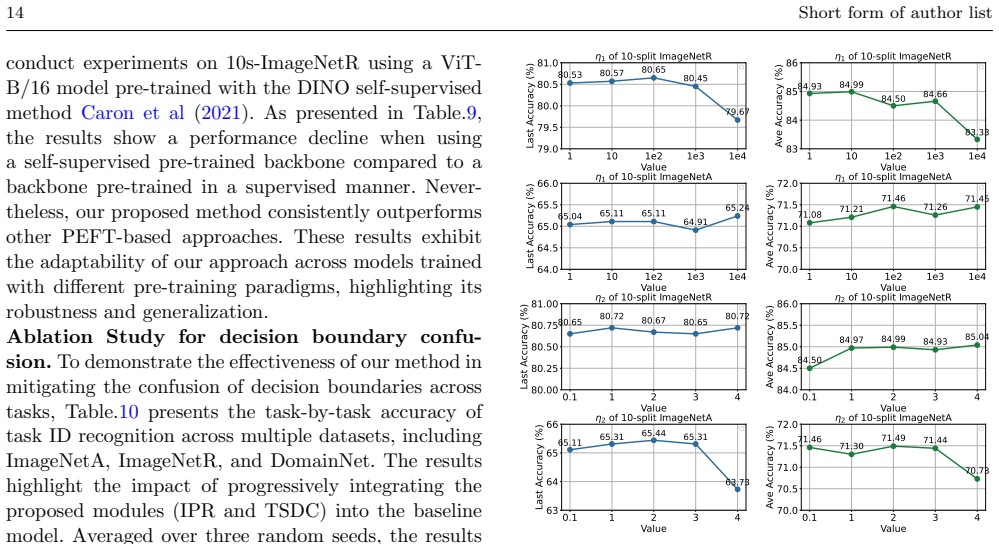
Walked the derivation chain. IPR: Eq. 2 is a weighted L2 regularizer; the importance weights in Eqs. 7-17 are computed from (i) channel-wise mean/variance of current-task features extracted by the frozen previous adapter and (ii) perturbation sensitivity of individual adapter outputs, then fused via the hyperparameters eta1 and eta2. These are data-dependent statistics, not functions of the final accuracy, so the regularizer is a constraint rather than a disguised predictor. TSDC: Eq. 18 estimates old-prototype drift as a similarity-weighted average of current-sample feature displacement between the (t-1)-th and t-th feature extractors; Eq. 19 penalizes the drift norm toward zero; Eq. 20 adds the regularized drift to stored prototypes before Gaussian sampling and unified-classifier training in Eq. 23. This is an assumption-laden heuristic (the displacement of new-class features is assumed to transfer to old classes), but no term is fitted to the accuracy that is later reported, so it is not circular. Hyperparameters (eta1, eta2, w1, w2) are ablated with sensitivity analyses and are not renamed predictions. The only same-group citation with any load-bearing potential is Lu et al. (2024), used for the DomainNet 200-class selection protocol and as the VPT-NSP baseline; this is a dataset/convention citation, not a theorem or ingredient of EKPC, and other same-group citations are related-work background. Table 4's missing error bars and omitted SSIAT baseline, and the very large 100-split DomainNet margin, are reproducibility/protocol concerns rather than circularity. Verdict: no circular step found.
Assumptions & free parameters
free parameters (6)
- lambda
- eta1 and eta2 =
100.0 and 1.0
- w1 and w2 =
1.0 and 1.0
- s and m =
20.0 and 0.01
- Ns =
not stated
- sigma_c in Eq. 18 =
not stated
assumptions (5)
- domain assumption Channel activations of a class are approximately Gaussian (invoked via the Central Limit Theorem).
- domain assumption The classifier score is linear (w·x+b) for the importance derivation.
- domain assumption First-order Taylor approximations capture perturbation effects in adapters.
- domain assumption Semantic drift of old prototypes can be transferred from current-task samples.
- domain assumption Class features are Gaussian for prototype sampling in the unified classifier.
Cite this review
Pith. "Pith review of EKPC: Elastic Knowledge Preservation and Compensation for Class-Incremental Learning." pith.science (2026). https://pith.science/paper/2OKLTMAD
@misc{pith2026250612351,
  author       = {Pith},
  title        = {Pith review of: EKPC: Elastic Knowledge Preservation and Compensation for Class-Incremental Learning},
  year         = {2026},
  howpublished = {\url{https://pith.science/paper/2OKLTMAD}},
  note         = {Machine review of arXiv:2506.12351}
}
read the original abstract
Class-Incremental Learning (CIL) aims to enable AI models to continuously learn from sequentially arriving data of different classes over time while retaining previously acquired knowledge. Recently, Parameter-Efficient Fine-Tuning (PEFT) methods, like prompt pool-based approaches and adapter tuning, have shown great attraction in CIL. However, these methods either introduce additional parameters that increase memory usage, or rely on rigid regularization techniques which reduce forgetting but compromise model flexibility. To overcome these limitations, we propose the Elastic Knowledge Preservation and Compensation (EKPC) method, integrating Importance-aware Parameter Regularization (IPR) and Trainable Semantic Drift Compensation (TSDC) for CIL. Specifically, the IPR method assesses the sensitivity of network parameters to prior tasks using a novel parameter-importance algorithm. It then selectively constrains updates within the shared adapter according to these importance values, thereby preserving previously acquired knowledge while maintaining the model's flexibility. However, it still exhibits slight semantic differences in previous knowledge to accommodate new incremental tasks, leading to decision boundaries confusion in classifier. To eliminate this confusion, TSDC trains a unified classifier by compensating prototypes with trainable semantic drift. Extensive experiments on five CIL benchmarks demonstrate the effectiveness of the proposed method, showing superior performances to existing state-of-the-art methods.
Figures


Figures from the paper (3 more)


Forward citations
Cited by 2 Pith papers
-
Symbiosis-Inspired Knowledge Distillation for Incremental Object Detection
SIKD improves incremental object detection by distilling old-model responses in co-occurring, overlapping regions plus old-class rank structure, instead of discarding high-overlap predictions.
-
CKAA: Cross-subspace Knowledge Alignment and Aggregation for Robust Continual Learning
CKAA aligns features and decision boundaries across task-specific subspaces and mixes adapters by task confidence, improving class-incremental learning accuracy under misidentified task labels.
Reference graph
Works this paper leans on
-
[1]
In: Proceedings of the European conference on computer vision (ECCV), pp 139--154
Aljundi R, Babiloni F, Elhoseiny M, Rohrbach M, Tuytelaars T (2018) Memory aware synapses: Learning what (not) to forget. In: Proceedings of the European conference on computer vision (ECCV), pp 139--154
work page 2018
-
[2]
In: Proceedings of the IEEE/CVF conference on computer vision and pattern recognition, pp 8218--8227
Bang J, Kim H, Yoo Y, Ha JW, Choi J (2021) Rainbow memory: Continual learning with a memory of diverse samples. In: Proceedings of the IEEE/CVF conference on computer vision and pattern recognition, pp 8218--8227
work page 2021
-
[3]
Belouadah E, Popescu A, Kanellos I (2021) A comprehensive study of class incremental learning algorithms for visual tasks. Neural Networks 135:38--54
work page 2021
-
[4]
In: European Conference on Computer Vision, Springer, pp 692--709
Boschini M, Bonicelli L, Porrello A, Bellitto G, Pennisi M, Palazzo S, Spampinato C, Calderara S (2022) Transfer without forgetting. In: European Conference on Computer Vision, Springer, pp 692--709
work page 2022
-
[5]
In: Proceedings of the IEEE/CVF international conference on computer vision, pp 9650--9660
Caron M, Touvron H, Misra I, J \'e gou H, Mairal J, Bojanowski P, Joulin A (2021) Emerging properties in self-supervised vision transformers. In: Proceedings of the IEEE/CVF international conference on computer vision, pp 9650--9660
work page 2021
-
[6]
In: Proceedings of the European conference on computer vision (ECCV), pp 532--547
Chaudhry A, Dokania PK, Ajanthan T, Torr PH (2018) Riemannian walk for incremental learning: Understanding forgetting and intransigence. In: Proceedings of the European conference on computer vision (ECCV), pp 532--547
work page 2018
-
[7]
Advances in Neural Information Processing Systems 35:16664--16678
Chen S, Ge C, Tong Z, Wang J, Song Y, Wang J, Luo P (2022) Adaptformer: Adapting vision transformers for scalable visual recognition. Advances in Neural Information Processing Systems 35:16664--16678
work page 2022
-
[8]
Cheng D, Xu Z, Jiang X, Wang N, Li D, Gao X (2024) Disentangled prompt representation for domain generalization. In: Proceedings of the IEEE/CVF Conference on Computer Vision and Pattern Recognition, pp 23595--23604
work page 2024
Show all 74 references
-
[9]
IEEE transactions on pattern analysis and machine intelligence 44(7):3366--3385
De Lange M, Aljundi R, Masana M, Parisot S, Jia X, Leonardis A, Slabaugh G, Tuytelaars T (2021) A continual learning survey: Defying forgetting in classification tasks. IEEE transactions on pattern analysis and machine intelligence 44(7):3366--3385
2021
-
[10]
arXiv preprint arXiv:201011929
Dosovitskiy A, Beyer L, Kolesnikov A, Weissenborn D, Zhai X, Unterthiner T, Dehghani M, Minderer M, Heigold G, Gelly S, et al (2020) An image is worth 16x16 words: Transformers for image recognition at scale. arXiv preprint arXiv:201011929
2020
-
[11]
Advances in Neural Information Processing Systems 35:10629--10642
Ermis B, Zappella G, Wistuba M, Rawal A, Archambeau C (2022) Memory efficient continual learning with transformers. Advances in Neural Information Processing Systems 35:10629--10642
2022
-
[12]
In: Proceedings of the IEEE/CVF International Conference on Computer Vision, pp 11483--11493
Gao Q, Zhao C, Sun Y, Xi T, Zhang G, Ghanem B, Zhang J (2023) A unified continual learning framework with general parameter-efficient tuning. In: Proceedings of the IEEE/CVF International Conference on Computer Vision, pp 11483--11493
2023
-
[13]
In: European Conference on Computer Vision, Springer, pp 89--106
Gao X, Dong S, He Y, Wang Q, Gong Y (2024 a ) Beyond prompt learning: Continual adapter for efficient rehearsal-free continual learning. In: European Conference on Computer Vision, Springer, pp 89--106
2024
-
[14]
In: Proceedings of the IEEE/CVF Conference on Computer Vision and Pattern Recognition, pp 28463--28473
Gao Z, Cen J, Chang X (2024 b ) Consistent prompting for rehearsal-free continual learning. In: Proceedings of the IEEE/CVF Conference on Computer Vision and Pattern Recognition, pp 28463--28473
2024
-
[15]
International Journal of Computer Vision pp 1--20
He L, Cheng D, Wang N, Gao X (2024) Exploring homogeneous and heterogeneous consistent label associations for unsupervised visible-infrared person reid. International Journal of Computer Vision pp 1--20
2024
-
[16]
In: Proceedings of the IEEE/CVF International Conference on Computer Vision, pp 8340--8349
Hendrycks D, Basart S, Mu N, Kadavath S, Wang F, Dorundo E, Desai R, Zhu T, Parajuli S, Guo M, et al (2021 a ) The many faces of robustness: A critical analysis of out-of-distribution generalization. In: Proceedings of the IEEE/CVF International Conference on Computer Vision, ...
2021
-
[17]
In: Proceedings of the IEEE/CVF Conference on Computer Vision and Pattern Recognition, pp 15262--15271
Hendrycks D, Zhao K, Basart S, Steinhardt J, Song D (2021 b ) Natural adversarial examples. In: Proceedings of the IEEE/CVF Conference on Computer Vision and Pattern Recognition, pp 15262--15271
2021
-
[18]
In: Proceedings of the IEEE/CVF conference on computer vision and pattern recognition, pp 831--839
Hou S, Pan X, Loy CC, Wang Z, Lin D (2019) Learning a unified classifier incrementally via rebalancing. In: Proceedings of the IEEE/CVF conference on computer vision and pattern recognition, pp 831--839
2019
-
[19]
In: International Conference on Machine Learning, PMLR, pp 2790--2799
Houlsby N, Giurgiu A, Jastrzebski S, Morrone B, De Laroussilhe Q, Gesmundo A, Attariyan M, Gelly S (2019) Parameter-efficient transfer learning for nlp. In: International Conference on Machine Learning, PMLR, pp 2790--2799
2019
-
[20]
ICLR 1(2):3
Hu EJ, Shen Y, Wallis P, Allen-Zhu Z, Li Y, Wang S, Wang L, Chen W, et al (2022) Lora: Low-rank adaptation of large language models. ICLR 1(2):3
2022
-
[21]
In: International Conference on Learning Representations
Huang WC, Chen CF, Hsu H (2024) OVOR : OnePrompt with virtual outlier regularization for rehearsal-free class-incremental learning. In: International Conference on Learning Representations
2024
-
[22]
In: European Conference on Computer Vision, Springer, pp 709--727
Jia M, Tang L, Chen BC, Cardie C, Belongie S, Hariharan B, Lim SN (2022) Visual prompt tuning. In: European Conference on Computer Vision, Springer, pp 709--727
2022
-
[23]
In: European Conference on Computer Vision, Springer, pp 163--179
Kim Y, Li Y, Panda P (2024) One-stage prompt-based continual learning. In: European Conference on Computer Vision, Springer, pp 163--179
2024
-
[24]
Proceedings of the national academy of sciences 114(13):3521--3526
Kirkpatrick J, Pascanu R, Rabinowitz N, Veness J, Desjardins G, Rusu AA, Milan K, Quan J, Ramalho T, Grabska-Barwinska A, et al (2017) Overcoming catastrophic forgetting in neural networks. Proceedings of the national academy of sciences 114(13):3521--3526
2017
-
[25]
Placeholder Journal
Krizhevsky A, Hinton G, et al (2009) Learning multiple layers of features from tiny images. Placeholder Journal
2009
-
[26]
arXiv preprint arXiv:210408691
Lester B, Al-Rfou R, Constant N (2021) The power of scale for parameter-efficient prompt tuning. arXiv preprint arXiv:210408691
2021
-
[27]
arXiv preprint arXiv:210100190
Li XL, Liang P (2021) Prefix-tuning: Optimizing continuous prompts for generation. arXiv preprint arXiv:210100190
2021
-
[28]
IEEE transactions on pattern analysis and machine intelligence 40(12):2935--2947
Li Z, Hoiem D (2017) Learning without forgetting. IEEE transactions on pattern analysis and machine intelligence 40(12):2935--2947
2017
-
[29]
Advances in Neural Information Processing Systems 35:109--123
Lian D, Zhou D, Feng J, Wang X (2022) Scaling & shifting your features: A new baseline for efficient model tuning. Advances in Neural Information Processing Systems 35:109--123
2022
-
[30]
In: Proceedings of the IEEE/CVF Conference on Computer Vision and Pattern Recognition, pp 23638--23647
Liang YS, Li WJ (2024) Inflora: Interference-free low-rank adaptation for continual learning. In: Proceedings of the IEEE/CVF Conference on Computer Vision and Pattern Recognition, pp 23638--23647
2024
-
[31]
arXiv preprint arXiv:240605658
Lu Y, Zhang S, Cheng D, Xing Y, Wang N, Wang P, Zhang Y (2024) Visual prompt tuning in null space for continual learning. arXiv preprint arXiv:240605658
2024
-
[32]
In: Proceedings of the IEEE conference on Computer Vision and Pattern Recognition, pp 7765--7773
Mallya A, Lazebnik S (2018) Packnet: Adding multiple tasks to a single network by iterative pruning. In: Proceedings of the IEEE conference on Computer Vision and Pattern Recognition, pp 7765--7773
2018
-
[33]
In: Proceedings of the European conference on computer vision (ECCV), pp 67--82
Mallya A, Davis D, Lazebnik S (2018) Piggyback: Adapting a single network to multiple tasks by learning to mask weights. In: Proceedings of the European conference on computer vision (ECCV), pp 67--82
2018
-
[34]
IEEE Transactions on Pattern Analysis and Machine Intelligence 45(5):5513--5533
Masana M, Liu X, Twardowski B, Menta M, Bagdanov AD, Van De Weijer J (2022) Class-incremental learning: survey and performance evaluation on image classification. IEEE Transactions on Pattern Analysis and Machine Intelligence 45(5):5513--5533
2022
-
[35]
In: Psychology of Learning and Motivation, vol 24, Elsevier, pp 109--165
McCloskey M, Cohen NJ (1989) Catastrophic interference in connectionist networks: The sequential learning problem. In: Psychology of Learning and Motivation, vol 24, Elsevier, pp 109--165
1989
-
[36]
In: Proceedings of the IEEE/CVF conference on computer vision and pattern recognition, pp 11321--11329
Ostapenko O, Puscas M, Klein T, Jahnichen P, Nabi M (2019) Learning to remember: A synaptic plasticity driven framework for continual learning. In: Proceedings of the IEEE/CVF conference on computer vision and pattern recognition, pp 11321--11329
2019
-
[37]
In: European Conference on Computer Vision, Springer, pp 382--397
Peng C, Zhao K, Wang T, Li M, Lovell BC (2022) Few-shot class-incremental learning from an open-set perspective. In: European Conference on Computer Vision, Springer, pp 382--397
2022
-
[38]
In: Proceedings of the IEEE/CVF international conference on computer vision, pp 1406--1415
Peng X, Bai Q, Xia X, Huang Z, Saenko K, Wang B (2019) Moment matching for multi-source domain adaptation. In: Proceedings of the IEEE/CVF international conference on computer vision, pp 1406--1415
2019
-
[39]
In: International Conference on Learning Representations
Qiao J, Zhang Z, Tan X, Chen C, Qu Y, Peng Y, Xie Y (2024) Prompt Gradient Projection for Continual Learning . In: International Conference on Learning Representations
2024
-
[40]
In: International conference on machine learning, PMLR, pp 8748--8763
Radford A, Kim JW, Hallacy C, Ramesh A, Goh G, Agarwal S, Sastry G, Askell A, Mishkin P, Clark J, et al (2021) Learning transferable visual models from natural language supervision. In: International conference on machine learning, PMLR, pp 8748--8763
2021
-
[41]
Psychological review 97(2):285
Ratcliff R (1990) Connectionist models of recognition memory: Constraints imposed by learning and forgetting functions. Psychological review 97(2):285
1990
-
[42]
In: Proceedings of the IEEE conference on Computer Vision and Pattern Recognition, pp 2001--2010
Rebuffi SA, Kolesnikov A, Sperl G, Lampert CH (2017) icarl: Incremental classifier and representation learning. In: Proceedings of the IEEE conference on Computer Vision and Pattern Recognition, pp 2001--2010
2017
-
[43]
In: Proceedings of the IEEE/CVF Conference on Computer Vision and Pattern Recognition, pp 23616--23626
Roy A, Moulick R, Verma VK, Ghosh S, Das A (2024) Convolutional prompting meets language models for continual learning. In: Proceedings of the IEEE/CVF Conference on Computer Vision and Pattern Recognition, pp 23616--23626
2024
-
[44]
In: International conference on machine learning, PMLR, pp 4548--4557
Serra J, Suris D, Miron M, Karatzoglou A (2018) Overcoming catastrophic forgetting with hard attention to the task. In: International conference on machine learning, PMLR, pp 4548--4557
2018
-
[45]
Advances in neural information processing systems 30
Shin H, Lee JK, Kim J, Kim J (2017) Continual learning with deep generative replay. Advances in neural information processing systems 30
2017
-
[46]
arXiv preprint arXiv:230406027
Smith JS, Hsu YC, Zhang L, Hua T, Kira Z, Shen Y, Jin H (2023 a ) Continual diffusion: Continual customization of text-to-image diffusion with c-lora. arXiv preprint arXiv:230406027
2023
-
[47]
In: IEEE / CVF Conference on Computer Vision and Pattern Recognition , pp 11909--11919, doi:10.1109/CVPR52729.2023.01146
Smith JS, Karlinsky L, Gutta V, Cascante-Bonilla P, Kim D, Arbelle A, Panda R, Feris R, Kira Z (2023 b ) CODA-Prompt : COntinual Decomposed Attention-Based Prompting for Rehearsal-Free Continual Learning . In: IEEE / CVF Conference on Computer Vision and Pattern Recognition , ...
2023
-
[48]
In: International Conference on Machine Learning (ICML) Workshops, vol 2
Soutif-Cormerais A, Masana M, Van de Weijer J, Twardowski B (2021) On the importance of cross-task features for class-incremental learning. In: International Conference on Machine Learning (ICML) Workshops, vol 2
2021
-
[49]
In: Proceedings of the IEEE/CVF Conference on Computer Vision and Pattern Recognition, pp 23252--23262
Tan Y, Zhou Q, Xiang X, Wang K, Wu Y, Li Y (2024) Semantically-shifted incremental adapter-tuning is a continual vitransformer. In: Proceedings of the IEEE/CVF Conference on Computer Vision and Pattern Recognition, pp 23252--23262
2024
-
[50]
In: Proceedings of the IEEE/CVF International Conference on Computer Vision, pp 1706--1716
Tang YM, Peng YX, Zheng WS (2023) When prompt-based incremental learning does not meet strong pretraining. In: Proceedings of the IEEE/CVF International Conference on Computer Vision, pp 1706--1716
2023
-
[51]
In: Proceedings of the IEEE/CVF conference on computer vision and pattern recognition, pp 12183--12192
Tao X, Hong X, Chang X, Dong S, Wei X, Gong Y (2020) Few-shot class-incremental learning. In: Proceedings of the IEEE/CVF conference on computer vision and pattern recognition, pp 12183--12192
2020
-
[52]
Placeholder Journal
Wah C, Branson S, Welinder P, Perona P, Belongie S (2011) The caltech-ucsd birds-200-2011 dataset. Placeholder Journal
2011
-
[53]
In: Proceedings of the IEEE conference on computer vision and pattern recognition, pp 5265--5274
Wang H, Wang Y, Zhou Z, Ji X, Gong D, Zhou J, Li Z, Liu W (2018) Cosface: Large margin cosine loss for deep face recognition. In: Proceedings of the IEEE conference on computer vision and pattern recognition, pp 5265--5274
2018
-
[54]
Advances in Neural Information Processing Systems 36
Wang L, Xie J, Zhang X, Huang M, Su H, Zhu J (2024) Hierarchical decomposition of prompt-based continual learning: Rethinking obscured sub-optimality. Advances in Neural Information Processing Systems 36
2024
-
[55]
In: European Conference on Computer Vision, Springer, pp 631--648
Wang Z, Zhang Z, Ebrahimi S, Sun R, Zhang H, Lee CY, Ren X, Su G, Perot V, Dy J, et al (2022 a ) Dualprompt: Complementary prompting for rehearsal-free continual learning. In: European Conference on Computer Vision, Springer, pp 631--648
2022
-
[56]
In: Proceedings of the IEEE/CVF Conference on Computer Vision and Pattern Recognition, pp 139--149
Wang Z, Zhang Z, Lee CY, Zhang H, Sun R, Ren X, Su G, Perot V, Dy J, Pfister T (2022 b ) Learning to prompt for continual learning. In: Proceedings of the IEEE/CVF Conference on Computer Vision and Pattern Recognition, pp 139--149
2022
-
[57]
In: European Conference on Computer Vision, Springer, pp 205--222
Xiang X, Tan Y, Wan Q, Ma J, Yuille A, Hager GD (2022) Coarse-to-fine incremental few-shot learning. In: European Conference on Computer Vision, Springer, pp 205--222
2022
-
[58]
In: Proceedings of the IEEE/CVF Conference on Computer Vision and Pattern Recognition, pp 3014--3023
Yan S, Xie J, He X (2021) Der: Dynamically expandable representation for class incremental learning. In: Proceedings of the IEEE/CVF Conference on Computer Vision and Pattern Recognition, pp 3014--3023
2021
-
[59]
In: Proceedings of the IEEE/CVF Conference on Computer Vision and Pattern Recognition, pp 23219--23230
Yu J, Zhuge Y, Zhang L, Hu P, Wang D, Lu H, He Y (2024) Boosting continual learning of vision-language models via mixture-of-experts adapters. In: Proceedings of the IEEE/CVF Conference on Computer Vision and Pattern Recognition, pp 23219--23230
2024
-
[60]
In: Proceedings of the IEEE/CVF conference on computer vision and pattern recognition, pp 6982--6991
Yu L, Twardowski B, Liu X, Herranz L, Wang K, Cheng Y, Jui S, Weijer Jvd (2020) Semantic drift compensation for class-incremental learning. In: Proceedings of the IEEE/CVF conference on computer vision and pattern recognition, pp 6982--6991
2020
-
[61]
In: International conference on machine learning, PMLR, pp 3987--3995
Zenke F, Poole B, Ganguli S (2017) Continual learning through synaptic intelligence. In: International conference on machine learning, PMLR, pp 3987--3995
2017
-
[62]
arXiv preprint arXiv:240608830
Zhang D, Li Y, Cheng D, Wang N, Han J (2024) Center-sensitive kernel optimization for efficient on-device incremental learning. arXiv preprint arXiv:240608830
2024
-
[63]
In: Proceedings of the IEEE/CVF International Conference on Computer Vision, pp 19148--19158
Zhang G, Wang L, Kang G, Chen L, Wei Y (2023) Slca: Slow learner with classifier alignment for continual learning on a pre-trained model. In: Proceedings of the IEEE/CVF International Conference on Computer Vision, pp 19148--19158
2023
-
[64]
In: Proceedings of the IEEE/CVF Conference on Computer Vision and Pattern Recognition, pp 8552--8562
Zhang R, Guo Z, Zhang W, Li K, Miao X, Cui B, Qiao Y, Gao P, Li H (2022) Pointclip: Point cloud understanding by clip. In: Proceedings of the IEEE/CVF Conference on Computer Vision and Pattern Recognition, pp 8552--8562
2022
-
[65]
arXiv preprint arXiv:230203648
Zhou DW, Wang QW, Qi ZH, Ye HJ, Zhan DC, Liu Z (2023 a ) Deep class-incremental learning: A survey. arXiv preprint arXiv:230203648
2023
-
[66]
International Journal of Computer Vision pp 1--21
Zhou DW, Cai ZW, Ye HJ, Zhan DC, Liu Z (2024 a ) Revisiting class-incremental learning with pre-trained models: Generalizability and adaptivity are all you need. International Journal of Computer Vision pp 1--21
2024
-
[67]
International Journal of Computer Vision pp 1--21
Zhou DW, Cai ZW, Ye HJ, Zhan DC, Liu Z (2024 b ) Revisiting class-incremental learning with pre-trained models: Generalizability and adaptivity are all you need. International Journal of Computer Vision pp 1--21
2024
-
[68]
In: Proceedings of the IEEE/CVF Conference on Computer Vision and Pattern Recognition, pp 23554--23564
Zhou DW, Sun HL, Ye HJ, Zhan DC (2024 c ) Expandable subspace ensemble for pre-trained model-based class-incremental learning. In: Proceedings of the IEEE/CVF Conference on Computer Vision and Pattern Recognition, pp 23554--23564
2024
-
[69]
In: Proceedings of the IEEE/CVF Conference on Computer Vision and Pattern Recognition, pp 16816--16825
Zhou K, Yang J, Loy CC, Liu Z (2022 a ) Conditional prompt learning for vision-language models. In: Proceedings of the IEEE/CVF Conference on Computer Vision and Pattern Recognition, pp 16816--16825
2022
-
[70]
International Journal of Computer Vision 130(9):2337--2348
Zhou K, Yang J, Loy CC, Liu Z (2022 b ) Learning to prompt for vision-language models. International Journal of Computer Vision 130(9):2337--2348
2022
-
[71]
Neural Processing Letters pp 1--17
Zhou Q, Xiang X, Ma J (2023 b ) Hierarchical task-incremental learning with feature-space initialization inspired by neural collapse. Neural Processing Letters pp 1--17
2023
-
[72]
In: Proceedings of the IEEE/CVF Conference on Computer Vision and Pattern Recognition, pp 5871--5880
Zhu F, Zhang XY, Wang C, Yin F, Liu CL (2021) Prototype augmentation and self-supervision for incremental learning. In: Proceedings of the IEEE/CVF Conference on Computer Vision and Pattern Recognition, pp 5871--5880
2021
-
[73]
, " * write output.state after.block = add.period write newline
ENTRY address archive author booktitle chapter doi edition editor eid eprint howpublished institution journal key month note number organization pages publisher school series title type url volume year label extra.label sort.label short.list INTEGERS output.state before.all mi...
-
[74]
write newline
" write newline "" before.all 'output.state := FUNCTION add.period duplicate empty 'skip "." * add.blank if FUNCTION if.digit duplicate "0" = swap duplicate "1" = swap duplicate "2" = swap duplicate "3" = swap duplicate "4" = swap duplicate "5" = swap duplicate "6" = swap dupl...
Reviewed August 7, 2026 · model on record in the stance chip above.
Discussion (0). Sign in to comment.