REVIEW 4 major objections 5 minor 96 references
Efficient Unified Caching for Accelerating Heterogeneous AI Workloads
T0 review · 4 major / 5 minor · reviewed 2026-08-07 · deepseek-v4-flash
Pith's one-line read IGTCache claims that one cluster-wide cache can lift cache hit ratio by 55.6% and cut average job completion time by 52.2% by detecting each stream's access pattern and granularity and switching prefetch, eviction, and allocation policies…
desk verdict A genuine, well-scoped systems contribution that adapts known caching policies per access stream using a hierarchical access tree and K-S hypothesis testing; the end-to-end wins are plausible but rest on a single testbed and an underspecified statistical assumption about dataset size c. read the letter →
The pith
A machine-rendered reading of the paper's core claim, the machinery that carries it, and where it could break.
The reading
What carries the argument
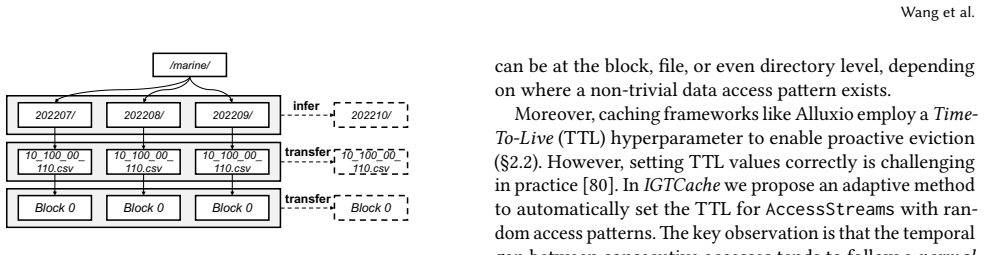
The AccessStreamTree, a hierarchical index of recent accesses built by prefix-matching each request's path, with one AccessStream node per granularity, is what lets pattern detection occur at block, file, or directory level. The second carrier is the K-S hypothesis test, which compares the empirical spatial-gap distribution to the triangular CDF $F(k)=2k/(c-1)-k(k+1)/(c(c-1))$ to call a stream random, with other shapes treated as skewed and small gaps as sequential. The third is the marginal-benefit metric $B$ (for example, $B=1/(g\cdot n)$ for random streams), a common currency that lets cache space migrate between streams every 60 seconds.
What would settle it
Generate a stream that samples a dataset of known size $c$ uniformly with replacement and compute the empirical spatial-gap distribution over 100 consecutive accesses; if the K-S test at $\alpha=0.01$ rejects the triangular reference $F(k)=2k/(c-1)-k(k+1)/(c(c-1))$ while the stream is genuinely random, the paper's random-pattern model is falsified and the policies keyed to it would be misconfigured.
Extended reading notes
Core claim
IGTCache's central claim is that one shared cache can serve the full mixture of preprocessing, training, and inference workloads because each access stream is classified at runtime and given the policy that fits its pattern and granularity. Recent accesses are folded into an AccessStreamTree, whose nodes correspond to directory, file, or block granularity; each non-trivial stream is classified by a K-S test comparing the empirical spatial-gap distribution against the triangular reference $P(Z=k)=2(c-k)/(c(c-1))$ that uniform sampling without replacement produces. Sequential streams get sequential prefetch and eager eviction, random streams get dataset prefetching and uniform pinning, and skewed streams get LRU and no prefetching, while a marginal-benefit metric shifts cache space among streams. On an 18-job mixed workload the paper measures a 55.6% higher cache hit ratio than existing caching frameworks and a 52.2% lower average job completion time, with 0.36% average I/O-time computation overhead.
Load-bearing premise
The pattern detector assumes that a random workload touches every data item exactly once per pass, that the cache knows the dataset's total item count, and that random and non-random accesses never mix in one stream; if a data loader samples with replacement, shards data, or mixes patterns, the triangular gap distribution breaks and the K-S test can pick the wrong policy class for the stream.
Editorial extensions
If this is right
- A cluster can run a single shared cache instead of one cache per workload, because each AccessStream keeps its policy decisions isolated even though the cache space is shared.
- Pattern changes are handled automatically: if a dataset shifts from training (random) to testing (sequential), the same AccessStream is reclassified and its prefetching and eviction policies switch accordingly.
- The reported gain is largest when cache is scarce, with a 55.6% hit-ratio improvement at 35% dataset-size cache, and gains persist even at 100% cache size because prefetching removes compulsory misses.
- Random training streams receive statistical dataset prefetching, which alone reduced first-epoch completion time by 6.8% in the paper's measurement.
- Adaptive TTL eviction releases cache space of finished jobs much sooner (86 seconds versus 600 seconds in the reported experiment), so surviving jobs see higher throughput.
Reading between the lines
- Beyond the paper's testbed, the classifier consumes only access sequences and item counts, so the same machinery could be wrapped around page caches, object-store gateways, or data-loading pipelines to test whether pattern-switched policies reproduce the reported gains elsewhere.
- The uniform-without-replacement reference distribution will need generalization before the method transfers to data loaders that sample with replacement, shard across workers, or repeat items within an epoch; an occupancy-based or beta-binomial gap model is a concrete candidate.
- Aggregate JCT and hit-ratio numbers likely hide heterogeneous per-job effects, so a percentile breakdown would tell operators which workload class receives most of the 52.2% job-completion-time reduction and whether any class regresses.
- Because every downstream policy is determined by a single K-S verdict, an online calibration of the significance level per stream, rather than a fixed 0.01, would be a natural robustness follow-up.
Editorial analysis
A structured set of objections, weighed in public.
Referee Report
Summary. The paper presents IGTCache, a unified cache layer for AI clusters that serves heterogeneous workloads (data preprocessing, training, inference) in a single shared cache pool. IGTCache organizes recent accesses into an AccessStreamTree, whose nodes represent access streams at directory, file, or block granularity. For each non-trivial stream, it uses a Kolmogorov–Smirnov test against a triangular gap distribution to classify the access pattern as sequential, random, or skewed. Based on the classification, it adaptively selects prefetching, eviction, and cache-space-allocation policies per stream. The experimental section reports a 55.6% cache hit ratio improvement and a 52.2% average job completion time reduction over JuiceFS on a hand-assembled 18-job mixed workload, with computation overhead of 0.36% of average I/O time. The paper also includes micro-benchmarks for prefetching, eviction, allocation, and sensitivity analysis of the K-S test parameters.
Significance. If the claims hold, the paper offers a practical recipe for making a single cache pool adapt to the heterogeneous access patterns and storage granularities found in modern AI clusters, without requiring application code changes. The AccessStreamTree abstraction is clearly presented, the implementation on JuiceFS is concrete, and the inclusion of sensitivity analysis for the significance level and observation window is a genuine robustness check. The paper also makes falsifiable predictions, such as the adaptive TTL behavior evaluated in §5.3. However, the statistical classifier underlying the three adaptive policies rests on assumptions that are only partially validated: it requires knowledge of the total item count c, assumes uniform sampling without replacement, and applies continuous K-S critical values to a discrete variable. These issues, together with the single-run nature of the headline end-to-end results, prevent the current manuscript from fully supporting its central claims.
major comments (4)
- [§3.2, Eq. (1)] The reference distribution for the K-S test, F(k) = 2k/(c-1) - k(k+1)/(c(c-1)), requires the total item count c of the dataset, but the paper never states how IGTCache obtains c for an AccessStream at file or directory granularity. The implementation section (§4) describes the FUSE hook and tree updates but does not mention any metadata lookup that would provide c. If c is unknown, the test statistic cannot be computed; if it is estimated from the observation window, the estimate may be biased for small windows. Because the resulting classification drives prefetching, eviction, and allocation in §3.3, this is a load-bearing omission. Please specify the source of c and provide a sensitivity analysis of the classifier to errors in c.
- [§3.2, footnote 6; Table 3] The triangular gap model assumes uniform sampling without replacement from the full dataset. Two failure modes are unaddressed: (i) distributed data loaders shard the dataset, so the merged stream combines independent uniform streams over shards, yielding a different gap distribution; (ii) epoch boundaries cause repeated samples, violating the without-replacement assumption. Footnote 6 explicitly excludes mixed random/non-random streams, but the workload suite in Table 3 includes job 18, whose pattern is listed as 'Sequential and Random' (multimodal finetuning), and other workloads may share datasets. The paper should either demonstrate that misclassification is rare under these conditions (e.g., by testing on sharded loaders and multi-epoch runs) or qualify the headline claims accordingly.
- [§5.1] The headline numbers—55.6% CHR improvement and 52.2% JCT reduction—are point estimates from a single run of one hand-assembled 18-job mix against one baseline (JuiceFS). No confidence intervals, multiple seeds, or workload-composition sensitivity are reported. The micro-benchmarks in §5.2–§5.4 compare against stronger baselines, but the end-to-end claim is the paper's central result. Several independent runs (e.g., different job arrival intervals and dataset orderings) are needed to establish that the gains are not an artifact of a particular mix.
- [§3.2, K-S test application] The K-S test is applied to a discrete variable (spatial gaps Z with integer values), yet the critical values D_α are those of the continuous Kolmogorov distribution. With ties, the standard test is conservative, which biases towards rejecting the random-pattern null hypothesis. The practical consequence is that truly random streams may be classified as skewed, switching eviction from uniform caching to LRU and disabling statistical prefetching—exactly the actions that drive the §5.1 gains. The authors should use a discrete K-S test or provide a correction and quantify the impact.
minor comments (5)
- [Abstract and §5.1] The abstract and §5.1 describe JuiceFS as a 'state-of-the-art' caching framework, but Alluxio is only mentioned, not evaluated; the claim of improvement 'over state-of-the-art caching frameworks' is broader than the experimental evidence.
- [Table 3] For job 18 (LLaVa multimodal finetuning), the pattern is listed as 'Sequential and Random'; given footnote 6's exclusion of mixed random and non-random streams, it is unclear whether the AccessStreamTree separates the text and image accesses into different streams by path. Please clarify how this workload is handled.
- [§3.3] For random patterns, the marginal benefit is defined as B = 1/(g·n), where g is the 'inter-access temporal gap'; the text does not define how g is measured for a stream with multiple concurrent workers, and the assumption of a single constant g is not justified.
- [§4] The hard limit of 10,000 nodes in the AccessStreamTree, with excess nodes removed by LRU, can evict the state of a non-trivial AccessStream and reset its classification; the effect on ongoing policy adaptation is not discussed.
- [§5.5] Figures 14 and 15 report classification accuracy but do not state the numerical values in the text; the claim that α=0.01 is 'sufficiently good' would be easier to evaluate with stated numbers.
Circularity Check
No significant circularity: pattern classification is an operational hypothesis test, policy gains are measured end-to-end, and the sole overlapping-author citation is independent support.
full rationale
The claimed derivation is not circular. IGTCache's pattern recognition (Section 3.2) tests observed spatial-gap samples against the triangular reference distribution P(Z=k)=2(c-k)/(c(c-1)) derived from the uniform-without-replacement model; the reference distribution is a mathematical consequence of the assumed random-access model, not a fit to the workloads, and Section 5.5 checks the classifier against independently labeled workload types over 100 trials per pattern. The adaptive policies (Section 3.3) are selected from the recognized pattern by construction, but the headline JCT/CHR results (Section 5.1) are measured end-to-end on the 18-job testbed and each component is ablated in Sections 5.2-5.4 against external baselines (stride, SFP, LRU, FIFO, ARC, uniform caching, Quiver, Fluid). No parameter is fitted to the headline metrics: alpha=0.01, window=100, prefetch depth=4, and BufferWindow=100 are stated defaults, and the marginal benefit B is measured via a ghost cache or computed from dataset size n and access gap g rather than tuned to JCT. The one overlapping-author citation, Silod [87] for the uniform-caching eviction policy, is independent published work and is also supported by the non-overlapping citation [58], so it is not load-bearing self-citation. Footnote 6's exclusion of mixed random/non-random streams and the paper's silence on how c in Eq. (1) is obtained are correctness/generality risks, not circular reductions: nothing in the paper defines c in terms of the classification outcome or equates a prediction with a fitted value.
Assumptions & free parameters
free parameters (8)
- K-S significance level alpha =
0.01
- Observation window size =
100
- Sequential prefetch depth N =
4
- Hot-unit prefetch threshold f_p =
0.8
- BufferWindow size w =
100
- TTL base time =
60 s
- Cache shifting round and amount =
640 MB per 60 s round
- Dataset-prefetch hit-ratio threshold =
not specified in text
assumptions (6)
- domain assumption Random-access streams sample item indices uniformly without replacement within an epoch, so consecutive-access gaps follow P(Z=k)=2(c-k)/(c(c-1)).
- domain assumption IGTCache knows the dataset item count c required by the reference CDF of Eq. (1).
- ad hoc to paper No AccessStream mixes random and non-random access patterns.
- domain assumption Continuous-distribution K-S critical values remain valid for the discrete triangular CDF.
- domain assumption The per-pattern policy mappings are the right ones: eager eviction for sequential, uniform pinning for random, LRU and no prefetching for skewed.
- domain assumption Temporal gaps between consecutive accesses of a random-pattern stream are normally distributed.
invented entities (1)
-
AccessStreamTree (with per-node AccessStream and per-stream CacheManageUnit)
independent evidence
Cite this review
Pith. "Pith review of Efficient Unified Caching for Accelerating Heterogeneous AI Workloads." pith.science (2026). https://pith.science/paper/3PRLJP2S
@misc{pith2026250612370,
  author       = {Pith},
  title        = {Pith review of: Efficient Unified Caching for Accelerating Heterogeneous AI Workloads},
  year         = {2026},
  howpublished = {\url{https://pith.science/paper/3PRLJP2S}},
  note         = {Machine review of arXiv:2506.12370}
}
read the original abstract
Modern AI clusters, which host diverse workloads like data pre-processing, training and inference, often store the large-volume data in cloud storage and employ caching frameworks to facilitate remote data access. To avoid code-intrusion complexity and minimize cache space wastage, it is desirable to maintain a unified cache shared by all the workloads. However, existing cache management strategies, designed for specific workloads, struggle to handle the heterogeneous AI workloads in a cluster -- which usually exhibit heterogeneous access patterns and item storage granularities. In this paper, we propose IGTCache, a unified, high-efficacy cache for modern AI clusters. IGTCache leverages a hierarchical access abstraction, AccessStreamTree, to organize the recent data accesses in a tree structure, facilitating access pattern detection at various granularities. Using this abstraction, IGTCache applies hypothesis testing to categorize data access patterns as sequential, random, or skewed. Based on these detected access patterns and granularities, IGTCache tailors optimal cache management strategies including prefetching, eviction, and space allocation accordingly. Experimental results show that IGTCache increases the cache hit ratio by 55.6% over state-of-the-art caching frameworks, reducing the overall job completion time by 52.2%.
Figures


Figures from the paper (9 more)



Reference graph
Works this paper leans on
-
[1]
2024. Alluxio. https://www.alluxio.io/. Retrieved on September 12, 2024
2024
-
[2]
ALLUXIO FUSE
2024. ALLUXIO FUSE. https://docs.alluxio.io/os/user/stable/en/api/ POSIX-API.html. Retrieved on September 12, 2024
2024
-
[3]
Amazon S3
2024. Amazon S3. https://aws.amazon.com/s3/ . Retrieved on September 12, 2024
2024
-
[4]
Azure Blob
2024. Azure Blob. https://azure.microsoft.com/en-us/products/storag e/blobs. Retrieved on September 12, 2024
2024
-
[5]
Data preloading in Alluxio
2024. Data preloading in Alluxio. https://docs.alluxio.io/ee-ai/user/st able/en/feature/Cache-Preloading.html. Retrieved on September 12, 2024
2024
-
[6]
Free Speech… Recognition (Linux, Windows and Mac) - vox- forge.org
2024. Free Speech… Recognition (Linux, Windows and Mac) - vox- forge.org. https://www.voxforge.org/. Retrieved on July 31, 2024
2024
-
[7]
International Comprehensive Ocean-Atmosphere Data Set (ICOADS) Release 3, Individual Observations
2024. International Comprehensive Ocean-Atmosphere Data Set (ICOADS) Release 3, Individual Observations. https://rda.ucar.e du/datasets/dsd548000/. Retrieved on September 12, 2024
2024
-
[8]
2024. JuiceFS. https://juicefs.com/en/ . Retrieved on September 12, 2024
2024
Show all 96 references
-
[9]
JuiceFS cache strategies
2024. JuiceFS cache strategies. https://juicefs.com/docs/cloud/guide /cache/#consistency-exceptions. Retrieved on September 12, 2024
2024
-
[10]
JuiceFS FUSE
2024. JuiceFS FUSE. https://juicefs.com/docs/community/fuse mou nt options/. Retrieved on September 12, 2024
2024
-
[11]
Time Series Air Quality Data of India (2010-2023)
2024. Time Series Air Quality Data of India (2010-2023). https: //www.kaggle.com/datasets/abhisheksjha/time-series-air-quality- data-of-india-2010-2023 . Retrieved on September 11, 2024
2024
-
[12]
TTL (Time-to-live) setup in Alluxio
2024. TTL (Time-to-live) setup in Alluxio. https://docs.alluxio.io/os/u ser/stable/en/core-services/Caching.html. Retrieved on September 12, 2024
2024
-
[13]
TTL (Time-to-live) setup in JuiceFS
2024. TTL (Time-to-live) setup in JuiceFS. https://juicefs.com/docs/c ommunity/guide/cache/. Retrieved on September 12, 2024
2024
-
[14]
What is Object storage? https://cloud.google.com/learn/what- is-object-storage?hl=en
2024. What is Object storage? https://cloud.google.com/learn/what- is-object-storage?hl=en. Retrieved on September 12, 2024
2024
-
[15]
Configure Object Storage with Milvus Operator
2025. Configure Object Storage with Milvus Operator. https://milvus .io/docs/object storage operator.md. Retrieved on May 16, 2025
2025
-
[16]
deepseek-v3
2025. deepseek-v3. https://ollama.com/library/deepseek-v3. Retrieved on May 16, 2025
2025
-
[17]
GPT-4: Details Leaked
2025. GPT-4: Details Leaked. https://plainswipe.com/gpt-4-details- leaked/index.html. Retrieved on January 10, 2025
2025
-
[18]
GPT-4o System Card
2025. GPT-4o System Card. https://openai.com/index/gpt-4o-system- card/. Retrieved on January 10, 2025
2025
-
[19]
2025. Milvus. https://milvus.io/. Retrieved on January 10, 2025
2025
-
[20]
Wikipedia (en) embedded with cohere.ai multilingual22-12 encoder
2025. Wikipedia (en) embedded with cohere.ai multilingual22-12 encoder. https://huggingface.co/datasets/Cohere/wikipedia-22-12- en-embeddings/. Retrieved on January 10, 2025
2025
-
[21]
Param Aggarwal. 2019. Fashion Product Images Dataset. https: //doi.org/10.34740/KAGGLE/DS/139630
2019 doi
-
[22]
Maen M Al Assaf. 2015. Predictive Prefetching for Parallel Hybrid Storage Systems. International Journal of Communications, Network and System Sciences 8, 5 (2015), 161–180
2015
-
[23]
Hasan Al Maruf and Mosharaf Chowdhury. 2020. Effectively prefetch- ing remote memory with leap. In USENIX ATC
2020
-
[24]
Kolmogorov An. 1933. Sulla determinazione empirica di una legge didistribuzione. Giorn Dell’inst Ital Degli Att 4 (1933), 89–91
1933
-
[25]
Sorav Bansal, Dharmendra S Modha, et al . 2004. Car: Clock with adaptive replacement.. In FAST, Vol. 4. 187–200
2004
-
[26]
S¨oren Becker, Johanna Vielhaben, Marcel Ackermann, Klaus-Robert M¨uller, Sebastian Lapuschkin, and Wojciech Samek. 2024. AudioM- NIST: Exploring Explainable Artificial Intelligence for audio analysis on a simple benchmark. Journal of the Franklin Institute 361, 1 (2024), 418–428
2024
-
[27]
Jia Deng, Wei Dong, Richard Socher, Li-Jia Li, Kai Li, and Li Fei-Fei
-
[28]
Yuhao Deng, Chengliang Chai, Lei Cao, Qin Yuan, Siyuan Chen, Yanrui Yu, Zhaoze Sun, Junyi Wang, Jiajun Li, Ziqi Cao, et al. 2024. LakeBench: A Benchmark for Discovering Joinable and Unionable Tables in Data Lakes. Proceedings of the VLDB Endowment 17, 8 (2024), 1925–1938
2024
-
[29]
Shi Dong, Ping Wang, and Khushnood Abbas. 2021. A survey on deep learning and its applications. Computer Science Review 40 (2021), 100379
2021
-
[30]
Nikoli Dryden, Roman B ¨ohringer, Tal Ben-Nun, and Torsten Hoefler
-
[31]
Gil Einziger, Ohad Eytan, Roy Friedman, and Benjamin Manes. 2022. Lightweight robust size aware cache management. ACM Transactions on Storage (TOS) 18, 3 (2022), 1–23
2022
-
[32]
Gil Einziger, Roy Friedman, and Ben Manes. 2017. Tinylfu: A highly efficient cache admission policy. ACM Transactions on Storage (ToS) 13, 4 (2017), 1–31
2017
-
[33]
Mark Everingham, Luc Van Gool, Christopher KI Williams, John Winn, and Andrew Zisserman. 2010. The pascal visual object classes (voc) challenge. International journal of computer vision 88 (2010), 303–338
2010
-
[34]
Peter X Gao, Akshay Narayan, Sagar Karandikar, Joao Carreira, Sangjin Han, Rachit Agarwal, Sylvia Ratnasamy, and Scott Shenker
-
[35]
Shaleen Garg, Jian Zhang, Rekha Pitchumani, Manish Parashar, Bing Xie, and Sudarsun Kannan. 2024. CrossPrefetch: Accelerating I/O Prefetching for Modern Storage. In ACM ASPLOS
2024
-
[36]
Binny S Gill and Luis Angel D Bathen. 2007. AMP: Adaptive Multi- stream Prefetching in a Shared Cache.. In USENIX FAST
2007
-
[37]
Xiangyang Gou, Long He, Yinda Zhang, Ke Wang, Xilai Liu, Tong Yang, Yi Wang, and Bin Cui. 2020. Sliding sketches: A framework using time zones for data stream processing in sliding windows. In PAKDD
2020
-
[38]
Jim Griffioen and Randy Appleton. 1994. Reducing File System Latency using a Predictive Approach.. In USENIX summer. 197–207
1994
-
[39]
Rong Gu, Simian Li, Haipeng Dai, Hancheng Wang, Yili Luo, Bin Fan, Ran Ben Basat, Ke Wang, Zhenyu Song, Shouwei Chen, et al . 2023. Adaptive online cache capacity optimization via lightweight working set size estimation at scale. In USENIX ATC
2023
-
[40]
Rong Gu, Kai Zhang, Zhihao Xu, Yang Che, Bin Fan, Haojun Hou, Haipeng Dai, Li Yi, Yu Ding, Guihai Chen, et al. 2022. Fluid: Dataset abstraction and elastic acceleration for cloud-native deep learning training jobs. In IEEE ICDE. 13 Wang et al
2022
-
[41]
Kaiming He, Xiangyu Zhang, Shaoqing Ren, and Jian Sun. 2016. Deep residual learning for image recognition. In IEEE CVPR
2016
-
[42]
Virajith Jalaparti, Chris Douglas, Mainak Ghosh, Ashvin Agrawal, Avrilia Floratou, Srikanth Kandula, Ishai Menache, Joseph Seffi Naor, and Sriram Rao. 2018. Netco: Cache and i/o management for analytics over disaggregated stores. In ACM SoCC
2018
-
[43]
Mandar Joshi, Eunsol Choi, Daniel S Weld, and Luke Zettlemoyer
-
[44]
Aarati Kakaraparthy, Abhay Venkatesh, Amar Phanishayee, and Shiv- aram Venkataraman. 2019. The case for unifying data loading in machine learning clusters. In 11th USENIX Workshop on Hot Topics in Cloud Computing (HotCloud 19)
2019
-
[45]
Redwan Ibne Seraj Khan, Ahmad Hossein Yazdani, Yuqi Fu, Arnab K Paul, Bo Ji, Xun Jian, Yue Cheng, and Ali R Butt. 2023. SHADE: Enable Fundamental Cacheability for Distributed Deep Learning Training. In USENIX FAST
2023
-
[46]
Nicholas Krichevsky, Renee St Louis, and Tian Guo. 2021. Quantifying and improving performance of distributed deep learning with cloud storage. In IEEE IC2E
2021
-
[47]
Alex Krizhevsky, Ilya Sutskever, and Geoffrey E Hinton. 2012. Im- agenet classification with deep convolutional neural networks. Ad- vances in neural information processing systems 25 (2012)
2012
-
[48]
Thomas M Kroeger and Darrell Long. 2001. Design and implementa- tion of a predictive file prefetching algorithm. (2001)
2001
-
[49]
Abhishek Vijaya Kumar and Muthian Sivathanu. 2020. Quiver: An informed storage cache for deep learning. In USENIX FAST
2020
-
[50]
Hui Lei and Dan Duchamp. 1997. An analytical approach to file prefetching
1997
-
[51]
Patrick Lewis, Ethan Perez, Aleksandra Piktus, Fabio Petroni, Vladimir Karpukhin, Naman Goyal, Heinrich K ¨uttler, Mike Lewis, Wen-tau Yih, Tim Rockt ¨aschel, et al. 2020. Retrieval-augmented generation for knowledge-intensive nlp tasks. Advances in Neural Information Processi...
2020
-
[52]
Zhenmin Li, Zhifeng Chen, Sudarshan M Srinivasan, Yuanyuan Zhou, et al. 2004. C-miner: Mining block correlations in storage systems.. In USENIX FAST
2004
-
[53]
Tsung-Yi Lin, Michael Maire, Serge Belongie, James Hays, Pietro Per- ona, Deva Ramanan, Piotr Doll´ar, and C Lawrence Zitnick. 2014. Mi- crosoft coco: Common objects in context. In Computer Vision–ECCV 2014: 13th European Conference, Zurich, Switzerland, September 6-12, 2014, ...
2014
-
[54]
Aixin Liu, Bei Feng, Bing Xue, Bingxuan Wang, Bochao Wu, Chengda Lu, Chenggang Zhao, Chengqi Deng, Chenyu Zhang, Chong Ruan, et al . 2024. Deepseek-v3 technical report. arXiv preprint arXiv:2412.19437 (2024)
2024 arXiv
-
[55]
Haotian Liu, Chunyuan Li, Qingyang Wu, and Yong Jae Lee. 2023. Visual Instruction Tuning
2023
-
[56]
Nimrod Megiddo and Dharmendra S Modha. 2003. ARC: A Self-Tuning, low overhead replacement cache. In USENIX FAST
2003
-
[57]
Madalin Mihailescu, Gokul Soundararajan, and Cristiana Amza. 2013. {MixApart}: Decoupled Analytics for Shared Storage Systems. In 11th USENIX Conference on File and Storage Technologies (FAST 13) . 133–146
2013
-
[58]
Jayashree Mohan, Amar Phanishayee, Ashish Raniwala, and Vijay Chidambaram. 2020. Analyzing and mitigating data stalls in DNN training. arXiv preprint arXiv:2007.06775 (2020)
2020 arXiv
-
[59]
Djob Mvondo, Mathieu Bacou, Kevin Nguetchouang, Lucien Ngale, St´ephane Pouget, Josiane Kouam, Renaud Lachaize, Jinho Hwang, Tim Wood, Daniel Hagimont, et al. 2021. OFC: an opportunistic caching system for FaaS platforms. In ACM EuroSys
2021
-
[60]
Elizabeth J O’neil, Patrick E O’neil, and Gerhard Weikum. 1993. The LRU-K page replacement algorithm for database disk buffering. Acm Sigmod Record 22, 2 (1993), 297–306
1993
-
[61]
Ray Perrault and Jack Clark. 2024. Artificial intelligence index report
2024
-
[62]
Bryan A Plummer, Liwei Wang, Chris M Cervantes, Juan C Caicedo, Julia Hockenmaier, and Svetlana Lazebnik. 2015. Flickr30k entities: Collecting region-to-phrase correspondences for richer image-to- sentence models. In Proceedings of the IEEE international conference on computer...
2015
-
[63]
Moinuddin K Qureshi, Aamer Jaleel, Yale N Patt, Simon C Steely, and Joel Emer. 2007. Adaptive insertion policies for high performance caching. ACM SIGARCH Computer Architecture News 35, 2 (2007), 381–391
2007
-
[64]
Pranav Rajpurkar, Jian Zhang, Konstantin Lopyrev, and Percy Liang
-
[65]
Adib Bin Rashid and Ashfakul Karim Kausik. 2024. AI revolutioniz- ing industries worldwide: A comprehensive overview of its diverse applications. Hybrid Advances (2024), 100277
2024
-
[66]
Susmita Ray. 2019. A quick review of machine learning algorithms. In 2019 International conference on machine learning, big data, cloud and parallel computing (COMITCon). IEEE, 35–39
2019
-
[67]
Zujie Ren, Jian Wan, Weisong Shi, Xianghua Xu, and Min Zhou. 2013. Workload analysis, implications, and optimization on a production hadoop cluster: A case study on taobao. IEEE Transactions on Services Computing 7, 2 (2013), 307–321
2013
-
[68]
Francisco Romero, Gohar Irfan Chaudhry, ´I˜nigo Goiri, Pragna Gopa, Paul Batum, Neeraja J Yadwadkar, Rodrigo Fonseca, Christos Kozyrakis, and Ricardo Bianchini. 2021. FaaT: A transparent auto- scaling cache for serverless applications. In ACM SoCC
2021
-
[69]
arXiv preprint arXiv:1606.05250 (2016)
Squad: 100,000+ questions for machine comprehension of text. arXiv preprint arXiv:1606.05250 (2016)
2016 arXiv
-
[70]
Sambhav Satija, Chenhao Ye, Ranjitha Kosgi, Aditya Jain, Romit Kankaria, Yiwei Chen, Andrea C Arpaci-Dusseau, Remzi H Arpaci- Dusseau, and Kiran Srinivasan. 2025. Cloudscape: A Study of Storage Services in Modern Cloud Architectures. In 23rd USENIX Conference on File and Stora...
2025
-
[71]
Karen Simonyan and Andrew Zisserman. 2014. Very deep convo- lutional networks for large-scale image recognition. arXiv preprint arXiv:1409.1556 (2014)
2014 arXiv
-
[72]
Yannis Smaragdakis, Scott Kaplan, and Paul Wilson. 1999. EELRU: simple and effective adaptive page replacement. ACM SIGMETRICS Performance Evaluation Review 27, 1 (1999), 122–133
1999
-
[73]
Nickolay Smirnov. 1948. Table for estimating the goodness of fit of empirical distributions. The annals of mathematical statistics 19, 2 (1948), 279–281
1948
-
[74]
Ayodeji Olalekan Salau and Shruti Jain. 2019. Feature extraction: a survey of the types, techniques, applications. In IEEE ICSC
2019
-
[75]
Aidan Toner-Rodgers. 2024. Artificial intelligence, scientific discovery, and product innovation. arXiv preprint arXiv:2412.17866 (2024)
2024 arXiv
-
[76]
Han Wang, Longfei Luo, Liang Shi, Changlong Li, Chun Jason Xue, Qingfeng Zhuge, and Edwin H-M Sha. 2021. SFP: Smart file-aware prefetching for flash based storage systems. In ACM GLSVLSI
2021
-
[77]
Fengguang Wu, Hongsheng Xi, Jun Li, and Nanhai Zou. 2007. Linux readahead: less tricks for more. InProceedings of the Linux Symposium, Vol. 2. Citeseer, 273–284
2007
-
[78]
Yi Xu, Jiandong Ding, Lu Zhang, and Shuigeng Zhou. 2021. Dp-ssl: Towards robust semi-supervised learning with a few labeled samples. Advances in Neural Information Processing Systems 34 (2021), 15895– 15907
2021
-
[79]
Gokul Soundararajan, Madalin Mihailescu, and Cristiana Amza. 2008. Context-Aware Prefetching at the Storage Server. InUSENIX ATC
2008
-
[80]
Juncheng Yang, Yao Yue, and KV Rashmi. 2021. A large-scale analysis of hundreds of in-memory key-value cache clusters at twitter. ACM Transactions on Storage (TOS) 17, 3 (2021), 1–35. 14 Efficient Unified Caching for Accelerating Heterogeneous AI Workloads
2021
-
[81]
Juncheng Yang, Yazhuo Zhang, Ziyue Qiu, Yao Yue, and Rashmi Vinayak. 2023. FIFO queues are all you need for cache eviction. In ACM SOSP
2023
-
[82]
Anil Yelam. 2022. Systems for memory disaggregation: challenges & opportunities. arXiv preprint arXiv:2202.02223 (2022)
2022 arXiv
-
[83]
Fuxun Yu, Di Wang, Longfei Shangguan, Minjia Zhang, Chenchen Liu, and Xiang Chen. 2022. A survey of multi-tenant deep learning inference on gpu. arXiv preprint arXiv:2203.09040 (2022)
2022 arXiv
-
[84]
Juncheng Yang, Reza Karimi, Trausti Sæmundsson, Avani Wildani, and Ymir Vigfusson. 2017. Mithril: mining sporadic associations for cache prefetching. In ACM SoCC
2017
-
[85]
Susan Zhang, Stephen Roller, Naman Goyal, Mikel Artetxe, Moya Chen, Shuohui Chen, Christopher Dewan, Mona Diab, Xian Li, Xi Vic- toria Lin, et al . 2022. Opt: Open pre-trained transformer language models. arXiv preprint arXiv:2205.01068 (2022)
2022 arXiv
-
[86]
Yazhuo Zhang, Juncheng Yang, Yao Yue, Ymir Vigfusson, and KV Rashmi. 2024. SIEVE is Simpler than LRU: an Efficient Turn-Key Eviction Algorithm for Web Caches. In USENIX NSDI
2024
-
[87]
Hanyu Zhao, Zhenhua Han, Zhi Yang, Quanlu Zhang, Mingxia Li, Fan Yang, Qianxi Zhang, Binyang Li, Yuqing Yang, Lili Qiu, et al . 2023. Silod: A co-design of caching and scheduling for deep learning clusters. In ACM EuroSys
2023
-
[88]
Bolei Zhou, Agata Lapedriza, Jianxiong Xiao, Antonio Torralba, and Aude Oliva. 2014. Learning deep features for scene recognition using places database. NeurIPS (2014)
2014
-
[89]
Di Zhang, Monish Soundar Raj, Bing Xie, Sheng Di, and Dong Dai
-
[90]
Yukun Zhu, Ryan Kiros, Rich Zemel, Ruslan Salakhutdinov, Raquel Urtasun, Antonio Torralba, and Sanja Fidler. 2015. Aligning Books and Movies: Towards Story-Like Visual Explanations by Watching Movies and Reading Books. In IEEE ICCV. 15
2015
-
[95]
Zixuan Zhou, Xuefei Ning, Ke Hong, Tianyu Fu, Jiaming Xu, Shiyao Li, Yuming Lou, Luning Wang, Zhihang Yuan, Xiuhong Li, et al. 2024. A survey on efficient inference for large language models. arXiv preprint arXiv:2404.14294 (2024)
2024 arXiv
-
[2009]
In IEEE CVPR
Imagenet: A large-scale hierarchical image database. In IEEE CVPR
-
[2016]
In USENIX OSDI
Network requirements for resource disaggregation. In USENIX OSDI
-
[2017]
arXiv preprint arXiv:1705.03551 (2017)
Triviaqa: A large scale distantly supervised challenge dataset for reading comprehension. arXiv preprint arXiv:1705.03551 (2017)
2017 arXiv
-
[2021]
In IEEE SC
Clairvoyant prefetching for distributed machine learning I/O. In IEEE SC
-
[2024]
In 2024 IEEE International Parallel and Distributed Processing Symposium (IPDPS)
Cross-system analysis of job characterization and scheduling in large-scale computing clusters. In 2024 IEEE International Parallel and Distributed Processing Symposium (IPDPS) . IEEE, 716–727
2024
Reviewed August 7, 2026 · model on record in the stance chip above.
Discussion (0). Sign in to comment.