REVIEW 3 major objections 6 minor 146 references
Symmetry-preserving neural networks in lattice field theories
T0 review · 3 major / 6 minor · reviewed 2026-08-07 · deepseek-v4-flash
Pith's one-line read Neural networks that respect gauge symmetry by construction can regress Wilson-loop observables accurately, while symmetry-breaking networks of comparable size fail as the loops grow.
desk verdict Solid compilation of the author's own L-CNN work, with a genuinely useful layer construction but a headline comparison that is confounded by asymmetric supervision and a universality claim that is not fully proven. read the letter →
The pith
A machine-rendered reading of the paper's core claim, the machinery that carries it, and where it could break.
The reading
What carries the argument
The central object is the lattice gauge equivariant convolutional network (L-CNN), and the identity that carries the argument is the lattice gauge equivariant convolution, $C_{x,i}(U,W) = \sum_{j,\mu,k} \omega_{i,j,\mu,k} U_{x,k\cdot\mu} W_{x+k\cdot\mu,j} U^\dagger_{x,k\cdot\mu}$, where $U_{x,k\cdot\mu}$ is the parallel transporter along lattice axis $\mu$. This parallel transport makes the layer equivariant under local gauge transformations and, with translation-invariant weights $\omega$, under translations as well. The bilinear layer multiplies locally transforming objects at the same site to combine loops, the trace layer projects to gauge-invariant outputs, and the exponentiation layer updates links while preserving unitarity and determinant; together these layers let a deep network build Wilson loops of arbitrary shape from elementary plaquettes.
What would settle it
Train a fixed-depth L-CNN to regress a contractible Wilson loop whose construction requires a connecting path with more axis-direction changes than the number of L-Conv layers available, such as a staircase loop in 3+1D; if even a wide network cannot match the accuracy it reaches on rectangular loops, the completeness step of the universality claim is false. A cheaper check is to enumerate all loops up to some perimeter and test whether each is expressible by the L-Conv/L-Bilin construction; one inexpressible contractible loop would refute the claim that arbitrary Wilson loops are generated.
Extended reading notes
Core claim
The central result is that a network whose layers are gauge equivariant by construction is sufficient to express and learn gauge-invariant lattice observables. The paper defines L-CNNs built from lattice gauge equivariant convolutions (L-Conv), which parallel-transport local objects to a common site along straight lattice-axis paths before summing them with translation-invariant weights, combined with bilinear layers that multiply such objects and a trace layer that extracts gauge-invariant scalars. Repeated L-Conv and bilinear blocks can grow Wilson loops by doubling their area, and the paper gives a proof sketch, based on tessellating a loop into plaquettes, that any contractible Wilson loop can be generated this way; with Polyakov layers, non-contractible loops are covered too. Empirically, L-CNNs regress traced $1\times1$, $1\times2$, $2\times2$, and $4\times4$ Wilson loops in 1+1D and $2\times2$ and $4\times4$ loops plus the topological charge density in 3+1D with orders-of-magnitude lower mean squared error than gauge-symmetry-breaking CNNs with comparable parameter counts, and the trained models transfer to larger lattices. The scalar-field chapter establishes the analogous benefit for translational symmetry: an equivariant CNN outperforms strided and flattening baselines across tasks, sample sizes, and lattice sizes.
Load-bearing premise
The load-bearing premise is that every contractible Wilson loop can be decomposed by removing a unit plaquette whose connecting path from the loop origin is always reproducible by consecutive L-Conv layers; the proof sketch gives this as an induction step but does not prove that every required path and loop shape in D>2 is reachable with finite depth.
Editorial extensions
If this is right
- L-CNNs can in principle approximate any gauge-equivariant function on the lattice, so Wilson-loop-based observables beyond those tested, such as improved actions, become learnable targets.
- Because gauge invariance is exact by construction, training needs no gauge-copy data augmentation, and models trained on small lattices apply directly to larger lattices.
- Translation-equivariant CNNs are not locked to the training lattice size, while flattening architectures are, so symmetry preservation removes a retraining bottleneck for lattice studies.
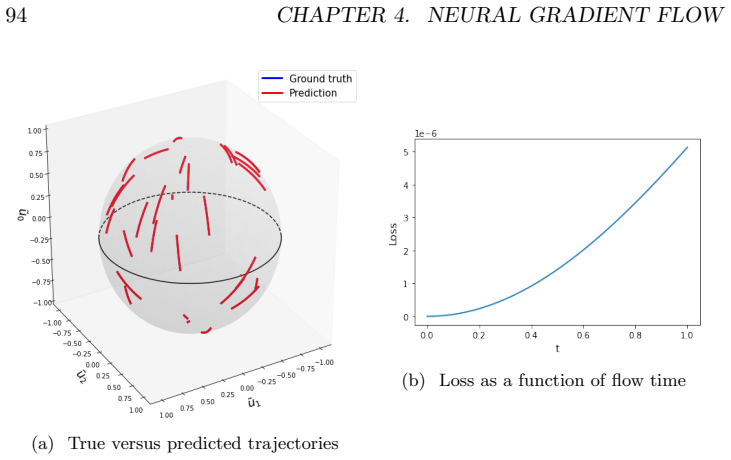
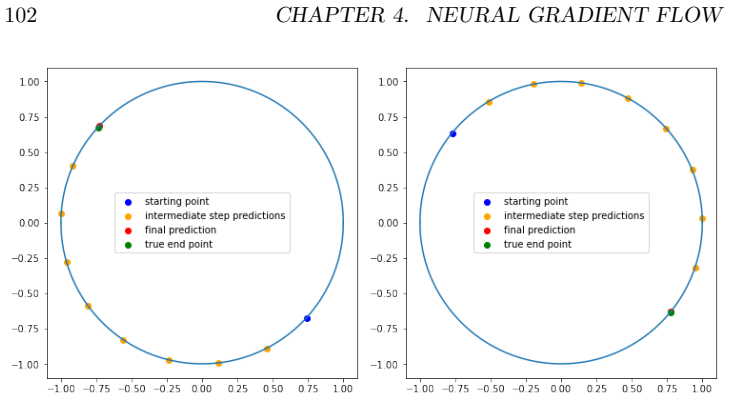
- Neural gradient flow, if it trains successfully, turns configuration generation into a cheap integration of a learned differential equation from random initial links.
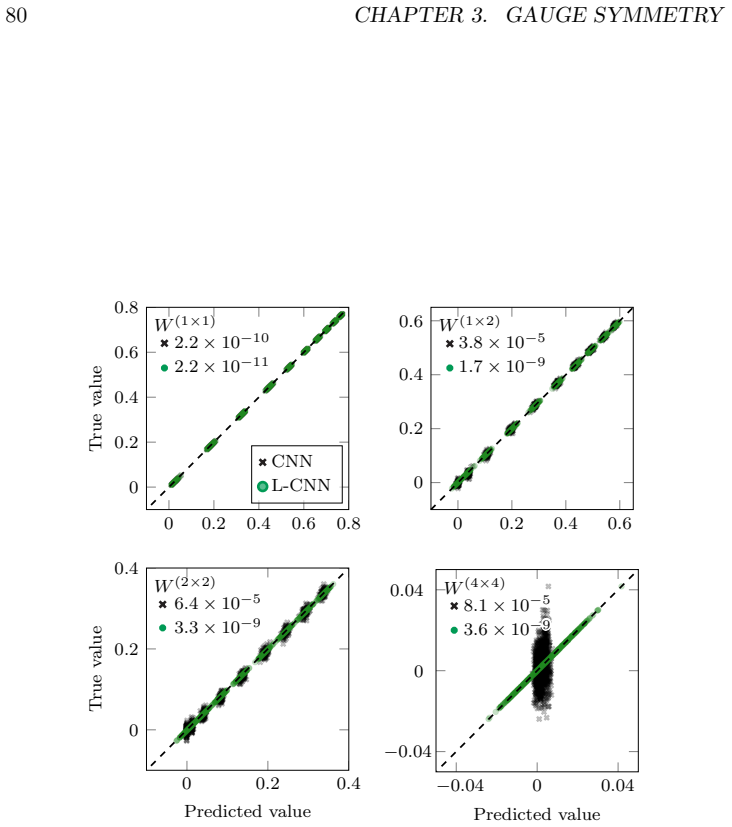
- The failure mode of baseline CNNs grows with loop size—predictions collapse toward the training average—so symmetry is not a minor advantage but the deciding factor for these observables.
Reading between the lines
- The induction sketch in Section 3.4 is the fragile point: if some contractible loop requires a connecting path with more axis-direction changes than the available depth, the universality claim overreaches even though the tested rectangular-loop regressions stand as reported.
- The same parallel-transport construction could be transplanted to non-Abelian gauge theories on curved lattices or manifolds by replacing straight-axis paths with geodesics, which would connect this method to equivariant networks on manifolds.
- Neural gradient flow could be trained directly on expectation values rather than final link configurations, which would sidestep the need for paired initial-final samples and make the method usable where target configurations are not available.
- The scalar-field results suggest that for theories with both global and local symmetries, the two equivariances compose cleanly: a translation-equivariant CNN after the trace layer inherits the full symmetry group of the lattice theory.
Editorial analysis
A structured set of objections, weighed in public.
Referee Report
Summary. This thesis-style manuscript studies neural networks that respect the symmetries of lattice field theories. Chapter 2 formulates translation-equivariant CNNs for a complex scalar field in flux representation, comparing equivariant (EQ), strided (ST), and flattening (FL) architectures on three tasks: regression of the observables n and |phi|^2, detection of flux violations, and counting of open worms. Chapter 3 defines a family of gauge-equivariant layers (L-Conv, L-Bilin, L-Act, L-Exp, Trace, Plaq, Poly), assembles them into L-CNNs, sketches a proof that arbitrary Wilson loops can be generated by such networks, and reports regression experiments for traced Wilson loops and topological charge in 1+1D and 3+1D. Chapter 4 adapts neural ODEs to SU(N_c) gauge links, proposing a 'neural gradient flow' as a generative method and testing it on a single-SU(2)-link toy model. The central claim is that L-CNNs solve Wilson-loop regressions essentially perfectly while gauge-symmetry-breaking CNNs fail, demonstrating the advantage of building gauge equivariance into the architecture.
Significance. If the headline comparison were clean, the manuscript would provide a strong demonstration that hard-wiring gauge equivariance is a decisive inductive bias for lattice-gauge-theory observables, with practical implications for machine-learning-based lattice QCD. The layer-wise equivariance proofs in Sections 2.2 and 3.2 are clear and self-contained, and the experimental methodology is careful in several respects: optuna-based architecture search with validation-based selection, 10 to 50 random initializations per architecture, early stopping, and honest reporting of non-convergence and outliers. However, the central L-CNN-versus-CNN comparison in Chapter 3 is confounded by an asymmetry in the supervision target, and the Section 3.4 universality proof is a sketch rather than a rigorous argument. The neural-gradient-flow chapter is a suggestive proof of principle but does not yet demonstrate a practical sampling method. The empirical demonstration that L-CNNs can regress Wilson loops and topological charge to high accuracy is valuable on its own; the comparative claim against CNNs needs to be repaired before it can support the abstract's conclusion.
major comments (3)
- [§3.5.2 and §3.5.3] The headline claim that gauge-symmetric L-CNNs greatly outperform gauge-breaking CNNs rests on an asymmetric training and evaluation protocol. Section 3.5.2 states that the L-CNN output is defined at every lattice site and that omitting a global average pooling (GAP) layer 'leads to much easier convergence'; Section 3.5.3 states that CNNs 'without a GAP layer performed much worse' and that, to enable comparison, 'we take the lattice average over the final output layer of the L-CNN models.' Thus L-CNNs are trained with per-site MSE against the local labels W^{(m×n)}_{x,μν}, while the CNN with GAP and a dense head is trained against a global average label, and the L-CNN is only spatially averaged at evaluation time. A regressor trained on the global mean has no incentive to reproduce local spatial variation; the reported failure of CNNs on the negative values of W^{(1×2)} and W^{(2×2)} and the collapse to the training-set average for W^{(4×4)} are exactly the signatures of a mean predictor. This confound, rather than the presence or absence of gauge equivariance, can explain the observed gap. Please rerun the comparison with matched supervision: train the CNN with per-site outputs (for example, replace GAP by a 1×1 convolution at each site and use the same per-site MSE), or train the L-CNN with GAP and a global MSE, and report both configurations.
- [§3.4] The induction sketch does not establish the stated universality claim. The step 'By means of the iterated application of L-Convs, it is always possible to generate the path that connects the origin with the removed plaquette' is asserted but not proved. The L-Conv of Eq. (3.2.13) transports W only along straight, axis-aligned paths with translation-invariant weights; paths that turn corners require a specific composition of L-Conv and L-Bilin operations, and the sketch does not show that every path required by an arbitrary tessellation—nor every non-planar loop in D>2, where the surface tessellation is non-unique—is reachable with finite depth. Since the sentence 'L-CNNs can be seen as universal approximators of functions on the lattice' depends directly on this step, the section should either supply a rigorous constructive proof with explicit depth bounds or weaken the claim to the class of loops demonstrably constructible (for example, rectangular loops) and explicitly flag the unresolved general case.
- [§3.5.4] The hyperparameter schedules are not matched between the two architecture families in 1+1D. For CNNs the learning rate is 3×10^{-2}, the maximum number of epochs is 100, and the patience is 25; for L-CNNs the corresponding values are 3×10^{-3}, 20, and 5 for the 1×1 and 1×2 tasks, and 1×10^{-3}, 100, and 25 for the 2×2 and 4×4 tasks. Even if the supervision-target asymmetry of Section 3.5.3 is fixed, the reported performance gap could still be influenced by unequal training budgets. Please report results under a shared hyperparameter protocol, or justify why the per-architecture schedules are the appropriate fair comparison.
minor comments (6)
- [§3.2.9] In Eq. (3.2.52), the product defining the Polyakov loop should specify the range of k; with periodic boundary conditions the product over all k is ambiguous unless the number of links in the temporal direction is stated explicitly.
- [§3.5.5] The W^{(1×1)} comparison should be presented as a sanity check rather than as evidence of the gauge-equivariance advantage, because the L-CNN contains an explicit Trace layer and the input already contains the plaquette matrices; the large performance gap for this observable is partly by construction.
- [§3.5.7] Equation (3.5.6) defines QP, but Fig. 3.5 labels the ordinate Qplaq(τ); please align the notation.
- [§4.1] The derivation of the Hermiticity and tracelessness of H assumes time-independent gauge transformations; this assumption should be stated explicitly when deriving the transformation property in Eq. (4.1.28), since time-dependent gauge transformations would introduce additional terms.
- [§2.5] The observation that the observable n can be reproduced exactly by an equivariant linear model with a single 1×1 convolution should appear earlier in Chapter 2 and be used to frame Task I as a warm-up, so that the reader does not over-interpret the EQ advantage on that observable.
- [Abstract] The phrase 'L-CNNs are specifically designed ad hoc' is redundant; consider 'purpose-built' or simply 'designed'.
Circularity Check
Wilson-loop regressions reduce to the L-CNN's own loop-building construction; the CNN comparison remains independent.
-
self definitional
[Section 3.5.5, with Eq. (3.5.1), Eq. (3.2.46), and Section 3.2.1]
"The first task we investigate is almost trivial: predicting the real value of the traced 1×1 Wilson loop as in Eq. (3.5.1). Since part of the input data consists of all possible 1×1 Wilson loops, the only required computations are first to perform the trace operation and then to take its real part."
The target is W(1×1)_{x,μν} = (1/N_c) ReTr[U_{x,μν}] (Eq. 3.5.1), while the input tuple (U,W) already contains W = {U_{x,μν}} as the locally transforming variables (Section 3.2.1). The Trace layer (Eq. 3.2.46) outputs T_{x,i} = Tr[W_{x,i}]. Therefore the L-CNN 'prediction' of W(1×1) is the trace of an input plaquette, up to the fixed 1/N_c and Re operations. The reported L-CNN success on this regression is the architecture's definition, not an independent empirical finding; the paper's own 'almost trivial' comment confirms the reduction.
-
self definitional
[Section 3.3 and Section 3.5.2, with Eq. (3.2.13), Eq. (3.2.20), and the W(1×2), W(2×2), W(4×4) regressions]
"Given that an L-CB layer doubles the maximum possible loop area, the repetition of n L-CB layers that take plaquettes as initial input allows to predict loops of area 2^n. ... it may seem trivial for L-CNNs to solve regression tasks involving Wilson loops, since they are intrinsically constructed to form arbitrarily sized loops."
An m×n Wilson loop is a product of link variables along a rectangle; L-Conv (Eq. 3.2.13) parallel-transports plaquettes along the lattice axes and L-Bilin (Eq. 3.2.20) multiplies such locally transforming objects at a site. The sequence Plaq → L-Conv → L-Bilin is, by the authors' own description, exactly the mechanism that 'grows' a larger Wilson loop out of 1×1 plaquettes. Hence the 'success' on these regressions is substantially the execution of the loop-composition algorithm the layers were built to implement. The paper's own caveat that the task 'may seem trivial' because the networks are 'intrinsically constructed to form arbitrarily sized loops' states the reduction. The comparison with non-equivariant CNNs remains an independent benchmark, so the circularity is partial.
1 more flagged steps
-
self definitional
[Section 2.5, with Eq. (2.4.1) and Table 2.4]
"This is not surprising if we consider that the observable n can be reproduced exactly by an equivariant linear model with a single 1×1 convolution."
The target n is defined in Eq. (2.4.1) as n = (1/N_x N_t) Σ_x k_{x,2}, a linear function of one input channel. The EQ architecture in Table 2.4 begins with Conv(1×1,4,64) and ends with GlobalAvgPool + Linear; a single 1×1 convolution can select the k_{x,2} channel and the global average computes the sum. Thus the EQ model's success on the n part of Task I is guaranteed by the layer definitions. The paper explicitly labels this 'not surprising'; the |φ|^2 observable, which requires neighboring-site information, carries the non-trivial content of the comparison.
full rationale
The paper contains genuine circularity in the Wilson-loop benchmarks, but it is openly acknowledged and only partially load-bearing. The W(1×1) regression reduces to tracing an input plaquette: Eq. (3.5.1) defines the target as (1/N_c)ReTr of U_{x,μν}, and the input tuple already contains W = {U_{x,μν}}, with the Trace layer (Eq. 3.2.46) producing Tr[W]. The larger-loop regressions likewise use L-Conv (parallel transport) and L-Bilin (multiplication) in the exact combination the paper says can 'grow' arbitrarily sized Wilson loops; the paper's own caveat in Section 3.5.6 concedes the task 'may seem trivial... since they are intrinsically constructed to form arbitrarily sized loops.' The Chapter 2 scalar-field Task I contains a second, less central reduction: n is exactly reproducible by a single 1×1 equivariant convolution, as the paper states. None of these reductions, however, make the whole derivation circular. The headline comparison of L-CNNs against gauge-symmetry-breaking CNNs is an external benchmark with reported scatter plots and MSEs; the CNN failure on 4×4 loops is an independent empirical observation, even though the per-site vs GAP supervision asymmetry weakens it as a clean test of gauge symmetry. The universality claim is under-supported by the proof-by-induction sketch, but that is a completeness gap rather than a circular reduction. No load-bearing self-citation chain or imported uniqueness theorem was found; citations to the authors' own prior papers are used for background and for the 'number of loops grows exponentially' remark, not to force the central result. Overall score 6: some 'predictions' reduce by construction, but the central architecture comparison retains independent empirical content.
Assumptions & free parameters
free parameters (1)
- Topological charge rescaling constant C =
100
assumptions (4)
- domain assumption Duality (flux) representation of the complex scalar field with chemical potential, partition function Eq. (2.1.22), taken from Gattringer et al. [96]
- standard math Non-Abelian Stokes' theorem: any contractible Wilson loop equals the ordered product over an enclosing surface, allowing tessellation into unit plaquettes
- domain assumption Universal approximation theorems for CNNs transfer to the L-CNN stack (Trace layer plus ordinary CNN)
- ad hoc to paper Restricting parallel transport to straight axis-aligned paths (Eq. 3.2.13) does not limit the loop shapes constructible by L-CNNs
invented entities (2)
-
L-CNN layer family (L-Conv, L-Bilin, L-Act, L-Exp, Trace, Plaq, Poly)
independent evidence
-
Neural gradient flow (NODE-based ODE on SU(Nc) links, Eq. 4.1.16)
Cite this review
Pith. "Pith review of Symmetry-preserving neural networks in lattice field theories." pith.science (2026). https://pith.science/paper/3LQIFG25
@misc{pith2026250612493,
  author       = {Pith},
  title        = {Pith review of: Symmetry-preserving neural networks in lattice field theories},
  year         = {2026},
  howpublished = {\url{https://pith.science/paper/3LQIFG25}},
  note         = {Machine review of arXiv:2506.12493}
}
read the original abstract
This thesis deals with neural networks that respect symmetries and presents the advantages in applying them to lattice field theory problems. The concept of equivariance is explained, together with the reason why such a property is crucial for the network to preserve the desired symmetry. The benefits of choosing equivariant networks are first illustrated for translational symmetry on a complex scalar field toy model. The discussion is then extended to gauge theories, for which Lattice Gauge Equivariant Convolutional Neural Networks (L-CNNs) are specifically designed ad hoc. Regressions of physical observables such as Wilson loops are successfully solved by L-CNNs, whereas traditional architectures which are not gauge symmetric perform significantly worse. Finally, we introduce the technique of neural gradient flow, which is an ordinary differential equation solved by neural networks, and propose it as a method to generate lattice gauge configurations.
Figures


Figures from the paper (27 more)








Reference graph
Works this paper leans on
- [1]
- [2]
- [3]
-
[4]
Weinberg, A Model of Leptons , Phys
S. Weinberg, A Model of Leptons , Phys. Rev. Lett. 19 (1967) 1264
1967
-
[5]
Salam, Weak and Electromagnetic Interactions , Conf
A. Salam, Weak and Electromagnetic Interactions , Conf. Proc. C 680519 (1968) 367
1968
-
[6]
The Muon g − 2 Collaboration collaboration, Measurement of the Positive Muon Anomalous Magnetic Moment to 0.20 ppm , Phys. Rev. Lett. 131 (2023) 161802
2023
-
[7]
Aoyama et al., The anomalous magnetic moment of the muon in the Standard Model , Phys
T. Aoyama et al., The anomalous magnetic moment of the muon in the Standard Model , Phys. Rept. 887 (2020) 1 [ 2006.04822]
arXiv 2020
-
[8]
Metropolis and S
N. Metropolis and S. Ulam, The Monte Carlo Method , Journal of the American Statistical Association 44 (1949) 335
1949
Show all 146 references
-
[9]
Sokal, Monte Carlo Methods in Statistical Mechanics: Foundations and New Algorithms , Springer US, Boston, MA (1997), 10.1007/978-1-4899-0319-8 6
A. Sokal, Monte Carlo Methods in Statistical Mechanics: Foundations and New Algorithms , Springer US, Boston, MA (1997), 10.1007/978-1-4899-0319-8 6
1997 doi
-
[10]
Aarts, Introductory lectures on lattice QCD at nonzero baryon number, Journal of Physics: Conference Series 706 (2016) 022004
G. Aarts, Introductory lectures on lattice QCD at nonzero baryon number, Journal of Physics: Conference Series 706 (2016) 022004
2016
-
[11]
Gattringer and K
C. Gattringer and K. Langfeld, Approaches to the sign problem in lattice field theory , Int. J. Mod. Phys. A 31 (2016) 1643007 [1603.09517]. 129 130 BIBLIOGRAPHY
2016 arXiv
-
[12]
Russakovsky, J
O. Russakovsky, J. Deng, H. Su, J. Krause, S. Satheesh, S. Ma et al., ImageNet Large Scale Visual Recognition Challenge , International Journal of Computer Vision (IJCV) 115 (2015) 211 [ 1409.0575]
2015 arXiv
-
[13]
OpenAI, GPT-4 Technical Report, 2303.08774
-
[14]
Silver, T
D. Silver, T. Hubert, J. Schrittwieser, I. Antonoglou, M. Lai, A. Guez et al., A general reinforcement learning algorithm that masters chess, shogi, and Go through self-play , Science 362 (2018) 1140
2018
-
[15]
Jumper, R
J. Jumper, R. Evans, A. Pritzel, T. Green, M. Figurnov, O. Ronneberger et al., Highly accurate protein structure prediction with AlphaFold, Nature 596 (2021) 583
2021
-
[16]
K.A. Tran, O. Kondrashova, A. Bradley, E.D. Williams, J.V. Pearson and N. Waddell, Deep learning in cancer diagnosis, prognosis and treatment selection, Genome Medicine 13 (2021) 152
2021
-
[17]
Dubey, S.K
S.R. Dubey, S.K. Singh and B.B. Chaudhuri, Activation functions in deep learning: A comprehensive survey and benchmark , Neurocomputing 503 (2022) 92
2022
-
[18]
Rosenblatt, The perceptron - A perceiving and recognizing automaton, Tech
F. Rosenblatt, The perceptron - A perceiving and recognizing automaton, Tech. Rep. 85-460-1, Cornell Aeronautical Laboratory, Ithaca, New York (January, 1957)
1957
-
[19]
Rosenblatt, The perceptron: A probabilistic model for information storage and organization in the brain
F. Rosenblatt, The perceptron: A probabilistic model for information storage and organization in the brain. , Psychological Review 65 (1958) 386
1958
-
[20]
LeCun, Y
Y. LeCun, Y. Bengio and G. Hinton, Deep learning, Nature 521 (2015) 436
2015
-
[21]
Ruder, An overview of gradient descent optimization algorithms , 1609.04747
S. Ruder, An overview of gradient descent optimization algorithms , 1609.04747
-
[22]
Ying, An Overview of Overfitting and its Solutions , Journal of Physics: Conference Series 1168 (2019) 022022
X. Ying, An Overview of Overfitting and its Solutions , Journal of Physics: Conference Series 1168 (2019) 022022
2019
-
[23]
Cybenko, Approximation by superpositions of a sigmoidal function, Mathematics of Control, Signals and Systems 2 (1989) 303
G. Cybenko, Approximation by superpositions of a sigmoidal function, Mathematics of Control, Signals and Systems 2 (1989) 303
1989
-
[24]
Z. Lu, H. Pu, F. Wang, Z. Hu and L. Wang, The Expressive Power of Neural Networks: A View from the Width , 1709.02540
-
[25]
Carrasquilla and R.G
J. Carrasquilla and R.G. Melko, Machine learning phases of matter , Nature Physics 13 (2017) 431–434. BIBLIOGRAPHY 131
2017
-
[26]
K. Zhou, G. Endr˝ odi, L.-G. Pang and H. St¨ ocker,Regressive and generative neural networks for scalar field theory , Phys. Rev. D 100 (2019) 011501(R) [ 1810.12879]
2019 arXiv
-
[27]
L. Wang, Y. Jiang, L. He and K. Zhou, Continuous-mixture Autoregressive Networks for efficient variational calculation of many-body systems, 2005.04857
2005 arXiv
-
[28]
Bachtis, G
D. Bachtis, G. Aarts and B. Lucini, Mapping distinct phase transitions to a neural network , Phys. Rev. E 102 (2020) 053306 [2007.00355]
2020 arXiv
-
[29]
Bl¨ ucher, L
S. Bl¨ ucher, L. Kades, J.M. Pawlowski, N. Strodthoff and J.M. Urban, Towards novel insights in lattice field theory with explainable machine learning, Physical Review D 101 (2020) [ 2003.01504]
2020 arXiv
-
[30]
Shanahan, D
P.E. Shanahan, D. Trewartha and W. Detmold, Machine learning action parameters in lattice quantum chromodynamics , Phys. Rev. D 97 (2018) 094506 [ 1801.05784]
2018 arXiv
-
[31]
Nicoli, C.J
K.A. Nicoli, C.J. Anders, L. Funcke, T. Hartung, K. Jansen, P. Kessel et al., Estimation of Thermodynamic Observables in Lattice Field Theories with Deep Generative Models , Phys. Rev. Lett. 126 (2021) 032001 [ 2007.07115]
2021 arXiv
-
[32]
Alexandru, G
A. Alexandru, G. Basar, P.F. Bedaque and N.C. Warrington, Complex paths around the sign problem , Rev. Mod. Phys. 94 (2022) 015006 [2007.05436]
2022 arXiv
-
[33]
Alvestad, R
D. Alvestad, R. Larsen and A. Rothkopf, Towards learning optimized kernels for complex Langevin , JHEP 04 (2023) 057 [ 2211.15625]
2023 arXiv
-
[34]
Alvestad, A
D. Alvestad, A. Rothkopf and D. Sexty, Lattice real-time simulations with learned optimal kernels , Phys. Rev. D 109 (2024) L031502 [2310.08053]
2024 arXiv
-
[35]
Kanwar, A
G. Kanwar, A. Lovato, N. Rocco and M. Wagman, Mitigating Green ’s function Monte Carlo signal-to-noise problems using contour deformations, 2304.03229
-
[36]
Hu, S.-H
H.-Y. Hu, S.-H. Li, L. Wang and Y.-Z. You, Machine Learning Holographic Mapping by Neural Network Renormalization Group , Phys. Rev. Res. 2 (2020) 023369 [ 1903.00804]
2020 arXiv
-
[37]
Bachtis, G
D. Bachtis, G. Aarts, F. Di Renzo and B. Lucini, Inverse Renormalization Group in Quantum Field Theory , Phys. Rev. Lett. 128 (2022) 081603 [ 2107.00466]. 132 BIBLIOGRAPHY
2022 arXiv
-
[38]
Bachtis, G
D. Bachtis, G. Aarts and B. Lucini, Adding machine learning within Hamiltonians: Renormalization group transformations, symmetry breaking and restoration, Phys. Rev. Res. 3 (2021) 013134 [2010.00054]
2021 arXiv
-
[39]
Pawlowski and J.M
J.M. Pawlowski and J.M. Urban, Reducing Autocorrelation Times in Lattice Simulations with Generative Adversarial Networks , Mach. Learn. Sci. Tech. 1 (2020) 045011 [ 1811.03533]
2020 arXiv
-
[40]
L. Wang, G. Aarts and K. Zhou, Generative Diffusion Models for Lattice Field Theory, in 37th Conference on Neural Information Processing Systems, 11, 2023 [ 2311.03578]
2023 arXiv
-
[41]
H. Wu, J. K¨ ohler and F. Noe,Stochastic Normalizing Flows , in Advances in Neural Information Processing Systems , H. Larochelle, M. Ranzato, R. Hadsell, M. Balcan and H. Lin, eds., vol. 33, pp. 5933–5944, Curran Associates, Inc., 2020 [ 2002.06707]
2020 arXiv
-
[42]
Caselle, E
M. Caselle, E. Cellini, A. Nada and M. Panero, Stochastic normalizing flows as non-equilibrium transformations , JHEP 2022 (2022) 15 [ 2201.08862]
2022 arXiv
-
[43]
Bonanno, A
C. Bonanno, A. Nada and D. Vadacchino, Mitigating topological freezing using out-of-equilibrium simulations , 2402.06561
-
[44]
Caselle, E
M. Caselle, E. Cellini and A. Nada, Sampling the lattice Nambu-Goto string using Continuous Normalizing Flows , JHEP 02 (2024) 048 [2307.01107]
2024 arXiv
-
[45]
Noether, Invariante Variationsprobleme, Nachrichten von der Gesellschaft der Wissenschaften zu G¨ ottingen, Mathematisch-Physikalische Klasse 1918 (1918) 235
E. Noether, Invariante Variationsprobleme, Nachrichten von der Gesellschaft der Wissenschaften zu G¨ ottingen, Mathematisch-Physikalische Klasse 1918 (1918) 235
1918
-
[46]
J¨ ahne,Digital Image Processing, 5th revised and extended edition , Berlin: Springer-Verlag (2002), 10.1088/0957-0233/13/9/711
B. J¨ ahne,Digital Image Processing, 5th revised and extended edition , Berlin: Springer-Verlag (2002), 10.1088/0957-0233/13/9/711
2002 doi
-
[47]
Yarotsky, Universal Approximations of Invariant Maps by Neural Networks, Constructive Approximation 55 (2022) 407
D. Yarotsky, Universal Approximations of Invariant Maps by Neural Networks, Constructive Approximation 55 (2022) 407
2022
-
[48]
Zhou, Universality of deep convolutional neural networks , Applied and Computational Harmonic Analysis 48 (2020) 787
D.-X. Zhou, Universality of deep convolutional neural networks , Applied and Computational Harmonic Analysis 48 (2020) 787
2020
-
[49]
Fukushima, Neocognitron: A Self-organizing Neural Network Model for a Mechanism of Pattern Recognition Unaffected by Shift in Position, Biological Cybernetics 36 (1980) 193
K. Fukushima, Neocognitron: A Self-organizing Neural Network Model for a Mechanism of Pattern Recognition Unaffected by Shift in Position, Biological Cybernetics 36 (1980) 193
1980
-
[50]
Krizhevsky, I
A. Krizhevsky, I. Sutskever and G.E. Hinton, ImageNet Classification with Deep Convolutional Neural Networks , Commun. ACM 60 (2017) 84–90. BIBLIOGRAPHY 133
2017
-
[51]
M. Lin, Q. Chen and S. Yan, Network in network , 1312.4400
-
[52]
K. He, X. Zhang, S. Ren and J. Sun, Delving Deep into Rectifiers: Surpassing Human-Level Performance on ImageNet Classification , in 2015 IEEE International Conference on Computer Vision (ICCV) , (Los Alamitos, CA, USA), pp. 1026–1034, IEEE Computer Society, dec, 2015, 10.1109...
2015 doi
-
[53]
Wetzel and M
S.J. Wetzel and M. Scherzer, Machine learning of explicit order parameters: From the Ising model to SU(2) lattice gauge theory , Physical Review B 96 (2017) [ 1705.05582]
2017 arXiv
-
[54]
Padavala, A
K. Padavala, A. Singh and J. Kundu, Machine Learned Phase Transitions in a System of Anisotropic Particles on a Square Lattice , 2102.03006
-
[55]
Y. Wang, Z. Cao and A.B. Farimani, Deep Reinforcement Learning Optimizes Graphene Nanopores for Efficient Desalination , 2101.07399
-
[56]
Karniadakis, I.G
G.E. Karniadakis, I.G. Kevrekidis, L. Lu, P. Perdikaris, S. Wang and L. Yang, Physics-informed machine learning , Nature Reviews Physics 3 (2021) 422
2021
-
[57]
Greydanus, M
S. Greydanus, M. Dzamba and J. Yosinski, Hamiltonian Neural Networks, in Advances in Neural Information Processing Systems , H. Wallach, H. Larochelle, A. Beygelzimer, F. d 'Alch´ e-Buc, E. Fox and R. Garnett, eds., vol. 32, Curran Associates, Inc., 2019 [1906.01563]
2019 arXiv
-
[58]
Cranmer, S
M.D. Cranmer, S. Greydanus, S. Hoyer, P.W. Battaglia, D.N. Spergel and S. Ho, Lagrangian Neural Networks, 2003.04630
2003 arXiv
-
[59]
M¨ uller,Exact conservation laws for neural network integrators of dynamical systems , Journal of Computational Physics 488 (2023) 112234
E.H. M¨ uller,Exact conservation laws for neural network integrators of dynamical systems , Journal of Computational Physics 488 (2023) 112234
2023
-
[60]
Cohen and M
T.S. Cohen and M. Welling, Group Equivariant Convolutional Networks, in Proceedings of The 33rd International Conference on Machine Learning, vol. 48, pp. 2990–2999, JMLR, Jun, 2016 [1602.07576]
2016 arXiv
-
[61]
Cohen and M
T.S. Cohen and M. Welling, Steerable CNNs, in International Conference on Learning Representations (ICLR) , Apr, 2017 [1612.08498]
2017 arXiv
-
[62]
Worrall, S.J
D.E. Worrall, S.J. Garbin, D. Turmukhambetov and G.J. Brostow, Harmonic Networks: Deep Translation and Rotation Equivariance , in 134 BIBLIOGRAPHY IEEE Conference on Computer Vision and Pattern Recognition (CVPR), pp. 7168–7177, Jul, 2017, 10.1109/CVPR.2017.758 [1612.04642]
2017 arXiv
-
[63]
Worrall and G
D. Worrall and G. Brostow, CubeNet: Equivariance to 3D Rotation and Translation, in Proceedings of the European Conference on Computer Vision (ECCV) , pp. 567–584, Sep, 2018, 10.1007/978-3-030-01228-1 35 [1804.04458]
2018 arXiv
-
[64]
Ecker, F.H
A.S. Ecker, F.H. Sinz, E. Froudarakis, P.G. Fahey, S.A. Cadena, E.Y. Walker et al., A rotation-equivariant convolutional neural network model of primary visual cortex , in International Conference on Learning Representations (ICLR) , May, 2019 [1809.10504]
2019 arXiv
-
[65]
Veeling, J
B.S. Veeling, J. Linmans, J. Winkens, T. Cohen and M. Welling, Rotation Equivariant CNNs for Digital Pathology , in Medical Image Computing and Computer-Assisted Intervention (MICCAI) , pp. 210–218, Sep, 2018, 10.1007/978-3-030-00934-2 24 [1806.03962]
2018 arXiv
-
[66]
Lafarge, E.J
M.W. Lafarge, E.J. Bekkers, J.P.W. Pluim, R. Duits and M. Veta, Roto-Translation Equivariant Convolutional Networks: Application to Histopathology Image Analysis , Medical Image Analysis 68 (2021) [2002.08725]
2021 arXiv
-
[67]
S. Pang, A. Du, M.A. Orgun, Y. Wang, Q. Sheng, S. Wang et al., Beyond CNNs: Exploiting Further Inherent Symmetries in Medical Images for Segmentation , 2005.03924
2005 arXiv
-
[68]
Scaife and F
A.M.M. Scaife and F. Porter, Fanaroff-Riley classification of radio galaxies using group-equivariant convolutional neural networks , Monthly Notices of the Royal Astronomical Society 503 (2021) 2369–2379 [2102.08252]
2021 arXiv
-
[69]
Kondor and S
R. Kondor and S. Trivedi, On the Generalization of Equivariance and Convolution in Neural Networks to the Action of Compact Groups, 1802.03690
-
[70]
Cheng, V
M.C. Cheng, V. Anagiannis, M. Weiler, P. de Haan, T.S. Cohen and M. Welling, Covariance in Physics and Convolutional Neural Networks, 1906.02481
1906 arXiv
-
[71]
Esteves, Theoretical Aspects of Group Equivariant Neural Networks, 2004.05154
C. Esteves, Theoretical Aspects of Group Equivariant Neural Networks, 2004.05154
2004 arXiv
-
[72]
Rath and A.P
M. Rath and A.P. Condurache, Boosting Deep Neural Networks with Geometrical Prior Knowledge: A Survey , 2006.16867. BIBLIOGRAPHY 135
2006 arXiv
-
[73]
Gerken, J
J.E. Gerken, J. Aronsson, O. Carlsson, H. Linander, F. Ohlsson, C. Petersson et al., Geometric Deep Learning and Equivariant Neural Networks, 2105.13926
-
[74]
Celledoni, M.J
E. Celledoni, M.J. Ehrhardt, C. Etmann, B. Owren, C.-B. Sch¨ onlieb and F. Sherry, Equivariant neural networks for inverse problems , Inverse Problems 37 (2021) 085006
2021
-
[75]
Aronsson, Homogeneous vector bundles and G-equivariant convolutional neural networks , Sampling Theory, Signal Processing, and Data Analysis 20 (2022) 10
J. Aronsson, Homogeneous vector bundles and G-equivariant convolutional neural networks , Sampling Theory, Signal Processing, and Data Analysis 20 (2022) 10
2022
-
[76]
Zhdanov, N
M. Zhdanov, N. Hoffmann and G. Cesa, Implicit Convolutional Kernels for Steerable CNNs , in Advances in Neural Information Processing Systems, A. Oh, T. Neumann, A. Globerson, K. Saenko, M. Hardt and S. Levine, eds., vol. 36, pp. 17395–17407, Curran Associates, Inc., 2023 [ 22...
2023 arXiv
-
[77]
Hossain, S
M.S. Hossain, S. Roy, K. Asad, A. Momen, A.A. Ali, M.A. Amin et al., Morphological classification of Radio Galaxies using Semi-Supervised Group Equivariant CNNs , Procedia Computer Science 222 (2023) 601
2023
-
[78]
Edixhoven, A
T. Edixhoven, A. Lengyel and J. van Gemert, Using and Abusing Equivariance, in Proceedings of the IEEE/CVF International Conference on Computer Vision (ICCV) Workshops , pp. 119–128, 2023, 10.1109/ICCVW60793.2023.00019
2023
-
[79]
Cohen, M
T.S. Cohen, M. Weiler, B. Kicanaoglu and M. Welling, Gauge Equivariant Convolutional Networks and the Icosahedral CNN , 1902.04615
1902 arXiv
-
[80]
D. Luo, G. Carleo, B.K. Clark and J. Stokes, Gauge equivariant neural networks for quantum lattice gauge theories , 2012.05232
2012 arXiv
-
[81]
Finzi, S
M. Finzi, S. Stanton, P. Izmailov and A.G. Wilson, Generalizing Convolutional Neural Networks for Equivariance to Lie Groups on Arbitrary Continuous Data , 2002.12880
2002 arXiv
-
[82]
Nagai and A
Y. Nagai and A. Tomiya, Gauge covariant neural network for 4 dimensional non-abelian gauge theory , 2103.11965
-
[83]
Aronsson, D.I
J. Aronsson, D.I. M¨ uller and D. Schuh,Geometrical aspects of lattice gauge equivariant convolutional neural networks , 2303.11448
-
[84]
Lehner and T
C. Lehner and T. Wettig, Gauge-equivariant neural networks as preconditioners in lattice QCD , Phys. Rev. D 108 (2023) 034503 [2302.05419]. 136 BIBLIOGRAPHY
2023 arXiv
-
[85]
Lehner and T
C. Lehner and T. Wettig, Gauge-equivariant pooling layers for preconditioners in lattice QCD , 2304.10438
-
[86]
Holland, A
K. Holland, A. Ipp, D.I. M¨ uller and U. Wenger, Machine learning a fixed point action for SU(3) gauge theory with a gauge equivariant convolutional neural network , 2401.06481
-
[87]
Nagai and A
Y. Nagai and A. Tomiya, Self-learning Monte Carlo with equivariant Transformer, 2306.11527
-
[88]
Tomiya and Y
A. Tomiya and Y. Nagai, Equivariant transformer is all you need , PoS LA TTICE2023(2024) 001 [ 2310.13222]
2024 arXiv
-
[89]
Kanwar, M.S
G. Kanwar, M.S. Albergo, D. Boyda, K. Cranmer, D.C. Hackett, S. Racani` ere et al.,Equivariant Flow-Based Sampling for Lattice Gauge Theory, Physical Review Letters 125 (2020) [ 2003.06413]
2020 arXiv
-
[90]
Boyda, G
D. Boyda, G. Kanwar, S. Racani` ere, D.J. Rezende, M.S. Albergo, K. Cranmer et al., Sampling using SU (N ) gauge equivariant flows , Phys. Rev. D 103 (2021) 074504 [ 2008.05456]
2021 arXiv
-
[91]
Albergo, G
M.S. Albergo, G. Kanwar, S. Racani` ere, D.J. Rezende, J.M. Urban, D. Boyda et al., Flow-based sampling for fermionic lattice field theories, Phys. Rev. D 104 (2021) 114507 [ 2106.05934]
2021 arXiv
-
[92]
Abbott, M.S
R. Abbott, M.S. Albergo, D. Boyda, K. Cranmer, D.C. Hackett, G. Kanwar et al., Gauge-equivariant flow models for sampling in lattice field theories with pseudofermions , Phys. Rev. D 106 (2022) 074506
2022
-
[93]
Nicoli, C.J
K.A. Nicoli, C.J. Anders, T. Hartung, K. Jansen, P. Kessel and S. Nakajima, Detecting and mitigating mode-collapse for flow-based sampling of lattice field theories , Phys. Rev. D 108 (2023) 114501 [2302.14082]
2023 arXiv
-
[94]
Bacchio, P
S. Bacchio, P. Kessel, S. Schaefer and L. Vaitl, Learning trivializing gradient flows for lattice gauge theories , Phys. Rev. D 107 (2023) L051504
2023
-
[95]
Brauner, Remarks on relativistic scalar models with chemical potential, 2009.08895
T. Brauner, Remarks on relativistic scalar models with chemical potential, 2009.08895
2009 arXiv
-
[96]
Gattringer and T
C. Gattringer and T. Kloiber, Lattice study of the Silver Blaze phenomenon for a charged scalar ϕ4 field, Nuclear Physics B 869 (2013) 56–73 [ 1206.2954]
2013 arXiv
-
[97]
Angulu, J.R
R. Angulu, J.R. Tapamo and A.O. Adewumi, Age estimation via face images: a survey , EURASIP Journal on Image and Video Processing 2018 (2018) 42. BIBLIOGRAPHY 137
2018
-
[98]
Paszke, S
A. Paszke, S. Gross, F. Massa, A. Lerer, J. Bradbury, G. Chanan et al., PyTorch: An Imperative Style, High-Performance Deep Learning Library, in Advances in Neural Information Processing Systems (NeurIPS) , vol. 32, pp. 8026–8037, Dec, 2019 [ 1912.01703]
2019 arXiv
-
[99]
Bozinovski, Reminder of the First Paper on Transfer Learning in Neural Networks, 1976 , Informatica (Slovenia) 44 (2020) 291
S. Bozinovski, Reminder of the First Paper on Transfer Learning in Neural Networks, 1976 , Informatica (Slovenia) 44 (2020) 291
2020
-
[100]
Yu and V
F. Yu and V. Koltun, Multi-Scale Context Aggregation by Dilated Convolutions, in ICLR, 2016 [ 1511.07122]
2016 arXiv
-
[101]
Prokof’ev and B
N. Prokof’ev and B. Svistunov, Worm Algorithms for Classical Statistical Models, Physical Review Letters 87 (2001) [cond-mat/0103146]
2001 arXiv
-
[102]
Akiba, S
T. Akiba, S. Sano, T. Yanase, T. Ohta and M. Koyama, Optuna: A Next-generation Hyperparameter Optimization Framework, in Proceedings of the 25th ACM SIGKDD International Conference on Knowledge Discovery and Data Mining , p. 2623–2631, Association for Computing Machinery, Jul,...
2019
-
[103]
Reddi, S
S.J. Reddi, S. Kale and S. Kumar, On the Convergence of Adam and Beyond, in International Conference on Learning Representations (ICLR), May, 2018 [1904.09237]
2018 arXiv
-
[104]
Loshchilov and F
I. Loshchilov and F. Hutter, Fixing Weight Decay Regularization in Adam, in International Conference on Learning Representations (ICLR), May, 2019 [1711.05101]
2019 arXiv
-
[105]
Goodfellow, Y
I. Goodfellow, Y. Bengio and A. Courville, Deep Learning, MIT Press (2016). http://www.deeplearningbook.org
2016
-
[106]
Cohen, Functional Integrals for QCD at Nonzero Chemical Potential and Zero Density , Phys
T.D. Cohen, Functional Integrals for QCD at Nonzero Chemical Potential and Zero Density , Phys. Rev. Lett. 91 (2003) 222001
2003
-
[107]
Gattringer and T
C. Gattringer and T. Kloiber, Spectroscopy in finite density lattice field theory: An exploratory study in the relativistic Bose gas , Physics Letters B 720 (2013) 210–214 [ 1212.3770]
2013 arXiv
-
[108]
Rindlisbacher, O
T. Rindlisbacher, O. ˚Akerlund and P. de Forcrand, Sampling of general correlators in worm-algorithm based simulations , Nuclear Physics B 909 (2016) 542–583 [ 1602.09017]
2016 arXiv
-
[109]
G. Gao, J. Gao, Q. Liu, Q. Wang and Y. Wang, CNN-based Density Estimation and Crowd Counting: A Survey , 2003.12783. 138 BIBLIOGRAPHY
2003 arXiv
-
[110]
Gattringer and C.B
C. Gattringer and C.B. Lang, Quantum Chromodynamics on the Lattice, Springer Berlin Heidelberg (2010), 10.1007/978-3-642-01850-3
2010 doi
-
[111]
Smit, Introduction to Quantum Fields on a Lattice , Cambridge University Press (Sept., 2002), 10.1017/cbo9780511583971
J. Smit, Introduction to Quantum Fields on a Lattice , Cambridge University Press (Sept., 2002), 10.1017/cbo9780511583971
2002 doi
-
[112]
Metropolis, A.W
N. Metropolis, A.W. Rosenbluth, M.N. Rosenbluth, A.H. Teller and E. Teller, Equation of State Calculations by Fast Computing Machines, The Journal of Chemical Physics 21 (1953) 1087
1953
-
[113]
Creutz, Monte Carlo study of quantized SU(2) gauge theory , Phys
M. Creutz, Monte Carlo study of quantized SU(2) gauge theory , Phys. Rev. D 21 (1980) 2308
1980
-
[114]
Niedermayer, Improved lattice actions, Nucl
F. Niedermayer, Improved lattice actions, Nucl. Phys. B Proc. Suppl. 53 (1997) 56 [ hep-lat/9608097]
1997 arXiv
-
[115]
Iwasaki, Renormalization Group Analysis of Lattice Theories and Improved Lattice Action: Two-Dimensional Nonlinear O(N) Sigma Model, Nucl
Y. Iwasaki, Renormalization Group Analysis of Lattice Theories and Improved Lattice Action: Two-Dimensional Nonlinear O(N) Sigma Model, Nucl. Phys. B 258 (1985) 141
1985
-
[116]
Moore, Improved Hamiltonian for Minkowski Yang-Mills theory, Nucl
G.D. Moore, Improved Hamiltonian for Minkowski Yang-Mills theory, Nucl. Phys. B 480 (1996) 689 [ hep-lat/9605001]
1996 arXiv
-
[117]
Laga¨ e and D.K
J.F. Laga¨ e and D.K. Sinclair,Improved staggered quark actions with reduced flavor symmetry violations for lattice QCD , Phys. Rev. D 59 (1998) 014511 [ hep-lat/9806014]
1998 arXiv
-
[118]
Ipp and D
A. Ipp and D. M¨ uller,Implicit schemes for real-time lattice gauge theory, Eur. Phys. J. C78 (2018) 884 [ 1804.01995]
2018 arXiv
-
[119]
Wilson, Confinement of quarks , Phys
K.G. Wilson, Confinement of quarks , Phys. Rev. D 10 (1974) 2445
1974
-
[120]
Bali, QCD forces and heavy quark bound states , Phys
G.S. Bali, QCD forces and heavy quark bound states , Phys. Rept. 343 (2001) 1 [ hep-ph/0001312]
2001 arXiv
-
[121]
Alexandrou, A
C. Alexandrou, A. Athenodorou, K. Cichy, A. Dromard, E. Garcia-Ramos, K. Jansen et al., Comparison of topological charge definitions in Lattice QCD , Eur. Phys. J. C 80 (2020) 424 [1708.00696]
2020 arXiv
-
[122]
Bilson-Thompson, D.B
S.O. Bilson-Thompson, D.B. Leinweber and A.G. Williams, Highly improved lattice field strength tensor , Annals Phys. 304 (2003) 1 [hep-lat/0203008]
2003 arXiv
-
[123]
Caracciolo, G
S. Caracciolo, G. Curci, P. Menotti and A. Pelissetto, The Energy Momentum Tensor for Lattice Gauge Theories , Annals Phys. 197 (1990) 119. BIBLIOGRAPHY 139
1990
-
[124]
Polyakov, Thermal Properties of Gauge Fields and Quark Liberation, Phys
A.M. Polyakov, Thermal Properties of Gauge Fields and Quark Liberation, Phys. Lett. B 72 (1978) 477
1978
-
[125]
J. Kuti, J. Polonyi and K. Szlachanyi, Monte Carlo Study of SU(2) Gauge Theory at Finite Temperature , Phys. Lett. B 98 (1981) 199
1981
-
[126]
McLerran and B
L.D. McLerran and B. Svetitsky, Quark Liberation at High Temperature: A Monte Carlo Study of SU(2) Gauge Theory , Phys. Rev. D 24 (1981) 450
1981
-
[127]
K. He, X. Zhang, S. Ren and J. Sun, Deep Residual Learning for Image Recognition, in 2016 IEEE Conference on Computer Vision and Pattern Recognition (CVPR) , pp. 770–778, 2016, 10.1109/CVPR.2016.90 [1512.03385]
2016 arXiv
-
[128]
Ambjørn, T
J. Ambjørn, T. Askgaard, H. Porter and M. Shaposhnikov, Sphaleron transitions and baryon asymmetry: A Numerical real time analysis, Nucl. Phys. B 353 (1991) 346
1991
-
[129]
L¨ uscher,Properties and uses of the Wilson flow in lattice QCD , JHEP 08 (2010) 071 [ 1006.4518]
M. L¨ uscher,Properties and uses of the Wilson flow in lattice QCD , JHEP 08 (2010) 071 [ 1006.4518]
2010 arXiv
-
[130]
Brannick, R.C
J. Brannick, R.C. Brower, M.A. Clark, J.C. Osborn and C. Rebbi, Adaptive Multigrid Algorithm for Lattice QCD , Phys. Rev. Lett. 100 (2008) 041601
2008
-
[131]
Fishbane, S
P.M. Fishbane, S. Gasiorowicz and P. Kaus, Stokes’ Theorems for Nonabelian Fields, Phys. Rev. D 24 (1981) 2324
1981
-
[132]
Giles, The Reconstruction of Gauge Potentials From Wilson Loops, Phys
R. Giles, The Reconstruction of Gauge Potentials From Wilson Loops, Phys. Rev. D 24 (1981) 2160
1981
-
[133]
Loll, Yang-Mills theory without Mandelstam constraints , Nucl
R. Loll, Yang-Mills theory without Mandelstam constraints , Nucl. Phys. B 400 (1993) 126
1993
-
[134]
Szegedy, W
C. Szegedy, W. Liu, Y. Jia, P. Sermanet, S. Reed, D. Anguelov et al., Going deeper with convolutions , in Proceedings of the IEEE conference on computer vision and pattern recognition , pp. 1–9, 2015, 10.1109/CVPR.2015.7298594
2015
-
[135]
Symanzik, Continuum Limit and Improved Action in Lattice Theories
K. Symanzik, Continuum Limit and Improved Action in Lattice Theories. 1. Principles and ϕ4 Theory, Nucl. Phys. B 226 (1983) 187
1983
-
[136]
Symanzik, Continuum Limit and Improved Action in Lattice Theories
K. Symanzik, Continuum Limit and Improved Action in Lattice Theories. 2. O(N) Nonlinear Sigma Model in Perturbation Theory , Nucl. Phys. B 226 (1983) 205. 140 BIBLIOGRAPHY
1983
-
[137]
L¨ uscher and P
M. L¨ uscher and P. Weisz,On-shell improved lattice gauge theories , Commun. Math. Phys. 98 (1985) 433
1985
-
[138]
Hasenfratz and F
P. Hasenfratz and F. Niedermayer, Perfect lattice action for asymptotically free theories, Nucl. Phys. B 414 (1994) 785 [hep-lat/9308004]
1994 arXiv
-
[139]
L¨ uscher,Trivializing maps, the Wilson flow and the HMC algorithm, Commun
M. L¨ uscher,Trivializing maps, the Wilson flow and the HMC algorithm, Commun. Math. Phys. 293 (2010) 899 [ 0907.5491]
2010 arXiv
-
[140]
R.T.Q. Chen, Y. Rubanova, J. Bettencourt and D.K. Duvenaud, Neural Ordinary Differential Equations , in Advances in Neural Information Processing Systems, S. Bengio, H. Wallach, H. Larochelle, K. Grauman, N. Cesa-Bianchi and R. Garnett, eds., vol. 31, Curran Associates, Inc., ...
2018 arXiv
-
[141]
Thijssen, Numerical methods, Cambridge University Press (2007), 10.1017/CBO9781139171397
J. Thijssen, Numerical methods, Cambridge University Press (2007), 10.1017/CBO9781139171397
2007 doi
-
[142]
M¨ uller,Simulations of the Glasma in 3+1D , Ph.D
D. M¨ uller,Simulations of the Glasma in 3+1D , Ph.D. thesis, Vienna, Tech. U., 2019. 1904.04267
2019 arXiv
-
[143]
Errico, What Is an Adjoint Model? , Bulletin of the American Meteorological Society 78 (1997) 2577
R.M. Errico, What Is an Adjoint Model? , Bulletin of the American Meteorological Society 78 (1997) 2577
1997
-
[144]
Plessix, A review of the adjoint-state method for computing the gradient of a functional with geophysical applications , Geophysical Journal International 167 (2006) 495
R.-E. Plessix, A review of the adjoint-state method for computing the gradient of a functional with geophysical applications , Geophysical Journal International 167 (2006) 495
2006
-
[145]
Y. Cao, S. Li and L. Petzold, Adjoint sensitivity analysis for differential-algebraic equations: algorithms and software , Journal of Computational and Applied Mathematics 149 (2002) 171
2002
-
[146]
Munthe-Kaas, Runge-Kutta methods on Lie groups , BIT Numerical Mathematics 38 (1998) 92
H. Munthe-Kaas, Runge-Kutta methods on Lie groups , BIT Numerical Mathematics 38 (1998) 92
1998
Reviewed August 7, 2026 · model on record in the stance chip above.
Discussion (0). Sign in to comment.