REVIEW 5 major objections 5 minor 19 references
Retrieval Augmented Comic Image Generation
T0 review · 5 major / 5 minor · reviewed 2026-08-07 · deepseek-v4-flash
Pith's one-line read The paper claims that a retrieval-augmented pipeline, RaCig, generates multi-panel comic stories in which each character's face and costume remain consistent across panels while poses vary widely.
desk verdict A plausible pipeline with an unverified core mechanism; no quantitative evaluation, but worth a critical look. read the letter →
The pith
A machine-rendered reading of the paper's core claim, the machinery that carries it, and where it could break.
The reading
What carries the argument
The Harmonious Multi-Subject Injection (HMSI) is the load-bearing mechanism: it runs IP-Adapter once per character using disentangled face features from a face-focused IP-Adapter and body features from a general IP-Adapter, merges each character's features into the noisy latent, and combines the per-character latents with masks from the retrieved image, $\tilde{z}_t = \sum_{i} \tilde{z}_t^i \cdot M_{nn}^i$, while ControlNet skeleton features steer the pose. The action-aware character assignment network, a fine-tuned Grounding DINO with a classifier head, decides which segmented region in the retrieved photo belongs to which named character.
What would settle it
Generate a two-person scene with two well-separated reference identities, using a pose not present in the training database, and measure face-embedding similarity of each generated person to both references. The claim collapses if the wrong-reference similarity is not consistently below the correct-reference similarity across many samples.
Extended reading notes
Core claim
On the paper's own terms, the central discovery is that IP-Adapter, a personalization module trained on single-person images, can be stretched to multi-subject scenes: running it once per character with the global text prompt and merging the per-character latent perturbations with masks and a ControlNet skeleton yields images in which every character matches its own reference. The system pairs this with a retrieval stage that supplies pose, segmentation, and per-person reference crops, and an assignment network that maps character names in the prompt to the segmented regions. The authors claim the result is coherent comic narratives with persistent identity and costume across panels and dynamic interactions, with only the ControlNet branch trainable and the base diffusion model left frozen.
Load-bearing premise
The entire multi-character consistency mechanism rests on the stated 'discovery' that IP-Adapter, though trained on single-person images, faithfully honors multiple distinct reference identities in one image when their features are merged in the latent; the paper offers no quantitative evidence for this.
Editorial extensions
If this is right
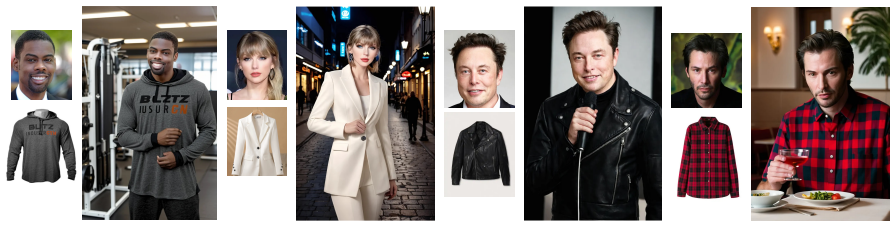
- A user can draft an entire comic by writing a script and supplying one reference photo per character; panel poses are pulled from a retrieval database rather than hand-authored.
- Because face and body features are injected separately, clothing can be swapped without changing identity, enabling costume changes mid-story (the paper demonstrates virtual try-on).
- The approach inherits the pose vocabulary of the retrieval database: more diverse collected actions directly translate into more expressive generated panels.
- The base text-to-image model remains frozen; only a ControlNet branch and a small assignment classifier are trained, making the system cheap to adapt to new backbones.
Reading between the lines
- The multi-subject 'discovery' about IP-Adapter is asserted without a quantitative identity-similarity test; a direct evaluation on pairs of faces with varied poses would tell whether the merging truly keeps each subject matched to its own reference.
- Because the captioning scheme strips appearance words and labels people as 'Character 1, Character 2', the assignment network may effectively learn positional or order-based priors; stories that reorder characters in the prompt could stress-test this.
- If the retrieval database is crawled from the web, the identity encoders carry dataset biases, so consistency may degrade for faces or clothing styles underrepresented online; a curated or synthetic database could mitigate this.
- The system's gesture diversity is bounded by what poses exist in MSDB; generating panels for poses absent from the database would show whether the ControlNet plus retrieval truly generalizes or just copies near neighbors.
Editorial analysis
A structured set of objections, weighed in public.
Referee Report
Summary. RaCig is a system for comic-style image sequence generation that combines retrieval-based character assignment with regional character injection. The paper constructs a dataset (MSDB) of over 110k human action images with pose, segmentation, and captions, and proposes an Action-aware Character Assignment network built on Grounding-DINO plus Harmonious Multi-Subject Injection (HMSI) using IP-Adapter features and ControlNet skeleton conditioning. The manuscript reports qualitative results on personalized generation, virtual try-on, and multi-panel story generation, claiming consistent characters and expressive gestures, with the source code promised for public release.
Significance. If the claimed capability holds, the system would be a useful contribution to personalized storytelling and multi-subject image generation, and the MSDB dataset could support further research. The paper is also honest about the 'discovery' nature of the multi-subject IP-Adapter behavior. However, the manuscript provides no quantitative validation, and the formulation of the core injection module has technical gaps, so the significance cannot currently be assessed from the evidence given.
major comments (5)
- [Section 5.2] The central claim that RaCig 'effectively generates engaging comic narratives with coherent characters and dynamic interactions' is supported only by a handful of qualitative figures. There are no quantitative metrics (e.g., identity similarity, CLIP score, pose accuracy), no comparisons to existing multi-subject personalization methods such as FastComposer, UniPortrait, MoA, or InstantFamily, and no ablations of the retrieval or injection components. Since the abstract makes a strong effectiveness claim, the evidence is insufficient to establish it.
- [Section 4.3.2, Eq. (13)] The addition z_t + f_i^IP + S_nn + c_text is dimensionally inconsistent. z_t is a spatial latent, f_i^IP is an attention output over the latent (matching its spatial dimensions), S_nn is a ControlNet feature map, but c_text is a sequence of text embeddings. Adding a sequence to a spatial feature is not defined without explicit reshaping or projection. This makes the derivation that follows in Eqs. (14)-(18) unverifiable; the authors need to specify how these terms are combined (concatenated, projected, or added after alignment).
- [Section 4.3.2, Eqs. (14)-(18)] The claimed 'harmonious' multi-subject injection does not guarantee per-subject identity localization. IP-Adapter's decoupled cross-attention is global: for each subject i, the reference features affect all spatial queries, not only the masked region. The mask M_nn is applied to the final merged latent after denoising, so at mask boundaries the latent switches between two full-image denoising results, inviting seams and identity blending. No experiment verifies that each character matches its own reference in multi-subject outputs, which is the load-bearing premise for the paper's central claim.
- [Section 5.1 vs. Figure 6] The Action-aware Character Assignment network is described as using a 2-class classifier head ('considering a maximum of 2 characters'), but Story 2 in Figure 6 contains three characters (John, Joker, Annie). The paper does not explain how the network handles three subjects, or whether the story was generated with a different, unreported setting. This internal inconsistency undermines the generality of the central claim and suggests the system may not support the three-character scenario shown.
- [Section 4.3.2, Eq. (14)] The face and body masks used in Eq. (14) come from the retrieved image, but the final generated layout may differ from the retrieved pose due to text-driven variations. The paper does not address this misalignment, which could lead to incorrect feature injection into regions that do not correspond to the character in the generated image. This is a correctness concern for the injection mechanism.
minor comments (5)
- [Section 4.3.1] The phrase 'we employee two independent identity feature extractor' should be 'we employ two independent identity feature extractors'.
- [Section 4.1.2, Eqs. (3)-(4)] The definitions of K, V, K', V' are incomplete: Eq. (4) uses c_t W_k and c_t W_v but does not define W_k, W_v, and Eq. (3) references K' and V' without giving their definitions. Please clarify the notation.
- [Section 4.3.2] The sentence 'together with the skeleton feature, as illustrated in Equation (5)' refers to Equation (5) which describes ControlNet's zero-convolution formulation, not skeleton injection. The cross-reference appears misplaced.
- [Figure 1 caption] The caption text is missing spaces between words; for example, 'Emmameeting Brandtin a bar' should be 'Emma meeting Brandt in a bar'. Please fix the formatting.
- [References] Reference [10] is cited for Stable Diffusion in Section 4.1.1, but the reference is the SDXL paper by Podell et al.; the original LDM paper by Rombach et al. is listed as reference [12]. Please correct the citation mapping.
Circularity Check
No significant circularity: the system combines externally pretrained components and a new dataset; the HMSI 'discovery' is an empirical premise, not a derived prediction.
full rationale
RaCig is a systems paper whose claimed contribution is a pipeline, not a mathematical derivation whose conclusion is equivalent to its inputs. The main steps are retrieval-based drafting (CLIP features, nearest-neighbor selection), action-aware character assignment (Grounding-DINO with a new classifier head), and regional character injection (IP-Adapter features plus ControlNet skeleton conditioning merged by masks in Eq. (18)). Every load-bearing component is either a pretrained external model or trained on the new MSDB; no parameter is fitted to a target quantity that is later announced as a prediction. The HMSI 'discovery' in Section 4.3.2 is an empirical observation about IP-Adapter's behavior, not a result derived from Eqs. (13)-(18), so it is not circular even though it is not quantitatively validated. The masked latent combination is a heuristic, and whether it preserves identity is an empirical question, not a tautology. There are no self-citations used as load-bearing evidence, no imported uniqueness theorems, and no known result merely renamed. The noted weaknesses—global attention affecting masked regions, mask-boundary seams, and the two-class assignment network despite three-character stories—are correctness and robustness concerns, not circularity.
Assumptions & free parameters
free parameters (2)
- Maximum number of characters per image =
2
- Retrieval neighbor count M =
Not reported
assumptions (4)
- domain assumption IP-Adapter, trained on single-subject data, can generate multi-subject images where all subjects match their respective references when multiple reference embeddings are merged in the latent.
- domain assumption The MSDB retrieval database of 110k images and 1,800 verb-subject pairs provides sufficient coverage of daily actions and appearances for the retrieval mechanism.
- ad hoc to paper Grounding-DINO with a 2-class classifier head correctly assigns each character in the prompt to a segmented region in the retrieved image.
- ad hoc to paper Adding IP-Adapter features, skeleton features, and text embeddings directly to the noisy latent as in Equation (13) is a valid way to condition the diffusion process.
Cite this review
Pith. "Pith review of Retrieval Augmented Comic Image Generation." pith.science (2026). https://pith.science/paper/DNH3X6M2
@misc{pith2026250612517,
  author       = {Pith},
  title        = {Pith review of: Retrieval Augmented Comic Image Generation},
  year         = {2026},
  howpublished = {\url{https://pith.science/paper/DNH3X6M2}},
  note         = {Machine review of arXiv:2506.12517}
}
read the original abstract
We present RaCig, a novel system for generating comic-style image sequences with consistent characters and expressive gestures. RaCig addresses two key challenges: (1) maintaining character identity and costume consistency across frames, and (2) producing diverse and vivid character gestures. Our approach integrates a retrieval-based character assignment module, which aligns characters in textual prompts with reference images, and a regional character injection mechanism that embeds character features into specified image regions. Experimental results demonstrate that RaCig effectively generates engaging comic narratives with coherent characters and dynamic interactions. The source code will be publicly available to support further research in this area.
Figures


Figures from the paper (4 more)


Reference graph
Works this paper leans on
-
[1]
Re-imagen: Retrieval-augmented text-to-image gen- erator.arXiv preprint arXiv:2209.14491, 2022
Wenhu Chen, Hexiang Hu, Chitwan Saharia, and William W Cohen. Re-imagen: Retrieval-augmented text-to-image gen- erator.arXiv preprint arXiv:2209.14491, 2022
arXiv 2022
-
[2]
Junjie He, Yifeng Geng, and Liefeng Bo. Unipor- trait: A unified framework for identity-preserving single- and multi-human image personalization.arXiv preprint arXiv:2408.05939, 2024
arXiv 2024
-
[3]
Gabriel Ilharco, Mitchell Wortsman, Nicholas Carlini, Rohan Taori, Achal Dave, Vaishaal Shankar, Hongseok Namkoong, John Miller, Hannaneh Hajishirzi, Ali Farhadi, and Ludwig Schmidt. Open clip, 7 2021
work page 2021
-
[4]
Sapiens: Foundation for human vision models
Rawal Khirodkar, Timur Bagautdinov, Julieta Martinez, Su Zhaoen, Austin James, Peter Selednik, Stuart Anderson, and Shunsuke Saito. Sapiens: Foundation for human vision models. InEuropean Conference on Computer Vision, pages 206–228. Springer, 2024
work page 2024
-
[5]
Chanran Kim, Jeongin Lee, Shichang Joung, Bongmo Kim, and Yeul-Min Baek. Instantfamily: Masked attention for zero-shot multi-id image generation.arXiv preprint arXiv:2404.19427, 2024
arXiv 2024
-
[6]
Grounding dino: Marrying dino with grounded pre-training for open-set object detection
Shilong Liu, Zhaoyang Zeng, Tianhe Ren, Feng Li, Hao Zhang, Jie Yang, Qing Jiang, Chunyuan Li, Jianwei Yang, Hang Su, et al. Grounding dino: Marrying dino with grounded pre-training for open-set object detection. InEuropean Con- ference on Computer Vision, pages 38–55. Springer, 2024
work page 2024
-
[7]
Dpm-solver: A fast ode solver for diffusion probabilistic model sampling in around 10 steps.Advances in Neural Information Processing Systems, 35:5775–5787, 2022
Cheng Lu, Yuhao Zhou, Fan Bao, Jianfei Chen, Chongxuan Li, and Jun Zhu. Dpm-solver: A fast ode solver for diffusion probabilistic model sampling in around 10 steps.Advances in Neural Information Processing Systems, 35:5775–5787, 2022
2022
-
[8]
Rtmo: towards high-performance one-stage real-time multi-person pose estimation
Peng Lu, Tao Jiang, Yining Li, Xiangtai Li, Kai Chen, and Wenming Yang. Rtmo: towards high-performance one-stage real-time multi-person pose estimation. InProceedings of the IEEE/CVF conference on computer vision and pattern recognition, pages 1491–1500, 2024
work page 2024
Show all 19 references
-
[9]
Gpt-4o system card, 2024
OpenAI. Gpt-4o system card, 2024. URL https:// arxiv.org/abs/2410.21276
2024 arXiv
-
[10]
Sdxl: Improving latent diffusion models for high-resolution image synthesis.arXiv preprint arXiv:2307.01952, 2023
Dustin Podell, Zion English, Kyle Lacey, Andreas Blattmann, Tim Dockhorn, Jonas Müller, Joe Penna, and Robin Rombach. Sdxl: Improving latent diffusion models for high-resolution image synthesis.arXiv preprint arXiv:2307.01952, 2023
2023 arXiv
-
[11]
Learning transferable visual models from natural language supervision, 2021
Alec Radford, Jong Wook Kim, Chris Hallacy, Aditya Ramesh, Gabriel Goh, Sandhini Agarwal, Girish Sastry, Amanda Askell, Pamela Mishkin, Jack Clark, Gretchen Krueger, and Ilya Sutskever. Learning transferable visual models from natural language supervision, 2021
2021
-
[12]
High-resolution image synthesis with latent diffusion models
Robin Rombach, Andreas Blattmann, Dominik Lorenz, Patrick Esser, and Björn Ommer. High-resolution image synthesis with latent diffusion models. InCVPR, pages 10684– 10695, 2022
2022
-
[13]
Knn- diffusion: Image generation via large-scale retrieval.arXiv preprint arXiv:2204.02849, 2022
Shelly Sheynin, Oron Ashual, Adam Polyak, Uriel Singer, Oran Gafni, Eliya Nachmani, and Yaniv Taigman. Knn- diffusion: Image generation via large-scale retrieval.arXiv preprint arXiv:2204.02849, 2022
2022 arXiv
-
[14]
Fairrag: Fair human generation via fair retrieval augmentation
Robik Shrestha, Yang Zou, Qiuyu Chen, Zhiheng Li, Yusheng Xie, and Siqi Deng. Fairrag: Fair human generation via fair retrieval augmentation. InProceedings of the IEEE/CVF Conference on Computer Vision and Pattern Recognition, pages 11996–12005, 2024
2024
-
[15]
Moa: Mixture-of-attention for subject-context disentanglement in personalized image generation
Kuan-Chieh Wang, Daniil Ostashev, Yuwei Fang, Sergey Tulyakov, and Kfir Aberman. Moa: Mixture-of-attention for subject-context disentanglement in personalized image generation. InSIGGRAPH Asia 2024 Conference Papers, pages 1–12, 2024
2024
-
[16]
Instantid: Zero-shot identity-preserving generation in seconds.arXiv preprint arXiv:2401.07519, 2024
Qixun Wang, Xu Bai, Haofan Wang, Zekui Qin, and Anthony Chen. Instantid: Zero-shot identity-preserving generation in seconds.arXiv preprint arXiv:2401.07519, 2024
2024 arXiv
-
[17]
Fastcomposer: Tuning-free multi- subject image generation with localized attention.Interna- tional Journal of Computer Vision, pages 1–20, 2024
Guangxuan Xiao, Tianwei Yin, William T Freeman, Frédo Durand, and Song Han. Fastcomposer: Tuning-free multi- subject image generation with localized attention.Interna- tional Journal of Computer Vision, pages 1–20, 2024. Walking on the StreetCooking in the kitchenJumping to th...
2024
-
[18]
Ip- adapter: Text compatible image prompt adapter for text-to- image diffusion models.arXiv preprint arXiv:2308.06721, 2023
Hu Ye, Jun Zhang, Sibo Liu, Xiao Han, and Wei Yang. Ip- adapter: Text compatible image prompt adapter for text-to- image diffusion models.arXiv preprint arXiv:2308.06721, 2023
2023 arXiv
-
[19]
Adding conditional control to text-to-image diffusion models, 2023
Lvmin Zhang, Anyi Rao, and Maneesh Agrawala. Adding conditional control to text-to-image diffusion models, 2023. Bellapulls a suitcase holds a heavy bag on the shoulderBellawalks into school, Edwardwalks in front of BellaEdwardstands in sunlight filtering through the leavesEdw...
2023
Reviewed August 7, 2026 · model on record in the stance chip above.
Discussion (0). Sign in to comment.