REVIEW 5 major objections 5 minor 2 cited by
A Gradient Meta-Learning Joint Optimization for Beamforming and Antenna Position in Pinching-Antenna Systems
T0 review · 5 major / 5 minor · reviewed 2026-08-07 · deepseek-v4-flash
Pith's one-line read A gradient meta-learning joint optimizer for pinching-antenna systems is claimed to push weighted sum rate 32.7% above alternating optimization with roughly tenfold lower computation.
desk verdict Plausible learned optimizer for pinching-antenna WSR, but the headline gain over AO is internally inconsistent and the evaluation lacks a held-out test set, so the key performance claims need verification. read the letter →
The pith
A machine-rendered reading of the paper's core claim, the machinery that carries it, and where it could break.
The reading
What carries the argument
The load-bearing mechanism is a two-network gradient meta-learning loop with a three-layer nesting. The beamforming network and the antenna-position network are unfolded gradient-descent solvers: each takes a real-valued gradient vector of its subproblem objective, passes it through three linear layers with ELU and tanh activations, and outputs a bounded update step. The inner loop alternates the two networks to update beamforming vectors and positions; the middle loop accumulates the per-channel negative WSR loss; the outer loop updates the network parameters with Adam on the average loss across channel sub-tasks. The convexification that makes the gradients well-defined is the auxiliary-variable transformation of the WSR objective in Theorems 1 and 2, the first-order Taylor expansions of $\sqrt{G_m}$ and $I_m$ in (27)--(28), and the quadratic penalty in (33) for the SINR constraints.
What would settle it
Run GML-JO on a fixed channel from 100 random initial antenna coordinates and beamformer settings, then check the spread of final WSR values and whether every returned point satisfies the per-user SINR constraints (6d); the claim would be falsified if the WSR spread matches the roughly 15% fluctuations reported for AO, or if the returned solutions routinely violate the SINR constraints even after the penalty term has converged.
Extended reading notes
Core claim
The paper's central claim is that joint downlink beamforming and pinching-antenna position design for weighted sum rate maximization can be handled by a gradient meta-learning loop instead of conventional alternating optimization. The original nonconvex problem is rewritten through an auxiliary-variable Lagrangian transform and a quadratic transform, then the beamforming and position subproblems are convexified by first-order Taylor expansion and a quadratic SINR penalty. Two gradient-input unfolded neural networks, one for beamforming and one for antenna position, compute the subproblem updates, and across multiple channel realizations treated as sub-tasks, the average negative-WSR loss is minimized with Adam to update the network parameters. The authors report that this yields a solution robust to initialization, reaches 5.6 bits/s/Hz WSR in 100 iterations, improves WSR by 32.7% over the AO benchmark, approaches the exhaustive-search bound for small user counts, and runs more than ten times faster than AO.
Load-bearing premise
The whole result depends on the assumption that the simplified, penalty-based versions of the optimization problem behave like the real one, so that many gradient steps on them lead to a solution that is both near-optimal and respects the users' quality-of-service requirements, yet the paper supplies no proof of convergence or optimality.
Editorial extensions
If this is right
- If GML-JO works as reported, joint beamforming and position optimization for pinching-antenna downlinks no longer needs to be re-solved from scratch per channel; one meta-trained network pair applies across channel sub-tasks.
- The reported 32.7% WSR gain over AO and more than tenfold CPU-time reduction imply that the main practical bottleneck for pinching-antenna optimization shifts from per-instance computation to training data and network capacity.
- The reported robustness to initialization means system operators could start from arbitrary antenna placements without the WSR fluctuations of up to 15% that the paper attributes to AO under different initial coordinates.
- For two users and two waveguides, the algorithm's WSR nearly matches the exhaustive-search upper bound, suggesting that in small configurations the meta-learning optimizer is effectively finding the global optimum despite the non-convexity.
Reading between the lines
- The averaging over channel sub-tasks suggests a transfer-learning property the paper does not test: after meta-training, the networks may need only a few inner-loop updates on an unseen channel, which would make GML-JO an online optimizer rather than a per-channel solver.
- A natural stress test is to re-weight the average loss toward channel realizations where the AO baseline performs worst; if the robustness claim is real, worst-case WSR should improve more than average WSR.
- Because gradient-input unfolding does not depend on the pinching-antenna channel formula beyond its position-dependent phase, the same two-network meta-learning structure could be applied to fluid- or movable-antenna systems with coupled position and beamforming variables.
- The paper reports no final check of the per-user SINR constraints (6d); an implementation-level extension would be to add a feasibility-restoration projection and report constraint-violation statistics, since the current projection only enforces the total power constraint.
Editorial analysis
A structured set of objections, weighed in public.
Referee Report
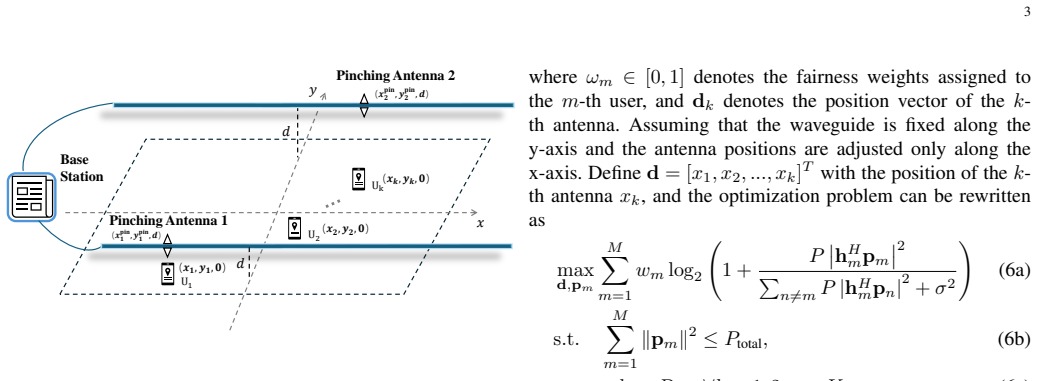
Summary. This paper studies weighted sum-rate (WSR) maximization for a downlink multi-waveguide pinching-antenna system, jointly optimizing beamforming coefficients and continuous antenna positions under a total power constraint and per-user SINR constraints. The authors transform the non-convex problem using a Lagrangian dual transformation (Theorem 1) and a quadratic transform (Theorem 2), then propose a gradient meta-learning joint optimization (GML-JO) algorithm in which two unfolded neural networks, a beamforming network and an antenna position network, are trained over multiple channel realizations treated as sub-tasks. The paper claims 5.6 bits/s/Hz within 100 iterations, a 32.7% gain over alternating optimization, reduced computational complexity, and robustness to initialization.
Significance. The equivalence transformations in Theorems 1 and 2 are correctly derived, and the idea of averaging the loss over channel sub-tasks to obtain initialization robustness is reasonable; the CPU-time comparison in Fig. 10 is also a useful practical element. However, the central performance claims are not currently supported: the gain over AO is stated inconsistently (32.7% vs. 16.7%), the first-order expansion in Eq. (27) is incorrect, and no feasibility or convergence guarantee is provided for the QoS-constrained problem. These load-bearing issues must be resolved before the numerical claims can be accepted, so the paper is best characterized as a promising but currently unverified heuristic optimization framework.
major comments (5)
- [Abstract, Section V.B, Fig. 4] The headline performance claim is internally inconsistent. The abstract and conclusion state a 32.7% performance enhancement over conventional AO, whereas Section V.B, in the text accompanying Fig. 4, states that the WSR of GML-JO is enhanced by 30.2% and 16.7% compared to the GD method and the AO method, respectively. Section V.A (Fig. 3) additionally reports a 5.7% gain over GML and a 24.4% gain over ET-CA, and the 32.7% figure does not appear in the simulation section at all. Please reconcile these numbers and state precisely the operating point (SNR, numbers of users and waveguides, iteration count, and whether the result is on training or test channels) to which the abstract claim refers.
- [Eq. (27)] The first-order Taylor expansion of sqrt(G_m) in Eq. (27) is not correct. For G_m = |h_m^H p_m|^2, the linearization at p_m^{(t)} is sqrt(G_m) approximately sqrt(G_m^{(t)}) + Re[(p_m^{(t)})^H h_m h_m^H (p_m - p_m^{(t)})] / sqrt(G_m^{(t)}) when the denominator is nonzero, not sqrt(G_m^{(t)}) + (1/(2 sqrt(G_m^{(t)}))) Re[h_m^H (p_m - p_m^{(t)})]. The missing factor (p_m^{(t)})^H h_m changes the surrogate objective (29), the gradient in (36), and therefore the input and training of the beamforming network. Since the proposed algorithm is built on this surrogate, the correctness of Eq. (27) is load-bearing and must be fixed.
- [Section IV.C, Eqs. (33), (38), (56)] No guarantee is provided that the output of GML-JO is feasible for the original problem (6). The projection (38) enforces only the total power constraint (6b); the per-user SINR constraints (6d) enter only through the penalty term V_m in (33), and this penalty is based on the linearized interference (35), not on the exact SINR. Moreover, the meta-learning loss (56) is the negative WSR without any penalty for SINR violations, so the meta-updates (58)-(59) do not train toward constraint satisfaction. Please report the worst-case or average SINR constraint violation of the returned solution, and provide a convergence or optimality argument for the penalized surrogate if such a claim is intended.
- [Section V, Figs. 5, 8, 9] The 'Exhaustive' baseline used to claim that GML-JO 'closely approaches the theoretical upper limit' is not defined. Since the antenna positions d_k are continuous variables, an exhaustive search requires a discretization grid; the grid resolution and the treatment of the beamforming variables in that search are not specified. Without this information, the near-optimality claim cannot be assessed.
- [Section V.A, Algorithm 1] The evaluation protocol is ambiguous. The simulations set 500 iterations for sub-task computation and 50 channels, but the abstract claims convergence within 100 iterations and Fig. 4 plots WSR against 500 iterations. It is unclear whether the reported 5.6 bits/s/Hz is the WSR at inner-loop iteration 100 of a single run, the average over the 50 sub-tasks after meta-training, or the best value over the outer loop. Please specify the exact protocol and provide separate results on channels not used for meta-training, because no train/test split is described and the same WSR objective is used as both training loss and evaluation metric.
minor comments (5)
- [Section III.B, after (31)] The statement that problem (31) is a convex optimization problem is not justified, since constraint (30) is of the form convex function >= linear function, which does not define a convex feasible set; please correct or clarify.
- [Section V.A, Eqs. (37), (41)] The learning rates are denoted eta for p and alpha for d in Section III, but Section V.A introduces eta_D and eta_p; please unify the notation.
- [Section V.C, Fig. 10] The sentence 'GML-JO has more than 10 times the speedup of the AO' is stronger than the figure text reports; please state the measured speedup range and the configuration at which it is achieved.
- [Throughout] There are typos such as 'the the beamforming coefficient', 'sovled', 'activates', and 'optimizatio', and the symbols N and K appear to be used interchangeably in the caption of Fig. 10; a careful copy edit is needed.
- [Section V.A, Appendix A] The ET-CA baseline uses CVX, but no solver, tolerance, or stopping criterion is given; please provide implementation details for reproducibility.
Circularity Check
No significant circularity: GML-JO is evaluated against external baselines and its equivalence transforms are exact; the reported WSR is an optimization objective, not a derivation from its own inputs.
full rationale
The paper's derivation chain is an algorithmic construction rather than a derivation of an output from its own assumptions. Theorems 1 and 2 (Eqs. (7) and (14)) are exact auxiliary-variable rewrites of the WSR objective using standard Lagrangian/quadratic transforms with external references, not self-citations. The convex approximations in (27)-(28) and the penalty relaxation in (33) are explicitly presented as approximations; even if their convergence to the original problem (6) is not proven, that is a correctness and optimality gap, not a circularity. The GML-JO networks are trained using the average negative WSR as the loss (Eqs. (56)-(57)) and evaluated by the same WSR metric; this means the reported 5.6 bits/s/Hz and the 32.7% improvement over AO are training-set performance figures with no described train/test split, but using the optimized objective as the reported metric is standard for an optimization paper and does not make the result equal to the input by construction. The baselines (GML, ET-CA, AO, GD, exhaustive search) provide external comparisons, and no load-bearing uniqueness theorem or core premise is imported solely from the authors' prior work. The internally inconsistent gain figures (32.7% in the abstract vs 16.7% in Section V.B) and the undefined exhaustive-search baseline are evidence-quality issues, not circularity. No definitional, self-citation, or renamed-known-result circularity is present.
Assumptions & free parameters
free parameters (4)
- Neural network weights and biases of BN and AN =
not reported
- Penalty factor mu =
not reported
- Learning rates for antenna and beamforming networks =
5e-4 and 2e-4
- Inner iteration count N_i =
500
assumptions (4)
- standard math Lagrangian dyadic transformation in Theorem 1 and quadratic transform in Theorem 2 are valid for all SINR values.
- domain assumption The channel model in (2) accurately describes pinching-antenna propagation with in-waveguide and free-space phase terms.
- ad hoc to paper The first-order Taylor expansions in (27) and (28) provide a valid surrogate for the non-convex objective.
- ad hoc to paper The quadratic penalty method in (33) yields feasible solutions after normalization by (38).
Cite this review
Pith. "Pith review of A Gradient Meta-Learning Joint Optimization for Beamforming and Antenna Position in Pinching-Antenna Systems." pith.science (2026). https://pith.science/paper/CAWITRWO
@misc{pith2026250612583,
  author       = {Pith},
  title        = {Pith review of: A Gradient Meta-Learning Joint Optimization for Beamforming and Antenna Position in Pinching-Antenna Systems},
  year         = {2026},
  howpublished = {\url{https://pith.science/paper/CAWITRWO}},
  note         = {Machine review of arXiv:2506.12583}
}
read the original abstract
In this paper, we consider a novel optimization design for multi-waveguide pinching-antenna systems, aiming to maximize the weighted sum rate (WSR) by jointly optimizing beamforming coefficients and antenna position. To handle the formulated non-convex problem, a gradient-based meta-learning joint optimization (GML-JO) algorithm is proposed. Specifically, the original problem is initially decomposed into two sub-problems of beamforming optimization and antenna position optimization through equivalent substitution. Then, the convex approximation methods are used to deal with the nonconvex constraints of sub-problems, and two sub-neural networks are constructed to calculate the sub-problems separately. Different from alternating optimization (AO), where two sub-problems are solved alternately and the solutions are influenced by the initial values, two sub-neural networks of proposed GML-JO with fixed channel coefficients are considered as local sub-tasks and the computation results are used to calculate the loss function of joint optimization. Finally, the parameters of sub-networks are updated using the average loss function over different sub-tasks and the solution that is robust to the initial value is obtained. Simulation results demonstrate that the proposed GML-JO algorithm achieves 5.6 bits/s/Hz WSR within 100 iterations, yielding a 32.7\% performance enhancement over conventional AO with substantially reduced computational complexity. Moreover, the proposed GML-JO algorithm is robust to different choices of initialization and yields better performance compared with the existing optimization methods.
Figures


Figures from the paper (3 more)


Forward citations
Cited by 2 Pith papers
-
Pinching-Antenna System Design with LoS Blockage: Does In-Waveguide Attenuation Matter?
Under realistic LoS blockage, ignoring in-waveguide attenuation costs only about α^2/(β ln2) bps/Hz in large dense-blockage areas, but the loss grows with area squared when blockages are sparse.
-
Pinching-Antenna Systems with In-Waveguide Attenuation: Performance Analysis and Algorithm Design
Pinching-antenna placement must trade free-space path loss against exponential in-waveguide attenuation; the paper gives a closed-form single-user solution and a rate-loss approximation, then extends to multi-user bea...
Reference graph
Works this paper leans on
-
[1]
S. K. Sharma and X. Wang, “Toward massive machine type communi- cations in ultra-dense cellular IoT networks: Current issues and machine learning-assisted solutions,”IEEE Communications Surveys & Tutorials, vol. 22, no. 1, pp. 426–471, 2019
work page 2019
-
[2]
6G Hyper Reliable and Low-latency Communication - Requirement Analysis and Proof of Concept,
T. Tao, Y . Wang, D. Li, Y . Wan, P. Baracca, and A. Wang, “6G Hyper Reliable and Low-latency Communication - Requirement Analysis and Proof of Concept,” in98th IEEE Vehicular Technology Conference, VTC Fall 2023, Hong Kong, SAR, China, October 10-13, 2023. IEEE, 2023, pp. 1–5. [Online]. Available: https: //doi.org/10.1109/VTC2023-Fall60731.2023.10333792
arXiv 2023
-
[3]
3GPP Evolution from 5G to 6G: A 10-year retrospective,
X. Lin, “3GPP Evolution from 5G to 6G: A 10-year retrospective,”arXiv preprint arXiv:2412.21077, 2024
arXiv 2024
-
[4]
On the road to 6G: Visions, requirements, key technologies, and testbeds,
C.-X. Wang, X. You, X. Gao, X. Zhu, Z. Li, C. Zhang, H. Wang, Y . Huang, Y . Chen, H. Haaset al., “On the road to 6G: Visions, requirements, key technologies, and testbeds,”IEEE Communications Surveys & Tutorials, vol. 25, no. 2, pp. 905–974, 2023. 12
work page 2023
-
[5]
Key focus areas and enabling technologies for 6G,
C. G. Brinton, M. Chiang, K. T. Kim, D. J. Love, M. Beesley, M. Repeta, J. Roese, P. Beming, E. Ekudden, C. Liet al., “Key focus areas and enabling technologies for 6G,”IEEE Communications Magazine, vol. 63, no. 3, pp. 84–91, 2025
2025
-
[6]
Noncooperative cellular wireless with unlimited num- bers of base station antennas,
T. L. Marzetta, “Noncooperative cellular wireless with unlimited num- bers of base station antennas,”IEEE transactions on wireless communi- cations, vol. 9, no. 11, pp. 3590–3600, 2010
2010
-
[7]
Massive MIMO for next generation wireless systems,
E. G. Larsson, O. Edfors, F. Tufvesson, and T. L. Marzetta, “Massive MIMO for next generation wireless systems,”IEEE communications magazine, vol. 52, no. 2, pp. 186–195, 2014
work page 2014
-
[8]
Y . Xu, E. G. Larsson, E. A. Jorswieck, X. Li, S. Jin, and T.-H. Chang, “Distributed signal processing for extremely large-scale antenna array systems: State-of-the-art and future directions,”IEEE Journal of Selected Topics in Signal Processing, vol. 19, no. 2, pp. 304–330, 2025
work page 2025
Show all 31 references
-
[9]
Exploiting the Preferred Domain of FDD Massive MIMO Systems with Uniform Planar Arrays,
J. Choi, T. Kim, D. J. Love, and J.-y. Seol, “Exploiting the Preferred Domain of FDD Massive MIMO Systems with Uniform Planar Arrays,” in2015 IEEE International Conference on Communications (ICC). IEEE, 2015, pp. 1465–1470
2015
-
[10]
A tutorial on extremely large-scale MIMO for 6G: Fundamentals, signal processing, and applications,
Z. Wang, J. Zhang, H. Du, D. Niyato, S. Cui, B. Ai, M. Debbah, K. B. Letaief, and H. V . Poor, “A tutorial on extremely large-scale MIMO for 6G: Fundamentals, signal processing, and applications,”IEEE Communications Surveys & Tutorials, vol. 26, no. 3, pp. 1560–1605, 2024
2024
-
[11]
Extremely Large-scale MIMO: Fundamentals, challenges,
Z. Wang, J. Zhang, H. Du, W. Sha, B. Ai, D. Niyato, and M. Debbah, “Extremely Large-scale MIMO: Fundamentals, challenges,”Solutions, and Future Directions. arXiv, 2022
2022
-
[12]
Fluid Antenna Systems enabling 6G: Principles, Applications, and Research Directions,
T. Wu, K. Zhi, J. Yao, X. Lai, J. Zheng, H. Niu, M. Elkashlan, K.-K. Wong, C.-B. Chae, Z. Dinget al., “Fluid Antenna Systems enabling 6G: Principles, Applications, and Research Directions,”arXiv preprint arXiv:2412.03839, 2024
2024 arXiv
-
[13]
Modeling and performance analysis for movable antenna enabled wireless communications,
L. Zhu, W. Ma, and R. Zhang, “Modeling and performance analysis for movable antenna enabled wireless communications,”IEEE Transactions on Wireless Communications, vol. 23, no. 6, pp. 6234–6250, 2023
2023
-
[14]
Pinching antenna—using a dielectric waveguide as an antenna,
A. Fukuda, H. Yamamoto, H. Okazaki, Y . Suzuki, and K. Kawai, “Pinching antenna—using a dielectric waveguide as an antenna,” NTT DOCOMO Technical Journal, vol. 23, no. 3, pp. 5–12, Jan
-
[15]
Flexible-antenna systems: A pinching-antenna perspective,
Z. Ding, R. Schober, and H. V . Poor, “Flexible-antenna systems: A pinching-antenna perspective,”IEEE Transactions on Communications, 2025
2025
-
[16]
Historical review of fluid antenna and movable antenna,
L. Zhu and K.-K. Wong, “Historical review of fluid antenna and movable antenna,”arXiv preprint arXiv:2401.02362, 2024
2024 arXiv
-
[17]
Pinching antennas: Principles, applica- tions and challenges,
Z. Yang, N. Wang, Y . Sun, Z. Ding, R. Schober, G. K. Karagiannidis, V . W. Wong, and O. A. Dobre, “Pinching antennas: Principles, applica- tions and challenges,”arXiv preprint arXiv:2501.10753, 2025
2025 arXiv
-
[18]
Pinching antenna systems (PASS): Architecture designs, opportunities, and out- look,
Y . Liu, Z. Wang, X. Mu, C. Ouyang, X. Xu, and Z. Ding, “Pinching antenna systems (PASS): Architecture designs, opportunities, and out- look,”arXiv preprint arXiv:2501.18409, 2025
2025 arXiv
-
[19]
LoS blockage in pinching-antenna systems: Curse or blessing?
Z. Ding and H. V . Poor, “LoS blockage in pinching-antenna systems: Curse or blessing?”arXiv preprint arXiv:2503.08554, 2025
2025 arXiv
-
[20]
Modeling and Beam- forming Optimization for Pinching-Antenna Systems,
Z. Wang, C. Ouyang, X. Mu, Y . Liu, and Z. Ding, “Modeling and Beam- forming Optimization for Pinching-Antenna Systems,”arXiv preprint arXiv:2502.05917, 2025
2025 arXiv
-
[21]
Rate maximization for downlink pinching-antenna systems,
Y . Xu, Z. Ding, and G. K. Karagiannidis, “Rate maximization for downlink pinching-antenna systems,”IEEE Wireless Communications Letters, 2025
2025
-
[22]
Pinching-Antenna Systems (PASS): Power Radiation Model and Optimal Beamforming Design,
X. Xu, X. Mu, Z. Wang, Y . Liu, and A. Nallanathan, “Pinching-Antenna Systems (PASS): Power Radiation Model and Optimal Beamforming Design,”arXiv preprint arXiv:2505.00218, 2025
2025 arXiv
-
[23]
Two-Timescale Joint Trans- mit and Pinching Beamforming for Pinching-Antenna Systems,
L. Zhang, X. Mu, A. Liu, and Y . Liu, “Two-Timescale Joint Trans- mit and Pinching Beamforming for Pinching-Antenna Systems,”arXiv preprint arXiv:2504.16099, 2025
2025 arXiv
-
[24]
QoS-aware NOMA design for downlink pinching-antenna systems,
Y . Xu, Z. Ding, D. Cai, and V . W. Wong, “QoS-aware NOMA design for downlink pinching-antenna systems,”arXiv preprint arXiv:2504.13723, 2025
2025 arXiv
-
[25]
Pinching-Antenna Systems (PASS) Aided Over-the-air Computation,
Z. Lyu, H. Li, Y . Gao, M. Xiao, and H. V . Poor, “Pinching-Antenna Systems (PASS) Aided Over-the-air Computation,”arXiv preprint arXiv:2505.07559, 2025
2025 arXiv
-
[26]
GPASS: Deep Learning for Beamforming in Pinching-Antenna Systems (PASS),
J. Guo, Y . Liu, and A. Nallanathan, “GPASS: Deep Learning for Beamforming in Pinching-Antenna Systems (PASS),”arXiv preprint arXiv:2502.01438, 2025
2025 arXiv
-
[27]
Channel estimation for pinching-antenna systems (PASS),
J. Xiao, J. Wang, and Y . Liu, “Channel estimation for pinching-antenna systems (PASS),”arXiv preprint arXiv:2503.13268, 2025
2025 arXiv
-
[28]
Channel estimation for mmwave pinching-antenna systems,
G. Zhou, V . Papanikolaou, Z. Ding, and R. Schober, “Channel estimation for mmwave pinching-antenna systems,”arXiv preprint arXiv:2504.09317, 2025
2025 arXiv
-
[29]
Discerning and enhancing the weighted sum-rate maximization algorithms in commu- nications,
Z. Zhang, Z. Zhao, K. Shen, D. P. Palomar, and W. Yu, “Discerning and enhancing the weighted sum-rate maximization algorithms in commu- nications,”arXiv preprint arXiv:2311.04546, 2023
2023 arXiv
-
[30]
Fractional programming for communication systems—part i: Power control and beamforming,
K. Shen and W. Yu, “Fractional programming for communication systems—part i: Power control and beamforming,”IEEE Transactions on Signal Processing, vol. 66, no. 10, pp. 2616–2630, 2018
2018
-
[2022]
Available: https://www.docomo.ne.jp/english/corporate/ technology/rd/technical journal/bn/vol23 3/
[Online]. Available: https://www.docomo.ne.jp/english/corporate/ technology/rd/technical journal/bn/vol23 3/
Reviewed August 7, 2026 · model on record in the stance chip above.
Discussion (0). Sign in to comment.