REVIEW 5 major objections 6 minor 50 references
INTERPOS: Interaction Rhythm Guided Positional Morphing for Mobile App Recommender Systems
T0 review · 5 major / 6 minor · reviewed 2026-08-07 · deepseek-v4-flash
Pith's one-line read INTERPOS fuses a user's interaction time gaps into positional embeddings, and across seven mobile app datasets its three fusion variants outperform sequential and time-aware baselines on NDCG@K and HIT@K.
desk verdict New idea for time-aware sequential recommendation, but evaluation needs a permutation control and the arithmetic doesn't add up. read the letter →
The pith
A machine-rendered reading of the paper's core claim, the machinery that carries it, and where it could break.
The reading
What carries the argument
The central object is the rhythm embedding layer $f_\Omega$, which maps each inter-interaction interval $\Delta t_i$ to a vector $R_i$, together with a fusion function that combines the position embedding $\Theta$ with the rhythm embedding $\Omega$. The paper names three fusion strategies: basic fusion ($M = \Theta + \Omega$), MLP fusion ($M = h([\Theta,\Omega])$ with $h: \mathbb{R}^{2d} \to \mathbb{R}^d$), and gated fusion ($M = W \odot \tanh(h_p(\Theta)) + (1-W) \odot \tanh(h_r(\Omega))$, where $W = \sigma(h_c([\Theta,\Omega]))$). The morphed position embeddings $M$ replace $\Theta$ in the input to self-attention, so the mechanism's work is to expose the self-attention layers to elapsed-time information one step earlier than interval-aware attention baselines do.
What would settle it
Retrain any INTERPOS variant on the same seven splits after replacing each user's inter-interaction gaps with gaps drawn from other users' histories, keeping the rhythm embedding table and fusion-layer sizes identical; if NDCG@20 stays within noise of the reported values, the rhythm content itself is not what drives the improvement.
Extended reading notes
Core claim
On the paper's own terms, the discovery is that a user's interaction rhythm—the sequence of inter-interaction intervals $\Delta t_i = t_i - t_{i-1}$ over an activity window—is a learnable signal that can be fused with absolute position embeddings to make a transformer-based sequential recommender predict the next app more accurately. Rather than making attention itself time-aware, as interval-aware baselines do, INTERPOS injects the rhythm at the input embedding layer, producing morphed position embeddings $M$ that replace the standard position term in $E = \Psi + \Theta$. The paper claims this early fusion captures the long, irregular gaps typical of mobile app usage and consistently outperforms all baselines on seven datasets, with relative improvements in NDCG@10 as large as 157–158% over the best baseline on the Action category.
Load-bearing premise
The paper assumes the measured gains come from the time-gap information itself, rather than from the extra rhythm embedding table and fusion layers, because no equal-capacity control without rhythm information is evaluated.
Editorial extensions
If this is right
- On the six sparse MobileRec category datasets, the LightSANs-based INTERPOS variants produce the largest relative gains, with NDCG@10 improvements of 157–158% over the best baseline on Action.
- On the full 48-category MobileRec dataset, gains are smaller but still consistent: INTERPOS-GF improves NDCG@10 by 8.04% and HIT@10 by 12.20% over SASRec.
- Because INTERPOS fuses rhythm before self-attention, the same morphed-embedding mechanism can be added to other autoregressive transformer recommenders without changing their attention layers.
- Across datasets there is no single winning fusion strategy, so the choice among basic, MLP, and gated fusion should depend on the data distribution and the evaluation metric.
Reading between the lines
- Beyond the paper's experiments, the same embedding-stage fusion should transfer to other domains with irregular inter-event times, such as news reading, health tracking, or financial transactions, where order-only positional encodings are equally blind to elapsed time.
- Beyond the paper's reported datasets, the gap between the huge relative gains on short category sequences and the modest gains on full MobileRec suggests the benefit scales with sequence sparsity, which could be tested by varying the maximum sequence length and the gap distribution.
- Beyond the paper's choices, a continuous rhythm encoding could replace the clipped lookup table (category gaps normalized by 0.2, MobileRec gaps clipped at 800) to test whether the model exploits fine-grained interval differences or just a few coarse regimes.
Editorial analysis
A structured set of objections, weighed in public.
Referee Report
Summary. The paper proposes INTERPOS, a family of positional-morphing strategies that inject user interaction rhythm (time gaps between consecutive interactions) into the position embeddings of autoregressive Transformer-based sequential recommenders. Three fusion mechanisms are introduced: basic additive fusion (BF), MLP-based fusion (MF), and gated fusion (GF). INTERPOS is integrated into LightSANs and SASRec and evaluated on seven mobile app recommendation datasets (six category subsets of MobileRec plus the full MobileRec) using NDCG@K and HIT@K. The authors report large relative gains over strong sequential and time-aware baselines, and they release the source code.
Significance. If the reported gains are attributable to the rhythm signal, the paper would make a useful contribution: it demonstrates that temporal gap information is better injected at the embedding layer for sparse, slow-paced mobile app interaction sequences, where existing time-aware self-attention mechanisms underperform. The work also extends evaluation to a relatively underexplored domain. The paper provides open-source code, evaluates on seven datasets including a large-scale dataset, and includes time-aware baselines such as TiSASRec and FEARec, which is commendable. However, the central interpretation—that the improvements are driven by rhythm information rather than by added model capacity—is not yet supported by the experimental design.
major comments (5)
- [Section V, 'Summary of Results' and Section IV.A] The central claim that interaction rhythm drives the large improvements is not isolated from the increase in model capacity. Every INTERPOS variant adds parameters beyond the base model: a rhythm embedding table whose size depends on the maximum normalized time gap, and for MF and GF one or more MLP/gating layers. The baselines do not have these parameters. Report a capacity-matched control, for example by permuting the Δt values within each user sequence while keeping the architecture and parameter count identical. If performance remains at the reported INTERPOS level after permutation, the gains cannot be attributed to rhythm; if it drops to the base LightSANs/SASRec level, the rhythm signal is shown to be load-bearing. Also test an equal-capacity variant that replaces the rhythm embedding table with a randomly initialized learnable table independent of Δt.
- [Section IV.A and Section V, 'Summary of Results'] If the authors keep the significance claim, they must report the test procedure and the resulting p-values; otherwise the claim is unverifiable.
- [Section V, 'Performance on RolePlaying dataset' and Section I] These inconsistencies undermine the reader's ability to trust the quantitative claims, even though the direction of the results is consistent.
- [Section IV.A, 'Experimental Setup'] This is important because the method is specifically about temporal gaps; a non-chronological split could artificially favor models that use time information.
- [Section IV.A, last paragraph] The normalization factor (0.2) and clipping threshold (800) for the interaction rhythm are chosen constants, and no sensitivity analysis is provided. The paper should report how performance varies with these hyperparameters over a reasonable range, since they directly control the granularity of the rhythm embedding space. Without this analysis, the robustness of the method to these two free parameters is unclear.
minor comments (6)
- [Section II] In the definition of absolute positions, the set is written as P = {P1, P1, ..., Pn}, where 'P1' is repeated; this appears to be a typo for P2.
- [Section IV.B] The list of selected categories reads 'including (Action, RolePlaying, Puzzle, Casual, Simulation, Strategy, and Simulation)' — 'Simulation' is listed twice; the set of six categories plus the full MobileRec should be stated correctly.
- [Section V, 'Performance on Casual dataset'] There is a typo 'INTREPOS-MF' that should be 'INTERPOS-MF'.
- [Section V, 'Summary of Results'] The sentence 'the results of these strategies are statistically insignificant when compared with with another' contains a duplicated 'with' and a grammatical error; also 'another' should be 'each other'.
- [Section I and Section V] The percentage values quoted for improvements on the Action dataset in the Introduction appear to be a mixture of NDCG@10 and NDCG@20 values; please separate them clearly and align them with the tables.
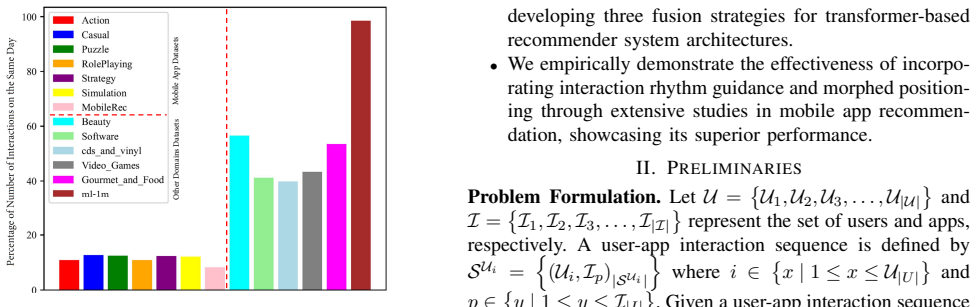
- [Figure 2] Figure 2 reports the percentage of same-day interactions but does not show the actual values or the number of consecutive-interaction pairs per dataset; adding these details would improve reproducibility and interpretability.
Circularity Check
No significant circularity; INTERPOS's rhythm embeddings are derived from timestamps and evaluated on external ranking metrics, and the missing capacity-control ablation is an experimental concern rather than a circular step.
full rationale
INTERPOS's construction chain is transparent and non-circular: user timestamps define Δti = ti − ti−1 (Eq. 5), fΩ maps these gaps to a learnable rhythm embedding Ω (Eq. 6), and the morphed position M is a deterministic fusion f(Θ,Ω) of the absolute position Θ and rhythm embedding (Eqs. 7–13). The downstream next-item prediction is trained with cross-entropy and evaluated with NDCG@K and HIT@K, neither of which is defined in terms of the rhythm embedding or the fusion parameters. No fitted parameter is renamed as a prediction: the model's output is the next app, and the rhythm signal is an input feature. The only self-citation, MobileRec [29], supplies the benchmark dataset and does not justify the method; it is not load-bearing. The lack of a parameter-matched or permutation ablation means the reported gains are not fully attributed to the rhythm signal, but that is an experimental confound, not a circular derivation. Therefore the paper does not exhibit definitional, fitted-input, or self-citation circularity.
Assumptions & free parameters
free parameters (2)
- Rhythm normalization factor =
0.2
- Rhythm clipping threshold =
800
assumptions (3)
- domain assumption Time intervals between consecutive app interactions carry predictive signal for the next app.
- ad hoc to paper Fusing rhythm embeddings with position embeddings via addition, MLP, or gating is an effective way for transformers to exploit temporal gaps.
- domain assumption The evaluation protocol (leave-one-out on the full item set) reflects the true next-app prediction task.
Cite this review
Pith. "Pith review of INTERPOS: Interaction Rhythm Guided Positional Morphing for Mobile App Recommender Systems." pith.science (2026). https://pith.science/paper/YGLAU4QW
@misc{pith2026250612661,
  author       = {Pith},
  title        = {Pith review of: INTERPOS: Interaction Rhythm Guided Positional Morphing for Mobile App Recommender Systems},
  year         = {2026},
  howpublished = {\url{https://pith.science/paper/YGLAU4QW}},
  note         = {Machine review of arXiv:2506.12661}
}
read the original abstract
The mobile app market has expanded exponentially, offering millions of apps with diverse functionalities, yet research in mobile app recommendation remains limited. Traditional sequential recommender systems utilize the order of items in users' historical interactions to predict the next item for the users. Position embeddings, well-established in transformer-based architectures for natural language processing tasks, effectively distinguish token positions in sequences. In sequential recommendation systems, position embeddings can capture the order of items in a user's historical interaction sequence. Nevertheless, this ordering does not consider the time elapsed between two interactions of the same user (e.g., 1 day, 1 week, 1 month), referred to as "user rhythm". In mobile app recommendation datasets, the time between consecutive user interactions is notably longer compared to other domains like movies, posing significant challenges for sequential recommender systems. To address this phenomenon in the mobile app domain, we introduce INTERPOS, an Interaction Rhythm Guided Positional Morphing strategy for autoregressive mobile app recommender systems. INTERPOS incorporates rhythm-guided position embeddings, providing a more comprehensive representation that considers both the sequential order of interactions and the temporal gaps between them. This approach enables a deep understanding of users' rhythms at a fine-grained level, capturing the intricacies of their interaction patterns over time. We propose three strategies to incorporate the morphed positional embeddings in two transformer-based sequential recommendation system architectures. Our extensive evaluations show that INTERPOS outperforms state-of-the-art models using 7 mobile app recommendation datasets on NDCG@K and HIT@K metrics. The source code of INTERPOS is available at https://github.com/dlgrad/INTERPOS.
Figures


Reference graph
Works this paper leans on
-
[1]
Apple, “Apple app store,” https://apps.apple.com/, 2024, accessed: 2024- 01-06
work page 2024
-
[2]
Google, “Google play store,” https://play.google.com/store/apps, 2022, accessed: 2024-01-06
work page 2022
-
[3]
Number of apps available in leading app store,
L. Ceci, “Number of apps available in leading app store,” https://www.statista.com/statistics/276623/ number-of-apps-available-in-leading-app-stores/, accessed: 2024- 01-06
work page 2024
-
[4]
Image-based recommendations on styles and substitutes,
J. McAuley, C. Targett, Q. Shi, and A. Van Den Hengel, “Image-based recommendations on styles and substitutes,” in Proceedings of the 38th international ACM SIGIR conference on research and development in information retrieval, 2015, pp. 43–52
work page 2015
-
[5]
R. He and J. McAuley, “Ups and downs: Modeling the visual evolution of fashion trends with one-class collaborative filtering,” in proceedings of the 25th international conference on world wide web , 2016, pp. 507– 517
work page 2016
-
[6]
Justifying recommendations using distantly-labeled reviews and fine-grained aspects,
J. Ni, J. Li, and J. McAuley, “Justifying recommendations using distantly-labeled reviews and fine-grained aspects,” in Proceedings of the 2019 conference on empirical methods in natural language pro- cessing and the 9th international joint conference on natural language processing (EMNLP-IJCNLP), 2019, pp. 188–197
2019
-
[7]
The movielens datasets: History and context,
F. M. Harper and J. A. Konstan, “The movielens datasets: History and context,” Acm transactions on interactive intelligent systems (tiis), vol. 5, no. 4, pp. 1–19, 2015
2015
-
[8]
Time interval aware self-attention for sequential recommendation,
J. Li, Y . Wang, and J. McAuley, “Time interval aware self-attention for sequential recommendation,” in Proceedings of the 13th international conference on web search and data mining , 2020, pp. 322–330
2020
Show all 50 references
-
[9]
Frequency enhanced hybrid attention network for sequential recommendation,
X. Du, H. Yuan, P. Zhao, J. Qu, F. Zhuang, G. Liu, Y . Liu, and V . S. Sheng, “Frequency enhanced hybrid attention network for sequential recommendation,” in Proceedings of the 46th International ACM SIGIR Conference on Research and Development in Information Retrieval , 2023,...
2023
-
[10]
Lighter and better: low-rank decomposed self-attention networks for next-item recommendation,
X. Fan, Z. Liu, J. Lian, W. X. Zhao, X. Xie, and J.-R. Wen, “Lighter and better: low-rank decomposed self-attention networks for next-item recommendation,” in Proceedings of the 44th international ACM SIGIR conference on research and development in information retrieval , 2021...
2021
-
[11]
Self-attentive sequential recommenda- tion,
W.-C. Kang and J. McAuley, “Self-attentive sequential recommenda- tion,” in 2018 IEEE international conference on data mining (ICDM) . IEEE, 2018, pp. 197–206
2018
-
[12]
Attention is all you need,
A. Vaswani, N. Shazeer, N. Parmar, J. Uszkoreit, L. Jones, A. N. Gomez, Ł. Kaiser, and I. Polosukhin, “Attention is all you need,” Advances in neural information processing systems , vol. 30, 2017
2017
-
[13]
Improving language understanding by generative pre-training,
A. Radford, K. Narasimhan, T. Salimans, I. Sutskever et al., “Improving language understanding by generative pre-training,” 2018
2018
-
[14]
Exploring the limits of transfer learning with a unified text-to-text transformer,
A. Roberts, C. Raffel, K. Lee, M. Matena, N. Shazeer, P. J. Liu, S. Narang, W. Li, and Y . Zhou, “Exploring the limits of transfer learning with a unified text-to-text transformer,” 2019
2019
-
[15]
Bert: Pre-training of deep bidirectional transformers for language understanding,
J. Devlin, M.-W. Chang, K. Lee, and K. Toutanova, “Bert: Pre-training of deep bidirectional transformers for language understanding,” arXiv preprint arXiv:1810.04805, 2018
2018 arXiv
-
[16]
Xlnet: Generalized autoregressive pretraining for language understanding,
Z. Yang, Z. Dai, Y . Yang, J. Carbonell, R. R. Salakhutdinov, and Q. V . Le, “Xlnet: Generalized autoregressive pretraining for language understanding,” Advances in neural information processing systems , vol. 32, 2019
2019
-
[17]
Ctrl: A conditional transformer language model for controllable gen- eration,
N. S. Keskar, B. McCann, L. R. Varshney, C. Xiong, and R. Socher, “Ctrl: A conditional transformer language model for controllable gen- eration,” arXiv preprint arXiv:1909.05858 , 2019
1909 arXiv
-
[18]
Unified language model pre-training for natural language understanding and generation,
L. Dong, N. Yang, W. Wang, F. Wei, X. Liu, Y . Wang, J. Gao, M. Zhou, and H.-W. Hon, “Unified language model pre-training for natural language understanding and generation,” Advances in neural information processing systems , vol. 32, 2019
2019
-
[19]
Roberta: A robustly optimized bert pretraining approach,
Y . Liu, M. Ott, N. Goyal, J. Du, M. Joshi, D. Chen, O. Levy, M. Lewis, L. Zettlemoyer, and V . Stoyanov, “Roberta: A robustly optimized bert pretraining approach,” arXiv preprint arXiv:1907.11692 , 2019
1907 arXiv
-
[20]
Deberta: Decoding-enhanced bert with disentangled attention,
P. He, X. Liu, J. Gao, and W. Chen, “Deberta: Decoding-enhanced bert with disentangled attention,” arXiv preprint arXiv:2006.03654 , 2020
2006 arXiv
-
[21]
Improved recurrent neural networks for session-based recommendations,
Y . K. Tan, X. Xu, and Y . Liu, “Improved recurrent neural networks for session-based recommendations,” in Proceedings of the 1st workshop on deep learning for recommender systems , 2016, pp. 17–22
2016
-
[22]
Sparse- interest network for sequential recommendation,
Q. Tan, J. Zhang, J. Yao, N. Liu, J. Zhou, H. Yang, and X. Hu, “Sparse- interest network for sequential recommendation,” in Proceedings of the 14th ACM international conference on web search and data mining , 2021, pp. 598–606
2021
-
[23]
Hierarchical gating networks for sequential recommendation,
C. Ma, P. Kang, and X. Liu, “Hierarchical gating networks for sequential recommendation,” in Proceedings of the 25th ACM SIGKDD interna- tional conference on knowledge discovery & data mining , 2019, pp. 825–833
2019
-
[24]
Graph contextualized self-attention network for session-based recommendation
C. Xu, P. Zhao, Y . Liu, V . S. Sheng, J. Xu, F. Zhuang, J. Fang, and X. Zhou, “Graph contextualized self-attention network for session-based recommendation.” in IJCAI, vol. 19, 2019, pp. 3940–3946
2019
-
[25]
Bert4rec: Sequential recommendation with bidirectional encoder representations from transformer,
F. Sun, J. Liu, J. Wu, C. Pei, X. Lin, W. Ou, and P. Jiang, “Bert4rec: Sequential recommendation with bidirectional encoder representations from transformer,” in Proceedings of the 28th ACM international confer- ence on information and knowledge management , 2019, pp. 1441–1450
2019
-
[26]
Recbole: Towards a unified, comprehensive and efficient framework for recommendation algorithms,
W. X. Zhao, S. Mu, Y . Hou, Z. Lin, Y . Chen, X. Pan, K. Li, Y . Lu, H. Wang, C. Tian, Y . Min, Z. Feng, X. Fan, X. Chen, P. Wang, W. Ji, Y . Li, X. Wang, and J. Wen, “Recbole: Towards a unified, comprehensive and efficient framework for recommendation algorithms,” in CIKM. AC...
2021
-
[27]
Towards a more user-friendly and easy-to-use benchmark library for recommender systems,
L. Xu, Z. Tian, G. Zhang, J. Zhang, L. Wang, B. Zheng, Y . Li, J. Tang, Z. Zhang, Y . Hou, X. Pan, W. X. Zhao, X. Chen, and J.-R. Wen, “Towards a more user-friendly and easy-to-use benchmark library for recommender systems,” 2023, p. 2837–2847
2023
-
[28]
Recbole 2.0: Towards a more up-to-date recommendation library,
W. X. Zhao, Y . Hou, X. Pan, C. Yang, Z. Zhang, Z. Lin, J. Zhang, S. Bian, J. Tang, W. Sun et al., “Recbole 2.0: Towards a more up-to-date recommendation library,” in Proceedings of the 31st ACM International Conference on Information & Knowledge Management, 2022, pp. 4722– 4726
2022
-
[29]
Mobilerec: A large scale dataset for mobile apps recommendation,
M. H. Maqbool, U. Farooq, A. Mosharrof, A. B. Siddique, and H. Foroosh, “Mobilerec: A large scale dataset for mobile apps recommendation,” p. 3007–3016, 2023. [Online]. Available: https://doi.org/10.1145/3539618.3591906
2023
-
[30]
Personalized complementary product recommendation,
A. Yan, C. Dong, Y . Gao, J. Fu, T. Zhao, Y . Sun, and J. McAuley, “Personalized complementary product recommendation,” in Companion Proceedings of the Web Conference 2022 , 2022, pp. 146–151
2022
-
[31]
Attentive sequential models of latent intent for next item recommen- dation,
M. M. Tanjim, C. Su, E. Benjamin, D. Hu, L. Hong, and J. McAuley, “Attentive sequential models of latent intent for next item recommen- dation,” in Proceedings of The Web Conference 2020 , 2020, pp. 2528– 2534
2020
-
[32]
Mind: A large-scale dataset for news recommendation,
F. Wu, Y . Qiao, J.-H. Chen, C. Wu, T. Qi, J. Lian, D. Liu, X. Xie, J. Gao, W. Wu et al., “Mind: A large-scale dataset for news recommendation,” in Proceedings of the 58th Annual Meeting of the Association for Computational Linguistics, 2020, pp. 3597–3606
2020
-
[33]
Jointly modeling aspects, ratings and sentiments for movie recommendation (jmars),
Q. Diao, M. Qiu, C.-Y . Wu, A. J. Smola, J. Jiang, and C. Wang, “Jointly modeling aspects, ratings and sentiments for movie recommendation (jmars),” in Proceedings of the 20th ACM SIGKDD international con- ference on Knowledge discovery and data mining , 2014, pp. 193–202
2014
-
[34]
Im- proving sequential recommendation with knowledge-enhanced memory networks,
J. Huang, W. X. Zhao, H. Dou, J.-R. Wen, and E. Y . Chang, “Im- proving sequential recommendation with knowledge-enhanced memory networks,” in The 41st international ACM SIGIR conference on research & development in information retrieval , 2018, pp. 505–514
2018
-
[35]
Fusing similarity models with markov chains for sparse sequential recommendation,
R. He and J. McAuley, “Fusing similarity models with markov chains for sparse sequential recommendation,” in 2016 IEEE 16th international conference on data mining (ICDM) . IEEE, 2016, pp. 191–200
2016
-
[36]
Core: simple and effective session-based recommendation within consistent representation space,
Y . Hou, B. Hu, Z. Zhang, and W. X. Zhao, “Core: simple and effective session-based recommendation within consistent representation space,” in Proceedings of the 45th international ACM SIGIR conference on research and development in information retrieval, 2022, pp. 1796–1801
2022
-
[37]
Repeatnet: A repeat aware neural recommendation machine for session-based recommendation,
P. Ren, Z. Chen, J. Li, Z. Ren, J. Ma, and M. De Rijke, “Repeatnet: A repeat aware neural recommendation machine for session-based recommendation,” in Proceedings of the AAAI Conference on Artificial Intelligence, vol. 33, no. 01, 2019, pp. 4806–4813
2019
-
[38]
Stamp: short-term attention/memory priority model for session-based recommendation,
Q. Liu, Y . Zeng, R. Mokhosi, and H. Zhang, “Stamp: short-term attention/memory priority model for session-based recommendation,” in Proceedings of the 24th ACM SIGKDD international conference on knowledge discovery & data mining , 2018, pp. 1831–1839
2018
-
[39]
S3-rec: Self-supervised learning for sequential recom- mendation with mutual information maximization,
K. Zhou, H. Wang, W. X. Zhao, Y . Zhu, S. Wang, F. Zhang, Z. Wang, and J.-R. Wen, “S3-rec: Self-supervised learning for sequential recom- mendation with mutual information maximization,” in Proceedings of the 29th ACM international conference on information & knowledge managem...
2020
-
[40]
Personalized top-n sequential recommendation via convolutional sequence embedding,
J. Tang and K. Wang, “Personalized top-n sequential recommendation via convolutional sequence embedding,” in Proceedings of the eleventh ACM international conference on web search and data mining , 2018, pp. 565–573
2018
-
[41]
Parallel recurrent neural network architectures for feature-rich session-based recommen- dations,
B. Hidasi, M. Quadrana, A. Karatzoglou, and D. Tikk, “Parallel recurrent neural network architectures for feature-rich session-based recommen- dations,” in Proceedings of the 10th ACM conference on recommender systems, 2016, pp. 241–248
2016
-
[42]
Sequential recommender system based on hierarchical attention network,
H. Ying, F. Zhuang, F. Zhang, Y . Liu, G. Xu, X. Xie, H. Xiong, and J. Wu, “Sequential recommender system based on hierarchical attention network,” in IJCAI International Joint Conference on Artificial Intelligence, 2018
2018
-
[43]
A simple convolutional generative network for next item recommendation,
F. Yuan, A. Karatzoglou, I. Arapakis, J. M. Jose, and X. He, “A simple convolutional generative network for next item recommendation,” in Proceedings of the twelfth ACM international conference on web search and data mining , 2019, pp. 582–590
2019
-
[44]
Feature-level deeper self-attention network for sequential recom- mendation
T. Zhang, P. Zhao, Y . Liu, V . S. Sheng, J. Xu, D. Wang, G. Liu, X. Zhou et al., “Feature-level deeper self-attention network for sequential recom- mendation.” in IJCAI, 2019, pp. 4320–4326
2019
-
[45]
Session-based recommendation with graph neural networks,
S. Wu, Y . Tang, Y . Zhu, L. Wang, X. Xie, and T. Tan, “Session-based recommendation with graph neural networks,” in Proceedings of the AAAI conference on artificial intelligence , vol. 33, no. 01, 2019, pp. 346–353
2019
-
[46]
Npe: neural personalized embedding for collaborative filtering,
T. Nguyen and A. Takasu, “Npe: neural personalized embedding for collaborative filtering,” arXiv preprint arXiv:1805.06563 , 2018
2018 arXiv
-
[47]
Augmenting sequential rec- ommendation with pseudo-prior items via reversely pre-training trans- former,
Z. Liu, Z. Fan, Y . Wang, and P. S. Yu, “Augmenting sequential rec- ommendation with pseudo-prior items via reversely pre-training trans- former,” in Proceedings of the 44th international ACM SIGIR conference on Research and development in information retrieval , 2021, pp. 1608– 1612
2021
-
[48]
App- aware response synthesis for user reviews,
U. Farooq, A. B. Siddique, F. Jamour, Z. Zhao, and V . Hristidis, “App- aware response synthesis for user reviews,” in 2020 IEEE International Conference on Big Data (Big Data) , 2020, pp. 699–708
2020
-
[49]
Proactive prioritization of app issues via contrastive learning,
M. Fereidouni, A. Mosharrof, U. Farooq, and A. Siddique, “Proactive prioritization of app issues via contrastive learning,” in 2022 IEEE International Conference on Big Data (Big Data) , 2022, pp. 535–544
2022
-
[50]
Mobileconvrec: A conversational dataset for mobile apps recommendations,
S. Maji, M. Fereidouni, V . Chhetri, U. Farooq, and A. B. Siddique, “Mobileconvrec: A conversational dataset for mobile apps recommendations,” 2024. [Online]. Available: https://arxiv.org/abs/2405. 17740
2024
Reviewed August 7, 2026 · model on record in the stance chip above.
Discussion (0). Continue with ORCID to comment.