REVIEW 4 major objections 6 minor 41 references
TFKAN: Time-Frequency KAN for Long-Term Time Series Forecasting
T0 review · 4 major / 6 minor · reviewed 2026-08-07 · deepseek-v4-flash
Pith's one-line read The paper claims that applying Kolmogorov-Arnold Networks directly to complex FFT coefficients, inside a dual-branch time-frequency architecture, yields consistently better long-term forecasts than eight state-of-the-art baselines on…
desk verdict Genuinely applies KAN in the frequency domain, but the SOTA claim is contradicted by its own table and the missing parameter-matched ablation leaves the core advantage unproven. read the letter →
The pith
A machine-rendered reading of the paper's core claim, the machinery that carries it, and where it could break.
The reading
What carries the argument
The load-bearing mechanism is the frequency-domain KAN (FreqKAN), which applies KAN's base SiLU transformation and B-spline transformation to the real and imaginary components of complex FFT coefficients, sharing one KAN for both components. A dimension-adjustment step multiplies the input by a learnable vector of width $d=128$ only in the frequency branch, creating a richer spectral representation while leaving the time branch at its original width. The time-domain KAN processes the raw input, and the two branch outputs are combined with a bias term before a final KAN-based predictor maps the flattened hidden state to the forecast horizon $\tau$.
What would settle it
Train a parameter-matched TFKAN variant (for example, reduce the hidden size or spline grid so it has roughly 31K parameters, matching TimeKAN) on the same seven datasets and check whether it still beats TimeKAN and LTSF-Linear; if the gap disappears or reverses, the reported frequency-domain KAN advantage is not established. Equivalently, scale TimeKAN or LTSF-Linear up to about 16M parameters and see whether the margin shrinks.
Extended reading notes
Core claim
The central claim is that placing KAN modules directly on the Fourier representation of a time series is both feasible and beneficial for long-term forecasting. The frequency-domain KAN processes the real and imaginary parts of the FFT output separately through a shared two-layer KAN, recombines them into a complex signal, and transforms back with the inverse FFT. Combined with a time-domain KAN branch and a selective upscaling strategy that enriches only the frequency path, this dual-branch design is reported to achieve the lowest MAE and RMSE on all tested datasets and horizons, beating frequency-domain MLPs, frequency-enhanced Transformers, and prior KAN hybrids. The paper presents this as the first direct application of KAN in the frequency domain for time series forecasting.
Load-bearing premise
The load-bearing premise is that the evaluation is fair: TFKAN (16.33M parameters) is compared against TimeKAN (31.1K) and LTSF-Linear (4.66K) with no parameter-matched ablation, so if extra capacity explains the gains, the frequency-domain KAN claim collapses.
Editorial extensions
If this is right
- Frequency-domain KAN is a workable design: applying spline activations to Fourier coefficients improves accuracy over time-domain-only KAN baselines like TimeKAN.
- The dual-branch structure is necessary: removing either the time or frequency branch degrades performance, indicating that temporal and spectral information are complementary.
- Selective upscaling only in the frequency branch beats both no adjustment and full adjustment, suggesting that the two domains should be processed asymmetrically.
- Sharing one KAN for the real and imaginary parts is sufficient; separate KANs add parameters with only marginal accuracy gains and impose a form of conjugate consistency.
- TFKAN keeps GPU memory around 251 MB, far below Transformer-based baselines, while delivering the reported accuracy gains.
Reading between the lines
- If the frequency-domain KAN advantage is real, it should transfer to pipelines that operate entirely on complex frequency components, such as interpolation-based complex spectral models, and the gain should persist when those pipelines are matched for parameter count.
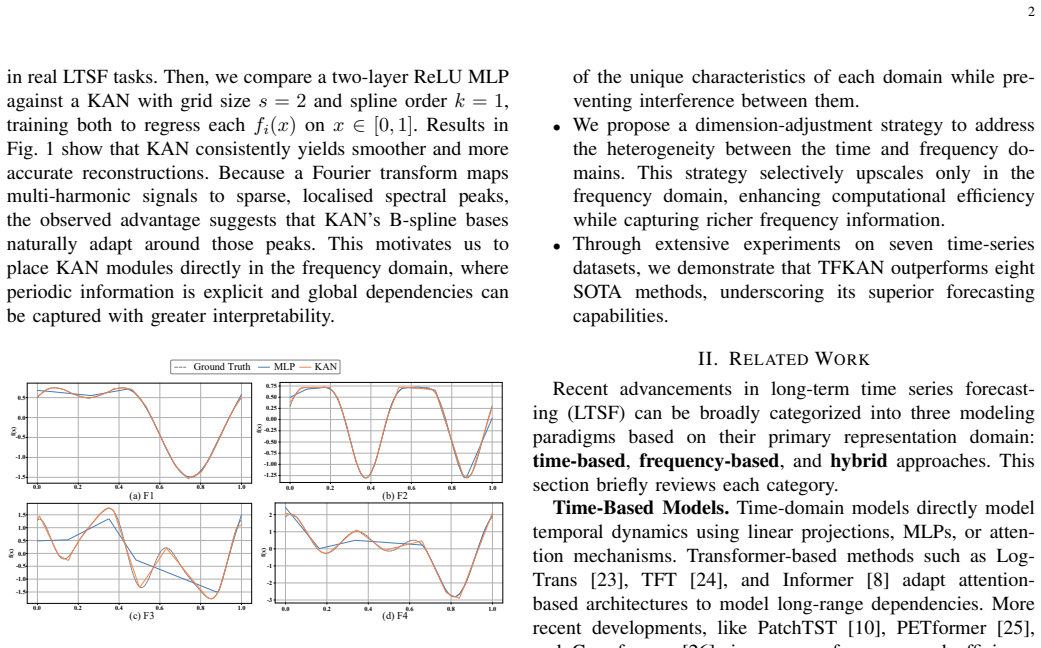
- The toy experiments suggest a testable hypothesis: KAN's advantage over MLPs should grow with the number of harmonics and phase shifts in the signal. A synthetic benchmark with known spectral sparsity could localize exactly where frequency-domain KAN helps.
- A parameter-matched or FLOP-matched comparison is the missing control: TFKAN uses 16.33M parameters versus 31.1K for TimeKAN and 4.66K for LTSF-Linear, so the reported margins may reflect capacity rather than the frequency-domain KAN mechanism itself.
Editorial analysis
A structured set of objections, weighed in public.
Referee Report
Summary. The paper proposes TFKAN, a dual-branch architecture for long-term time series forecasting that combines a KAN operating on the frequency-domain representation of the input (FreqKAN) with a KAN operating on the raw time-domain signal (TimeKAN), followed by a KAN-based predictor. The frequency branch applies FFT, processes the real and imaginary parts with a shared two-layer KAN, then applies IFFT; a dimension-adjustment strategy embeds the frequency-branch input to a higher dimension while leaving the time-branch input unchanged. The authors claim this is the first direct application of KAN in the frequency domain for time series forecasting, and they report experiments on seven datasets (ETT, Air, Weather, ILI) comparing against eight baselines, together with ablations over KAN placement, single-branch variants, dimension adjustment, and parameter sensitivity. The main text asserts that TFKAN consistently outperforms all baselines on all datasets and horizons.
Significance. If the central claim were fully established, the contribution would be of moderate significance: it would demonstrate that KAN modules applied to complex FFT coefficients, combined with a time-domain KAN branch, improve long-term forecasting accuracy over existing KAN-based, frequency-based, and hybrid baselines. The paper has strengths that deserve credit: the code is publicly released, the ablation suite is fairly extensive, the efficiency table reports parameter counts and GPU memory, and the toy periodic-function experiment provides a concrete motivation for placing KAN in the frequency domain. However, the empirical evidence as presented is not yet sufficient to support the claimed consistent superiority, and the missing capacity-controlled comparison is load-bearing because TFKAN has orders of magnitude more parameters than the most relevant baselines. The significance of the result is therefore conditional on the authors addressing the evaluation gaps.
major comments (4)
- [Section IV-B / Table III] The claim in Section IV-B that "TFKAN achieves consistently superior results across all datasets and forecasting lengths" is contradicted by the paper's own Table III. For example, on ETTh1 with tau=336 the MAE for TimeKAN is 0.069 while TFKAN is 0.071; with tau=720 TimeKAN gives 0.080 vs TFKAN 0.082; and on ETTm1 with tau=192 TimeKAN gives 0.057 vs TFKAN 0.058. Several other cells are tied or within 0.001. The paper does not report standard deviations, confidence intervals, or multi-seed runs, so the aggregate "Num First" counts (21 vs 20 for MAE) cannot be interpreted as a statistically meaningful advantage. Please revise the claimed consistent superiority, report error bars or significance tests, and state explicitly which cells are and are not statistically distinguishable.
- [Section IV-A / Table VIII / Table IV] The reported gains may reflect model capacity rather than the benefit of frequency-domain KAN. Table VIII shows TFKAN has 16.33M parameters on ILI, while TimeKAN has 31.1K, LTSF-Linear has 4.66K, and TSMixer has about 215K. The KAN-vs-MLP ablation in Table IV does not remove this confound, because replacing a KAN layer with a two-layer MLP drastically reduces the parameter count; for instance, on ETTh2 with tau=720 the TFKAN MAE is 0.047 and the fully MLP variant is 0.060, but the two models are not parameter-matched. Without a comparison in which the MLP baseline is widened to match TFKAN's parameter budget, or a FLOP-matched comparison, the claim that applying KAN in the frequency domain is the cause of the accuracy advantage is not established. Please add parameter-matched or FLOP-matched experiments, or otherwise show that the improvements are not attributable to capacity alone.
- [Section IV-A / Table II / Table III] The evaluation omits several strong recent baselines that are standard in LTSF, including PatchTST, iTransformer, and TimeMixer. PatchTST and iTransformer in particular are widely reported to outperform several of the included baselines (e.g., Informer and Autoformer), so the statement that TFKAN outperforms "state-of-the-art methods" is not supported by the chosen comparison set. The authors should either add these models (or cite published results on the same datasets and horizons) or soften the SOTA claim to "outperforms the eight selected baselines." This is load-bearing because the paper's central empirical claim is about superiority to the state of the art, not merely to the eight implemented baselines.
- [Section III-C / Equations (5)-(8)] The dimension-adjustment strategy introduces an asymmetry between the two branches that is also a capacity difference: the frequency branch embeds the input to N x L x d (d=128), while the time branch processes the raw N x L input. Consequently, the frequency branch has substantially more representation capacity regardless of whether KAN or MLP is used, and the ablation "All Adjust" in Table VI does not isolate the frequency-domain KAN contribution because it applies upscaling to both branches. Please clarify, either by controlling total width/capacity across branches or by reporting an ablation that keeps the frequency-branch capacity fixed while varying only the use of KAN versus MLP, whether the reported Freq branch advantage is due to the KAN module or to the higher-dimensional embedding.
minor comments (6)
- [Equations (6)-(7)] Equations (6) and (7) present the Fourier transform and its inverse as continuous integrals, but the implementation uses the discrete FFT/IFFT on a finite sequence of length L. Please replace these with discrete summations or explicitly state that the continuous forms are illustrative; the current notation is mathematically inconsistent with the dimensions given, such as C^{(L/2+1) x d}.
- [Section IV-A] The text states that each KAN layer uses a hidden size of 258; given the embedding size d=128 and grid size s=2, this number looks like a typo (possibly 256). Please verify and correct.
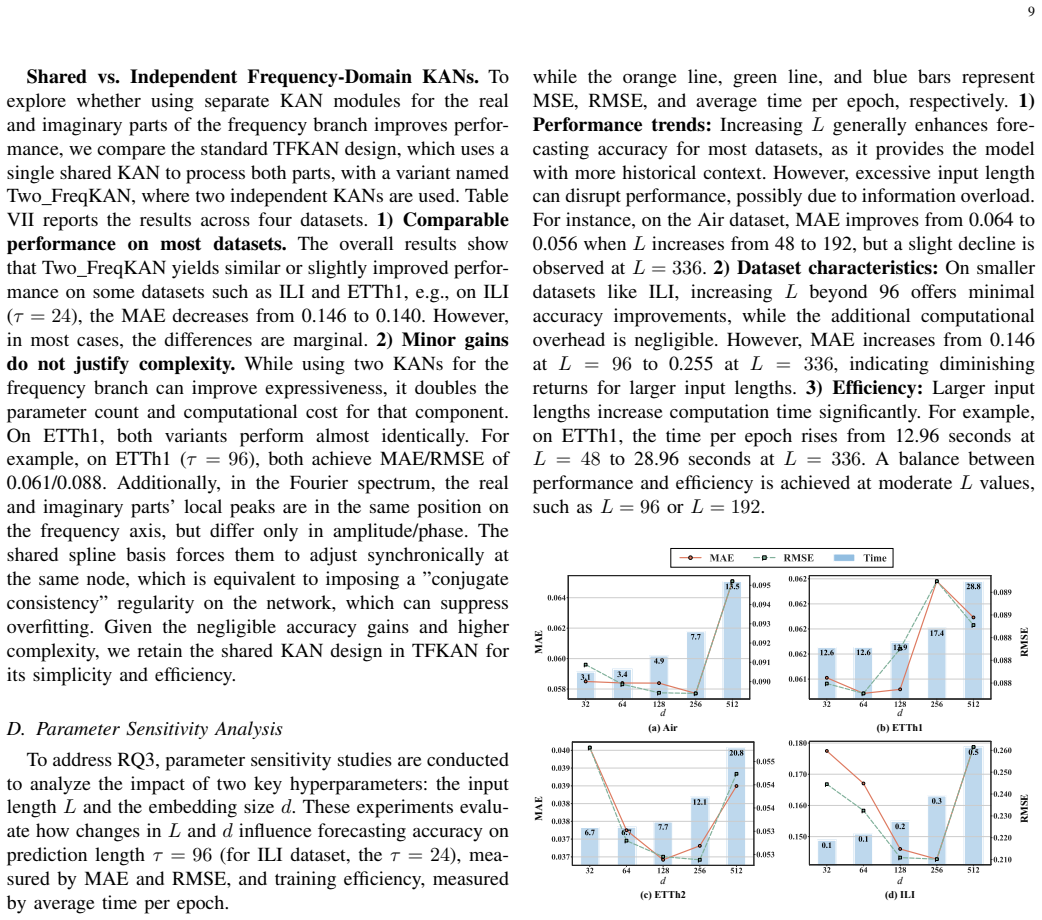
- [Figures 3 and 4] The captions refer to orange, green, and blue lines/bars, but the printed figures appear to use a different color scheme or insufficient contrast. Also, Figure 3's caption says the bars represent MSE while the text says MAE; please align the caption, axis labels, and legend.
- [Section II / Section III-C] The name "TimeKAN" is used both for a baseline method (Ref. [22]) and for the time-domain KAN branch of TFKAN in Figure 2 and Section III-C, which is confusing. Please rename the branch, for example to Time-Domain KAN or T-KAN, to avoid ambiguity.
- [Section I / Figure 1] The toy experiment is presented as evidence that KAN's spline bases naturally adapt around spectral peaks, but Figure 1 shows only qualitative curves and no error metric or training setup (e.g., epochs, parameter counts, number of trials). A quantitative comparison with error bars would make the motivation more convincing.
- [Table IV caption] The caption lists variants "MLP time freq," "MLP pred freq," and "MLP pred time" without defining the naming convention in the text; please define exactly which modules are replaced by MLPs in each variant before the table is referenced.
Circularity Check
No circularity found: TFKAN is an empirical architecture paper whose claims are evaluated against external benchmarks, not derived from its own fitted values or self-citations.
full rationale
The paper does not present a derivation in which a claimed prediction is defined in terms of the fitted quantity. The toy experiment in Section I motivates frequency-domain KANs by showing that KAN approximates sinusoidal functions more smoothly than an MLP, but this is motivation, not a load-bearing circular reduction. The proposed architecture (Section III) combines a frequency-domain KAN, a time-domain KAN, a dimension-adjustment strategy, and a KAN-based predictor; the final forecast is produced by a trainable model and evaluated against held-out data (Table III), so the main empirical claim is checked against external benchmarks rather than being forced by construction. The ablations in Section IV-C compare KAN versus MLP variants and single-branch versus dual-branch configurations; these are component analyses, and although the parameter counts differ (Table VIII), that is a potential confound or fairness issue, not circularity. The paper cites prior KAN and time-series work, including TimeKAN [22], but none of these citations carry a load-bearing uniqueness claim by the present authors, and there is no self-citation chain that defines TFKAN's result in terms of its own prior output. Concerns about parameter-matched comparisons, multi-seed variance, and the 'consistently superior' statement exceeding some table cells are scientific-validity criticisms and do not constitute circularity under the defined criteria. Therefore, the appropriate finding is no significant circularity.
Assumptions & free parameters
free parameters (4)
- Embedding size d =
128
- KAN grid size s =
2
- KAN spline order k =
1
- KAN hidden size =
258
assumptions (4)
- standard math Kolmogorov-Arnold representation theorem
- domain assumption FFT of a real signal captures periodic patterns in a form suitable for learning
- domain assumption Shared KAN weights for real and imaginary parts preserve phase information
- ad hoc to paper The toy experiment (Fig. 1) demonstrates KAN's advantage for multi-harmonic functions
Cite this review
Pith. "Pith review of TFKAN: Time-Frequency KAN for Long-Term Time Series Forecasting." pith.science (2026). https://pith.science/paper/UZVOTRAX
@misc{pith2026250612696,
  author       = {Pith},
  title        = {Pith review of: TFKAN: Time-Frequency KAN for Long-Term Time Series Forecasting},
  year         = {2026},
  howpublished = {\url{https://pith.science/paper/UZVOTRAX}},
  note         = {Machine review of arXiv:2506.12696}
}
abstract
Kolmogorov-Arnold Networks (KANs) are highly effective in long-term time series forecasting due to their ability to efficiently represent nonlinear relationships and exhibit local plasticity. However, prior research on KANs has predominantly focused on the time domain, neglecting the potential of the frequency domain. The frequency domain of time series data reveals recurring patterns and periodic behaviors, which complement the temporal information captured in the time domain. To address this gap, we explore the application of KANs in the frequency domain for long-term time series forecasting. By leveraging KANs' adaptive activation functions and their comprehensive representation of signals in the frequency domain, we can more effectively learn global dependencies and periodic patterns. To integrate information from both time and frequency domains, we propose the $\textbf{T}$ime-$\textbf{F}$requency KAN (TFKAN). TFKAN employs a dual-branch architecture that independently processes features from each domain, ensuring that the distinct characteristics of each domain are fully utilized without interference. Additionally, to account for the heterogeneity between domains, we introduce a dimension-adjustment strategy that selectively upscales only in the frequency domain, enhancing efficiency while capturing richer frequency information. Experimental results demonstrate that TFKAN consistently outperforms state-of-the-art (SOTA) methods across multiple datasets. The code is available at https://github.com/LcWave/TFKAN.
Figures

Figures from the paper (2 more)


Reference graph
Works this paper leans on
-
[1]
Z. Shao, F. Wang, Y . Xu, W. Wei, C. Yu, Z. Zhang, D. Yao, T. Sun, G. Jin, X. Cao, G. Cong, C. S. Jensen, and X. Cheng, “Exploring progress in multivariate time series forecasting: Comprehensive bench- marking and heterogeneity analysis,”IEEE Transactions on Knowledge and Data Engineering, vol. 37, no. 1, pp. 291–305, 2025
work page 2025
-
[2]
Y . Jia, Y . Lin, X. Hao, Y . Lin, S. Guo, and H. Wan, “Witran: Water- wave information transmission and recurrent acceleration network for long-range time series forecasting,”Advances in Neural Information Processing Systems, vol. 36, 2024
work page 2024
-
[3]
Time-series forecasting with deep learning: a survey,
B. Lim and S. Zohren, “Time-series forecasting with deep learning: a survey,”Philosophical Transactions of the Royal Society A, vol. 379, no. 2194, p. 20200209, 2021
2021
-
[4]
J. Kim, H. Kim, H. Kim, D. Lee, and S. Yoon, “A comprehensive survey of deep learning for time series forecasting: architectural diversity and 11 open challenges,”Artificial Intelligence Review, vol. 58, no. 7, pp. 1–95, 2025
work page 2025
-
[5]
A systematic review for transformer-based long-term series forecasting,
L. Su, X. Zuo, R. Li, X. Wang, H. Zhao, and B. Huang, “A systematic review for transformer-based long-term series forecasting,”Artificial Intelligence Review, vol. 58, no. 3, p. 80, 2025
work page 2025
-
[6]
Long sequence time-series forecasting with deep learning: A survey,
Z. Chen, M. Ma, T. Li, H. Wang, and C. Li, “Long sequence time-series forecasting with deep learning: A survey,”Information Fusion, vol. 97, p. 101819, 2023
2023
-
[7]
Transformers in time series: a survey,
Q. Wen, T. Zhou, C. Zhang, W. Chen, Z. Ma, J. Yan, and L. Sun, “Transformers in time series: a survey,” inProceedings of the Thirty- Second International Joint Conference on Artificial Intelligence, 2023, pp. 6778–6786
work page 2023
-
[8]
Informer: Beyond efficient transformer for long sequence time-series forecasting,
H. Zhou, S. Zhang, J. Peng, S. Zhang, J. Li, H. Xiong, and W. Zhang, “Informer: Beyond efficient transformer for long sequence time-series forecasting,” inProceedings of the AAAI conference on artificial intel- ligence, vol. 35, no. 12, 2021, pp. 11 106–11 115
2021
Show all 41 references
-
[9]
Autoformer: Decomposition transformers with Auto-Correlation for long-term series forecasting,
H. Wu, J. Xu, J. Wang, and M. Long, “Autoformer: Decomposition transformers with Auto-Correlation for long-term series forecasting,” in Advances in Neural Information Processing Systems, 2021
2021
-
[10]
A time series is worth 64 words: Long-term forecasting with transformers,
Y . Nie, N. H. Nguyen, P. Sinthong, and J. Kalagnanam, “A time series is worth 64 words: Long-term forecasting with transformers,” in International Conference on Learning Representations, 2023
2023
-
[11]
Kan: Kolmogorov-arnold networks,
Z. Liu, Y . Wang, S. Vaidya, F. Ruehle, J. Halverson, M. Solja ˇci´c, T. Y . Hou, and M. Tegmark, “Kan: Kolmogorov-arnold networks,”arXiv preprint arXiv:2404.19756, 2024
2024 arXiv
-
[12]
Kolmogorov-arnold networks for time series: Bridging predictive power and interpretability,
K. Xu, L. Chen, and S. Wang, “Kolmogorov-arnold networks for time series: Bridging predictive power and interpretability,”arXiv preprint arXiv:2406.02496, 2024
2024 arXiv
-
[13]
Kolmogorov- arnold networks (kans) for time series analysis,
C. J. Vaca-Rubio, L. Blanco, R. Pereira, and M. Caus, “Kolmogorov- arnold networks (kans) for time series analysis,”arXiv preprint arXiv:2405.08790, 2024
2024
-
[14]
Frequency-domain mlps are more effective learners in time series forecasting,
K. Yi, Q. Zhang, W. Fan, S. Wang, P. Wang, H. He, N. An, D. Lian, L. Cao, and Z. Niu, “Frequency-domain mlps are more effective learners in time series forecasting,”Advances in Neural Information Processing Systems, vol. 36, 2024
2024
-
[15]
Spectral temporal graph neural network for multivariate time-series forecasting,
D. Cao, Y . Wang, J. Duan, C. Zhang, X. Zhu, C. Huang, Y . Tong, B. Xu, J. Bai, J. Tonget al., “Spectral temporal graph neural network for multivariate time-series forecasting,”Advances in neural information processing systems, vol. 33, pp. 17 766–17 778, 2020
2020
-
[16]
Are transformers effective for time series forecasting?
A. Zeng, M. Chen, L. Zhang, and Q. Xu, “Are transformers effective for time series forecasting?” inProceedings of the AAAI conference on artificial intelligence, vol. 37, no. 9, 2023, pp. 11 121–11 128
2023
-
[17]
Kan4tsf: Are kan and kan-based models effective for time series forecasting?
X. Han, X. Zhang, Y . Wu, Z. Zhang, and Z. Wu, “Kan4tsf: Are kan and kan-based models effective for time series forecasting?”arXiv preprint arXiv:2408.11306, 2024
2024 arXiv
-
[18]
Tkan: Temporal kolmogorov-arnold net- works,
R. Genet and H. Inzirillo, “Tkan: Temporal kolmogorov-arnold net- works,”arXiv preprint arXiv:2405.07344, 2024
2024 arXiv
-
[19]
A temporal kolmogorov-arnold transformer for time series fore- casting,
——, “A temporal kolmogorov-arnold transformer for time series fore- casting,”ArXiv, 2024
2024
-
[20]
Zero shot time series forecasting using kolmogorov arnold networks,
A. Bhattacharya and N. Haq, “Zero shot time series forecasting using kolmogorov arnold networks,”arXiv preprint arXiv:2412.17853, 2024
2024 arXiv
-
[21]
Hippo-kan: Efficient kan model for time series analysis,
S. Lee, J.-K. Kim, J. Kim, T. Kim, and J. Lee, “Hippo-kan: Efficient kan model for time series analysis,”arXiv preprint arXiv:2410.14939, 2024
2024 arXiv
-
[22]
TimeKAN: KAN-based frequency decomposition learning architecture for long-term time series forecasting,
S. Huang, Z. Zhao, C. Li, and L. BAI, “TimeKAN: KAN-based frequency decomposition learning architecture for long-term time series forecasting,” inThe Thirteenth International Conference on Learning Representations, 2025. [Online]. Available: https: //openreview.net/forum?id=wTLc79YNbh
2025
-
[23]
En- hancing the locality and breaking the memory bottleneck of transformer on time series forecasting,
S. Li, X. Jin, Y . Xuan, X. Zhou, W. Chen, Y .-X. Wang, and X. Yan, “En- hancing the locality and breaking the memory bottleneck of transformer on time series forecasting,”Advances in neural information processing systems, vol. 32, 2019
2019
-
[24]
Temporal fusion transform- ers for interpretable multi-horizon time series forecasting,
B. Lim, S. ¨O. Arık, N. Loeff, and T. Pfister, “Temporal fusion transform- ers for interpretable multi-horizon time series forecasting,”International Journal of Forecasting, vol. 37, no. 4, pp. 1748–1764, 2021
2021
-
[25]
Petformer: Long-term time series forecasting via placeholder-enhanced transformer,
S. Lin, W. Lin, W. Wu, S. Wang, and Y . Wang, “Petformer: Long-term time series forecasting via placeholder-enhanced transformer,”IEEE Transactions on Emerging Topics in Computational Intelligence, 2024
2024
-
[26]
Crossformer: Transformer utilizing cross- dimension dependency for multivariate time series forecasting,
Y . Zhang and J. Yan, “Crossformer: Transformer utilizing cross- dimension dependency for multivariate time series forecasting,” inThe eleventh international conference on learning representations, 2023
2023
-
[27]
Less is more: Fast multivariate time series forecasting with light sampling- oriented mlp structures,
T. Zhang, Y . Zhang, W. Cao, J. Bian, X. Yi, S. Zheng, and J. Li, “Less is more: Fast multivariate time series forecasting with light sampling- oriented mlp structures,”arXiv preprint arXiv:2207.01186, 2022
2022 arXiv
-
[28]
Long- term forecasting with tide: Time-series dense encoder,
A. Das, W. Kong, A. Leach, S. Mathur, R. Sen, and R. Yu, “Long- term forecasting with tide: Time-series dense encoder,”arXiv preprint arXiv:2304.08424, 2023
2023 arXiv
-
[29]
Mts-mixers: Multivariate time series forecasting via factorized temporal and channel mixing,
Z. Li, Z. Rao, L. Pan, and Z. Xu, “Mts-mixers: Multivariate time series forecasting via factorized temporal and channel mixing,”arXiv preprint arXiv:2302.04501, 2023
2023 arXiv
-
[30]
Timemixer: Decomposable multiscale mixing for time series forecasting,
S. Wang, H. Wu, X. Shi, T. Hu, H. Luo, L. Ma, J. Y . Zhang, and J. ZHOU, “Timemixer: Decomposable multiscale mixing for time series forecasting,” inThe Twelfth International Conference on Learning Representations, 2024. [Online]. Available: https: //openreview.net/forum?id=7oLshfEIC2
2024
-
[31]
Hdmixer: Hierarchical dependency with extendable patch for multivariate time series forecasting,
Q. Huang, L. Shen, R. Zhang, J. Cheng, S. Ding, Z. Zhou, and Y . Wang, “Hdmixer: Hierarchical dependency with extendable patch for multivariate time series forecasting,” inProceedings of the AAAI Conference on Artificial Intelligence, vol. 38, no. 11, 2024, pp. 12 608– 12 616
2024
-
[32]
Are kan effective for identifying and tracking concept drift in time series?
K. Xu, L. Chen, and S. Wang, “Are kan effective for identifying and tracking concept drift in time series?”arXiv preprint arXiv:2410.10041, 2024
2024 arXiv
-
[33]
C-kan: A new approach for integrating convolutional layers with kolmogorov–arnold networks for time-series forecasting,
I. E. Livieris, “C-kan: A new approach for integrating convolutional layers with kolmogorov–arnold networks for time-series forecasting,” Mathematics, vol. 12, no. 19, p. 3022, 2024
2024
-
[34]
Fedformer: Frequency enhanced decomposed transformer for long-term series fore- casting,
T. Zhou, Z. Ma, Q. Wen, X. Wang, L. Sun, and R. Jin, “Fedformer: Frequency enhanced decomposed transformer for long-term series fore- casting,” inInternational conference on machine learning. PMLR, 2022, pp. 27 268–27 286
2022
-
[35]
FITS: Modeling time series with $10k$ parameters,
Z. Xu, A. Zeng, and Q. Xu, “FITS: Modeling time series with $10k$ parameters,” inThe Twelfth International Conference on Learning Representations, 2024. [Online]. Available: https: //openreview.net/forum?id=bWcnvZ3qMb
2024
-
[36]
Atfnet: Adaptive time-frequency ensembled network for long-term time series forecasting,
H. Ye, J. Chen, S. Gong, F. Jiang, T. Zhang, J. Chen, and X. Gao, “Atfnet: Adaptive time-frequency ensembled network for long-term time series forecasting,”arXiv preprint arXiv:2404.05192, 2024
2024 arXiv
-
[37]
A joint time- frequency domain transformer for multivariate time series forecasting,
Y . Chen, S. Liu, J. Yang, H. Jing, W. Zhao, and G. Yang, “A joint time- frequency domain transformer for multivariate time series forecasting,” Neural Networks, vol. 176, p. 106334, 2024
2024
-
[38]
T-fia: Temporal-frequency in- teractive attention network for long-term time series forecasting,
H. Yang, Y . Wang, Y . Wang, and J. Chen, “T-fia: Temporal-frequency in- teractive attention network for long-term time series forecasting,” inPa- cific Rim International Conference on Artificial Intelligence. Springer, 2024, pp. 257–268
2024
-
[39]
Multi-resolution expansion of analysis in time-frequency domain for time series forecasting,
K. Yan, C. Long, H. Wu, and Z. Wen, “Multi-resolution expansion of analysis in time-frequency domain for time series forecasting,”IEEE Transactions on Knowledge and Data Engineering, 2024
2024
-
[40]
Sigmoid-weighted linear units for neural network function approximation in reinforcement learning,
S. Elfwing, E. Uchibe, and K. Doya, “Sigmoid-weighted linear units for neural network function approximation in reinforcement learning,” Neural networks, vol. 107, pp. 3–11, 2018
2018
-
[41]
Tsmixer: An all-mlp architecture for time series forecasting,
S.-A. Chen, C.-L. Li, N. Yoder, S. O. Arik, and T. Pfister, “Tsmixer: An all-mlp architecture for time series forecasting,”arXiv preprint arXiv:2303.06053, 2023
2023 arXiv
Reviewed August 7, 2026 · model on record in the stance chip above.
Discussion (0). Sign in to comment.