REVIEW 4 major objections 6 minor 61 references
Efficient multi-view training for 3D Gaussian Splatting
T0 review · 4 major / 6 minor · reviewed 2026-08-07 · deepseek-v4-flash
Pith's one-line read This paper claims that single-view mini-batch training is the bottleneck in 3DGS and that multi-view training, made efficient with partial rendering and a 3D-aware D-SSIM loss, consistently improves reconstruction quality.
desk verdict Solid engineering contribution with a weakly supported theoretical framing and an unablated hyperparameter confound; worth a serious referee, but needs ablation and significance data. read the letter →
The pith
A machine-rendered reading of the paper's core claim, the machinery that carries it, and where it could break.
The reading
What carries the argument
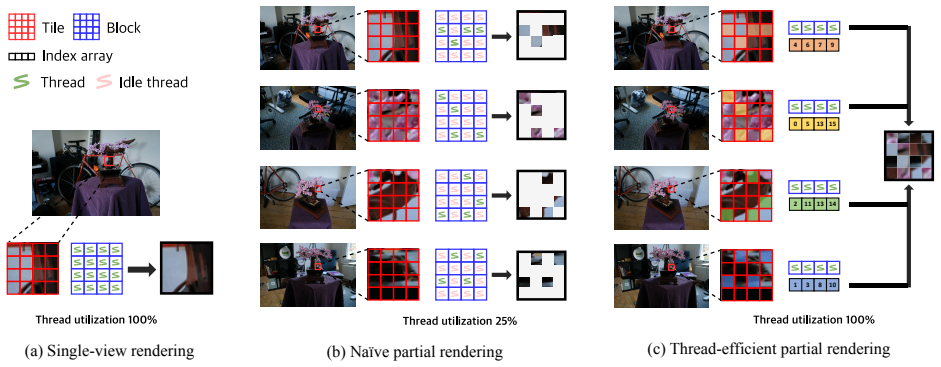
The engine of the argument is Lemma 1, a variance identity for sample means: if one draws $K$ samples from each of $N$ distributions with distinct means, the variance of the resulting mini-batch mean is proportional to $1/m$, where $m$ is the number of distributions sampled, so drawing from all distributions ($m=N$) minimizes variance and drawing from a single distribution ($m=1$) maximizes it. Proposition 1 lifts this to gradients: when the clusters of input data match the clusters of gradient vectors, sampling across clusters reduces mini-batch gradient variance, and the paper applies this to the camera viewpoints acting as clusters. The engineering machinery that makes the principle usable in 3DGS is threefold: thread-efficient partial rendering, which splits each tile across small thread blocks so masked-out pixels never leave threads idle; a 3D distance-aware D-SSIM loss, which replaces the 2D Gaussian kernel $K_\sigma$ with a kernel $K^*_\sigma(u,v)=(1/2\pi\sigma^2)\exp(-(X^2+Y^2+Z^2)/2\sigma^2)$ built from the world-space position of each pixel computed through predicted depth; and multi-view adaptive density control, which substitutes invalid sums of 2D positional gradients in different image planes with the space-independent metrics $E_1(G)=\sum_{k}\sum_{V_{p_i}=k}\|\nabla_{p_i}L\|_2$ and $E_2(G)=\sum_k\|\sum_{V_{p_i}=k}\nabla_{p_i}L\|_2$. Together, these pieces carry the variance-reduction principle into 3DGS without the full cost of multi-view rendering.
What would settle it
Freeze a trained or mid-training 3DGS model, sample many single-view and many four-view mini-batches, and compute the per-parameter gradient variance for the actual Gaussian means, scales, rotations, colors, and opacities; if single-view variance is not substantially larger than multi-view variance, the proposed explanation is wrong even if the methods still improve the metrics. Repeating the paper's Fig. 2 measurement on the rasterized Gaussian parameters rather than a proxy would settle whether the variance reduction actually occurs where it is claimed.
Extended reading notes
Core claim
The paper's central claim is that the de facto single-view mini-batch training of 3DGS is suboptimal, and that multi-view training is strictly better once it is made affordable. The core discovery is a variance argument: for a fixed number of samples, a mini-batch that draws from all N distributions (viewpoints) has sample-mean variance proportional to 1/N, while drawing all samples from one distribution leaves variance roughly N times larger, so multi-view gradients are closer to the true batch gradient and give more stable optimization. The paper then makes multi-view practical for 3DGS with three changes: a thread-efficient partial rendering that renders a sub-sampled set of pixels per viewpoint without idle GPU threads; a 3D distance-aware D-SSIM loss that measures structural similarity from 3D distances rather than 2D pixel neighborhoods, so pixels from different viewpoints are not forced to be similar; and a multi-view adaptive density control that replaces invalid sums of 2D positional gradients from different image planes with a sum of norms. With these pieces, training 3DGS and 3DGS-MCMC with four views per iteration improves PSNR, SSIM, and LPIPS over the single-view baselines across MipNeRF-360, Deep Blending, Tanks and Temples, and OMMO.
Load-bearing premise
The load-bearing assumption is that each camera viewpoint produces its own distinct cluster of per-image gradients for the Gaussian parameters, so mixing viewpoints lowers the variance of the mini-batch gradient; if the gradients from one viewpoint are just samples of the same distribution as any other, the variance argument collapses, though the empirical gains could still hold.
Editorial extensions
If this is right
- Training 3DGS with four views per iteration instead of one produces higher PSNR/SSIM and lower LPIPS on MipNeRF-360, Deep Blending, Tanks and Temples, and OMMO, with the same or lower wall-clock time when partial rendering and halved iterations are used.
- The multi-view benefit is not specific to the original 3DGS: adding only the multi-view strategy to 3DGS-MCMC raises its numbers, so the method transfers to variants that do not use adaptive density control.
- The densification fix matters: multi-view training without the modified density control underperforms multi-view training with it, because summing 2D positional gradients across different image planes can cancel to zero.
- D-SSIM cannot simply be applied per viewpoint in partial rendering; the 3D distance-aware version recovers the structural-similarity benefit, and removing it costs PSNR, SSIM, and LPIPS.
- Because multi-view training changes the learning dynamics, the paper scales the pruning threshold by the number of images for 3DGS and divides the mean noise learning rate by the number of images for 3DGS-MCMC.
Reading between the lines
- If the variance mechanism is what drives the gain, then selecting a diverse or well-separated set of viewpoints per iteration should reduce gradient variance further than random selection, since Lemma 1's benefit comes from sampling across distinct gradient clusters; the paper does not test view-selection strategies.
- The 3D distance-aware D-SSIM loss suggests a general recipe for any renderer that composites pixels into a common buffer: replace 2D structural-similarity windows with kernels weighted by world-space distance, using predicted depth, to avoid penalizing discontinuities that are real scene boundaries.
- The same thread-efficient partial-rendering idea could be applied beyond training, for example to render only masked or sparse regions in an image while keeping tile-based rasterization fully occupied, which would benefit tasks like scene editing or segmentation-guided rendering.
- More than four views per iteration keeps improving PSNR in the paper's table, but at higher memory and preprocess cost; an adaptive budget that grows the number of views only when gradient variance is high could capture most of the benefit more cheaply.
Editorial analysis
A structured set of objections, weighed in public.
Referee Report
Summary. The paper argues that the de facto single-view mini-batch training of 3D Gaussian Splatting (3DGS) is suboptimal and proposes multi-view mini-batch training. To support this, it presents a variance-reduction argument (Lemma 1 and Proposition 1) and empirical gradient-variance plots (Fig. 2). It then introduces three components: thread-efficient partial rendering to reduce the cost of rendering multiple images per iteration, a 3D distance-aware D-SSIM loss computed in world space, and a multi-view adaptive density control that avoids summing 2D positional gradients across different viewpoints. Experiments on MipNeRF-360, OMMO, Deep Blending, and Tanks and Temples report consistent improvements over 3DGS and 3DGS-MCMC, with ablations for each component, a comparison of rendering strategies, and a matched-time experiment.
Significance. If the central causal claim holds, the paper is a practically valuable contribution: it turns a ubiquitous but undocumented training choice in 3DGS into a deliberate, better-performing protocol, and the proposed rasterizer modification is a genuine engineering contribution that could benefit downstream 3DGS variants. The paper is commendably transparent in several respects: it discloses the additional hyperparameter scalings in Sec. 10, reports per-scene results in Tab. 7, provides pseudocode for the rasterizer changes, and includes a matched-time control in Tab. 5. The main weakness is that the disclosed hyperparameter changes are not ablated, and the matched-time gains are small and reported without uncertainty, so the empirical core does not yet isolate the effect of multi-view training itself.
major comments (4)
- [Sec. 10, Tabs. 1 and 3] The paper changes two hyperparameters when switching to multi-view training—the pruning threshold is multiplied by the number of images B in 3DGS, and the mean-noise learning rate is divided by B in 3DGS-MCMC—but no ablation isolates these scalings. The 3DGS-MCMC row in Tab. 1 (29.83 to 30.42) is labeled 'only the multi-view training strategy is applied', yet it also includes the learning-rate division from Sec. 10. To support the claim that multi-view training itself is effective, the authors should compare single-view training with the same hyperparameter scaling against multi-view training with and without scaling. Similarly, Tab. 3 does not state whether the pruning threshold scaling is applied in the '✗' condition, so the improvement attributed to multi-view ADC could be confounded with the threshold change.
- [Tabs. 1, 4, and 5] The headline improvements are obtained at substantially increased wall-clock time (e.g., 50m vs. 26m for 3DGS in Tabs. 4 and 5), and the matched-time comparison in Tab. 5 shows only +0.15 PSNR for 3DGS and +0.42 for 3DGS-MCMC. No standard deviations or per-seed results are reported, despite the paper stating that three repeats were averaged. With gains of this size, run-to-run variability in 3DGS could be comparable to the reported improvement. The authors should report error bars or per-seed values and, ideally, a significance test for the matched-time comparison, since this is the experiment that directly supports the 'comparable or lower training time' claim.
- [Sec. 8.1, Proposition 1, and Fig. 2] The transfer of the variance-reduction Lemma 1 to 3DGS rests on the unverified assumption that 'clusters of x are the same as the clusters of psi(x,y)' for 3DGS rasterization parameters. The paper provides no evidence that each viewpoint forms a gradient cluster for Gaussian means, scales, or colors, and Fig. 2 does not specify which parameters were used for the 3DGS variance measurement or how the variance was computed. Because the theoretical analysis is a stated contribution and is used to motivate the method, the authors should either provide a concrete test of the cluster assumption (e.g., gradient-covariance analysis per parameter group and per viewpoint) or explicitly reframe Proposition 1 as motivation rather than proof.
- [Tab. 3 and Sec. 5.2.2] The multi-view ADC ablation is not sufficient to validate the proposed E1/E2 error metrics. The table contrasts 'Multi-view ADC ✗' with '✓', but it does not describe what the ✗ condition does when gradients arrive from multiple viewpoints—does it naively sum 2D gradients in different spaces, and is the pruning threshold scaling applied? Without these details, the +0.18 PSNR improvement cannot be uniquely attributed to the space-independent error metric.
minor comments (6)
- [Eq. (6), Sec. 4.2] Equation (6) writes 'P(w_t)' where a gradient is meant; as written, P(w_t) is the scalar objective, so the displayed expression is dimensionally inconsistent. Please replace it with ∇P(w_t) throughout Sec. 4.2.
- [Fig. 2] The two panels in Fig. 2 lack axis labels and the caption does not state which parameters were used for the 3DGS variance computation; please add these details and describe how the Monte Carlo estimate in Eq. (6) was instantiated.
- [Sec. 12 and Tab. 7] The Limitations section acknowledges overfitting in the bicycle/stump and Deep Blending scenes; this should be mentioned in the main results discussion, since Tab. 7 shows per-scene degradations such as Stump (26.88 to 26.70) for 3DGS.
- [Tab. 5] The description 'halving the training iterations and the iteration-related hyperparameters' is vague; please specify which hyperparameters were halved (e.g., densification interval, warm-up steps), so the matched-time comparison is reproducible.
- [Algorithm 3] The pseudocode in Algorithm 3 would benefit from a note that the K blocks run concurrently and from a clearer definition of the index array A, since the current 'for block' / 'for thread' nesting is easy to misread as sequential.
- [References] Reference [13] appears as an arXiv preprint, but 3DGS-MCMC was published at ICCV 2024; please update the citation.
Circularity Check
No significant circularity: the variance-reduction argument is an explicit conditional result and the experimental gains are measured against independent baselines, not derived from fitted parameters.
full rationale
The paper's central derivation chain is: Lemma 1 establishes a general variance comparison for stratified sampling from distributions with unequal means; Proposition 1 applies it to mini-batch gradients under an explicitly stated clustering assumption; and the empirical variance measurements (Fig. 2) plus the full 3DGS experiments test the resulting hypothesis. None of these steps defines its conclusion into its premises. Lemma 1 is proved from the definitions of variance and the law of total variance via equations (15)-(43), not imported from a self-citation. The 3D distance-aware D-SSIM loss and multi-view adaptive density control are new components evaluated by ablations against external baselines and against conventional losses (Tables 2 and 3), so they are not fitted parameters renamed as predictions. The paper does change two hyperparameters when switching to multi-view (pruning threshold scaled by the number of images in 3DGS, and mean noise learning rate divided by the number of images in 3DGS-MCMC, Sec. 10), and the matched-time comparison in Tab. 5 is thin, but these are empirical confounds, not circular reductions. The main unproven link is Proposition 1's assumption that clusters of x coincide with clusters of ∇_w L(x,y); that assumption is stated explicitly rather than derived, making it a correctness or generalization risk rather than a circular step, and it does not force the experimental results by construction.
Assumptions & free parameters
free parameters (3)
- Multi-view batch size B =
4
- Pruning threshold multiplier =
4 (equal to B)
- Mean noise learning rate divisor =
4 (equal to B)
assumptions (4)
- standard math Variance of mini-batch gradients is the key determinant of optimization quality
- domain assumption Each viewpoint forms a cluster in data space, and data-space clusters coincide with gradient clusters
- domain assumption Predicted depth from the rasterizer is accurate enough for unprojecting pixels to 3D for D-SSIM
- domain assumption NeRF gradient contributions concentrate at the surface intersection point (Lemma 2)
Cite this review
Pith. "Pith review of Efficient multi-view training for 3D Gaussian Splatting." pith.science (2026). https://pith.science/paper/5QDO7WVE
@misc{pith2026250612727,
  author       = {Pith},
  title        = {Pith review of: Efficient multi-view training for 3D Gaussian Splatting},
  year         = {2026},
  howpublished = {\url{https://pith.science/paper/5QDO7WVE}},
  note         = {Machine review of arXiv:2506.12727}
}
read the original abstract
3D Gaussian Splatting (3DGS) has emerged as a preferred choice alongside Neural Radiance Fields (NeRF) in inverse rendering due to its superior rendering speed. Currently, the common approach in 3DGS is to utilize "single-view" mini-batch training, where only one image is processed per iteration, in contrast to NeRF's "multi-view" mini-batch training, which leverages multiple images. We observe that such single-view training can lead to suboptimal optimization due to increased variance in mini-batch stochastic gradients, highlighting the necessity for multi-view training. However, implementing multi-view training in 3DGS poses challenges. Simply rendering multiple images per iteration incurs considerable overhead and may result in suboptimal Gaussian densification due to its reliance on single-view assumptions. To address these issues, we modify the rasterization process to minimize the overhead associated with multi-view training and propose a 3D distance-aware D-SSIM loss and multi-view adaptive density control that better suits multi-view scenarios. Our experiments demonstrate that the proposed methods significantly enhance the performance of 3DGS and its variants, freeing 3DGS from the constraints of single-view training.
Figures


Figures from the paper (4 more)


Reference graph
Works this paper leans on
-
[1]
Gaussian shell maps for efficient 3d human generation
Rameen Abdal, Wang Yifan, Zifan Shi, Yinghao Xu, Ryan Po, Zhengfei Kuang, Qifeng Chen, Dit-Yan Yeung, and Gor- don Wetzstein. Gaussian shell maps for efficient 3d human generation. In CVPR, 2024. 2
work page 2024
-
[2]
Barron, Ben Mildenhall, Matthew Tancik, Peter Hedman, Ricardo Martin-Brualla, and Pratul P
Jonathan T. Barron, Ben Mildenhall, Matthew Tancik, Peter Hedman, Ricardo Martin-Brualla, and Pratul P. Srinivasan. Mip-nerf: A multiscale representation for anti-aliasing neu- ral radiance fields. In ICCV, 2021. 7
work page 2021
-
[3]
Barron, Ben Mildenhall, Dor Verbin, Pratul P
Jonathan T. Barron, Ben Mildenhall, Dor Verbin, Pratul P. Srinivasan, and Peter Hedman. Mip-nerf 360: Unbounded anti-aliased neural radiance fields. In CVPR, 2022. 6, 7
work page 2022
-
[4]
Tensorf: Tensorial radiance fields
Anpei Chen, Zexiang Xu, Andreas Geiger, Jingyi Yu, and Hao Su. Tensorf: Tensorial radiance fields. In ECCV, 2022. 2
work page 2022
-
[5]
Hallucinated neural radiance fields in the wild
Xingyu Chen, Qi Zhang, Xiaoyu Li, Yue Chen, Ying Feng, Xuan Wang, and Jue Wang. Hallucinated neural radiance fields in the wild. In CVPR, 2022. 2
work page 2022
-
[6]
K-planes: Explicit radiance fields in space, time, and appearance
Sara Fridovich-Keil, Giacomo Meanti, Frederik Rahbæk Warburg, Benjamin Recht, and Angjoo Kanazawa. K-planes: Explicit radiance fields in space, time, and appearance. In CVPR, 2023. 2
2023
-
[7]
Instruct-nerf2nerf: Edit- ing 3d scenes with instructions
Ayaan Haque, Matthew Tancik, Alexei Efros, Aleksander Holynski, and Angjoo Kanazawa. Instruct-nerf2nerf: Edit- ing 3d scenes with instructions. In ICCV, 2023. 2
work page 2023
-
[8]
Deep blending for free-viewpoint image-based rendering
Peter Hedman, Julien Philip, True Price, Jan-Michael Frahm, George Drettakis, and Gabriel Brostow. Deep blending for free-viewpoint image-based rendering. TOG, 2018. 6, 7
work page 2018
Show all 61 references
-
[9]
Barron, Pieter Abbeel, and Ben Poole
Ajay Jain, Ben Mildenhall, Jonathan T. Barron, Pieter Abbeel, and Ben Poole. Zero-shot text-guided object gen- eration with dream fields. In CVPR, 2022. 2
2022
-
[10]
Sdfdiff: Differentiable rendering of signed distance fields for 3d shape optimization
Yue Jiang, Dantong Ji, Zhizhong Han, and Matthias Zwicker. Sdfdiff: Differentiable rendering of signed distance fields for 3d shape optimization. In CVPR, 2020. 2
2020
-
[11]
Gaussianshader: 3d gaussian splatting with shading functions for reflective surfaces
Yingwenqi Jiang, Jiadong Tu, Yuan Liu, Xifeng Gao, Xiaox- iao Long, Wenping Wang, and Yuexin Ma. Gaussianshader: 3d gaussian splatting with shading functions for reflective surfaces. In CVPR, 2024. 3
2024
-
[12]
3d gaussian splatting for real-time radiance field rendering
Bernhard Kerbl, Georgios Kopanas, Thomas Leimk ¨uhler, and George Drettakis. 3d gaussian splatting for real-time radiance field rendering. In TOG, 2023. 1, 2, 6, 7, 8, 15
2023
-
[13]
3d gaussian splatting as markov chain monte carlo
Shakiba Kheradmand, Daniel Rebain, Gopal Sharma, Wei- wei Sun, Jeff Tseng, Hossam Isack, Abhishek Kar, Andrea Tagliasacchi, and Kwang Moo Yi. 3d gaussian splatting as markov chain monte carlo. In arXiv, 2024. 6, 7, 8, 15
2024
-
[14]
Tanks and temples: Benchmarking large-scale scene reconstruction
Arno Knapitsch, Jaesik Park, Qian-Yi Zhou, and Vladlen Koltun. Tanks and temples: Benchmarking large-scale scene reconstruction. TOG, 2017. 6, 7
2017
-
[15]
Decomposing nerf for editing via feature field dis- tillation
Sosuke Kobayashi, Eiichi Matsumoto, and Vincent Sitz- mann. Decomposing nerf for editing via feature field dis- tillation. In NeurIPS, 2022. 2
2022
-
[16]
WildGaussians: 3D gaussian splatting in the wild
Jonas Kulhanek, Songyou Peng, Zuzana Kukelova, Marc Pollefeys, and Torsten Sattler. WildGaussians: 3D gaussian splatting in the wild. arXiv, 2024. 3
2024
-
[17]
Dream- scene: 3d gaussian-based text-to-3d scene generation via for- mation pattern sampling
Haoran Li, Haolin Shi, Wenli Zhang, Wenjun Wu, Yong Liao, Lin Wang, Lik-hang Lee, and Pengyuan Zhou. Dream- scene: 3d gaussian-based text-to-3d scene generation via for- mation pattern sampling. arXiv preprint arXiv:2404.03575,
-
[18]
Neural 3d video synthesis from multi-view video
Tianye Li, Mira Slavcheva, Michael Zollhoefer, Simon Green, Christoph Lassner, Changil Kim, Tanner Schmidt, Steven Lovegrove, Michael Goesele, Richard Newcombe, et al. Neural 3d video synthesis from multi-view video. In CVPR, 2022. 2
2022
-
[19]
Nero: Neural geometry and brdf reconstruction of reflective objects from multiview images
Yuan Liu, Peng Wang, Cheng Lin, Xiaoxiao Long, Jiepeng Wang, Lingjie Liu, Taku Komura, and Wenping Wang. Nero: Neural geometry and brdf reconstruction of reflective objects from multiview images. In SIGGRAPH, 2023. 2
2023
-
[20]
A large-scale outdoor multi-modal dataset and benchmark for novel view synthesis and implicit scene reconstruction
Chongshan Lu, Fukun Yin, Xin Chen, Tao Chen, Gang YU, and Jiayuan Fan. A large-scale outdoor multi-modal dataset and benchmark for novel view synthesis and implicit scene reconstruction. In arXiv, 2023. 6, 7
2023
-
[21]
Neural microfacet fields for inverse render- ing
Alexander Mai, Dor Verbin, Falko Kuester, and Sara Fridovich-Keil. Neural microfacet fields for inverse render- ing. In ICCV, 2023. 2
2023
-
[22]
Ricardo Martin-Brualla, Noha Radwan, Mehdi S. M. Sajjadi, Jonathan T. Barron, Alexey Dosovitskiy, and Daniel Duck- worth. NeRF in the Wild: Neural Radiance Fields for Un- constrained Photo Collections. In CVPR, 2021. 2
2021
-
[23]
Im-3d: Iterative multiview diffusion and re- construction for high-quality 3d generation
Luke Melas-Kyriazi, Iro Laina, Christian Rupprecht, Na- talia Neverova, Andrea Vedaldi, Oran Gafni, and Filippos Kokkinos. Im-3d: Iterative multiview diffusion and re- construction for high-quality 3d generation. arXiv preprint arXiv:2402.08682, 2024. 2
2024 arXiv
-
[24]
Srinivasan, Matthew Tancik, Jonathan T
Ben Mildenhall, Pratul P. Srinivasan, Matthew Tancik, Jonathan T. Barron, Ravi Ramamoorthi, and Ren Ng. Nerf: Representing scenes as neural radiance fields for view syn- thesis. In ECCV, 2020. 1, 2
2020
-
[25]
Instant neural graphics primitives with a mul- tiresolution hash encoding
Thomas M ¨uller, Alex Evans, Christoph Schied, and Alexan- der Keller. Instant neural graphics primitives with a mul- tiresolution hash encoding. ACM Trans. Graph., 2022. 1, 2, 7
2022
-
[26]
Gsedit: Efficient text-guided edit- ing of 3d objects via gaussian splatting
Francesco Palandra, Andrea Sanchietti, Daniele Baieri, and Emanuele Rodol `a. Gsedit: Efficient text-guided edit- ing of 3d objects via gaussian splatting. arXiv preprint arXiv:2403.05154, 2024. 2
2024 arXiv
-
[27]
Fast dy- namic 3d object generation from a single-view video
Zijie Pan, Zeyu Yang, Xiatian Zhu, and Li Zhang. Fast dy- namic 3d object generation from a single-view video. arXiv preprint arXiv 2401.08742, 2024. 2
2024
-
[28]
Barron, Sofien Bouaziz, Dan B Goldman, Steven M
Keunhong Park, Utkarsh Sinha, Jonathan T. Barron, Sofien Bouaziz, Dan B Goldman, Steven M. Seitz, and Ricardo Martin-Brualla. Nerfies: Deformable neural radiance fields. In ICCV, 2021. 2
2021
-
[29]
Barron, Sofien Bouaziz, Dan B Goldman, Ricardo Martin- Brualla, and Steven M
Keunhong Park, Utkarsh Sinha, Peter Hedman, Jonathan T. Barron, Sofien Bouaziz, Dan B Goldman, Ricardo Martin- Brualla, and Steven M. Seitz. Hypernerf: A higher- dimensional representation for topologically varying neural radiance fields. In TOG, 2021. 2
2021
-
[30]
Dreamgaussian4d: Genera- tive 4d gaussian splatting
Jiawei Ren, Liang Pan, Jiaxiang Tang, Chi Zhang, Ang Cao, Gang Zeng, and Ziwei Liu. Dreamgaussian4d: Genera- tive 4d gaussian splatting. arXiv preprint arXiv:2312.17142,
-
[31]
Pointpronets: Consolidation of point clouds 9 with convolutional neural networks
Riccardo Roveri, A Cengiz ¨Oztireli, Ioana Pandele, and Markus Gross. Pointpronets: Consolidation of point clouds 9 with convolutional neural networks. In Computer Graphics Forum, 2018. 2
2018
-
[32]
Plenoxels: Radiance fields without neural networks
Sara Fridovich-Keil and Alex Yu, Matthew Tancik, Qinhong Chen, Benjamin Recht, and Angjoo Kanazawa. Plenoxels: Radiance fields without neural networks. In CVPR, 2022. 1, 2, 7
2022
-
[33]
Structure- from-motion revisited
Johannes L Schonberger and Jan-Michael Frahm. Structure- from-motion revisited. In CVPR, 2016. 6
2016
-
[34]
Contrastive gaussian clustering: Weakly supervised 3d scene segmentation
Myrna C Silva, Mahtab Dahaghin, Matteo Toso, and Alessio Del Bue. Contrastive gaussian clustering: Weakly supervised 3d scene segmentation. arXiv preprint arXiv:2404.12784,
-
[35]
Nerf- player: A streamable dynamic scene representation with de- composed neural radiance fields
Liangchen Song, Anpei Chen, Zhong Li, Zhang Chen, Lele Chen, Junsong Yuan, Yi Xu, and Andreas Geiger. Nerf- player: A streamable dynamic scene representation with de- composed neural radiance fields. In TVCG, 2023. 2
2023
-
[36]
Dreamgaussian: Generative gaussian splatting for ef- ficient 3d content creation
Jiaxiang Tang, Jiawei Ren, Hang Zhou, Ziwei Liu, and Gang Zeng. Dreamgaussian: Generative gaussian splatting for ef- ficient 3d content creation. In ICLR, 2023. 3
2023
-
[37]
Ref-nerf: Struc- tured view-dependent appearance for neural radiance fields
Dor Verbin, Peter Hedman, Ben Mildenhall, Todd Zickler, Jonathan T Barron, and Pratul P Srinivasan. Ref-nerf: Struc- tured view-dependent appearance for neural radiance fields. In CVPR, 2022. 2
2022
-
[38]
Clip-nerf: Text-and-image driven manipula- tion of neural radiance fields
Can Wang, Menglei Chai, Mingming He, Dongdong Chen, and Jing Liao. Clip-nerf: Text-and-image driven manipula- tion of neural radiance fields. CVPR, 2022. 2
2022
-
[39]
Image quality assessment: from error visibility to structural similarity
Zhou Wang, Alan C Bovik, Hamid R Sheikh, and Eero P Simoncelli. Image quality assessment: from error visibility to structural similarity. TIP, 2004. 5, 6
2004
-
[40]
4d gaussian splatting for real-time dynamic scene rendering
Guanjun Wu, Taoran Yi, Jiemin Fang, Lingxi Xie, Xiaopeng Zhang, Wei Wei, Wenyu Liu, Qi Tian, and Xinggang Wang. 4d gaussian splatting for real-time dynamic scene rendering. In CVPR, 2024. 2, 3
2024
-
[41]
Gaussctrl: multi-view consistent text-driven 3d gaussian splatting edit- ing
Jing Wu, Jia-Wang Bian, Xinghui Li, Guangrun Wang, Ian Reid, Philip Torr, and Victor Adrian Prisacariu. Gaussctrl: multi-view consistent text-driven 3d gaussian splatting edit- ing. arXiv preprint arXiv:2403.08733, 2024. 2
2024 arXiv
-
[42]
Perspective transformer nets: Learning single-view 3d object reconstruction without 3d supervision
Xinchen Yan, Jimei Yang, Ersin Yumer, Yijie Guo, and Honglak Lee. Perspective transformer nets: Learning single-view 3d object reconstruction without 3d supervision. NeurIPS, 2016. 2
2016
-
[43]
Real- time photorealistic dynamic scene representation and render- ing with 4d gaussian splatting
Zeyu Yang, Hongye Yang, Zijie Pan, and Li Zhang. Real- time photorealistic dynamic scene representation and render- ing with 4d gaussian splatting. In ICLR, 2024. 2, 3
2024
-
[44]
Gaussiandreamer: Fast generation from text to 3d gaussians by bridging 2d and 3d diffusion models
Taoran Yi, Jiemin Fang, Junjie Wang, Guanjun Wu, Lingxi Xie, Xiaopeng Zhang, Wenyu Liu, Qi Tian, and Xinggang Wang. Gaussiandreamer: Fast generation from text to 3d gaussians by bridging 2d and 3d diffusion models. InCVPR,
-
[45]
The unreasonable effectiveness of deep features as a perceptual metric
Richard Zhang, Phillip Isola, Alexei A Efros, Eli Shechtman, and Oliver Wang. The unreasonable effectiveness of deep features as a perceptual metric. In CVPR, 2018. 6
2018
-
[46]
Loss functions for image restoration with neural networks
Hang Zhao, Orazio Gallo, Iuri Frosio, and Jan Kautz. Loss functions for image restoration with neural networks. IEEE Transactions on computational imaging, 2016. 5
2016
-
[47]
Accelerating minibatch stochastic gradient descent using stratified sampling
Peilin Zhao and Tong Zhang. Accelerating minibatch stochastic gradient descent using stratified sampling. arXiv,
-
[48]
Gala3d: Towards text-to-3d complex scene generation via layout-guided generative gaussian splatting
Xiaoyu Zhou, Xingjian Ran, Yajiao Xiong, Jinlin He, Zhi- wei Lin, Yongtao Wang, Deqing Sun, and Ming-Hsuan Yang. Gala3d: Towards text-to-3d complex scene generation via layout-guided generative gaussian splatting. arXiv preprint arXiv:2402.07207, 2024. 2
2024 arXiv
-
[49]
Tip-editor: An accurate 3d editor fol- lowing both text-prompts and image-prompts
Jingyu Zhuang, Di Kang, Yan-Pei Cao, Guanbin Li, Liang Lin, and Ying Shan. Tip-editor: An accurate 3d editor fol- lowing both text-prompts and image-prompts. TOG, 2024. 2
2024
-
[50]
Ewa volume splatting
Matthias Zwicker, Hanspeter Pfister, Jeroen Van Baar, and Markus Gross. Ewa volume splatting. In Proceedings Visualization, 2001. VIS’01., 2001. 1, 2, 3 10
2001
-
[51]
Derivations We provide theoretical derivations of why the multi-view mini-batch strategy is superior to the single-view mini- batch strategy in NeRF and 3DGS in Sec. 8.1. In addi- tion, we derive the situation where the invalid addition of gradients in different image spaces l...
-
[52]
Then by Lemma 1, VS1 (Eψ(x,y)∈S [ψ(x, y)])<V S2 (Eψ(x,y)∈S [ψ(x, y)]) (46) Because we assume that clusters ofxare the same as the clusters ofψ(x, y), the proposition holds. Lemma 2.For a single rayr(t) =o+td, the intersection point on the rayr(t i)and weights of NeRFw σ andw c...
-
[53]
Additional experiment We compare different numbers of viewpoints in each itera- tion in Tab. 6. We observe that performance increases if we add the number of viewpoints for a mini-batch, but it should be noticed that more viewpoints in a minibatch is equivalent to more memory ...
-
[54]
Other hyperparame- ters are the same as before
Experiment details When applying multi-view training, we found that the learn- ing pattern changed, so in 3DGS, the threshold hyperparam- eter for pruning Gaussians was multiplied by the number of images, and in 3DGS-MCMC, the mean noise learning rate was divided by the number...
-
[55]
The 3DGS rasterizer primarily con- sists of two main components: preprocessing and rendering
Rasterization in multi-view training We describe the modifications made to the 3DGS rasterizer for multi-view training. The 3DGS rasterizer primarily con- sists of two main components: preprocessing and rendering. In the preprocessing stage, the rasterizer performs the fol- lo...
-
[56]
Computing projected 2D Gaussians
-
[57]
Duplicating projected Gaussians for each tile they cover
-
[58]
First, to reduce memory consumption, the ras- terizer determines which Gaussians participate in render- ing for each viewpoint in a mini-batch before preprocess- ing
Sorting Gaussians by depth for each tile For multi-view training, we introduce the following mod- ifications. First, to reduce memory consumption, the ras- terizer determines which Gaussians participate in render- ing for each viewpoint in a mini-batch before preprocess- ing. ...
-
[59]
It is necessary to eliminate the overhead of the preprocessing step to achieve constant time complexity concerning the number of images as NeRF
Limitations Even though we successfully mitigate the overhead of ren- dering part in rasterization, the overhead caused by the pre- processing step still remains. It is necessary to eliminate the overhead of the preprocessing step to achieve constant time complexity concerning...
-
[60]
Detailed results We provided full results of the main table in Tab. 7
-
[61]
We report the full table of 3DGS [12], 3DGS-MCMC [13] and the results of adding our method to them
Algorithms We provide detailed pseudocodes of the difference between the mini-batch strategy of NeRF and 3DGS in Algorithm 1, 14 3DGS 3DGS + Ours MCMC MCMC + Ours PSNR↑/ SSIM↑/ LPIPS↓PSNR↑/ SSIM↑/ LPIPS↓ PSNR↑/ SSIM↑/ LPIPS↓PSNR↑/ SSIM↑/ LPIPS↓ MipNeRF-360 Bicycle 25.62 / 0.77...
Reviewed August 7, 2026 · model on record in the stance chip above.
Discussion (0). Sign in to comment.