REVIEW 3 major objections 5 minor 1 cited by
Physics-informed Neural Motion Planning via Domain Decomposition in Large Environments
T0 review · 3 major / 5 minor · reviewed 2026-08-07 · deepseek-v4-flash
Pith's one-line read Latent-distance neural fields scale physics-informed motion planning to large real-world maps, planning under 0.1 seconds with high success.
desk verdict Solid empirical scaling of physics-informed neural planners, but the latent-distance representation's boundary behavior needs analysis before the method is fully trusted. read the letter →
The pith
A machine-rendered reading of the paper's core claim, the machinery that carries it, and where it could break.
The reading
What carries the argument
The central object is the composite latent embedding $\Phi_w(q)=\sum_i w_i\Phi_i(q)/\sum_i w_i$, where each $\Phi_i$ is a SIREN network with Fourier-feature input, normalized to its subdomain, and $w_i$ is a Gaussian weight that is nonzero only near that subdomain's center. The arrival time is the smooth $L^\infty$ (log-sum-exp) distance between the composite embeddings of the start and goal. This replaces output-space continuity constraints with a latent-space distance, so overlapping subdomains are stitched together by weighted averages of embeddings rather than by matching scalar values at boundary points.
What would settle it
Train FB-NTFields on a large map, then compare predicted $T(q_s,q_g)$ against the true shortest-path time from a fine-grid FMM for many start-goal pairs whose shortest paths cross multiple subdomain boundaries; if the prediction error is large or the gradient-following paths collide for a nontrivial fraction of pairs, the representational claim fails.
Extended reading notes
Core claim
The central claim is that the Eikonal cost-to-go $T(q_s,q_g)$ can be represented as $T(q_s,q_g)=\alpha\log\sum\exp\left(\beta\,|\Phi_w(q_s)-\Phi_w(q_g)|\right)$, where $\Phi_w$ is a weighted composition of subdomain-specific latent encoders, and that training this representation end-to-end with the Eikonal speed loss yields an arrival-time field whose negative gradient guides bidirectional path search. The paper reports that this scheme outperforms NTFields and P-NTFields, which enforce continuity only at individual spatial points and therefore fail to capture the two-point spatial connectivity required for motion planning in large environments.
Load-bearing premise
The load-bearing assumption is that the learned latent distance in equation (5) can represent the true Eikonal travel time for every start-goal pair in a large obstacle-filled environment once the PDE loss has been minimized on randomly sampled pairs, even though no proof is given that this distance obeys metric properties or propagates correctly across subdomain boundaries.
Editorial extensions
If this is right
- Planning in Gibson and real-world maps up to 1859.6 square meters completes in under 0.1 seconds on average with a success rate near 97 percent, against baselines that either collapse or take seconds.
- Training requires only random start-goal samples and distance-to-obstacle queries, no expert trajectories, so the approach can be applied to newly mapped environments in minutes.
- The latent-distance representation is symmetric by construction, so swapping start and goal leaves the predicted time field unchanged.
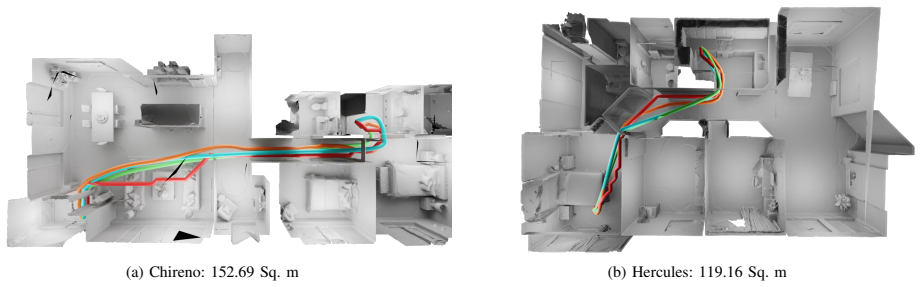
- Bidirectional gradient descent with speed-scaled step sizes produces smooth paths that a Unitree B1 quadruped can follow indoors.
- Because subdomains are small, the largest FB-NTFields model uses fewer parameters than the smallest NTFields and P-NTFields models tested, while converging in far fewer epochs.
Reading between the lines
- If the latent-distance representation reliably approximates the cost-to-go, the same architecture could be adapted to other two-point prediction problems, such as learned distance fields or pairwise collision likelihood, where pointwise scalar fields are awkward.
- The log-sum-exp form interpolates between max-norm and average-norm behavior in latent space, so tuning $\alpha$ and $\beta$ may trade off path safety against path directness, an effect the paper does not explore.
- The Gaussian-weighted subdomain composition should allow incremental updates: when a map changes locally, only the affected subdomain encoders would need retraining, which the paper does not test.
- A natural stress test would be to check whether the learned embedded distance satisfies the triangle inequality on random triples; if it approximately does, the latent space behaves as a learned metric space, which would clarify why gradient-descent path inference works.
Editorial analysis
A structured set of objections, weighed in public.
Referee Report
Summary. The paper introduces FB-NTFields, a neural representation for the Eikonal cost-to-go in motion planning. The workspace is partitioned into overlapping subdomains, each assigned a SIREN encoder with Fourier features; a global encoding Phi_w(q) is formed by Gaussian-weighted averaging of subdomain encodings, and the arrival time is defined as T(q_s,q_g)=alpha*log(sum exp(beta*|Phi_w(q_s)-Phi_w(q_g)|)). Training uses a speed-ratio loss derived from the Eikonal equation against a TSDF-based speed field, and inference follows negative gradients of T bidirectionally. Experiments compare the method with NTFields, P-NTFields, RRT-Connect, LazyPRM, and FMM on ten Gibson environments and two large real-world maps, including a Unitree B1 deployment.
Significance. If the reported results are reproducible, FB-NTFields would be a meaningful advance: it achieves roughly 97% success rate on Gibson maps where NTFields and P-NTFields are around 65%, with planning times of 0.05-0.1 s, lower parameter counts, and no demonstration data. The real-robot deployment and the comparisons against classical planners and FMM ground truth are relevant empirical evidence. The central representational assumption - that a smooth latent distance of the proposed form can represent the Eikonal solution - is, however, not analyzed, and the paper's reproducibility is incomplete because hyperparameters, seeds, and code are not provided.
major comments (3)
- [IV-D, Eq. (5); IV-F, Eq. (8)] The representation T(q_s,q_g)=alpha*log(sum exp(beta*|Phi_w(q_s)-Phi_w(q_g)|)) is symmetric in the two endpoints, and with the standard autodiff subgradient of |.| at 0 it satisfies nabla_{q_s}T(q,q)=0 and nabla_{q_g}T(q,q)=0 for every q. The true Eikonal arrival time has a non-smooth cusp at the source, with ||nabla T|| approaching 1/S*(q) as the moving endpoint approaches the source, not a smooth minimum. Because the training objective in Eq. (6) samples q_s and q_g independently, the near-diagonal region is essentially never penalized, so the predicted speed S=1/||nabla T|| can diverge there. In the bidirectional update of Eq. (8), the term gamma*S^2*nabla T then has magnitude gamma/||nabla T||, which is uncontrollable near the diagonal. The paper should add a boundary/diagonal loss term, sample close start-goal pairs, or report the sensitivity of the reported success rates to the stopping threshold and step size gamma.
- [IV-C, Eq. (4); IV-D, Eq. (5)] The global coherence claim is not established. The Gaussian-weighted average of subdomain encodings guarantees differentiability of Phi_w with respect to q, but it does not by itself guarantee that the induced latent distance satisfies the triangle inequality, that arrival times propagate correctly across subdomain boundaries, or that gradients of T agree with the true geodesic direction when start and goal lie in different subdomains. Eq. (6) constrains only local gradient magnitudes at sampled pairs. I recommend an ablation that reports success rate and path length separately for start-goal pairs that cross subdomain boundaries, and a comparison of the learned T with FMM along such pairs.
- [V-B, Table II; V-C, Table III; IV-G] The empirical core of the paper is not reproducible from the manuscript alone. The hyperparameters alpha, beta, gamma, subdomain count, overlap and Gaussian variance, and the speed-field constants d_min_obs, d_max_obs, and s_const are not specified; success rates are given as point estimates without seeds or confidence intervals; and the code is only promised for the final version. Since the main claim is the large success-rate improvement over NTFields and P-NTFields, the paper should include the configuration (or code) and report variance across at least three seeds, together with the stopping threshold used in Eq. (8).
minor comments (5)
- [III] The sentence 'finding an obstacle-free trajectory tau subset Q_free comparing configuration sequence connecting...' appears to have a typo; 'comparing' should likely be 'comprising' or 'connecting'.
- [III, Eq. (1)] Eq. (1) writes the Eikonal condition only for nabla_{q_g}T; since Eq. (6) also uses nabla_{q_s}T, please state the sign convention for the gradient with respect to the start.
- [V-B, Table II] The text says the table demonstrates the success rate across each environment, but Table II reports aggregate values only; please report per-environment success rates or correct the sentence.
- [IV-F] The stopping threshold for the bidirectional update is not specified; please provide it, as it is directly relevant to the terminal-phase behavior discussed in the major comments.
- [IV-G] The implementation section says the authors plan to release code with the final version; please include a reproducibility statement with hyperparameters and environment splits in the manuscript.
Circularity Check
No significant circularity: the method is trained against an externally specified TSDF speed field and evaluated against classical planners; the only same-author citation is a non-load-bearing design credit.
full rationale
FB-NTFields is self-contained against external benchmarks. Equation (5) defines the arrival time as a LogSumExp over latent differences, and Equation (6) trains the predicted Eikonal speed S = 1/||grad T|| to match the TSDF-derived speed S*(q), which is an externally specified function of obstacle distance. The reported success rates in Tables II and III are measured on start-goal pairs through the resulting time field and are compared against RRTConnect, LazyPRM, and FMM on Gibson and real-world maps, so the planning claim is not equivalent to a fitted target. The only citation to the authors' own prior work is the sentence in Section IV-D crediting the symmetric operator to NTFields; this is an explicit architectural inspiration, and no argument in the paper depends on that prior paper for validity. No uniqueness theorem or prior result is imported to force the architecture. The diagonal-gradient issue noted by a skeptical reader is a soundness limitation of the symmetric ansatz, but it is not a circularity: it does not make any output equal to an input or reduce a prediction to a fit. Accordingly, the derivation chain is not circular, and the score reflects only the minor self-citation.
Assumptions & free parameters
free parameters (4)
- alpha and beta scaling factors =
not reported
- subdomain count, arrangement, overlap, and Gaussian variance =
not reported
- speed-field constants d_min_obs, d_max_obs, s_const =
not reported
- path-inference step size gamma and iteration count =
not reported
assumptions (6)
- standard math The Eikonal PDE viscosity solution defines the true arrival time (cost-to-go) field from a start to a goal.
- ad hoc to paper A function of the form of a smooth L-infinity distance between learned pointwise latent embeddings can represent the Eikonal solution for arbitrary start-goal pairs.
- ad hoc to paper Gaussian-weighted averaging of overlapping subdomain encodings preserves differentiability and global consistency across subdomain boundaries.
- domain assumption SIREN activations and Fourier features can mitigate spectral bias sufficiently within each subdomain.
- domain assumption The speed field S* derived from a truncated signed distance to obstacles is an adequate ground-truth speed for the Eikonal equation in motion planning.
- domain assumption Training on randomly sampled start-goal pairs generalizes to unseen pairs and to new environments.
Cite this review
Pith. "Pith review of Physics-informed Neural Motion Planning via Domain Decomposition in Large Environments." pith.science (2026). https://pith.science/paper/7NFBJKYM
@misc{pith2026250612742,
  author       = {Pith},
  title        = {Pith review of: Physics-informed Neural Motion Planning via Domain Decomposition in Large Environments},
  year         = {2026},
  howpublished = {\url{https://pith.science/paper/7NFBJKYM}},
  note         = {Machine review of arXiv:2506.12742}
}
read the original abstract
Physics-informed Neural Motion Planners (PiNMPs) provide a data-efficient framework for solving the Eikonal Partial Differential Equation (PDE) and representing the cost-to-go function for motion planning. However, their scalability remains limited by spectral bias and the complex loss landscape of PDE-driven training. Domain decomposition mitigates these issues by dividing the environment into smaller subdomains, but existing methods enforce continuity only at individual spatial points. While effective for function approximation, these methods fail to capture the spatial connectivity required for motion planning, where the cost-to-go function depends on both the start and goal coordinates rather than a single query point. We propose Finite Basis Neural Time Fields (FB-NTFields), a novel neural field representation for scalable cost-to-go estimation. Instead of enforcing continuity in output space, FB-NTFields construct a latent space representation, computing the cost-to-go as a distance between the latent embeddings of start and goal coordinates. This enables global spatial coherence while integrating domain decomposition, ensuring efficient large-scale motion planning. We validate FB-NTFields in complex synthetic and real-world scenarios, demonstrating substantial improvements over existing PiNMPs. Finally, we deploy our method on a Unitree B1 quadruped robot, successfully navigating indoor environments. The supplementary videos can be found at https://youtu.be/OpRuCbLNOwM.
Figures


Figures from the paper (1 more)
Forward citations
Cited by 1 Pith paper
-
Mollified Value Learning
Mollified Value Learning regularizes offline goal-conditioned value estimates with a Feynman-Kac expectation version of the viscous HJB equation instead of a pointwise Eikonal constraint.
Reference graph
Works this paper leans on
-
[1]
S. LaValle, “Planning algorithms,”Cambridge University Press google schola, vol. 2, pp. 3671–3678, 2006
work page 2006
-
[2]
Sampling-based algorithms for optimal motion planning,
S. Karaman and E. Frazzoli, “Sampling-based algorithms for optimal motion planning,”The international journal of robotics research, vol. 30, no. 7, pp. 846–894, 2011
2011
-
[3]
Rapidly-exploring ran- dom trees: Progress and prospects,
S. M. LaValle, J. J. Kuffner, B. Donaldet al., “Rapidly-exploring ran- dom trees: Progress and prospects,”Algorithmic and computational robotics: new directions, vol. 5, pp. 293–308, 2001
work page 2001
-
[4]
J. D. Gammell, S. S. Srinivasa, and T. D. Barfoot, “Informed RRT: Optimal sampling-based path planning focused via direct sampling of an admissible ellipsoidal heuristic,” in2014 IEEE/RSJ International Conference on Intelligent Robots and Systems. IEEE, 2014, pp. 2997–3004
work page 2014
-
[5]
Fast marching tree: A fast marching sampling-based method for optimal motion planning in many dimensions,
L. Janson, E. Schmerling, A. Clark, and M. Pavone, “Fast marching tree: A fast marching sampling-based method for optimal motion planning in many dimensions,”The International journal of robotics research, vol. 34, no. 7, pp. 883–921, 2015
2015
-
[6]
Motion planning networks,
A. H. Qureshi, A. Simeonov, M. J. Bency, and M. C. Yip, “Motion planning networks,” in2019 International Conference on Robotics and Automation (ICRA). IEEE, 2019, pp. 2118–2124
2019
-
[7]
Motion planning networks: Bridging the gap between learning-based and classical motion planners,
A. H. Qureshi, Y . Miao, A. Simeonov, and M. C. Yip, “Motion planning networks: Bridging the gap between learning-based and classical motion planners,”IEEE Transactions on Robotics, vol. 37, no. 1, pp. 48–66, 2020
2020
-
[8]
Learning sampling dis- tributions for robot motion planning,
B. Ichter, J. Harrison, and M. Pavone, “Learning sampling dis- tributions for robot motion planning,” in2018 IEEE International Conference on Robotics and Automation (ICRA). IEEE, 2018, pp. 7087–7094
work page 2018
Show all 39 references
-
[9]
Deeply informed neural sampling for robot motion planning,
A. H. Qureshi and M. C. Yip, “Deeply informed neural sampling for robot motion planning,” in2018 IEEE/RSJ International Conference on Intelligent Robots and Systems (IROS). IEEE, 2018, pp. 6582– 6588
2018
-
[10]
Lego: Leveraging experience in roadmap generation for sampling-based planning,
R. Kumar, A. Mandalika, S. Choudhury, and S. Srinivasa, “Lego: Leveraging experience in roadmap generation for sampling-based planning,” in2019 IEEE/RSJ International Conference on Intelligent Robots and Systems (IROS). IEEE, 2019, pp. 1488–1495
2019
-
[11]
Differentiable spatial plan- ning using transformers,
D. S. Chaplot, D. Pathak, and J. Malik, “Differentiable spatial plan- ning using transformers,” inInternational Conference on Machine Learning. PMLR, 2021, pp. 1484–1495
2021
-
[12]
NTFields: Neural time fields for physics- informed robot motion planning,
R. Ni and A. H. Qureshi, “NTFields: Neural time fields for physics- informed robot motion planning,” inInternational Conference on Learning Representations, 2023
2023
-
[13]
Progressive learning for physics-informed neural motion plan- ning,
——, “Progressive learning for physics-informed neural motion plan- ning,”arXiv preprint arXiv:2306.00616, 2023
2023 arXiv
-
[14]
Pc-planner: Physics-constrained self-supervised learning for robust neural motion planning with shape-aware distance function,
X. Shen, H. Peng, Z. Yang, J. Xu, H. Bao, R. Hu, and Z. Cui, “Pc-planner: Physics-constrained self-supervised learning for robust neural motion planning with shape-aware distance function,” in SIGGRAPH Asia 2024 Conference Papers, 2024, pp. 1–11
2024
-
[15]
Physics-informed neural networks: A deep learning framework for solving forward and inverse problems involving nonlinear partial differential equations,
M. Raissi, P. Perdikaris, and G. E. Karniadakis, “Physics-informed neural networks: A deep learning framework for solving forward and inverse problems involving nonlinear partial differential equations,” Journal of Computational physics, vol. 378, pp. 686–707, 2019
2019
-
[16]
Physics-informed machine learning,
G. E. Karniadakis, I. G. Kevrekidis, L. Lu, P. Perdikaris, S. Wang, and L. Yang, “Physics-informed machine learning,”Nature Reviews Physics, vol. 3, no. 6, pp. 422–440, 2021
2021
-
[17]
Viscosity solutions of hamilton- jacobi equations,
M. G. Crandall and P.-L. Lions, “Viscosity solutions of hamilton- jacobi equations,”Transactions of the American mathematical society, vol. 277, no. 1, pp. 1–42, 1983
1983
-
[18]
Frequency principle: Fourier analysis sheds light on deep neural networks,
Z.-Q. J. Xu, Y . Zhang, T. Luo, Y . Xiao, and Z. Ma, “Frequency principle: Fourier analysis sheds light on deep neural networks,”arXiv preprint arXiv:1901.06523, 2019
1901 arXiv
-
[19]
Characterizing possible failure modes in physics-informed neural networks,
A. Krishnapriyan, A. Gholami, S. Zhe, R. Kirby, and M. W. Mahoney, “Characterizing possible failure modes in physics-informed neural networks,”Advances in Neural Information Processing Systems, vol. 34, pp. 26 548–26 560, 2021
2021
-
[20]
Finite basis physics- informed neural networks (fbpinns): a scalable domain decomposition approach for solving differential equations,
B. Moseley, A. Markham, and T. Nissen-Meyer, “Finite basis physics- informed neural networks (fbpinns): a scalable domain decomposition approach for solving differential equations,”Advances in Computa- tional Mathematics, vol. 49, no. 4, p. 62, 2023
2023
-
[21]
Kilonerf: Speeding up neural radiance fields with thousands of tiny mlps,
C. Reiser, S. Peng, Y . Liao, and A. Geiger, “Kilonerf: Speeding up neural radiance fields with thousands of tiny mlps,” inProceedings of the IEEE/CVF international conference on computer vision, 2021, pp. 14 335–14 345
2021
-
[22]
A fast marching level set method for monotonically advancing fronts,
J. A. Sethian, “A fast marching level set method for monotonically advancing fronts,”Proceedings of the National Academy of Sciences, vol. 93, no. 4, pp. 1591–1595, 1996
1996
-
[23]
Direct and indirect methods for trajectory optimization,
O. V on Stryk and R. Bulirsch, “Direct and indirect methods for trajectory optimization,”Annals of operations research, vol. 37, pp. 357–373, 1992
1992
-
[24]
Path-constrained trajectory opti- mization using sparse sequential quadratic programming,
J. T. Betts and W. P. Huffman, “Path-constrained trajectory opti- mization using sparse sequential quadratic programming,”Journal of Guidance, Control, and Dynamics, vol. 16, no. 1, pp. 59–68, 1993
1993
-
[25]
Chomp: Covariant hamiltonian optimization for motion planning,
M. Zucker, N. Ratliff, A. D. Dragan, M. Pivtoraiko, M. Klingensmith, C. M. Dellin, J. A. Bagnell, and S. S. Srinivasa, “Chomp: Covariant hamiltonian optimization for motion planning,”The International journal of robotics research, vol. 32, no. 9-10, pp. 1164–1193, 2013
2013
-
[26]
Value iter- ation networks,
A. Tamar, Y . Wu, G. Thomas, S. Levine, and P. Abbeel, “Value iter- ation networks,”Advances in neural information processing systems, vol. 29, 2016
2016
-
[27]
Prm-rl: Long-range robotic navigation tasks by combining reinforcement learning and sampling-based planning,
A. Faust, K. Oslund, O. Ramirez, A. Francis, L. Tapia, M. Fiser, and J. Davidson, “Prm-rl: Long-range robotic navigation tasks by combining reinforcement learning and sampling-based planning,” in 2018 IEEE international conference on robotics and automation (ICRA). IEEE, 2018,...
2018
-
[28]
Universal planning networks: Learning generalizable representations for visuo- motor control,
A. Srinivas, A. Jabri, P. Abbeel, S. Levine, and C. Finn, “Universal planning networks: Learning generalizable representations for visuo- motor control,” inInternational Conference on Machine Learning. PMLR, 2018, pp. 4732–4741
2018
-
[29]
Control transformer: robot navigation in unknown environments through prm-guided return-conditioned sequence modeling,
D. Lawson and A. H. Qureshi, “Control transformer: robot navigation in unknown environments through prm-guided return-conditioned sequence modeling,” in2023 IEEE/RSJ International Conference on Intelligent Robots and Systems (IROS). IEEE, 2023, pp. 9324–9331
2023
-
[30]
Physics-informed neural motion planning on constraint manifolds,
R. Ni and A. H. Qureshi, “Physics-informed neural motion planning on constraint manifolds,”arXiv preprint arXiv:2403.05765, 2024
2024 arXiv
-
[31]
Tensorf: Tensorial ra- diance fields,
A. Chen, Z. Xu, A. Geiger, J. Yu, and H. Su, “Tensorf: Tensorial ra- diance fields,” inEuropean conference on computer vision. Springer, 2022, pp. 333–350
2022
-
[32]
Instant neural graphics primitives with a multiresolution hash encoding,
T. M ¨uller, A. Evans, C. Schied, and A. Keller, “Instant neural graphics primitives with a multiresolution hash encoding,”ACM transactions on graphics (TOG), vol. 41, no. 4, pp. 1–15, 2022
2022
-
[33]
Nerf: Representing scenes as neural radiance fields for view synthesis,
B. Mildenhall, P. P. Srinivasan, M. Tancik, J. T. Barron, R. Ra- mamoorthi, and R. Ng, “Nerf: Representing scenes as neural radiance fields for view synthesis,”Communications of the ACM, vol. 65, no. 1, pp. 99–106, 2021
2021
-
[34]
Fourier features let networks learn high frequency functions in low dimen- sional domains,
M. Tancik, P. Srinivasan, B. Mildenhall, S. Fridovich-Keil, N. Ragha- van, U. Singhal, R. Ramamoorthi, J. Barron, and R. Ng, “Fourier features let networks learn high frequency functions in low dimen- sional domains,”Advances in Neural Information Processing Systems, vol. 33, ...
2020
-
[35]
Implicit neural representations with periodic activation functions,
V . Sitzmann, J. N. Martel, A. W. Bergman, D. B. Lindell, and G. Wetzstein, “Implicit neural representations with periodic activation functions,” inProc. NeurIPS, 2020
2020
-
[36]
igibson 2.0: Object-centric simulation for robot learning of everyday house- hold tasks,
C. Li, F. Xia, R. Mart ´ın-Mart´ın, M. Lingelbach, S. Srivastava, B. Shen, K. Vainio, C. Gokmen, G. Dharan, T. Jainet al., “igibson 2.0: Object-centric simulation for robot learning of everyday house- hold tasks,”arXiv preprint arXiv:2108.03272, 2021
2021 arXiv
-
[37]
RRT-connect: An efficient approach to single-query path planning,
J. J. Kuffner and S. M. LaValle, “RRT-connect: An efficient approach to single-query path planning,” inProceedings 2000 ICRA. Millen- nium Conference. IEEE International Conference on Robotics and Automation. Symposia Proceedings (Cat. No. 00CH37065), vol. 2. IEEE, 2000, pp. 995–1001
2000
-
[38]
Path planning using lazy prm,
R. Bohlin and L. E. Kavraki, “Path planning using lazy prm,” in Proceedings 2000 ICRA. Millennium conference. IEEE international conference on robotics and automation. Symposia proceedings (Cat. No. 00CH37065), vol. 1. IEEE, 2000, pp. 521–528
2000
-
[39]
GEASI: Geodesic-based earliest activation sites identification in cardiac models,
T. Grandits, A. Effland, T. Pock, R. Krause, G. Plank, and S. Pezzuto, “GEASI: Geodesic-based earliest activation sites identification in cardiac models,”International Journal for Numerical Methods in Biomedical Engineering, vol. 37, no. 8, p. e3505, 2021. [Online]. Available:...
2021 doi
Reviewed August 7, 2026 · model on record in the stance chip above.
Discussion (0). Sign in to comment.