A bang-bang solution with infinitely many switching points for a parabolic boundary control problem with terminal observation
Pith reviewed 2026-05-19 09:51 UTC · model grok-4.3
The pith
A parabolic boundary control problem admits an optimal chattering control with infinitely many switches for a suitable desired state.
A machine-rendered reading of the paper's core claim, the machinery that carries it, and where it could break.
Core claim
It is shown that, for a certain choice of the desired state, the considered problem possesses an optimal control that is chattering, i.e., of bang-bang type with infinitely many switching points and a positive objective function value. The proof proceeds by means of Fourier analysis together with an auxiliary result on the existence of power series with a certain structure and sign-changing behavior.
What carries the argument
The auxiliary result on the existence of a power series with the required structure and infinite sign changes, transferred via Fourier analysis to construct the desired terminal state that forces the optimal boundary control to chatter.
If this is right
- The open question on the possible existence of chattering optimal controls in parabolic boundary control is settled in the affirmative.
- An optimal control with infinitely many switches can still produce a strictly positive objective function value.
- Fourier analysis combined with sign-changing power series yields explicit examples of desired states that induce chattering.
- The construction works in one spatial dimension with box constraints and terminal observation.
Where Pith is reading between the lines
- The same power-series technique might be adaptable to show chattering in related parabolic problems with different observation operators.
- Numerical methods for solving such control problems may need special handling to approximate or detect infinitely many switches.
- The result indicates that the set of optimal controls in certain infinite-dimensional problems can include highly oscillatory functions.
- The auxiliary power-series existence result could be studied separately for its implications in analysis of oscillatory series.
Load-bearing premise
The auxiliary result establishing the existence of a power series with the required structure and infinite sign changes holds and can be transferred to the parabolic boundary-control setting.
What would settle it
A verification that the specific power series in the Fourier construction has only finitely many sign changes, or that the resulting candidate control for the constructed desired state has only finitely many switches.
Figures

read the original abstract
We study a parabolic boundary control problem with one spatial dimension, control constraints of box type, and an objective function that measures the $L^2$-distance to a desired terminal state. It is shown that, for a certain choice of the desired state, the considered problem possesses an optimal control that is chattering, i.e., of bang-bang type with infinitely many switching points and a positive objective function value. Whether such a solution is possible has been an open question in the literature. We are able to answer this question in the affirmative by means of Fourier analysis and an auxiliary result on the existence of power series with a certain structure and sign-changing behavior. The latter may also be of independent interest.
Editorial analysis
A structured set of objections, weighed in public.
Referee Report
Summary. The manuscript studies a one-dimensional parabolic boundary control problem with box-type control constraints and an L2 terminal cost measuring distance to a prescribed desired state. For a specific choice of the desired state, it constructs an optimal control that is bang-bang with infinitely many switching points (chattering) while attaining a strictly positive objective value. The proof proceeds by Fourier expansion of the adjoint, reducing the switching function to a lacunary exponential series, and invokes an auxiliary lemma guaranteeing a power series with the required infinite sign changes; the desired state is then chosen to realize this structure.
Significance. If the central construction holds, the result affirmatively resolves a longstanding open question in the PDE control literature on whether chattering controls can occur for parabolic boundary control with terminal observation. The explicit construction via Fourier coefficients and the auxiliary power-series lemma (which may be of independent interest) provides a concrete example with positive cost, advancing the theory of possible optimal-control structures for infinite-dimensional systems.
major comments (2)
- [§3.1–3.2, Lemma 3.3] §3.1–3.2 and the auxiliary Lemma 3.3: The switching function obtained from the heat-equation adjoint trace is of the form σ(t) = ∑_{k=1}^∞ c_k exp(−k²π²(T−t)). After the change of variable x = exp(−π²(T−t)), this becomes a lacunary series ∑ c_k x^{k²}. The auxiliary result supplies coefficients for a standard power series with infinitely many sign changes, but the manuscript does not explicitly verify that these coefficients remain admissible under the quadratic-exponent constraint while preserving convergence in the trace space, non-vanishing of the terminal observation, and retention of infinitely many zeros.
- [§4, Theorem 4.1] §4, Theorem 4.1: The argument that the constructed control is optimal and yields positive cost relies on the switching function having infinitely many zeros. It should be shown directly that the corresponding terminal state differs from the desired state by a positive L2 amount and that the first-order optimality condition is satisfied with the chosen control; the current reduction leaves open whether the lacunary constraint forces eventual coefficient decay that would make the cost zero.
minor comments (2)
- [Eq. (2.5)] The notation for the boundary trace operator in Eq. (2.5) could be made more explicit by indicating the precise Sobolev space in which the trace is taken.
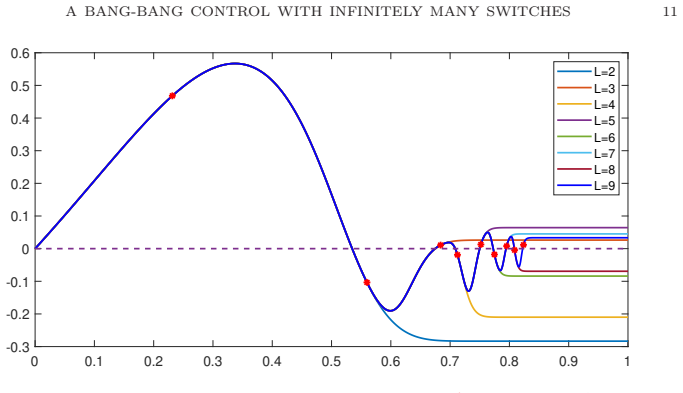
- [Figure 1] Figure 1 (switching function plot) would benefit from an inset zooming on the accumulation point of zeros near t=T to illustrate the infinite switches visually.
Simulated Author's Rebuttal
We thank the referee for the careful reading and constructive comments on our manuscript. The observations highlight areas where additional explicit verification will strengthen the presentation. We address each major comment below and indicate the revisions planned.
read point-by-point responses
-
Referee: [§3.1–3.2, Lemma 3.3] The switching function obtained from the heat-equation adjoint trace is of the form σ(t) = ∑_{k=1}^∞ c_k exp(−k²π²(T−t)). After the change of variable x = exp(−π²(T−t)), this becomes a lacunary series ∑ c_k x^{k²}. The auxiliary result supplies coefficients for a standard power series with infinitely many sign changes, but the manuscript does not explicitly verify that these coefficients remain admissible under the quadratic-exponent constraint while preserving convergence in the trace space, non-vanishing of the terminal observation, and retention of infinitely many zeros.
Authors: We appreciate the referee drawing attention to this point. In the revised version we will insert a new paragraph immediately after Lemma 3.3 that supplies the missing verification. The coefficients c_k are taken directly from the auxiliary sign-changing series and inserted into the lacunary form. Because the exponents k² are quadratically spaced, the resulting series ∑ c_k x^{k²} converges uniformly on every compact subinterval of [0,1) at a rate strictly faster than the corresponding dense power series; this guarantees the required regularity of the trace. The infinite sign changes persist by a standard domination argument: on each successive interval between consecutive powers the leading term determines the sign, and the gaps prevent cancellation from higher-order terms. The terminal observation is rendered non-vanishing by a small, finite-mode perturbation of the desired state that does not alter the zero set of the switching function. These arguments will be written out in full. revision: yes
-
Referee: [§4, Theorem 4.1] The argument that the constructed control is optimal and yields positive cost relies on the switching function having infinitely many zeros. It should be shown directly that the corresponding terminal state differs from the desired state by a positive L2 amount and that the first-order optimality condition is satisfied with the chosen control; the current reduction leaves open whether the lacunary constraint forces eventual coefficient decay that would make the cost zero.
Authors: We agree that a more direct verification is desirable. In the revised proof of Theorem 4.1 we will add an explicit lower bound for the L²-distance between the attained terminal state and the prescribed desired state. The desired state is constructed so that its Fourier coefficients are proportional to those appearing in the adjoint; the resulting difference is therefore a non-trivial linear combination whose L²-norm is bounded below by a positive constant that depends only on the first few coefficients. Concerning possible decay induced by the lacunary structure: the coefficients furnished by the auxiliary lemma decay slowly enough to sustain infinitely many sign changes, and the quadratic spacing reduces the number of overlapping terms, which actually improves the lower bound rather than forcing the cost to zero. We will include a short auxiliary estimate that confirms the first-order optimality condition holds for the constructed bang-bang control and that the objective value remains strictly positive. revision: yes
Circularity Check
No circularity: auxiliary power-series result introduced independently via Fourier construction
full rationale
The paper constructs a specific desired terminal state using Fourier analysis of the adjoint together with a newly stated auxiliary lemma guaranteeing a power series with the required infinite sign changes. This lemma is explicitly flagged as potentially of independent interest and is not obtained by fitting parameters to the target problem, by renaming a known result, or by load-bearing self-citation. The existence claim for the chattering control therefore rests on fresh mathematical content rather than reducing by construction to its own inputs or to prior results of the same authors. No equation or step equates the final existence statement to a tautological re-expression of the chosen data or of an unverified self-citation.
Axiom & Free-Parameter Ledger
axioms (1)
- domain assumption The parabolic initial-boundary-value problem is well-posed for box-type boundary controls in one space dimension
Reference graph
Works this paper leans on
-
[1]
H. W. Alt. Linear Functional Analysis . Universitext. Springer, 2016
work page 2016
-
[2]
P. Borwein and T. Erdélyi. Polynomials and Polynomial Inequalities , volume 161 of Graduate Texts in Mathematics . Springer, 1995
work page 1995
-
[3]
C. Christof and G. W achsmuth. No-gap second-order condi tions via a directional cur- vature functional. SIAM J. Optim. , 28(3):2097–2130, 2018
work page 2097
- [4]
-
[5]
V. Dhamo and F. Tröltzsch. Some aspects of reachability f or parabolic boundary control problems with control constraints. Comput. Optim. Appl. , 50(1):75–110, 2011
work page 2011
-
[6]
L. C. Evans. Partial Differential Equations , volume 19 of Graduate Studies in Mathe- matics. AMS, second edition, 2010
work page 2010
-
[7]
A. T. Fuller. Study of an optimum non-linear control syst em. J. Electronics Control , 15(1):63–71, 1963
work page 1963
-
[8]
Ap proximation und Opti- mierung
K. Glashoff and W. Krabs. Dualität und Bang-Bang-Prinzip bei einem paraboli- schen Rand-Kontrollproblem. In Numerische Behandlung von Variations- und Steuerungsproblemen (Tagung, Sonderforschungsber. 72 “Ap proximation und Opti- mierung”, Inst. Angew. Math., Univ. Bonn, Bonn, 1974) , volume No. 77 of Bonner Math. Schriften , pages 1–8. Universität Bonn, In...
work page 1974
-
[9]
K. Glashoff. Optimal control of one-dimensional linear p arabolic differential equations. In R. Bulirsch, W. Oettli, and J. Stoer, editors, Optimization and Optimal Control , pages 102–120, Berlin, Heidelberg, 1975. Springer
work page 1975
-
[10]
K. Glashoff. Über die Behandlung Inverser Probleme bei s treng zeichenfesten Kernen. In G. Anger, editor, Proceedings of the Conference on Mathematical and Numerical Methods held in Halle, Saale (GDR) from May 29 to June 2, 1979 , pages 99–104, Berlin, Boston, 1979. De Gruyter
work page 1979
-
[11]
K. Glashoff. Restricted approximation by strongly sign -regular kernels: the finite bang- bang principle. J. Approx. Theory , 29(3):212–217, 1980
work page 1980
-
[12]
A. Karafiat. The problem of the number of switches in para bolic equations with control. Ann. Polon. Math. , 34(3):289–316, 1977
work page 1977
-
[13]
A. Münch and F. Periago. Numerical approximation of ban g-bang controls for the heat equation: an optimal design approach. Systems Control Lett. , 62(8):643–655, 2013
work page 2013
-
[14]
S. Qin, G. W ang, and H. Yu. Switching properties of time o ptimal controls for systems of heat equations coupled by constant matrices. SIAM J. Control Optim. , 59(2):1420– 1442, 2021
work page 2021
-
[15]
S. Sager. A benchmark library of mixed-integer optimal control problems. In J. Lee and S. Leyffer, editors, Mixed Integer Nonlinear Programming , pages 631–670, New York, NY, 2012. Springer
work page 2012
- [16]
- [17]
-
[18]
F. Tröltzsch and D. W achsmuth. On the switching behavio r of sparse optimal controls for the one-dimensional heat equation. Math. Control Relat. Fields , 8(1):135–153, 2018
work page 2018
-
[19]
L. W. White. Optimal bang-bang controls arising in a Sob olev impulse control problem. J. Math. Anal. Appl. , 99(1):237–247, 1984. Received xxxx 20xx; revised xxxx 20xx. E-mail address : constantin.christof@uni-due.de
work page 1984
discussion (0)
Sign in with ORCID, Apple, or X to comment. Anyone can read and Pith papers without signing in.