REVIEW 3 major objections 5 minor 41 references
General and Estimable Learning Bound Unifying Covariate and Concept Shifts
T0 review · 3 major / 5 minor · reviewed 2026-08-07 · deepseek-v4-flash
Pith's one-line read This paper proves that target-domain error can be bounded by source error plus two entropic-optimal-transport shift terms, and that both terms can be estimated from finite samples with exponential concentration.
desk verdict Theorem 3.10 is a correct and genuinely general Lipschitz triangle inequality, but the paper's advertised estimability guarantee rests on two concentration theorems that are unproved in the version I read, and Eq. (19) is printed with the inequality reversed. read the letter →
The pith
A machine-rendered reading of the paper's core claim, the machinery that carries it, and where it could break.
The reading
What carries the argument
The load-bearing object is entropic optimal transport $W_\beta(P,Q)=\inf_{\gamma\in\Gamma(P,Q)}\{ \int \rho\,d\gamma + \beta H(\gamma\,|\,P\otimes Q)\}$, whose optimal plan $\gamma^*$ is unique for $\beta>0$ and has full product support. This plan simultaneously defines the covariate shift $S_{\rm Cov}=W_\beta(D_S^X,D_T^X)$ and the total pair concept shift $S^{\gamma^*}_{\rm Cpt}=\mathbb{E}_{(x_S,x_T)\sim\gamma^*}[W_1(D_S^{Y|X=x_S},D_T^{Y|X=x_T})]$, so no pointwise comparison of conditional label laws is needed outside the source support. The estimation side rests on a split-sample debiased estimator $W^{\rm deb}_\beta(\cdot,\cdot)$ that subtracts within-domain empirical transport distances from cross-domain ones, together with the Sinkhorn algorithm used to compute discrete entropic transport plans.
What would settle it
Run the debiased estimator on independent Gaussian samples in, say, $d=100$ with identical source and target distributions; the true $W_\beta$ is zero, so any upward bias is pure estimation error. If the error follows the known $O(N^{-1/d})$ decay of empirical Wasserstein distances instead of the claimed exponential decay, Theorem 4.3 is false. A complementary check: on a regression dataset with a known Lipschitz hypothesis, compute the estimated bound and compare it with the measured target error on many target domains; the paper's claim fails if the bound is routinely violated beyond numerical slack.
Extended reading notes
Core claim
The paper's central discovery is that entropic optimal transport gives a support-agnostic way to separate covariate shift from concept shift. For an $L_h$-Lipschitz hypothesis and a separately $(L_\ell,L'_\ell)$-Lipschitz loss, the target error satisfies $\epsilon_T(h) \le \epsilon_S(h) + L_h L'_\ell S_{\rm Cov} + L_\ell S^{\gamma^*}_{\rm Cpt}$, where $S_{\rm Cov}=W_\beta(D_S^X,D_T^X)$ and $S^{\gamma^*}_{\rm Cpt}=\mathbb{E}_{(x_S,x_T)\sim\gamma^*}[W_1(D_S^{Y|X=x_S},D_T^{Y|X=x_T})]$ with $\gamma^*$ the optimal entropic transport plan between the covariate distributions. Because $\gamma^*$ couples every source point to every target point when $\beta>0$, the concept-shift term stays well-defined even when $\operatorname{supp}(D_S^X)$ and $\operatorname{supp}(D_T^X)$ are disjoint. The paper further claims that split-sample debiasing of the plug-in entropic transport estimator removes the high-dimensional overestimation and yields exponential concentration, making the bound directly estimable from finite samples.
Load-bearing premise
The practical claim collapses if the split-sample debiased estimator does not actually eliminate the high-dimensional bias of empirical entropic transport distances, because the proof of its exponential concentration (Theorem 4.3) is the only bridge from the bound to finite-sample estimability.
Editorial extensions
If this is right
- Target error can be bounded and, given samples, estimated for regression, multiclass classification, and stochastic label noise, not just binary deterministic classification.
- Support overlap between source and target no longer needs to be assumed; the bound is meaningful when the target covariate distribution has mass outside the source support.
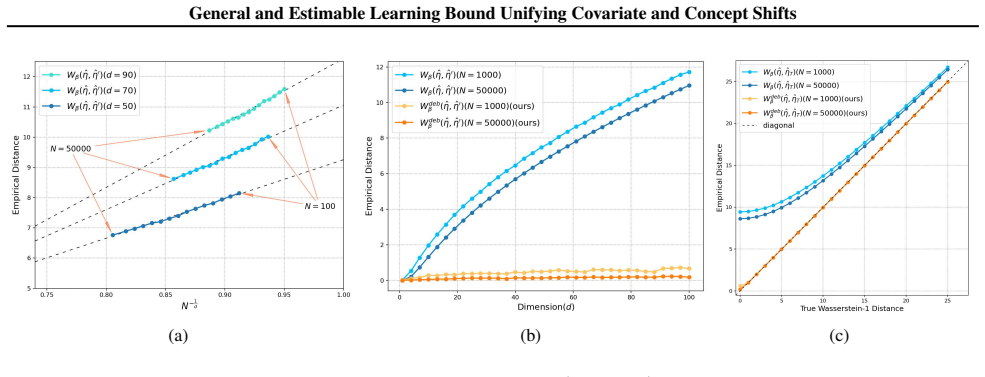
- The split-sample debiased estimator removes the curse-of-dimensionality overestimation of empirical Wasserstein distances, so shift quantification remains meaningful in high-dimensional covariate spaces.
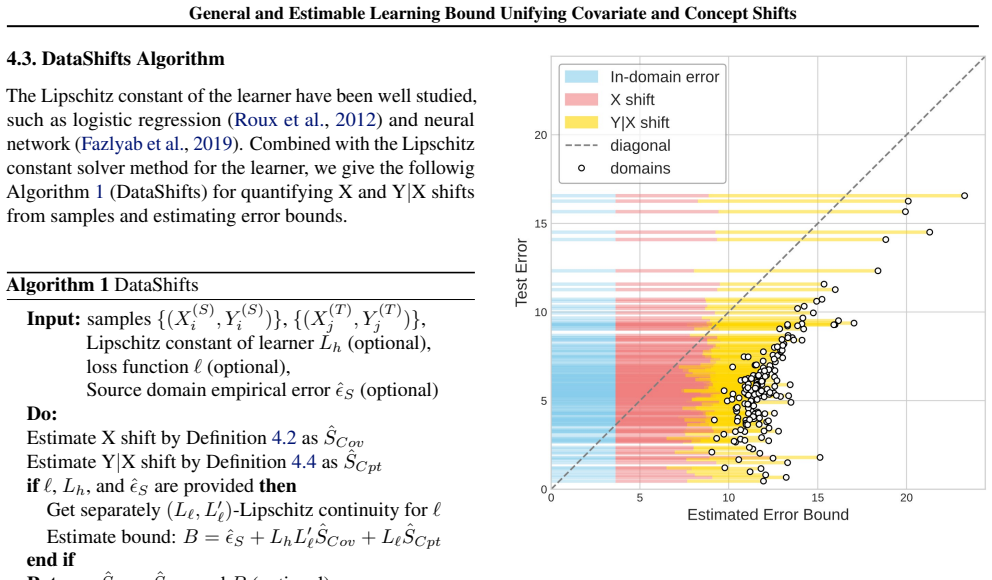
- The DataShifts algorithm outputs concrete numbers: an estimated covariate shift, concept shift, and an error-bound estimate, usable as a pre-deployment check.
- The bound's tightness on the enzyme-stability experiment indicates that estimated bounds can track actual test error across many target domains.
Reading between the lines
- Beyond the paper, the bound can be read as a pre-deployment diagnostic: compute the estimated bound on candidate target domains and withhold deployment where it exceeds the tolerable risk envelope.
- An extension the authors do not pursue is to use the same split-sample debiasing idea on heavy-tailed or non-Euclidean covariate spaces, where the squared-exponential-moment assumption and the exponential concentration of Theorem 4.3 may fail.
- Because the bound is linear in $L_h$, representation learning could directly optimize $\hat\epsilon_S + L_h L'_\ell \hat S_{\rm Cov} + L_\ell \hat S_{\rm Cpt}$ as a trainable surrogate, turning the theory into a training objective rather than only an evaluation tool.
- When target labels are unavailable, the concept-shift estimator cannot be evaluated; replacing them with pseudo-labels from the source-trained model is a natural testable extension that this paper does not cover.
Editorial analysis
A structured set of objections, weighed in public.
Referee Report
Summary. The paper proposes new, support-agnostic definitions of covariate and concept shift based on entropic optimal transport. Its main theoretical result, Theorem 3.10, states that for a separately Lipschitz loss and an L_h-Lipschitz hypothesis, the target error satisfies eps_T(h) <= eps_S(h) + L_h L'_l S_Cov + L_l S^{gamma*}_Cpt, where S_Cov is the entropic OT distance between source and target covariate marginals and S^{gamma*}_Cpt is the expected conditional-label Wasserstein distance under the optimal transport plan. The paper then introduces a split-sample debiased estimator for S_Cov and a label-pair estimator for S^{gamma*}_Cpt, claims exponential concentration inequalities for both (Theorems 4.3 and 4.6), and packages these into the DataShifts algorithm. Section 5 applies DataShifts to an enzyme-stability regression benchmark.
Significance. If all claims held, the paper would make a useful contribution: Theorem 3.10 is a clean, structurally sound triangle inequality that unifies covariate and concept shift for stochastic labeling, general metric label spaces, and general separately Lipschitz losses, and the critique of prior Y|X-shift definitions under support mismatch is correct. The estimability half, however, is not established. Theorem 4.3 is stated without proof despite asserting a surprisingly strong exponential concentration result, and Theorem 4.6 is false as printed because its inequality direction is reversed. Since the paper's central practical claim is that the bound can be estimated with concentration guarantees, the present manuscript does not yet support that claim. A proof or correction of the two concentration theorems is essential before the paper can be accepted.
major comments (3)
- [Section 4.1, Theorem 4.3] This theorem is the sole evidence for the claim that S_Cov can be estimated with exponential concentration, but no proof is given. The asserted result is much stronger than the O(N^{-1/d}) bias of the plug-in Wasserstein estimator that the authors themselves cite from Fournier and Guillin in the same section. The statement is of the form 'there exists N such that for NS, NT > N', so it does not provide explicit finite-sample rates, and it cannot by itself justify the high-dimensional accuracy shown in Figure 1 or the use of the debiased estimator in DataShifts. The authors need to supply a proof with explicit constants or replace the claim by standard finite-sample bounds and adjust the claims in the abstract and Section 4 accordingly.
- [Section 4.2, Theorem 4.6] As printed, the inequality direction is reversed: the theorem states P(|hat_S_Cpt - S^{gamma*}_Cpt - Delta| < eps) <= RHS, where RHS tends to 0 as N_S, N_T go to infinity, while the left-hand side tends to 1 for a consistent estimator. The intended statement is presumably P(|...| >= eps) <= RHS. In addition, the theorem is stated without proof, the constant Delta is not defined before the theorem, and Algorithm 1 uses hat_S_Cpt directly as an estimate of S^{gamma*}_Cpt even though the theorem is centered on S^{gamma*}_Cpt + Delta. The claimed bound 0 <= Delta <= sqrt(I(D_S_XY)) + sqrt(I(D_T_XY)) also requires proof. Without a corrected and proved statement, the estimability of the concept-shift term is unsupported.
- [Section 4.1, Definition 4.2 and Algorithm 1] Theorem 4.3 is stated only for beta = 0, whereas Definition 4.2, Figure 1, and the DataShifts algorithm use positive beta (Figure 1 reports beta = 0.001). The paper itself emphasizes that beta > 0 gives a unique optimal transport plan. Consequently, the concentration guarantee does not apply to the estimator actually used in the experiments and algorithm. The authors should either prove a version of Theorem 4.3 for beta > 0, set beta = 0 in the algorithm and experiments, or clearly state that the practical estimator is not covered by the theorem.
minor comments (5)
- [Section 3.2, Theorem 3.10] The main learning bound is stated without proof. The proof is an elementary triangle inequality plus a coupling argument, but it should be included so that readers can verify the role of the optimal transport plan and the measurable selection of optimal label couplings.
- [Section 4.1, Eq. (15)] The debiased estimator uses an absolute value inside the square root. If the bracketed expression is negative in expectation, the estimator is not a plug-in estimator of a squared Wasserstein quantity, and its bias behavior should be discussed.
- [Section 4.3, Algorithm 1] The text has a typo: 'followingig Algorithm 1' should be 'following Algorithm 1'.
- [Section 5.1, Figure 2] The sentence 'The results is shown in Fig.2' should be 'The results are shown in Fig.2'. The figure should also clearly label which points represent the estimated bound and which represent the test error, since the text's description of 'lies just below the diagonal' is ambiguous for an upper bound.
- [Abstract and Section 4] The abstract claims the method applies 'in most applications', but Theorems 4.3 and 4.6 require finite squared-exponential moments on X and a bounded label space; these assumptions should be stated in the abstract or at least in the contributions section.
Circularity Check
No circularity: the learning bound is a direct Lipschitz/triangle consequence of the shift definitions, and the estimability shortfalls are correctness risks, not circular reductions.
full rationale
The claimed derivation chain is not circular. S_Cov in Definition 3.1 and S^gamma*_Cpt in Definition 3.6 are defined solely from the source and target distributions; in particular, the transport plan gamma* is chosen from the covariate marginals D_S^X and D_T^X, not from the target error. Theorem 3.10 then follows structurally from the separately Lipschitz loss and the L_h-Lipschitz hypothesis: one bounds |ell(y_T,h(x_T)) - ell(y_S,h(x_S))| by L_ell rho_Y(y_S,y_T) + L'_ell rho'_Y(h(x_S),h(x_T)), controls the first term by the conditional-label Wasserstein distance under gamma*, and controls the second by the transport cost of gamma*, which is at most W_beta(D_S^X,D_T^X). No fitted parameter is renamed as a prediction, and no term in the bound is calibrated to epsilon_T. The estimators in Definitions 4.2 and 4.4 are plug-in or debiasing constructions from source and target samples and are not fit to test error. There are no load-bearing self-citations: Corollary 2.7 rests on standard entropic optimal transport properties and is not a self-citation chain. The genuine concerns in the paper are correctness and rigor issues, not circularity: Theorem 4.3 asserts exponential concentration for the debiased Wasserstein estimator under only finite squared-exponential moments, but no proof is supplied and the claim is in tension with known n^{-1/d} empirical Wasserstein rates; Theorem 4.6 states P(|hat S_Cpt - S^gamma*_Cpt - Delta| < eps) <= RHS, where the RHS tends to 0 although the left side should tend to 1 for a consistent estimator, so the inequality as printed cannot be correct. These issues are about the soundness of the estimability half, not about a definition or fit being circular, so the circularity score remains 0.
Assumptions & free parameters
free parameters (1)
- beta (entropic regularization strength) =
0.001 in experiments
assumptions (6)
- standard math Entropic optimal transport has a unique minimizer with full product support when beta > 0 (Corollary 2.7).
- standard math Conditional probabilities are only unique almost everywhere under the source measure, so expectations under a target measure with new support are ill-defined (Section 2.2).
- domain assumption The loss is separately (L_l, L'_l)-Lipschitz and the hypothesis is L_h-Lipschitz (Definition 3.9, Theorem 3.10).
- domain assumption Source and target covariate distributions have finite squared-exponential moments (Theorem 4.3).
- domain assumption Conditional label distributions are total-variation Lipschitz in x and the label space is bounded (Theorem 4.6).
- domain assumption The learner's Lipschitz constant L_h can be computed by existing solvers (Algorithm 1).
Cite this review
Pith. "Pith review of General and Estimable Learning Bound Unifying Covariate and Concept Shifts." pith.science (2026). https://pith.science/paper/SFHCJSZM
@misc{pith2026250612829,
  author       = {Pith},
  title        = {Pith review of: General and Estimable Learning Bound Unifying Covariate and Concept Shifts},
  year         = {2026},
  howpublished = {\url{https://pith.science/paper/SFHCJSZM}},
  note         = {Machine review of arXiv:2506.12829}
}
read the original abstract
Generalization under distribution shift remains a core challenge in modern machine learning, yet existing learning bound theory is limited to narrow, idealized settings and is non-estimable from samples. In this paper, we bridge the gap between theory and practical applications. We first show that existing bounds become loose and non-estimable because their concept shift definition breaks when the source and target supports mismatch. Leveraging entropic optimal transport, we propose new support-agnostic definitions for covariate and concept shifts, and derive a novel unified error bound that applies to broad loss functions, label spaces, and stochastic labeling. We further develop estimators for these shifts with concentration guarantees, and the DataShifts algorithm, which can quantify distribution shifts and estimate the error bound in most applications -- a rigorous and general tool for analyzing learning error under distribution shift.
Figures
Reference graph
Works this paper leans on
-
[1]
Arjovsky, M., Bottou, L., Gulrajani, I., and Lopez-Paz, D. Invariant risk minimization. arXiv preprint arXiv:1907.02893, 2019
arXiv 1907
-
[2]
Analysis of representations for domain adaptation
Ben-David, S., Blitzer, J., Crammer, K., and Pereira, F. Analysis of representations for domain adaptation. Advances in neural information processing systems, 19, 2006
work page 2006
-
[3]
Ben-David, S., Blitzer, J., Crammer, K., Kulesza, A., Pereira, F., and Vaughan, J. W. A theory of learning from different domains. Machine learning, 79: 0 151--175, 2010
2010
-
[4]
Berger, J. O. Statistical decision theory and Bayesian analysis. Springer Science & Business Media, 2013
work page 2013
-
[5]
Boyd, S. P. and Vandenberghe, L. Convex optimization. Cambridge university press, 2004
2004
-
[6]
T., Namkoong, H., and Yadlowsky, S
Cai, T. T., Namkoong, H., and Yadlowsky, S. Diagnosing model performance under distribution shift. arXiv preprint arXiv:2303.02011, 2023
arXiv 2023
-
[7]
Convergence of entropic schemes for optimal transport and gradient flows
Carlier, G., Duval, V., Peyr \'e , G., and Schmitzer, B. Convergence of entropic schemes for optimal transport and gradient flows. SIAM Journal on Mathematical Analysis, 49 0 (2): 0 1385--1418, 2017
work page 2017
-
[8]
Convergence rate of general entropic optimal transport costs
Carlier, G., Pegon, P., and Tamanini, L. Convergence rate of general entropic optimal transport costs. Calculus of Variations and Partial Differential Equations, 62 0 (4): 0 116, 2023
work page 2023
Show all 41 references
-
[9]
and Marchand, M
Chen, Q. and Marchand, M. Algorithm-dependent bounds for representation learning of multi-source domain adaptation. In International Conference on Artificial Intelligence and Statistics, pp.\ 10368--10394. PMLR, 2023
2023
-
[10]
Cole, S. R. and Frangakis, C. E. The consistency statement in causal inference: a definition or an assumption? Epidemiology, 20 0 (1): 0 3--5, 2009
2009
-
[11]
Joint distribution optimal transportation for domain adaptation
Courty, N., Flamary, R., Habrard, A., and Rakotomamonjy, A. Joint distribution optimal transportation for domain adaptation. Advances in neural information processing systems, 30, 2017
2017
-
[12]
Sinkhorn distances: Lightspeed computation of optimal transport
Cuturi, M. Sinkhorn distances: Lightspeed computation of optimal transport. Advances in neural information processing systems, 26, 2013
2013
-
[13]
Duncan, T. E. On the absolute continuity of measures. The Annals of Mathematical Statistics, 41 0 (1): 0 30--38, 1970
1970
-
[14]
Efficient and accurate estimation of lipschitz constants for deep neural networks
Fazlyab, M., Robey, A., Hassani, H., Morari, M., and Pappas, G. Efficient and accurate estimation of lipschitz constants for deep neural networks. Advances in neural information processing systems, 32, 2019
2019
-
[15]
and Guillin, A
Fournier, N. and Guillin, A. On the rate of convergence in wasserstein distance of the empirical measure. Probability theory and related fields, 162 0 (3): 0 707--738, 2015
2015
-
[16]
and McCann, R
Gangbo, W. and McCann, R. J. The geometry of optimal transportation. 1996
1996
-
[17]
Domain-adversarial training of neural networks
Ganin, Y., Ustinova, E., Ajakan, H., Germain, P., Larochelle, H., Laviolette, F., March, M., and Lempitsky, V. Domain-adversarial training of neural networks. Journal of machine learning research, 17 0 (59): 0 1--35, 2016
2016
-
[18]
and Meng, X.-L
Gelman, A. and Meng, X.-L. Simulating normalizing constants: From importance sampling to bridge sampling to path sampling. Statistical science, pp.\ 163--185, 1998
1998
-
[19]
Stochastic optimization for large-scale optimal transport
Genevay, A., Cuturi, M., Peyr \'e , G., and Bach, F. Stochastic optimization for large-scale optimal transport. Advances in neural information processing systems, 29, 2016
2016
-
[20]
Domain adaptation for large-scale sentiment classification: A deep learning approach
Glorot, X., Bordes, A., and Bengio, Y. Domain adaptation for large-scale sentiment classification: A deep learning approach. In Proceedings of the 28th international conference on machine learning (ICML-11), pp.\ 513--520, 2011
2011
-
[21]
What conditional probability could not be
H \'a jek, A. What conditional probability could not be. Synthese, 137 0 (3): 0 273--323, 2003
2003
-
[22]
An introduction to statistical learning, volume 112
James, G., Witten, D., Hastie, T., Tibshirani, R., et al. An introduction to statistical learning, volume 112. Springer, 2013
2013
-
[23]
and Kallenberg, O
Kallenberg, O. and Kallenberg, O. Foundations of modern probability, volume 2. Springer, 1997
1997
-
[24]
Out-of-distribution generalization via risk extrapolation (rex)
Krueger, D., Caballero, E., Jacobsen, J.-H., Zhang, A., Binas, J., Zhang, D., Le Priol, R., and Courville, A. Out-of-distribution generalization via risk extrapolation (rex). In International conference on machine learning, pp.\ 5815--5826. PMLR, 2021
2021
-
[25]
Towards out-of-distribution generalization: A survey
Liu, J., Shen, Z., He, Y., Zhang, X., Xu, R., Yu, H., and Cui, P. Towards out-of-distribution generalization: A survey. arXiv preprint arXiv:2108.13624, 2021
2021 arXiv
-
[26]
Learning transferable features with deep adaptation networks
Long, M., Cao, Y., Wang, J., and Jordan, M. Learning transferable features with deep adaptation networks. In International conference on machine learning, pp.\ 97--105. PMLR, 2015
2015
-
[27]
G., Raeder, T., Alaiz-Rodr \' guez, R., Chawla, N
Moreno-Torres, J. G., Raeder, T., Alaiz-Rodr \' guez, R., Chawla, N. V., and Herrera, F. A unifying view on dataset shift in classification. Pattern recognition, 45 0 (1): 0 521--530, 2012
2012
-
[28]
Novozymes Enzyme Stability Prediction , 2023
Novozymes. Novozymes Enzyme Stability Prediction , 2023. URL https://www.kaggle.com/competitions/novozymes-enzyme-stability-prediction/
2023
-
[29]
Panaretos, V. M. and Zemel, Y. Statistical aspects of wasserstein distances. Annual review of statistics and its application, 6 0 (1): 0 405--431, 2019
2019
-
[30]
Multi-adversarial domain adaptation
Pei, Z., Cao, Z., Long, M., and Wang, J. Multi-adversarial domain adaptation. In Proceedings of the AAAI conference on artificial intelligence, volume 32, 2018
2018
-
[31]
Fishr: Invariant gradient variances for out-of-distribution generalization
Rame, A., Dancette, C., and Cord, M. Fishr: Invariant gradient variances for out-of-distribution generalization. In International Conference on Machine Learning, pp.\ 18347--18377. PMLR, 2022
2022
-
[32]
A stochastic gradient method with an exponential convergence \_rate for finite training sets
Roux, N., Schmidt, M., and Bach, F. A stochastic gradient method with an exponential convergence \_rate for finite training sets. Advances in neural information processing systems, 25, 2012
2012
-
[33]
Wasserstein distance guided representation learning for domain adaptation
Shen, J., Qu, Y., Zhang, W., and Yu, Y. Wasserstein distance guided representation learning for domain adaptation. In Proceedings of the AAAI conference on artificial intelligence, volume 32, 2018
2018
-
[34]
Covariate shift adaptation by importance weighted cross validation
Sugiyama, M., Krauledat, M., and M \"u ller, K.-R. Covariate shift adaptation by importance weighted cross validation. Journal of Machine Learning Research, 8 0 (5), 2007
2007
-
[35]
and Saenko, K
Sun, B. and Saenko, K. Deep coral: Correlation alignment for deep domain adaptation. In Computer vision--ECCV 2016 workshops: Amsterdam, the Netherlands, October 8-10 and 15-16, 2016, proceedings, part III 14, pp.\ 443--450. Springer, 2016
2016
-
[36]
and Fran c ois, D
Verleysen, M. and Fran c ois, D. The curse of dimensionality in data mining and time series prediction. In International work-conference on artificial neural networks, pp.\ 758--770. Springer, 2005
2005
-
[37]
Towards a theoretical framework of out-of-distribution generalization
Ye, H., Xie, C., Cai, T., Li, R., Li, Z., and Wang, L. Towards a theoretical framework of out-of-distribution generalization. Advances in Neural Information Processing Systems, 34: 0 23519--23531, 2021
2021
-
[38]
Nico++: Towards better benchmarking for domain generalization
Zhang, X., He, Y., Xu, R., Yu, H., Shen, Z., and Cui, P. Nico++: Towards better benchmarking for domain generalization. In Proceedings of the IEEE/CVF conference on computer vision and pattern recognition, pp.\ 16036--16047, 2023
2023
-
[39]
Bridging theory and algorithm for domain adaptation
Zhang, Y., Liu, T., Long, M., and Jordan, M. Bridging theory and algorithm for domain adaptation. In International conference on machine learning, pp.\ 7404--7413. PMLR, 2019
2019
-
[40]
Unsupervised multi-class domain adaptation: Theory, algorithms, and practice
Zhang, Y., Deng, B., Tang, H., Zhang, L., and Jia, K. Unsupervised multi-class domain adaptation: Theory, algorithms, and practice. IEEE Transactions on Pattern Analysis and Machine Intelligence, 44 0 (5): 0 2775--2792, 2020
2020
-
[41]
T., Zhang, K., and Gordon, G
Zhao, H., Des Combes, R. T., Zhang, K., and Gordon, G. On learning invariant representations for domain adaptation. In International conference on machine learning, pp.\ 7523--7532. PMLR, 2019
2019
Reviewed August 7, 2026 · model on record in the stance chip above.
Discussion (0). Sign in to comment.