REVIEW 5 major objections 5 minor 34 references
Scalable Canonical and Isothermal-Isobaric Sampling of Coupled Spin-Lattice Systems with Machine-Learning Potentials
T0 review · 5 major / 5 minor · reviewed 2026-08-07 · deepseek-v4-flash
Pith's one-line read This paper introduces TSPIN, a symplectic Nosé–Hoover-chain framework that turns machine-learning potentials into finite-temperature spin-lattice sampling engines.
desk verdict A promising but not yet rigorous NVT/NPT extension of spin-lattice dynamics; the core idea deserves referee time, but the text as written does not demonstrate the central claim. read the letter →
The pith
A machine-rendered reading of the paper's core claim, the machinery that carries it, and where it could break.
The reading
What carries the argument
The central object is the augmented Hamiltonian built from the Lagrangian in Eq. (1): spin kinetic terms $p_{si}^2/2\mu_i$ place spins on the same footing as lattice kinetic terms $p_i^2/2M_i$, and Nosé–Hoover chain variables $\xi_k$ with masses $Q_k$, plus the Martyna–Tobias–Klein barostat $p_\epsilon/W$ for NPT, couple both subsystems to the desired ensemble. The machinery makes the dynamics symplectic, i.e., phase-space-volume-preserving, so a reversible integrator conserves energy and samples the correct ensemble while integrating spins and lattice together in one MLP evaluation per step instead of the multiple evaluations required by Suzuki–Trotter or Landau–Lifshitz–Gilbert schemes.
What would settle it
Run TSPIN on the same magnetic machine-learning potential at two spin masses differing by an order of magnitude and compare the predicted Curie or Néel temperature; if the transition temperature shifts by more than the stated few percent, the spin mass is not a harmless parameter and the unconstrained-amplitude ensemble is not unique.
Extended reading notes
Core claim
The paper's central claim is that spin–lattice dynamics with machine-learning potentials can be made rigorous and cheap by promoting each spin $\mathbf{S}_i$ to a canonical pair $(\mathbf{S}_i, \boldsymbol{\pi}_i)$ with an effective spin mass $\mu_i$. The extended Lagrangian produces a Hamiltonian whose Nosé–Hoover-chain and Martyna–Tobias–Klein extensions yield symplectic equations of motion for NVE, NVT, and NPT ensembles. Because the spin amplitude is unconstrained, longitudinal spin fluctuations are sampled natively, and because lattice and spin evolve in one reversible integrator, only one model inference per integration step is needed. The paper reports that TSPIN matches the MD/MC reference thermodynamics of Co at lower cost and reproduces the Curie and Néel temperatures within about 7% and 2% of experiment for Co and BiFeO$_3$.
Load-bearing premise
The load-bearing premise is that treating each spin as a free canonical coordinate whose length may fluctuate without constraint still samples the physical spin-lattice ensemble.
Editorial extensions
If this is right
- Magnetic MLPs can be run in direct NVT and NPT molecular dynamics, removing Monte Carlo spin moves or Landau–Lifshitz–Gilbert integration from the sampling loop.
- Cost per step becomes linear in system size and comparable to classical molecular dynamics, enabling large-scale spin-lattice trajectories at 1 fs time steps.
- The same unconstrained-amplitude dynamics distinguishes materials whose local moment softens with temperature (Co) from materials with a nearly rigid high-spin moment (BiFeO$_3$).
- The paper reports Curie and Néel temperatures within about 7% and 2% of experiment for Co and BiFeO$_3$, respectively.
- In FCC Fe, TSPIN captures the transition from double-layered antiferromagnetic order at 10 K to paramagnetic disorder at 600 K with stable energy conservation at 0.5–1.0 fs time steps.
Reading between the lines
- Editorial inference: the spin mass $\mu_i$ is a free parameter, so TSPIN should cover a spectrum from rigid-spin behavior (large $\mu_i$, slow amplitude relaxation) to free-rotor behavior (small $\mu_i$); the paper does not map where physical local moments sit on that spectrum.
- Editorial inference: the variance of $|\mathbf{S}_i|$ in an NVT run gives a direct simulation-derived measure of longitudinal spin-fluctuation cost, and comparing that variance with constrained-moment first-principles calculations would test whether the MLP's spin-length response is physically correct.
- Editorial inference: because the construction only needs canonical kinetic terms and a potential, the same thermostat/barostat extension could couple MLPs to other order parameters such as polarization or structural order parameters, but the paper leaves that as a stated possibility rather than a demonstrated result.
- Editorial inference: a decisive calibration check the paper does not report is whether the predicted Curie temperature depends on $\mu_i$; if it does, the spin mass must be fitted per material and the unconstrained-amplitude ensemble is not unique.
Signed reviews
Editorial analysis
A structured set of objections, weighed in public.
Referee Report
Summary. TSPIN proposes a unified Nosé–Hoover-chain / Martyna–Tobias–Klein framework for coupled spin–lattice dynamics, in which each spin component is promoted to a canonical coordinate with an associated mass. The manuscript claims a symplectic Hamiltonian formulation for NVE, NVT, and NPT ensembles, one machine-learning-potential inference per integration step, and linear scaling. Validation consists of a harmonic benchmark against analytical distributions, a stability/efficiency comparison against LLG-based spin–lattice dynamics in FCC Fe with the DeepSPIN potential, and a qualitative demonstration of antiferromagnetic-to-paramagnetic ordering with temperature. The abstract additionally claims quantitative agreement with experimental Curie and Néel temperatures for Co and BiFeO3, though these results do not appear in the main text.
Significance. If the central claims hold, the paper would provide a practically useful and efficient route to canonical and isothermal–isobaric sampling of spin–lattice systems with machine-learning potentials, an area where existing LLG-based methods incur multiple model evaluations and lack rigorous NPT sampling. The idea of treating spins as Cartesian canonical variables with an unconstrained amplitude is simple and appealing, and the reported one-inference-per-step scaling is attractive for large-scale simulations. The harmonic benchmark is a valid consistency check, and the efficiency comparison is informative. However, several load-bearing aspects of the derivation and validation are currently missing or internally inconsistent, as detailed in the major comments. The physical plausibility of the unconstrained spin amplitude and the quantitative accuracy claims for Co and BiFeO3 are not yet substantiated by the text.
major comments (5)
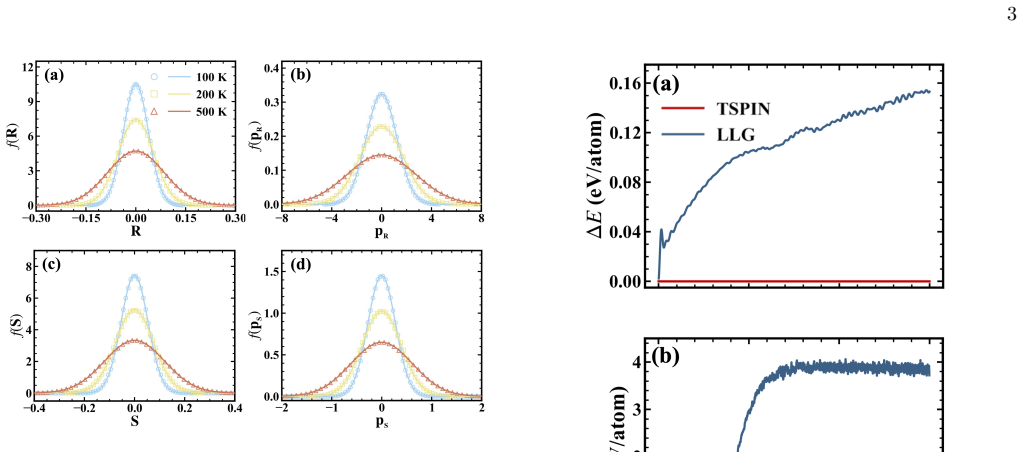
- [Theoretical derivation, Eqs. (1)–(3)] Equation (1) is introduced as the Lagrangian L but is written in terms of the momenta p_i and p_si with a minus sign on U; this is a phase-space Hamiltonian, not a Lagrangian. The 'Euler-Lagrange equations' in Eq. (2) are actually Hamilton's equations, and the 'Legendre transformation' leading to Eq. (3) is not a Legendre transform from L to H because L and H have the same functional form in the momenta. This inconsistency obscures the derivation of the symplectic NVE dynamics. Please rewrite Eq. (1) in velocity form with T = (1/2) M dot R^2 + (1/2) mu dot S^2, or present the phase-space Lagrangian explicitly as p dot q - H, so that the subsequent equations of motion follow unambiguously.
- [NPT equations (Eq. 7)] The NPT equations of motion for R, S, p_R, p_s, the NHC thermostats and the barostat are not given in the manuscript; the text only states that MTK corrections are applied and defers to the Supplemental Material. Without these equations, the central claim of rigorous isothermal-isobaric sampling cannot be verified. In particular, it is not shown whether the spin coordinates S_i are scaled by the barostat, which would affect the volume scaling of the kinetic energy and the pressure virial, and the counting that leads to (L+1)k_B T in Eq. (7) is not stated when L is the total number of unconstrained spin+lattice DOFs. Please include the full equations in the main text or in an appendix, and justify the DOF count.
- [Abstract vs. main text] The abstract asserts that TSPIN 'matches the MD/MC reference thermodynamics of Co' and 'reproduces the Curie and Néel temperatures within ~7% and ~2% of experiment' for Co and BiFeO3, but the main text contains no Co or BiFeO3 simulations; the only realistic-material results are for FCC Fe (Figs. 2–4), and no Curie or Néel temperature is reported there. If these results are in the Supplemental Material, they should be explicitly referenced in the abstract and body; otherwise the abstract overstates the validation and must be revised to reflect what the manuscript actually demonstrates.
- [Fig. 2 and energy conservation] Figure 2 compares the TSPIN conserved quantity (the extended-system Hamiltonian, Eq. (4)) with the potential energy of LLG dynamics under Langevin thermostats. These are not the same observable: the former is a constant of motion of the extended deterministic dynamics, while the latter is a fluctuating quantity in a stochastic thermostat. The energy drift attributed to LLG may reflect thermostatting and integration rather than a failure of the underlying dynamics. To support the stability claim, compare TSPIN with a symplectic spin-lattice integrator (e.g., the Suzuki-Trotter schemes in Refs. [21,22]) using the same conserved quantity, or at least report the total energy of the LLG system including thermostat variables.
- [Unconstrained spin amplitude (Eq. (1), harmonic benchmark)] The method treats S_i as Cartesian coordinates without a fixed-length constraint, which the paper describes as enabling longitudinal fluctuations. However, the harmonic benchmark in Fig. 1 uses a purely quadratic potential with no spin-lattice coupling and therefore cannot test whether the sampled spin modulus statistics are physical. For the Fe, Co, and BiFeO3 applications, the manuscript should report the distribution of |S_i| or the average spin moment as a function of temperature and compare it against fixed-spin-moment or first-principles reference values, and should comment on how the choice of spin mass μ affects equilibration of the longitudinal mode. Without such a check, the physical interpretation of the unconstrained amplitude is not yet substantiated.
minor comments (5)
- [Eq. (7)] The kinetic term for the lattice in Eq. (7) uses a lowercase m, inconsistent with M_i used in Eq. (1) and elsewhere.
- [Fig. 1] The agreement in Fig. 1 is only visual; adding a quantitative measure such as a Kolmogorov-Smirnov statistic would strengthen the benchmark claim.
- [Eqs. (4) and (7)] The definition of L, the total number of degrees of freedom, is missing; for a system with 3N lattice and 3N spin coordinates, L = 6N, and this should be stated explicitly.
- [Efficiency comparison, Fig. 3] The phrase '4×N model evaluations per step' for LLG is confusing because a single MLP inference already processes N atoms; please state the number of MLP inference calls per step instead.
- [Fig. 2] The energy drift is shown only over 3 ps; for a claim of long-term energy conservation, longer trajectories would be more convincing.
Circularity Check
No circular derivation: the TSPIN equations follow from a stated Hamiltonian and standard NHC/MTK extensions; the harmonic benchmark is a consistency check. A self-referential training loop and deferred NPT details are rigor concerns, not circular reductions.
full rationale
The core derivation is self-contained. Eqs. (1)-(3) begin from an explicitly defined Hamiltonian with a spin kinetic term; the NVE equations of motion are the corresponding Hamilton equations, and the NVT/NPT extensions (Eqs. 4-7) are the standard Nosé-Hoover-chain and Martyna-Tobias-Klein constructions cited to Refs. [28,29]. No parameter in these equations is fitted to a target result: the spin mass μ=0.01, thermostat masses, and barostat mass are chosen before the benchmarks, and the harmonic test compares TSPIN output to the analytical Boltzmann distribution of the same H_NVT, which is a self-consistency/integrator check rather than an independent prediction. The Fe/DeepSPIN application does contain a self-referential workflow: 'We integrated TSPIN with the active-learning framework DPGen2 [32] to sample Fe configurations across 0-1500K, constructing a comprehensive potential. ... Subsequently, we applied the trained DeepSPIN model to FCC iron.' This means the high-temperature paramagnetic configurations were already in the training set, so the observed DAFM-to-PM transition is not a fully independent prediction; however, it does not reduce the method's central derivation to a fit, because the validation of TSPIN's sampling rests on the harmonic benchmark and standard thermostat theory. Missing support for the NPT equations (deferred to the Supplemental Material) and the Fig. 2 comparison of the TSPIN extended-system conserved quantity with LLG potential energy are completeness and comparability concerns, not circular steps. The abstract's stated Co and BiFeO3 results are not shown in the provided full text, another missing-support issue. Overall, no load-bearing reduction by construction or via self-citation is present; the minor self-citation of the authors' own DeepSPIN/DPGen2 line is not load-bearing for the method itself.
Assumptions & free parameters
free parameters (3)
- spin mass mu_i =
0.01
- Nose-Hoover chain length C =
3
- integration time step =
0.1 fs
assumptions (4)
- domain assumption Classical spins S_i can be treated as independent canonical coordinates with an effective mass mu_i.
- domain assumption The DeepSPIN MLP U(R,S) accurately represents the spin-lattice potential energy surface for Fe.
- standard math The total number of degrees of freedom L in the NHC thermostat is counted correctly for the spin-lattice system.
- domain assumption The MTK corrections for the NPT barostat are correctly applied to both lattice and spin variables.
Cite this review
Pith. "Pith review of Scalable Canonical and Isothermal-Isobaric Sampling of Coupled Spin-Lattice Systems with Machine-Learning Potentials." pith.science (2026). https://pith.science/paper/ZZSS6YFN
@misc{pith2026250612877,
  author       = {Pith},
  title        = {Pith review of: Scalable Canonical and Isothermal-Isobaric Sampling of Coupled Spin-Lattice Systems with Machine-Learning Potentials},
  year         = {2026},
  howpublished = {\url{https://pith.science/paper/ZZSS6YFN}},
  note         = {Machine review of arXiv:2506.12877}
}
abstract
Magnetic machine-learning potentials (MLPs) now reach near-first-principles accuracy on the spin-lattice potential energy surface, but the dynamics and sampling frameworks that convert this accuracy into quantitative finite-temperature thermodynamics have lagged behind. Landau-Lifshitz-Gilbert spin-lattice dynamics fixes the local moment magnitude and incurs $O(N)$ MLP evaluations per integration step, while hybrid molecular-dynamics/Monte-Carlo lacks rigorous isothermal-isobaric sampling and remains expensive. We introduce TSPIN, which promotes the spin to a canonical pair $(\mathbf{S}_i,\boldsymbol{\pi}_i)$ alongside the lattice $(\mathbf{R}_i,\mathbf{p}_i)$ within a Nos\'e-Hoover-chain / Martyna-Tobias-Klein construction, delivering rigorous canonical and isothermal-isobaric sampling, native access to longitudinal spin fluctuations through an unconstrained spin amplitude, and one MLP evaluation per integration step. Applied to itinerant Co and localized multiferroic BiFeO$_3$, TSPIN matches the MD/MC reference thermodynamics of Co at substantially lower cost and reproduces the Curie and N\'eel temperatures within $\sim 7\%$ and $\sim 2\%$ of experiment, respectively. The same unconstrained-amplitude dynamics resolves contrasting spin-amplitude behavior: pronounced spin-modulus softening in Co, but a nearly temperature-independent high-spin Fe$^{3+}$ moment in BiFeO$_3$. TSPIN thereby promotes magnetic MLPs from accurate energy models to predictive finite-temperature simulation engines.
Figures


Reference graph
Works this paper leans on
-
[1]
Daan Frenkel and Berend Smit.Understanding molecu- lar simulation: from algorithms to applications. Elsevier, 2023
work page 2023
-
[2]
Oxford university press, 2017
Michael P Allen and Dominic J Tildesley.Computer sim- ulation of liquids. Oxford university press, 2017
2017
-
[3]
Complexity in strongly correlated elec- tronic systems.Science, 309(5732):257–262, 2005
Elbio Dagotto. Complexity in strongly correlated elec- tronic systems.Science, 309(5732):257–262, 2005
work page 2005
-
[4]
Interface physics in complex oxide heterostructures.Annu
Pavlo Zubko, Stefano Gariglio, Marc Gabay, Philippe Ghosez, and Jean-Marc Triscone. Interface physics in complex oxide heterostructures.Annu. Rev. Condens. Matter Phys., 2(1):141–165, 2011
work page 2011
-
[5]
Orbital physics in transition-metal oxides.science, 288(5465):462–468, 2000
Yoshinori Tokura and Naoto Nagaosa. Orbital physics in transition-metal oxides.science, 288(5465):462–468, 2000
work page 2000
-
[6]
Ferroelastic materials.Annual Review of Materials Research, 42(1):265–283, 2012
Ekhard KH Salje. Ferroelastic materials.Annual Review of Materials Research, 42(1):265–283, 2012
work page 2012
-
[7]
The renaissance of magnetoelectric multiferroics.Science, 309(5733):391– 392, 2005
Nicola A Spaldin and Manfred Fiebig. The renaissance of magnetoelectric multiferroics.Science, 309(5733):391– 392, 2005
work page 2005
-
[8]
Classifying multiferroics: Mechanisms and effects.Physics, 2:20, 2009
Daniel Khomskii. Classifying multiferroics: Mechanisms and effects.Physics, 2:20, 2009
work page 2009
Show all 34 references
-
[9]
A thermodynamic explanation of the invar effect.Nature Physics, 19(11):1642–1648, 2023
Stefan H Lohaus, Matthew Heine, Pedro Guzman, Camille M Bernal-Choban, Claire N Saunders, Guoyin Shen, Olle Hellman, David Broido, and Brent Fultz. A thermodynamic explanation of the invar effect.Nature Physics, 19(11):1642–1648, 2023
2023
-
[10]
Origin of the invar effect in iron–nickel alloys.Nature, 400(6739):46–49, 1999
Mark van Schilfgaarde, IA Abrikosov, and B Johansson. Origin of the invar effect in iron–nickel alloys.Nature, 400(6739):46–49, 1999
1999
-
[11]
Iron-based superelastic alloys with near-constant critical stress temperature dependence
Ji Xia, Yuki Noguchi, Xiao Xu, Takumi Odaira, Yuta Kimura, Makoto Nagasako, Toshihiro Omori, and Ryosuke Kainuma. Iron-based superelastic alloys with near-constant critical stress temperature dependence. Science, 369(6505):855–858, 2020
2020
-
[12]
Structurally triggered metal-insulator transi- tion in rare-earth nickelates.Nature communications, 8(1):1677, 2017
Alain Mercy, Jordan Bieder, Jorge ´I˜ niguez, and Philippe Ghosez. Structurally triggered metal-insulator transi- tion in rare-earth nickelates.Nature communications, 8(1):1677, 2017
2017
-
[13]
Quan- tifying the role of the lattice in metal–insulator phase transitions.Communications Physics, 5(1):135, 2022
Alexandru B Georgescu and Andrew J Millis. Quan- tifying the role of the lattice in metal–insulator phase transitions.Communications Physics, 5(1):135, 2022
2022
-
[14]
Interatomic potentials: Achievements and challenges.Advances in Physics: X, 8(1):2093129, 2023
Martin H M¨ user, Sergey V Sukhomlinov, and Lars Pastewka. Interatomic potentials: Achievements and challenges.Advances in Physics: X, 8(1):2093129, 2023
2023
-
[15]
Enhanced sampling meth- ods for molecular dynamics simulations.arXiv preprint arXiv:2202.04164, 2022
J´ erˆ ome H´ enin, Tony Leli` evre, Michael R Shirts, Omar Valsson, and Lucie Delemotte. Enhanced sampling meth- ods for molecular dynamics simulations.arXiv preprint arXiv:2202.04164, 2022
2022 arXiv
-
[16]
Deep learning illuminates spin and lattice interaction in magnetic materials.Phys- ical Review B, 110(6):064427, 2024
Teng Yang, Zefeng Cai, Zhengtao Huang, Wenlong Tang, Ruosong Shi, Andy Godfrey, Hanxing Liu, Yuanhua Lin, Ce-Wen Nan, Meng Ye, et al. Deep learning illuminates spin and lattice interaction in magnetic materials.Phys- ical Review B, 110(6):064427, 2024
2024
-
[17]
Equivariant neural network force fields for magnetic materials.Quantum Frontiers, 3(1):8, 2024
Zilong Yuan, Zhiming Xu, He Li, Xinle Cheng, Honggeng Tao, Zechen Tang, Zhiyuan Zhou, Wenhui Duan, and Yong Xu. Equivariant neural network force fields for magnetic materials.Quantum Frontiers, 3(1):8, 2024
2024
-
[18]
Spin- dependent graph neural network potential for magnetic materials.Physical Review B, 109(14):144426, 2024
Hongyu Yu, Yang Zhong, Liangliang Hong, Changsong Xu, Wei Ren, Xingao Gong, and Hongjun Xiang. Spin- dependent graph neural network potential for magnetic materials.Physical Review B, 109(14):144426, 2024
2024
-
[19]
Deep potential molecular dynamics: a scalable model with the accuracy of quantum mechanics.Physical review letters, 120(14):143001, 2018
Linfeng Zhang, Jiequn Han, Han Wang, and Roberto Car. Deep potential molecular dynamics: a scalable model with the accuracy of quantum mechanics.Physical review letters, 120(14):143001, 2018
2018
-
[20]
Recent advances and outstanding challenges for machine learning interatomic potentials.Nature Computational Science, 3(12):998– 1000, 2023
Tsz Wai Ko and Shyue Ping Ong. Recent advances and outstanding challenges for machine learning interatomic potentials.Nature Computational Science, 3(12):998– 1000, 2023
2023
-
[21]
Algorithm for molecular dynamics simulations of spin liquids.Physical review letters, 86(5):898, 2001
IP Omelyan, IM Mryglod, and R Folk. Algorithm for molecular dynamics simulations of spin liquids.Physical review letters, 86(5):898, 2001
2001
-
[22]
Massively parallel symplectic algorithm for coupled magnetic spin dynamics and molecular dynamics.Journal of Computational Physics, 372:406–425, 2018
Julien Tranchida, Steven J Plimpton, Pascal Thibaudeau, and Aidan P Thompson. Massively parallel symplectic algorithm for coupled magnetic spin dynamics and molecular dynamics.Journal of Computational Physics, 372:406–425, 2018
2018
-
[23]
General theory of fractal path integrals with applications to many-body theories and statistical physics.Journal of mathematical physics, 32(2):400–407, 1991
Masuo Suzuki. General theory of fractal path integrals with applications to many-body theories and statistical physics.Journal of mathematical physics, 32(2):400–407, 1991
1991
-
[24]
Explicit reversible integra- tors for extended systems dynamics.Molecular Physics, 87(5):1117–1157, 1996
Glenn J Martyna, Mark E Tuckerman, Douglas J To- bias, and Michael L Klein. Explicit reversible integra- tors for extended systems dynamics.Molecular Physics, 87(5):1117–1157, 1996
1996
-
[25]
Springer, 1985
Werner Heisenberg.Zur theorie des ferromagnetismus. Springer, 1985
1985
-
[26]
Non-collinear magnetic atomic cluster expansion for iron.npj Computational Materials, 10(1):12, 2024
Matteo Rinaldi, Matous Mrovec, Anton Bochkarev, Yury Lysogorskiy, and Ralf Drautz. Non-collinear magnetic atomic cluster expansion for iron.npj Computational Materials, 10(1):12, 2024
2024
-
[27]
Perfor- mance and cost assessment of machine learning inter- atomic potentials.The Journal of Physical Chemistry A, 124(4):731–745, 2020
Yunxing Zuo, Chi Chen, Xiangguo Li, Zhi Deng, Yiming Chen, J¨ org Behler, G´ abor Cs´ anyi, Alexander V Shapeev, Aidan P Thompson, Mitchell A Wood, et al. Perfor- mance and cost assessment of machine learning inter- atomic potentials.The Journal of Physical Chemistry A, 124(4)...
2020
-
[28]
Nos´ e–hoover chains: The canonical ensemble via continuous dynamics.The Journal of chemical physics, 97(4):2635–2643, 1992
Glenn J Martyna, Michael L Klein, and Mark Tucker- man. Nos´ e–hoover chains: The canonical ensemble via continuous dynamics.The Journal of chemical physics, 97(4):2635–2643, 1992
1992
-
[29]
Constant pressure molecular dynamics algorithms.J
Glenn J Martyna, Douglas J Tobias, and Michael L Klein. Constant pressure molecular dynamics algorithms.J. chem. Phys, 101(4177):10–1063, 1994
1994
-
[30]
General method for atomistic spin-lattice dynamics with first-principles accuracy.Physical Review 6 B, 99(10):104302, 2019
Johan Hellsvik, Danny Thonig, Klas Modin, Diana Iu¸ san, Anders Bergman, Olle Eriksson, Lars Bergqvist, and Anna Delin. General method for atomistic spin-lattice dynamics with first-principles accuracy.Physical Review 6 B, 99(10):104302, 2019
2019
-
[31]
Lammps-a flexible simulation tool for particle-based materials modeling at the atomic, meso, and continuum scales.Computer Physics Commu- nications, 271:108171, 2022
Aidan P Thompson, H Metin Aktulga, Richard Berger, Dan S Bolintineanu, W Michael Brown, Paul S Crozier, Pieter J In’t Veld, Axel Kohlmeyer, Stan G Moore, Trung Dac Nguyen, et al. Lammps-a flexible simulation tool for particle-based materials modeling at the atomic, meso, and c...
2022
-
[32]
Dp-gen: A con- current learning platform for the generation of reliable deep learning based potential energy models.Computer Physics Communications, 253:107206, 2020
Yuzhi Zhang, Haidi Wang, Weijie Chen, Jinzhe Zeng, Linfeng Zhang, Han Wang, et al. Dp-gen: A con- current learning platform for the generation of reliable deep learning based potential energy models.Computer Physics Communications, 253:107206, 2020
2020
-
[33]
On the theory of the dispersion of magnetic permeability in ferromagnetic bodies.Phys
LALE Landau, Evgeny Lifshitz, et al. On the theory of the dispersion of magnetic permeability in ferromagnetic bodies.Phys. Z. Sowjetunion, 8(153):101–114, 1935
1935
-
[34]
A phenomenological theory of damp- ing in ferromagnetic materials.IEEE transactions on magnetics, 40(6):3443–3449, 2004
Thomas L Gilbert. A phenomenological theory of damp- ing in ferromagnetic materials.IEEE transactions on magnetics, 40(6):3443–3449, 2004
2004
Reviewed August 7, 2026 · model on record in the stance chip above.
Discussion (0). Continue with ORCID to comment.