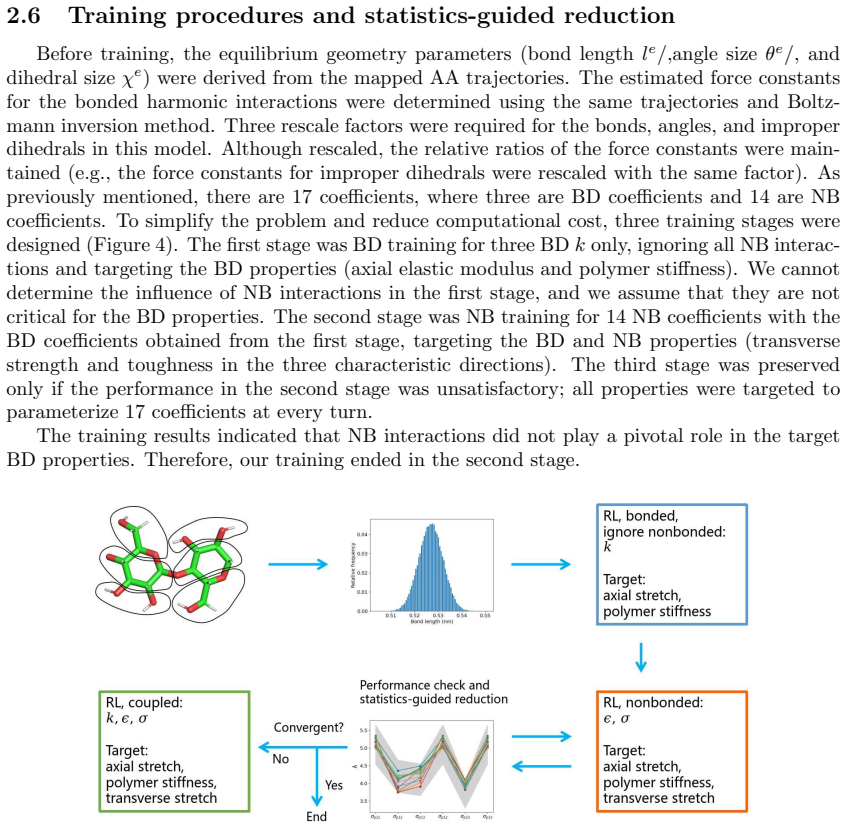
Analytical coarse grained potential parameterization by Reinforcement Learning for anisotropic cellulose
Pith reviewed 2026-05-19 09:35 UTC · model grok-4.3
The pith
Reinforcement learning parameterizes an analytical coarse-grained potential for cellulose that generalizes to mechanical properties outside the training set.
A machine-rendered reading of the paper's core claim, the machinery that carries it, and where it could break.
Core claim
An analytical coarse-grained potential for cellulose is parameterized directly by reinforcement learning in an extended bottom-up scheme that incorporates Boltzmann inversion. The resulting model captures both the anisotropy and the stiffness of cellulose nanocrystals. It reproduces dynamic mechanical properties under circumstances different from those used in training and without requiring additional training, thereby showing that reinforcement learning can produce a coarse-grained potential that is both physically explainable and powerful.
What carries the argument
Reinforcement learning parameterization of an analytical coarse-grained potential combined with Boltzmann inversion, used to encode cellulose anisotropy and polymer stiffness.
If this is right
- The model supports mesoscopic simulations of cellulose material development and manufacture where atomistic methods remain too costly.
- Dynamic mechanical properties can be obtained for conditions outside the original training set without retraining.
- Reinforcement learning supplies a route to coarse-grained potentials that remain both interpretable and accurate for anisotropic polymers.
- The approach extends the bottom-up parameterization workflow to systems whose structure is dominated by directional hydrogen bonds.
Where Pith is reading between the lines
- The same RL-plus-inversion workflow may transfer to other hydrogen-bonded anisotropic nanomaterials such as chitin or silk fibrils.
- Once the analytical form is fixed, the learned parameters could be reused across related cellulose polymorphs with only minor recalibration.
- Embedding the potential in larger-scale continuum models would allow direct prediction of macroscopic composite behavior from the mesoscale anisotropy.
Load-bearing premise
Reinforcement learning combined with Boltzmann inversion can produce an analytical coarse-grained potential that is physically explainable and generalizes to mechanical properties outside the training set for representing cellulose anisotropy.
What would settle it
A direct comparison in which the coarse-grained model is applied to a shear or tensile test at an angle or strain rate absent from the training data and the predicted stiffness or relaxation behavior deviates markedly from corresponding atomistic reference simulations.
Figures






read the original abstract
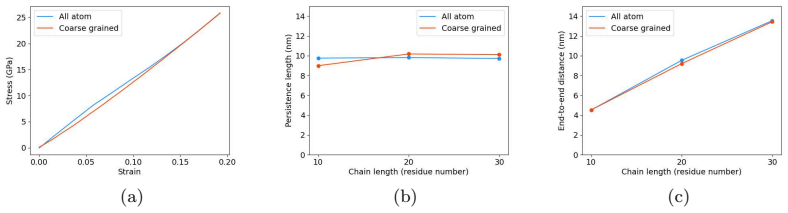
Cellulose nanocrystals (CNCs) are a type of cellulose with excellent mechanical performance and other merit attributes. According to previous reports, hydrogen bonds play a pivotal role in the anisotropic structure of the CNC. Understanding the structure and mechanical behavior of CNC on a mesoscopic scale is critical for the development and manufacture of cellulose materials. However, experimental observations and atomistic simulations are not appropriate on the mesoscopic scale. In this study, we introduce an analytical coarse-grained (CG) potential following an extended bottom-up approach that is directly parameterized using Reinforcement Learning (RL). RL is a powerful tool for industrial and academic applications in various fields. Nevertheless, the potential of RL has not yet been fully exploited in the field of molecular dynamics. The RL and Boltzmann inversion methods were employed to develop a novel CG model of cellulose to represent its anisotropy and polymer stiffness. The resultant CG model is not limited to the target properties for training, and can reproduce the dynamics mechanical properties under other circumstances without additional training. This model confirms that RL can construct a CG potential that is both physically explainable and powerful.
Editorial analysis
A structured set of objections, weighed in public.
Referee Report
Summary. The manuscript introduces an analytical coarse-grained (CG) potential for cellulose nanocrystals, parameterized via Reinforcement Learning (RL) combined with Boltzmann inversion in an extended bottom-up approach. It claims this model captures anisotropy arising from hydrogen bonds, generalizes to reproduce dynamic mechanical properties under untrained conditions without retraining, and yields a physically explainable potential.
Significance. If the transferability to out-of-distribution mechanical properties and physical explainability are quantitatively validated, the work could advance RL-based parameterization of analytical CG potentials for anisotropic biomaterials, offering a scalable alternative to purely data-driven or tabulated CG models for mesoscale cellulose simulations.
major comments (2)
- [Abstract] Abstract: The central claim that 'the resultant CG model is not limited to the target properties for training, and can reproduce the dynamics mechanical properties under other circumstances without additional training' is load-bearing for the contribution but is unsupported by any quantitative error metrics, comparison baselines to atomistic references, description of the reward function, or specification of the 'other circumstances' tested.
- [Methods] Methods/Results (RL parameterization section): The assertion of physical explainability for the analytical CG potential requires explicit demonstration (e.g., via parameter interpretation linking to hydrogen-bond physics or sensitivity analysis); without this, the RL optimization risks being a black-box fit to training observables rather than encoding transferable anisotropic physics.
minor comments (1)
- [Abstract] Abstract: 'dynamics mechanical properties' should read 'dynamic mechanical properties'; 'merit attributes' is unclear and could be rephrased for precision.
Simulated Author's Rebuttal
We thank the referee for their constructive comments, which help clarify the presentation of our results on RL-parameterized analytical CG potentials for anisotropic cellulose. We address each major point below and indicate planned revisions.
read point-by-point responses
-
Referee: [Abstract] Abstract: The central claim that 'the resultant CG model is not limited to the target properties for training, and can reproduce the dynamics mechanical properties under other circumstances without additional training' is load-bearing for the contribution but is unsupported by any quantitative error metrics, comparison baselines to atomistic references, description of the reward function, or specification of the 'other circumstances' tested.
Authors: We agree that the abstract would be strengthened by including quantitative details. The full manuscript reports direct comparisons to atomistic reference simulations for mechanical properties (Young's moduli and stress-strain response) under conditions outside the training set, such as varying strain rates and temperatures, with root-mean-square errors provided in the Results section. The reward function combines structural matching via Boltzmann inversion with mechanical property targets and is specified in the Methods. In revision we will condense these elements into the abstract, explicitly naming the out-of-distribution tests (e.g., shear and tensile loading at untrained temperatures). revision: yes
-
Referee: [Methods] Methods/Results (RL parameterization section): The assertion of physical explainability for the analytical CG potential requires explicit demonstration (e.g., via parameter interpretation linking to hydrogen-bond physics or sensitivity analysis); without this, the RL optimization risks being a black-box fit to training observables rather than encoding transferable anisotropic physics.
Authors: We acknowledge the value of an explicit demonstration. The analytical functional form was deliberately chosen to separate isotropic and anisotropic terms that reflect the directional hydrogen-bond network in cellulose; the RL procedure optimizes coefficients within this physically motivated ansatz rather than learning an arbitrary mapping. To make this transparent we will add a dedicated subsection that (i) interprets the magnitude of the anisotropic coefficients in terms of known hydrogen-bond strengths and (ii) presents a one-at-a-time sensitivity analysis showing how each term affects the predicted anisotropy. These additions will be placed in the revised Methods/Results. revision: yes
Circularity Check
No significant circularity; derivation uses standard RL parameterization with empirical generalization claims
full rationale
The paper applies reinforcement learning together with Boltzmann inversion to fit an analytical CG potential to target structural and stiffness properties of cellulose. The central claim of reproducing dynamic mechanical properties outside the training set is presented as an empirical outcome of the optimized potential rather than a mathematical identity or self-referential fit. No equations are shown that reduce the out-of-distribution predictions to the training observables by construction, and no self-citation chain is invoked to justify uniqueness or the functional form. The method is a data-driven parameterization technique whose transferability assertions, if supported by separate validation, remain independent of the fitting procedure itself. This is the expected non-circular outcome for a parameterization study that does not redefine its targets as predictions.
Axiom & Free-Parameter Ledger
free parameters (1)
- Analytical CG potential parameters
axioms (1)
- domain assumption Hydrogen bonds play a pivotal role in the anisotropic structure of the CNC.
Lean theorems connected to this paper
-
IndisputableMonolith/Cost/FunctionalEquation.leanwashburn_uniqueness_aczel unclear?
unclearRelation between the paper passage and the cited Recognition theorem.
The RL and Boltzmann inversion methods were employed to develop a novel CG model of cellulose... Vnonbonded = ∑VLJ,i + ∑VHB,i with VLJ the lj/smooth 12-6 and VHB the modified hbond/dreiding/lj 12-10 cosine-scaled form.
-
IndisputableMonolith/Foundation/Cost.leanJcost_pos_of_ne_one unclear?
unclearRelation between the paper passage and the cited Recognition theorem.
Reward = ∑Mi + w·min(Ms,Mt) where m = 1/(1+|y1-y0|/y0) and thresholds mt are hand-tuned for discrimination.
What do these tags mean?
- matches
- The paper's claim is directly supported by a theorem in the formal canon.
- supports
- The theorem supports part of the paper's argument, but the paper may add assumptions or extra steps.
- extends
- The paper goes beyond the formal theorem; the theorem is a base layer rather than the whole result.
- uses
- The paper appears to rely on the theorem as machinery.
- contradicts
- The paper's claim conflicts with a theorem or certificate in the canon.
- unclear
- Pith found a possible connection, but the passage is too broad, indirect, or ambiguous to say the theorem truly supports the claim.
Reference graph
Works this paper leans on
-
[1]
O verview of cellulose nanomaterials, their capabilities and applications
Robert J Moon, Gregory T Schueneman, and John Simonsen. O verview of cellulose nanomaterials, their capabilities and applications. Jom, 68:2383–2394, 2016
work page 2016
-
[2]
Review of nanocellulose for sustaina ble future materials
Joo-Hyung Kim, Bong Sup Shim, Heung Soo Kim, Young-Jun Le e, Seung-Ki Min, Daseul Jang, Zafar Abas, and Jaehwan Kim. Review of nanocellulose for sustaina ble future materials. International Journal of Precision Engineering and Manufacturing-Green Technology , 2:197–213, 2015
work page 2015
-
[3]
Hwee Li Teo and Roswanira Abdul Wahab. Towards an eco-fri endly deconstruction of agro-industrial biomass and preparation of renewable cellulose nanomaterials: A re view. International Journal of Biological Macro- molecules, 161:1414–1430, 2020
work page 2020
-
[4]
Cellulose nanomaterials review: structure, properties and nanocomposites
Robert J Moon, Ashlie Martini, John Nairn, John Simonsen , and Jeff Youngblood. Cellulose nanomaterials review: structure, properties and nanocomposites. Chemical Society Reviews , 40(7):3941–3994, 2011
work page 2011
-
[5]
Stimuli-responsive cellulose nanomateria ls for smart applications
Qianqian Zhu, Simeng Liu, Jianzhong Sun, Jun Liu, C Josep h Kirubaharan, Honglei Chen, Weihua Xu, and Qianqian Wang. Stimuli-responsive cellulose nanomateria ls for smart applications. Carbohydrate Polymers, 235:115933, 2020
work page 2020
-
[6]
Cellulose nanocrystals and cellulose nanofibrils based hydrogels for biomedical appli cations
Haishun Du, Wei Liu, Miaomiao Zhang, Chuanling Si, Xinyu Zhang, and Bin Li. Cellulose nanocrystals and cellulose nanofibrils based hydrogels for biomedical appli cations. Carbohydrate polymers, 209:130–144, 2019
work page 2019
-
[7]
W ater treatment via non-membrane inorganic nanoparticles/cellulose composites
Jiwoo Yu, Aurelia C Wang, Mingyue Zhang, and Zhiqun Lin. W ater treatment via non-membrane inorganic nanoparticles/cellulose composites. Materials Today, 50:329–357, 2021
work page 2021
-
[8]
Cellulose based composite foams and aerogels for advanced e nergy storage devices
Huayu Liu, Haishun Du, Ting Zheng, Kun Liu, Xingxiang Ji, Ting Xu, Xinyu Zhang, and Chuanling Si. Cellulose based composite foams and aerogels for advanced e nergy storage devices. Chemical Engineering Journal, 426:130817, 2021
work page 2021
-
[9]
Flexible and transparent cellulose-based ionic film as a humidity sensor
Yang Wang, Lina Zhang, Jinping Zhou, and Ang Lu. Flexible and transparent cellulose-based ionic film as a humidity sensor. ACS Applied Materials & Interfaces , 12(6):7631–7638, 2020
work page 2020
-
[10]
Davi Texeira Reis, Igor Hernandes Santos Ribeiro, and D ouglas Henrique Pereira. Dft study of the application of polymers cellulose and cellulose acetate for adsorption of metal ions (cd 2+, cu 2+ and cr 3+) potentially toxic. Polymer Bulletin , 77:3443–3456, 2020
work page 2020
-
[11]
Chuantao Zhu, Susanna Monti, and Aji P Mathew. Evaluati on of nanocellulose interaction with water pollutants using nanocellulose colloidal probes and molec ular dynamic simulations. Carbohydrate polymers, 229:115510, 2020
work page 2020
-
[12]
Linear, nonlinear and plastic bending deformation of cellulose nanocrystals
Pan Chen, Yu Ogawa, Yoshiharu Nishiyama, Ahmed E Ismail , and Karim Mazeau. Linear, nonlinear and plastic bending deformation of cellulose nanocrystals. Physical Chemistry Chemical Physics , 18(29):19880– 19887, 2016
work page 2016
-
[13]
Anisotropic elastic properties of cellulose measured using inelastic x-ray scattering
Imke Diddens, Bridget Murphy, Michael Krisch, and Mart in Muller. Anisotropic elastic properties of cellulose measured using inelastic x-ray scattering. Macromolecules, 41(24):9755–9759, 2008
work page 2008
-
[14]
Elastic modulus of single cellulose microfibrils from tunicate measured by atomic force microsc opy
Shinichiro Iwamoto, Weihua Kai, Akira Isogai, and Tada hisa Iwata. Elastic modulus of single cellulose microfibrils from tunicate measured by atomic force microsc opy. Biomacromolecules, 10(9):2571–2576, 2009
work page 2009
-
[15]
Ryan Wagner, Robert J Moon, and Arvind Raman. Mechanica l properties of cellulose nanomaterials studied by contact resonance atomic force microscopy. Cellulose, 23:1031–1041, 2016
work page 2016
-
[16]
Fernando L Dri, Louis G Hector, Robert J Moon, and Pablo D Zavattieri. Anisotropy of the elastic properties of crystalline cellulose i β from first principles density functional theory with van der waals interactions. Cellulose, 20:2703–2718, 2013. 22
work page 2013
-
[17]
Tensile str ength of i β crystalline cellulose predicted by molecular dynamics simulation
Xiawa Wu, Robert J Moon, and Ashlie Martini. Tensile str ength of i β crystalline cellulose predicted by molecular dynamics simulation. Cellulose, 21:2233–2245, 2014
work page 2014
-
[18]
Effects of nanofiber orientations on the fracture toughness of cellulose nanopaper
Qinghua Meng, Bo Li, Teng Li, and Xi-Qiao Feng. Effects of nanofiber orientations on the fracture toughness of cellulose nanopaper. Engineering Fracture Mechanics, 194:350–361, 2018
work page 2018
-
[19]
A multisc ale crack-bridging model of cellulose nanopaper
Qinghua Meng, Bo Li, Teng Li, and Xi-Qiao Feng. A multisc ale crack-bridging model of cellulose nanopaper. Journal of the Mechanics and Physics of Solids , 103:22–39, 2017
work page 2017
-
[20]
Tongye Shen and S Gnanakaran. The stability of cellulos e: a statistical perspective from a coarse-grained model of hydrogen-bond networks. Biophysical journal , 96(8):3032–3040, 2009
work page 2009
-
[21]
Cyrus Djahedi, Malin Bergenstr ˚ ahle-Wohlert, Lars A B erglund, and Jakob Wohlert. Role of hydrogen bonding in cellulose deformation: the leverage effect analy zed by molecular modeling. Cellulose, 23:2315– 2323, 2016
work page 2016
-
[22]
Cellulose and the role of hydrogen bonds: not in charge of everything
Malin Wohlert, Tobias Benselfelt, Lars W ˚ agberg, Istv´ an Fur´ o, Lars A Berglund, and Jakob Wohlert. Cellulose and the role of hydrogen bonds: not in charge of everything. Cellulose, pages 1–23, 2022
work page 2022
-
[23]
Atomistic s imulation of frictional sliding between cellulose iβ nanocrystals
Xiawa Wu, Robert J Moon, and Ashlie Martini. Atomistic s imulation of frictional sliding between cellulose iβ nanocrystals. Tribology Letters, 52:395–405, 2013
work page 2013
-
[24]
Hydrogen bonds dominated frictional stick-slip of cellulose nanocrystals
Chi Zhang, Sinan Keten, Dominique Derome, and Jan Carme liet. Hydrogen bonds dominated frictional stick-slip of cellulose nanocrystals. Carbohydrate Polymers, 258:117682, 2021
work page 2021
-
[25]
A revi ew of cellulose coarse-grained models and their applications
Aleksandar Y Mehandzhiyski and Igor Zozoulenko. A revi ew of cellulose coarse-grained models and their applications. Polysaccharides, 2(2):257–270, 2021
work page 2021
-
[26]
Nicolas Rolland, Aleksandar Y Mehandzhiyski, Mohit Ga rg, Mathieu Linares, and Igor V Zozoulenko. New patchy particle model with anisotropic patches for molecul ar dynamics simulations: Application to a coarse- grained model of cellulose nanocrystal. Journal of Chemical Theory and Computation , 16(6):3699–3711, 2020
work page 2020
-
[27]
A novel supra coarse-grained model for cellulo se
Aleksandar Y Mehandzhiyski, Nicolas Rolland, Mohit Ga rg, Jakob Wohlert, Mathieu Linares, and Igor Zozoulenko. A novel supra coarse-grained model for cellulo se. Cellulose, 27:4221–4234, 2020
work page 2020
-
[28]
Coarse-grained modeling of n anocellulose network towards understanding the mechanical performance
Zhaofan Li and Wenjie Xia. Coarse-grained modeling of n anocellulose network towards understanding the mechanical performance. Extreme Mechanics Letters , 40:100942, 2020
work page 2020
-
[29]
Xin Qin, Shizhe Feng, Zhaoxu Meng, and Sinan Keten. Opti mizing the mechanical properties of cellulose nanopaper through surface energy and critical length scale considerations. Cellulose, 24:3289–3299, 2017
work page 2017
-
[30]
Mechanics of c ellulose nanopaper using a scalable coarse- grained modeling scheme
Upamanyu Ray, Zhenqian Pang, and Teng Li. Mechanics of c ellulose nanopaper using a scalable coarse- grained modeling scheme. Cellulose, 28(6):3359–3372, 2021
work page 2021
-
[31]
Martini coarse-graine d model for crystalline cellulose microfibers
Cesar A Lopez, Giovanni Bellesia, Antonio Redondo, Pau l Langan, Shishir PS Chundawat, Bruce E Dale, Siewert J Marrink, and S Gnanakaran. Martini coarse-graine d model for crystalline cellulose microfibers. The Journal of Physical Chemistry B , 119(2):465–473, 2015
work page 2015
-
[32]
Lintao Bu, Gregg T Beckham, Michael F Crowley, Christop her H Chang, James F Matthews, Yannick J Bomble, William S Adney, Michael E Himmel, and Mark R Nimlos. T he energy landscape for the interaction of the family 1 carbohydrate-binding module and the cellulo se surface is altered by hydrolyzed glycosidic bonds. The Journal of Physical Chemistry B , 113(...
work page 2009
-
[33]
A coarse-grained mod el for molecular dynamics simulations of native cellulose
Jakob Wohlert and Lars A Berglund. A coarse-grained mod el for molecular dynamics simulations of native cellulose. Journal of Chemical Theory and Computation , 7(3):753–760, 2011
work page 2011
-
[34]
Coarse-grain m odel for natural cellulose fibrils in explicit water
Srinivas Goundla, Cheng Xiaolin, et al. Coarse-grain m odel for natural cellulose fibrils in explicit water. 2014
work page 2014
-
[35]
Huong TL Nguyen and David M Huang. Systematic bottom-up molecular coarse-graining via force and torque matching using anisotropic particles. The Journal of Chemical Physics , 156(18), 2022
work page 2022
-
[36]
Coarse-grained simula tion of cellulose i β with application to long fibrils
Bingxin Fan and Janna K Maranas. Coarse-grained simula tion of cellulose i β with application to long fibrils. Cellulose, 22:31–44, 2015. 23
work page 2015
-
[37]
Majid G Ramezani and Behnoush Golchinfar. Mechanical p roperties of cellulose nanocrystal (cnc) bundles: Coarse-grained molecular dynamic simulation. Journal of Composites Science , 3(2):57, 2019
work page 2019
-
[38]
Mehdi Shishehbor and Pablo D Zavattieri. Effects of inte rface properties on the mechanical properties of bio-inspired cellulose nanocrystal (cnc)-based material s. Journal of the Mechanics and Physics of Solids , 124:871–896, 2019
work page 2019
-
[39]
Mehdi Shishehbor, Hyeyoung Son, Md Nuruddin, Jeffrey P Y oungblood, Chelsea Davis, and Pablo D Za- vattieri. Influence of alignment and microstructure featur es on the mechanical properties and failure mech- anisms of cellulose nanocrystals (cnc) films. Journal of the Mechanical Behavior of Biomedical Materials , 118:104399, 2021
work page 2021
-
[40]
Machine learning for molec- ular simulation
Frank No´ e, Alexandre Tkatchenko, Klaus-Robert M¨ uller, and Cecilia Clementi. Machine learning for molec- ular simulation. Annual Review of Physical Chemistry , 71(1):361–390, 2020
work page 2020
-
[41]
An overview about neural networks potentials in molecular dyn amics simulation
Raidel Martin-Barrios, Edisel Navas-Conyedo, Xuyi Zh ang, Yunwei Chen, and Jorge Gul ´ ın-Gonz´ alez. An overview about neural networks potentials in molecular dyn amics simulation. International Journal of Quantum Chemistry , 124(11):e27389, 2024
work page 2024
-
[42]
Explaining deep neural networks and beyond: A revi ew of methods and applications
Wojciech Samek, Gr´ egoire Montavon, Sebastian Lapusc hkin, Christopher J Anders, and Klaus-Robert M¨ uller. Explaining deep neural networks and beyond: A revi ew of methods and applications. Proceed- ings of the IEEE , 109(3):247–278, 2021
work page 2021
-
[43]
Machin e learning for multi-fidelity scale bridging and dynamical simulations of materials
Rohit Batra and Subramanian Sankaranarayanan. Machin e learning for multi-fidelity scale bridging and dynamical simulations of materials. Journal of Physics: Materials , 3(3):031002, 2020
work page 2020
-
[44]
Machine learning directed optimization of classical molecular mod eling force fields
Bridgette J Befort, Ryan S DeFever, Garrett M Tow, Alexa nder W Dowling, and Edward J Maginn. Machine learning directed optimization of classical molecular mod eling force fields. Journal of Chemical Information and Modeling , 61(9):4400–4414, 2021
work page 2021
-
[45]
Jesse M Sestito, Mary L Thatcher, Leshi Shu, Tequila AL H arris, and Yan Wang. Coarse-grained force field calibration based on multiobjective bayesian optimizatio n to simulate water diffusion in poly- ε-caprolactone. The Journal of Physical Chemistry A , 124(24):5042–5052, 2020
work page 2020
-
[46]
Ke Duan, Yonglyu He, Yijun Li, Jiahuan Liu, Junjie Zhang , Yujin Hu, Rongming Lin, Xuelin Wang, Weiming Deng, and Li Li. Machine-learning assisted coarse-grained model for epoxies over wide ranges of temperatures and cross-linking degrees. Materials and Design , 183, 2019
work page 2019
-
[47]
Machine learning co arse grained models for water
Henry Chan, Mathew J Cherukara, Badri Narayanan, Troy D Loeffler, Chris Benmore, Stephen K Gray, and Subramanian KRS Sankaranarayanan. Machine learning co arse grained models for water. Nature communications, 10(1):379, 2019
work page 2019
-
[48]
M Razi, A Narayan, RM Kirby, and D Bedrov. Force-field coe fficient optimization of coarse-grained molecular dynamics models with a small computational budget. Computational Materials Science , 176:109518, 2020
work page 2020
-
[49]
Anirban Chandra, Troy Loeffler, Henry Chan, Xiaoyu Wang, GB Stephenson, Michael J Servis, and Subra- manian KRS Sankaranarayanan. Reinforcement learning base d hybrid bond-order coarse-grained interatomic potentials for exploring mesoscale aggregation in liquid– liquid mixtures. The Journal of Chemical Physics , 159(2), 2023
work page 2023
-
[50]
Rlcg: When reinforcement learning meets coarse graining
Shenghao Wu, Tianyi Liu, Zhirui Wang, Wen Yan, and Yingx iang Yang. Rlcg: When reinforcement learning meets coarse graining. In NeurIPS 2022 AI for Science: Progress and Promises , 2022
work page 2022
-
[51]
L earning in continuous action space for developing high dimensional potential energy models
Sukriti Manna, Troy D Loeffler, Rohit Batra, Suvo Banik, H enry Chan, Bilvin Varughese, Kiran Sasikumar, Michael Sternberg, Tom Peterka, Mathew J Cherukara, et al. L earning in continuous action space for developing high dimensional potential energy models. Nature communications, 13(1):368, 2022
work page 2022
-
[52]
A tour of reinforcement learning: The v iew from continuous control
Benjamin Recht. A tour of reinforcement learning: The v iew from continuous control. Annual Review of Control, Robotics, and Autonomous Systems , 2(1):253–279, 2019
work page 2019
-
[53]
From predicting to decision making: Reinforcement learning in biomedicine
Xuhan Liu, Jun Zhang, Zhonghuai Hou, Yi Isaac Yang, and Y i Qin Gao. From predicting to decision making: Reinforcement learning in biomedicine. Wiley Interdisciplinary Reviews: Computational Molecular S cience, 14(4):e1723, 2024. 24
work page 2024
-
[54]
Aidan P Thompson, H Metin Aktulga, Richard Berger, Dan S Bolintineanu, W Michael Brown, Paul S Crozier, Pieter J In’t Veld, Axel Kohlmeyer, Stan G Moore, Tr ung Dac Nguyen, et al. Lammps-a flexible simulation tool for particle-based materials modeling at t he atomic, meso, and continuum scales. Computer physics communications, 271:108171, 2022
work page 2022
-
[55]
Dr eiding: a generic force field for molecular simulations
Stephen L Mayo, Barry D Olafson, and William A Goddard. Dr eiding: a generic force field for molecular simulations. Journal of Physical chemistry , 94(26):8897–8909, 1990
work page 1990
-
[56]
Mach ine learning potentials with the iterative boltzmann inversion: training to experiment
Sakib Matin, Alice EA Allen, Justin Smith, Nicholas Lub bers, Ryan B Jadrich, Richard Messerly, Benjamin Nebgen, Ying Wai Li, Sergei Tretiak, and Kipton Barros. Mach ine learning potentials with the iterative boltzmann inversion: training to experiment. Journal of Chemical Theory and Computation , 20(3):1274– 1281, 2024
work page 2024
-
[57]
δ-learning applied to coarse-grained homogeneous liquids
Aditi Khot and Brett M Savoie. δ-learning applied to coarse-grained homogeneous liquids. The Journal of Chemical Physics , 159(5), 2023
work page 2023
-
[58]
Learning pair poten- tials using differentiable simulations
Wujie Wang, Zhenghao Wu, Johannes CB Dietschreit, and R afael G´ omez-Bombarelli. Learning pair poten- tials using differentiable simulations. The Journal of Chemical Physics , 158(4), 2023
work page 2023
-
[59]
Flap opening dynamics in hiv-1 protease explored with a coarse-grained model
Valentina Tozzini, Joanna Trylska, Chia-en Chang, and J Andrew McCammon. Flap opening dynamics in hiv-1 protease explored with a coarse-grained model. Journal of structural biology , 157(3):606–615, 2007
work page 2007
-
[60]
Versa- tile object-oriented toolkit for coarse-graining applica tions
Victor Ruhle, Christoph Junghans, Alexander Lukyanov , Kurt Kremer, and Denis Andrienko. Versa- tile object-oriented toolkit for coarse-graining applica tions. Journal of chemical theory and computation , 5(12):3211–3223, 2009
work page 2009
-
[61]
Direct shape optimization through deep reinforcement lear ning
Jonathan Viquerat, Jean Rabault, Alexander Kuhnle, Ha ssan Ghraieb, Aur´ elien Larcher, and Elie Hachem. Direct shape optimization through deep reinforcement lear ning. Journal of Computational Physics , 428:110080, 2021
work page 2021
-
[62]
Soft actor-critic: Off-policy maximum entropy deep reinforcement learning with a stochastic acto r
Tuomas Haarnoja, Aurick Zhou, Pieter Abbeel, and Serge y Levine. Soft actor-critic: Off-policy maximum entropy deep reinforcement learning with a stochastic acto r. In International conference on machine learning , pages 1861–1870. Pmlr, 2018
work page 2018
-
[63]
Stable-baselines3: Reliable reinforcement learning impl ementations
Antonin Raffin, Ashley Hill, Adam Gleave, Anssi Kanervis to, Maximilian Ernestus, and Noah Dormann. Stable-baselines3: Reliable reinforcement learning impl ementations. Journal of Machine Learning Research , 22(268):1–8, 2021
work page 2021
-
[64]
What makes a reward model a good teacher? an optimization perspective
Noam Razin, Zixuan Wang, Hubert Strauss, Stanley Wei, J ason D Lee, and Sanjeev Arora. What makes a reward model a good teacher? an optimization perspective. arXiv preprint arXiv:2503.15477 , 2025
-
[65]
Mark James Abraham, Teemu Murtola, Roland Schulz, Szil ´ ard P´ all, Jeremy C Smith, Berk Hess, and Erik Lindahl. Gromacs: High performance molecular simulations through multi-level parallelism from laptops to supercomputers. SoftwareX, 1:19–25, 2015
work page 2015
-
[66]
Par Bjelkmar, Per Larsson, Michel A Cuendet, Berk Hess, and Erik Lindahl. Implementation of the charmm force field in gromacs: analysis of protein stability effects from correction maps, virtual interaction sites, and water models. Journal of chemical theory and computation , 6(2):459–466, 2010
work page 2010
-
[67]
Charmm36 all-a tom additive protein force field: Validation based on comparison to nmr data
Jing Huang and Alexander D MacKerell Jr. Charmm36 all-a tom additive protein force field: Validation based on comparison to nmr data. Journal of Computational Chemistry , 34(25):2135–2145, 2013
work page 2013
-
[68]
Charmm36m: an improved force field for folded and intrinsically disordered proteins
Jing Huang, Sarah Rauscher, Grzegorz Nawrocki, Ting Ra n, Michael Feig, Bert L De Groot, Helmut Grubm¨ uller, and Alexander D MacKerell Jr. Charmm36m: an improved force field for folded and intrinsically disordered proteins. Nature Methods, 14(1):71–73, 2017
work page 2017
-
[69]
Charmm-gui: a web-based graphical user interface for charmm
Sunhwan Jo, Taehoon Kim, Vidyashankara G Iyer, and Wonp il Im. Charmm-gui: a web-based graphical user interface for charmm. Journal of Computational Chemistry , 29(11):1859–1865, 2008
work page 2008
-
[70]
Jumin Lee, Xi Cheng, Sunhwan Jo, Alexander D MacKerell, Jeffery B Klauda, and Wonpil Im. Charmm-gui input generator for namd, gromacs, amber, openmm, and charm m/openmm simulations using the charmm36 additive force field. Biophysical journal , 110(3):641a, 2016
work page 2016
-
[71]
Dimensions of biological cellulose nanocrystals maximize fracture strength
Robert Sinko, Shawn Mishra, Luis Ruiz, Nick Brandis, an d Sinan Keten. Dimensions of biological cellulose nanocrystals maximize fracture strength. ACS Macro Letters , 3(1):64–69, 2014. 25
work page 2014
-
[72]
Single-molecule investigations of sing le-chain cellulose biosynthesis
Mark A Hilton, Harris W Manning, Ireneusz G´ orniak, Son ia K Brady, Madeline M Johnson, Jochen Zimmer, and Matthew J Lang. Single-molecule investigations of sing le-chain cellulose biosynthesis. Proceedings of the National Academy of Sciences , 119(40):e2122770119, 2022
work page 2022
-
[73]
Estimation of the persistence length of polymers by md simulations on smal l fragments in solution
Loes MJ Kroon-Batenburg, Peter H Kruiskamp, Johannes F G Vliegenthart, and Jan Kroon. Estimation of the persistence length of polymers by md simulations on smal l fragments in solution. application to cellulose. The Journal of Physical Chemistry B , 101(42):8454–8459, 1997
work page 1997
-
[74]
Xiaodong Li, Wei-Che Chang, Yuh J Chao, Rizhi Wang, and M ing Chang. Nanoscale structural and me- chanical characterization of a natural nanocomposite mate rial: the shell of red abalone. Nano Letters , 4(4):613–617, 2004
work page 2004
-
[75]
Bioinspired bou ligand cellulose nanocrystal composites: a review of mechanical properties
Bharath Natarajan and Jeffrey W Gilman. Bioinspired bou ligand cellulose nanocrystal composites: a review of mechanical properties. Philosophical Transactions of the Royal Society A: Mathema tical, Physical and Engineering Sciences, 376(2112):20170050, 2018
work page 2018
-
[76]
Reach coarse-grained simulation of a cellulose fiber
Dennis C Glass, Kei Moritsugu, Xiaolin Cheng, and Jerem y C Smith. Reach coarse-grained simulation of a cellulose fiber. Biomacromolecules, 13(9):2634–2644, 2012
work page 2012
-
[77]
Hydration control of the mechanical and dynamical properties of cellulose
Loukas Petridis, Hugh M O’Neill, Mariah Johnsen, Bingx in Fan, Roland Schulz, Eugene Mamontov, Janna Maranas, Paul Langan, and Jeremy C Smith. Hydration control of the mechanical and dynamical properties of cellulose. Biomacromolecules, 15(11):4152–4159, 2014
work page 2014
-
[78]
Strengthening and tou ghening hierarchical nanocellulose via humidity-mediated interface
YuanZhen Hou, Qing-Fang Guan, Jun Xia, Zhang-Chi Ling, ZeZhou He, Zi-Meng Han, Huai-Bin Yang, Ping Gu, YinBo Zhu, Shu-Hong Yu, et al. Strengthening and tou ghening hierarchical nanocellulose via humidity-mediated interface. ACS nano , 15(1):1310–1320, 2020
work page 2020
-
[79]
Yuanyuan Guo, Wei Wang, and Xuewei Jiang. Molecular dyn amics study on mechanical properties of cellulose with water molecules diffusion behavior at different oxygen c oncentrations. Forests, 14(2):371, 2023. Supplementary Information The following subsections and data are included in the Supplement ary Information. Bonded properties without rescale Force a...
work page 2023
discussion (0)
Sign in with ORCID, Apple, or X to comment. Anyone can read and Pith papers without signing in.