REVIEW 5 major objections 7 minor 36 references
Structure-Preserving Patch Decoding for Efficient Neural Video Representation
T0 review · 5 major / 7 minor · reviewed 2026-08-07 · deepseek-v4-flash
Pith's one-line read The paper claims that PixelUnshuffle-style Structure-Preserving Patches let a neural video decoder fit global layout first and local detail second, beating NeRV, HNeRV, and BoostingNeRV on reconstruction quality and rate–distortion.
desk verdict Modest but consistent gains for patch-based INR video decoding; the causal mechanism needs an ablation before the paper is fully convincing. read the letter →
The pith
A machine-rendered reading of the paper's core claim, the machinery that carries it, and where it could break.
The reading
What carries the argument
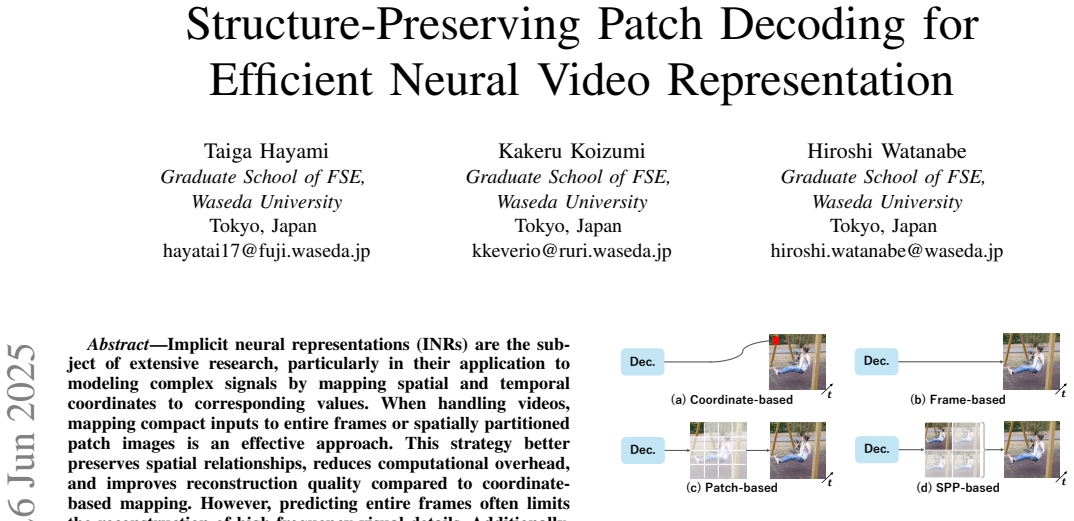
The load-bearing mechanism is the Structure-Preserving Patch (SPP), produced by a deterministic pixel rearrangement similar to PixelUnshuffle that converts a frame into $P$ spatially aligned patch images. The decoder is a stack of blocks in which early layers are conditioned only on the temporal index $t$ and content embedding $z_t$ to capture the global layout, while later layers also receive the patch index $i$ to refine local details; the reconstructed frame is obtained by spatially rearranging the patch outputs. This arrangement is what the paper credits for avoiding boundary discontinuities and for letting a single decoder balance global coherence with local fidelity.
What would settle it
Train the same SPP architecture on DAVIS and MCL-JCV in three variants—the proposed global-to-local conditioning, the reverse order, and patch indices injected in every decoder layer—and compare PSNR. If the reversed or uniform variants match the reported 34.23 and 35.94 PSNR, the central mechanism claim fails; if they drop clearly, the conditioning order is carrying the improvement.
Extended reading notes
Core claim
The central claim is that patch formation can carry spatial structure: splitting each frame by rearranging pixels from spatially aligned positions into patch images, in the manner of PixelUnshuffle, keeps the global layout intact while still giving the network the efficiency of patch-level decoding. The paper argues that the corresponding global-to-local decoder—early layers conditioned on the content embedding $z_t$ and temporal index $t$, later layers additionally conditioned on patch index $i$—lets the model fit the overall frame first and then specialize to high-frequency detail, which reduces boundary seams and upsampling artifacts. The paper's quantitative statement is that this yields higher reconstruction quality than prior INR-based video methods, with DAVIS PSNR 34.23 versus 33.53 for BoostingNeRV, MCL-JCV PSNR 35.94 versus 35.60, faster convergence on Bunny, and a UVG rate–distortion curve above the baselines.
Load-bearing premise
The load-bearing premise is that the quality gain comes from the global-to-local conditioning order of the decoder (temporal and content conditioning early, patch conditioning late) rather than from the PixelUnshuffle-style target or from hyperparameters, and the paper does not run an ablation that isolates this cause.
Editorial extensions
If this is right
- Patch-based INR video decoding can avoid boundary seams without post-processing or overlapping tiles, because the structure-preserving target keeps neighboring patches spatially aligned by construction.
- The reconstruction gains carry over to compression: with quantization and entropy coding, the UVG rate–distortion curve sits above BoostingNeRV, so the same model size stores video at better quality per bit.
- Training converges faster on Bunny at every reported epoch (37.80 PSNR at epoch 50 versus 34.90 for BoostingNeRV), which suggests the SPP target is easier for the optimizer and shortens training time.
- Because the decoder blocks are inherited from BoostingNeRV, the SPP splitting and conditioning scheme is a patch-level strategy that can be attached to other NeRV-style architectures.
Reading between the lines
- Beyond the paper's explicit evidence, the global-to-local conditioning order is not isolated by an ablation; a version with patch indices injected at all layers would show how much of the gain belongs to the hierarchical conditioning rather than to the PixelUnshuffle target.
- The SPP arrangement is domain-agnostic, so the same pixel-rearrangement idea could be tested for gigapixel images, medical volumes, or light fields, wherever uniform tiling causes boundary artifacts.
- The adaptive patch weighting is a separate design choice; training with uniform weights would reveal whether the weighting or the patch structure drives the quality gains on difficult regions.
- If the structure-preserving target is the dominant factor, even frame-based or coordinate-based decoders might improve by predicting an SPP-arranged output and reassembling it, which would extend the result beyond patch-based architectures.
Editorial analysis
A structured set of objections, weighed in public.
Referee Report
Summary. The paper proposes a neural video representation method based on Structure-Preserving Patches (SPPs). Each frame is rearranged by a PixelUnshuffle-like deterministic pixel split into several spatially aligned patch images, and a decoder is trained to reconstruct these patches. The decoder is designed to follow a 'global-to-local' strategy: early layers are conditioned only on the temporal index content embedding to model shared global structure, while later layers also receive the patch index to refine local details. An adaptive patch weighting term (Eq. 4) is added to the composite loss (Eq. 2). The method is compared with NeRV, HNeRV, and BoostingNeRV on DAVIS, MCL-JCV, Bunny, and UVG, reporting higher PSNR/MS-SSIM/LPIPS in Tables I-III and faster convergence in Table IV, plus rate-distortion curves on UVG (Fig. 5). The central claim is that the SPP formation and global-to-local decoding improve reconstruction quality and compression over existing INR-based baselines.
Significance. If the reported results are reproducible, the paper offers a simple and potentially useful modification to NeRV-style video representations: replacing uniform patch tiling with a structure-preserving PixelUnshuffle split, and conditioning later decoder layers on the patch index. The reported gains over BoostingNeRV are modest (about 0.25-0.70 dB PSNR on DAVIS and MCL-JCV, and 0.25 dB average on UVG) but consistent across the three datasets. The toy experiment in Fig. 2 is a useful illustrative motivation, and the authors disclose important caveats, including the exclusion of HNeRV from the UVG average RD curve and the method's remaining gap to HEVC. However, the paper does not provide ablations isolating the global-to-local conditioning order from other changes, does not report variance across training runs, and leaves the compression protocol incompletely specified. These gaps prevent the mechanism claim from being fully supported, although the overall direction is plausible and the paper is clearly written.
major comments (5)
- [Section III-C, Fig. 3] The main mechanistic claim is that the improvement comes from the global-to-local decoder, where early layers are conditioned only on t and later layers on i. No ablation isolates this design from the other components. The strongest baseline, BoostingNeRV, already uses a conditional decoder, so the measured delta between 'Ours' and 'Boost' is a compound of (i) the PixelUnshuffle-based SPP target, (ii) the late-stage patch-index injection, (iii) the adaptive patch weighting in Eq. (4), and (iv) stride and hyperparameter differences. Please add controlled ablations: a uniform-tiling patch target with the same decoder, a variant with patch-index conditioning at all layers, and variants with and without the adaptive weighting term. Without these, the 0.25-0.70 dB gains cannot be attributed to the claimed global-to-local reconstruction strategy.
- [Tables I-III, Section IV] All quantitative results appear to be single training runs with no error bars, multiple seeds, or significance tests. Some differences are small: on UVG the average PSNR is 33.70 vs. 33.45 and MS-SSIM is 0.9312 vs. 0.9311 for Ours vs. BoostingNeRV. The statement that the method 'consistently achieves higher scores' is not supported by the reported precision for close entries. Please report mean and standard deviation over at least three seeds and, where appropriate, per-sequence paired comparisons.
- [Fig. 5, Section IV (compression)] The compression claim rests on the UVG RD curves, but HNeRV is excluded from the average curve due to repeated convergence failures, and the details of quantization, entropy coding, and bitrate measurement are not provided. The exclusion is disclosed, but it means the average RD comparison is against a reduced baseline set. To make the compression claim load-bearing, please (a) specify the quantization and entropy coding procedure, (b) report RD curves per sequence or with HNeRV included where it converges, and (c) state explicitly whether the HEVC curve shown is an operating-point standard reference or the authors' own encoding, since the text says the method does not match HEVC.
- [Section IV (hyperparameters)] The loss weights alpha=42 and beta=18, the patch count P=4, and the decoder stride configurations are described as 'empirically set' without a validation protocol. Because the adaptive patch weighting in Eq. (4) is a novel component and the reported gains are modest, the paper should include a sensitivity analysis over these choices or describe how they were selected on a validation split. As written, the reader cannot rule out that the gains come from hyperparameter tuning on the evaluation sets.
- [Section III-B, Fig. 2] The toy experiment is qualitative and does not directly test the proposed conditioning order. It compares point-wise, segment-wise, global, and SPP-style fitting, but it does not vary whether the patch index is injected early or late in the network. Since the paper uses this experiment to motivate the global-to-local decoder, please add quantitative metrics (e.g., final MSE or PSNR for each strategy) and, ideally, a variant in which the patch index is available from the first layer. Otherwise, Fig. 2 should be framed as an illustration of the SPP target rather than evidence for the decoder architecture.
minor comments (7)
- [Eq. (3)] The frequency-domain loss is written as L1(FFT(x), FFT(hat{x})) with complex-valued FFT outputs; please clarify whether the magnitude (or magnitude plus phase) spectrum is used.
- [Table III] The BoostingNeRV row has missing spaces in several entries (e.g., '33.84 /0.925327.72 /0.907035.55 / 0.9532 29.03 /0.8967'), which makes the table difficult to read; please reformat.
- [Section IV] Please report the full training setup (optimizer, learning rate schedule, batch size, number of epochs) for all datasets so that the convergence comparison in Table IV and the RD curves are reproducible.
- [References] Reference [30] lists an author as 'Kakeru' rather than 'Koizumi'; please check the author list. Also, 'DA VIS' in reference [33] should be 'DAVIS' for consistency with the main text.
- [Conclusion] The sentence 'This strategy mitigates the degradation commonly seen in conventional methods and contribute to the fitting of global structures' has a subject-verb agreement error ('contribute' should be 'contributes').
- [Fig. 2] The panels in the bottom row are not explicitly labeled; please label them and add axis titles so the reader can distinguish the segment-wise and SPP-style curves at a glance.
- [Abstract and Section IV] The phrase 'better compression performance than existing INR-based baselines' should be qualified in the abstract or conclusion by the disclosed caveat that the method is below HEVC; otherwise the claim is easy to over-read.
Circularity Check
No circularity: the paper reports empirical results against external baselines, and no claimed prediction reduces by construction to a fitted input or to a self-citation.
full rationale
This is an empirical method paper, not a derivation. The central claim is evaluated against external INR baselines (NeRV, HNeRV, BoostingNeRV) on DAVIS, MCL-JCV, UVG, and Bunny, with PSNR/MS-SSIM/LPIPS and rate-distortion curves computed from actual decoded frames. The SPP operation is a deterministic PixelUnshuffle-style pixel rearrangement, and the global-to-local decoder conditioning is an architectural choice; neither is defined in terms of the reported metrics. The loss in Eqs. (2)-(4) computes the adaptive patch weight w_i from ground-truth patches, but this is a per-sample training loss weight, not a quantity that is subsequently reported as a prediction; the reported reconstruction quality comes from network outputs, so there is no reduction of the headline result to the fitted weight. The self-citations (refs. 27, 28, 30) appear only in a related-work enumeration and are not load-bearing for the method's validity or for the comparison against baselines. The 1D toy experiment in Fig. 2 is qualitative, but it is presented as motivation, not as a derivation of the video results. The absence of an ablation isolating the global-to-local mechanism is a legitimate concern about causal attribution, and tuning hyperparameters (alpha=42, beta=18, P=4) on the evaluation datasets is a benchmark-tuning concern, but neither is circularity under the definitions used here: no equation or citation chain makes the reported gain equivalent to an input by construction. Therefore the paper is self-contained against external benchmarks and warrants a circularity score of 0.
Assumptions & free parameters
free parameters (4)
- alpha loss weight =
42
- beta loss weight =
18
- number of patches P =
4
- decoder stride configuration =
[5,4,2,2,2] for 640x1280, [5,3,2,2] for 1080x1920
assumptions (3)
- domain assumption PixelUnshuffle-style splitting preserves global spatial structure and reduces boundary artifacts compared to uniform spatial partitioning.
- domain assumption Early decoder layers conditioned only on t capture global structure, and later layers conditioned on i refine local details.
- standard math L1, MS-SSIM and FFT L1 losses are valid optimization targets for reconstruction quality.
Cite this review
Pith. "Pith review of Structure-Preserving Patch Decoding for Efficient Neural Video Representation." pith.science (2026). https://pith.science/paper/2YIXA2OL
@misc{pith2026250612896,
  author       = {Pith},
  title        = {Pith review of: Structure-Preserving Patch Decoding for Efficient Neural Video Representation},
  year         = {2026},
  howpublished = {\url{https://pith.science/paper/2YIXA2OL}},
  note         = {Machine review of arXiv:2506.12896}
}
read the original abstract
Implicit neural representations (INRs) are the subject of extensive research, particularly in their application to modeling complex signals by mapping spatial and temporal coordinates to corresponding values. When handling videos, mapping compact inputs to entire frames or spatially partitioned patch images is an effective approach. This strategy better preserves spatial relationships, reduces computational overhead, and improves reconstruction quality compared to coordinate-based mapping. However, predicting entire frames often limits the reconstruction of high-frequency visual details. Additionally, conventional patch-based approaches based on uniform spatial partitioning tend to introduce boundary discontinuities that degrade spatial coherence. We propose a neural video representation method based on Structure-Preserving Patches (SPPs) to address such limitations. Our method separates each video frame into patch images of spatially aligned frames through a deterministic pixel-based splitting similar to PixelUnshuffle. This operation preserves the global spatial structure while allowing patch-level decoding. We train the decoder to reconstruct these structured patches, enabling a global-to-local decoding strategy that captures the global layout first and refines local details. This effectively reduces boundary artifacts and mitigates distortions from naive upsampling. Experiments on standard video datasets demonstrate that our method achieves higher reconstruction quality and better compression performance than existing INR-based baselines.
Figures


Figures from the paper (2 more)


Reference graph
Works this paper leans on
-
[1]
NeRF: Representing Scenes as Neural Radiance Fields for View Synthesis,
B. Mildenhall, P. Srinivasan, M. Tancik, J. Barron, R. Ramamoorthi, and R. Ng, “NeRF: Representing Scenes as Neural Radiance Fields for View Synthesis,” European Conference on Computer Vision (ECCV), 2020, pp. 405-421
work page 2020
-
[2]
Mip-NeRF: A Multiscale Representation for Anti- Aliasing Neural Radiance Fields,
J. Barron, B. Mildenhall, M. Tancik, P. Hedman, R. Martin-Brualla, and P. Srinivasan, “Mip-NeRF: A Multiscale Representation for Anti- Aliasing Neural Radiance Fields,” IEEE/CVF International Conference on Computer Vision (ICCV), 2021, pp. 5855-5864
work page 2021
-
[3]
D-NeRF: Neural Radiance Fields for Dynamic Scenes,
A. Pumarola1, E. Corona1, G. Pons-Moll, and F. Moreno-Noguer, “D-NeRF: Neural Radiance Fields for Dynamic Scenes,” IEEE/CVF Conference on Computer Vision and Pattern Recognition (CVPR), 2021, pp. 10318-10327
work page 2021
-
[4]
NeRF in the Wild: Neural Radiance Fields for Unconstrained Photo Collections,
R. Martin-Brualla, N. Radwan, M. Sajjadi, J. Barron, A. Dosovitskiy, and D. Duckworth, “NeRF in the Wild: Neural Radiance Fields for Unconstrained Photo Collections,” IEEE/CVF Conference on Computer Vision and Pattern Recognition (CVPR), 2021, pp. 7210-7219
work page 2021
-
[5]
COIN: COmpression with Implicit Neural representations,
E. Dupont, A. Goli ´nski, M. Alizadeh, Y . Teh, and A. Doucet, “COIN: COmpression with Implicit Neural representations,” arXiv preprint arXiv:2103.03123, 2021
arXiv 2021
-
[6]
COIN++: Neural Compression Across Modalities,
E. Dupont, H. Loya, M. Alizadeh, A. Goli ´nski, Y . Teh, and A Doucet, “COIN++: Neural Compression Across Modalities,” arXiv preprint arXiv:2201.12904, 2022
arXiv 2022
-
[7]
COOL- CHIC: Coordinate-based Low Complexity Hierarchical Image Codec,
T. Ladune, P. Philippe, F. Henry, G. Clare, and T Leguay, “COOL- CHIC: Coordinate-based Low Complexity Hierarchical Image Codec,” IEEE/CVF International Conference on Computer Vision (ICCV), 2023, pp. 13515-13522
work page 2023
-
[8]
C3: High- performance and low-complexity neural compression from a single image or video,
H. Kim, M. Bauer, L. Theis, J. Schwarz, and E. Dupont, “C3: High- performance and low-complexity neural compression from a single image or video,”
Show all 36 references
-
[9]
NeRV: Neural Representations for Videos,
H. Chen, B. He, H. Wang, Y . Ren, S. Lim, and A. Shrivastava, “NeRV: Neural Representations for Videos,” Advances in Neural Information Processing Systems (NeurIPS), 2021, pp. 21557-21568
2021
-
[10]
E-NeRV: Expedite Neural Video Representation with Disen- tangled Spatial-Temporal Context,
L. Zizhang, W. Mengmeng, P. Huaijin, X. Kechun, M. Jianbiao, and L. Yong, “E-NeRV: Expedite Neural Video Representation with Disen- tangled Spatial-Temporal Context,” European Conference on Computer Vision (ECCV), 2022, pp. 267-284
2022
-
[11]
HNeRV: A Hybrid Neural Representation for Videos,
H. Chen, M. Gwilliam, S. Lim, and A. Shrivastava, “HNeRV: A Hybrid Neural Representation for Videos,” IEEE/CVF Conference on Computer Vision and Pattern Recognition (CVPR), 2023, pp. 10270-10279
2023
-
[12]
Implicit Neural Representations with Periodic Activation Functions,
S. Vincent, M. Julien, B. Alexander, L. David, and W. Gordon, “Implicit Neural Representations with Periodic Activation Functions,” Advances in Neural Information Processing Systems (NeurIPS), 2020, pp. 7462- 7473
2020
-
[13]
Bias for Action: Video Implicit Neural Representations with Bias Modulation,
A. Kayabasi, A. Vadathya, G. Balakrishnan, and V . Saragadam, “Bias for Action: Video Implicit Neural Representations with Bias Modulation,” the Computer Vision and Pattern Recognition Conference (CVPR), 2025, pp. 27999-28008
2025
-
[14]
PS-NeRV: Patch-wise Stylized Neural Representations for Videos,
Y . Bai, C. Dong, and C. Wang, “PS-NeRV: Patch-wise Stylized Neural Representations for Videos,” IEEE International Conference on Image Processing (ICIP), 2023, pp. 41-45
2023
-
[15]
NIRV ANA: Neural Implicit Represen- tations of Videos with Adaptive Networks and Autoregressive Patch- wise Modeling,
S. Maiya, S. Girish, M. Ehrlich, H. Wang, K. Lee, P. Poirson, P. Wu, C. Wang, and A. Shrivastava, “NIRV ANA: Neural Implicit Represen- tations of Videos with Adaptive Networks and Autoregressive Patch- wise Modeling,” IEEE/CVF Conference on Computer Vision and Pattern Recognit...
2023
-
[16]
On the Spectral Bias of Neural Networks,
N. Rahaman, A. Baratin, D. Arpit, F. Draxler, M. Lin, F. Hamprecht, Y . Bengio, and A. Courville, “On the Spectral Bias of Neural Networks,” Proceedings of Machine Learning Research, 5301-5310, Jun. 2019
2019
-
[17]
Towards Understanding the Spectral Bias of Deep Learning,
Y . Cao, Z. Fang, Y . Wu, D. Zhou, and Q. Gu, “Towards Understanding the Spectral Bias of Deep Learning,” arXiv preprint arXiv:1912.01198, 2020
1912 arXiv
-
[18]
Batch Normalization Alleviates the Spectral Bias in Coordinate Networks,
Z. Cai, H. Zhu, Q. Shen, X. Wang, and X. Cao, “Batch Normalization Alleviates the Spectral Bias in Coordinate Networks,” IEEE/CVF Con- ference on Computer Vision and Pattern Recognition (CVPR), 25160- 25171, Jun. 2024
2024
-
[19]
FINER: Flexible Spectral-bias Tuning in Implicit NEural Representa- tion by Variable-periodic Activation Functions,
Z. Liu, H. Zhu, Q. Zhang, J. Fu, W. Deng, Z. Ma, Y . Guo, X. Cao, “FINER: Flexible Spectral-bias Tuning in Implicit NEural Representa- tion by Variable-periodic Activation Functions,” IEEE/CVF Conference on Computer Vision and Pattern Recognition (CVPR), 2024, pp. 2713- 2722
2024
-
[20]
Arbitrary Style Transfer in Real-time with Adaptive Instance Normalization,
X. Huang, and S. Belongie, “Arbitrary Style Transfer in Real-time with Adaptive Instance Normalization,” IEEE International Conference on Computer Vision (ICCV), 2017, pp. 1501-1510
2017
-
[21]
Boosting Neural Representations for Videos with a Conditional Decoder,
X. Zhang, R. Yang, D. He, X. Ge, T. Xu, Y . Wang, H. Qin, and J. Zhang, “Boosting Neural Representations for Videos with a Conditional Decoder,” IEEE/CVF Conference on Computer Vision and Pattern Recognition (CVPR), 2024, pp. 2556-2566
2024
-
[22]
DNeRV: Modeling Inherent Dynamics via Difference Neural Representation for Videos,
Q. Zhao, M. S. Asif, and Z. Ma, “DNeRV: Modeling Inherent Dynamics via Difference Neural Representation for Videos,” IEEE/CVF Confer- ence on Computer Vision and Pattern Recognition (CVPR), 2023, pp. 2031-2040
2023
-
[23]
DS- NeRV: Implicit Neural Video Representation with Decomposed Static and Dynamic Codes,
Y . Hao, K. Zhihui, Z. Xiaobo, Q. Tie, S. Xidong, and J. Dadong, “DS- NeRV: Implicit Neural Video Representation with Decomposed Static and Dynamic Codes,” IEEE/CVF Conference on Computer Vision and Pattern Recognition (CVPR), 2024, pp. 23019-23029
2024
-
[24]
HiNeRV: Video Compression with Hierarchical Encoding-based Neural Representation,
H. Kwan, G. Gao, F. Zhang, A. Gower, and D. Bull, “HiNeRV: Video Compression with Hierarchical Encoding-based Neural Representation,” Advances in Neural Information Processing Systems (NeurIPS), 2023, pp. 72692-72704
2023
-
[25]
PNeRV: Enhancing Spatial Consistency via Pyramidal Neural Representation for Videos,
Q. Zhao, M. Asif, and Z. Ma, “PNeRV: Enhancing Spatial Consistency via Pyramidal Neural Representation for Videos,” IEEE/CVF Confer- ence on Computer Vision and Pattern Recognition (CVPR), 2024, pp. 19103-19112
2024
-
[26]
Res-NeRV: Residual Blocks For A Practical Implicit Neu- ral Video Decoder,
M. Tarchouli, T. Guionnet, M. Riviere, W. Hamidouche, M. Outtas, and O. Deforges, “Res-NeRV: Residual Blocks For A Practical Implicit Neu- ral Video Decoder,” IEEE International Conference on Image Processing (ICIP), 2024, pp. 3751-3757
2024
-
[27]
Implicit Neural Representation for Videos Based on Residual Connection,
T. Hayami and H. Watanabe, “Implicit Neural Representation for Videos Based on Residual Connection,” IEEE Global Conference on Consumer Electronics (GCCE), 2024, pp. 317-318
2024
-
[28]
Neural Video Representation for Redundancy Reduction and Consistency Preserva- tion,
T. Hayami, T. Shindo, S. Akamatsu, and H. Watanabe, “Neural Video Representation for Redundancy Reduction and Consistency Preserva- tion,” IEEE International Conference on Consumer Electronics (ICCE), 2025, pp. 1-6
2025
-
[29]
SNeRV: Spectra-preserving Neural Representation for Video,
J. Kim, J. Lee, and J. Kang, “SNeRV: Spectra-preserving Neural Representation for Video,” European Conference on Computer Vision (ECCV) 2024, pp. 332-348
2024
-
[30]
SR-NeRV: Improving Embedding Efficiency of Neural Video Representation via Super-Resolution,
T. Hayami, K. Kakeru, H. Watanabe, “SR-NeRV: Improving Embedding Efficiency of Neural Video Representation via Super-Resolution,” arXiv preprint arXiv:2505.00046, 2025
2025 arXiv
-
[31]
A ConvNet for the 2020s,
Z. Liu, H. Mao, C. Wu, C. Feichtenhofer, T. Darrell, and S. Xie, “A ConvNet for the 2020s,” IEEE/CVF Conference on Computer Vision and Pattern Recognition (CVPR), 2022, pp. 11976-11986
2022
-
[32]
Big buck bunny,
T. Roosendaal, “Big buck bunny,” ACM SIGGRAPH ASIA 2008 computer animation festival. 2008, pp. 62-62
2008
-
[33]
A Benchmark Dataset and Evaluation Methodology for Video Object Segmentation,
F. Parazzi, J. Pont-Tuset, B. McWilliams, L. Van Gool, M. Gross, and A. Sorkine-Hornung, “A Benchmark Dataset and Evaluation Methodology for Video Object Segmentation,” IEEE Conference on Computer Vision and Pattern Recognition (CVPR), 2016, pp. 724-732
2016
-
[34]
MCL-JCV: A JND-based H.264/A VC video quality assessment dataset,
H. Wang, W. Gan, S. Hu, J. Lin, L. Jin, L. Song, P. Wang, I. Katsavouni- dis, A. Aaron, and C. Kuo, “MCL-JCV: A JND-based H.264/A VC video quality assessment dataset,” IEEE International Conference on Image Processing (ICIP), 2016, pp. 1509-1513
2016
-
[35]
UVG dataset: 50/120fps 4K sequences for video codec analysis and development,
A. Mercat, M. Viitanen, and J. Vanne, “UVG dataset: 50/120fps 4K sequences for video codec analysis and development,” ACM Multimedia Systems Conference, 2020, pp. 297-302
2020
-
[36]
High Efficiency Video Coding, Standard ISO/IEC 23008-2, ISO/IEC JTC 1, Apr. 2013
2013
Reviewed August 7, 2026 · model on record in the stance chip above.
Discussion (0). Sign in to comment.