REVIEW 3 major objections 5 minor 1 cited by
Generative modeling of seismic data using diffusion models and its application to multi-purpose posterior sampling for noisy inverse problems
T0 review · 3 major / 5 minor · reviewed 2026-08-07 · deepseek-v4-flash
Pith's one-line read This paper claims that a single unconditional diffusion model trained on seismic data with a power-function noise schedule can generate diverse posterior samples for several noisy linear inverse problems—denoising, interpolation, and…
desk verdict Useful engineering on a known backbone, but the power noise schedule is undefined as written and the quantitative evidence is missing. read the letter →
The pith
A machine-rendered reading of the paper's core claim, the machinery that carries it, and where it could break.
The reading
What carries the argument
The load-bearing mechanism is the trained noise-prediction network $\epsilon_\theta$ of a DDPM, used in two roles: generating unconditional seismic samples and, through Algorithm 1, driving the conditional reverse chain in the spectral domain of the forward operator. Three design choices carry the argument: the power-function noise schedule, which the paper says injects noise slowly enough for low-amplitude seismic signals; the non-Markov DDIM subsampling rule, which cuts function evaluations from $T$ to $\dim(\tau)$ while preserving quality; and the singular-value-decomposition-based conditional transition (Equations 8 and 9) that connects observation noise $\sigma_y$ to the diffusion noise levels, with pixelwise noise levels estimated by a separate variational model.
What would settle it
Inspect the released training configuration or code for the exact sequence $\beta_t$ used when $T=1000$ and $a=3$; if $\beta_T$ is not below $1$, the documented forward process is ill-defined. Alternatively, retrain with an explicitly normalized power schedule (for example $\beta_t = (t/T)^a$) and compare standard sample-quality metrics and posterior SNR/SSIM on the Sigmoid and field test cases; a material difference would show the reported results depend on a schedule the paper does not state.
Extended reading notes
Core claim
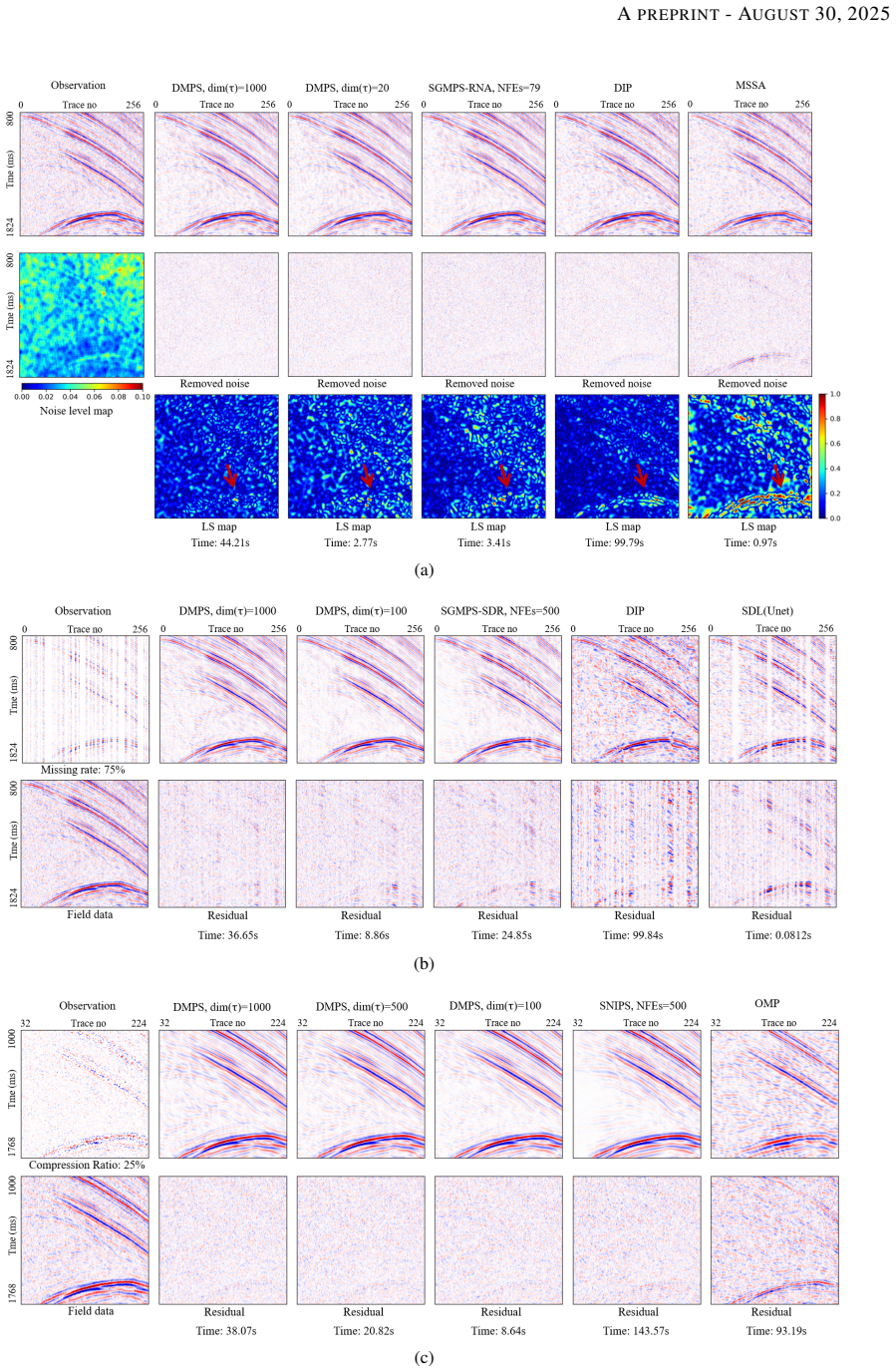
The paper's central claim is that an unconditional denoising diffusion probabilistic model, trained with a power-function noise schedule ($\beta_t = t^a$ with $a=3$ or $4$), gives a single pretrained network sufficient for posterior sampling across distinct noisy linear inverse problems. The posterior sampler works in the singular-value basis of the forward operator $G=U\Sigma V^\top$, reusing the same noise-predictor $\epsilon_\theta$ from the unconditional model and the estimated observation noise level $\sigma_y$; it produces stochastic solutions whose mean approximates the posterior expectation and whose spread provides uncertainty information. With the DDIM-style non-Markov sampling trajectory shortened to $20$ steps, the authors report output comparable to the full $1000$-step chain and faster than score-based posterior samplers that need hundreds of evaluations.
Load-bearing premise
The load-bearing premise is that the power noise schedule is specified precisely enough to reproduce the trained model; as written, $\beta_t = t^a$ with $T=1000$ and $a=3$ gives $\beta_T = 10^9$, contradicting the paper's own bound $0<\beta_t<1$, so an unstated normalization is required for the schedule to exist.
Editorial extensions
If this is right
- One trained unconditional diffusion model can serve denoising, interpolation, and compressed sensing by swapping only the forward operator $G$, eliminating task-specific conditional retraining.
- Using a subsequence of 20 reverse steps reproduces the posterior quality of the full 1000-step chain, giving more than a 50× speed-up in unconditional sampling.
- The assumed observation noise level $\sigma_y$ acts as a user dial: larger values suppress noise more strongly while preserving signal, enabling interactive posterior exploration.
- The method's time complexity scales as $O(\dim(\tau)\cdot d)$ with $O(d)$ memory, below the score-based baselines used, supporting larger seismic datasets.
- Because the method generates multiple samples, posterior mean and variance provide uncertainty quantification for each inverse problem, which deterministic discriminative methods cannot supply.
Reading between the lines
- An untested extension is to other low-amplitude geophysical or medical signals where the power schedule's slow noise injection should behave similarly; the paper only demonstrates seismic data.
- The noise-level interaction suggests a practical uncertainty-quantification protocol: sample at fixed $\sigma_y$ for diversity, then sweep $\sigma_y$ to map the trade-off between resolution and noise suppression; the paper shows the trade-off qualitatively but does not formalize such a protocol.
- The Discussion's claim that the method extends to nonlinear inverse problems remains a sketch; a concrete test would replace $G$ with a linearization of a nonlinear operator and compare against task-specific nonlinear solvers.
- If the power schedule is made explicit and normalized, the same framework could be benchmarked against later conditional diffusion models on identical compute budgets; this comparison is not in the paper.
Editorial analysis
A structured set of objections, weighed in public.
Referee Report
Summary. The paper proposes an unconditional denoising diffusion probabilistic model (DDPM) trained with a newly introduced "power function" noise schedule for seismic data, and combines it with the DDRM posterior-sampling framework to solve noisy linear inverse problems (denoising, interpolation, compressed sensing) without task-specific retraining. The authors claim that 20-step accelerated sampling is comparable to 1000-step sampling, that the method outperforms score-based and classical baselines, and that it generalizes out-of-distribution. The experimental section reports only qualitative visual results on synthetic and field data, with no tables of quantitative metrics. The power schedule is defined as beta_t = t^a, which conflicts with the stated 0 < beta_t < 1 requirement, leaving the actual training schedule unspecified and making the central construction irreproducible as written.
Significance. The idea of reusing a single unconditional diffusion prior for multiple seismic inverse problems is practically appealing, and the qualitative demonstrations on field data suggest potential. The proposed power schedule, if properly normalized and validated, could be a useful adaptation for low-amplitude seismic signals. However, the posterior sampling machinery is directly inherited from DDRM, and the paper provides no code or numerical results; the claimed advantages over baselines are therefore unverified. The paper does not present machine-checked proofs, reproducible code, parameter-free derivations, or falsifiable quantitative predictions, so its significance currently rests on a promising but incompletely specified empirical recipe.
major comments (3)
- [Section 2.1.1, Equations (1)-(3)] The power noise schedule beta_t = t^a is incompatible with the stated bound 0 < beta_1 < ... < beta_T < 1. For the reported settings a = 3, a = 4, and T = 1000, beta_1000 = 10^9 and beta_2 = 8 > 1, so alpha_t = 1 - beta_t becomes negative for t >= 2, and the cumulative product alpha_bar_t in Equation (2) no longer yields a valid variance schedule. Consequently, the closed-form noising q(x_t|x_0) and the training objective in Equation (3) are not well defined for the stated schedule. The paper must specify the actual normalized schedule (e.g., beta_t = (t/T)^a or a similar normalization) and verify that 0 < beta_t < 1 for all t; without this, the trained model and all downstream posterior-sampling results are not reproducible.
- [Section 3, Figures 9-12] The paper reports no quantitative metrics. The text claims 'higher SNR and SSIM values' (Section 3.4, Figure 11) and 'best results' for interpolation and compressed sensing, but no tables or numerical values are provided. This makes it impossible to assess the central claims of superiority over SGMPS-RNA, SGMPS-SDR, SNIPS, DIP, MSSA, and OMP, especially because baseline hyperparameters (e.g., DIP iterations, MSSA singular values) are described only loosely. The authors should add quantitative tables with SNR and SSIM values and runtime comparisons for all tasks and baseline methods.
- [Section 2.2.1, Equations (7)-(9) and Algorithm 1] The posterior sampling construction is imported from DDRM, but the presentation contains several internal inconsistencies that prevent independent implementation. The condition in Equation (9) uses sigma_t, whereas the surrounding text defines sigma_hat_t as the diffusion noise level and earlier (Equation (4)) sets sigma_t = beta_t; the variance term in the third case of Equation (9) is written without a square root and is dimensionally inconsistent with the first two cases; Equation (8) uses z without specifying its distribution; and Algorithm 1 lines 4 and 7 are inverse operations of each other, making the update redundant. Since these formulas are the core of the proposed method, the authors need to re-derive them carefully and align the notation with the cited DDRM reference.
minor comments (5)
- [Section 1] There is a typo 'denoisng' in the first sentence; please correct it.
- [Section 2.1.1] The sentence 'the larger a is, the slower the noise level curve rises' appears inconsistent with beta_t = t^a for t > 1, where a larger exponent actually makes beta_t rise faster in the later steps. Please clarify the intended behavior, possibly by plotting the normalized schedule.
- [Section 2.2.4] The phrase 'on feild data' should be 'on field data'.
- [Table 1] The complexity entries for SGMPS-RNA are unclear ('O(Ln · d), L n < T'); please format the table so each method has a single time-complexity expression and a single space-complexity expression.
- [References] Reference [16] is a conference version of the present work; the relation should be explicitly stated to avoid self-citation ambiguity. Additionally, the paper does not compare against DDRM or DPS, which are the most direct diffusion-based posterior sampling baselines; such a comparison would contextualize the claimed improvements.
Circularity Check
No circularity found: the central construction is an application of the external DDRM/DDIM/DDPM framework plus an explicitly stated (if under-specified) power noise schedule; self-citations appear only as baselines or auxiliary estimators and do not force the claimed results.
full rationale
The paper's claimed derivation chain is: (1) train an unconditional DDPM with a proposed power-function noise schedule; (2) accelerate sampling with DDIM; (3) reuse the same network in a DDRM-style posterior sampler; (4) estimate the observation noise level with an external VI-non-IID model. None of these steps equates a predicted output to a fitted input or reduces the target result to a self-citation by construction. The power schedule β_t = t^a is introduced as an explicit input hyperparameter, not inferred from the data or from the evaluation metrics; this is a design choice, not a fitted parameter renamed as a prediction. The posterior sampling update (Eq. 9) is explicitly adopted from the external DDRM paper [36] and uses the unconditional denoiser as a prior; the paper does not claim to derive this update from its own assumptions. The unconditional model is trained on Marmousi/OpenSEGY and then evaluated on held-out and out-of-distribution data (Sigmoid, field data), so the posterior samples are not statistically forced by the training fit. Self-citations appear for the SGM baselines [15, 20, 24] and for the VI-non-IID noise-level estimator [39]; these are independently published artifacts used as comparison methods or auxiliary inputs, and the main result does not reduce to them. The paper does contain a serious internal inconsistency: as written, β_t = t^a with a = 3 or 4 and T = 1000 violates the stated requirement 0 < β_t < 1 of Eq. (1), implying an unstated normalization; however, that is a reproducibility/correctness flaw in the specification, not a circular reduction. Under the hard rule that circularity must be exhibited as an equation-level equivalence or a fitted-input-called-prediction, no such step can be identified. Therefore the appropriate finding is no significant circularity.
Assumptions & free parameters
free parameters (4)
- a (power schedule exponent) =
a = 3, 4 (examples given)
- gamma and gamma_b (posterior sampling noise injection) =
gamma = 0.9, gamma_b = 1
- sigma_y (observation noise level) =
Estimated per image via VI-non-IID; defaults to min/median/max: 0.0204, 0.0658, 0.1739 on the field data
- eta (DDIM stochasticity) =
eta = 0.8 for unconditional sampling in Figure 8
assumptions (4)
- domain assumption The unconditional DDPM trained on Marmousi and OpenSEGY captures the seismic data distribution accurately enough for posterior sampling.
- domain assumption The observation noise n is Gaussian with known or reliably estimated level sigma_y.
- standard math DDIM acceleration and DDRM posterior sampling theory apply unchanged when the DDPM is trained with the new power schedule.
- domain assumption The forward operator G is linear and its SVD is computable.
Cite this review
Pith. "Pith review of Generative modeling of seismic data using diffusion models and its application to multi-purpose posterior sampling for noisy inverse problems." pith.science (2026). https://pith.science/paper/SNVLM66C
@misc{pith2026250612897,
  author       = {Pith},
  title        = {Pith review of: Generative modeling of seismic data using diffusion models and its application to multi-purpose posterior sampling for noisy inverse problems},
  year         = {2026},
  howpublished = {\url{https://pith.science/paper/SNVLM66C}},
  note         = {Machine review of arXiv:2506.12897}
}
read the original abstract
Geophysical inverse problems are often ill-posed and admit multiple solutions. Conventional discriminative methods typically yield a single deterministic solution, which fails to model the posterior distribution, cannot generate diverse high-quality stochastic solutions, and limits uncertainty quantification. Addressing this gap, we propose an unsupervised posterior sampling method conditioned on the noisy observations and the inverse problem, eliminating the need to retrain a task-specific conditional diffusion model with paired data for each new application. Specifically, we first propose a diffusion model enhanced with a novel noise schedule for generative modeling of seismic data, and introduce the non-Markov sampling strategy to achieve fast and quality-controllable unconditional sampling. Building upon this, we further present a posterior sampling method for various noisy inverse problems using the trained unconditional diffusion model. Our method requires only a small number of function evaluations to achieve competitive performance, while enabling flexible posterior sampling that interacts adaptively with different noise levels.Experiments on unconditional generation and posterior sampling across different tasks show that our method not only efficiently models the seismic data distribution and posterior conditioned on observations and tasks but also achieves substantially faster sampling and superior out-of-distribution generalization.
Figures


Figures from the paper (10 more)



Forward citations
Cited by 1 Pith paper
-
Estimation of Elastic Parameters with Guidance-based Diffusion model
Using a diffusion-model prior guided by Aki-Richards physics, the authors invert seismic angle-stack data for elastic parameters and show the method's uncertainty estimates are systematically overconfident compared wi...
Reference graph
Works this paper leans on
-
[1]
S. Yu, J. Ma, and W. Wang. Deep learning for denoising. Geophysics, 84(6):1–107, 2019
work page 2019
-
[2]
Learning to decouple and generate seismic random noise via invertible neural network
Chuangji Meng, Jinghuai Gao, Yajun Tian, and Zhen Li. Learning to decouple and generate seismic random noise via invertible neural network. IEEE Transactions on Geoscience and Remote Sensing, 61:1–16, 2023
work page 2023
-
[3]
Deep-learning-based seismic data interpolation: A preliminary result
Benfeng Wang, Ning Zhang, Wenkai Lu, and Jialin Wang. Deep-learning-based seismic data interpolation: A preliminary result. Geophysics, 84(1):V11–V20, 2019
work page 2019
-
[4]
Seismic data interpolation using deep learning with generative adversarial networks
Harpreet Kaur, Nam Pham, and Sergey Fomel. Seismic data interpolation using deep learning with generative adversarial networks. Geophysical Prospecting, 69(2):307–326, 2021
work page 2021
-
[5]
Mauricio Araya-Polo, Joseph Jennings, Amir Adler, and Taylor Dahlke. Deep-learning tomography. The Leading Edge, 37(1):58–66, 2018
work page 2018
-
[6]
Seismic noise attenuation using unsupervised sparse feature learning
Mi Zhang, Yang Liu, Min Bai, and Yangkang Chen. Seismic noise attenuation using unsupervised sparse feature learning. IEEE Transactions on Geoscience and Remote Sensing, 57(12):9709–9723, 2019
work page 2019
-
[7]
Porosity and permeability prediction using a transformer and periodic long short-term network
Liuqing Yang, Sergey Fomel, Shoudong Wang, Xiaohong Chen, Wei Chen, Omar M Saad, and Yangkang Chen. Porosity and permeability prediction using a transformer and periodic long short-term network. Geophysics, 88(1):W A293–W A308, 2023
work page 2023
-
[8]
Yajun Tian, Alexey Stovas, Jinghuai Gao, Chuangji Meng, and Chun Yang. Frequency-dependent avo inversion and application on tight sandstone gas reservoir prediction using deep neural network. IEEE Transactions on Geoscience and Remote Sensing, 61:1–13, 2023
work page 2023
Show all 46 references
-
[9]
Seismic fault detection with convolutional neural network
Wei Xiong, Xu Ji, Yue Ma, Yuxiang Wang, Nasher M AlBinHassan, Mustafa N Ali, and Yi Luo. Seismic fault detection with convolutional neural network. Geophysics, 83(5):O97–O103, 2018
2018
-
[10]
Building realistic structure models to train convolutional neural networks for seismic structural interpretation
Xinming Wu, Zhicheng Geng, Yunzhi Shi, Nam Pham, Sergey Fomel, and Guillaume Caumon. Building realistic structure models to train convolutional neural networks for seismic structural interpretation. Geophysics, 85(4):W A27–W A39, 2020
2020
-
[11]
Snips: Solving noisy inverse problems stochastically
Bahjat Kawar, Gregory Vaksman, and Michael Elad. Snips: Solving noisy inverse problems stochastically. Advances in Neural Information Processing Systems, 34:21757–21769, 2021
2021
-
[12]
Score-based generative modeling through stochastic differential equations
Yang Song, Jascha Sohl-Dickstein, Diederik P Kingma, Abhishek Kumar, Stefano Ermon, and Ben Poole. Score-based generative modeling through stochastic differential equations. arXiv preprint arXiv:2011.13456, 2020
2011 arXiv
-
[13]
Generative modeling by estimating gradients of the data distribution
Yang Song and Stefano Ermon. Generative modeling by estimating gradients of the data distribution. Advances in neural information processing systems, 32:11895–11907, 2019
2019
-
[14]
Denoising diffusion probabilistic models
Jonathan Ho, Ajay Jain, and Pieter Abbeel. Denoising diffusion probabilistic models. Advances in neural information processing systems, 33:6840–6851, 2020
2020
-
[15]
Generative modeling of seismic data using score-based generative models
Chuangji Meng, Jinghuai Gao, Yajun Tian, Hongling Chen, and Renyu Luo. Generative modeling of seismic data using score-based generative models. In 85th EAGE Annual Conference & Exhibition (including the Workshop Programme), volume 2024, pages 1–5. European Association of Geosc...
2024
-
[16]
Generative modeling of seismic data using diffusion models and its application to multi-purpose seismic inverse problems
C Meng, J Gao, Y Tian, H Chen, L Zhou, J Chen, Q Du, and Y Li. Generative modeling of seismic data using diffusion models and its application to multi-purpose seismic inverse problems. In86th EAGE Annual Conference & Exhibition, volume 2025, pages 1–5. European Association of ...
2025
-
[17]
Controllable seismic velocity synthesis using generative diffusion models
Fu Wang, Xinquan Huang, and Tariq Alkhalifah. Controllable seismic velocity synthesis using generative diffusion models. Journal of Geophysical Research: Machine Learning and Computation, 1(3):e2024JH000153, 2024
2024
-
[18]
Analysis of das seismic noise generation and elimination process based on mean-sde diffusion model
Qiankun Feng, Shigang Wang, and Yue Li. Analysis of das seismic noise generation and elimination process based on mean-sde diffusion model. IEEE Transactions on Geoscience and Remote Sensing, 62:1–13, 2024
2024
-
[19]
Seismic data strong noise attenuation based on diffusion model and principal component analysis
Junheng Peng, Yong Li, Zhangquan Liao, Xuben Wang, and Xingyu Yang. Seismic data strong noise attenuation based on diffusion model and principal component analysis. IEEE Transactions on Geoscience and Remote Sensing, 62:1–11, 2024
2024
-
[20]
Posterior sampling for random noise attenuation via score-based generative models
Chuangji Meng, Jinghuai Gao, Baohai Wu, Hongling Chen, and Yajun Tian. Posterior sampling for random noise attenuation via score-based generative models. Geophysics, 90(2):V83–V95, 2025. 15 A PREPRINT - AUGUST 30, 2025
2025
-
[21]
Fast diffusion model for seismic data noise attenuation
Junheng Peng, Yong Li, Yingtian Liu, Mingwei Wang, Zhangquan Liao, and Xiaowen Wang. Fast diffusion model for seismic data noise attenuation. Geophysics, 90(4):1–55, 2025
2025
-
[22]
Generative interpolation via a diffusion probabilistic model
Qi Liu and Jianwei Ma. Generative interpolation via a diffusion probabilistic model. Geophysics, 89(1):V65–V85, 2024
2024
-
[23]
Seismic data interpolation via denoising diffusion implicit models with coherence-corrected resampling
Xiaoli Wei, Chunxia Zhang, Hongtao Wang, Chengli Tan, Deng Xiong, Baisong Jiang, Jiangshe Zhang, and Sang-Woon Kim. Seismic data interpolation via denoising diffusion implicit models with coherence-corrected resampling. IEEE Transactions on Geoscience and Remote Sensing, 62:1–17, 2024
2024
-
[24]
Stochastic solutions for simultaneous seismic data denoising and reconstruction via score-based generative models
Chuangji Meng, Jinghuai Gao, Yajun Tian, Hongling Chen, Wei Zhang, and Renyu Luo. Stochastic solutions for simultaneous seismic data denoising and reconstruction via score-based generative models. IEEE Transactions on Geoscience and Remote Sensing, 2024
2024
-
[25]
Seisfusion: Constrained diffusion model with input guidance for 3d seismic data interpolation and reconstruction
Shuang Wang, Fei Deng, Peifan Jiang, Zishan Gong, Xiaolin Wei, and Yuqing Wang. Seisfusion: Constrained diffusion model with input guidance for 3d seismic data interpolation and reconstruction. IEEE Transactions on Geoscience and Remote Sensing, 2024
2024
-
[26]
Generative diffusion model for seismic imaging improvement of sparsely acquired data and uncertainty quantification
Xingchen Shi, Shijun Cheng, Weijian Mao, and Wei Ouyang. Generative diffusion model for seismic imaging improvement of sparsely acquired data and uncertainty quantification. IEEE Transactions on Geoscience and Remote Sensing, 2024
2024
-
[27]
Seisresodiff: Seismic resolution enhancement based on a diffusion model
Hao-Ran Zhang, Yang Liu, Yu-Hang Sun, and Gui Chen. Seisresodiff: Seismic resolution enhancement based on a diffusion model. Petroleum Science, 21(5):3166–3188, 2024
2024
-
[28]
Diffusion model for das-vsp data denoising
Donglin Zhu, Lei Fu, Vladimir Kazei, and Weichang Li. Diffusion model for das-vsp data denoising. Sensors, 23(20):8619, 2023
2023
-
[29]
Conditional denoising diffusion probabilistic model for seismic diffraction separation and imaging
Hao Zhang, Yuanyuan Li, and Jianping Huang. Conditional denoising diffusion probabilistic model for seismic diffraction separation and imaging. IEEE Transactions on Geoscience and Remote Sensing, 2024
2024
-
[30]
Deep diffusion models for seismic processing
Ricard Durall, Ammar Ghanim, Mario Ruben Fernandez, Norman Ettrich, and Janis Keuper. Deep diffusion models for seismic processing. Computers & Geosciences, 177:105377, 2023
2023
-
[31]
Unsupervised seismic acoustic impedance inversion based on generative diffusion model
Hongling Chen, Jie Chen, Mauricio Sacchi, Jinghuai Gao, and Ping Yang. Unsupervised seismic acoustic impedance inversion based on generative diffusion model. Geophysics, 90(4):1–98, 2025
2025
-
[32]
Conditional score- based diffusion models for bayesian inference in infinite dimensions
Lorenzo Baldassari, Ali Siahkoohi, Josselin Garnier, Knut Solna, and Maarten V de Hoop. Conditional score- based diffusion models for bayesian inference in infinite dimensions. Advances in Neural Information Processing Systems, 36, 2024
2024
-
[33]
A generative foundation model for an all-in-one seismic processing framework
Shijun Cheng, Randy Harsuko, and Tariq Alkhalifah. A generative foundation model for an all-in-one seismic processing framework. arXiv preprint arXiv:2502.01111, 2025
2025 arXiv
-
[34]
Denoising diffusion implicit models
Jiaming Song, Chenlin Meng, and Stefano Ermon. Denoising diffusion implicit models. arXiv preprint arXiv:2010.02502, 2020
2010 arXiv
-
[35]
Improved denoising diffusion probabilistic models
Alexander Quinn Nichol and Prafulla Dhariwal. Improved denoising diffusion probabilistic models. In International conference on machine learning, pages 8162–8171. PMLR, 2021
2021
-
[36]
Denoising diffusion restoration models.Advances in Neural Information Processing Systems, 35:23593–23606, 2022
Bahjat Kawar, Michael Elad, Stefano Ermon, and Jiaming Song. Denoising diffusion restoration models.Advances in Neural Information Processing Systems, 35:23593–23606, 2022
2022
-
[37]
Stochastic solutions for linear inverse problems using the prior implicit in a denoiser
Kadkhodaie, Zahra and Simoncelli, Eero. Stochastic solutions for linear inverse problems using the prior implicit in a denoiser. Advances in Neural Information Processing Systems, 34:13242–13254, 2021
2021
-
[38]
Diffusion posterior sampling for general noisy inverse problems
Hyungjin Chung, Jeongsol Kim, Michael Thompson Mccann, Marc Louis Klasky, and Jong Chul Ye. Diffusion posterior sampling for general noisy inverse problems. In The Eleventh International Conference on Learning Representations, 2023
2023
-
[39]
Seismic random noise attenuation based on non-iid pixel-wise gaussian noise modeling
Chuangji Meng, Jinghuai Gao, Yajun Tian, and Zhiqiang Wang. Seismic random noise attenuation based on non-iid pixel-wise gaussian noise modeling. IEEE Transactions on Geoscience and Remote Sensing, 60:1–16, 2022
2022
-
[40]
Improved techniques for training score-based generative models
Song, Yang and Ermon, Stefano. Improved techniques for training score-based generative models. Advances in neural information processing systems, 33:12438–12448, 2020
2020
-
[41]
Unified matrix treatment of the fast walsh-hadamard transform.IEEE Transactions on Computers, 100(11):1142–1146, 1976
Fino and Algazi. Unified matrix treatment of the fast walsh-hadamard transform.IEEE Transactions on Computers, 100(11):1142–1146, 1976
1976
-
[42]
Deep image prior
Dmitry Ulyanov, Andrea Vedaldi, and Victor Lempitsky. Deep image prior. InProceedings of the IEEE conference on computer vision and pattern recognition, pages 9446–9454, 2018. 16 A PREPRINT - AUGUST 30, 2025
2018
-
[43]
Simultaneous seismic data denoising and reconstruction via multichannel singular spectrum analysis
Vicente Oropeza and Mauricio Sacchi. Simultaneous seismic data denoising and reconstruction via multichannel singular spectrum analysis. Geophysics, 76(3):V25–V32, 2011
2011
-
[44]
U-net: Convolutional networks for biomedical image segmentation
Olaf Ronneberger, Philipp Fischer, and Thomas Brox. U-net: Convolutional networks for biomedical image segmentation. In International Conference on Medical image computing and computer-assisted intervention, pages 234–241. Springer, 2015
2015
-
[45]
Signal recovery from random measurements via orthogonal matching pursuit
Joel A Tropp and Anna C Gilbert. Signal recovery from random measurements via orthogonal matching pursuit. IEEE Transactions on information theory, 53(12):4655–4666, 2007
2007
-
[46]
Discrete cosine transform
Nasir Ahmed, T_ Natarajan, and Kamisetty R Rao. Discrete cosine transform. IEEE transactions on Computers, 100(1):90–93, 2006. 17
2006
Reviewed August 7, 2026 · model on record in the stance chip above.
Discussion (0). Continue with ORCID to comment.