REVIEW 4 major objections 4 minor 73 references
SmartHome-Bench: A Comprehensive Benchmark for Video Anomaly Detection in Smart Homes Using Multi-Modal Large Language Models
T0 review · 4 major / 4 minor · reviewed 2026-08-07 · deepseek-v4-flash
Pith's one-line read SmartHome-Bench, the first benchmark for smart-home video anomaly detection with large language models, shows plain prompting is near chance and a taxonomy-driven reflection chain adds 11.62% accuracy.
desk verdict A genuinely useful smart-home VAD benchmark with a method claim that needs tighter experiments before the 11.62% number is trusted. read the letter →
The pith
A machine-rendered reading of the paper's core claim, the machinery that carries it, and where it could break.
The reading
What carries the argument
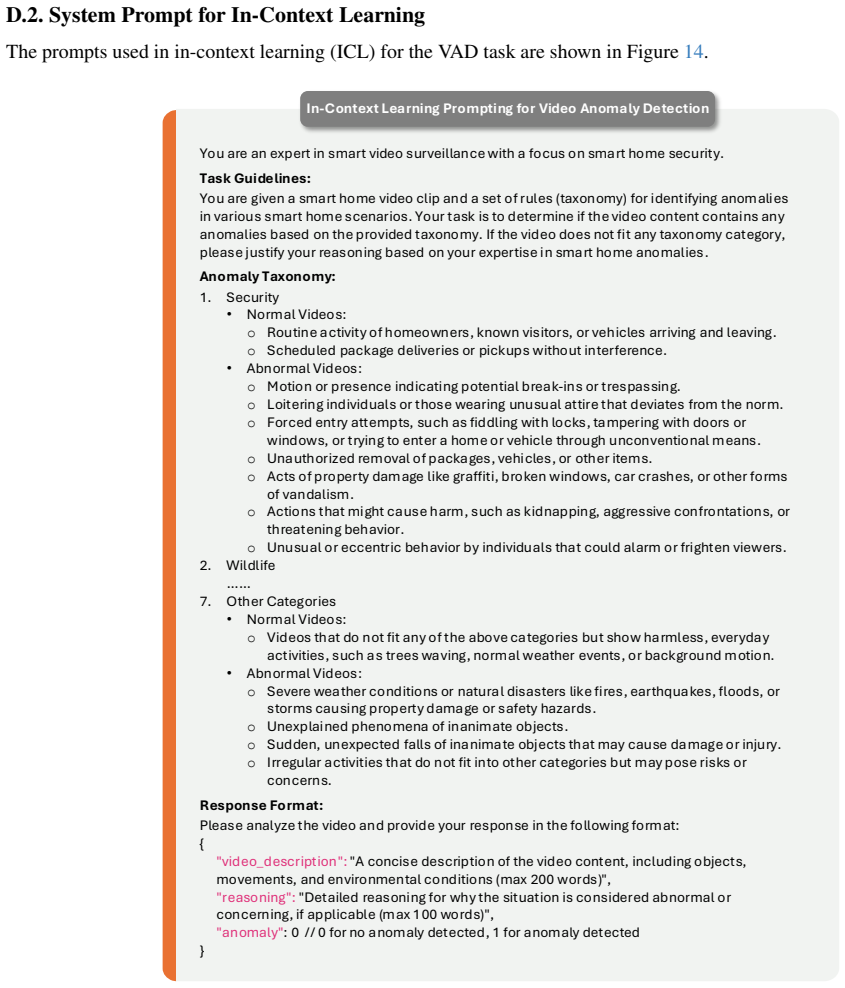
The load-bearing mechanism is the Taxonomy-Driven Reflective LLM Chain (TRLC), a three-call LLM pipeline built on the observation that long taxonomy text dilutes a single prompt. In step (a) one call compresses the full seven-category taxonomy into ten concise rules, such as 'identify pets outdoors without their owner'; step (b) makes the initial chain-of-thought prediction with those rules available; step (c) reintroduces the rules and the initial result, asking the model to update the anomaly label if a rule applies. The self-reflection step is what produces the reported gain, exemplified by an outdoor cat first judged normal and then reclassified as abnormal once the unattended-pet rule is applied. Because the taxonomy is a configurable input rather than a fixed label set, the same chain is the paper's stated route to adapting VAD to other environments or to personalized household definitions of an anomaly.
What would settle it
Re-run TRLC with the self-reflection step intact but with the ten taxonomy-derived rules replaced by irrelevant or empty rule lists; if accuracy stays at the full TRLC level, the gain comes from the second look at the video, not from the taxonomy's content. A complementary test deletes one category's rules (for example, all wildlife rules) from the list and checks whether accuracy on that category's videos drops relative to the other six categories.
Extended reading notes
Core claim
The central claim is that no existing benchmark measures whether MLLMs can catch the events that actually matter in a home, and that on such a benchmark today's models fail until they are given the right scaffolding. SmartHome-Bench supplies that measuring instrument: 1,203 camera videos labeled through an anomaly taxonomy that defines normal and abnormal events in seven categories, with a third 'vague abnormal' tag reserved for clips where annotators could not agree. The paper reports that without prompting guidance, all tested models hover near random accuracy, and that in-context learning with the full taxonomy is inconsistent across models. TRLC then decomposes the task into three calls: rule generation from the taxonomy, an initial chain-of-thought prediction, and a self-reflection pass that applies a rule to revise the prediction when one matches. The result is the paper's headline number, an 11.62% average accuracy gain over zero-shot across five closed-source MLLMs, with Claude-3.5-sonnet reaching 79.05% and majority voting among the top three models reaching 81.63%.
Load-bearing premise
The TRLC improvement depends on the assumption that the taxonomy in Appendix B can be condensed into general rules that the model applies during self-reflection without merely restating how the labels were assigned, so part of the 11.62% gain could measure checklist-following rather than video anomaly understanding.
Editorial extensions
If this is right
- Off-the-shelf MLLMs with plain prompting are not ready to be the backbone of smart-home anomaly alerts; near-chance accuracy means deployment needs either grounding structure or fine-tuning.
- Pasting a long taxonomy into a single prompt is the wrong way to use it; condensing it into a handful of rules and checking predictions against them works better and more consistently.
- The 91 'vague abnormal' videos form a hard subset where even the best models stay around 50 to 60% accuracy, so genuinely ambiguous household events remain an open problem.
- Majority voting across MLLMs reaches 81.63% overall and 91.2% on unanimously voted videos, pointing to a practical way to auto-label large smart-home video collections cheaply.
- Since the taxonomy is an input to the chain rather than a fixed label set, the same pipeline should transfer to other environments or to user-defined household rules without retraining.
Reading between the lines
- A fair reading of the 11.62% gain is that part of it may be the model following a provided checklist; a control experiment with deliberately wrong rules would reveal how much of the reflection step is genuine video understanding versus rule application.
- The paper's own error analysis finds that context lack, not perception, is the dominant failure mode, which implies the next bottleneck is social context such as who the people on camera are, something a taxonomy of event types alone cannot encode.
- Because the rules were generated from the same taxonomy that defines the ground-truth labels, an independent test of the framework should use a taxonomy written by a different set of annotators, or apply SmartHome-Bench's taxonomy to a second dataset, to check that the gain transfers rather than overfitting the annotation schema.
- A practical extension the authors gesture at but do not develop: use unanimous MLLM votes to bootstrap pseudo-labels for new smart-home footage, then fine-tune a small open model on those pseudo-labels rather than paying for closed-source inference at scale.
Editorial analysis
A structured set of objections, weighed in public.
Referee Report
Summary. The paper introduces SmartHome-Bench, a dataset of 1,203 smart-home camera videos annotated with event category, anomaly tag (normal, abnormal, or vague abnormal), free-text descriptions, and reasoning, organized under a seven-category anomaly taxonomy. It then benchmarks six MLLMs across zero-shot, chain-of-thought, few-shot CoT, and in-context learning prompts, and proposes the Taxonomy-Driven Reflective LLM Chain (TRLC), which generates rules from the taxonomy, produces an initial prediction, and then applies a self-reflection step that updates the prediction if any rule matches. The authors report that TRLC improves average detection accuracy by 11.62% over zero-shot prompting and that majority voting over the top three models reaches 81.63% accuracy.
Significance. If the benchmark and the TRLC results hold, this would be a useful contribution: SmartHome-Bench is, to my knowledge, the first video anomaly detection benchmark aimed specifically at smart-home scenarios for MLLM evaluation, and the dataset release with human-written descriptions and reasoning is a valuable resource. The paper also provides a systematic comparison of six models and five prompting strategies, and the internal comparisons across methods appear consistent with the reported tables. However, the central methodological claim about TRLC is currently under-supported because the self-reflection step is given a condensed version of the same taxonomy that defines the ground-truth labels, and no ablation isolates the effect of the chain from the effect of handing the model the label semantics. The claims about the benchmark's comprehensiveness are the strongest part; the claims about TRLC as a reasoning enhancer need additional controls.
major comments (4)
- [Section 5.4 and Figure 18] The 11.62% TRLC improvement is not isolated from the annotation taxonomy. In Step (c), the model is instructed to update its prediction if the video description matches any of the 10 rules, and those rules were generated in Step (a) by condensing the exact Appendix B taxonomy that annotators used to assign ground-truth labels (with vague abnormal also mapped to 1). This makes the self-reflection step a near re-statement of the label semantics plus an explicit bias toward positive predictions. The paper does not ablate Step (c), nor does it compare TRLC against a single-pass CoT prompt that contains the same 10 rules, so the reported gain cannot be attributed to the chaining mechanism as opposed to rule-following and label-positive bias. Please add (i) TRLC without self-reflection, (ii) a single-pass CoT or ICL prompt with the same 10 rules, and (iii) threshold-independent metrics such as AUC or precision-recall, and report the direction of label flips in Step (c).
- [Section 5.1 and Appendix A] The video input pipeline is underspecified, which is a load-bearing reproducibility issue for a benchmark paper. The text never states how videos are converted into model inputs: frame sampling rate, number of frames, spatial resolution, or whether the full video is passed. Since VAD performance is sensitive to temporal and spatial subsampling, other researchers cannot reproduce the reported numbers or meaningfully compare new methods. Please specify the exact preprocessing used for each API and the open-source model.
- [Section 5.4 and Figure 6] The majority-voting result of 81.63% is computed by selecting the top three models (Gemini-1.5-pro, GPT-4o, Claude-3.5-sonnet) after observing their TRLC accuracy on the test set. This is post-hoc test-set selection and should not be presented on equal footing with the per-model results. The paper does label this as peak performance achievable, which is honest, but it should be explicitly framed as an upper-bound analysis and the selection criterion should be stated. Additionally, no confidence intervals or repeated runs are reported for any of the accuracy, precision, recall, or F1 numbers in Section 5, despite small differences between methods (e.g., GPT-4o-mini ICL versus TRLC); a bootstrap interval or an acknowledgment of single-run variance is needed.
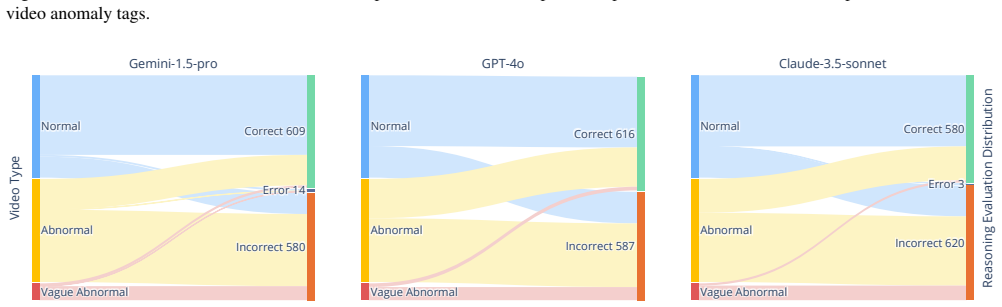
- [Section 5 and Table 6] The decision to map vague abnormal to 1 is consequential and underexamined. Table 6 shows that accuracy on the 91 vague videos is very low (e.g., 16.48% for Gemini-1.5-pro under zero-shot), yet these videos are collapsed into the positive class in all main results. This conflation hides the models' behavior on genuinely ambiguous cases and may inflate or deflate the reported gains depending on the distribution of flips in Step (c). Please report results separately for the normal, abnormal, and vague-abnormal subsets, and discuss whether collapsing the vague class is appropriate for the intended use case, or at least justify it with an analysis of annotator agreement.
minor comments (4)
- [Appendix C] The annotation process reveals that Gemini-1.5-pro was used to generate initial drafts of descriptions and reasoning, which annotators then refined. This introduces a potential model bias into the ground-truth text. Please report how many drafts were used unchanged and discuss the implications, or provide an analysis of annotator edits.
- [Section 5.5 and Figures 7-8] The counts in Figures 7 and 8 exceed the dataset size of 1,203 because a single video may exhibit multiple failure types. The text states this, but the figures could be clearer if they used percentages or explicitly noted the overlap in the caption.
- [Appendix B] The taxonomy is described as developed based on user study but no details of the user study, participant demographics, or methodology are provided. Since the taxonomy is the foundation of both the dataset and the TRLC rules, a brief description or a reference to a companion document would improve transparency.
- [General] There are several typographical and formatting issues throughout, including the word V AD appearing with a space and the repeated duplicate of the zero-shot prompt in Figures 11, 21, and elsewhere. A careful proofreading pass is recommended.
Circularity Check
No circularity: the TRLC improvement is an empirical system comparison; the taxonomy-derived rules are prompt context, not a fitted label or self-citation.
full rationale
SmartHome-Bench is a dataset and benchmark paper, not a derivation. The ground-truth labels are produced by human annotators using the Appendix B taxonomy, while the TRLC method receives a GPT-4o-condensed version of the same taxonomy as prompt context. This is a standard use of class definitions in in-context prompting, not a fitted parameter renamed as a prediction. No equation in the paper constructs the reported 11.62% accuracy gain from the labels themselves: the MLLM must still watch the video, generate a description, and match that description to the rules, and the paper reports accuracy, precision, recall, and F1 against the held-out human labels. The self-reflection step is one-sided in that it only updates 0 to 1 when a rule matches, which is a potential evaluation confound for low-recall baselines, but this is a validity or bias concern rather than circularity: the rules do not contain the video content, and the gain is not statistically forced. There are no load-bearing self-citations, no imported uniqueness theorems, and no ansatz smuggled in by citation. The benchmark construction, annotation, and evaluation are empirically self-contained, so no circular step is established.
Assumptions & free parameters
free parameters (3)
- Top-three ensemble membership =
Gemini-1.5-pro, GPT-4o, Claude-3.5-sonnet
- Number of few-shot examples =
3
- Rule set size =
10
assumptions (3)
- ad hoc to paper The seven-category anomaly taxonomy in Appendix B correctly captures the space of smart home anomalies relevant to users.
- domain assumption Public YouTube videos are representative of real smart home camera footage.
- domain assumption GPT-4 can reliably judge whether MLLM descriptions and reasoning match human annotations.
Cite this review
Pith. "Pith review of SmartHome-Bench: A Comprehensive Benchmark for Video Anomaly Detection in Smart Homes Using Multi-Modal Large Language Models." pith.science (2026). https://pith.science/paper/EOKKX345
@misc{pith2026250612992,
  author       = {Pith},
  title        = {Pith review of: SmartHome-Bench: A Comprehensive Benchmark for Video Anomaly Detection in Smart Homes Using Multi-Modal Large Language Models},
  year         = {2026},
  howpublished = {\url{https://pith.science/paper/EOKKX345}},
  note         = {Machine review of arXiv:2506.12992}
}
read the original abstract
Video anomaly detection (VAD) is essential for enhancing safety and security by identifying unusual events across different environments. Existing VAD benchmarks, however, are primarily designed for general-purpose scenarios, neglecting the specific characteristics of smart home applications. To bridge this gap, we introduce SmartHome-Bench, the first comprehensive benchmark specially designed for evaluating VAD in smart home scenarios, focusing on the capabilities of multi-modal large language models (MLLMs). Our newly proposed benchmark consists of 1,203 videos recorded by smart home cameras, organized according to a novel anomaly taxonomy that includes seven categories, such as Wildlife, Senior Care, and Baby Monitoring. Each video is meticulously annotated with anomaly tags, detailed descriptions, and reasoning. We further investigate adaptation methods for MLLMs in VAD, assessing state-of-the-art closed-source and open-source models with various prompting techniques. Results reveal significant limitations in the current models' ability to detect video anomalies accurately. To address these limitations, we introduce the Taxonomy-Driven Reflective LLM Chain (TRLC), a new LLM chaining framework that achieves a notable 11.62% improvement in detection accuracy. The benchmark dataset and code are publicly available at https://github.com/Xinyi-0724/SmartHome-Bench-LLM.
Figures


Figures from the paper (18 more)




Reference graph
Works this paper leans on
-
[1]
Gpt-4 technical report.arXiv preprint arXiv:2303.08774,
Josh Achiam, Steven Adler, Sandhini Agarwal, Lama Ah- mad, Ilge Akkaya, Florencia Leoni Aleman, Diogo Almeida, Janko Altenschmidt, Sam Altman, Shyamal Anadkat, et al. Gpt-4 technical report.arXiv preprint arXiv:2303.08774,
-
[2]
Flamingo: a visual language model for few-shot learning.Advances in neural information processing systems, 35:23716–23736,
Jean-Baptiste Alayrac, Jeff Donahue, Pauline Luc, Antoine Miech, Iain Barr, Yana Hasson, Karel Lenc, Arthur Men- sch, Katherine Millican, Malcolm Reynolds, et al. Flamingo: a visual language model for few-shot learning.Advances in neural information processing systems, 35:23716–23736,
-
[3]
Real-time video anomaly detection for smart surveillance.IET Image Processing, 17(5):1375–1388,
Manal Mostafa Ali. Real-time video anomaly detection for smart surveillance.IET Image Processing, 17(5):1375–1388,
- [4]
-
[5]
UABUA Bakar, Hemant Ghayvat, SF Hasanm, and Sub- has Chandra Mukhopadhyay. Activity and anomaly detec- tion in smart home: A survey.Next generation sensors and systems, pages 191–220, 2015. 4
work page 2015
-
[6]
LLM meets Vision-Language Models for Zero-Shot One-Class Classification
Yassir Bendou, Giulia Lioi, Bastien Pasdeloup, Lukas Mauch, Ghouthi Boukli Hacene, Fabien Cardinaux, and Vincent Gripon. Llm meets vision-language models for zero-shot one-class classification.arXiv preprint arXiv:2404.00675, 2024. 24
work page Pith review arXiv 2024
-
[7]
Vane-bench: Video anomaly evaluation benchmark for conversational lmms
Rohit Bharadwaj, Hanan Gani, Muzammal Naseer, Fa- had Shahbaz Khan, and Salman Khan. Vane-bench: Video anomaly evaluation benchmark for conversational lmms. arXiv preprint arXiv:2406.10326, 2024. 2, 3
arXiv 2024
-
[8]
Meva: A large-scale multiview, multimodal video dataset for activity detection
Kellie Corona, Katie Osterdahl, Roderic Collins, and An- thony Hoogs. Meva: A large-scale multiview, multimodal video dataset for activity detection. InProceedings of the IEEE/CVF winter conference on applications of computer vision, pages 1060–1068, 2021. 3, 12
work page 2021
Show all 73 references
-
[9]
Palm- e: An embodied multimodal language model.arXiv preprint arXiv:2303.03378, 2023
Danny Driess, Fei Xia, Mehdi SM Sajjadi, Corey Lynch, Aakanksha Chowdhery, Brian Ichter, Ayzaan Wahid, Jonathan Tompson, Quan Vuong, Tianhe Yu, et al. Palm- e: An embodied multimodal language model.arXiv preprint arXiv:2303.03378, 2023. 1, 2
2023 arXiv
-
[10]
Video-mme: The first-ever compre- hensive evaluation benchmark of multi-modal llms in video analysis.arXiv preprint arXiv:2405.21075, 2024
Chaoyou Fu, Yuhan Dai, Yondong Luo, Lei Li, Shuhuai Ren, Renrui Zhang, Zihan Wang, Chenyu Zhou, Yunhang Shen, Mengdan Zhang, et al. Video-mme: The first-ever compre- hensive evaluation benchmark of multi-modal llms in video analysis.arXiv preprint arXiv:2405.21075, 2024. 3
2024 arXiv
-
[11]
Memorizing normality to detect anomaly: Memory-augmented deep autoencoder for unsupervised anomaly detection
Dong Gong, Lingqiao Liu, Vuong Le, Budhaditya Saha, Moussa Reda Mansour, Svetha Venkatesh, and Anton van den Hengel. Memorizing normality to detect anomaly: Memory-augmented deep autoencoder for unsupervised anomaly detection. InProceedings of the IEEE/CVF inter- national conf...
-
[12]
Learning temporal reg- ularity in video sequences
Mahmudul Hasan, Jonghyun Choi, Jan Neumann, Amit K Roy-Chowdhury, and Larry S Davis. Learning temporal reg- ularity in video sequences. InProceedings of the IEEE con- ference on computer vision and pattern recognition, pages 733–742, 2016. 1
2016
-
[13]
Gpt-4o system card
Aaron Hurst, Adam Lerer, Adam P Goucher, Adam Perel- man, Aditya Ramesh, Aidan Clark, AJ Ostrow, Akila Weli- hinda, Alan Hayes, Alec Radford, et al. Gpt-4o system card. arXiv preprint arXiv:2410.21276, 2024. 5
2024 arXiv
-
[14]
Llama guard: Llm- based input-output safeguard for human-ai conversations
Hakan Inan, Kartikeya Upasani, Jianfeng Chi, Rashi Rungta, Krithika Iyer, Yuning Mao, Michael Tontchev, Qing Hu, Brian Fuller, Davide Testuggine, et al. Llama guard: Llm- based input-output safeguard for human-ai conversations. arXiv preprint arXiv:2312.06674, 2023. 5
2023 arXiv
-
[15]
Object-centric auto-encoders and dummy anomalies for abnormal event detection in video
Radu Tudor Ionescu, Fahad Shahbaz Khan, Mariana-Iuliana Georgescu, and Ling Shao. Object-centric auto-encoders and dummy anomalies for abnormal event detection in video. In Proceedings of the IEEE/CVF conference on computer vi- sion and pattern recognition, pages 7842–7851, 2019. 1
2019
-
[16]
Dog behavior recognition based on multimodal data from a camera and wearable de- vice.Applied sciences, 12(6):3199, 2022
Jinah Kim and Nammee Moon. Dog behavior recognition based on multimodal data from a camera and wearable de- vice.Applied sciences, 12(6):3199, 2022. 3, 12
2022
-
[17]
Blip-2: Bootstrapping language-image pre-training with frozen image encoders and large language models
Junnan Li, Dongxu Li, Silvio Savarese, and Steven Hoi. Blip-2: Bootstrapping language-image pre-training with frozen image encoders and large language models. InIn- ternational conference on machine learning, pages 19730– 19742. PMLR, 2023. 1, 2
2023
-
[18]
Videochat: Chat-centric video understanding.arXiv preprint arXiv:2305.06355, 2023
KunChang Li, Yinan He, Yi Wang, Yizhuo Li, Wenhai Wang, Ping Luo, Yali Wang, Limin Wang, and Yu Qiao. Videochat: Chat-centric video understanding.arXiv preprint arXiv:2305.06355, 2023. 1
2023 arXiv
-
[19]
Mvbench: A comprehensive multi-modal video understand- ing benchmark
Kunchang Li, Yali Wang, Yinan He, Yizhuo Li, Yi Wang, Yi Liu, Zun Wang, Jilan Xu, Guo Chen, Ping Luo, et al. Mvbench: A comprehensive multi-modal video understand- ing benchmark. InProceedings of the IEEE/CVF Conference on Computer Vision and Pattern Recognition, pages 22195– ...
2024
-
[20]
Self-training multi- sequence learning with transformer for weakly supervised video anomaly detection
Shuo Li, Fang Liu, and Licheng Jiao. Self-training multi- sequence learning with transformer for weakly supervised video anomaly detection. InProceedings of the AAAI Con- ference on Artificial Intelligence, pages 1395–1403, 2022. 1
2022
-
[21]
Anomaly detection and localization in crowded scenes.IEEE transactions on pattern analysis and machine intelligence, 36(1):18–32, 2013
Weixin Li, Vijay Mahadevan, and Nuno Vasconcelos. Anomaly detection and localization in crowded scenes.IEEE transactions on pattern analysis and machine intelligence, 36(1):18–32, 2013. 2
2013
-
[22]
Videovista: A versatile bench- mark for video understanding and reasoning.arXiv preprint arXiv:2406.11303, 2024
Yunxin Li, Xinyu Chen, Baotian Hu, Longyue Wang, Haoyuan Shi, and Min Zhang. Videovista: A versatile bench- mark for video understanding and reasoning.arXiv preprint arXiv:2406.11303, 2024. 2
2024 arXiv
-
[23]
Vila: On pre-training for vi- sual language models
Ji Lin, Hongxu Yin, Wei Ping, Pavlo Molchanov, Moham- mad Shoeybi, and Song Han. Vila: On pre-training for vi- sual language models. InProceedings of the IEEE/CVF Con- ference on Computer Vision and Pattern Recognition, pages 26689–26699, 2024. 2, 5 9
2024
-
[24]
Privacy-preserving video fall detection using visual shielding information.The Visual Computer, 37(2):359–370, 2021
Jixin Liu, Yinyun Xia, and Zheng Tang. Privacy-preserving video fall detection using visual shielding information.The Visual Computer, 37(2):359–370, 2021. 2
2021
-
[25]
Fu- ture frame prediction for anomaly detection–a new baseline
Wen Liu, Weixin Luo, Dongze Lian, and Shenghua Gao. Fu- ture frame prediction for anomaly detection–a new baseline. InProceedings of the IEEE conference on computer vision and pattern recognition, pages 6536–6545, 2018. 2
2018
-
[26]
Tempcom- pass: Do video llms really understand videos?arXiv preprint arXiv:2403.00476, 2024
Yuanxin Liu, Shicheng Li, Yi Liu, Yuxiang Wang, Shuhuai Ren, Lei Li, Sishuo Chen, Xu Sun, and Lu Hou. Tempcom- pass: Do video llms really understand videos?arXiv preprint arXiv:2403.00476, 2024. 3
2024 arXiv
-
[27]
Abnormal event detec- tion at 150 fps in matlab
Cewu Lu, Jianping Shi, and Jiaya Jia. Abnormal event detec- tion at 150 fps in matlab. InProceedings of the IEEE inter- national conference on computer vision, pages 2720–2727,
-
[28]
Video anomaly detection and explanation via large language models.arXiv preprint arXiv:2401.05702, 2024
Hui Lv and Qianru Sun. Video anomaly detection and explanation via large language models.arXiv preprint arXiv:2401.05702, 2024. 2
2024 arXiv
-
[29]
Learning normal dynamics in videos with meta prototype network
Hui Lv, Chen Chen, Zhen Cui, Chunyan Xu, Yong Li, and Jian Yang. Learning normal dynamics in videos with meta prototype network. InProceedings of the IEEE/CVF con- ference on computer vision and pattern recognition, pages 15425–15434, 2021. 1
2021
-
[30]
Video-chatgpt: Towards detailed video understanding via large vision and language models.arXiv preprint arXiv:2306.05424, 2023
Muhammad Maaz, Hanoona Rasheed, Salman Khan, and Fa- had Shahbaz Khan. Video-chatgpt: Towards detailed video understanding via large vision and language models.arXiv preprint arXiv:2306.05424, 2023. 3
2023 arXiv
-
[31]
Graph embedded pose clustering for anomaly detection
Amir Markovitz, Gilad Sharir, Itamar Friedman, Lihi Zelnik- Manor, and Shai Avidan. Graph embedded pose clustering for anomaly detection. InProceedings of the IEEE/CVF Conference on Computer Vision and Pattern Recognition, pages 10539–10547, 2020. 2
2020
-
[32]
Using an llm to help with code understanding
Daye Nam, Andrew Macvean, Vincent Hellendoorn, Bogdan Vasilescu, and Brad Myers. Using an llm to help with code understanding. InProceedings of the IEEE/ACM 46th Inter- national Conference on Software Engineering, pages 1–13,
-
[33]
A comprehensive review on deep learning-based methods for video anomaly detection.Image and Vision Computing, 106:104078, 2021
Rashmiranjan Nayak, Umesh Chandra Pati, and Santos Ku- mar Das. A comprehensive review on deep learning-based methods for video anomaly detection.Image and Vision Computing, 106:104078, 2021. 3
2021
-
[34]
Callm: Cas- cading autoencoder and large language model for video anomaly detection
Apostolos Ntelopoulos and Kamal Nasrollahi. Callm: Cas- cading autoencoder and large language model for video anomaly detection. InInternational Conference on Image Processing Theory, Tools and Applications. IEEE, 2024. 2
2024
-
[35]
Evaluating the impact of hallucinations on user trust and satisfaction in llm-based systems, 2024
Richard Oelschlager. Evaluating the impact of hallucinations on user trust and satisfaction in llm-based systems, 2024. 2
2024
-
[36]
Gpt-4o-mini: Advancing cost-efficient intelligence,
OpenAI. Gpt-4o-mini: Advancing cost-efficient intelligence,
-
[37]
Smart home anti-theft system: a novel approach for near real-time mon- itoring and smart home security for wellness protocol.Ap- plied System Innovation, 1(4):42, 2018
Sharnil Pandya, Hemant Ghayvat, Ketan Kotecha, Mo- hammed Awais, Saeed Akbarzadeh, Prosanta Gope, Sub- has Chandra Mukhopadhyay, and Wei Chen. Smart home anti-theft system: a novel approach for near real-time mon- itoring and smart home security for wellness protocol.Ap- plied...
2018
-
[38]
Deep video anomaly detection: Opportunities and challenges
Jing Ren, Feng Xia, Yemeng Liu, and Ivan Lee. Deep video anomaly detection: Opportunities and challenges. In 2021 international conference on data mining workshops (ICDMW), pages 959–966. IEEE, 2021. 2
2021
-
[39]
Real-world anomaly detection in surveillance videos
Waqas Sultani, Chen Chen, and Mubarak Shah. Real-world anomaly detection in surveillance videos. InProceedings of the IEEE conference on computer vision and pattern recog- nition, pages 6479–6488, 2018. 1, 2
2018
-
[40]
Abnormal event de- tection for video surveillance using deep one-class learning
Jiayu Sun, Jie Shao, and Chengkun He. Abnormal event de- tection for video surveillance using deep one-class learning. Multimedia Tools and Applications, 78(3):3633–3647, 2019. 24
2019
-
[41]
Gemini: a family of highly capable multimodal models.arXiv preprint arXiv:2312.11805, 2023
Gemini Team, Rohan Anil, Sebastian Borgeaud, Yonghui Wu, Jean-Baptiste Alayrac, Jiahui Yu, Radu Soricut, Johan Schalkwyk, Andrew M Dai, Anja Hauth, et al. Gemini: a family of highly capable multimodal models.arXiv preprint arXiv:2312.11805, 2023. 1
2023 arXiv
-
[42]
Gemini 1.5: Unlocking multimodal understanding across millions of tokens of con- text.arXiv preprint arXiv:2403.05530, 2024
Gemini Team, Petko Georgiev, Ving Ian Lei, Ryan Burnell, Libin Bai, Anmol Gulati, Garrett Tanzer, Damien Vincent, Zhufeng Pan, Shibo Wang, et al. Gemini 1.5: Unlocking multimodal understanding across millions of tokens of con- text.arXiv preprint arXiv:2403.05530, 2024. 2, 5
2024 arXiv
-
[43]
Weakly-supervised video anomaly detection with robust temporal feature magni- tude learning
Yu Tian, Guansong Pang, Yuanhong Chen, Rajvinder Singh, Johan W Verjans, and Gustavo Carneiro. Weakly-supervised video anomaly detection with robust temporal feature magni- tude learning. InProceedings of the IEEE/CVF international conference on computer vision, pages 4975–498...
2021
-
[44]
Chain-of-thought prompting elicits reasoning in large lan- guage models.Advances in neural information processing systems, 35:24824–24837, 2022
Jason Wei, Xuezhi Wang, Dale Schuurmans, Maarten Bosma, Fei Xia, Ed Chi, Quoc V Le, Denny Zhou, et al. Chain-of-thought prompting elicits reasoning in large lan- guage models.Advances in neural information processing systems, 35:24824–24837, 2022. 5
2022
-
[45]
Fall recovery sub- activity recognition with rgb-d cameras.IEEE transactions on industrial informatics, 12(6):2312–2320, 2016
Kalana Ishara Withanage, Ivan Lee, Russell Brinkworth, Shylie Mackintosh, and Dominic Thewlis. Fall recovery sub- activity recognition with rgb-d cameras.IEEE transactions on industrial informatics, 12(6):2312–2320, 2016. 2
2016
-
[46]
Learning causal temporal relation and feature discrimination for anomaly detection.IEEE Transac- tions on Image Processing, 30:3513–3527, 2021
Peng Wu and Jing Liu. Learning causal temporal relation and feature discrimination for anomaly detection.IEEE Transac- tions on Image Processing, 30:3513–3527, 2021. 1
2021
-
[47]
Not only look, but also listen: Learning multimodal violence detection under weak supervision
Peng Wu, Jing Liu, Yujia Shi, Yujia Sun, Fangtao Shao, Zhaoyang Wu, and Zhiwei Yang. Not only look, but also listen: Learning multimodal violence detection under weak supervision. InComputer Vision–ECCV 2020: 16th Euro- pean Conference, Glasgow, UK, August 23–28, 2020, Pro- ce...
2020
-
[48]
Ai chains: Transparent and controllable human-ai interaction by chaining large language model prompts
Tongshuang Wu, Michael Terry, and Carrie Jun Cai. Ai chains: Transparent and controllable human-ai interaction by chaining large language model prompts. InProceedings of the 2022 CHI conference on human factors in computing systems, pages 1–22, 2022. 5
2022
-
[49]
Next-qa: Next phase of question-answering to explaining temporal actions
Junbin Xiao, Xindi Shang, Angela Yao, and Tat-Seng Chua. Next-qa: Next phase of question-answering to explaining temporal actions. InProceedings of the IEEE/CVF con- ference on computer vision and pattern recognition, pages 9777–9786, 2021. 2
2021
-
[50]
Customizing visual-language founda- tion models for multi-modal anomaly detection and reason- ing.arXiv preprint arXiv:2403.11083, 2024
Xiaohao Xu, Yunkang Cao, Yongqi Chen, Weiming Shen, and Xiaonan Huang. Customizing visual-language founda- tion models for multi-modal anomaly detection and reason- ing.arXiv preprint arXiv:2403.11083, 2024. 2 10
2024 arXiv
-
[51]
To- wards a data-driven adaptive anomaly detection system for human activity.Pattern Recognition Letters, 145:200–207,
Salisu Wada Yahaya, Ahmad Lotfi, and Mufti Mahmud. To- wards a data-driven adaptive anomaly detection system for human activity.Pattern Recognition Letters, 145:200–207,
-
[52]
Anomaly detection in smart home operation from user behaviors and home conditions
Masaaki Yamauchi, Yuichi Ohsita, Masayuki Murata, Ken- suke Ueda, and Yoshiaki Kato. Anomaly detection in smart home operation from user behaviors and home conditions. IEEE Transactions on Consumer Electronics, 66(2):183– 192, 2020. 4
2020
-
[53]
Follow the rules: Reasoning for video anomaly detection with large language models.arXiv preprint arXiv:2407.10299, 2024
Yuchen Yang, Kwonjoon Lee, Behzad Dariush, Yinzhi Cao, and Shao-Yuan Lo. Follow the rules: Reasoning for video anomaly detection with large language models.arXiv preprint arXiv:2407.10299, 2024. 2
2024 arXiv
-
[54]
Generative cooperative learning for unsupervised video anomaly detection
M Zaigham Zaheer, Arif Mahmood, M Haris Khan, Mattia Segu, Fisher Yu, and Seung-Ik Lee. Generative cooperative learning for unsupervised video anomaly detection. InPro- ceedings of the IEEE/CVF conference on computer vision and pattern recognition, pages 14744–14754, 2022. 1
2022
-
[55]
Harnessing large language mod- els for training-free video anomaly detection
Luca Zanella, Willi Menapace, Massimiliano Mancini, Yim- ing Wang, and Elisa Ricci. Harnessing large language mod- els for training-free video anomaly detection. InProceedings of the IEEE/CVF Conference on Computer Vision and Pat- tern Recognition, pages 18527–18536, 2024. 2
2024
-
[56]
Holmes-vad: Towards unbiased and explainable video anomaly detection via multi-modal llm
Huaxin Zhang, Xiaohao Xu, Xiang Wang, Jialong Zuo, Chuchu Han, Xiaonan Huang, Changxin Gao, Yuehuan Wang, and Nong Sang. Holmes-vad: Towards unbiased and explainable video anomaly detection via multi-modal llm. arXiv preprint arXiv:2406.12235, 2024. 2
2024 arXiv
-
[57]
Isee smart home (ish): Smart video analysis for home security.Neu- rocomputing, 149:752–766, 2015
Junge Zhang, Yanhu Shan, and Kaiqi Huang. Isee smart home (ish): Smart video analysis for home security.Neu- rocomputing, 149:752–766, 2015. 3, 12
2015
-
[58]
normality
Sijie Zhu, Chen Chen, and Waqas Sultani. Video anomaly detection for smart surveillance. InComputer Vision: A Ref- erence Guide, pages 1315–1322. Springer, 2021. 2 11 A. Video Collection To curate our SmartHome-Bench dataset, we collect videos from public sources, such as YouT...
2021
-
[60]
video_description
Example 1: { "video_description" : "The video shows a young child running towards a swimming pool. The child jumps into the pool and does not resurface. A man, who appears to be a neighbor, jumps the fence and pulls the child from the pool. The man then performs CPR on the chi...
-
[61]
video_description
Example 2: { "video_description" : "A security camera captures a woman attempting to wrangle a small dog on a leash in a driveway. The dog breaks free and runs off -screen. The woman briefly chases after the dog before giving up and returning to the house.", "reasoning" : "The...
-
[62]
video_description
Example 3: { "video_description" : "The video, taken from a smart doorbell camera, shows a man attempting to break into a house. He is using a crowbar to pry open the front door. The man is wearing a black shirt, black shorts, a maroon beanie, and blue gloves.", "reasoning" : ...
-
[63]
o Scheduled package deliveries or pickups without interference
Security • Normal Videos: o Routine activity of homeowners, known visitors, or vehicles arriving and leaving. o Scheduled package deliveries or pickups without interference. • Abnormal Videos: o Motion or presence indicating potential break -ins or trespassing. o Loitering ind...
-
[64]
video_description
Other Categories • Normal Videos: o Videos that do not fit any of the above categories but show harmless, everyday activities, such as trees waving, normal weather events, or background motion. • Abnormal Videos: o Severe weather conditions or natural disasters like fires, ear...
-
[65]
Ensure each rule is distinct and not repetitive or similar to others
-
[66]
Pets seen outdoors without their owner, which could suggest escape or abandonment
Each rule should be general enough to apply to various scenarios without being overly specific. Reference Rule: "Pets seen outdoors without their owner, which could suggest escape or abandonment." Output Format: Please structure the output as follows, with each rule being a cl...
-
[68]
If the LLM description is 'NAN', select only option (F)
-
[69]
If the ground -truth description is 'NAN', select only option (H) and set the Reason to 'The ground-truth description is NAN’
-
[70]
Option" : [
If none of the above conditions apply, select all applicable options from (B) through (E) and (G). Multiple options may be selected LLM Description: {llm_descriptions} Ground-Truth Reasoning: {true_description} ------ Question: What situation describes the video description ge...
-
[71]
If the LLM reasoning fully matches the ground -truth reasoning, select only option (A)
-
[72]
If the LLM reasoning is 'NAN', select only option ( F)
-
[73]
If the ground -truth reasoning is 'NAN', select only option ( H) and set the Reason to 'The ground-truth reasoning is NAN'
-
[74]
Option" : [
If none of the above conditions apply, select all applicable options from (B) through ( E) and (G). Multiple options may be selected. LLM Reasoning: {llm_explanations} Ground-Truth Reasoning: {true_explanation} ------ Question: Based on the comparison, which of the following o...
-
[2024]
Accessed: 2025-04-05. 5
2025
Reviewed August 7, 2026 · model on record in the stance chip above.
Discussion (0). Sign in to comment.