REVIEW 3 major objections 8 minor 1 cited by
CMU's IWSLT 2025 Simultaneous Speech Translation System
T0 review · 3 major / 8 minor · reviewed 2026-08-07 · deepseek-v4-flash
Pith's one-line read This paper reports that a simultaneous speech translation system combining a chunkwise causal Wav2Vec 2.0 encoder with a 7B-parameter LLM decoder achieves 44.3 BLEU for English-to-Chinese and 25.1 BLEU for English-to-German on the…
desk verdict A clean, honest competition system paper with a useful synthetic-data recipe; the unvalidated alignment-based training targets are the main caveat, not a fatal flaw. read the letter →
The pith
A machine-rendered reading of the paper's core claim, the machinery that carries it, and where it could break.
The reading
What carries the argument
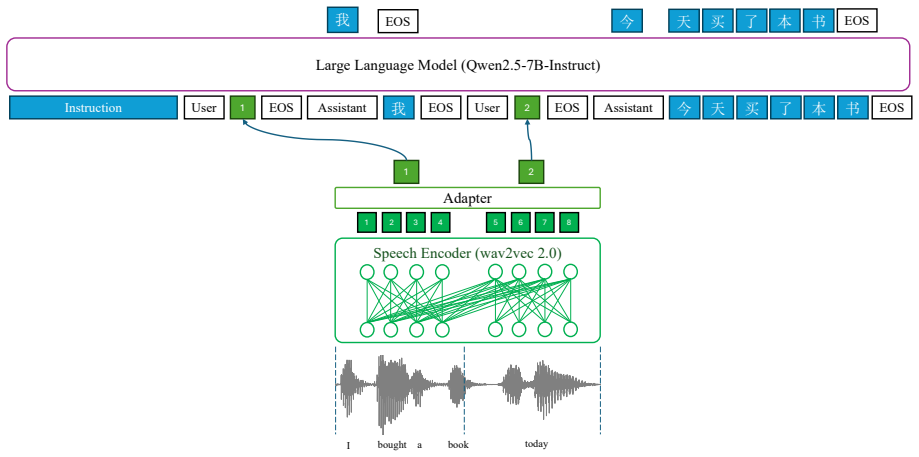
The central object is the translation trajectory: for each utterance, speech is aligned to transcript words, transcript words to translation words, and the resulting word-level right boundaries are made monotone by taking running maxima; a 960 ms fixed chunk then carries the translation span whose boundary timestamps fall inside that chunk. This trajectory supervision is what lets a chunkwise causal encoder and a multi-turn LLM decoder train on streaming speech without seeing the future. The encoder itself uses chunk-wise causal attention with a sliding window, and the decoder maintains a KV cache that concatenates the initial instruction with the most recent 1K tokens.
What would settle it
A concrete test: take a set of English utterances with human word-level time alignments, run the paper's alignment pipeline on them, measure the boundary error, and then retrain the same model with the human boundaries in place of the estimated ones; if BLEU does not change, the trajectory construction is not the load-bearing part of the reported quality.
Extended reading notes
Core claim
On the paper's own terms, the central discovery is that a simultaneous speech-to-text model built from a causal Wav2Vec2.0 encoder and a frozen-large-language-model decoder, trained with plain cross-entropy loss on synthetic speech-translation trajectories, translates unsegmented English speech into Chinese and German with competitive BLEU while emitting output at 1.7–2.7 seconds of latency. The mechanism that enables this is the construction of a monotone word-level translation trajectory via forced alignment of speech to transcript and word alignment of transcript to translation, which turns each 960 ms speech chunk into a supervised target span. The paper further claims that adding synthetic data from a third corpus (VoxPopuli) improves BLEU by at least one point even after 3,000 hours of training, and that the choice of decoder LLM yields over three BLEU points on English-to-Chinese.
Load-bearing premise
The training targets assume that the two-stage alignment (speech-to-transcript then transcript-to-translation) plus a monotonicity correction produces word-level time boundaries accurate enough to tell the model which translation words correspond to each 960 ms speech chunk; if those boundaries are systematically wrong, every chunk's supervision is corrupted.
Editorial extensions
If this is right
- Adding synthetic data from another ASR corpus improves BLEU by at least one point even past 3,000 hours, so further scaling the synthesis pipeline should keep helping both language pairs.
- The decoder LLM is a major quality lever: Qwen2.5-7B-Instruct beats Llama-3.1-8B-Instruct by more than three BLEU points for English-to-Chinese while staying comparable for English-to-German.
- The latency multiplier provides a single test-time knob that trades output latency for translation quality, with the reported numbers coming from multipliers of 3 (Chinese) and 2 (German).
- Two-stage training—first freezing the LLM and updating only encoder and adapter, then LoRA-finetuning the LLM—with standard cross-entropy loss is sufficient to learn streaming speech translation without a specialized simultaneous-training objective.
- Because the model emits an EOS token when it needs more speech, the same architecture can process unbounded input without explicit speech segmentation.
Reading between the lines
- If the synthetic-data scaling pattern holds, any large unlabeled speech corpus with ASR transcripts can be converted into streaming translation training data, shifting the practical bottleneck from parallel speech-text availability to alignment accuracy.
- The monotonicity correction (taking running maxima of word boundaries) discards future context for non-monotone language pairs, so languages with systematic reordering, such as German verb-final structures, may benefit from a bounded lookahead rather than strict chunk monotonicity.
- Since the training data is generated from ASR transcripts, translation quality is implicitly capped by ASR errors; comparing against oracle transcripts would isolate how much of the reported BLEU is lost to transcription noise.
- The robustness segments created by splicing utterances with silence intervals may not reproduce real acoustic conditions like overlapping speakers or background noise, so stress-testing on noisy unsegmented audio would reveal how much of the reported robustness transfers.
Editorial analysis
A structured set of objections, weighed in public.
Referee Report
Summary. The manuscript reports CMU's IWSLT 2025 simultaneous speech-to-text translation system for English-to-Chinese and English-to-German, built on the InfiniSST framework. The architecture combines a chunk-wise causal Wav2Vec 2.0 encoder, a convolutional adapter, and a 7B-parameter instruct-tuned LLM decoder (Qwen2.5-7B-Instruct or Llama-3.1-8B-Instruct) in a multi-turn dialogue formulation. Training uses two stages (encoder+adapter update followed by LoRA on the LLM) on roughly 3,850 hours of synthetic speech-translation data derived from LibriSpeech, CommonVoice, and VoxPopuli, with word-level alignments computed by MFA and SimAlign to construct chunk-level training trajectories. The paper reports 44.3/25.1 BLEU on the ACL60/60 development set with theoretical latencies of 2.2/1.7 seconds and computation-aware latencies of 2.7/2.3 seconds for English-to-Chinese/English-to-German, and an adjustable latency multiplier that trades quality against latency.
Significance. If the results hold, this is a competitive end-to-end streaming speech translation system worth recording: it demonstrates that synthetic data scaling beyond 3,000 hours continues to improve BLEU and that a 7B instruct-tuned decoder is effective for low-latency simultaneous translation. The paper's strengths are its concreteness and reproducibility: the architecture modifications to Wav2Vec 2.0 (RoPE, chunk-wise causal attention, sliding window), the explicit two-stage training recipe, the data synthesis pipeline, and the latency-multiplier design are all described in sufficient detail for a systems paper. The ablations across data sources and decoder choices are informative and internally consistent. The main weakness is that the alignment-based training-target construction is not validated, and all empirical claims rest on single point estimates on one development set.
major comments (3)
- [Section 3.2] The speech-to-translation-word mapping that defines every chunk-level training target (MFA for speech-to-transcript, SimAlign with LaBSE for transcript-to-translation, and the monotonicity correction m_i = max(m_i, m_{i-1})) is never validated. No alignment error rate, no manual sample inspection, and no ablation against an alternative trajectory (e.g., uniform duration-proportional boundaries) is reported. Since both training stages use these targets, a systematic alignment error would corrupt the supervision and invalidate the attribution of the reported BLEU/latency gains to the model and data. Please add an alignment-quality evaluation (for instance, AER on a subset or a few visual examples) and an ablation demonstrating that the alignment-based trajectory is more informative than a simple uniform-chunk baseline.
- [Table 2 / Section 4.2] The central empirical claims—that adding VoxPopuli synthetic data 'consistently improves BLEU scores by at least 1 point' and that Qwen2.5 'significantly outperforms' Llama-3.1—are based on single runs on one development set, with no variance estimates, significance tests, or held-out test results. BLEU differences of 1.5–2.6 points on a small dev set can lie within run-to-run noise. Please soften these claims to describe point estimates on this development set, and if possible provide multiple runs or a significance check; at a minimum, explicitly state that these are single development-set observations.
- [Section 3.2, monotonicity correction] The operation m_i = max(m_i, m_{i-1}) forces monotone boundaries by postponing any target word whose raw alignment boundary precedes the previous word's boundary to the later chunk. For English-to-Chinese and English-to-German, where reordering is frequent, this systematically delays target tokens relative to their source evidence even under perfect alignments, potentially biasing the learned latency-quality policy. The paper neither quantifies the magnitude of this correction (e.g., the fraction of words whose m_i is changed) nor discusses its effect on the reported latency. Please measure the amount of correction applied and comment on its consequences for the learned simultaneous policy.
minor comments (8)
- [Section 2] StreamLAAL is cited as Papi et al. (2024a), but the reference list identifies 2024a as the StreamAtt paper; the StreamLAAL definition appears in Papi et al. (2024b). Please correct the citation and also define StreamLAAL_CA explicitly, as it is used in Table 2 without explanation.
- [Table 2] The units for columns B and C are not stated in the table; the abstract reports seconds, whereas the table values are in milliseconds. Please specify the units in the table header or caption.
- [Abstract / Section 3.2] The dataset name is spelled 'CommonV oice' in the abstract and table, whereas the correct spelling is 'CommonVoice' (as used elsewhere in the text). Please fix the typo.
- [Section 3.2] The distribution for sampling the latency multiplier m (m ≤ 12) is not specified; state whether it is uniform over {1, ..., 12} or follows some other distribution, as this affects the reproducibility of the data augmentation.
- [Section 3.2] When a robust segment is shifted to align its start with an utterance boundary, clarify whether the segment length is kept to 30 chunks or allowed to vary; the current description is ambiguous.
- [Section 4.1] The phrase 'maximum effective batch size of 57.6K tokens' is ambiguous; specify whether this is per GPU, per step, or the global batch, and how the maximum is enforced.
- [Section 4.1 / Conclusion] Minor language issues: 'ngram_no_repeat 5' should be written as 'no_repeat_ngram_size=5' for clarity, and the conclusion contains 'a adapter', which should be 'an adapter'.
- [Figure 1] Figure 1 is referenced in Section 3.1 but the callout is not explicit in the provided text; please add a visible reference to the figure at the point where the three components are described.
Circularity Check
No significant circularity: headline BLEU and latency figures are external measurements on ACL60/60; the InfiniSST self-citation is framework-level provenance, not a derivation forcing the reported numbers.
full rationale
The paper is an experimental system report: the headline claims (44.3/25.1 BLEU; StreamLAAL 2.189/1.689 s; StreamLAAL_CA 2.739/2.306 s on the ACL60/60 development set) are measurements against human references by the task's official metric tooling, not quantities derived by construction from the paper's own equations. The only self-citation with any structural role is the reliance on InfiniSST (Ouyang, Xu, and Li, the same three authors) for the multi-turn LLM decoder, KV-cache strategy, and chunk-wise causal encoder (Sections 1 and 3.1). That citation is architectural provenance, not a load-bearing proof: the actual contributions—3,854 hours of synthesized training data, the Llama-vs-Qwen decoder comparison, and the final operating points—are independently measured and would not change if the InfiniSST reference were removed. The latency multiplier is an explicitly hand-set inference knob (Section 4.1: 'We set test-time latency multiplier to 3 for English-to-Chinese and 2 for English-to-German'), so the reported latencies are measurements at a chosen operating point, not fitted values renamed as predictions. Section 3.2's trajectory construction (MFA speech-transcript alignment, SimAlign transcript-translation alignment, monotone correction m_i = max(m_i, m_{i-1})) defines training targets only; BLEU and StreamLAAL are computed on held-out speech with independent references. The skeptic's concern that MFA/SimAlign boundaries might be systematically wrong and corrupt every chunk-level target is a legitimate data-validity risk that could bias the reported numbers, but it is not circularity: corrupted targets would degrade or distort the measured scores, not make those scores equal their inputs by construction. Verdict: no significant circularity; score 2 solely for the minor, non-load-bearing self-citation.
Assumptions & free parameters
free parameters (6)
- test-time latency multiplier =
3 for EN->ZH, 2 for EN->DE
- speech chunk duration =
960 ms (48 wav2vec frames)
- encoder sliding window size ws =
10 chunks
- LoRA rank, alpha, dropout =
rank 32, alpha 16, dropout 0.1
- beam search decoding parameters =
beam 4, repetition penalty 1.2, ngram_no_repeat 5
- training latency multiplier sampling range =
random m up to 12
assumptions (4)
- domain assumption Pretrained Wav2Vec2.0 and Qwen2.5-7B-Instruct weights transfer to the simultaneous speech translation task.
- domain assumption MFA and SimAlign/LaBSE alignments produce correct word-level time boundaries for trajectory construction.
- domain assumption LLM-translated transcripts from 4-bit Qwen2.5-32B are faithful training targets.
- domain assumption The ACL60/60 development set is representative of the IWSLT 2025 evaluation conditions.
Cite this review
Pith. "Pith review of CMU's IWSLT 2025 Simultaneous Speech Translation System." pith.science (2026). https://pith.science/paper/OZQQANDM
@misc{pith2026250613143,
  author       = {Pith},
  title        = {Pith review of: CMU's IWSLT 2025 Simultaneous Speech Translation System},
  year         = {2026},
  howpublished = {\url{https://pith.science/paper/OZQQANDM}},
  note         = {Machine review of arXiv:2506.13143}
}
read the original abstract
This paper presents CMU's submission to the IWSLT 2025 Simultaneous Speech Translation (SST) task for translating unsegmented English speech into Chinese and German text in a streaming manner. Our end-to-end speech-to-text system integrates a chunkwise causal Wav2Vec 2.0 speech encoder, an adapter, and the Qwen2.5-7B-Instruct as the decoder. We use a two-stage simultaneous training procedure on robust speech segments curated from LibriSpeech, CommonVoice, and VoxPopuli datasets, utilizing standard cross-entropy loss. Our model supports adjustable latency through a configurable latency multiplier. Experimental results demonstrate that our system achieves 44.3 BLEU for English-to-Chinese and 25.1 BLEU for English-to-German translations on the ACL60/60 development set, with computation-aware latencies of 2.7 seconds and 2.3 seconds, and theoretical latencies of 2.2 and 1.7 seconds, respectively.
Figures
Forward citations
Cited by 1 Pith paper
-
Seed LiveInterpret 2.0: End-to-end Simultaneous Speech-to-speech Translation with Your Voice
An end-to-end simultaneous speech-to-speech translation model with voice cloning, trained with a two-stage reinforcement learning reward scheme, reports high accuracy and low latency on the authors' RealSI benchmark.
Reference graph
Works this paper leans on
-
[1]
Idris Abdulmumin, Victor Agostinelli, Tanel Alumäe, Antonios Anastasopoulos, Ashwin, Luisa Bentivogli, Ondřej Bojar, Claudia Borg, Fethi Bougares, Roldano Cattoni, Mauro Cettolo, Lizhong Chen, William Chen, Raj Dabre, Yannick Estève, Marcello Federico, Marco Gaido, Dávid Javorský, Marek Kasztelnik, and 30 others. 2025. Findings of the iwslt 2025 evaluatio...
work page 2025
-
[2]
Ibrahim Said Ahmad, Antonios Anastasopoulos, Ond r ej Bojar, Claudia Borg, Marine Carpuat, Roldano Cattoni, Mauro Cettolo, William Chen, Qianqian Dong, Marcello Federico, Barry Haddow, D \'a vid Javorsk \'y , Mateusz Krubi \'n ski, Tsz Kin Lam, Xutai Ma, Prashant Mathur, Evgeny Matusov, Chandresh Maurya, John McCrae, and 25 others. 2024. https://doi.org/1...
-
[3]
Rosana Ardila, Megan Branson, Kelly Davis, Michael Kohler, Josh Meyer, Michael Henretty, Reuben Morais, Lindsay Saunders, Francis Tyers, and Gregor Weber. 2020. https://aclanthology.org/2020.lrec-1.520/ Common voice: A massively-multilingual speech corpus . In Proceedings of the Twelfth Language Resources and Evaluation Conference, pages 4218--4222, Marse...
2020
-
[4]
Alexei Baevski, Henry Zhou, Abdelrahman Mohamed, and Michael Auli. 2020 a . https://arxiv.org/abs/2006.11477 wav2vec 2.0: A framework for self-supervised learning of speech representations
arXiv 2020
-
[5]
Alexei Baevski, Yuhao Zhou, Abdelrahman Mohamed, and Michael Auli. 2020 b . https://proceedings.neurips.cc/paper_files/paper/2020/file/ 92d1e1eb1cd6f9fba3227870bb6d7f07-Paper.pdf wav2vec 2.0: A framework for self-supervised learning of speech representations . In Advances in Neural Information Processing Systems, volume 33, pages 12449--12460. Curran Asso...
work page 2020
-
[6]
Puvvada, Jason Li, Subhankar Ghosh, Jagadeesh Balam, and Boris Ginsburg
Zhehuai Chen, He Huang, Andrei Andrusenko, Oleksii Hrinchuk, Krishna C. Puvvada, Jason Li, Subhankar Ghosh, Jagadeesh Balam, and Boris Ginsburg. 2024. https://doi.org/10.1109/ICASSP48485.2024.10447553 Salm: Speech-augmented language model with in-context learning for speech recognition and translation . In ICASSP 2024 - 2024 IEEE International Conference ...
arXiv 2024
-
[7]
Fangxiaoyu Feng, Yinfei Yang, Daniel Cer, Naveen Arivazhagan, and Wei Wang. 2022. https://doi.org/10.18653/v1/2022.acl-long.62 Language-agnostic BERT sentence embedding . In Proceedings of the 60th Annual Meeting of the Association for Computational Linguistics (Volume 1: Long Papers), pages 878--891, Dublin, Ireland. Association for Computational Linguistics
-
[8]
Aaron Grattafiori, Abhimanyu Dubey, Abhinav Jauhri, Abhinav Pandey, Abhishek Kadian, Ahmad Al-Dahle, Aiesha Letman, Akhil Mathur, Alan Schelten, Alex Vaughan, Amy Yang, Angela Fan, Anirudh Goyal, Anthony Hartshorn, Aobo Yang, Archi Mitra, Archie Sravankumar, Artem Korenev, Arthur Hinsvark, and 542 others. 2024. https://arxiv.org/abs/2407.21783 The llama 3...
arXiv 2024
Show all 31 references
-
[9]
Guerreiro, Ricardo Rei, Daan van Stigt, Luisa Coheur, Pierre Colombo, and Andr \'e F
Nuno M. Guerreiro, Ricardo Rei, Daan van Stigt, Luisa Coheur, Pierre Colombo, and Andr \'e F. T. Martins. 2024. https://doi.org/10.1162/tacl_a_00683 xcomet: Transparent machine translation evaluation through fine-grained error detection . Transactions of the Association for Co...
2024 doi
-
[10]
Chi Han, Qifan Wang, Hao Peng, Wenhan Xiong, Yu Chen, Heng Ji, and Sinong Wang. 2024. https://doi.org/10.18653/v1/2024.naacl-long.222 LM -infinite: Zero-shot extreme length generalization for large language models . In Proceedings of the 2024 Conference of the North American C...
2024 doi
-
[11]
Edward J Hu, yelong shen, Phillip Wallis, Zeyuan Allen-Zhu, Yuanzhi Li, Shean Wang, Lu Wang, and Weizhu Chen. 2022. https://openreview.net/forum?id=nZeVKeeFYf9 Lo RA : Low-rank adaptation of large language models . In International Conference on Learning Representations
2022
-
[12]
Zhichao Huang, Rong Ye, Tom Ko, Qianqian Dong, Shanbo Cheng, Mingxuan Wang, and Hang Li. 2023. https://arxiv.org/abs/2312.13585 Speech translation with large language models: An industrial practice
2023 arXiv
-
[13]
Javier Iranzo-Sánchez, Joan Albert Silvestre-Cerdà, Javier Jorge, Nahuel Roselló, Adrià Giménez, Albert Sanchis, Jorge Civera, and Alfons Juan. 2020. https://doi.org/10.1109/ICASSP40776.2020.9054626 Europarl-st: A multilingual corpus for speech translation of parliamentary deb...
2020
-
[14]
Masoud Jalili Sabet, Philipp Dufter, Fran c ois Yvon, and Hinrich Sch \"u tze. 2020. https://doi.org/10.18653/v1/2020.findings-emnlp.147 S im A lign: High quality word alignments without parallel training data using static and contextualized embeddings . In Findings of the Ass...
2020 doi
-
[15]
Kingma and Jimmy Ba
Diederik P. Kingma and Jimmy Ba. 2015. http://arxiv.org/abs/1412.6980 Adam: A method for stochastic optimization . In 3rd International Conference on Learning Representations, ICLR 2015, San Diego, CA, USA, May 7-9, 2015, Conference Track Proceedings
2015 arXiv
-
[16]
Michael McAuliffe, Michaela Socolof, Sarah Mihuc, Michael Wagner, and Morgan Sonderegger. 2017. https://doi.org/10.21437/Interspeech.2017-1386 Montreal forced aligner: Trainable text-speech alignment using kaldi . In Interspeech 2017, pages 498--502
2017 doi
-
[17]
Siqi Ouyang, Xi Xu, and Lei Li. 2025. https://arxiv.org/abs/2503.02969 Infinisst: Simultaneous translation of unbounded speech with large language model
2025 arXiv
-
[18]
Vassil Panayotov, Guoguo Chen, Daniel Povey, and Sanjeev Khudanpur. 2015. https://doi.org/10.1109/ICASSP.2015.7178964 Librispeech: An asr corpus based on public domain audio books . In 2015 IEEE International Conference on Acoustics, Speech and Signal Processing (ICASSP), page...
2015
-
[19]
Sara Papi, Marco Gaido, Matteo Negri, and Luisa Bentivogli. 2024 a . https://doi.org/10.18653/v1/2024.acl-long.202 S tream A tt: Direct streaming speech-to-text translation with attention-based audio history selection . In Proceedings of the 62nd Annual Meeting of the Associat...
2024 doi
-
[20]
Sara Papi, Peter Polák, Dominik Macháček, and Ondřej Bojar. 2024 b . https://doi.org/10.1162/tacl_a_00740 How “real” is your real-time simultaneous speech-to-text translation system? Transactions of the Association for Computational Linguistics, 13:281--313
2024 doi
-
[21]
Kishore Papineni, Salim Roukos, Todd Ward, and Wei-Jing Zhu. 2002. https://doi.org/10.3115/1073083.1073135 B leu: a method for automatic evaluation of machine translation . In Proceedings of the 40th Annual Meeting of the Association for Computational Linguistics, pages 311--3...
2002
-
[22]
Qwen, :, An Yang, Baosong Yang, Beichen Zhang, Binyuan Hui, Bo Zheng, Bowen Yu, Chengyuan Li, Dayiheng Liu, Fei Huang, Haoran Wei, Huan Lin, Jian Yang, Jianhong Tu, Jianwei Zhang, Jianxin Yang, Jiaxi Yang, Jingren Zhou, and 25 others. 2025. https://arxiv.org/abs/2412.15115 Qwe...
2025 arXiv
-
[23]
Elizabeth Salesky, Kareem Darwish, Mohamed Al-Badrashiny, Mona Diab, and Jan Niehues. 2023. https://doi.org/10.18653/v1/2023.iwslt-1.2 Evaluating multilingual speech translation under realistic conditions with resegmentation and terminology . In Proceedings of the 20th Interna...
2023 doi
-
[24]
Thibault Sellam, Dipanjan Das, and Ankur Parikh. 2020. https://doi.org/10.18653/v1/2020.acl-main.704 BLEURT : Learning robust metrics for text generation . In Proceedings of the 58th Annual Meeting of the Association for Computational Linguistics, pages 7881--7892, Online. Ass...
2020 doi
-
[25]
Jianlin Su, Murtadha Ahmed, Yu Lu, Shengfeng Pan, Wen Bo, and Yunfeng Liu. 2024. https://doi.org/10.1016/j.neucom.2023.127063 Roformer: Enhanced transformer with rotary position embedding . Neurocomput., 568(C)
2024
-
[26]
Changhan Wang, Morgane Riviere, Ann Lee, Anne Wu, Chaitanya Talnikar, Daniel Haziza, Mary Williamson, Juan Pino, and Emmanuel Dupoux. 2021 a . https://doi.org/10.18653/v1/2021.acl-long.80 V ox P opuli: A large-scale multilingual speech corpus for representation learning, semi-...
2021 doi
-
[27]
Changhan Wang, Anne Wu, Jiatao Gu, and Juan Pino. 2021 b . https://doi.org/10.21437/Interspeech.2021-2027 Covost 2 and massively multilingual speech translation . In Interspeech 2021, pages 2247--2251
2021 doi
-
[28]
Xi Xu, Siqi Ouyang, Brian Yan, Patrick Fernandes, William Chen, Lei Li, Graham Neubig, and Shinji Watanabe. 2024. https://doi.org/10.18653/v1/2024.iwslt-1.20 CMU `s IWSLT 2024 simultaneous speech translation system . In Proceedings of the 21st International Conference on Spoke...
2024 doi
-
[29]
Hao Zhang, Nianwen Si, Yaqi Chen, Wenlin Zhang, Xukui Yang, Dan Qu, and Xiaolin Jiao. 2023. https://arxiv.org/abs/2310.02050 Tuning large language model for end-to-end speech translation
2023 arXiv
-
[30]
online" 'onlinestring :=
ENTRY address archivePrefix author booktitle chapter edition editor eid eprint eprinttype howpublished institution journal key month note number organization pages publisher school series title type volume year doi pubmed url lastchecked label extra.label sort.label short.list...
-
[31]
write newline
" write newline "" before.all 'output.state := FUNCTION n.dashify 't := "" t empty not t #1 #1 substring "-" = t #1 #2 substring "--" = not "--" * t #2 global.max substring 't := t #1 #1 substring "-" = "-" * t #2 global.max substring 't := while if t #1 #1 substring * t #2 gl...
Reviewed August 7, 2026 · model on record in the stance chip above.
Discussion (0). Sign in to comment.