REVIEW 3 major objections 5 minor 69 references
Ab initio functional-independent calculations of the clamped Pockels tensor of tetragonal barium titanate
T0 review · 3 major / 5 minor · reviewed 2026-08-07 · deepseek-v4-flash
Pith's one-line read An ab initio workflow that works with any exchange-correlation functional recovers the large Pockels coefficient r51 of tetragonal BaTiO3 and traces it to titanium off-centering.
desk verdict Useful functional-independent Pockels workflow with an honest sensitivity study, but the headline r51 'recovery' is a tuned parameter, not a prediction. read the letter →
The pith
A machine-rendered reading of the paper's core claim, the machinery that carries it, and where it could break.
The reading
What carries the argument
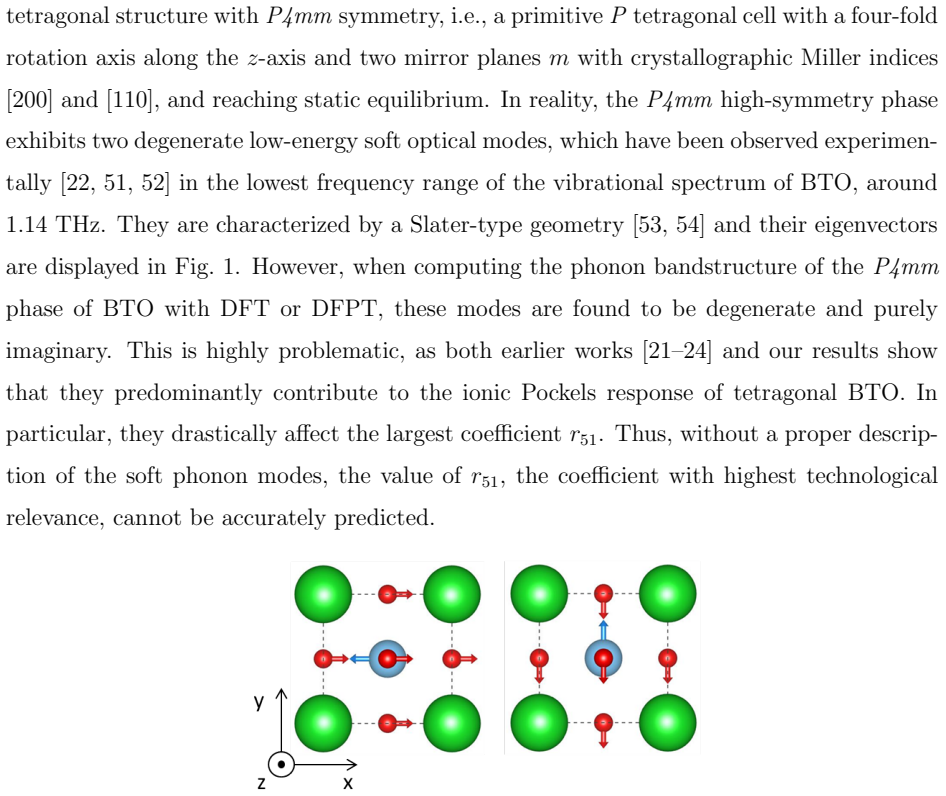
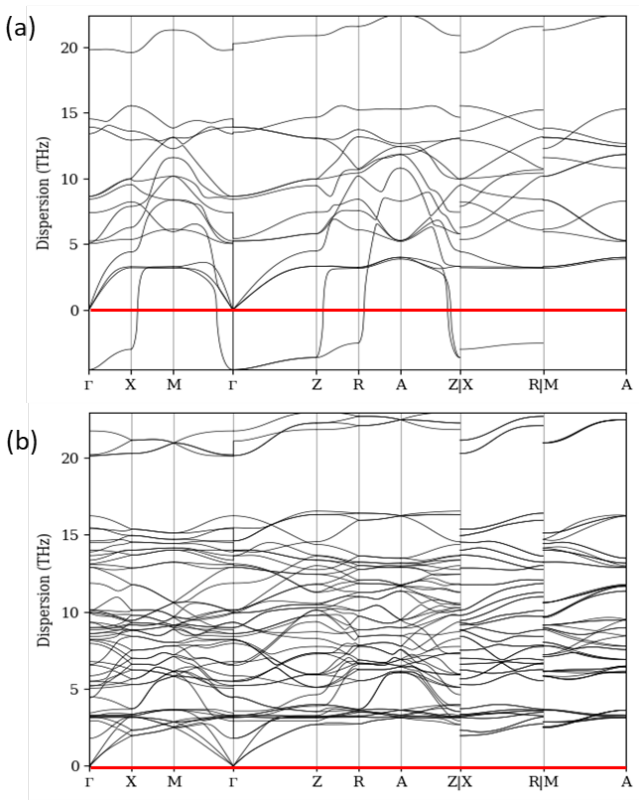
The load-bearing object is a $2\times2\times1$ P4bm supercell of tetragonal BTO with local titanium off-centering along the $\langle110\rangle$ directions: four titanium atoms displaced in a vortex-like pattern that keeps the macroscopic polarization along [001] while replacing one mirror plane by a glide plane. Combined with PBEsol and RRKJ ultrasoft pseudopotentials, this structural prototype turns the imaginary soft phonon modes of the P4mm cell into positive, Slater-type modes, making it possible to evaluate the phonon contribution to the Pockels tensor. The calculation itself is carried by automated first- and second-order finite-difference derivatives of the polarization and of the Hellmann-Feynman forces, together with the modern theory of polarization through the electric-enthalpy functional; the titanium displacement percentage is the tunable parameter that controls $r_{51}$.
What would settle it
Measure the local titanium displacement magnitude in clamped tetragonal BTO films (e.g., by extended X-ray absorption fine structure or diffuse scattering that resolves the $\langle110\rangle$ component); if it comes out at 0.466% or larger rather than 0.45%, the reported recovery of $r_{51}$ fails, since the paper's own ground-state calculation gives $r_{51}\approx391$ pm/V, well below the experimental $730\pm150$ pm/V.
Extended reading notes
Core claim
The central claim is that the clamped Pockels tensor of tetragonal BTO can be obtained at the ab initio level for any exchange-correlation functional, and that the experimentally large coefficient $r_{51}$ is recovered once the structure is described with the P4bm supercell whose titanium atoms are displaced along $\langle110\rangle$, using PBEsol and ultrasoft pseudopotentials. At the ground-state 0.466% titanium displacement the calculation gives $r_{51}=391.2$ pm/V, outside the experimental $730\pm150$ pm/V; moving the titanium positions toward the high-symmetry P4mm geometry so that the displacement is 0.45% yields $r_{51}=667$ pm/V, while 0.425% yields 1614.7 pm/V. The same trend connects the soft phonon frequency (2.0, 1.5, and 1.0 THz at 0.466%, 0.45%, and 0.425%) and the in-plane dielectric constant, matching the physical picture that decreasing titanium off-centering softens the low-energy modes and enhances the electro-optic response. The paper also argues that the PBEsol+U+V correction, although it improves the band gap and dielectric tensor, destroys the Slater-type character of the soft mode eigenvectors and therefore is not suitable for Pockels predictions.
Load-bearing premise
The load-bearing premise is that real tetragonal BTO films have a titanium off-centering near the tuned 0.45% displacement along $\langle110\rangle$, rather than the 0.466% of the computed P4bm ground state, because the cited X-ray experiments show off-centering exists but do not fix its magnitude.
Editorial extensions
If this is right
- With a titanium off-centering of 0.45% along $\langle110\rangle$, the computed clamped $r_{51}$ of 667 pm/V falls inside the experimental range of 730 ± 150 pm/V, while the soft phonon frequency drops from 2.0 to 1.5 THz.
- Starting from the P4bm ground state, moving titanium toward the P4mm geometry monotonically increases $r_{51}$; at 0.425% displacement it reaches 1614.7 pm/V, so small structural changes produce large electro-optic changes.
- The smallest coefficient $r_{13}$ remains vanishingly small and negative in the tuned structures, even though tetragonal symmetry requires $r_{13}$, $r_{33}$, and $r_{51}$ to share a sign, indicating a missing contribution in the calculation.
- PBEsol+U+V should not be used for Pockels predictions in BTO: it raises the soft mode frequency to 3.16 THz and changes the eigenvectors away from the Slater type, driving $r_{51}$ down to 65.5 pm/V despite improving the band gap and dielectric constants.
- Because the workflow is exchange-correlation functional independent, it can be applied to strained or defective ferroelectric films, the configurations relevant for integrated electro-optical modulators.
Reading between the lines
- Beyond the paper: if the monotonic relation between titanium off-centering and $r_{51}$ holds in films, strain or defect engineering that reduces the off-centering would become a concrete design lever for electro-optic modulators.
- Beyond the paper: the X-ray experiments cited establish that local titanium off-centering exists but not its magnitude, so a direct measurement of the displaced amount would decide whether 0.45% is a prediction or an adjustable fit.
- Beyond the paper: applying the same finite-difference workflow to other ferroelectric perovskites would test whether softer Slater-type modes generically produce larger Pockels coefficients, as suggested by the BTO results.
- Beyond the paper: the persistent sign mismatch for $r_{13}$ hints that physics omitted here, such as anharmonicity, finite temperature, or strain coupling, is needed before the full tensor can be trusted.
Editorial analysis
A structured set of objections, weighed in public.
Referee Report
Summary. The paper presents an automated finite-difference DFT workflow for computing clamped Pockels tensors, based on the modern theory of polarization, the electric-enthalpy functional, and finite-difference derivatives of forces and polarizations, implemented in the open-source Vibroscopy/AiiDA ecosystem. It applies this workflow to tetragonal BaTiO3 using PBEsol, RRKJ ultrasoft pseudopotentials, and a P4bm 2x2x1 supercell with local titanium off-centering, which stabilizes the soft phonon modes that LDA-based DFPT cannot describe. The authors compute r13, r33, and r51, test an extended-Hubbard correction (PBEsol+U+V), and study the dependence of the Pockels tensor on the magnitude of titanium off-centering. They report that r51 increases as titanium off-centering decreases and claim that at 0.45% displacement r51 enters the experimental range, recovering the measured value.
Significance. If the central claim were actually predictive, the paper would be significant: a functional-independent, reproducible workflow that avoids imaginary soft modes in a technologically relevant ferroelectric and reproduces the largest Pockels coefficient of BaTiO3 would be a useful contribution to electro-optic materials design. The strengths of the paper are its open-source implementation, the availability of data on the Materials Cloud Archive, the self-consistent first-principles determination of Hubbard parameters, and the clean sensitivity analysis showing that r51 increases with decreasing titanium off-centering. However, the quantitative recovery of r51 is currently a post-hoc parameter selection rather than a prediction, and the full clamped tensor is not reproduced at the selected geometry because r13 has the wrong sign. These issues affect the paper's headline claim and require reframing or additional evidence before publication.
major comments (3)
- [Section III C and Table IV] The central claim that r51 is recovered rests on a post-hoc choice of titanium off-centering. The P4bm ground state at 0.466% displacement gives r51 = 391.2 pm/V, 46% below experiment; reducing the displacement to 0.45% gives 667 pm/V and to 0.425% gives 1614.7 pm/V. The paper selects the intermediate value because it falls inside the experimental window of 730 ± 150 pm/V. References [55] and [56] establish the existence and direction of local titanium off-centering but do not pin down its magnitude, so the paper provides no independent evidence that real clamped films have 0.45% rather than 0.466% displacement. A 3.4% relative change in this parameter changes r51 by about 70%, and an 8.8% change multiplies it by about four, making the agreement at 0.45% highly sensitive to an unconstrained input. The abstract and conclusion should either be reworded to present this as a sensitivity study, or independent evidence for the 0.45% magnitude must be supplied.
- [Section III C, final paragraph and Table IV] Even at the tuned geometry, the full clamped Pockels tensor is not captured: at 0.45% displacement the computed r13 is -1.5 pm/V, whereas the experimental value is 9 ± 2 pm/V. The manuscript itself concedes, in the final paragraph of Section III C, that the negative r13 suggests a missing physical contribution. Thus the statement that the correct value range of r51 is recovered cannot be extended to a claim that the Pockels tensor is quantitatively reproduced. The authors should identify and correct the missing contribution, or explicitly limit the paper's quantitative claim to r51.
- [Section III B] The claim that symmetry requires r13, r33, and r51 to have the same sign is incorrect. For point group 4mm, the independent electro-optic coefficients are not related to one another by symmetry, and the group-theoretical tensor tables cited as reference [57] do not impose equal signs on these coefficients. Consequently, the inference that a negative and small r13 must indicate a missing physical contribution does not follow from symmetry alone. The discrepancy with the experimental r13 remains, but the stated symmetry-based reasoning should be removed or corrected.
minor comments (5)
- [Reference [40]] Reference [40] is the 1996 PBE paper, not the PBEsol functional; the PBEsol functional should be cited to Perdew et al., Phys. Rev. Lett. 100, 136406 (2008).
- [Section III B and Conclusion] The overestimation of r33 is stated as 26% in Section III B and as 35% in the Conclusion, while Table II gives 58.4 pm/V against an experimental value of 43 pm/V, i.e., about 36%; these numbers should be made consistent.
- [Conclusion] The statement 'r51 within 4% of the experimental value at 0.45% displacement' is difficult to reconcile with Table IV, where 667 pm/V is about 8.6% lower than the quoted experimental center value of 730 pm/V; the comparison basis (center value, near boundary, or corrected reference) should be specified.
- [Fig. 8 caption] The left panel in Fig. 8 is labeled r31 in the caption, but the discussion concerns r13; this label should be corrected.
- [Section III C, comparison with Kim et al.] The sentence comparing Kim et al.'s r51 = 1844 pm/V with the present 1614.7 pm/V is confusing, because the phrase 'is even smaller than our result' reads as if the coefficient were smaller when numerically it is larger; the intended comparison is with the titanium displacement, and the sentence should be rephrased.
Circularity Check
The claimed recovery of r51 depends on manually selecting the titanium off-centering magnitude, so the headline result is a post-hoc parameter choice rather than an ab initio prediction.
-
fitted input called prediction
[Section III C, Fig. 8, Table IV; Abstract]
"This issue is resolved in Section III C where the extent of titanium off-centering is modified, resulting in an increasing r51 that brings it within the expected experimental range. ... It can be seen in Fig. 8 that a 0.45% titanium displacement brings r51 within the experimental range (see Table IV)."
The genuine ground-state P4bm structure has 0.466% titanium off-centering and yields r51 = 391.2 pm/V, 46% below the experimental 730 ± 150 pm/V. The paper then scans titanium displacement along ⟨110⟩ and reports 0.45% (r51 = 667.0 pm/V) and 0.425% (r51 = 1614.7 pm/V). No independent evidence pins the real clamped-film off-centering magnitude to 0.45%; refs [55,56] establish local off-centering and its direction, not its magnitude. Thus the experimental r51 window is effectively used to select the structural parameter that is then presented as 'recovering' r51. The match is a post-hoc choice, not an independent prediction, and the extreme sensitivity (a 3.4% parameter change shifts r51 by roughly 70%) highlights that the agreement is not robust.
full rationale
The underlying formalism (Eq. (4) from the electric-enthalpy functional and finite-difference derivatives) is established theory, and the implementation in Vibroscopy is a legitimate, functional-independent tool. The paper is also transparent about the ground-state mismatch: PBEsol at the P4bm ground state gives r51 = 391.2 pm/V, outside experiment. The circularity enters only in the headline claim: 'the correct value range of r51 ... is recovered.' That recovery is achieved by scanning the percentage of titanium off-centering and selecting 0.45% because that value lands inside the experimental range. Because the off-centering magnitude is not independently determined — the cited X-ray experiments only show that local off-centering exists and has a ⟨110⟩/[001] character — the experimental r51 is being recycled as an input to choose the structure that then 'predicts' r51. The monotonic trend (r51 increases as off-centering decreases) is a useful, falsifiable sensitivity statement, but it does not by itself validate the claimed quantitative recovery. The self-citations (Refs. [28,43,58]) are not load-bearing in a circular way here, since the P4bm structural prototype has external experimental support. Overall, the central quantitative match reduces to a fitted structural parameter, so the paper deserves a substantial circularity score, though the methodology itself remains partially independent and the authors do disclose the scan.
Assumptions & free parameters
free parameters (3)
- Titanium off-centering displacement along <110> =
0.45% (best match; 0.425% gives 1614.7 pm/V; ground state 0.466% gives 391.2 pm/V)
- PBEsol+U+V Hubbard parameters =
U = 5.223 eV (Ti 3d), V = 1.0 to 1.275 eV (Ti(3d)-O(2p))
- Exchange-correlation functional and pseudopotential choice =
PBEsol with RRKJ ultrasoft pseudopotentials
assumptions (4)
- domain assumption Density functional theory with PBEsol approximates the ground-state electronic structure, forces, and polarizations of tetragonal BTO accurately enough for Pockels coefficients.
- domain assumption The P4bm supercell with local Ti off-centering along <110> represents the true local structure of tetragonal BTO, rather than the high-symmetry P4mm cell.
- standard math The clamped Pockels tensor can be computed from Eq. (4), neglecting strain and piezoelectric contributions.
- standard math Finite-difference derivatives with the stated step sizes and supercell sizes accurately approximate the analytic derivatives.
Cite this review
Pith. "Pith review of Ab initio functional-independent calculations of the clamped Pockels tensor of tetragonal barium titanate." pith.science (2026). https://pith.science/paper/RM7QQG47
@misc{pith2026250613209,
  author       = {Pith},
  title        = {Pith review of: Ab initio functional-independent calculations of the clamped Pockels tensor of tetragonal barium titanate},
  year         = {2026},
  howpublished = {\url{https://pith.science/paper/RM7QQG47}},
  note         = {Machine review of arXiv:2506.13209}
}
abstract
We present an ab initio method to calculate the clamped Pockels tensor of ferroelectric materials from density-functional theory, the modern theory of polarization exploiting the electric-enthalpy functional, and automated first- and second-order finite-difference derivatives of the polarizations and the Hellmann-Feynman forces. Thanks to the functional-independent capabilities of our approach, we can determine the Pockels tensor of tetragonal barium titanate (BTO) beyond the local density approximation (LDA), with arbitrary exchange-correlation (XC) functionals, for example, PBEsol. The latter, together with RRKJ ultra-soft pseudo-potentials (PP) and a supercell exhibiting local titanium off-centering, enables us to stabilize the negative optical phonon modes encountered in tetragonal BTO when LDA and norm-conserving PP are combined. As a result, the correct value range of $r_{51}$, the largest experimental Pockels coefficient of BTO, is recovered. We also reveal that $r_{51}$ increases with decreasing titanium off-centering for this material. The lessons learned from the structural, dielectric, and vibrational investigations of BTO will be essential to design next-generation electro-optical modulators based on the Pockels effect.
Figures

Figures from the paper (5 more)


Reference graph
Works this paper leans on
-
[55]
A. Scalabrin, A. Chaves, D. Shim, and S. Porto, Temperature dependence of the A1 and E optical phonons in BaTiO 3, Phys. Stat. Sol. 79, 731 (1977)
work page 1977
-
[56]
M. DiDomenico Jr, S. Wemple, S. Porto, and R. Bauman, Raman spectrum of single-domain BaTiO3, Phys. Rev. 174, 522 (1968)
work page 1968
-
[57]
V. Dwij, B. K. De, G. Sharma, D. Shukla, M. Gupta, R. Mittal, and V. Sathe, Revisiting eigen displacements of tetragonal BaTiO3: Combined first principle and experimental investigation, Physica B 624, 413381 (2022)
work page 2022
-
[1]
N. Margalit, C. Xiang, S. M. Bowers, A. Bjorlin, R. Blum, and J. E. Bowers, Perspective on the future of silicon photonics and electronics, Appl. Phys. Lett. 118, 10.1063/5.0050117 (2021)
-
[2]
C. Kachris and I. Tomkos, A survey on optical interconnects for data centers, IEEE Commun. Surv. Tutorials 14, 1021 (2012)
work page 2012
-
[3]
G. Reed, D. Thomson, W. Zhang, F. Gardes, L. Mastronardi, K. Li, S. Matsuo, S. Kanazawa, L. Vivien, C. Lafforgue, et al., Silicon optical modulators, Nat. Photonics , 518 (2010)
work page 2010
- [4]
- [5]
Show all 69 references
-
[6]
Hochberg and T
M. Hochberg and T. Baehr-Jones, Towards fabless silicon photonics, Nat. Photonics 4, 492 (2010)
2010
-
[7]
R. W. Boyd, A. L. Gaeta, and E. Giese, Nonlinear optics, in Springer Handbook of Atomic, Molecular, and Optical Physics(Springer, 2008) pp. 1097–1110
2008
-
[8]
G. A. Reider, Photonics (Springer, 2016)
2016
-
[9]
S. Abel, T. St¨ oferle, C. Marchiori, C. Rossel, M. D. Rossell, R. Erni, D. Caimi, M. Sousa, A. Chelnokov, B. J. Offrein, et al., A strong electro-optically active lead-free ferroelectric integrated on silicon, Nat. Commun. 4, 1671 (2013)
2013
-
[10]
E. L. Wooten, K. M. Kissa, A. Yi-Yan, E. J. Murphy, D. A. Lafaw, P. F. Hallemeier, D. Maack, D. V. Attanasio, D. J. Fritz, G. J. McBrien, et al., A review of lithium niobate modulators for fiber-optic communications systems, IEEE J. Sel. Top. Quantum Electron. 6, 69 (2000)
2000
-
[11]
Chmielak, M
B. Chmielak, M. Waldow, C. Matheisen, C. Ripperda, J. Bolten, T. Wahlbrink, M. Nagel, F. Merget, and H. Kurz, Pockels effect based fully integrated, strained silicon electro-optic modulator, Opt. Express 19, 17212 (2011)
2011
-
[12]
Winiger, K
J. Winiger, K. Keller, D. Moor, M. Baumann, D. Kim, D. Chelladurai, M. Kohli, T. Blatter, E. D´ enervaud, Y. Fedoryshyn,et al., PLD epitaxial thin-film BaTiO 3 on MgO- dielectric and electro-optic properties, Adv. Mater. Interfaces 11, 2300665 (2024)
2024
-
[13]
Chen and R
L. Chen and R. M. Reano, Compact electric field sensors based on indirect bonding of lithium niobate to silicon microrings, Opt. Express 20, 4032 (2012)
2012
-
[14]
S. Abel, F. Eltes, J. E. Ortmann, A. Messner, P. Castera, T. Wagner, D. Urbonas, A. Rosa, A. M. Gutierrez, D. Tulli, et al., Large pockels effect in micro-and nanostructured barium titanate integrated on silicon, Nat. Mater. 18, 42 (2019)
2019
-
[15]
U Bremen Excellence Chair Program
Experiment 9 ± 2 43 ± 5 730 ± 150 TABLE II. Clamped Pockels coefficients as computed in this work with PBEsol, PBEsol+εexp, and PBEsol+U +V using the P4bm structural prototype of tetragonal BTO. Comparison with other works relying on DFPT, the 2 n + 1 theorem, with or without ...
-
[16]
Eltes, M
F. Eltes, M. Kroh, D. Caimi, C. Mai, Y. Popoff, G. Winzer, D. Petousi, S. Lischke, J. E. Ortmann, L. Czornomaz, et al., A novel 25 gbps electro-optic pockels modulator integrated on an advanced si photonic platform, in 2017 IEEE International Electron Devices Meeting (IEDM) (I...
2017
-
[17]
Leuthold, C
J. Leuthold, C. Koos, W. Freude, L. Alloatti, R. Palmer, D. Korn, J. Pfeifle, M. Lauermann, R. Dinu, S. Wehrli, et al., Silicon-organic hybrid electro-optical devices, IEEE J. Sel. Top. Quantum Electron. 19, 114 (2013)
2013
-
[18]
Alexander, J
K. Alexander, J. P. George, J. Verbist, K. Neyts, B. Kuyken, D. Van Thourhout, and J. Beeck- man, Nanophotonic pockels modulators on a silicon nitride platform, Nat. Commun. 9, 3444 (2018)
2018
-
[19]
Zgonik, P
M. Zgonik, P. Bernasconi, M. Duelli, R. Schlesser, P. G¨ unter, M. Garrett, D. Rytz, Y. Zhu, and X. Wu, Dielectric, elastic, piezoelectric, electro-optic, and elasto-optic tensors of BaTiO 3 crystals, Phys. Rev. B 50, 5941 (1994)
1994
-
[20]
A. K. Hamze, M. Reynaud, J. Geler-Kremer, and A. A. Demkov, Design rules for strong electro-optic materials, npj Comput. Mater. 6, 130 (2020)
2020
-
[21]
LDA + scissor 12.7 30.8 -
-
[22]
Fontana, K
M. Fontana, K. Laabidi, B. Jannot, M. Maglione, and P. Jullien, Relationship between electro- optic, vibrational and dielectric properties in BaTiO 3, Solid State Commun. 92, 827 (1994)
1994
-
[23]
Acosta, N
M. Acosta, N. Novak, V. Rojas, S. Patel, R. Vaish, J. Koruza, G. Rossetti, and J. R¨ odel, BaTiO3-based piezoelectrics: Fundamentals, current status, and perspectives, Appl. Phys. Rev. 4, 10.1063/1.4990046 (2017)
2017 doi
-
[24]
LDA + scissor -24.3 43 820.8
-
[25]
Veithen, X
M. Veithen, X. Gonze, and P. Ghosez, Nonlinear optical susceptibilities, raman efficiencies, and electro-optic tensors from first-principles density functional perturbation theory, Phys. Rev. B 71, 125107 (2005)
2005
-
[26]
Baroni, S
S. Baroni, S. De Gironcoli, A. Dal Corso, and P. Giannozzi, Phonons and related crystal properties from density-functional perturbation theory, Rev. Mod. Phys. 73, 515 (2001)
2001
-
[27]
Veithen, X
M. Veithen, X. Gonze, and P. Ghosez, First-principles study of the electro-optic effect in ferroelectric oxides, Phys. Rev. Lett. 93, 187401 (2004)
2004
-
[28]
I. Kim, T. Paoletta, and A. A. Demkov, Nature of electro-optic response in tetragonal BaTiO3, Phys. Rev. B 108, 115201 (2023)
2023
-
[29]
Gonze, B
X. Gonze, B. Amadon, G. Antonius, F. Arnardi, L. Baguet, J.-M. Beuken, J. Bieder, F. Bot- tin, J. Bouchet, E. Bousquet, et al., The ABINIT project: Impact, environment and recent developments, Comput. Phys. Commun. 248, 107042 (2020)
2020
-
[30]
Bastonero and N
L. Bastonero and N. Marzari, Automated all-functionals infrared and raman spectra, npj 25 Comput. Mater. 10, 55 (2024)
2024
-
[31]
Resta, Macroscopic polarization in crystalline dielectrics: the geometric phase approach, Rev
R. Resta, Macroscopic polarization in crystalline dielectrics: the geometric phase approach, Rev. Mod. Phys. 66, 899 (1994)
1994
-
[32]
Kotiuga, private communication (2022)
M. Kotiuga, private communication (2022)
2022
-
[33]
Johnston Jr, Nonlinear optical coefficients and the raman scattering efficiency of LO and TO phonons in acentric insulating crystals, Phys
W. Johnston Jr, Nonlinear optical coefficients and the raman scattering efficiency of LO and TO phonons in acentric insulating crystals, Phys. Rev. B 1, 3494 (1970)
1970
-
[34]
Giannozzi, O
P. Giannozzi, O. Andreussi, T. Brumme, O. Bunau, M. B. Nardelli, M. Calandra, R. Car, C. Cavazzoni, D. Ceresoli, M. Cococcioni, et al., Advanced capabilities for materials modelling with Quantum ESPRESSO, J. Phys.: Condens. Matter 29, 465901 (2017)
2017
-
[35]
S. P. Huber, S. Zoupanos, M. Uhrin, L. Talirz, L. Kahle, R. H¨ auselmann, D. Gresch, T. M¨ uller, A. V. Yakutovich, C. W. Andersen, et al., AiiDA 1.0, a scalable computational infrastructure for automated reproducible workflows and data provenance, Sci. Data 7, 300 (2020)
2020
-
[36]
Uhrin, S
M. Uhrin, S. P. Huber, J. Yu, N. Marzari, and G. Pizzi, Workflows in AiiDA: Engineer- ing a high-throughput, event-based engine for robust and modular computational workflows, Comput. Mater. Sci. 187, 110086 (2021)
2021
-
[37]
Giannozzi, S
P. Giannozzi, S. Baroni, N. Bonini, M. Calandra, R. Car, C. Cavazzoni, D. Ceresoli, G. L. Chiarotti, M. Cococcioni, I. Dabo, et al., QUANTUM ESPRESSO: a modular and open-source software project for quantum simulations of materials, J. Phys.: Condens. Matter 21, 395502 (2009)
2009
-
[38]
Souza, J
I. Souza, J. ´Iniguez, and D. Vanderbilt, First-principles approach to insulators in finite electric fields, Phys. Rev. Lett. 89, 117602 (2002)
2002
-
[39]
Giannozzi, O
P. Giannozzi, O. Baseggio, P. Bonf` a, D. Brunato, R. Car, I. Carnimeo, C. Cavazzoni, S. De Gironcoli, P. Delugas, F. Ferrari Ruffino, et al., Quantum ESPRESSO toward the exascale, J. Chem. Phys. 152, 10.1063/5.0005082 (2020)
2020 doi
-
[40]
Togo, First-principles phonon calculations with Phonopy and Phono3py, J
A. Togo, First-principles phonon calculations with Phonopy and Phono3py, J. Phys. Soc. Jpn. 92, 012001 (2023)
2023
-
[41]
P. S. H. Ghosez, X. Gonze, and J.-P. Michenaud, Ab initio phonon dispersion curves and interatomic force constants of barium titanate, Ferroelectrics 206, 205 (1998)
1998
-
[42]
Dal Corso, Pseudopotentials periodic table: From H to Pu, Comput
A. Dal Corso, Pseudopotentials periodic table: From H to Pu, Comput. Mater. Sci 95, 337 (2014). 26
2014
-
[43]
Umari and A
P. Umari and A. Pasquarello, Ab initio molecular dynamics in a finite homogeneous electric field, Phys. Rev. Lett. 89, 157602 (2002)
2002
-
[44]
J. P. Perdew, K. Burke, and M. Ernzerhof, Generalized gradient approximation made simple, Phys. Rev. Lett. 77, 3865 (1996)
1996
-
[45]
A. M. Rappe, K. M. Rabe, E. Kaxiras, and J. Joannopoulos, Optimized pseudopotentials, Phys. Rev. B 41, 1227 (1990)
1990
- [46]
-
[47]
Kotiuga, S
M. Kotiuga, S. Halilov, B. Kozinsky, M. Fornari, N. Marzari, and G. Pizzi, Microscopic picture of paraelectric perovskites from structural prototypes, Phys. Rev. Res. 4, L012042 (2022)
2022
-
[48]
V. L. Campo and M. Cococcioni, Extended DFT+U+V method with on-site and inter-site electronic interactions, J. Phys.: Condens. Matter 22, 055602 (2010)
2010
-
[49]
Van Loon and M
E. Van Loon and M. Katsnelson, The extended Hubbard model with attractive interactions, in J. Phys. Conf. Ser., Vol. 1136 (IOP Publishing, 2018) p. 012006
2018
-
[50]
L¨ owdin, On the non-orthogonality problem connected with the use of atomic wave functions in the theory of molecules and crystals, J
P.-O. L¨ owdin, On the non-orthogonality problem connected with the use of atomic wave functions in the theory of molecules and crystals, J. Chem. Phys. 18, 365 (1950)
1950
-
[51]
Timrov, N
I. Timrov, N. Marzari, and M. Cococcioni, Hubbard parameters from density-functional per- turbation theory, Phys. Rev. B 98, 085127 (2018)
2018
-
[52]
Timrov, N
I. Timrov, N. Marzari, and M. Cococcioni, Self-consistent Hubbard parameters from density- functional perturbation theory in the ultrasoft and projector-augmented wave formulations, Phys. Rev. B 103, 045141 (2021)
2021
-
[53]
Timrov, N
I. Timrov, N. Marzari, and M. Cococcioni, HP - a code for the calculation of Hubbard pa- rameters using density-functional perturbation theory, Comput. Phys. Commun. 279, 108455 (2022)
2022
-
[54]
Slater, The lorentz correction in barium titanate, Phys
J. Slater, The lorentz correction in barium titanate, Phys. Rev. 78, 748 (1950)
1950
-
[58]
Gebreyesus, L
G. Gebreyesus, L. Bastonero, M. Kotiuga, N. Marzari, and I. Timrov, Understanding the role of Hubbard corrections in the rhombohedral phase of BaTiO 3, Phys. Rev. B 108, 235171 (2023)
2023
-
[59]
Comes, M
R. Comes, M. Lambert, and A. Guinier, The chain structure of BaTiO 3 and KNbO 3, Solid State Commun. 6, 715 (1968)
1968
-
[60]
E. A. Stern, Character of order-disorder and displacive components in barium titanate, Phys. Rev. Lett. 93, 037601 (2004). 27
2004
-
[61]
S. V. Gallego, J. Etxebarria, L. Elcoro, E. S. Tasci, and J. M. Perez-Mato, Automatic calcu- lation of symmetry-adapted tensors in magnetic and non-magnetic materials: a new tool of the Bilbao Crystallographic Server, Acta Crystallogr., Sect. A: Found. Crystallogr. 75, 438 (2019)
2019
-
[62]
Veithen and P
M. Veithen and P. Ghosez, Temperature dependence of the electro-optic tensor and refractive indices of BaTiO 3 from first principles, Phys. Rev. B 71, 132101 (2005)
2005
-
[63]
Wemple, Polarization fluctuations and the optical-absorption edge in BaTiO 3, Phys
S. Wemple, Polarization fluctuations and the optical-absorption edge in BaTiO 3, Phys. Rev. B 2, 2679 (1970)
1970
-
[64]
Li, S.-K
Z. Li, S.-K. Chan, M. Grimsditch, and E. Zouboulis, The elastic and electromechanical prop- erties of tetragonal BaTiO 3 single crystals, J. Appl. Phys. 70, 7327 (1991)
1991
-
[65]
Monacelli, R
L. Monacelli, R. Bianco, M. Cherubini, M. Calandra, I. Errea, and F. Mauri, The stochastic self-consistent harmonic approximation: calculating vibrational properties of materials with full quantum and anharmonic effects, J. Phys.: Condens. Matter 33, 363001 (2021)
2021
-
[67]
Ong and J
P. Ong and J. Lee, Strain dependent polarization and dielectric properties of epitaxial batio3 from first-principles, J. Appl. Phys. 112, 10.1063/1.4736375 (2012)
2012 doi
-
[68]
K. D. Fredrickson, V. V. Vogler-Neuling, K. J. Kormondy, D. Caimi, F. Eltes, M. Sousa, J. Fompeyrine, S. Abel, and A. A. Demkov, Strain enhancement of the electro-optical response in BaTiO3 films integrated on Si (001), Phys. Rev. B 98, 075136 (2018)
2018
-
[69]
de Mestral, L
V. de Mestral, L. Bastonero, M. Kotiuga, M. Mladenovic, N. Marzari, and M. Luisier, Ab initio functional-independent calculations of the clamped pockels tensor of tetragonal bar- ium titanate, Materials Cloud Archive 2025.57, https://doi.org/10.24435/materialscloud:9p- tz (2025). 28
2025 doi
-
[200]
and [110], and reaching static equilibrium. In reality, the P4mm high-symmetry phase exhibits two degenerate low-energy soft optical modes, which have been observed experimen- tally [22, 51, 52] in the lowest frequency range of the vibrational spectrum of BTO, around 1.14 THz....
Reviewed August 7, 2026 · model on record in the stance chip above.
Discussion (0). Continue with ORCID to comment.