REVIEW 3 major objections 5 minor 50 references
Polyra Swarms: A Shape-Based Approach to Machine Learning
T0 review · 3 major / 5 minor · reviewed 2026-08-07 · deepseek-v4-flash
Pith's one-line read The paper claims that machine learning can be reframed as shape approximation: a Polyra Swarm of random conditional polytopes can approximate any measurable bounded shape to arbitrary accuracy, and this universality makes the method…
desk verdict Genuinely new non-gradient shape-learning representation with a strong abstraction idea, but the empirical superiority claims rest on an unproven link between an existential theorem and a random heuristic. read the letter →
The pith
A machine-rendered reading of the paper's core claim, the machinery that carries it, and where it could break.
The reading
What carries the argument
The load-bearing object is the conditional polytope base shape $f_i(x) = (x \in A_i \Rightarrow x \in B_i)$, equivalently the complement of $A_i \setminus B_i$. Each base shape removes one impossible region from the accepted set, and the swarm's conjunction makes the accepted set the complement of the union of all removed regions. The universal approximation proof partitions a bounding box into arbitrarily small $d$-simplices, sets each condition polytope $A_i$ to one simplex, and sets each consequent polytope $B_i$ to match the target shape inside that simplex, so the error is at most the total volume of simplices touching the boundary, which tends to zero. The practical learning algorithm draws random Gaussian constraint directions, sets bounds from the training data, and fixes consequent bounds at the most extreme observed values, which by construction keeps every training sample inside the shape.
What would settle it
Fix a target shape with known volume, such as a disk in $\mathbb{R}^2$, draw training samples inside it, and fit Polyra Swarms with increasing numbers of random submodels under the Equation 5 initialization; measure the $L^1$ volume error against the true shape. If the error does not decrease toward zero as the submodel count grows, the random-initialization version of the universal approximation claim fails.
Extended reading notes
Core claim
On its own terms, the paper's discovery is that learning a data distribution can be replaced by learning the set of points the distribution occupies, and that this set can be built from simple conditional polytopes. A base shape $f_i$ is the implication $x \in A_i \Rightarrow x \in B_i$, which excludes exactly $A_i \setminus B_i$ from the accepted set; a Polyra Swarm intersects many such base shapes, so its accepted region is the complement of the union of all excluded pieces. Theorem 1 shows that for any measurable bounded shape with finite-length boundary, sufficiently many carefully chosen simplices make the excluded-volume error arbitrarily small. The paper then identifies this universality with general-purpose learning: one swarm per class for classification, the graph of a regression function as a shape in $\mathbb{R}^{d+n}$, a swarm over normal points for anomaly detection, and Hit-and-Run-based sampling for generation. In the 121-dataset anomaly-detection study, the authors report that Polyra Swarms outperform all seven deep learning baselines in average rank.
Load-bearing premise
The load-bearing premise is that the random initialization in Equation 5 yields a swarm close to the target shape, while the proof of Theorem 1 uses carefully chosen simplices rather than random halfspaces and gives no bound on the number of submodels the random procedure needs.
Editorial extensions
If this is right
- Classification with one swarm per class gives a built-in reject option, so a sample can be labeled 'neither' or 'both' instead of being forced into a class.
- Regression, modeled as the graph of the function in $\mathbb{R}^{d+n}$, returns a valid interval of outputs for each input, which acts as an uncertainty estimate.
- The abstraction step can compress a fragmented 2000-submodel fit into a five-halfspace description while raising volumetric intersection-over-union from 0.844 to 0.994, so transparency and generalization improve together.
- Because no gradient descent is used, the fitted swarm cannot get stuck in local minima, which the authors demonstrate on a two-dimensional 'Polyra' text shape that a neural network fails to recover.
- Classes can be added or removed without retraining the whole model, since each class is described by its own shape.
Reading between the lines
- If the random initialization converges as assumed, the paper's construction gives a universal approximation theorem with no parameter-count or depth caveats; the unproven step is that random halfspaces behave like the carefully chosen simplices in the proof.
- The abstraction results suggest that logical simplicity and test-set accuracy can coincide, so model selection for Polyra Swarms could be driven by compression of the logical tree rather than by a validation loss.
- In higher dimensions, the method's cost and fragmentation make it a natural fit as a geometric post-processor on learned representations, which the authors already use with PCA and autoencoders; a testable extension is whether the same anomaly-detection advantage persists when the input is an embedding from a large pretrained model in a low-dimensional space.
Editorial analysis
A structured set of objections, weighed in public.
Referee Report
Summary. The paper introduces Polyra Swarms, a new machine-learning paradigm based on shape approximation rather than function approximation. A Polyra Swarm is a conjunction of base shapes, each a logical implication whose condition and consequent are polytopes; the method carves away regions of space until only the region containing the training samples remains. The authors prove, in Theorem 1 (Appendix B), that every measurable bounded shape with finite-length boundary can be approximated arbitrarily well by some Polyra Swarm, and they present a semi-random initialization procedure (Eqs. 5-6). The paper then applies this framework to classification, anomaly detection, regression with uncertainty, generative sampling, and abstraction, and reports state-of-the-art anomaly detection results on 121 ADBench datasets (Figure 4). The central scientific claim is that shape approximation is a viable general-purpose learning alternative to neural networks in low-to-moderate dimensions, with particular strengths in anomaly detection and interpretability.
Significance. If the central claims hold, Polyra Swarms offer a genuinely different inductive bias from neural networks: they avoid gradient-based optimization, provide explicit logical descriptions after abstraction, and can reach extremely low bias on geometric tasks such as the Mandelbrot fit (Figure 1). The universal approximation theorem is plausible and, at the level of a proof sketch, internally coherent; the abstraction procedure, which reduces a 2,000-submodel swarm to a printed five-inequality model (Figure 7), is a concrete and appealing contribution. The paper also ships links to implementation code and detailed appendices for reproducibility, which is a strength. However, the practical learning algorithm is not connected to the theorem by any convergence or sample-complexity guarantee, and the headline anomaly-detection comparison has protocol weaknesses; these are the load-bearing gaps between the existence result and the reported general-purpose behavior.
major comments (3)
- [Section 3, Eqs. (5)-(6); Appendix B] The proof of Theorem 1 constructs an approximating swarm from carefully chosen dim-simplices of volume ν obtained by filling the bounding region (Appendix B), whereas the algorithm actually used in all experiments is the random halfspace procedure of Eqs. (5)-(6), where each consequent polytope is an empirical projection hull. No result in the paper shows that this random procedure converges to the target shape as the number of submodels and samples grow, nor does the paper bound the number of submodels needed for a given error ε. Consequently, the practical claims of "universal shape approximation" as an algorithmic guarantee, including the anomaly-detection and classification results, rest on an unverified equivalence between the theorem's construction and the implemented initialization.
- [Section 4.3 and Appendix T, Figure 4, Table 11] The claim that Polyra Swarms "outperforms all our competitors and does so significantly for most of them" is not adequately supported by the reported protocol. The better-performing anomaly score (Eq. 34) and the ensemble size of up to 400,000 submodels were selected after observing performance differences (Table 11), and the comparison reports only average ranks with no per-dataset error bars, no per-dataset variance, and no reported p-values for the Wilcoxon or Friedman tests. The paper should either provide a pre-registered or held-out selection protocol, or present the performance as a heuristic demonstration rather than a statistically supported superiority claim.
- [Appendix C versus Appendices E.5 and E.6] Appendix C proves that p(x)=TRUE for every training sample under the default setting, and this property is used in the main text to claim that false negatives are impossible by construction. However, Appendices E.5 and E.6 state that setting the quantile or subsample hyperparameters to nonzero values "breaks the assumption that every training sample is considered inside the learned shape." The text should therefore clearly scope the impossibility-of-false-negatives claim to the quantile=0 and subsample=0 configuration; otherwise the property is presented more generally than the method actually provides.
minor comments (5)
- [Title page / affiliations] There is a typo in the affiliation: "TU Dortmund Univerity" should read "TU Dortmund University."
- [Section 4.3, Figure 4 caption] The caption refers to "a Friedmann test"; the correct spelling is "Friedman test".
- [Appendix J.2, Eqs. (23)-(24)] The distributive-law expansions contain repeated terms: in Eq. (23) the last disjunct should be (b ∧ d), not another (a ∧ d), and in Eq. (24) the last conjunct should be (b ∨ d), not another (a ∨ d).
- [Appendix E.8] The sentence "This is shown in Figure 17" appears to reference the wrong figure; the volume-versus-ensemble-size behavior is plotted in Figure 18, while Figure 17 concerns dataset size.
- [Appendix M.5] There is a typo: "aswell as the limitations" should be "as well as the limitations."
Circularity Check
No circular derivation: the universal approximation theorem is self-contained, and the only self-citation (DeepSVDD baseline) is not load-bearing.
full rationale
The central derivation chain is Theorem 1 (Appendix B) plus the random-initialization algorithm (Eqs. 5-6). Theorem 1 is proved constructively: the swarm is rewritten as the complement of a union of carved-out regions (Eq. 9), bounded boxes are filled with dim-simplices, and the error is bounded by ν·C(ν) → 0. This proof does not assume the target result and does not rely on the random algorithm; it is a self-contained existential construction. The random algorithm's lack of a convergence guarantee (Eqs. 5-6 vs. the carefully chosen simplices of Appendix B) is a gap between existence and practice, not a circularity, because no claim in the paper reduces the theorem to the algorithm's output by definition. The property that all training samples are inside the learned shape is, as the paper states, a construction: Eq. 6 sets (bB) to the maximum over Xtrain, so the inclusion proof in Appendix C follows directly. This is presented as a guarantee, not as a prediction. The anomaly-detection comparison uses DeepSVDD (Ruff et al. 2018a), a baseline co-authored by the present second author; however, the comparison is an external benchmark with implementations from pyod/original papers, and the self-citation only identifies the method rather than justifying Polyra's superiority, so it is not load-bearing. Appendix T's selection of the anomaly score and of up to 400,000 submodels after observing benchmark performance is empirical tuning and a statistical risk, but it does not make the reported average rank equivalent to an input by construction. Overall, no equation-level or citation-level circularity is present.
Assumptions & free parameters
free parameters (5)
- Adim =
varies (e.g., 2, 6)
- minpoi =
varies (0 to 7500)
- extend =
varies (0 to 0.2)
- model count =
100 to 1,000,000
- delta_V (abstraction) =
0.05
assumptions (3)
- domain assumption The target shape has a boundary that is locally hyperplane-like, enabling the counting estimate C(nu) proportional to nu^(-(d-1)/d).
- ad hoc to paper Random halfspace initialization (Eq. 5) with sufficient submodels will approximate any shape with high probability.
- ad hoc to paper The abstraction procedures (sampling and LP-based) preserve the essential shape and improve generalization.
Cite this review
Pith. "Pith review of Polyra Swarms: A Shape-Based Approach to Machine Learning." pith.science (2026). https://pith.science/paper/KN4EQJIS
@misc{pith2026250613217,
  author       = {Pith},
  title        = {Pith review of: Polyra Swarms: A Shape-Based Approach to Machine Learning},
  year         = {2026},
  howpublished = {\url{https://pith.science/paper/KN4EQJIS}},
  note         = {Machine review of arXiv:2506.13217}
}
read the original abstract
We propose Polyra Swarms, a novel machine-learning approach that approximates shapes instead of functions. Our method enables general-purpose learning with very low bias. In particular, we show that depending on the task, Polyra Swarms can be preferable compared to neural networks, especially for tasks like anomaly detection. We further introduce an automated abstraction mechanism that simplifies the complexity of a Polyra Swarm significantly, enhancing both their generalization and transparency. Since Polyra Swarms operate on fundamentally different principles than neural networks, they open up new research directions with distinct strengths and limitations.
Figures


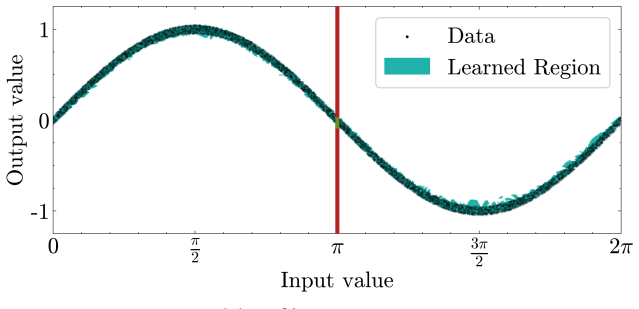
Figures from the paper (22 more)



Reference graph
Works this paper leans on
-
[1]
Adam, Martin Piccolrovazzi, Sebastian Eger, and Eckehard Steinbach
Michael G. Adam, Martin Piccolrovazzi, Sebastian Eger, and Eckehard Steinbach. Bounding box disparity: 3d metrics for object detection with full degree of freedom. In 2022 IEEE International Conference on Image Processing (ICIP), page 1491–1495. IEEE, October 2022. doi:10.1109/icip46576.2022.9897588. URL http://dx.doi.org/10.1109/ICIP46576.2022.9897588
arXiv 2022
-
[2]
Does deep learning learn to abstract? a systematic probing framework
Shengnan An, Zhen Lin, Beichen Chen, Qi Fu, Nian Zheng, and Jianguo Lou. Does deep learning learn to abstract? a systematic probing framework. In Proceedings of the International Conference on Learning Representations (ICLR), 2023. URL https://openreview.net/forum?id=QB1dMPEXau5
work page 2023
-
[3]
A. Azzalini and A. W. Bowman. A look at some data on the old faithful geyser. Journal of the Royal Statistical Society. Series C (Applied Statistics), 39 0 (3): 0 357--365, 1990. ISSN 00359254, 14679876. URL http://www.jstor.org/stable/2347385
-
[4]
Richard Bellman. Dynamic programming. Science, 153 0 (3731): 0 34--37, 1966
work page 1966
-
[5]
Classification-based anomaly detection for general data
Liron Bergman and Yedid Hoshen. Classification-based anomaly detection for general data. In ICLR. OpenReview.net, 2020. URL http://dblp.uni-trier.de/db/conf/iclr/iclr2020.html#BergmanH20
work page 2020
-
[6]
Anselm Blumer, Andrzej Ehrenfeucht, David Haussler, and Manfred K. Warmuth. Occam's razor. Information Processing Letters, 24 0 (6): 0 377--380, 1987. ISSN 0020-0190. doi:https://doi.org/10.1016/0020-0190(87)90114-1. URL https://www.sciencedirect.com/science/article/pii/0020019087901141
arXiv 1987
-
[7]
Analysis of explainers of black box deep neural networks for computer vision: A survey
Vanessa Buhrmester, David Münch, and Michael Arens. Analysis of explainers of black box deep neural networks for computer vision: A survey. Machine Learning and Knowledge Extraction, 3 0 (4): 0 966--989, 2021. ISSN 2504-4990. doi:10.3390/make3040048. URL https://www.mdpi.com/2504-4990/3/4/48
-
[8]
Giordano, Michele Pagano, and Teresa Pepe
Christian Callegari, Loris Gazzarrini, S. Giordano, Michele Pagano, and Teresa Pepe. A novel pca-based network anomaly detection. pages 1 -- 5, 07 2011. doi:10.1109/icc.2011.5962595
arXiv 2011
Show all 50 references
-
[9]
Topology and data
Gunnar Carlsson. Topology and data. Bulletin of the American Mathematical Society, 46 0 (2): 0 255--308, 2009. doi:10.1090/S0273-0979-09-01249-X
2009 doi
- [10]
-
[11]
The mnist database of handwritten digit images for machine learning research
Li Deng. The mnist database of handwritten digit images for machine learning research. IEEE Signal Processing Magazine, 29, 2012
2012
-
[12]
The Reflex Arc Concept in Psychology, volume 3
John Dewey. The Reflex Arc Concept in Psychology, volume 3. The Psychological Review, 1896. doi:10.1037/h0070601
-
[13]
Diffusion models beat gans on image synthesis
Prafulla Dhariwal and Alex Nichol. Diffusion models beat gans on image synthesis. In Proceedings of the 35th International Conference on Neural Information Processing Systems, NIPS '21, Red Hook, NY, USA, 2021. Curran Associates Inc. ISBN 9781713845393
2021
-
[14]
Benoit Richard Umbert Dherin, Micheal Munn, and David G. T. Barrett. The geometric occam's razor implicit in deep learning. ArXiv, abs/2111.15090, 2021
2021 arXiv
-
[15]
Empirical comparison between autoencoders and traditional dimensionality reduction methods
Quentin Fournier and Daniel Aloise. Empirical comparison between autoencoders and traditional dimensionality reduction methods. In 2019 IEEE Second International Conference on Artificial Intelligence and Knowledge Engineering (AIKE), pages 211--214, 2019. doi:10.1109/AIKE.2019.00044
2019
-
[16]
A comparison of alternative tests of significance for the problem of \ m\ rankings
Milton Friedman. A comparison of alternative tests of significance for the problem of \ m\ rankings. Annals of Mathematical Statistics, 11: 0 86--92, 1940
1940
-
[17]
Cardiovascular disease dataset, 2020
Rajib Kumar Halder. Cardiovascular disease dataset, 2020. URL https://dx.doi.org/10.21227/7qm5-dz13
2020 doi
-
[18]
Adbench: Anomaly detection benchmark
Songqiao Han, Xiyang Hu, Hailiang Huang, Mingqi Jiang, and Yue Zhao. Adbench: Anomaly detection benchmark. In NeurIPS, 2022
2022
-
[19]
Machine learning with a reject option: A survey, 2024
Kilian Hendrickx, Lorenzo Perini, Dries Van der Plas, Wannes Meert, and Jesse Davis. Machine learning with a reject option: A survey, 2024. URL https://arxiv.org/abs/2107.11277
2024 arXiv
-
[20]
Deep learning with topological signatures
Christoph Hofer, Roland Kwitt, Marc Niethammer, and Andreas Uhl. Deep learning with topological signatures. In Advances in Neural Information Processing Systems (NeurIPS), volume 30, 2017
2017
-
[21]
A simple sequentially rejective multiple test procedure
Sture Holm. A simple sequentially rejective multiple test procedure. Scandinavian Journal of Statistics, 6 0 (2): 0 65--70, 1979. ISSN 03036898, 14679469. URL http://www.jstor.org/stable/4615733
1979
-
[22]
Khan and Michael G
Shehroz S. Khan and Michael G. Madden. A survey of recent trends in one class classification. In Lorcan Coyle and Jill Freyne, editors, Artificial Intelligence and Cognitive Science, pages 188--197, Berlin, Heidelberg, 2010. Springer Berlin Heidelberg. ISBN 978-3-642-17080-5
2010
-
[23]
Gregory R. Koch. Siamese neural networks for one-shot image recognition. 2015
2015
-
[24]
The self-organizing map
Teuvo Kohonen. The self-organizing map. Proceedings of the IEEE, 78 0 (9): 0 1464--1480, 1990. doi:10.1109/5.58325
1990 doi
-
[25]
Siegelmann
Robert Kozma, Roman Ilin, and Hava T. Siegelmann. Evolution of abstraction across layers in deep learning neural networks. Procedia Computer Science, 144: 0 203--213, 2018. ISSN 1877-0509. doi:https://doi.org/10.1016/j.procs.2018.10.520. URL https://www.sciencedirect.com/scien...
2018 doi
-
[26]
On diffusion modeling for anomaly detection
Victor Livernoche, Vineet Jain, Yashar Hezaveh, and Siamak Ravanbakhsh. On diffusion modeling for anomaly detection. In ICLR 2024, 2024. URL https://openreview.net/forum?id=lR3rk7ysXz
2024
-
[27]
Mitchell
Tom M. Mitchell. Machine Learning. McGraw-Hill, New York, 1997. ISBN 9780070428072
1997
-
[28]
Meta-survey on outlier and anomaly detection
Madalina Olteanu, Fabrice Rossi, and Florian Yger. Meta-survey on outlier and anomaly detection. Neurocomputing, 555: 0 126634, 2023. ISSN 0925-2312. doi:https://doi.org/10.1016/j.neucom.2023.126634. URL https://www.sciencedirect.com/science/article/pii/S0925231223007579
2023
-
[29]
Pardalos
Panos M. Pardalos. Linear programmingLinear Programming, pages 1276--1278. Springer US, Boston, MA, 2001. ISBN 978-0-306-48332-5. doi:10.1007/0-306-48332-7_261. URL https://doi.org/10.1007/0-306-48332-7_261
2001 doi
-
[30]
Kepler’s goat herd: An exact solution to kepler’s equation for elliptical orbits
Oliver H E Philcox, Jeremy Goodman, and Zachary Slepian. Kepler’s goat herd: An exact solution to kepler’s equation for elliptical orbits. Monthly Notices of the Royal Astronomical Society, 506 0 (4): 0 6111–6116, May 2021. ISSN 1365-2966. doi:10.1093/mnras/stab1296. URL http:...
2021 doi
-
[31]
Functionalism as a philosophical theory of the cognitive sciences
Thomas Polger. Functionalism as a philosophical theory of the cognitive sciences. Wiley Interdisciplinary Reviews: Cognitive Science, 3, 05 2012. doi:10.1002/wcs.1170
2012 doi
-
[32]
Interior Point Methods for Nonlinear Optimization, pages 215--276
Imre P \'o lik and Tam \'a s Terlaky. Interior Point Methods for Nonlinear Optimization, pages 215--276. Springer Berlin Heidelberg, Berlin, Heidelberg, 2010. ISBN 978-3-642-11339-0. doi:10.1007/978-3-642-11339-0_4. URL https://doi.org/10.1007/978-3-642-11339-0_4
2010 doi
-
[33]
Neural transformation learning for deep anomaly detection beyond images, 2022
Chen Qiu, Timo Pfrommer, Marius Kloft, Stephan Mandt, and Maja Rudolph. Neural transformation learning for deep anomaly detection beyond images, 2022. URL https://arxiv.org/abs/2103.16440
2022 arXiv
-
[34]
Ross Quinlan
J. Ross Quinlan. C4.5: Programs for Machine Learning. Morgan Kaufmann, 1993. ISBN 978-1-55860-238-0
1993
-
[35]
Occam s razor
Carl Rasmussen and Zoubin Ghahramani. Occam s razor. In T. Leen, T. Dietterich, and V. Tresp, editors, Advances in Neural Information Processing Systems, volume 13. MIT Press, 2000. URL https://proceedings.neurips.cc/paper_files/paper/2000/file/0950ca92a4dcf426067cfd2246bb5ff3...
2000
-
[36]
Variational inference with normalizing flows
Danilo Jimenez Rezende and Shakir Mohamed. Variational inference with normalizing flows. In Proceedings of the 32nd International Conference on International Conference on Machine Learning - Volume 37, ICML'15, page 1530–1538. JMLR.org, 2015
2015
-
[37]
The Perceptron: A Probabilistic Model for Information Storage and Organization in the Brain, volume 65
Frank Rosenblatt. The Perceptron: A Probabilistic Model for Information Storage and Organization in the Brain, volume 65. Psychological Review, 1958. doi:10.1037/h0042519
1958 doi
-
[38]
Deep one-class classification
Lukas Ruff, Robert Vandermeulen, Nico Goernitz, Lucas Deecke, Shoaib Ahmed Siddiqui, Alexander Binder, Emmanuel M \"u ller, and Marius Kloft. Deep one-class classification. In ICML, 2018 a
2018
-
[39]
Deep one-class classification
Lukas Ruff, Robert Vandermeulen, Nico Goernitz, Lucas Deecke, Shoaib Ahmed Siddiqui, Alexander Binder, Emmanuel M \"u ller, and Marius Kloft. Deep one-class classification. In Proceedings of the 35th International Conference on Machine Learning, 2018 b
2018
-
[40]
Kauffmann, Robert A
Lukas Ruff, Jacob R. Kauffmann, Robert A. Vandermeulen, Gregoire Montavon, Wojciech Samek, Marius Kloft, Thomas G. Dietterich, and Klaus-Robert Muller. A unifying review of deep and shallow anomaly detection. Proceedings of the IEEE, 109 0 (5): 0 756–795, May 2021. ISSN 1558-2256
2021
-
[41]
Titchener
Edward B. Titchener. An Outline of Psychology. Macmillan, 1896
-
[42]
Santosh S. Vempala. Hit-and-run is fast and fun. 2003. URL https://api.semanticscholar.org/CorpusID:8398546
2003
-
[43]
Individual comparisons by ranking methods
Frank Wilcoxon. Individual comparisons by ranking methods. Biometrics Bulletin, 1 0 (6): 0 80--83, 1945. ISSN 00994987
1945
-
[44]
K. V. Wilkes. Functionalism, psychology, and the philosophy of mind. Philosophical Topics, 12 0 (1): 0 147--167, 1981. ISSN 02762080, 2154154X. URL http://www.jstor.org/stable/43153849
1981
-
[45]
Mang Ye, Jianbing Shen, Gaojie Lin, Tao Xiang, Ling Shao, and Steven C. H. Hoi. Deep Learning for Person Re-Identification: A Survey and Outlook . IEEE Transactions on Pattern Analysis & Machine Intelligence, 44 0 (06): 0 2872--2893, June 2022. ISSN 1939-3539. doi:10.1109/TPAM...
2022
-
[46]
Zelle and Raymond J
John M. Zelle and Raymond J. Mooney. Learning to parse database queries using inductive logic programming. In Proceedings of the Thirteenth National Conference on Artificial Intelligence (AAAI), pages 1050--1055, Portland, OR, USA, 1996. AAAI Press
1996
-
[47]
Pyod: A python toolbox for scalable outlier detection
Yue Zhao, Zain Nasrullah, and Zheng Li. Pyod: A python toolbox for scalable outlier detection. Journal of Machine Learning Research, 20 0 (96): 0 1--7, 2019. URL http://jmlr.org/papers/v20/19-011.html
2019
-
[48]
Feature Engineering for Machine Learning: Principles and Techniques for Data Scientists
Alice Zheng and Amanda Casari. Feature Engineering for Machine Learning: Principles and Techniques for Data Scientists. O'Reilly Media, Inc., 1st edition, 2018. ISBN 1491953241
2018
-
[49]
Campello, and J\" o rg Sander
Arthur Zimek, Matthew Gaudet, Ricardo J.G.B. Campello, and J\" o rg Sander. Subsampling for efficient and effective unsupervised outlier detection ensembles. In Proceedings of the 19th ACM SIGKDD International Conference on Knowledge Discovery and Data Mining, KDD '13, page 42...
2013
-
[50]
Deep autoencoding gaussian mixture model for unsupervised anomaly detection
Bo Zong, Qi Song, Martin Renqiang Min, Wei Cheng, Cristian Lumezanu, Dae ki Cho, and Haifeng Chen. Deep autoencoding gaussian mixture model for unsupervised anomaly detection. In International Conference on Learning Representations, 2018. URL https://api.semanticscholar.org/Co...
2018
Reviewed August 7, 2026 · model on record in the stance chip above.
Discussion (0). Continue with ORCID to comment.