REVIEW 3 major objections 6 minor 98 references
Advancing Image-Based Grapevine Variety Classification with a New Benchmark and Evaluation of Masked Autoencoders
T0 review · 3 major / 6 minor · reviewed 2026-08-15 · deepseek-v4-flash
Pith's one-line read A masked autoencoder pre-trained on 54,571 unlabeled grapevine images, then fine-tuned, reaches F1 scores of 0.7956 and 0.8112 on two variety-classification test sets, beating all ImageNet-initialized baselines.
desk verdict A genuinely useful new benchmark and a thorough MAE evaluation, but the headline claim about domain-specific SSL beating ImageNet transfer is confounded by pre-training data that includes the fine-tuning training set. read the letter →
The pith
A machine-rendered reading of the paper's core claim, the machinery that carries it, and where it could break.
The reading
What carries the argument
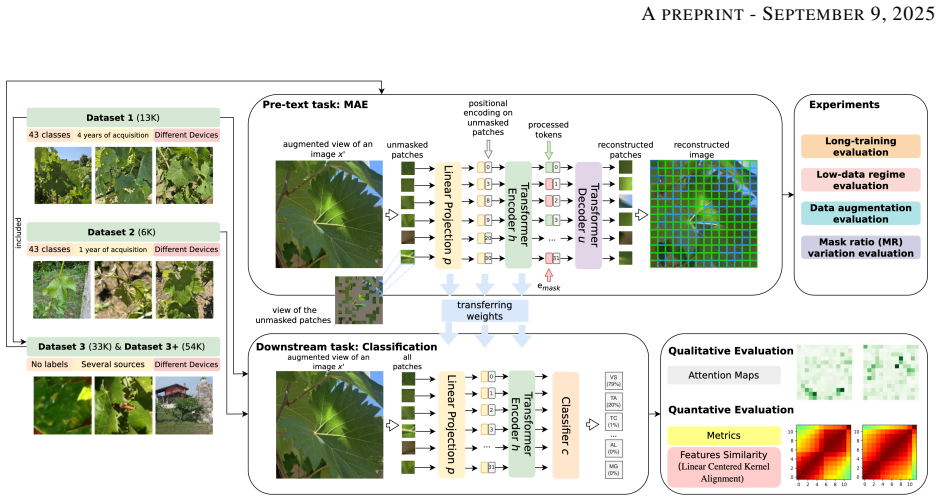
The central mechanism is the masked autoencoder (MAE): a self-supervised pre-training objective in which random patches of an input image are removed and an encoder–decoder transformer is trained to reconstruct only the missing patches from the visible ones. Because the loss ignores visible patches, the encoder is forced to learn the visual structure of grapevine leaves without labels. The paper pairs this with a Vision Transformer encoder, uses the default MAE hyperparameters (mask ratio 0.6, decoder with 8 blocks), discards the decoder after pre-training, and fine-tunes the entire encoder on labeled data. The MAE's label efficiency and its lack of reliance on large batches or complex augmentation are what make it attractive for agricultural datasets where annotation is scarce.
What would settle it
Re-train the best configuration with an unlabeled pool that excludes every image overlapping in location and variety with the labeled datasets; if the $F_1$ gap over an ImageNet-initialized baseline shrinks or disappears, the claimed benefit of domain-specific MAE pre-training is explained by data overlap rather than by self-supervised representation learning.
Extended reading notes
Core claim
On the paper's own terms, the central discovery is that a MAE pre-trained on grapevine leaf images, rather than on ImageNet, produces the best representations for grapevine variety classification. The authors pre-train ViT-T/16, ViT-S/16, and ViT-B/16 encoders by masking 60% of image patches and reconstructing them, using an unlabeled dataset of 33,671 images and an extended version of 54,571 images. After discarding the decoder and fine-tuning the encoder on labeled data from 43 varieties, the ViT-B/16 pre-trained on the extended unlabeled set achieves the highest $F_1$ score, 0.7956 on the 2020–2023 test set, and 0.8112 on the 2024 test set after merging both labeled datasets for fine-tuning. The paper also reports that these models outperform SimSiam and DINO initializations, benefit from 2,000–2,500 pre-training epochs, degrade when strong augmentation is used, and generalize across seasons only when seasonal data is included in fine-tuning.
Load-bearing premise
The central assumption is that the model benefits from learning grapevine image structure without labels, and not simply from having already seen the same varieties from the same vineyard in its pre-training pool.
Editorial extensions
If this is right
- Domain-specific MAE pre-training can replace ImageNet transfer for grapevine variety identification, with the best model outperforming the strongest ImageNet baseline by over 12 $F_1$ points.
- Pre-trained on unlabeled vineyard images, models retain useful features when fine-tuned with as little as 10 percent of labeled data, making annotation-hungry precision-viticulture tasks more feasible.
- Long pre-training (2,000–2,500 epochs) improves downstream performance for ViT models, while simple random-crop augmentation beats stronger SimCLR-style augmentation during pre-training.
- Fine-tuning on data from multiple seasons markedly improves cross-season performance, whereas models trained on a single season drop sharply on a new season.
- The new 43-variety, multi-season benchmark provides a more challenging and representative evaluation than existing public grapevine datasets.
Reading between the lines
- Because the unlabeled Dataset 3 explicitly includes the training subset of Dataset 1, the paper's comparison does not isolate self-supervised learning from exposure to the same varieties and site as the test distribution; a version of the experiment with a disjoint unlabeled pool would clarify the source of the gain.
- The same recipe—MAE pre-training on a small, domain-specific unlabeled pool, then full fine-tuning—should transfer to other fine-grained agricultural identification tasks such as cultivar, pest, or disease classification where labeled data are expensive.
- The seasonal analysis suggests a testable data-collection policy: if early phenological stages are the hard cases, acquiring more labeled images in late May should improve variety classifiers more than adding images from later weeks.
- The LCKA and attention-map analyses imply that domain pre-training principally reshapes the later transformer blocks; probing layer-wise linear separability before and after fine-tuning would quantify where that specialization happens.
Signed reviews
Editorial analysis
A structured set of objections, weighed in public.
Referee Report
Summary. The paper introduces two labeled grapevine-leaf datasets covering 43 varieties across multiple growing seasons (Dataset 1, 2020–2023, and Dataset 2, 2024) and two unlabeled collections (Dataset 3 with 33,671 images; Dataset 3+ with 54,571 images) used for self-supervised pre-training. The authors pre-train ViT-T/S/B encoders with Masked Autoencoders on the unlabeled data, fine-tune on labeled data, and compare against ImageNet (IN1K)-initialized baselines. The best configuration (ViT-B/16 pre-trained on Dataset 3+) achieves F1 0.7956 on Dataset 1 and 0.8112 on Dataset 2 after merged fine-tuning, outperforming IN1K-initialized baselines and the DINO baseline. Ablations examine pre-training duration, low-data regimes, data augmentation, and mask ratio, and qualitative analyses use attention maps and LCKA representation similarity.
Significance. If the central comparison were unconfounded, this would be a valuable contribution: the benchmark is the largest public multi-season grapevine-variety dataset to date, and the practical recommendations (long pre-training helps up to about 2,500 epochs; simple random-crop augmentation beats strong augmentations; mask ratio has minor impact) are useful for practitioners. However, the quantitative claim that domain-specific SSL outperforms IN1K transfer is weakened by the fact that the pre-training corpus includes the fine-tuning training images and images from the same test sites. Given this confound, the significance of the SSL-specific conclusion is currently conditional; the benchmark and ablation findings remain useful.
major comments (3)
- [Section 2.1.3, Tables 3 and 6] The central comparison between VIT-B (Dataset 3+) and VIT-B (IN1K) changes both the pre-training objective and the pre-training corpus. Section 2.1.3 states that Dataset 3 includes the training subset of Dataset 1 and that Dataset 3+ adds images sourced near Vila Real, Portugal, the same sites used to collect Datasets 1 and 2. Consequently, the winning model was pre-trained on unlabeled versions of the very images used later for fine-tuning (and on near-duplicates of the test distribution), while the IN1K baseline had no such exposure. This confound can explain part of the F1 advantage (0.7956 vs. 0.7851 on Dataset 1 and 0.8112 vs. 0.7794 on Dataset 2 in Table 6) without requiring any benefit from self-supervised learning per se. Section 5.8, which lists limitations, does not mention this overlap, and no deduplication against the test splits is reported. Please add a control with MAE pre-trained on a disjoint version of Dataset 3/3+ (all Dataset 1/2 images and near-duplicates removed), and report overlap statistics between pre-training and test sets to quantify potential leakage.
- [Section 4.1, Tables 3–6] All headline numbers are single-run results with no error bars or repeated seeds. The decisive margin between VIT-B (Dataset 3+) and VIT-B (IN1K) is only 1.05 percentage points on the Dataset 1 test subset in Table 6, a difference comparable to the typical run-to-run variance of ViT fine-tuning. Even the 3.18 percentage-point gap on Dataset 2 is not conclusive without variance estimates. Please report mean ± standard deviation over at least three seeds for the main comparisons, together with a significance test (e.g., paired bootstrap or Wilcoxon signed-rank test), and apply the same treatment to the low-data regime results in Figure 6(b).
- [Section 4.2, Figure 6(b)] The low-data regime experiment inherits the pre-training/fine-tuning overlap problem. Since Dataset 3 contains the Dataset 1 training subset and Dataset 3+ contains additional Vila Real images, the conclusion that 'Dataset 3+ consistently outperformed all other models across all proportions of data' may reflect prior exposure to the target domain rather than label-efficient self-supervised learning. The label-efficiency claim is load-bearing for the paper's practical message, so it should be re-run on a disjoint pre-training corpus; until then, the claim is not supported by the presented evidence.
minor comments (6)
- [Section 2.2 and Section 5.2] There are typos: 'collpased' should be 'collapsed' and the heading 'Initiaslisation' should be 'Initialisation'; additionally, the architecture abbreviation is inconsistent ('VIT' vs. 'ViT') across tables and text.
- [Equation (2)] The accuracy formula uses 'VN' where it should read 'TN' (true negatives).
- [Section 5.4] At matched pre-training length (1,000 epochs), DINO outperforms MAE (0.6367 vs. 0.5779), and the paper's claim that MAE is 'more effective' rests on longer training; please add an explicit compute/epoch trade-off discussion to support this conclusion.
- [Section 3.2] The pre-training description says 'other hyperparameters followed IN1K default settings,' but the mask ratio is set to 0.60 while the original MAE uses 0.75; please clarify this deviation and ensure the mask-ratio ablation covers it.
- [Section 2.1.3] The square-slicing procedure (including the 'up to 10% overlap between slices' condition) is not precisely specified; please report slice dimensions and step sizes for reproducibility.
- [References] The reference list contains incomplete entries (e.g., 'Doersch et al.' and 'El-Nouby et al.' with no year or venue); please complete these citations.
Circularity Check
No circularity found; the dataset-overlap confound is a validity concern, not a circular derivation.
full rationale
The paper's central comparison contrasts MAE pre-training on grapevine images with IN1K-initialized baselines. The downstream classification labels and the reconstruction pre-text objective are distinct, and the baselines are externally sourced (ImageNet weights and the original MAE method of He et al.). No fitted parameter is renamed as a prediction, and no uniqueness theorem or load-bearing self-citation is invoked. The only arguable issue is that Dataset 3 explicitly includes the training subset of Dataset 1 (Section 2.1.3), and Dataset 3+ adds images from the same Vila Real sites; this makes the MAE-vs-IN1K comparison confounded because the pre-training corpus overlaps the target domain. However, that is an experimental-design and validity concern, not a circular derivation: the reported F1 scores are not equal by construction to any input, and the paper does not use the overlap to define the method. Self-citations (Carneiro et al.) are used only as background support for dataset limitations and prior results, not as load-bearing justification. Consequently, no circularity step meets the quote-and-reduction bar.
Assumptions & free parameters
free parameters (4)
- MAE mask ratio =
0.60 for ViT-T/S, 0.50 for ViT-B
- Pre-training duration (epoch number) =
2000-2500 epochs depending on model and dataset
- Fine-tuning learning rate and layer decay =
1e-3 with layer-wise decay 0.65
- Dataset 3+ size (adding 62% more images) =
54,571 images
assumptions (4)
- domain assumption MAE learns representations that transfer to fine-grained classification better than ImageNet-supervised pre-training for this domain
- domain assumption The labels in Dataset 1/Dataset 2 are correct (variety names are accurate)
- domain assumption F1 score computed by macro-averaging is the appropriate measure (the paper does not state whether macro or weighted)
- standard math Standard deep learning training stability assumptions (optimizer convergence, no pathological seeds)
Cite this review
Pith. "Pith review of Advancing Image-Based Grapevine Variety Classification with a New Benchmark and Evaluation of Masked Autoencoders." pith.science (2026). https://pith.science/paper/UXF2IX56
@misc{pith2026250613335,
  author       = {Pith},
  title        = {Pith review of: Advancing Image-Based Grapevine Variety Classification with a New Benchmark and Evaluation of Masked Autoencoders},
  year         = {2026},
  howpublished = {\url{https://pith.science/paper/UXF2IX56}},
  note         = {Machine review of arXiv:2506.13335}
}
read the original abstract
Grapevine varieties are essential for the economies of many wine-producing countries, influencing the production of wine, juice, and the consumption of fruits and leaves. Traditional identification methods, such as ampelography and molecular analysis, have limitations: ampelography depends on expert knowledge and is inherently subjective, while molecular methods are costly and time-intensive. To address these limitations, recent studies have applied deep learning (DL) models to classify grapevine varieties using image data. However, due to the small dataset sizes, these methods often depend on transfer learning from datasets from other domains, e.g., ImageNet1K (IN1K), which can lead to performance degradation due to domain shift and supervision collapse. In this context, self-supervised learning (SSL) methods can be a good tool to avoid this performance degradation, since they can learn directly from data, without external labels. This study presents an evaluation of Masked Autoencoders (MAEs) for identifying grapevine varieties based on field-acquired images. The main contributions of this study include two benchmarks comprising 43 grapevine varieties collected across different seasons, an analysis of MAE's application in the agricultural context, and a performance comparison of trained models across seasons. Our results show that a ViT-B/16 model pre-trained with MAE and the unlabeled dataset achieved an F1 score of 0.7956, outperforming all other models. Additionally, we observed that pre-trained models benefit from long pre-training, perform well under low-data training regime, and that simple data augmentation methods are more effective than complex ones. The study also found that the mask ratio in MAE impacts performance only marginally.
Figures


Figures from the paper (5 more)


Reference graph
Works this paper leans on
-
[1]
write newline
" write newline "" before.all 'output.state := FUNCTION n.dashify 't := "" t empty not t #1 #1 substring "-" = t #1 #2 substring "--" = not "--" * t #2 global.max substring 't := t #1 #1 substring "-" = "-" * t #2 global.max substring 't := while if t #1 #1 substring * t #2 global.max substring 't := if while FUNCTION word.in bbl.in ":" * " " * FUNCTION f...
-
[2]
Data Driven Approach to Leaf Recognition : Logistic Regression for Smart Agriculture
Altamash Ahmad Abbasi and Ahmad Jalal. Data Driven Approach to Leaf Recognition : Logistic Regression for Smart Agriculture . In 2024 5th International Conference on Advancements in Computational Sciences , ICACS 2024 , 2024. doi:10.1109/ICACS60934.2024.10473258. URL https://www.scopus.com/inward/record.uri?eid=2-s2.0-85190287647&doi=10.1109 Type: Confere...
arXiv 2024
-
[3]
Grape bunch and vine trunk dataset for Deep Learning object detection., July 2021
André Silva Aguiar and Sandro Magalhães. Grape bunch and vine trunk dataset for Deep Learning object detection., July 2021. URL https://zenodo.org/records/5139598
arXiv 2021
-
[4]
Lafta R. Al-khazraji, Mohammed Abdallazez Mohammed, Dhafar Hamed Abd, Wasiq Khan, Bilal Khan, and Abir Jaafar Hussain. Image dataset of important grape varieties in the commercial and consumer market. Data in Brief, 47: 0 108906, April 2023. ISSN 2352-3409. doi:10.1016/j.dib.2023.108906. URL https://www.sciencedirect.com/science/article/pii/S2352340923000240
arXiv 2023
-
[5]
Michele Alessandrini, Romel Calero Fuentes Rivera, Laura Falaschetti, Danilo Pau, Valeria Tomaselli, and Claudio Turchetti. ESCA -dataset. 1, February 2021. doi:10.17632/89cnxc58kj.1. URL https://data.mendeley.com/datasets/89cnxc58kj/1. Publisher: Mendeley Data
-
[6]
The Hidden Uniform Cluster Prior in Self - Supervised Learning , October 2022
Mahmoud Assran, Randall Balestriero, Quentin Duval, Florian Bordes, Ishan Misra, Piotr Bojanowski, Pascal Vincent, Michael Rabbat, and Nicolas Ballas. The Hidden Uniform Cluster Prior in Self - Supervised Learning , October 2022. URL http://arxiv.org/abs/2210.07277. arXiv:2210.07277 [cs]
arXiv 2022
-
[7]
A Cookbook of Self - Supervised Learning , June 2023
Randall Balestriero, Mark Ibrahim, Vlad Sobal, Ari Morcos, Shashank Shekhar, Tom Goldstein, Florian Bordes, Adrien Bardes, Gregoire Mialon, Yuandong Tian, Avi Schwarzschild, Andrew Gordon Wilson, Jonas Geiping, Quentin Garrido, Pierre Fernandez, Amir Bar, Hamed Pirsiavash, Yann LeCun, and Micah Goldblum. A Cookbook of Self - Supervised Learning , June 202...
arXiv 2023
-
[8]
Adrien Bardes, Jean Ponce, and Yann LeCun. VICReg : Variance - Invariance - Covariance Regularization for Self - Supervised Learning , January 2022. URL http://arxiv.org/abs/2105.04906. arXiv:2105.04906 [cs]
arXiv 2022
Show all 98 references
-
[9]
VINEyard Piacenza Image Collections - VINEPICs , April 2023
Riccardo Bertoglio, Matteo Gatti, Stefano Poni, and Matteo Matteucci. VINEyard Piacenza Image Collections - VINEPICs , April 2023. URL https://zenodo.org/records/7866442
2023
-
[10]
EVALUATING DATA AUGMENTATION FOR GRAPEVINE VARIETIES IDENTIFICATION
Gabriel Carneiro, Alexandre Neto, Ana Teixeira, Antonio Cunha, and Joaquim Sousa. EVALUATING DATA AUGMENTATION FOR GRAPEVINE VARIETIES IDENTIFICATION . In IGARSS 2023 - 2023 IEEE INTERNATIONAL GEOSCIENCE AND REMOTE SENSING SYMPOSIUM , IEEE International Symposium on Geoscience...
2023
-
[11]
Carneiro, Ana Texeira, Raul Morais, Joaquim J
Gabriel A. Carneiro, Ana Texeira, Raul Morais, Joaquim J. Sousa, and Ant \'o nio Cunha. Can the segmentation improve the grape varieties' identification through images acquired on-field? In Nuno Moniz, Zita Vale, Jos \'e Cascalho, Catarina Silva, and Raquel Sebasti \ a o, edit...
2023
-
[12]
Carneiro, António Cunha, and Joaquim Sousa
Gabriel A. Carneiro, António Cunha, and Joaquim Sousa. Deep Learning and Machine Learning for Automatic Grapevine Varieties Identification : A Brief Review , May 2024. URL https://www.preprints.org/manuscript/202403.0484/v2
2024
-
[13]
Sousa, and António Cunha
Gabriel Antonio Carneiro, Luis Pádua, Emanuel Peres, Raul Morais, Joaquim J. Sousa, and António Cunha. Grapevine Varieties Identification Using Vision Transformers . In IGARSS 2022 - 2022 IEEE International Geoscience and Remote Sensing Symposium , pages 5866--5869, July 2022 ...
2022
-
[14]
Carneiro, Ana Ferreira, Raul Morais, Joaquim J
Gabriel S. Carneiro, Ana Ferreira, Raul Morais, Joaquim J. Sousa, and António Cunha. Analyzing the Fine Tuning ’s impact in Grapevine Classification . Procedia Computer Science, 196: 0 364--370, January 2022 b . ISSN 1877-0509. doi:10.1016/j.procs.2021.12.025. URL https://www....
2022 doi
-
[15]
Unsupervised Learning of Visual Features by Contrasting Cluster Assignments , January 2021
Mathilde Caron, Ishan Misra, Julien Mairal, Priya Goyal, Piotr Bojanowski, and Armand Joulin. Unsupervised Learning of Visual Features by Contrasting Cluster Assignments , January 2021. URL http://arxiv.org/abs/2006.09882. arXiv:2006.09882 [cs]
2021 arXiv
-
[16]
Pan, and Huajun Chen
Jiaoyan Chen, Yuxia Geng, Zhuo Chen, Ian Horrocks, Jeff Z. Pan, and Huajun Chen. Knowledge-aware Zero - Shot Learning : Survey and Perspective , May 2021. URL http://arxiv.org/abs/2103.00070. arXiv:2103.00070
2021 arXiv
-
[17]
A Simple Framework for Contrastive Learning of Visual Representations , June 2020 a
Ting Chen, Simon Kornblith, Mohammad Norouzi, and Geoffrey Hinton. A Simple Framework for Contrastive Learning of Visual Representations , June 2020 a . URL http://arxiv.org/abs/2002.05709. arXiv:2002.05709 [cs, stat]
2020 arXiv
-
[18]
Exploring Simple Siamese Representation Learning , November 2020
Xinlei Chen and Kaiming He. Exploring Simple Siamese Representation Learning , November 2020. URL http://arxiv.org/abs/2011.10566. arXiv:2011.10566 [cs]
2020 arXiv
-
[19]
Improved Baselines with Momentum Contrastive Learning , March 2020 b
Xinlei Chen, Haoqi Fan, Ross Girshick, and Kaiming He. Improved Baselines with Momentum Contrastive Learning , March 2020 b . URL http://arxiv.org/abs/2003.04297. arXiv:2003.04297 [cs]
2020 arXiv
-
[20]
Chitwood, Laura L
Daniel H. Chitwood, Laura L. Klein, Regan O'Hanlon, Steven Chacko, Matthew Greg, Cassandra Kitchen, Allison J. Miller, and Jason P. Londo. Latent developmental and evolutionary shapes embedded within the grapevine leaf. New Phytologist, 210 0 (1): 0 343--355, April 2016. ISSN ...
2016 doi
-
[21]
Deep Learning with Python
F Chollet. Deep Learning with Python . Manning Publications Company, 2017. ISBN 978-1-61729-443-3. URL https://books.google.pt/books?id=Yo3CAQAACAAJ
2017
-
[22]
Cunha, M
J. Cunha, M. Teixeira Santos, L. C. Carneiro, P. Fevereiro, and J. E. Eiras-Dias. Portuguese traditional grapevine cultivars and wild vines ( Vitis vinifera L .) share morphological and genetic traits. Genetic Resources and Crop Evolution, 56 0 (7): 0 975--989, November 2009. ...
2009 doi
-
[23]
Jubery , Thomas Lübberstedt , and Baskar Ganapathysubramanian
David Dong , Koushik Nagasubramanian , Ruidong Wang , Ursula Frei , Talukder Z. Jubery , Thomas Lübberstedt , and Baskar Ganapathysubramanian . Self-supervised maize kernel classification and segmentation for embryo identification. 14, April 2023. doi:10.3389/fpls.2023.1108355...
2023
-
[24]
De Nart, M
D. De Nart, M. Gardiman, V. Alba, L. Tarricone, P. Storchi, S. Roccotelli, M. Ammoniaci, V. Tosi, R. Perria, and R. Carraro. Vine variety identification through leaf image classification: a large-scale study on the robustness of five deep learning models. JOURNAL OF AGRICULTUR...
2024 doi
-
[25]
Imagenet: A large-scale hierarchical image database
Jia Deng, Wei Dong, Richard Socher, Li-Jia Li, Kai Li, and Li Fei-Fei. Imagenet: A large-scale hierarchical image database. In 2009 IEEE conference on computer vision and pattern recognition , pages 248--255. Ieee, 2009
2009
-
[26]
CrossTransformers : spatially-aware few-shot transfer
Carl Doersch, Ankush Gupta, and Andrew Zisserman. CrossTransformers : spatially-aware few-shot transfer. URL http://arxiv.org/abs/2007.11498
2007 arXiv
-
[27]
An Image is Worth 16x16 Words : Transformers for Image Recognition at Scale
Alexey Dosovitskiy, Lucas Beyer, Alexander Kolesnikov, Dirk Weissenborn, Xiaohua Zhai, Thomas Unterthiner, Mostafa Dehghani, Matthias Minderer, Georg Heigold, Sylvain Gelly, Jakob Uszkoreit, and Neil Houlsby. An Image is Worth 16x16 Words : Transformers for Image Recognition a...
2020 arXiv
-
[28]
With a Little Help from My Friends : Nearest - Neighbor Contrastive Learning of Visual Representations , October 2021
Debidatta Dwibedi, Yusuf Aytar, Jonathan Tompson, Pierre Sermanet, and Andrew Zisserman. With a Little Help from My Friends : Nearest - Neighbor Contrastive Learning of Visual Representations , October 2021. URL http://arxiv.org/abs/2104.14548. arXiv:2104.14548 [cs]
2021 arXiv
-
[29]
Are large-scale datasets necessary for self-supervised pre-training? URL http://arxiv.org/abs/2112.10740
Alaaeldin El-Nouby, Gautier Izacard, Hugo Touvron, Ivan Laptev, Hervé Jegou, and Edouard Grave. Are large-scale datasets necessary for self-supervised pre-training? URL http://arxiv.org/abs/2112.10740
-
[30]
Sugars, organic acids, and phenolic compounds of ancient grape cultivars ( Vitis vinifera L .) from Igdir province of Eastern Turkey
Sadiye Peral Eyduran, Meleksen Akin, Sezai Ercisli, Ecevit Eyduran, and David Maghradze. Sugars, organic acids, and phenolic compounds of ancient grape cultivars ( Vitis vinifera L .) from Igdir province of Eastern Turkey . Biological Research, 48 0 (1): 0 2, January 2015. ISS...
2015 doi
-
[31]
Fanzone, Fernando Zamora, Viviana Patricia Jofr \'e , Mariela Assof, Carmen G \'o mez-Cordov \'e s, and \'A lvaro Pe \ n a-Neira
Mart \'i n L. Fanzone, Fernando Zamora, Viviana Patricia Jofr \'e , Mariela Assof, Carmen G \'o mez-Cordov \'e s, and \'A lvaro Pe \ n a-Neira. Phenolic characterisation of red wines from different grape varieties cultivated in mendoza province (argentina). Journal of the scie...
2012
-
[32]
Big Data
Armando M. Fernandes, Andrei B. Utkin, José Eiras-Dias, Jorge Cunha, José Silvestre, and Pedro Melo-Pinto. Grapevine variety identification using “ Big Data ” collected with miniaturized spectrometer combined with support vector machines and convolutional neural networks. Comp...
2019
-
[33]
Ampelography - An old technique with future uses: the case of minor varieties of Vitis vinifera L
Sonia Garcia-Muñoz, G Muñoz-Organero, María de Andrés, and Felix Cabello. Ampelography - An old technique with future uses: the case of minor varieties of Vitis vinifera L . from the Balearic Islands . Journal International des Sciences de la Vigne et du Vin, 45: 0 125--137, 2...
2011 doi
-
[34]
Richemond, Elena Buchatskaya, Carl Doersch, Bernardo Avila Pires, Zhaohan Daniel Guo, Mohammad Gheshlaghi Azar, Bilal Piot, Koray Kavukcuoglu, Rémi Munos, and Michal Valko
Jean-Bastien Grill, Florian Strub, Florent Altché, Corentin Tallec, Pierre H. Richemond, Elena Buchatskaya, Carl Doersch, Bernardo Avila Pires, Zhaohan Daniel Guo, Mohammad Gheshlaghi Azar, Bilal Piot, Koray Kavukcuoglu, Rémi Munos, and Michal Valko. Bootstrap your own latent:...
2020 arXiv
-
[35]
Diago, and Javier Tardaguila
Salvador Gutierrez, Juan Fernandez-Novales, Maria P. Diago, and Javier Tardaguila. On- The - Go Hyperspectral Imaging Under Field Conditions and Machine Learning for the Classification of Grapevine Varieties . FRONTIERS IN PLANT SCIENCE, 9, July 2018. ISSN 1664-462X. doi:10.33...
2018
-
[36]
Self-supervised contrastive learning on agricultural images
Ronja Güldenring and Lazaros Nalpantidis. Self-supervised contrastive learning on agricultural images. Computers and Electronics in Agriculture, 191: 0 106510, December 2021. ISSN 0168-1699. doi:10.1016/j.compag.2021.106510. URL https://www.sciencedirect.com/science/article/pi...
2021
-
[37]
TransFG : A Transformer Architecture for Fine -grained Recognition , December 2021 a
Ju He, Jie-Neng Chen, Shuai Liu, Adam Kortylewski, Cheng Yang, Yutong Bai, and Changhu Wang. TransFG : A Transformer Architecture for Fine -grained Recognition , December 2021 a . URL http://arxiv.org/abs/2103.07976. arXiv:2103.07976
2021 arXiv
-
[38]
Deep residual learning for image recognition
Kaiming He, Xiangyu Zhang, Shaoqing Ren, and Jian Sun. Deep residual learning for image recognition. CoRR, abs/1512.03385, 2015. URL http://arxiv.org/abs/1512.03385
2015 arXiv
-
[39]
Momentum Contrast for Unsupervised Visual Representation Learning , March 2020
Kaiming He, Haoqi Fan, Yuxin Wu, Saining Xie, and Ross Girshick. Momentum Contrast for Unsupervised Visual Representation Learning , March 2020. URL http://arxiv.org/abs/1911.05722. arXiv:1911.05722 [cs]
2020 arXiv
-
[40]
Masked Autoencoders Are Scalable Vision Learners , December 2021 b
Kaiming He, Xinlei Chen, Saining Xie, Yanghao Li, Piotr Dollár, and Ross Girshick. Masked Autoencoders Are Scalable Vision Learners , December 2021 b . URL http://arxiv.org/abs/2111.06377. arXiv:2111.06377 [cs]
2021 arXiv
-
[41]
INoD : Injected Noise Discriminator for Self - Supervised Representation Learning in Agricultural Fields
Julia Hindel, Nikhil Gosala, Kevin Bregler, and Abhinav Valada. INoD : Injected Noise Discriminator for Self - Supervised Representation Learning in Agricultural Fields . IEEE ROBOTICS AND AUTOMATION LETTERS, 8 0 (9): 0 6013--6020, September 2023. ISSN 2377-3766. doi:10.1109/L...
2023
-
[42]
Searching for mobileNetV3
Andrew Howard, Mark Sandler, Bo Chen, Weijun Wang, Liang Chieh Chen, Mingxing Tan, Grace Chu, Vijay Vasudevan, Yukun Zhu, Ruoming Pang, Quoc Le, and Hartwig Adam. Searching for mobileNetV3 . In Proceedings of the IEEE International Conference on Computer Vision , volume 2019-O...
2019
-
[43]
Hughes and Marcel Salathe
David P. Hughes and Marcel Salathe. An open access repository of images on plant health to enable the development of mobile disease diagnostics, April 2016. URL http://arxiv.org/abs/1511.08060. arXiv:1511.08060 [cs]
2016 arXiv
-
[44]
DOP Porto
Instituto da Vinha e do Vinho, I.P. DOP Porto . Technical report. URL http://www.ivv.gov.pt/np4/home/901.html
-
[45]
The distribution of the world’s grapevine varieties
International Organisation of Vine and Wine . The distribution of the world’s grapevine varieties. Technical report, February 2018. URL https://www.oiv.int/public/medias/5888/en-distribution-of-the-worlds-grapevine-varieties.pdf
2018
-
[46]
YOLOv5 by Ultralytics , May 2020
Glenn Jocher. YOLOv5 by Ultralytics , May 2020. URL https://github.com/ultralytics/yolov5
2020
-
[47]
Identification of hickory nuts with different oxidation levels by integrating self-supervised and supervised learning
Haoyu Kang, Dan Dai, Jian Zheng, Zile Liang, Siwei Chen, and Lizhong Ding. Identification of hickory nuts with different oxidation levels by integrating self-supervised and supervised learning. FRONTIERS IN SUSTAINABLE FOOD SYSTEMS, 7, March 2023. doi:10.3389/fsufs.2023.1144998
2023
-
[48]
Carroll, Craig A
Soumyashree Kar, Koushik Nagasubramanian, Dinakaran Elango, Matthew E. Carroll, Craig A. Abel, Ajay Nair, Daren S. Mueller, Matthew E. O'Neal, Asheesh K. Singh, Soumik Sarkar, Baskar Ganapathysubramanian, and Arti Singh. Self-supervised learning improves classification of agri...
2023 doi
-
[49]
Fahri Unlersen, Ilker Ali Ozkan, M
Murat Koklu, M. Fahri Unlersen, Ilker Ali Ozkan, M. Fatih Aslan, and Kadir Sabanci. A CNN - SVM study based on selected deep features for grapevine leaves classification. Measurement, 188: 0 110425, January 2022. ISSN 0263-2241. doi:10.1016/J.MEASUREMENT.2021.110425. Publisher...
2022
-
[50]
Similarity of Neural Network Representations Revisited , July 2019
Simon Kornblith, Mohammad Norouzi, Honglak Lee, and Geoffrey Hinton. Similarity of Neural Network Representations Revisited , July 2019. URL http://arxiv.org/abs/1905.00414. arXiv:1905.00414 [cs, q-bio, stat]
2019 arXiv
-
[51]
ImageNet Classification with Deep Convolutional Neural Networks
Alex Krizhevsky, Ilya Sutskever, and Geoffrey E Hinton. ImageNet Classification with Deep Convolutional Neural Networks . In F Pereira, C J C Burges, L Bottou, and K Q Weinberger, editors, Advances in Neural Information Processing Systems , volume 25. Curran Associates, Inc., 2012
2012
-
[52]
Advancements in deep learning for accurate classification of grape leaves and diagnosis of grape diseases
Ismail Kunduracioglu and Ishak Pacal. Advancements in deep learning for accurate classification of grape leaves and diagnosis of grape diseases. JOURNAL OF PLANT DISEASES AND PROTECTION, March 2024. ISSN 1861-3829. doi:10.1007/s41348-024-00896-z. URL https://www.scopus.com/inw...
2024 doi
-
[53]
Accurate classification of fresh and charred grape seeds to the varietal level, using machine learning based classification method
Vlad Landa, Yekaterina Shapira, Michal David, Avshalom Karasik, Ehud Weiss, Yuval Reuveni, and Elyashiv Drori. Accurate classification of fresh and charred grape seeds to the varietal level, using machine learning based classification method. SCIENTIFIC REPORTS, 11 0 (1), June...
2021 doi
-
[54]
Label-efficient learning in agriculture: A comprehensive review
Jiajia Li, Dong Chen, Xinda Qi, Zhaojian Li, Yanbo Huang, Daniel Morris, and Xiaobo Tan. Label-efficient learning in agriculture: A comprehensive review. Computers and Electronics in Agriculture, 215: 0 108412, 2023. ISSN 0168-1699. doi:https://doi.org/10.1016/j.compag.2023.10...
2023
-
[55]
Research on a Flower Recognition Method Based on Masked Autoencoders
Yin Li, Yang Lv, Yuhang Ding, Haotian Zhu, Hua Gao, and Lifei Zheng. Research on a Flower Recognition Method Based on Masked Autoencoders . Horticulturae, 10 0 (5): 0 517, May 2024. ISSN 2311-7524. doi:10.3390/horticulturae10050517. URL https://www.mdpi.com/2311-7524/10/5/517....
2024 doi
-
[56]
Incremental learning with neural networks for computer vision: a survey
Hao Liu, Yong Zhou, Bing Liu, Jiaqi Zhao, Rui Yao, and Zhiwen Shao. Incremental learning with neural networks for computer vision: a survey. Artificial Intelligence Review, 56 0 (5): 0 4557--4589, May 2023. ISSN 1573-7462. doi:10.1007/s10462-022-10294-2. URL https://doi.org/10...
2023 doi
-
[57]
Self-supervised transformer-based pre-training method using latent semantic masking auto-encoder for pest and disease classification
Honglin Liu, Yongzhao Zhan, Huifen Xia, Qirong Mao, and Yixin Tan. Self-supervised transformer-based pre-training method using latent semantic masking auto-encoder for pest and disease classification. Computers and Electronics in Agriculture, 203: 0 107448, December 2022 a . I...
2022
-
[58]
Development of a mobile application for identification of grapevine ( Vitis vinifera l.) cultivars via deep learning
Yixue Liu, Jinya Su, Lei Shen, Nan Lu, Yulin Fang, Fei Liu, Yuyang Song, and Baofeng Su. Development of a mobile application for identification of grapevine ( Vitis vinifera l.) cultivars via deep learning. International Journal of Agricultural and Biological Engineering, 14 0...
2021 arXiv
-
[59]
Swin Transformer : Hierarchical Vision Transformer using Shifted Windows , August 2021 b
Ze Liu, Yutong Lin, Yue Cao, Han Hu, Yixuan Wei, Zheng Zhang, Stephen Lin, and Baining Guo. Swin Transformer : Hierarchical Vision Transformer using Shifted Windows , August 2021 b . URL http://arxiv.org/abs/2103.14030. arXiv:2103.14030 [cs]
2021 arXiv
-
[60]
A ConvNet for the 2020s, March 2022 b
Zhuang Liu, Hanzi Mao, Chao-Yuan Wu, Christoph Feichtenhofer, Trevor Darrell, and Saining Xie. A ConvNet for the 2020s, March 2022 b . URL http://arxiv.org/abs/2201.03545. arXiv:2201.03545 [cs]
2022 arXiv
-
[61]
A hybrid model of ghost-convolution enlightened transformer for effective diagnosis of grape leaf disease and pest
Xiangyu Lu, Rui Yang, Jun Zhou, Jie Jiao, Fei Liu, Yufei Liu, Baofeng Su, and Peiwen Gu. A hybrid model of ghost-convolution enlightened transformer for effective diagnosis of grape leaf disease and pest. Journal of King Saud University - Computer and Information Sciences, 34 ...
2022 doi
-
[62]
Ogayar, Francisco R
Alfonso López, Carlos J. Ogayar, Francisco R. Feito, and Joaquim J. Sousa. Classification of Grapevine Varieties Using UAV Hyperspectral Imaging . Remote Sensing, 16 0 (12): 0 2103, January 2024. ISSN 2072-4292. doi:10.3390/rs16122103. URL https://www.mdpi.com/2072-4292/16/12/...
2024 doi
-
[63]
Macklin, Rachel O
Samantha C. Macklin, Rachel O. Mariani, Emily N. Young, Rosalyn Kish, Kimberley A. Cathline, Gavin Robertson, and Adam R. Martin. Intraspecific Leaf Trait Variation across and within Five Common Wine Grape Varieties . Plants, 11 0 (20): 0 2792, October 2022. ISSN 2223-7747. do...
2022 doi
-
[64]
Toward Grapevine Digital Ampelometry Through Vision Deep Learning Models
Sandro Costa Magalhaes, Luis Castro, Leandro Rodrigues, Tiago Cerveira Padilha, Frederico de Carvalho, Filipe Neves dos Santos, Tatiana Pinho, Germano Moreira, Jorge Cunha, Mario Cunha, Paulo Silva, and Antonio Paulo Moreira. Toward Grapevine Digital Ampelometry Through Vision...
2023
-
[65]
Strawberry Pests and Diseases Recognition with Self - Supervised Learning
Aung Si Min Htet and Hyo Jong Lee. Strawberry Pests and Diseases Recognition with Self - Supervised Learning . In 2023 Congress in Computer Science , Computer Engineering , & Applied Computing ( CSCE ) , pages 1949--1953, July 2023. doi:10.1109/CSCE60160.2023.00321. URL https:...
2023
-
[66]
GVxmi Grapevine Bunches Dataset , October 2022
Germano Moreira, Mário Cunha, and Filipe Neves dos Santos. GVxmi Grapevine Bunches Dataset , October 2022. URL https://zenodo.org/records/7157193
2022
-
[67]
AI4Agriculture Grape Dataset , November 2021
Josep Ramon Morros, Tomas Pariente Lobo, Sergio Salmeron-Majadas, Javier Villazan, Diego Merino, Ana Antunes, Mihai Datcu, Chandrabali Karmakar, Edmundo Guerra, Despina-Athanasia Pantazi, and George Stamoulis. AI4Agriculture Grape Dataset , November 2021. URL https://zenodo.or...
2021
-
[68]
Rui Nascimento, Marisa Maia, António E. N. Ferreira, Anabela B. Silva, Ana Ponces Freire, Carlos Cordeiro, Marta Sousa Silva, and Andreia Figueiredo. Early stage metabolic events associated with the establishment of Vitis vinifera – Plasmopara viticola compatible interaction. ...
2019 doi
-
[69]
Ogidi, Mark G
Franklin C. Ogidi, Mark G. Eramian, and Ian Stavness. Benchmarking Self - Supervised Contrastive Learning Methods for Image - Based Plant Phenotyping . Plant Phenomics, 5: 0 0037, January 2023. doi:10.34133/plantphenomics.0037. URL https://spj.science.org/doi/10.34133/plantphe...
2023 doi
-
[70]
SSFE - Net : Self - Supervised Feature Enhancement for Ultra - Fine - Grained Few - Shot Class Incremental Learning
Zicheng Pan, Xiaohan Yu, Miaohua Zhang, and Yongsheng Gao. SSFE - Net : Self - Supervised Feature Enhancement for Ultra - Fine - Grained Few - Shot Class Incremental Learning . In 2023 IEEE / CVF Winter Conference on Applications of Computer Vision ( WACV ) , pages 6264--6273,...
2023
-
[71]
Learning from Few Examples : A Summary of Approaches to Few - Shot Learning , March 2022
Archit Parnami and Minwoo Lee. Learning from Few Examples : A Summary of Approaches to Few - Shot Learning , March 2022. URL http://arxiv.org/abs/2203.04291. arXiv:2203.04291
2022 arXiv
-
[72]
Pavek, Warren F
Diane S. Pavek, Warren F. Lamboy, and Edward J. Garvey. Selecting in situ conservation sites for grape genetic resources in the USA . Genetic Resources and Crop Evolution 2003 50:2, 50 0 (2): 0 165--173, March 2003. ISSN 1573-5109. doi:10.1023/A:1022947605916. URL https://link...
2003 doi
-
[73]
Grapevine Bunch Condition Detection Dataset , January 2023
Isabel Pinheiro. Grapevine Bunch Condition Detection Dataset , January 2023. URL https://zenodo.org/records/7717014
2023
-
[74]
Rankine, John C
Bryce C. Rankine, John C. M. Fornachon, Edward W. Boehm, and K. M. Cellier. lnfluence of grape variety, climate and soil on grape composition and on the composition and quality of table wines. Vitis: Journal of Grapevine Research, 10: 0 33--33, 2017. URL https://api.semanticsc...
2017
-
[75]
Robinson, J
J. Robinson, J. Harding, and J. Vouillamoz. Wine Grapes : A complete guide to 1,368 vine varieties, including their origins and flavours . Penguin Books Limited, 2013. ISBN 978-0-14-196882-7. URL https://books.google.es/books?id=YGTnD2wGn94C
2013
-
[76]
Identification and characterization of white grape varieties autochthonous of a warm climate region (andalusia, spain)
Pau Sancho-Gal \'a n, Antonio Amores-Arrocha, V \'i ctor Palacios, and Ana Jim \'e nez-Cantizano. Identification and characterization of white grape varieties autochthonous of a warm climate region (andalusia, spain). Agronomy, 2020. URL https://api.semanticscholar.org/CorpusI...
2020
-
[77]
MobileNetV2 : Inverted Residuals and Linear Bottlenecks
Mark Sandler, Andrew Howard, Menglong Zhu, Andrey Zhmoginov, and Liang Chieh Chen. MobileNetV2 : Inverted Residuals and Linear Bottlenecks . Proceedings of the IEEE Computer Society Conference on Computer Vision and Pattern Recognition, pages 4510--4520, January 2018. ISSN 106...
2018
-
[78]
Embrapa Wine Grape Instance Segmentation Dataset – Embrapa WGISD
Thiago Santos, Leonardo de Souza, dos Santos Andreza, and Sandra Avila. Embrapa Wine Grape Instance Segmentation Dataset – Embrapa WGISD . July 2019. doi:10.5281/ZENODO.3361736. URL https://zenodo.org/record/3361736
2019
-
[79]
Santos, Leonardo L
Thiago T. Santos, Leonardo L. de Souza, Andreza A. dos Santos, and Sandra Avila. Grape detection, segmentation and tracking using deep neural networks and three-dimensional association. Computers and Electronics in Agriculture, 170: 0 105247, March 2020. ISSN 01681699. doi:10....
2020
-
[80]
A survey on semi-, self- and unsupervised learning for image classification
Lars Schmarje, Monty Santarossa, Simon-Martin Schröder, and Reinhard Koch. A survey on semi-, self- and unsupervised learning for image classification. IEEE Access, 9: 0 82146--82168, 2021. doi:10.1109/ACCESS.2021.3084358
2021
-
[81]
Schneider, A
A. Schneider, A. Carra, A. Akkak, P. This, V. Laucou, and R. Botta. Verifying synonymies between grape cultivars from France and Northwestern Italy using molecular markers. VITIS - Journal of Grapevine Research, 40 0 (4): 0 197--197, 2001. ISSN 2367-4156. doi:10.5073/vitis.200...
2001 doi
-
[82]
Schmidtke, and Suzy Y
Kah Phooi Seng, Li-Minn Ang, Leigh M. Schmidtke, and Suzy Y. Rogiers. Computer Vision and Machine Learning for Viticulture Technology . IEEE Access, 6: 0 67494--67510, 2018. ISSN 2169-3536. doi:10.1109/ACCESS.2018.2875862. URL https://ieeexplore.ieee.org/document/8502206. Conf...
2018
-
[83]
wGrapeUNIPD - DL : An open dataset for white grape bunch detection
Marco Sozzi, Silvia Cantalamessa, Alessia Cogato, Ahmed Kayad, and Francesco Marinello. wGrapeUNIPD - DL : An open dataset for white grape bunch detection. Data in Brief, 43: 0 108466, August 2022. ISSN 2352-3409. doi:10.1016/j.dib.2022.108466. URL https://www.sciencedirect.co...
2022
-
[84]
Going Deeper with Convolutions , September 2014
Christian Szegedy, Wei Liu, Yangqing Jia, Pierre Sermanet, Scott Reed, Dragomir Anguelov, Dumitru Erhan, Vincent Vanhoucke, and Andrew Rabinovich. Going Deeper with Convolutions , September 2014. URL http://arxiv.org/abs/1409.4842. arXiv:1409.4842
2014 arXiv
-
[85]
Rethinking the Inception Architecture for Computer Vision , December 2015
Christian Szegedy, Vincent Vanhoucke, Sergey Ioffe, Jonathon Shlens, and Zbigniew Wojna. Rethinking the Inception Architecture for Computer Vision , December 2015. URL http://arxiv.org/abs/1512.00567. arXiv:1512.00567 [cs]
2015 arXiv
-
[86]
Inception-v4, Inception - ResNet and the Impact of Residual Connections on Learning
Christian Szegedy, Sergey Ioffe, and Vincent Vanhoucke. Inception-v4, Inception - ResNet and the Impact of Residual Connections on Learning . CoRR, abs/1602.0, 2016. URL http://arxiv.org/abs/1602.07261. arXiv: 1602.07261
2016 arXiv
-
[87]
Mingxing Tan and Quoc V. Le. EfficientNet : Rethinking Model Scaling for Convolutional Neural Networks . 36th International Conference on Machine Learning, ICML 2019, 2019-June: 0 10691--10700, May 2019. URL https://arxiv.org/abs/1905.11946v5. arXiv: 1905.11946 Publisher: Inte...
2019 arXiv
-
[88]
Automatic detection of grape varieties with the newly proposed CNN model using ampelographic characteristics
Ismail Terzi, Mehmet Metin Ozguven, and Adem Yagci. Automatic detection of grape varieties with the newly proposed CNN model using ampelographic characteristics. Scientia Horticulturae, 334: 0 113340, August 2024. ISSN 0304-4238. doi:10.1016/j.scienta.2024.113340. URL https://...
2024
-
[89]
P. This, A. Jung, P. Boccacci, J. Borrego, R. Botta, L. Costantini, M. Crespan, G. S. Dangl, C. Eisenheld, F. Ferreira-Monteiro, S. Grando, J. Ibáñez, T. Lacombe, V. Laucou, R. Magalhães, C. P. Meredith, N. Milani, E. Peterlunger, F. Regner, L. Zulini, and E. Maul. Development...
2004
-
[90]
Training data-efficient image transformers & distillation through attention, January 2021
Hugo Touvron, Matthieu Cord, Matthijs Douze, Francisco Massa, Alexandre Sablayrolles, and Hervé Jégou. Training data-efficient image transformers & distillation through attention, January 2021. URL http://arxiv.org/abs/2012.12877. arXiv:2012.12877 [cs]
2021 arXiv
-
[91]
Benchmarking Representation Learning for Natural World Image Collections , June 2021
Grant Van Horn, Elijah Cole, Sara Beery, Kimberly Wilber, Serge Belongie, and Oisin Mac Aodha. Benchmarking Representation Learning for Natural World Image Collections , June 2021. URL http://arxiv.org/abs/2103.16483. arXiv:2103.16483 [cs]
2021 arXiv
-
[92]
Grapevine leaves, 2021
Maxim Vlah. Grapevine leaves, 2021. URL https://www.kaggle.com/ds/1248678
2021
-
[93]
Sergio Vélez, Mar Ariza-Sentís, and João Valente. Precision viticulture dataset for detailed vineyard mapping composed of geotagged smartphone ground images, phytosanitary status, UAV orthomosaics, 3D point clouds, and RTK GNSS data - Northern Spain , July 2022, December 2023....
2022
-
[94]
Dense Contrastive Learning for Self - Supervised Visual Pre - Training , April 2021
Xinlong Wang, Rufeng Zhang, Chunhua Shen, Tao Kong, and Lei Li. Dense Contrastive Learning for Self - Supervised Visual Pre - Training , April 2021. URL http://arxiv.org/abs/2011.09157. arXiv:2011.09157 [cs]
2021 arXiv
-
[95]
Classification of Plant Leaf Disease Recognition Based on Self - Supervised Learning
Yuzhi Wang, Yunzhen Yin, Yaoyu Li, Tengteng Qu, Zhaodong Guo, Mingkang Peng, Shujie Jia, Qiang Wang, Wuping Zhang, and Fuzhong Li. Classification of Plant Leaf Disease Recognition Based on Self - Supervised Learning . Agronomy, 14 0 (3): 0 500, March 2024. ISSN 2073-4395. doi:...
2024 doi
-
[96]
Table grape inflorescence dataset, September 2022
Du Wensheng. Table grape inflorescence dataset, September 2022. URL https://zenodo.org/records/7096319
2022
-
[97]
Self-supervised Animal Detection in Indoor Environment
Taifour Yousra, Hina Afridi, Adane Nega Tarekegn, Mohib Ullah, Azzedine Beghdadi, and Faouzi Alaya Cheikh. Self-supervised Animal Detection in Indoor Environment . In 2023 Twelfth International Conference on Image Processing Theory , Tools and Applications ( IPTA ) , pages 1--...
2023
-
[98]
Barlow Twins : Self - Supervised Learning via Redundancy Reduction , June 2021
Jure Zbontar, Li Jing, Ishan Misra, Yann LeCun, and Stéphane Deny. Barlow Twins : Self - Supervised Learning via Redundancy Reduction , June 2021. URL http://arxiv.org/abs/2103.03230. arXiv:2103.03230 [cs, q-bio]
2021 arXiv
Reviewed August 15, 2026 · model on record in the stance chip above.
Discussion (0). Continue with ORCID to comment.