REVIEW 4 major objections 5 minor 39 references
Characteristic Imsets for Cyclic Linear Causal Models and the Chickering Ideal
T0 review · 4 major / 5 minor · reviewed 2026-08-15 · deepseek-v4-flash
Pith's one-line read Two directed graphs that share a characteristic imset vector are covariance equivalent: their cyclic linear SEMs generate the same covariance matrices up to Lebesgue-null sets and Euclidean closure.
desk verdict New algebraic refinement of covariance equivalence for cyclic SEMs; the main theorem is plausible but the proof of the geometric step is not yet written. read the letter →
The pith
A machine-rendered reading of the paper's core claim, the machinery that carries it, and where it could break.
The reading
What carries the argument
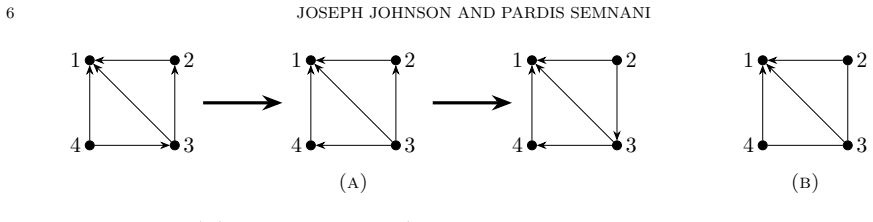
The characteristic imset vector c_G(A)=#{a∈A : A\{a}⊆pa_G(a)} is the finite-dimensional signature at the center of the argument; the family variable vector v_G records, for every possible child b and candidate parent set A, whether pa_G(b)=A. The linear map φ_n sends v_G to c_G, and its kernel is generated by vectors of the form e_{A→b}+e_{A∪b→c}−e_{A→c}−e_{A∪c→b}, exactly the algebraic footprint of covered edge flips. The Chickering ideal C_n is the toric ideal of φ_n's integer matrix, and its doubled version C'_n, with extra invertible variables, is radical and can be eliminated to recover C_n. The final link to covariance equivalence is the proper Givens transformation, imported from the known transformational characterization, which realizes a covered edge flip as an orthogonal change of the factor matrix Q while generically preserving the sparsity pattern of its columns.
What would settle it
An explicit pair of directed graphs with identical characteristic imset vectors but different Euclidean closures of their precision-matrix sets would refute Theorem 4.1. A practical search would enumerate all directed graphs on n=5 or 6 vertices, group them by c_G, and compare, for each fiber, numerically sampled precision matrices from the two parameterizations to see whether the closures differ.
Extended reading notes
Core claim
The central claim is Theorem 4.1: if G and H are directed graphs on the same vertex set and c_G = c_H, then G and H are covariance equivalent, meaning their sets of precision matrices have the same Euclidean closure. The vector c_G(A) counts, for each nonempty set A, how many elements a of A have A\{a} contained in the parent set of a; this is the same definition as in the acyclic case, but now the vector need not be a 0/1-vector because cycles can force a node to receive multiple parent sets. The authors prove the claim by mapping family variable vectors v_G, which record each node's parent set, through a linear map φ_n whose kernel defines the Chickering ideal, showing that the ideal is a saturation of covered-edge-flip binomials, and then demonstrating that each relevant binomial in the doubled Chickering ideal moves the factor matrix Q along orthogonal transformations that generically preserve its column sparsity. Equality of imset vectors therefore forces a path of sparsity-preserving orthogonal transformations joining the two models, so their precision matrices share the same Euclidean closure.
Load-bearing premise
The theorem depends on the claim that the algebraic binomial moves connecting two graphs with the same imset vector can be ordered and the Givens rotations chosen generically so that at every intermediate step the current matrix has exactly the zero pattern that its column labels describe; the paper asserts this translation from algebra to geometry but does not prove the ordering or the genericity.
Editorial extensions
If this is right
- If two cyclic directed graphs share a characteristic imset vector, they cannot be told apart by covariance data alone: their precision matrices fill the same Euclidean closure, so any covariance-based scoring criterion assigns both graphs the same value.
- Searching over standard imset vectors instead of over all directed graphs avoids scoring multiple graphs inside one imset equivalence class, shrinking the search space for greedy causal discovery in the cyclic setting.
- For Gaussian noise, covariance equivalence coincides with model equivalence, so equal imset vectors imply agreement of the full set of distributions, not merely of covariance matrices.
- The Chickering ideal encodes the imset-equivalence relation: its binomials connect graphs with identical imset vectors, and these binomials translate into orthogonal transformations of the factor matrix Q.
- Imset equivalence refines covariance equivalence but is strictly finer even among graphs with the same skeleton; the paper exhibits a pair that is covariance equivalent yet imset-distinct, showing the two relations do not coincide in general.
Reading between the lines
- Reading beyond the paper, the failure of the converse in Example 4.4 suggests that a complete algebraic characterization of cyclic covariance equivalence will need invariants beyond the characteristic imset, possibly tracking 3-cycles or other local structures that the imset vector cannot see.
- If the fibers of the Chickering ideal admit Markov bases, causal discovery over cyclic models could be implemented as walks along these binomial moves, making the algebraic path constructive rather than existential.
- The proof strategy indicates a quantitative route toward a converse: one could look for classes of graphs where every binomial in the Chickering ideal is realizable by sparsity-preserving Givens rotations; for such classes, imset equivalence and covariance equivalence might coincide.
- Because imset equivalence is finer than covariance equivalence, a search space of imset vectors may contain multiple representatives of a single covariance class; the size of the resulting redundancy is an open geometric question about the Chickering variety.
Signed reviews
Editorial analysis
A structured set of objections, weighed in public.
Referee Report
Summary. The paper studies characteristic imset vectors for directed graphs that may contain directed cycles. It defines the Chickering ideal, a toric ideal associated with the linear map from family variable vectors to characteristic imset vectors, and introduces a 'doubled' version in which extra y-variables are added. The algebraic heart of the paper is Theorem 3.16, which identifies the Chickering ideal with the intersection of the doubled ideal with the polynomial ring in the z-variables. The main statistical result, Theorem 4.1, asserts that two directed graphs with the same characteristic imset vector are covariance equivalent. The proof proceeds by writing the difference of the two graph monomials as a sum of binomials in the doubled ideal and claiming that each binomial induces an orthogonal transformation of the matrix Q from Proposition 2.5, ultimately showing that the covariance/precision set of G is contained in the Euclidean closure of that of H.
Significance. If Theorem 4.1 is correct, it is a meaningful structural contribution to the theory of cyclic linear SEMs: characteristic imset vectors would provide a vector-valued representative that refines the covariance equivalence relation, and the smaller search space of imsets could be used in score-based or greedy causal discovery. The paper's algebraic development is extensive and largely convincing: Proposition 3.4, the primary decomposition in Proposition 3.12, and the proof of Theorem 3.16 are worked out in detail and appear internally sound. The paper also gives useful examples, including a pair of covariance-equivalent graphs that are not imset-equivalent, clarifying that the implication in Theorem 4.1 is not reversible. The main weakness is that the proof of Theorem 4.1 contains a substantial gap: the translation from a binomial representation in the doubled ideal to a valid sequence of sparsity-preserving orthogonal transformations on the matrix Q is asserted rather than proved. This gap is load-bearing, because the central claim of the paper rests on exactly this geometric realization of the algebraic path.
major comments (4)
- [Section 4, Eq. (6)] The proof of Theorem 4.1 asserts that a representation z_G - z_H = sum_i z^{p_i} y^{q_i}(z^{u_i^+} - z^{u_i^-} y^{v_i}) in the doubled Chickering ideal yields a sequence of moves acting on the matrix Q. This requires that each partial sum corresponds to a valid graph monomial, i.e. a z-monomial in which, for every vertex, exactly one family A -> b with b in A appears. The text does not prove that the binomial representation can be ordered so that every intermediate monomial has this property. A general binomial representation can pass through monomials with repeated families or with multiple families for the same vertex, and for such monomials no matrix Q with the corresponding column-supports exists. Without an explicit induction showing that the sequence of binomials can be chosen to stay in the set of graph monomials, the claimed action on Q is not well-defined.
- [Section 4, paragraph on second-form binomials] The second-form binomial z_{A cup b -> c} - (y_{A -> c}/y_{A -> b}) z_{A cup c -> b} is said to 'relabel' the column labeled A cup b -> c as A cup c -> b. While the two families have the same support, they have different distinguished children, and the column labels of Q are tied to the row indexing of the matrix through the families fa_G(i). The proof does not track how the row indices of Q are permuted when the distinguished child changes. A rigorous argument needs a bookkeeping lemma that fixes the row labels of Q and shows that after relabeling, the column sparsity still matches the active graph monomial. As written, the claimed preservation of 'column labels agree with sparsity' is simply asserted.
- [Section 4, third-form binomials] The third-form binomial z_{A -> b} z_{A cup b -> c} - z_{A -> c} z_{A cup c -> b} is implemented by a 'proper Givens transformation' cited from [12, Definition 6 and Proposition 3]. That result supplies a Givens rotation realizing a single covered edge flip, starting from a matrix whose sparsity is the initial graph and, generically, preserving the column sparsity pattern. In the present proof, however, the third-form move must be applied to arbitrary intermediate states created by the partial sums of Eq. (6), and those states may not have the property that the relevant edge is covered in the sense required by [12]. The paper gives no argument that the intermediate graph monomials produced by the algebraic path correspond to graphs in which the next covered-edge flip is actually available, nor that the genericity of the Givens rotation can be maintained simultaneously over all steps. This is a second load-bearing gap: without it, the conclusion that Q Q^T lies in the Euclidean closure of M(H) does not follow from the written argument.
- [Theorem 3.16 and Section 4 transition] The algebraic part of the paper is careful about the distinction between the Chickering ideal C_n and the doubled ideal C'_n, and Theorem 3.16 is proved in detail. However, the passage from 'z_G - z_H belongs to C'_n' to 'the binomials in Eq. (5) can be applied sequentially to z_G to obtain z_H' requires that the representation in Eq. (6) be a Markov-basis-style path that respects the monomial partial order at every step. The proof does not provide such a path; it only states that z_G can be transformed 'via the binomials' and then immediately interprets each binomial as a geometric operation on Q. Even if every individual binomial can be realized geometrically in favorable situations, the global sequencing and compatibility of those realizations is the core of the theorem and is not established.
minor comments (5)
- [Throughout] The word 'indeterminants' should be 'indeterminates' in several places, including Section 3 before Definition 3.1.
- [Example 3.5 and Remark 3.6] The generators of C_3 are displayed in a format that may confuse readers: the two rows in the displayed list are part of the same list, and the first row consists of the six covered edge flip binomials while the second row contains three additional generators. A short sentence making the grouping explicit would improve readability.
- [Figure 6] The caption says 'Boxed stars represent the distinguished child in the family that indexes the column.' This is helpful, but the figure itself is not referenced in the main text immediately before or after the proof of Theorem 4.1; adding an explicit reference in Example 4.2 would make the relationship between the algebra and the matrix clearer.
- [Definition 2.15 and Remark 3.2] The paper notes that singleton coordinates are included for algebraic reasons. This is a useful remark, but it would be even clearer to state explicitly in Definition 2.15 that the vector is indexed by all nonempty subsets including singletons, and that the singleton coordinates are identically 1 for every graph. This sentence is already present in the text, so the issue is only one of placement and emphasis.
- [Section 5.1] The paper says that greedy search can search over standard imset vectors instead of directed graphs, but notes that one needs a way to recover a graph in the fiber. This is an honest statement of the limitation, but it may be worth adding a sentence on whether the recovery problem is known to be computationally hard for the cyclic case or whether it is open.
Circularity Check
No significant circularity: the imset-to-covariance implication is genuinely derived, with its main external input coming from non-overlapping prior work.
full rationale
The derivation chain of Theorem 4.1 starts from c_G = c_H, passes through the algebraic containment z_G - z_H in the doubled Chickering ideal (Definition 3.7 and Theorem 3.16), and then interprets each binomial in the representation (6) as a matrix operation on Q: a monomial rescaling, a column relabeling, or a proper Givens rotation imported from [12, Proposition 3]. None of these steps defines characteristic imsets in terms of covariance equivalence, nor does the proof fit a parameter and then rename it as a prediction. The characteristic imset vector is defined independently in Definition 2.15, the Chickering ideal is defined algebraically in Definition 3.1, and the geometric input from [12] concerns covered edge flips and Givens transformations, which are prior results by a non-overlapping set of authors. The cited prior work by the present authors, e.g., [30] and [16], appears only in contextual or future-direction remarks and is not load-bearing. The proof does contain an under-justified invariant: the ordering of the binomial moves in (6) is asserted to keep every intermediate exponent vector a graph monomial and to keep the column labels of Q in agreement with its sparsity at every step, while [12, Proposition 3] is quoted for a single covered edge flip rather than for arbitrary intermediate states. That is a completeness or correctness gap in the written argument, not a circularity, because the missing invariant is neither the conclusion of Theorem 4.1 nor an input built into the definitions. Therefore the central claim is a substantive implication rather than an equivalent restatement of its assumptions.
Assumptions & free parameters
assumptions (3)
- domain assumption Precision matrices of a linear SEM for a graph G are parameterized by Q Q^T, where the sparsity of column j of Q is the family fa_G(j) (Proposition 2.5 in this paper, based on [12]).
- domain assumption A covered edge flip is realized by a proper Givens transformation that generically preserves column sparsity ([12, Proposition 3]).
- standard math Standard binomial ideal results, including the Eisenbud-Sturmfels theorem on binomial ideals [9, Theorem 2.1], used to identify the Chickering ideal with a saturation and to compute primary decompositions.
Cite this review
Pith. "Pith review of Characteristic Imsets for Cyclic Linear Causal Models and the Chickering Ideal." pith.science (2026). https://pith.science/paper/TOM5NFKL
@misc{pith2026250613407,
  author       = {Pith},
  title        = {Pith review of: Characteristic Imsets for Cyclic Linear Causal Models and the Chickering Ideal},
  year         = {2026},
  howpublished = {\url{https://pith.science/paper/TOM5NFKL}},
  note         = {Machine review of arXiv:2506.13407}
}
read the original abstract
Two directed graphs are called covariance equivalent if they induce the same set of covariance matrices, up to a Lebesgue measure zero set, on the random variables of their associated linear structural equation models. For acyclic graphs, covariance equivalence is characterized both structurally, via essential graphs and characteristic imsets, and transformationally, through sequences of covered edge flips. However, when cycles are allowed, only a transformational characterization of covariance equivalence has been discovered. We consider a linear map whose fibers correspond to the sets of graphs with identical characteristic imset vectors, and study the toric ideal associated to its integer matrix. Using properties of this ideal we show that directed graphs with the same characteristic imset vectors are covariance equivalent. In applications, imsets form a smaller search space for solving causal discovery via greedy search.
Figures


Figures from the paper (4 more)


Reference graph
Works this paper leans on
-
[12]
Amiremad Ghassami, Alan Yang, Negar Kiyavash, and Kun Zhang. Characterizing distribution equivalence and structure learning for cyclic and acyclic directed graphs. In Hal Daum´ e III and Aarti Singh, editors,Proceedings of the 37th International Conference on Machine Learning , volume 119 of Proceedings of Machine Learning Research, pages 3494–3504. PMLR,...
work page 2020
-
[1]
Structure learning for cyclic linear causal models
Carlos Amendola, Philipp Dettling, Mathias Drton, Federica Onori, and Jun Wu. Structure learning for cyclic linear causal models. In Jonas Peters and David Sontag, editors, Proceedings of the 36th Conference on Uncer- tainty in Artificial Intelligence (UAI) , volume 124 of Proceedings of Machine Learning Research, pages 999–1008. PMLR, 03–06 Aug 2020. 2, 5, 19
work page 2020
-
[2]
Andersson, David Madigan, and Michael D
Steen A. Andersson, David Madigan, and Michael D. Perlman. A characterization of Markov equivalence classes for acyclic digraphs. Annals of Statistics , 25(2):505–541, 1997. 5
work page 1997
-
[3]
Ordering-based causal structure learning in the presence of latent variables
Daniel Bernstein, Basil Saeed, Chandler Squires, and Caroline Uhler. Ordering-based causal structure learning in the presence of latent variables. In Proceedings of the Twenty Third International Conference on Artificial Intelligence and Statistics , volume 108, pages 4098–4108. PMLR, 2020. 1
work page 2020
-
[4]
A transformational characterization of equivalent Bayesian network structures
David Maxwell Chickering. A transformational characterization of equivalent Bayesian network structures. In Uncertainty in artificial intelligence (Montreal, PQ, 1995) , pages 87–98. Morgan Kaufmann, San Francisco, CA,
work page 1995
-
[5]
Optimal structure identification with greedy search
David Maxwell Chickering. Optimal structure identification with greedy search. J. Mach. Learn. Res., 3:507–554,
-
[6]
Maximum likelihood pedigree reconstruc- tion using integer linear programming
James Cussens, Mark Bartlett, Elinor M Jones, and Nuala A Sheehan. Maximum likelihood pedigree reconstruc- tion using integer linear programming. Genetic epidemiology, 37(1):69–83, 2013. 2, 6
work page 2013
-
[7]
Polyhedral aspects of score equivalence in Bayesian network structure learning
James Cussens, David Haws, and Milan Studen´ y. Polyhedral aspects of score equivalence in Bayesian network structure learning. Math. Program., 164(1-2):285–324, 2017. 3, 6
work page 2017
Show all 39 references
-
[8]
Korhonen, and Mark Bartlett
James Cussens, Matti J¨ arvisalo, Janne H. Korhonen, and Mark Bartlett. Bayesian network structure learning with integer programming: Polytopes, facets and complexity (extended abstract). In Proceedings of the Twenty- Sixth International Joint Conference on Artificial Intellig...
2017
-
[9]
Binomial ideals
David Eisenbud and Bernd Sturmfels. Binomial ideals. Duke Math. J. , 84(1):1–45, 1996. 9
1996
-
[10]
Markov properties for graphical models with cycles and latent variables
Patrick Forr´ e and Joris M Mooij. Markov properties for graphical models with cycles and latent variables. arXiv:1710.08775, 2017. 2
2017 arXiv
-
[11]
Friedman, M Linial, I
N. Friedman, M Linial, I. Nachman, and D. Peter. Using Bayesian networks to analyze expression data. Journal of Computational Biology , 7(3-4):601–620, 2000. 1 IMSETS FOR CYCLIC GRAPHS 21
2000
-
[13]
Goldberger
Arthur S. Goldberger. Structural equation methods in the social sciences. Econometrica, 40(6):979–1001, 1972. 1
1972
-
[14]
The statistical implications of a system of simultaneous equations
Trygve Haavelmo. The statistical implications of a system of simultaneous equations. Econometrica, 11(1):1–12,
-
[15]
Heckerman, Dan Geiger, and David Maxwell Chickering
David E. Heckerman, Dan Geiger, and David Maxwell Chickering. Learning Bayesian networks: The combination of knowledge and statistical data. Machine Learning, 20:197–243, 1995. 1
1995
-
[16]
Hyperplane representations of interventional characteristic imset polytopes, 2024
Benjamin Hollering, Joseph Johnson, and Liam Solus. Hyperplane representations of interventional characteristic imset polytopes, 2024. 2, 19
2024
-
[17]
Learning Bayesian network structure using LP relaxations
Tommi Jaakkola, David Sontag, Amir Globerson, and Marina Meila. Learning Bayesian network structure using LP relaxations. In Proceedings of the thirteenth international conference on artificial intelligence and statistics , pages 358–365. JMLR Workshop and Conference Proceedin...
2010
-
[18]
Gustavo Lacerda, Peter Spirtes, Joseph Ramsey, and Patrik O. Hoyer. Discovering cyclic causal models by independent components analysis. In Proceedings of the Twenty-Fourth Conference on Uncertainty in Artificial Intelligence, UAI’08, page 366–374, Arlington, Virginia, USA, 20...
2008
-
[19]
Rhombus criterion and the chordal graph polytope
Svante Linusson and Petter Restadh. Rhombus criterion and the chordal graph polytope. 2023. 19
2023
-
[20]
On the edges of characteristic imset polytopes
Svante Linusson, Petter Restadh, and Liam Solus. On the edges of characteristic imset polytopes. arXiv preprint arXiv:2209.07579, 2022. 19
2022 arXiv
-
[21]
Greedy causal discovery is geometric.SIAM J
Svante Linusson, Petter Restadh, and Liam Solus. Greedy causal discovery is geometric.SIAM J. Discrete Math., 37(1):233–252, 2023. 19
2023
-
[22]
Samuel J. Mason. Feedback theory-some properties of signal flow graphs. Proceedings of the IRE , 41(9):1144– 1156, 1953. 1
1953
-
[23]
Samuel J. Mason. Feedback theory-further properties of signal flow graphs.Proceedings of the IRE, 44(7):920–926,
-
[24]
Graphical Models: Selecting causal and statistical models
Christopher Meek. Graphical Models: Selecting causal and statistical models . Phd thesis, Carnegie Mellon Uni- versity, 1997. 1
1997
-
[25]
Causality
Judea Pearl. Causality. Cambridge University Press, 2 edition, 2009. 1
2009
-
[26]
Causality: Models, Reasoning and Inference
Judea Pearl. Causality: Models, Reasoning and Inference . Cambridge University Press, USA, 2nd edition, 2009. 1, 2
2009
-
[27]
Learning directed acyclic graph models based on sparsest permutations
Garvesh Raskutti and Caroline Uhler. Learning directed acyclic graph models based on sparsest permutations. Stat, 7(1):e183, 2018. e183 sta4.183. 1
2018
-
[28]
A discovery algorithm for directed cyclic graphs
Thomas Richardson. A discovery algorithm for directed cyclic graphs. In Proceedings of the Twelfth International Conference on Uncertainty in Artificial Intelligence , UAI’96, page 454–461, San Francisco, CA, USA, 1996. Morgan Kaufmann Publishers Inc. 1
1996
-
[29]
J. M. Robins, M. A. Hern´ an, and B. Brumback. Marginal structural models and causal inference in epidemiology. Epidemiology, 11(5):550–560, 2000. 1
2000
-
[30]
Causal structure learning in directed, possibly cyclic, graphical models
Pardis Semnani and Elina Robeva. Causal structure learning in directed, possibly cyclic, graphical models. Journal of Causal Inference , 13(1):20240037, 2025. 1
2025
-
[31]
Consistency guarantees for greedy permutation-based causal inference algorithms
L Solus, Y Wang, and C Uhler. Consistency guarantees for greedy permutation-based causal inference algorithms. Biometrika, 108(4):795–814, 01 2021. 1
2021
-
[32]
Causation, Prediction, and Search , volume 81
Peter Spirtes, Clark Glymour, and Richard Scheines. Causation, Prediction, and Search , volume 81. Springer New York, 01 1993. 1
1993
-
[33]
Information Science and Statistics
Milan Studen´ y.Probabilistic conditional independence structures. Information Science and Statistics. Springer, London, 2005. 2, 7
2005
-
[34]
Characteristic imset: a simple algebraic representative of a Bayesian network structure
Milan Studen` y, Raymond Hemmecke, and Silvia Lindner. Characteristic imset: a simple algebraic representative of a Bayesian network structure. In Proceedings of the 5th European workshop on probabilistic graphical models , pages 257–264. HIIT Publications, 2010. 2, 6, 7
2010
-
[35]
Algebraic statistics, volume 194 of Graduate Studies in Mathematics
Seth Sullivant. Algebraic statistics, volume 194 of Graduate Studies in Mathematics . American Mathematical Society, Providence, RI, 2018. 2
2018
-
[36]
Ordering-based search: A simple and effective algorithm for learning Bayesian networks
Marc Teyssier and Daphne Koller. Ordering-based search: A simple and effective algorithm for learning Bayesian networks. In Proceedings of the Twenty-First Conference on Uncertainty in Artificial Intelligence , UAI’05, page 584–590, Arlington, Virginia, USA, 2005. AUAI Press. 1
2005
-
[37]
The max-min hill-climbing Bayesian network structure learning algorithm
Ioannis Tsamardinos, Laura E Brown, and Constantin F Aliferis. The max-min hill-climbing Bayesian network structure learning algorithm. Machine learning, 65:31–78, 2006. 1
2006
-
[38]
Equivalence and synthesis of causal models
Thomas S Verma and Judea Pearl. Equivalence and synthesis of causal models. In Probabilistic and Causal Inference: The Works of Judea Pearl , pages 221–236. 2022. 5 22 JOSEPH JOHNSON AND PARDIS SEMNANI
2022
-
[39]
The characteristic imset polytope of Bayesian networks with ordered nodes
Jing Xi and Ruriko Yoshida. The characteristic imset polytope of Bayesian networks with ordered nodes. SIAM J. Discrete Math. , 29(2):697–715, 2015. 19 Institutionen f ¨or Matematik, KTH, SE-100 44 Stockholm, Sweden Email address: josjohn@kth.se, joejohnsondoesnumbers@gmail.co...
2015
Reviewed August 15, 2026 · model on record in the stance chip above.
Discussion (0). Continue with ORCID to comment.