REVIEW 4 major objections 6 minor 82 references
Beyond One-Size-Fits-All: A Study of Neural and Behavioural Variability Across Different Recommendation Categories
T0 review · 4 major / 6 minor · reviewed 2026-08-15 · deepseek-v4-flash
Pith's one-line read Different recommendation categories—Exact, Substitute, Complement, Irrelevant—are decodable from EEG signals and from user ratings, with Exact and Substitute the most similar.
desk verdict Behavioral results are solid, but the neural-signature claim is undermined by the oddball design and a misread FAA value. read the letter →
The pith
A machine-rendered reading of the paper's core claim, the machinery that carries it, and where it could break.
The reading
What carries the argument
The argument runs on a within-subjects pairwise classification machinery: a support vector machine trained on one-second EEG windows after each recommendation, with features that include single-trial event-related potentials, power spectral density in delta, theta, alpha and low-beta bands, Kullback-Leibler divergence from mean responses, and signal complexity measures (approximate entropy, Higuchi and Katz fractal dimension, detrended fluctuation analysis), reduced by PCA and evaluated on repeated down-sampled train/test splits. A second layer averages epochs into synthetic ERPs and trains per-channel multilayer perceptrons whose probabilistic outputs feed a logistic-regression meta-classifier for between-subject decoding. The experimental scaffold is an oddball-like trial in which a query is followed by one to three Exact products and then the target recommendation, so Exact is a repetition of the context class and the other categories are deviations from it; this scaffold is what makes the category signals measurable, and also what leaves the novelty confound open.
What would settle it
Run the same task with context products drawn from all four categories in balanced proportions; if pairwise EEG classification of Exact versus Irrelevant (or Exact versus Substitute) collapses to chance when Exact is no longer the repeated baseline, then the reported neural signatures reflect stimulus novelty rather than recommendation semantics. A simpler check: compare classification accuracy between trials with k=1 and k=3 Exact context products, since an oddball effect would grow with the number of repetitions.
Extended reading notes
Core claim
In the paper's own terms, the discovery is that recommendation semantics are decodable from the user's brain: pairwise SVM classifiers operating on single-trial EEG features (ERPs, band power, KL divergence, complexity measures) distinguish Exact from Irrelevant recommendations at around 0.545 accuracy before subject exclusions and up to 0.599 afterward, while Exact versus Substitute is consistently the hardest pair (0.524 before exclusions, about 0.567 afterward). Between-subject ERP meta-classifiers reproduce the ordering, with Complement versus Substitute unexpectedly strongest in that setting. Behavioural ratings show significant category effects on relevance, likelihood of purchase, and diversity, and engagement markers (frontal alpha asymmetry, theta and beta power) peak for Exact items. Together the results are interpreted as evidence that the brain treats exact matches and functional substitutes in a closely related way, separates relevant from irrelevant recommendations, and exhibits large inter-subject variability that speaks against one-size-fits-all recommendation strategies.
Load-bearing premise
Every trial shows the user one to three Exact products before the target, so an Exact target repeats the pattern while Substitute, Complement, and Irrelevant targets break it; the paper's central claim assumes that category identity, not that breaking-the-pattern effect, produces the neural differences.
Editorial extensions
If this is right
- Recommender systems could use neural signatures of the Exact–Irrelevant distinction as an implicit relevance signal, reducing reliance on clicks and ratings.
- Because Exact and Substitute produce similar neural and behavioural responses, systems may safely rank substitutes close to exact matches without confusing users.
- Complement recommendations occupy a middle ground on relevance and diversity, so blending them into result lists can broaden choice without sacrificing perceived quality.
- Engagement markers (frontal alpha asymmetry, theta and beta power) favour Exact items, giving a physiological target for evaluating recommendation quality.
- Large inter-subject variability in decoding accuracy implies that category-aware ranking should be personalised rather than globally optimised.
Reading between the lines
- A control experiment that varies the context type (not always Exact) is needed to separate semantic category identity from oddball novelty; the current design cannot rule out that some of the EEG separation is a response to any non-Exact item.
- If the neural decodability survives that control, EEG-derived labels could be used to improve or re-rank recommendations in categories like Complement, where behavioural ratings alone are ambiguous.
- The behavioural overlap of Substitute and Complement clusters suggests a testable extension: users may accept a related-items shelf mixing substitutes and complements, provided per-user diversity thresholds are tuned.
- The between-subject strength of Complement-versus-Substitute decoding hints that semantic association processing is a separate neural axis from relevance; this could be probed with queries that deliberately vary association strength.
Signed reviews
Editorial analysis
A structured set of objections, weighed in public.
Referee Report
Summary. The paper reports a controlled EEG and behavioral study (N=21, 19 after exclusions) in which participants viewed a search query, a sequence of one to three Exact products, and then a target product labeled Exact, Substitute, Complement, or Irrelevant according to the ESCI benchmark. The authors report within-subject pairwise SVM classification accuracies (Tables 2 and 3), between-subject ERP-based meta-classifier accuracies (Table 4), behavioral ratings for relevance, likelihood of purchase, and diversity (Table 5), and engagement metrics including frontal alpha asymmetry (FAA), theta, and beta power (Section 4.3). Their central claims are that recommendation categories evoke differentiable neural signatures, that Exact and Substitute evoke the most similar neural responses, that behavioral ratings distinguish Exact and Irrelevant at the extremes with Substitute and Complement in between, and that FAA/theta/beta index category-dependent engagement. The behavioral analysis is largely convincing, but the neural analyses are compromised by a stimulus-design confound, a post-hoc subject-exclusion procedure, and an internal contradiction in the FAA interpretation.
Significance. If the neural claims were valid, the paper would be a useful first step toward using EEG to study how different recommendation types, beyond binary relevance, are processed, with potential implications for personalized recommender systems. The paper has genuine strengths: it uses real e-commerce data (ESCI labels), a within-subjects design, standard nonparametric tests for the behavioral ratings, and a rich feature exploration. However, the central neural-signature claim is not currently supported. The oddball design means that the target category is confounded with stimulus novelty, the reported classification accuracies are close to chance and partly reflect post-hoc exclusions, and the FAA result as written contradicts the equation defining the measure. The behavioral findings are solid and could stand on their own, but the abstract and contributions place the neural novelty first, so the main scientific contribution is not established.
major comments (4)
- [§3.3.4 and §3.4] The design confounds recommendation category with oddball novelty. Every trial presents a query followed by one to three Exact context products before the target recommendation, so an Exact target is a repetition of the context class while Substitute, Complement, and Irrelevant targets are oddball deviations. This is explicitly an oddball paradigm (Section 3.4, citing Sutton et al. 1965). Any EEG differentiation involving Exact, such as the Exact vs. Irrelevant accuracies in Tables 2 and 3 (0.545 and 0.599), could be driven by target-vs-context novelty rather than by semantic recommendation category. The paper's further claim that Exact and Substitute are the most similar is especially vulnerable, because that comparison would pit category similarity against oddball-driven dissimilarity and could yield low accuracy for either reason. The authors need a control condition in which all four categories appear as context products, or an analysis that isolates category identity from repetition/novelty; without this, the neural claims in RQ1 are not supported.
- [§4.1.1, Tables 2 and 3] The reported above-chance accuracies are inflated by post-hoc exclusion of non-significant subjects. Table 3 reports mean accuracies after removing individual models with near-chance performance, but the criterion for exclusion appears to be applied after seeing the results, and no pre-registered rule or multiple-comparison correction is described. The unexcluded accuracies in Table 2 are only 0.545–0.549 for the best features, i.e., 9% above chance at most. The statement that these are 'meaningful neurophysiological differences' is therefore too strong. The authors should report classification accuracy on all subjects, with a proper statistical test against chance (e.g., a permutation test at the group level), and treat the post-hoc exclusions only as a hypothesis-generating sensitivity analysis.
- [§3.7.3 vs. §4.3] The FAA interpretation is internally inconsistent. Equation (1) defines FAA = log(P_F4) − log(P_F3), and Section 3.7.3 correctly states that higher values indicate greater relative right-frontal activity (withdrawal-related) and lower/negative values indicate left-frontal dominance (approach-related). Section 4.3 then claims that the Exact condition's only positive mean value (Mean = 9.91e-14) indicates 'greater left frontal activity' associated with approach motivation. This directly contradicts the equation and the definition given in the Methods. Moreover, a mean of 9.91e-14 is effectively zero, so it cannot support any claim about hemispheric asymmetry. The authors must correct this misreading of the sign and, more importantly, report the actual effect sizes and confidence intervals for the FAA comparison.
- [§3.7.2 and Table 4] The between-subject classification results do not include a significance test against chance. Table 4 reports accuracies from five runs for each comparison, with run-to-run variation that is substantial (e.g., E vs. I: 0.568 ± 0.055; I vs. S: 0.495 ± 0.063), yet the text claims these results are 'comparable to or even higher than' individual models and that certain comparisons 'remain among the top performers.' With only five stochastic runs, a permutation test or a confidence interval against 0.5 is necessary before drawing conclusions. The data augmentation procedure, which multiplies epoch weights by uniform noise in [0.5, 1] to create synthetic ERPs, should also be validated more carefully; as described, it may artificially inflate agreement among the meta-model's training and test samples if the augmentation is not performed independently within each cross-validation fold.
minor comments (6)
- [§3.1] The sentence 'The study used a within-subjects design with one independent variables' contains a grammatical error: 'variables' should be 'variable.'
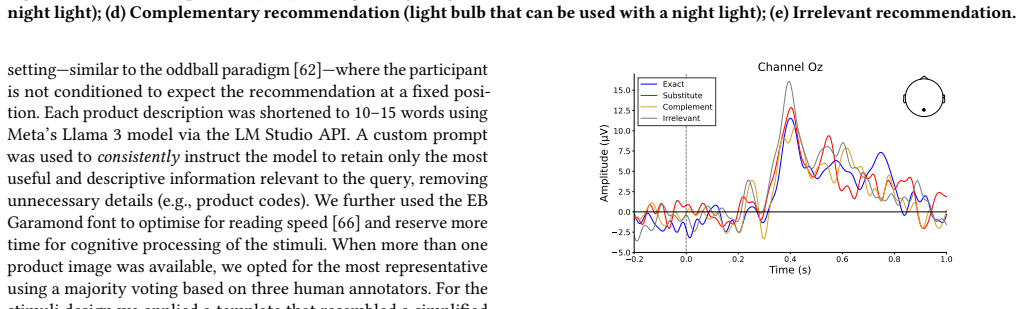
- [Figure 2] The figure presents a single-channel ERP plot (channel Oz) without error bars or the number of participants/trials used to compute the average. The caption 'average neural responses' is insufficiently precise for an EEG result figure.
- [Tables 2 and 3] The definition of 'Diff (%)' is not stated. The reader must infer that it is (accuracy − 0.5)/0.5; this should be stated in the table caption.
- [§4.1.1] The text says 'even after excluding individual models (42%) with near-chance performance'; it is unclear whether 42% refers to subjects or models, and this percentage appears to refer only to the E vs. I comparison, not to all models. The wording should be clarified.
- [§3.3.4] Using an LLM (Llama 3) to shorten product descriptions may alter the semantic cues that drive category perception. The paper does not provide any validation that the shortened descriptions preserve the ESCI label distinctions; a small human validation study or example-based consistency check would strengthen the stimulus-construction section.
- [General] The paper does not mention whether the data or analysis code will be made available. Given the small sample and the number of analysis choices (band-pass range, PCA variance threshold, MLP regularization, augmentation noise), a data/code availability statement would aid reproducibility.
Circularity Check
No significant circularity: the neural and behavioural claims are empirical outcomes measured against external ESCI ground truth, not derived from fitted inputs or self-citations.
full rationale
The paper's central claims—that Exact, Substitute, Complement, and Irrelevant recommendations evoke differentiable EEG signatures and behavioral ratings—are empirical results obtained by recording EEG and self-reports and comparing categories defined by the externally curated ESCI labels (McAuley et al. [43]). No parameter is fitted to the target claim and then renamed as a prediction: the SVM and MLP classifiers are trained and tested on held-out trials or subjects with cross-validation, and the reported accuracies are measured, not derived. The within-subjects analysis uses 70/30 splits, and the between-subjects analysis uses leave-one-subject-out outer cross-validation; the synthetic ERP augmentation is tied to participants assigned to the training side. The ESCI labels are an external ground truth, not an output of the model. The cited prior work, including two papers co-authored by the present authors ([60] and [73]), is used only for contextual claims about diversity and the value of recommender systems and is not load-bearing for the neural-decoding result. The Friedman and Wilcoxon tests on ratings are direct statistical comparisons of observed self-reports. There is a genuine validity concern that the design (always preceding targets with Exact context products, per Section 3.4) confounds category identity with repetition and oddball status, but that is a confound in experimental interpretation, not circularity: the paper does not define category identity in terms of EEG outcomes, and the 'prediction' is an empirical classification result rather than an input to the analysis. Under the stated rules, no circular step can be exhibited, so the appropriate finding is no significant circularity.
Assumptions & free parameters
free parameters (4)
- MLP regularization alpha =
0.05
- PCA variance threshold =
99%
- ERP augmentation weight noise range =
[0.5, 1]
- Band-pass filter range =
0.5-20 Hz
assumptions (4)
- domain assumption ESCI labels accurately represent query-product relevance categories
- domain assumption EEG features (ERP, PSD, complexity) are valid proxies for cognitive processing of recommendation categories
- domain assumption The oddball paradigm is an appropriate model for recommendation processing
- domain assumption Self-reports (Relevance, Purchaseability, Diversity) reflect user perception
Cite this review
Pith. "Pith review of Beyond One-Size-Fits-All: A Study of Neural and Behavioural Variability Across Different Recommendation Categories." pith.science (2026). https://pith.science/paper/PW7H4JHC
@misc{pith2026250613409,
  author       = {Pith},
  title        = {Pith review of: Beyond One-Size-Fits-All: A Study of Neural and Behavioural Variability Across Different Recommendation Categories},
  year         = {2026},
  howpublished = {\url{https://pith.science/paper/PW7H4JHC}},
  note         = {Machine review of arXiv:2506.13409}
}
read the original abstract
Traditionally, Recommender Systems (RS) have primarily measured performance based on the accuracy and relevance of their recommendations. However, this algorithmic-centric approach overlooks how different types of recommendations impact user engagement and shape the overall quality of experience. In this paper, we shift the focus to the user and address for the first time the challenge of decoding the neural and behavioural variability across distinct recommendation categories, considering more than just relevance. Specifically, we conducted a controlled study using a comprehensive e-commerce dataset containing various recommendation types, and collected Electroencephalography and behavioural data. We analysed both neural and behavioural responses to recommendations that were categorised as Exact, Substitute, Complement, or Irrelevant products within search query results. Our findings offer novel insights into user preferences and decision-making processes, revealing meaningful relationships between behavioural and neural patterns for each category, but also indicate inter-subject variability.
Figures


Figures from the paper (4 more)


Reference graph
Works this paper leans on
-
[1]
Haider Abdulkarim and Mohammed Al-Faiz. 2021. Online multiclass EEG feature extraction and recognition using modified convolutional neural network method. International Journal of Electrical and Computer Engineering11 (05 2021), 4016–
2021
-
[2]
Gediminas Adomavicius and Alexander Tuzhilin. 2005. Toward the next gen- eration of recommender systems: A survey of the state-of-the-art and possible extensions.Knowledge and Data Engineering, IEEE Transactions on17 (07 2005), 734–749. https://doi.org/10.1109/TKDE.2005.99
-
[3]
Mashael Aldayel, Mourad Ykhlef, and Abeer Al-Nafjan. 2020. Deep learning for EEG-based preference classification in neuromarketing.Applied Sciences10, 4 (2020), 1525
2020
-
[4]
Ashton Anderson, Lucas Maystre, Ian Anderson, Rishabh Mehrotra, and Mounia Lalmas. 2020. Algorithmic Effects on the Diversity of Consumption on Spotify. In Proceedings of The Web Conference 2020(Taipei, Taiwan)(WWW ’20). Association for Computing Machinery, New York, NY, USA, 2155–2165. https://doi.org/10. 1145/3366423.3380281
arXiv 2020
-
[5]
Diego Antognini, Claudiu Musat, and Boi Faltings. 2021. Interacting with Explanations through Critiquing. InProceedings of the Thirtieth International Joint Conference on Artificial Intelligence, IJCAI-21, Zhi-Hua Zhou (Ed.). Inter- national Joint Conferences on Artificial Intelligence Organization, 515–521. https://doi.org/10.24963/ijcai.2021/72 Main Track
-
[6]
Diego Antognini, Claudiu Cristian Musat, and Boi Faltings. 2020. T-RECS: a Transformer-based Recommender Generating Textual Explanations and Inte- grating Unsupervised Language-based Critiquing.ArXivabs/2005.11067 (2020). https://api.semanticscholar.org/CorpusID:218863076
work page Pith review arXiv 2020
-
[7]
Sathsarani K. Bandara, Uvini C. Wijesinghe, Badra P. Jayalath, Saumya K. Bandara, Prasanna S. Haddela, and Lumini M. Wickramasinghe. 2021. EEG Based Neuromarketing Recommender System for Video Commercials. In2021 IEEE 16th International Conference on Industrial and Information Systems (ICIIS). https://doi.org/10.1109/ICIIS53135.2021.9660742
-
[8]
Kurt Barbe, Rik Pintelon, and Johan Schoukens. 2009. Welch method revisited: nonparametric power spectrum estimation via circular overlap.IEEE Transactions on signal processing58, 2 (2009), 553–565
work page 2009
Show all 82 references
-
[9]
Catarina Barros, Ana Rita Pereira, Adriana Sampaio, Ana Buján, and Diego Pinal
-
[10]
2006.Rhythms of the Brain
Gyorgy Buzsaki. 2006.Rhythms of the Brain. Oxford university press
2006
-
[11]
György Buzsáki and Fernando Lopes da Silva. 2012. High frequency oscillations in the intact brain.Progress in neurobiology98, 3 (2012), 241–249
2012
-
[12]
Mark Claypool, Phong Le, Makoto Wased, and David Brown. 2001. Implicit interest indicators. InProceedings of the 6th international conference on Intelligent user interfaces. 33–40
2001
-
[13]
Aminu Da’u and Naomie Salim. 2020. Recommendation system based on deep learning methods: a systematic review and new directions.Artificial Intelligence Review53, 4 (2020), 2709–2748. https://doi.org/10.1007/s10462-019-09744-1
2020 doi
-
[14]
Davis, Michiel Spape, and Tuukka Ruotsalo
Keith M. Davis, Michiel Spape, and Tuukka Ruotsalo. 2023. Contradicted by the Brain: Predicting Individual and Group Preferences via Brain-Computer Interfacing.IEEE Transactions on Affective Computing14, 4 (2023), 3094–3105. https://doi.org/10.1109/TAFFC.2022.3225885
2023
-
[15]
Yashar Deldjoo, Zhankui He, Julian McAuley, Anton Korikov, Scott Sanner, Arnau Ramisa, René Vidal, Maheswaran Sathiamoorthy, Atoosa Kasirzadeh, and Silvia Milano. 2024. A Review of Modern Recommender Systems Using Generative Models (Gen-RecSys). arXiv:2404.00579 [cs.IR] https:...
2024 arXiv
-
[16]
Esteller, G
R. Esteller, G. Vachtsevanos, J. Echauz, and B. Litt. 2001. A comparison of waveform fractal dimension algorithms.IEEE Transactions on Circuits and Systems I: Fundamental Theory and Applications48, 2 (2001), 177–183. https: //doi.org/10.1109/81.904882
2001 doi
-
[17]
Manuel Eugster, Tuukka Ruotsalo, Michiel Spapé, Ilkka Kosunen, Oswald Barral, Niklas Ravaja, Giulio Jacucci, and Samuel Kaski. 2014. Predicting term-relevance from brain signals. (07 2014). https://doi.org/10.1145/2600428.2609594
2014
-
[18]
Chen Gao. 2022. Causal Inference in Recommender Systems: A Survey and Future Directions.arXiv preprint arXiv:2208.12397(Dec 2022). Version 2
2022 arXiv
-
[19]
Ian H Gotlib. 1998. EEG alpha asymmetry, depression, and cognitive functioning. Cognition & Emotion12, 3 (1998), 449–478
1998
-
[20]
Engemann, Daniel Strohmeier, Christian Brodbeck, Roman Goj, Mainak Jas, Teon Brooks, Lauri Parkkonen, and Matti S
Alexandre Gramfort, Martin Luessi, Eric Larson, Denis A. Engemann, Daniel Strohmeier, Christian Brodbeck, Roman Goj, Mainak Jas, Teon Brooks, Lauri Parkkonen, and Matti S. Hämäläinen. 2013. MEG and EEG Data Analysis with MNE-Python.Frontiers in Neuroscience7, 267 (2013), 1–13....
2013
-
[21]
Anjum Gupta, Shibin Parameswaran, and Cheng-Han Lee. 2009. Classification of electroencephalography (EEG) signals for different mental activities using Kullback Leibler (KL) divergence, In Proceedings of the IEEE International Con- ference on Acoustics, Speech, and Signal Proc...
2009
-
[22]
Hada, Vijaikumar M., and Shirish K
Deepesh V. Hada, Vijaikumar M., and Shirish K. Shevade. 2021. ReXPlug: Explain- able Recommendation using Plug-and-Play Language Model. InProceedings of the 44th International ACM SIGIR Conference on Research and Development in Infor- mation Retrieval(Virtual Event, Canada)(SI...
2021
-
[23]
Laura K Halderman, Bridgid Finn, JR Lockwood, Nicole M Long, and Michael J Kahana. 2021. EEG correlates of engagement during assessment.ETS Research Report Series2021, 1 (2021), 1–17
2021
-
[24]
Eddie Harmon-Jones, Philip A Gable, and Carly K Peterson. 2010. The role of asymmetric frontal cortical activity in emotion-related phenomena: A review and update.Biological psychology84, 3 (2010), 451–462
2010
-
[25]
Yujing Hu, Qing Da, Anxiang Zeng, Yang Yu, and Yinghui Xu. 2018. Reinforce- ment learning to rank in e-commerce search engine: Formalization, analysis, and application. InProceedings of the 24th ACM SIGKDD International Conference on Knowledge Discovery & Data Mining. 368–377
2018
-
[26]
Yifan Hu, Yehuda Koren, and Chris Volinsky. 2008. Collaborative Filtering for Implicit Feedback Datasets. In2008 Eighth IEEE International Conference on Data Mining. https://doi.org/10.1109/ICDM.2008.22
2008 doi
-
[27]
Ibáñez-Molina and S
A.J. Ibáñez-Molina and S. Iglesias-Parro. 2014. Fractal characterization of inter- nally and externally generated conscious experiences.Brain and Cognition87 (2014), 69–75. https://doi.org/10.1016/j.bandc.2014.03.002
2014 doi
-
[28]
Sheena S Iyengar and Mark R Lepper. 1999. Rethinking the value of choice: a cultural perspective on intrinsic motivation.Journal of personality and social psychology76, 3 (1999), 349
1999
-
[29]
Giulio Jacucci, Oswald Barral, Pedram Daee, Markus Wendt, Baris Serim, Tuukka Ruotsalo, Patrik Pluchino, Jonathan Freeman, Luciano Gamberini, Samuel Kaski, and Benjamin Blankertz. 2019. Integrating neurophysiologic relevance feed- back in intent modeling for information retrie...
2019 doi
-
[30]
Gawesh Jawaheer, Martin Szomszor, and Patty Kostkova. 2010. Comparison of implicit and explicit feedback from an online music recommendation service. In proceedings of the 1st international workshop on information heterogeneity and fusion in recommender systems. 47–51
2010
-
[31]
Gawesh Jawaheer, Peter Weller, and Patty Kostkova. 2014. Modeling user pref- erences in recommender systems: A classification framework for explicit and implicit user feedback.ACM Transactions on Interactive Intelligent Systems (TiiS) 4, 2 (2014), 1–26
2014
-
[32]
Hyeyoung Ko, Suyeon Lee, Yoonseo Park, and Anna Choi. 2022. A Survey of Rec- ommendation Systems: Recommendation Models, Techniques, and Application Fields.Electronics11, 1 (2022). https://doi.org/10.3390/electronics11010141
2022 doi
-
[33]
Lukas Lerche. 2016. Using implicit feedback for recommender systems: charac- teristics, applications, and challenges. (2016)
2016
-
[34]
Jiacheng Li, Zhankui He, Jingbo Shang, and Julian McAuley. 2023. UCEpic: Unifying Aspect Planning and Lexical Constraints for Generating Explana- tions in Recommendation. InProceedings of the 29th ACM SIGKDD Confer- ence on Knowledge Discovery and Data Mining(Long Beach, CA, U...
2023
-
[35]
Lei Li, Yongfeng Zhang, and Li Chen. 2021. Personalized Transformer for Explain- able Recommendation.ArXivabs/2105.11601 (2021). https://api.semanticscholar. org/CorpusID:235187032
2021 arXiv
-
[36]
Lei Li, Yongfeng Zhang, and Li Chen. 2023. Personalized Prompt Learning for Explainable Recommendation.ACM Trans. Inf. Syst.41, 4, Article 103 (March 2023), 26 pages. https://doi.org/10.1145/3580488
2023 doi
-
[37]
Sukun Li and Xiaoxing Liu. 2022. Toward a BCI-Based Personalized Recommender System Using Deep Learning. In2022 IEEE 8th Intl Conference on Big Data Security on Cloud (BigDataSecurity), IEEE Intl Conference on High Performance and Smart Computing, (HPSC) and IEEE Intl Conferen...
2022
-
[38]
Tengfei Liang, Zhonghua Hu, and Qiang Liu. 2017. Frontal Theta Activity Sup- ports Detecting Mismatched Information in Visual Working Memory.Frontiers in Psychology8 (10 2017). https://doi.org/10.3389/fpsyg.2017.01821
2017
-
[39]
Claudia Lindig-León, Sylvain Rimbert, and Laurent Bougrain. 2020. Multiclass Classification Based on Combined Motor Imageries.Frontiers in Neuroscience14 (2020), 559858. https://doi.org/10.3389/fnins.2020.559858 Published 2020 Nov 19
2020
-
[40]
Fabien Lotte, Laurent Bougrain, Andrzej Cichocki, Maureen Clerc, Marco Con- gedo, Alain Rakotomamonjy, and Florian Yger. 2018. A review of classification algorithms for EEG-based brain–computer interfaces: a 10 year update.Journal of neural engineering15, 3 (2018), 031005
2018
-
[41]
Michael L Mack, Alison R Preston, and Bradley C Love. 2020. Ventromedial prefrontal cortex compression during concept learning.Nat. Commun.11, 1 (Jan. 2020), 46
2020
-
[42]
Mack, Alison R
Michael L. Mack, Alison R. Preston, and Bradley C. Love. 2020. Ventromedial prefrontal cortex compression during concept learning.Nature Communications 11, 1 (2020), 46. https://doi.org/10.1038/s41467-019-13930-8
2020 doi
-
[43]
Julian McAuley, Rahul Pandey, and Jure Leskovec. 2015. Inferring Networks of Substitutable and Complementary Products. InProceedings of the 21th ACM Beyond One-Size-Fits-All: A Study of Neural and Behavioural Variability Across Different Recommendation Categories Conference ac...
2015
-
[44]
Yashar Moshfeghi and Frank Pollick. 2021. Neural Correlates of Realisation of Satisfaction in a Successful Search Process.Proceedings of the Association for Information Science and Technology58 (10 2021), 282–291. https://doi.org/10. 1002/pra2.456
2021
-
[45]
Jianmo Ni, Jiacheng Li, and Julian McAuley. 2019. Justifying Recommendations using Distantly-Labeled Reviews and Fine-Grained Aspects. InProceedings of the 2019 Conference on Empirical Methods in Natural Language Processing and the 9th International Joint Conference on Natural...
2019 doi
-
[46]
Nolan, R
H. Nolan, R. Whelan, and R. B. Reilly. 2010. FASTER: Fully Automated Statistical Thresholding for EEG artifact Rejection.Journal of Neuroscience Methods192, 1 (2010), 152–162. https://doi.org/10.1016/j.jneumeth.2010.07.015
2010 doi
-
[47]
Oard and Jinmook Kim
Douglas W. Oard and Jinmook Kim. 1998. Implicit Feedback for Recommender Systems. https://api.semanticscholar.org/CorpusID:8987583
1998
-
[48]
Spiro P Pantazatos, Ted K Yanagihara, Xian Zhang, Thomas Meitzler, and Joy Hirsch. 2012. Frontal-occipital connectivity during visual search.Brain Connect. 2, 3 (July 2012), 164–175
2012
-
[49]
Pappalettera, A
C. Pappalettera, A. Cacciotti, L. Nucci, F. Miraglia, P. M. Rossini, and F. Vecchio
-
[50]
Krupa Patel and Hiren B. Patel. 2020. A state-of-the-art survey on recommenda- tion system and prospective extensions.Computers and Electronics in Agriculture 178 (2020), 105779. https://doi.org/10.1016/j.compag.2020.105779
2020
-
[51]
Jonathan Peirce, Jeremy R Gray, Sol Simpson, Michael MacAskill, Richard Höchen- berger, Hiroyuki Sogo, Erik Kastman, and Jonas Kristoffer Lindeløv. 2019. Psy- choPy2: Experiments in behavior made easy.Behavior research methods51 (2019), 195–203
2019
-
[52]
C.-K. Peng, S. V. Buldyrev, S. Havlin, M. Simons, H. E. Stanley, and A. L. Goldberger
-
[53]
Alexandre Pereda-Baños, Ioannis Arapakis, and Miguel Barreda-Ángeles. 2015. On Human Information Processing in Information Retrieval (Position Paper). In SIGIR Workshop on Neuro-Physiological Methods in IR Research (NeuroIR). ACM
2015
-
[54]
McGeown, and Yashar Moshfeghi
Zuzana Pinkosova, William J. McGeown, and Yashar Moshfeghi. 2023. Revis- iting Neurological Aspects of Relevance: An EEG Study. InMachine Learning, Optimization, and Data Science. Springer Nature Switzerland
2023
-
[55]
Yuanpeng Qu and Hajime Nobuhara. 2024. Generating Explanations for Explain- able Recommendations Using Filter-Enhanced Time-Series Information.IEEE Access12 (2024), 78480–78495. https://doi.org/10.1109/ACCESS.2024.3408252
2024
-
[56]
Reddy, Lluís Màrquez, Fran Valero, Nikhil Rao, Hugo Zaragoza, Sambaran Bandyopadhyay, Arnab Biswas, Anlu Xing, and Karthik Subbian
Chandan K. Reddy, Lluís Màrquez, Fran Valero, Nikhil Rao, Hugo Zaragoza, Sambaran Bandyopadhyay, Arnab Biswas, Anlu Xing, and Karthik Subbian. 2022. Shopping Queries Dataset: A Large-Scale ESCI Benchmark for Improving Product Search. arXiv:2206.06588 [cs.IR] https://arxiv.org/...
2022 arXiv
-
[57]
Spapé, and Luis A
Tuukka Ruotsalo, Kalle Mäkelä, Michiel M. Spapé, and Luis A. Leiva. 2023. Af- fective Relevance: Inferring Emotional Responses via fNIRS Neuroimaging. In Proceedings of the 46th International ACM SIGIR Conference on Research and Development in Information Retrieval (SIGIR ’23)...
2023
-
[58]
Barry Schwartz. 2004. The paradox of choice: Why less is more.New York: Ecco (2004)
2004
-
[59]
Tanu Srivastava, Shilpi Singh, and Sanjeev Bhardwaj. 2013. Support vector machine technique for EEG signals.International Journal of Engineering Research and Applications3, 1 (2013), 533–538
2013
-
[60]
Dusan Stamenkovic, Alexandros Karatzoglou, Ioannis Arapakis, Xin Xin, and Kleomenis Katevas. 2021. Choosing the Best of Both Worlds: Diverse and Novel Recommendations through Multi-Objective Reinforcement Learning.CoRR abs/2110.15097 (2021). https://arxiv.org/abs/2110.15097
2021 arXiv
-
[61]
Abdulhamit Subasi, Ahmet Alkaya, Rahime Keskin, and Etem Koklukaya. 2017. Classification of EEG signals based on pattern recognition approach.International Journal of Imaging Systems and Technology27, 3 (2017), 213–221
2017
-
[62]
Samuel Sutton, Margery Braren, Joseph Zubin, and ER John. 1965. Evoked- potential correlates of stimulus uncertainty.Science150, 3700 (1965), 1187–1188
1965
-
[63]
Bella Tadson, Jared Boasen, François Courtemanche, Noémie Beauchemin, Alexander-John Karran, Pierre-Majorique Léger, and Sylvain Sénécal. 2023. Neuro-Adaptive Interface System to Evaluate Product Recommendations in the Context of E-Commerce. InDesign Science Research for a New...
2023
-
[64]
Shaohua Tang and Zheng Li. 2024. EEG complexity measures for detecting mind wandering during video-based learning.Scientific Reports14, 1 (8 4 2024), 8209. https://doi.org/10.1038/s41598-024-58889-9
2024 doi
-
[65]
Jorgensen, and Sanghag Kim
Ryan Thibodeau, Randall S. Jorgensen, and Sanghag Kim. 2006. Depression, anxiety, and resting frontal EEG asymmetry: A meta-analytic review.Journal of Abnormal Psychology115, 4 (2006), 715–729. https://doi.org/10.1037/0021- 843X.115.4.715
2006 doi
-
[66]
Miller, Jeff Huang, and Ben D
Shaun Wallace, Zoya Bylinskii, Jonathan Dobres, Bernard Kerr, Sam Berlow, Rick Treitman, Nirmal Kumawat, Kathleen Arpin, Dave B. Miller, Jeff Huang, and Ben D. Sawyer. 2022. Towards Individuated Reading Experiences: Different Fonts Increase Reading Speed for Different Individu...
2022 doi
-
[67]
Chun-Shu Wei, Yuan-Pin Lin, Yu-Te Wang, Tzyy-Ping Jung, Nima Bigdely-Shamlo, and Chin-Teng Lin. 2016. Classification of motor imagery EEG signals with support vector machines and particle swarm optimization.Computational and mathematical methods in medicine2016 (2016)
2016
-
[68]
Ryen W White, Joemon M Jose, Ian Ruthven, EM Voorhees, and DK Harman
-
[69]
An Yan, Chaosheng Dong, Yan Gao, Jinmiao Fu, Tong Zhao, Yi Sun, and Ju- lian McAuley. 2022. Personalized complementary product recommendation. (2022). https://www.amazon.science/publications/personalized-complementary- product-recommendation
2022
-
[70]
Banghua Yang, Fenqi Rong, Yunlong Xie, Du Li, Jiayang Zhang, Fu Li, Guangming Shi, and Xiaorong Gao. 2025. A multi-day and high-quality EEG dataset for motor imagery brain-computer interface.Scientific Data12, 1 (2025), 488. https: //doi.org/10.1038/s41597-025-04826-y
2025 doi
-
[71]
Ziyi Ye, Qingyao Ai, and Yiqun Liu. 2024. Brain-Computer Interface Meets Information Retrieval: Perspective on Next-generation Information System. In Proceedings of the 1st International Workshop on Brain-Computer Interfaces (BCI) for Multimedia Understanding. 61–65
2024
-
[72]
Ziyi Ye, Xiaohui Xie, Yiqun Liu, Zhihong Wang, Xuancheng Li, Jiaji Li, Xuesong Chen, Min Zhang, and Shaoping Ma. 2022. Why Don’t You Click: Understanding Non-Click Results in Web Search with Brain Signals. InProceedings of the 45th International ACM SIGIR Conference on Researc...
2022
-
[73]
Fajie Yuan, Alexandros Karatzoglou, Ioannis Arapakis, Joemon M Jose, and Xi- angnan He. 2019. A simple convolutional generative network for next item recommendation. InProceedings of the Twelfth ACM International Conference on Web Search and Data Mining. 582–590
2019
-
[74]
Yingchun Zhang, Xin Wang, Yiwen Jiang, and Xiaowei Xu. 2024. EEGGAN- Net: enhancing EEG signal classification through data augmentation framework. Frontiers in Human Neuroscience18 (2024), 1430086. https://doi.org/10.3389/ fnhum.2024.1430086
2024
-
[75]
Yong Zhang, Yong Wang, Jianting Jin, and Xingyu Wang. 2020. EEG signal classi- fication based on SVM with improved squirrel search algorithm.Computational intelligence and neuroscience2020 (2020)
2020
-
[76]
M. A. Zúñiga, Á. Acero-González, J. C. Restrepo-Castro, M. Á. Uribe-Laverde, D. A. Botero-Rosas, B. I. Ferreras, M. C. Molina-Borda, and M. P. Villa-Reyes. 2024. Is EEG Entropy a Useful Measure for Alzheimer’s Disease?Actas Esp Psiquiatr (2024). https://doi.org/10.62641/aep.v52i3.1632
2024 doi
- [1689]
-
[1994]
Mosaic organization of DNA nucleotides.Phys. Rev. E49 (Feb 1994), 1685–
1994
-
[2002]
InProceedings of the tenth text retrieval conference (TREC-10)
Comparing explicit and implicit feedback techniques for web retrieval: Trec-10 interactive track report. InProceedings of the tenth text retrieval conference (TREC-10)
-
[2022]
Frontal alpha asymmetry and negative Mood: a cross-sectional study in older and younger adults.Symmetry14, 8 (2022), 1579
2022
-
[2023]
https://doi.org/10.1007/s11357-022-00710-4
Approximate entropy analysis across electroencephalographic rhythmic frequency bands during physiological aging of human brain.Geroscience45, 2 (April 2023), 1131–1145. https://doi.org/10.1007/s11357-022-00710-4
2023 doi
-
[4026]
https://doi.org/10.11591/ijece.v11i5.pp4016-4026
Reviewed August 15, 2026 · model on record in the stance chip above.
Discussion (0). Continue with ORCID to comment.