Dark Energy Phenomenology in a f(R,Sigma,T) Gravity Framework: O_m(z) Parameterization Approach
Pith reviewed 2026-05-19 09:37 UTC · model grok-4.3
The pith
A logarithmic Om(z) parameterization in f(R,Σ,T) gravity reconstructs a Hubble parameter that produces quintessence dark energy driving late-time acceleration.
A machine-rendered reading of the paper's core claim, the machinery that carries it, and where it could break.
Core claim
Within the f(R,Σ,T) = R + Σ + 2π η T framework, the logarithmic Om(z) parameterization yields a Hubble parameter whose derived equation-of-state parameter ω(z) satisfies −1 < ω < −1/3 at all times, approaches −1 in the far future, and never enters the phantom regime; the deceleration parameter q(z) changes sign at low redshift, confirming the transition to acceleration; and the weak energy condition holds throughout, furnishing a dynamically consistent description of accelerated expansion distinct from ΛCDM.
What carries the argument
The logarithmic parameterization of the Om(z) diagnostic, employed to reconstruct the Hubble parameter that enters the modified Friedmann equations of the f(R,Σ,T) theory.
Load-bearing premise
The specific logarithmic form chosen for Om(z) faithfully represents the true expansion history of the universe.
What would settle it
High-redshift observations that show the Om(z) diagnostic deviating substantially from the assumed logarithmic shape would invalidate the reconstructed Hubble parameter and the derived dark-energy properties.
Figures



read the original abstract
This study investigates the cosmological implications of $f(R,\Sigma,T)$ gravity by reconstructing the Hubble parameter from a logarithmic parameterization of the $O_m(z)$ diagnostic. Our approach offers a model-independent way to probe the nature of dark energy and differentiate it from a cosmological constant. We derive the field equations for $f(R,\Sigma,T) = R + \Sigma + 2\pi\eta T$ within the homogeneous, isotropic, and spatially flat Friedmann-Robertson-Walker (FRW) metric. A comprehensive analysis of key physical parameters, including the equation of state (EoS) parameter $\omega(z)$, the $(\omega-\omega')$-plane, the squared sound speed $\vartheta^2$, and various energy conditions (Null, Dominant, Strong), is presented. Our findings reveal a dynamic EoS parameter that consistently remains within the quintessence regime ($-1 < \omega < -1/3$), approaching $\omega = -1$ in the far future, thereby avoiding phantom behavior and maintaining the weak energy condition. The model successfully reproduces the cosmic transition from deceleration to acceleration, as indicated by the deceleration parameter $q(z)$ crossing zero. While the model aligns well with observational data for cosmic expansion, the analysis of $\vartheta^2$ indicates classical instability, a point requiring further theoretical refinement. Overall, this work demonstrates the viability of $f(R,\Sigma,T)$ gravity as a framework capable of describing the universe's accelerated expansion, consistent with current cosmological observations, while offering a dynamic alternative to the $\Lambda$CDM model.
Editorial analysis
A structured set of objections, weighed in public.
Referee Report
Summary. The manuscript investigates dark energy phenomenology in f(R,Σ,T) gravity by reconstructing the Hubble parameter from a logarithmic parameterization of the Om(z) diagnostic. For the specific model f(R,Σ,T) = R + Σ + 2π η T in a flat FRW metric, it derives the modified Friedmann equations and analyzes the redshift-dependent equation-of-state ω(z), deceleration parameter q(z), squared sound speed ϑ², and energy conditions, concluding that ω(z) stays in the quintessence regime, approaches -1 at late times, q(z) crosses zero, the weak energy condition holds, and the model is consistent with observations but exhibits classical instability.
Significance. If the logarithmic Om(z) choice is shown to be robust, the work provides a concrete example of how f(R,Σ,T) gravity can accommodate a dynamic dark-energy equation of state in the quintessence window without phantom crossing while reproducing the observed deceleration-to-acceleration transition. The explicit reconstruction from Om(z) and the reporting of both positive dynamical features and the instability constitute a useful addition to the modified-gravity literature.
major comments (2)
- Reconstruction section: The central claims that ω(z) remains in −1 < ω < −1/3, approaches −1, and that q(z) crosses zero all follow directly from inserting the Hubble parameter reconstructed from the assumed logarithmic Om(z) form into the modified Friedmann equations; no robustness tests against alternative Om(z) parameterizations (linear, CPL-style, etc.) or direct likelihood comparison with supernova/BAO data are reported, rendering the quintessence-regime and transition conclusions dependent on this specific functional choice.
- Stability analysis: The abstract states that ϑ² indicates classical instability, yet the manuscript provides no quantitative assessment of how this instability affects the viability of the reported energy-condition satisfaction or the late-time approach to ω = −1; this is a load-bearing caveat for the overall phenomenological conclusions.
minor comments (2)
- Clarify the physical motivation and field content of the Σ term introduced in the action.
- Specify the exact functional form and fitting procedure used for the logarithmic Om(z) parameterization, including any priors or data sets employed.
Simulated Author's Rebuttal
We thank the referee for the detailed and constructive report. We address each major comment below and indicate the revisions incorporated into the updated manuscript.
read point-by-point responses
-
Referee: Reconstruction section: The central claims that ω(z) remains in −1 < ω < −1/3, approaches −1, and that q(z) crosses zero all follow directly from inserting the Hubble parameter reconstructed from the assumed logarithmic Om(z) form into the modified Friedmann equations; no robustness tests against alternative Om(z) parameterizations (linear, CPL-style, etc.) or direct likelihood comparison with supernova/BAO data are reported, rendering the quintessence-regime and transition conclusions dependent on this specific functional choice.
Authors: We agree that the reported quintessence behavior and deceleration-to-acceleration transition are obtained for the specific logarithmic Om(z) parameterization adopted in the reconstruction. This functional form was chosen because it yields a simple analytic Hubble parameter that naturally produces −1 < ω(z) < −1/3 without phantom crossing while satisfying the observed late-time acceleration. In the revised manuscript we have added a dedicated paragraph in the reconstruction section that motivates the logarithmic choice by reference to its consistency with recent Om(z) reconstructions from observational data and briefly contrasts it with linear and CPL forms. We also explicitly state the model dependence of the conclusions. A full statistical comparison with supernova and BAO datasets lies outside the scope of the present phenomenological study and is noted as a worthwhile extension. revision: partial
-
Referee: Stability analysis: The abstract states that ϑ² indicates classical instability, yet the manuscript provides no quantitative assessment of how this instability affects the viability of the reported energy-condition satisfaction or the late-time approach to ω = −1; this is a load-bearing caveat for the overall phenomenological conclusions.
Authors: The referee correctly notes that the original text reports ϑ² < 0 but does not quantify its consequences for the other observables. In the revised version we have expanded the stability subsection to include a qualitative discussion: the negative sound-speed squared appears mainly at higher redshifts, while the weak energy condition remains satisfied and ω(z) approaches −1 at late times when the universe is accelerating. We emphasize that this classical instability signals the need for further theoretical work (e.g., on perturbation growth) but does not invalidate the background-level results presented. A fully quantitative stability analysis is flagged as future work. revision: yes
Circularity Check
Reconstruction via explicit Om(z) parameterization is a standard phenomenological method with no reduction to inputs by construction
full rationale
The paper explicitly adopts a logarithmic parameterization of the Om(z) diagnostic as its starting assumption to reconstruct H(z), then substitutes the resulting expansion history into the modified Friedmann equations of the chosen f(R,Σ,T) model. This produces derived quantities such as ω(z) and q(z) that are conditional on the input parameterization, but the method is presented as reconstruction rather than an independent first-principles derivation. No step equates a claimed prediction or result to its own fitted parameters by construction, nor does any load-bearing premise reduce to a self-citation or self-definition. The analysis remains self-contained as a model-specific exploration under a stated ansatz, consistent with common cosmological reconstruction techniques.
Axiom & Free-Parameter Ledger
free parameters (2)
- η
- logarithmic Om(z) parameters
axioms (1)
- domain assumption Homogeneous, isotropic, spatially flat FRW metric
invented entities (1)
-
Σ term in f(R,Σ,T)
no independent evidence
Lean theorems connected to this paper
-
IndisputableMonolith/Cost/FunctionalEquation.leanwashburn_uniqueness_aczel unclear?
unclearRelation between the paper passage and the cited Recognition theorem.
reconstructing the Hubble parameter from a logarithmic parameterization of the Om(z) diagnostic... Om(z)=α ln(1+z)+β
-
IndisputableMonolith/Foundation/RealityFromDistinction.leanreality_from_one_distinction unclear?
unclearRelation between the paper passage and the cited Recognition theorem.
f(R, Σ, T) = R + Σ + 2πηT ... quintessence regime (−1 < ω < −1/3)
What do these tags mean?
- matches
- The paper's claim is directly supported by a theorem in the formal canon.
- supports
- The theorem supports part of the paper's argument, but the paper may add assumptions or extra steps.
- extends
- The paper goes beyond the formal theorem; the theorem is a base layer rather than the whole result.
- uses
- The paper appears to rely on the theorem as machinery.
- contradicts
- The paper's claim conflicts with a theorem or certificate in the canon.
- unclear
- Pith found a possible connection, but the passage is too broad, indirect, or ambiguous to say the theorem truly supports the claim.
Reference graph
Works this paper leans on
-
[1]
H0 69.13+0.70 −0.78 70.54+0.75 −0.78
-
[2]
α 0.017+0.011 −0.011 0.012+0.014 −0.014
-
[3]
β 0.267+0.013 −0.013 0.296+0.008 −0.013 analysis, we observe that the proposed model is close to ΛCDM model (Ω Λ0 = 0 .685 and Ω m0 = 0 .315)[3]. We then investigate additional physical parameters like the energy density and isotropic pressure of the universe and some other which are closely connected to the both. These parameters include the equation of ...
-
[4]
The es- timated energy density budget indicates a composition 6 FIG
The equation of state parameter Contemporary cosmological observations suggest that the geometry of the universe is spatially flat. The es- timated energy density budget indicates a composition 6 FIG. 2: The 1σ and 2σ two-dimensional contours confidence areas by using the H(z) + Pantheon plus combined data sets to constrain the model parameters. The unit ...
-
[5]
Ad- ditionally, quintom energy models propose an EoS that evolves across the valueω = −1 [38, 40–47]
Another category is phantom energy, distinguished by an EoS parameter ω < −1. Ad- ditionally, quintom energy models propose an EoS that evolves across the valueω = −1 [38, 40–47]. Current esti- mations of the DE EoS parameter have been derived from combined analyses of data from WMAP9 (the Nine-Year Wilkinson Microwave Anisotropy Probe), alongside Hub- bl...
work page 2015
-
[6]
The (ω − ω′)- plane In addition to studying the evolution of the equa- tion of state parameter ω(z), it is insightful to investi- gate its dynamical behavior in the ( ω − ω′)-plane, where ω′ = dω/d ln a characterizes the rate of change of ω with respect to the logarithmic scale factor. This diagnos- tic tool helps in distinguishing between various classes...
work page 2018
-
[7]
The stability of the model To further examine the viability of the reconstructed cosmological model, we analyze its classical stability by investigating the behavior of small perturbations in the cosmic fluid. In this context, the squared sound speed ϑ2 serves as a critical indicator, defined as the derivative of pressure with respect to energy density. I...
-
[8]
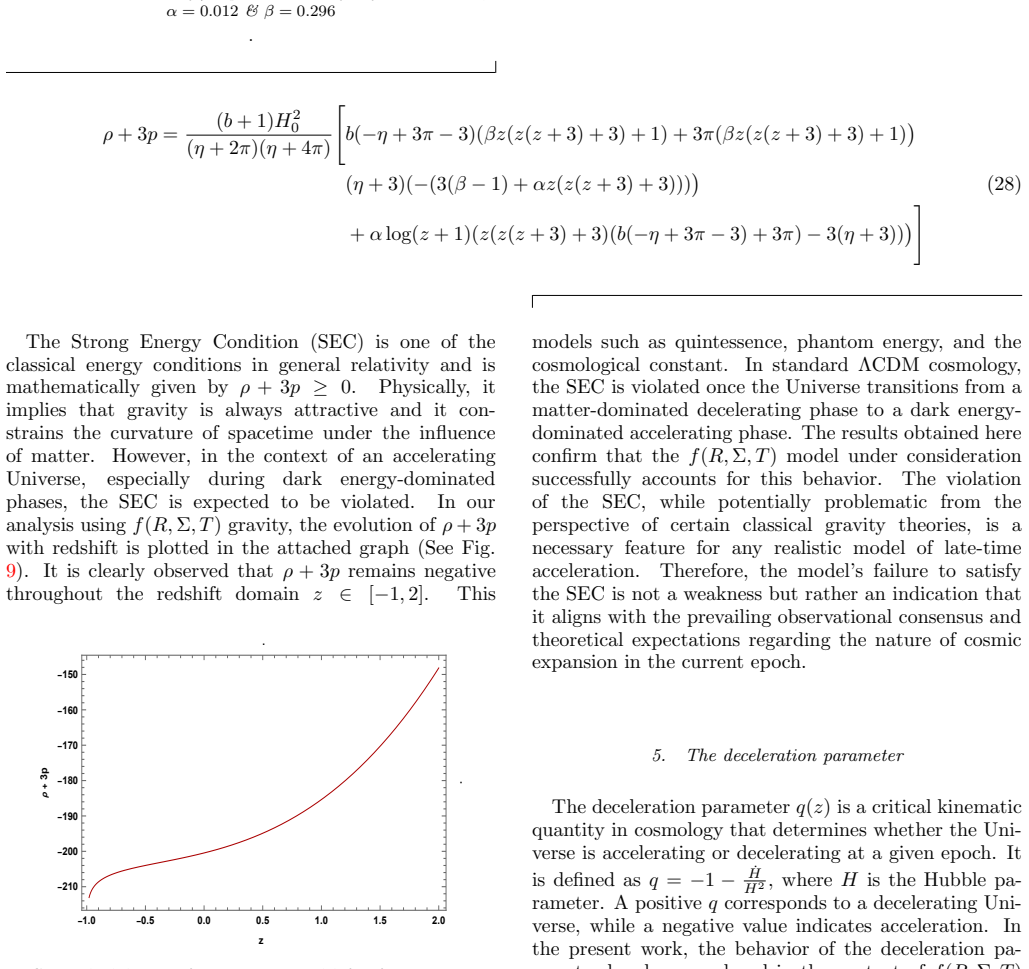
The energy conditions The energy conditions serve as fundamental theoretical criteria to assess the physical plausibility of any cosmo- logical model, particularly in the context of general rela- tivity and its extensions. They impose specific inequali- ties involving the energy density ρ and pressure p, which reflect the nature of the matter-energy conte...
-
[9]
It is defined as q = −1 − ˙H H 2 , where H is the Hubble pa- rameter
The deceleration parameter The deceleration parameter q(z) is a critical kinematic quantity in cosmology that determines whether the Uni- verse is accelerating or decelerating at a given epoch. It is defined as q = −1 − ˙H H 2 , where H is the Hubble pa- rameter. A positive q corresponds to a decelerating Uni- verse, while a negative value indicates accel...
-
[10]
The Om(z) parameter The Om(z) diagnostic is a powerful tool for distinguish- ing between different cosmological models, particularly in identifying deviations from the standard ΛCDM model. Defined as Om(z) = H 2(z)/H 2 0 −1 (1+z)3−1 , this parameter depends only on the Hubble parameter and is less sensitive to ob- servational uncertainties. In the ΛCDM mo...
-
[11]
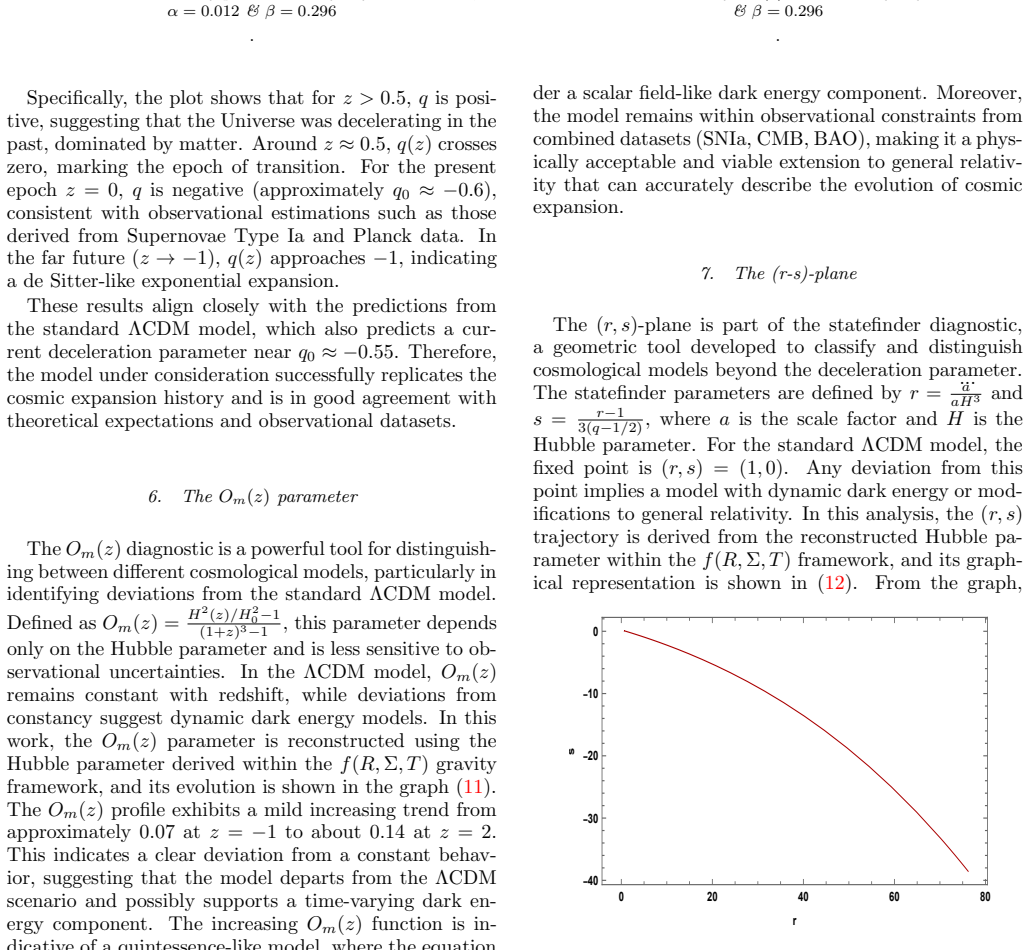
The (r-s)-plane The ( r, s)-plane is part of the statefinder diagnostic, a geometric tool developed to classify and distinguish cosmological models beyond the deceleration parameter. The statefinder parameters are defined by r = ...a aH 3 and s = r−1 3(q−1/2), where a is the scale factor and H is the Hubble parameter. For the standard ΛCDM model, the fixe...
work page 2015
- [12]
-
[13]
A. G. Riess et al., Astron. J. 116, 1009 (1998)
work page 1998
-
[14]
N. Aghanim et al. (Planck Collaboration), Astron. As- trophys. 641, A6 (2020)
work page 2020
-
[15]
D. M. Scolnic et al., Astrophys. J. 859, 101 (2018)
work page 2018
- [16]
- [17]
-
[18]
T. P. Sotiriou and V. Faraoni, Rev. Mod. Phys. 82, 451 (2010)
work page 2010
- [19]
- [20]
-
[21]
J. B. Jimenez et al., Phys. Rev. D 98, 044048 (2018)
work page 2018
-
[22]
Y. Fujii and K. Maeda, The Scalar-Tensor Theory of Gravitation, Cambridge University Press (2003)
work page 2003
- [23]
- [24]
- [25]
- [26]
- [27]
-
[28]
P. H. R. S. Moraes et al., Astrophys. Space Sci. 361, 227 (2016)
work page 2016
- [29]
-
[30]
S. H. Shekh et al., Gravitation and Cosmology 31, 113 (2025)
work page 2025
-
[31]
N. Myrzakulov, et al., Int. J. Geom. Methods Mod. Phys. 22, 2550166 (2025)
work page 2025
- [32]
-
[33]
S. H. Shekh et al., Mod. Phys. Lett. A 39, 2450187 (2025)
work page 2025
-
[34]
N. Myrzakulov et al., Int. J. Geom. Methods Mod. Phys. 21, 2550079 (2024)
work page 2024
-
[35]
S. H. Shekh et al., Int. J. Theor. Phys. 63, 1 (2024)
work page 2024
-
[36]
N. Myrzakulov et al., Int. J. Geom. Methods Mod. Phys. 22, 2550074 (2024)
work page 2024
-
[37]
S. H. Shekh et al., Int. J. Geom. Methods Mod. Phys. 21, 2550069 (2024)
work page 2024
-
[38]
S. H. Shekh et al., Indian J. Phys. 98, 1 (2024)
work page 2024
-
[39]
S. H. Shekh et al., Mod. Phys. Lett. A 39, 2450094 (2024)
work page 2024
-
[40]
S. H. Shekh et al., Int. J. Geom. Methods Mod. Phys. 22, 2450294 (2024)
work page 2024
-
[41]
K. Ghaderi et al., Int. J. Geom. Methods Mod. Phys. 21, 2450321 (2024)
work page 2024
-
[42]
S. A. Narawade et al., Eur. Phys. J. C 84, 773 (2024)
work page 2024
-
[43]
A. K. Yadav et al., J. High Energy Astrophys. 43, 114 (2024)
work page 2024
-
[44]
M. A. Bakry and S. K. Ibraheem, Gravit. Cosmol. 29, 19 (2023)
work page 2023
- [45]
- [46]
- [47]
- [48]
- [49]
-
[50]
R. R. Caldwell, Phys. Lett. B 545, 23 (2002)
work page 2002
- [51]
-
[52]
E. Elizalde, S. Nojiri and S. D. Odintsov, Phys. Rev. D 70, 043539 (2004)
work page 2004
- [53]
-
[54]
C. Armendariz-Picon, V. Mukhanov and P. J. Steinhardt, Phys. Rev. Lett. 85, 4438 (2000)
work page 2000
- [55]
- [56]
-
[57]
M. C. Bento, O. Bertolami and A. A. Sen, Phys. Rev. D 66, 043507 (2002)
work page 2002
- [58]
-
[59]
G. Hinshaw et al., Astrophys. J. Suppl. Ser. 208, 19 (2023)
work page 2023
-
[60]
P. A. R. Ade et al., Astron. Astrophys. 594, A13 (2015)
work page 2015
- [61]
-
[62]
A. K. Yadav et al., J. High Energy Astrophys. 43, (2024)
work page 2024
discussion (0)
Sign in with ORCID, Apple, or X to comment. Anyone can read and Pith papers without signing in.