REVIEW 3 major objections 5 minor 38 references
SA-LUT: Spatial Adaptive 4D Look-Up Table for Photorealistic Style Transfer
T0 review · 3 major / 5 minor · reviewed 2026-08-15 · deepseek-v4-flash
Pith's one-line read SA-LUT claims that a style-weighted 4D look-up table with a cross-attention context map can deliver photorealistic style transfer that is both spatially adaptive and fast enough for real-time 4K video, with the best scores on the new…
desk verdict SA-LUT is a sensible engineering contribution whose reported SOTA is inflated by a self-referential benchmark; the core method is worth a look but not the numbers. read the letter →
The pith
A machine-rendered reading of the paper's core claim, the machinery that carries it, and where it could break.
The reading
What carries the argument
The load-bearing object is the fused 4D look-up table $\mathrm{LUT}_{\mathrm{fused}} = \mathrm{LUT}_{\mathrm{identity}} + \sum_{i=1}^{N} \alpha_i\,\mathrm{LUT}_i$, where each basis $\mathrm{LUT}_i$ is a learnable tensor of shape $3 \times 2 \times 17 \times 17 \times 17$ and $\alpha$ is a softmax weight vector predicted from multi-scale deep features of the style image. The identity term guarantees that a vanishing $\alpha$ leaves the image unchanged. The second load-bearing component is the context map $\Gamma \in [0,1]^{H\times W}$, produced by content-style cross-attention with content features as queries and style features as keys and values. Concatenating $\Gamma$ with the LOG-space content image and running quadrilinear interpolation through the fused 4D LUT is what converts a global color transform into a spatially adaptive one, while keeping the mapping smooth enough to preserve structure. The paper also treats PST50, with its paired and unpaired partitions and ground-truth images and videos, as a load-bearing part of the argument, since every quality comparison is measured on it.
What would settle it
Construct a content image with two regions of identical RGB but different semantic identity (for example, sky versus sea) and a style image that grades those regions differently; SA-LUT's context map should assign them different output colors, and if it does not, the claim of spatially adaptive, semantics-aware grading fails. A complementary check is to recompute the PST50 comparisons on an independently created ground-truth set graded without LUT-based tools; if the 66.7% LPIPS advantage over NLUT largely disappears, the headline result is tied to the benchmark's construction.
Extended reading notes
Core claim
The central claim is that adding a spatial dimension to a look-up table dissolves the usual trade-off between color fidelity and content preservation. The style image is encoded by a pretrained feature network into a weight vector $\alpha \in \mathbb{R}^N$, which combines 64 learnable basis LUTs into one fused 4D LUT via $\mathrm{LUT}_{\mathrm{fused}} = \mathrm{LUT}_{\mathrm{identity}} + \sum_i \alpha_i \mathrm{LUT}_i$. In parallel, a context generator computes cross-attention between content features (queries) and style features (keys and values), producing a single-channel context map $\Gamma$ at full resolution. Concatenating $\Gamma$ with the LOG-space content image and applying quadrilinear interpolation lets each pixel choose where to sit between two 3D LUT slices, so identical colors in different semantic regions receive different grades. The paper reports that this design beats all six compared methods on PST50 on LPIPS, PSNR, SSIM, and H-Corr, and that once the LUT is built for a style, applying it to new content takes about 0.01 s per frame, enabling 4K video at over 16 FPS.
Load-bearing premise
The load-bearing premise is that the ground truth underlying both training supervision and PST50 evaluation—synthetic pairs created by applying professional 3D LUTs plus paired references graded by the authors with professional LUTs and manual adjustment—represents general photorealistic style transfer; if that ground truth is biased toward LUT-like transformations, the reported quality advantage could reflect alignment with the benchmark's construction rather than a general improvement.
Editorial extensions
If this is right
- Because the style is encoded once into a fused 4D LUT and only the context map must be recomputed per frame, applying a fixed style to a 4K video stream can run above 16 FPS, making interactive and on-set color grading practical.
- Pixels that share the same color but belong to different semantic regions can be graded differently, directly addressing a known failure of global 3D LUT methods such as confusing sky with sea.
- PST50 gives the field a common objective benchmark with paired and unpaired partitions, ground-truth images and videos, and standard metrics, so future methods can be compared on equal footing instead of through ad-hoc image pairs.
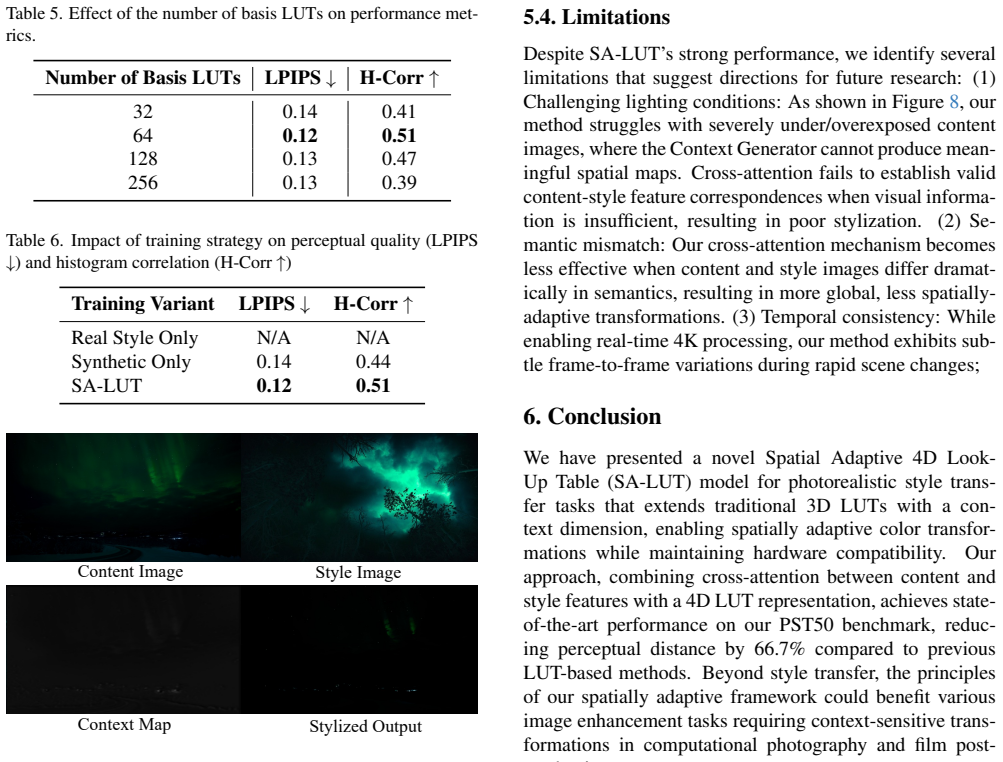
- The ablations indicate that the spatial context term carries a measurable share of the quality gain: removing the context generator raises LPIPS from 0.12 to 0.14 and lowers H-Corr from 0.51 to 0.38, while removing cross-attention gives 0.13 and 0.46.
Reading between the lines
- The 4D LUT mechanism is not tied to style transfer: the same context-dimension idea could carry depth-, exposure-, or object-class-guided color transformations in other enhancement tasks, which the paper does not explore.
- Because the paper traces its failures under extreme exposure to the context generator, inserting an exposure-normalization stage before cross-attention is a concrete fix that could extend the method into the very conditions its limitations section lists.
- The choice of exactly two context bins is a simplification; a natural variant is to learn multiple context maps so different semantic axes such as illumination, texture, and object class control different LUT slices.
Signed reviews
Editorial analysis
A structured set of objections, weighed in public.
Referee Report
Summary. The paper proposes SA-LUT, a style-transfer framework built around a style-weighted 4D look-up table whose fourth dimension is a per-pixel context map produced by content–style cross-attention. The authors also introduce PST50, a new benchmark with 100 content–style image pairs whose paired ground truth was generated through a professional LUT-plus-DaVinci-Resolve grading workflow. On PST50, SA-LUT is reported to outperform prior photorealistic style-transfer methods across LPIPS, PSNR, SSIM, and H-Corr, with a 66.7% LPIPS reduction relative to NLUT and with a claimed real-time 4K video processing rate. The paper includes ablations on the context generator, the number of basis LUTs, and the training strategy, as well as qualitative results on the DPST dataset.
Significance. If the central claim is validated, this is a valuable contribution: the style-guided 4D LUT with a cross-attention context map is an original combination that offers spatially varying color transformations at LUT-level efficiency, and the dual-stream training scheme is interesting. The authors also release code and a benchmark, which is a service to the community. The reported efficiency and architectural novelty are credible from the text. However, the evidence for superior quality rests almost entirely on PST50, a benchmark introduced in the same paper whose ground truth generation is in the same family as the training signal, so the significance is conditional on external validation or a clear re-scoping of the claims.
major comments (3)
- [§4.2, §3.4.1, Table 2] The headline quantitative results are measured on PST50, whose paired ground truth is created by applying professional LUTs and then manually refining them in DaVinci Resolve (Section 4.2). The synthetic training stream is generated by applying 3D LUTs to LOG-space images (Section 3.4.1), so the model is explicitly trained to reproduce LUT-style transformations. The PST50 ground truth therefore lies in the same transformation family as the training supervision, and the 66.7% LPIPS improvement over NLUT reported in Table 2 may reflect this distributional alignment rather than a general advantage in photorealistic style transfer. The manuscript provides no independent quantitative validation; Figure 6 on DPST is only qualitative, and the real-style-only ablation fails to converge (Table 6), which strengthens the concern that the model depends on LUT-like supervision. I request either an evaluation on an independently curated ground-truth benchmark, a human study on non-PST50 content with independent graders, or a clear re-scoping of the claims to LUT-based color grading rather than general PST.
- [§5.2, Table 2] The claim of 'real-time 4K video stylization at over 16 FPS' is not supported by the reported timings. Table 2 reports 0.2128 s for LUT generation and 0.0100 s for LUT application but does not state the image resolution, and the per-frame cost for video must include the Context Generator as well as the quadrilinear interpolation. Please report per-frame wall-clock timings at 4K resolution, and state clearly which components are amortized across frames.
- [§5.2.3, Table 3] The user study is limited to 20 image pairs from PST50 and compares against only two of the six baselines. The reported preference is a plurality (48.79%) rather than a majority, and no confidence intervals, standard deviations, or significance tests are provided, so the claim that users 'significantly' prefer SA-LUT is not justified by the data as presented.
minor comments (5)
- [§3.1.2, §5.1] The number of basis LUTs is denoted N in Equations (1)-(3) but K in Section 5.1; please use a single consistent symbol.
- [§5.3.1, Table 4] The text states that removing the Context Generator reduces H-Corr to 0.37, but Table 4 reports 0.38; please align the text with the table.
- [§3.4.1] In the description of Real Style Training, the sentence 'we first divide a single photograph into two non-overlapping crops I^RGB_1 and I^LOG_2' appears to contain a typo: I_1 is later used for both the style reference and the input to Style2Log, while I_2 is unused. Please clarify which crop serves as the content input.
- [Abstract, §5.2] The abstract states a '66.7% reduction in LPIPS compared to 3D LUT approaches,' but the comparison in Table 2 is specifically against NLUT; please state the comparison target precisely.
- [§5.2, Table 2] The inference time for Neural Preset is listed as N/A; please clarify whether an official implementation or timing measurement was available, since this baseline is otherwise used in quantitative comparisons.
Circularity Check
No significant circularity: SA-LUT's derivation is self-contained; PST50's LUT-based construction is a benchmark-validity concern, not a circular reduction.
full rationale
SA-LUT's core derivation is self-contained: the style-weighted 4D LUT is obtained by softmax MLP weights over learnable basis LUTs (Eqs. 1-3), the context map is produced by content-style cross-attention (Eq. 4), and the output is quadrilinear interpolation (Eq. 5). None of these equations define the predicted output in terms of the PST50 evaluation targets, nor is any parameter fitted to PST50 ground truth. The PST50 benchmark is introduced by the authors and its ground truth is created with professional LUTs plus DaVinci Resolve grading (Sec. 4.2), while synthetic training pairs are generated by applying 3D LUTs (Sec. 3.4.1); this is a distributional and benchmark-independence concern about generalization to non-LUT styles, not an equation-level reduction. The paper discloses the limitation that synthetic supervision is limited to the artistic range of available LUTs and reports that real-style-only training fails to converge (Table 6), which is evidence of generalizability risk rather than circularity. Self-citations ([28], [29], [36]-[38]) appear only as related-work references and are not load-bearing for the method or the benchmark. No uniqueness theorem or ansatz is smuggled via citation, so no circular step can be exhibited under the required standard.
Assumptions & free parameters
free parameters (4)
- Number of basis 4D LUTs (N) =
64
- LUT resolution (D) =
17
- Context dimension bins =
2
- Loss weights lambda_1 to lambda_4 =
unspecified
assumptions (4)
- domain assumption VGG features encode transferable style information
- domain assumption Cross-attention between content and style features produces meaningful region correspondences
- domain assumption Synthetic LUT-based training generalizes to real photographic styles
- domain assumption The professional grading workflow in PST50 produces a valid ground truth
Cite this review
Pith. "Pith review of SA-LUT: Spatial Adaptive 4D Look-Up Table for Photorealistic Style Transfer." pith.science (2026). https://pith.science/paper/MK6UIKGJ
@misc{pith2026250613465,
  author       = {Pith},
  title        = {Pith review of: SA-LUT: Spatial Adaptive 4D Look-Up Table for Photorealistic Style Transfer},
  year         = {2026},
  howpublished = {\url{https://pith.science/paper/MK6UIKGJ}},
  note         = {Machine review of arXiv:2506.13465}
}
read the original abstract
Photorealistic style transfer (PST) enables real-world color grading by adapting reference image colors while preserving content structure. Existing methods mainly follow either approaches: generation-based methods that prioritize stylistic fidelity at the cost of content integrity and efficiency, or global color transformation methods such as LUT, which preserve structure but lack local adaptability. To bridge this gap, we propose Spatial Adaptive 4D Look-Up Table (SA-LUT), combining LUT efficiency with neural network adaptability. SA-LUT features: (1) a Style-guided 4D LUT Generator that extracts multi-scale features from the style image to predict a 4D LUT, and (2) a Context Generator using content-style cross-attention to produce a context map. This context map enables spatially-adaptive adjustments, allowing our 4D LUT to apply precise color transformations while preserving structural integrity. To establish a rigorous evaluation framework for photorealistic style transfer, we introduce PST50, the first benchmark specifically designed for PST assessment. Experiments demonstrate that SA-LUT substantially outperforms state-of-the-art methods, achieving a 66.7% reduction in LPIPS score compared to 3D LUT approaches, while maintaining real-time performance at 16 FPS for video stylization. Our code and benchmark are available at https://github.com/Ry3nG/SA-LUT
Figures


Figures from the paper (5 more)


Reference graph
Works this paper leans on
-
[1]
Carlo Arrighetti. The academy color encoding system (aces): A professional color-management framework for produc- tion, post-production, and archival of still and motion pic- tures.Journal of Imaging, 3(4):40, 2017. 2
work page 2017
-
[2]
Learning photographic global tonal adjustment with a database of input / output image pairs
Vladimir Bychkovsky, Sylvain Paris, Eric Chan, and Fr ´edo Durand. Learning photographic global tonal adjustment with a database of input / output image pairs. InThe Twenty- Fourth IEEE Conference on Computer Vision and Pattern Recognition, 2011. 3
work page 2011
-
[3]
Simple baselines for image restoration.arXiv preprint arXiv:2204.04676, 2022
Liangyu Chen, Xiaojie Chu, Xiangyu Zhang, and Jian Sun. Simple baselines for image restoration.arXiv preprint arXiv:2204.04676, 2022. 12 9
arXiv 2022
-
[4]
Yaosen Chen, Han Yang, Yuexin Yang, Yuegen Liu, Wei Wang, Xuming Wen, and Chaoping Xie. Nlut: Neural-based 3d lookup tables for video photorealistic style transfer.arXiv preprint arXiv:2303.09170, 2023. 2, 3, 4, 6, 7, 8
arXiv 2023
-
[5]
Jiwoo Chung, Sangeek Hyun, and Jae-Pil Heo. Style in- jection in diffusion: A training-free approach for adapting large-scale diffusion models for style transfer, 2024. 2
work page 2024
-
[6]
A learned representation for artistic style, 2017
Vincent Dumoulin, Jonathon Shlens, and Manjunath Kudlur. A learned representation for artistic style, 2017. 2, 6
work page 2017
-
[7]
S. Fischer, P. Myland, M. Szarafanowicz, P. Bodrogi, and T.Q. Khanh. Strengths and limitations of a uniform 3d-lut ap- proach for digital camera characterization.Color and Imag- ing Conference, 24(1):315–315, 2016. 1, 2
work page 2016
-
[8]
Leon A. Gatys, Alexander S. Ecker, and Matthias Bethge. A neural algorithm of artistic style, 2015. 2
work page 2015
Show all 38 references
-
[9]
Deep bilateral learning for real- time image enhancement.ACM Transactions on Graphics (TOG), 36(4):118, 2017
Micha ¨el Gharbi, Jiawen Chen, Jonathan T Barron, Samuel W Hasinoff, and Fr´edo Durand. Deep bilateral learning for real- time image enhancement.ACM Transactions on Graphics (TOG), 36(4):118, 2017. 2, 3
2017
-
[10]
Guided image fil- tering.IEEE Transactions on Pattern Analysis and Machine Intelligence, 35(6):1397–1409, 2013
Kaiming He, Jian Sun, and Xiaoou Tang. Guided image fil- tering.IEEE Transactions on Pattern Analysis and Machine Intelligence, 35(6):1397–1409, 2013. 3
2013
-
[11]
Ho and Jinjia Zhou
Man M. Ho and Jinjia Zhou. Deep preset: Blending and re- touching photos with color style transfer. InProceedings of the IEEE/CVF Winter Conference on Applications of Com- puter Vision (WACV), pages 2113–2121, 2021. 1, 2, 3, 6, 7
2021
-
[12]
Arbitrary style transfer in real-time with adaptive instance normalization
Xun Huang and Serge Belongie. Arbitrary style transfer in real-time with adaptive instance normalization. InICCV,
-
[13]
Perceptual losses for real-time style transfer and super-resolution
Justin Johnson, Alexandre Alahi, and Li Fei-Fei. Perceptual losses for real-time style transfer and super-resolution. In European Conference on Computer Vision, 2016. 2
2016
-
[14]
Hakki Can Karaimer and Michael S. Brown. A software plat- form for manipulating the camera imaging pipeline. InCom- puter Vision–ECCV 2016: 14th European Conference, Am- sterdam, The Netherlands, October 11–14, 2016, Proceed- ings, Part I, pages 429–444. Springer, 2016. 1, 2
2016
-
[15]
Zhanghan Ke, Yuhao Liu, Lei Zhu, Nanxuan Zhao, and Ryn- son W.H. Lau. Neural preset for color style transfer. InCom- puter Vision and Pattern Recognition Conference (CVPR),
-
[16]
Color style transfer with modulated flows
Maria Larchenko, Alexander Lobashev, Dmitry Guskov, and Vladimir Vladimirovich Palyulin. Color style transfer with modulated flows. InICML 2024 Workshop on Structured Probabilistic Inference & Generative Modeling, 2024. 2, 6, 7
2024
-
[17]
MuLUT: Cooperating multiple look-up tables for efficient image super-resolution
Jiacheng Li, Chang Chen, Zhen Cheng, and Zhiwei Xiong. MuLUT: Cooperating multiple look-up tables for efficient image super-resolution. InECCV, 2022. 1
2022
-
[18]
Universal style transfer via feature transforms
Yijun Li, Chen Fang, Jimei Yang, Zhaowen Wang, Xin Lu, and Ming-Hsuan Yang. Universal style transfer via feature transforms. InAdvances in Neural Information Processing Systems, 2017. 1, 2
2017
-
[19]
A closed-form solution to photorealistic image stylization
Yijun Li, Ming-Yu Liu, Xueting Li, Ming-Hsuan Yang, and Jan Kautz. A closed-form solution to photorealistic image stylization. InComputer Vision – ECCV 2018: 15th Euro- pean Conference, Munich, Germany, September 8–14, 2018, Proceedings, Part III, page 468–483, Berlin, Heidelberg,
2018
-
[20]
4D LUT: learnable context-aware 4D lookup table for image enhancement.IEEE Transactions on Image Processing, 32: 4742–4756, 2023
Chengxu Liu, Huan Yang, Jianlong Fu, and Xueming Qian. 4D LUT: learnable context-aware 4D lookup table for image enhancement.IEEE Transactions on Image Processing, 32: 4742–4756, 2023. 2, 3, 4, 8
2023
-
[21]
Adaattn: Revisit attention mechanism in arbitrary neural style transfer, 2021
Songhua Liu, Tianwei Lin, Dongliang He, Fu Li, Meiling Wang, Xin Li, Zhengxing Sun, Qian Li, and Errui Ding. Adaattn: Revisit attention mechanism in arbitrary neural style transfer, 2021. 3
2021
-
[22]
Deep photo style transfer.arXiv preprint arXiv:1703.07511,
Fujun Luan, Sylvain Paris, Eli Shechtman, and Kavita Bala. Deep photo style transfer.arXiv preprint arXiv:1703.07511,
-
[23]
Comparing im- ages using color coherence vectors
Greg Pass, Ramin Zabih, and Justin Miller. Comparing im- ages using color coherence vectors. InProceedings of the Fourth ACM International Conference on Multimedia, page 65–73, New York, NY , USA, 1997. Association for Comput- ing Machinery. 7
1997
-
[24]
Color transfer between images.IEEE Computer Graphics and Applications, 21:34–41, 2001
Erik Reinhard, Michael Ashikhmin, Bruce Gooch, and Peter Shirley. Color transfer between images.IEEE Computer Graphics and Applications, 21:34–41, 2001. 1
2001
-
[25]
Remember what you have drawn: Se- mantic image manipulation with memory.arXiv preprint arXiv:2107.12579, 2021
Xiangxi Shi, Zhonghua Wu, Guosheng Lin, Jianfei Cai, and Shafiq Joty. Remember what you have drawn: Se- mantic image manipulation with memory.arXiv preprint arXiv:2107.12579, 2021. 2
2021 arXiv
-
[26]
Instantstyle: Free lunch towards style-preserving in text-to-image generation, 2024
Haofan Wang, Matteo Spinelli, Qixun Wang, Xu Bai, Zekui Qin, and Anthony Chen. Instantstyle: Free lunch towards style-preserving in text-to-image generation, 2024. 2
2024
-
[27]
Bovik, H.R
Zhou Wang, A.C. Bovik, H.R. Sheikh, and E.P. Simoncelli. Image quality assessment: from error visibility to structural similarity.IEEE Transactions on Image Processing, 13(4): 600–612, 2004. 6, 7
2004
-
[28]
Openuni: A sim- ple baseline for unified multimodal understanding and gen- eration.arXiv preprint arXiv:2505.23661, 2025
Size Wu, Zhonghua Wu, Zerui Gong, Qingyi Tao, Sheng Jin, Qinyue Li, Wei Li, and Chen Change Loy. Openuni: A sim- ple baseline for unified multimodal understanding and gen- eration.arXiv preprint arXiv:2505.23661, 2025. 2
2025 arXiv
-
[29]
M2e-try on net: Fashion from model to everyone
Zhonghua Wu, Guosheng Lin, Qingyi Tao, and Jianfei Cai. M2e-try on net: Fashion from model to everyone. InPro- ceedings of the 27th ACM international conference on mul- timedia, pages 293–301, 2019. 2
2019
-
[30]
Adaint: Learning adaptive intervals for 3d lookup tables on real-time image enhancement
Canqian Yang, Meiguang Jin, Xu Jia, Yi Xu, and Ying Chen. Adaint: Learning adaptive intervals for 3d lookup tables on real-time image enhancement. InProceedings of the IEEE/CVF Conference on Computer Vision and Pattern Recognition (CVPR), 2022. 1, 2
2022
-
[31]
Seplut: Separable image-adaptive lookup tables for real-time image enhancement
Canqian Yang, Meiguang Jin, Yi Xu, Rui Zhang, Ying Chen, and Huaida Liu. Seplut: Separable image-adaptive lookup tables for real-time image enhancement. InEuropean Con- ference on Computer Vision (ECCV), 2022. 1, 2, 3
2022
-
[32]
Photorealistic style transfer via wavelet transforms
Jaejun Yoo, Youngjung Uh, Sanghyuk Chun, Byeongkyu Kang, and Jung-Woo Ha. Photorealistic style transfer via wavelet transforms. InInternational Conference on Com- puter Vision (ICCV), 2019. 1, 2, 6, 7
2019
-
[33]
Hui Zeng, Jianrui Cai, Lida Li, Zisheng Cao, and Lei Zhang. Learning image-adaptive 3d lookup tables for high perfor- mance photo enhancement in real-time.IEEE Transactions on Pattern Analysis and Machine Intelligence, 44(4):2058– 2073, 2022. 1, 2, 6 10
2022
-
[34]
Clut-net: Learning adaptively compressed representations of 3dluts for lightweight image enhancement
Fengyi Zhang, Hui Zeng, Tianjun Zhang, and Lin Zhang. Clut-net: Learning adaptively compressed representations of 3dluts for lightweight image enhancement. InProceedings of the 30th ACM International Conference on Multimedia, page 6493–6501, 2022. 1
2022
-
[35]
Efros, Eli Shecht- man, and Oliver Wang
Richard Zhang, Phillip Isola, Alexei A. Efros, Eli Shecht- man, and Oliver Wang. The unreasonable effectiveness of deep features as a perceptual metric, 2018. 5, 7
2018
-
[36]
Sara: Controllable makeup trans- fer with spatial alignment and region-adaptive normalization
Xiaojing Zhong, Xinyi Huang, Zhonghua Wu, Guosheng Lin, and Qingyao Wu. Sara: Controllable makeup trans- fer with spatial alignment and region-adaptive normalization. arXiv preprint arXiv:2311.16828, 2023. 2
2023 arXiv
-
[37]
Di-net: Decomposed implicit garment transfer network for digital clothed 3d human.arXiv preprint arXiv:2311.16818, 2023
Xiaojing Zhong, Yukun Su, Zhonghua Wu, Guosheng Lin, and Qingyao Wu. Di-net: Decomposed implicit garment transfer network for digital clothed 3d human.arXiv preprint arXiv:2311.16818, 2023. 2
2023 arXiv
-
[38]
Ipvton: Image-based 3d vir- tual try-on with image prompt adapter.arXiv preprint arXiv:2501.15616, 2025
Xiaojing Zhong, Zhonghua Wu, Xiaofeng Yang, Guosheng Lin, and Qingyao Wu. Ipvton: Image-based 3d vir- tual try-on with image prompt adapter.arXiv preprint arXiv:2501.15616, 2025. 2 11 Supplementary Material Style ReferenceStylized Video Frames Figure A. Selected frames from vi...
2025 arXiv
Reviewed August 15, 2026 · model on record in the stance chip above.
Discussion (0). Continue with ORCID to comment.