REVIEW 2 major objections 4 minor 20 references
On the diffusion of hard sphere fluids in disordered porous media: New extended Enskog theory description
T0 review · 2 major / 4 minor · reviewed 2026-08-15 · deepseek-v4-flash
Pith's one-line read A new extended Enskog theory with a Fermi-like free-volume factor reproduces the simulated self-diffusion of hard-sphere fluids in disordered hard-sphere matrices across all densities tested.
desk verdict An honest but fitted Fermi-like ansatz, and as printed Eq. (3.1) moves D in the wrong direction for the matrix densities where the paper claims improvement. read the letter →
The pith
A machine-rendered reading of the paper's core claim, the machinery that carries it, and where it could break.
The reading
What carries the argument
The load-bearing mechanism is the Fermi-like multiplier (3.1), $[1+(\phi/\phi_0-1)\exp(\alpha(\eta_0-\eta_0^*))]^{-1}$, inserted in place of $\phi_0/\phi$ in the definitions of $G_{10}(\sigma_{10})$ and $G_{11}(\sigma_{11})$ (equations (3.4) and (3.5)). Near the bulk limit $\eta_0\to 0$ the multiplier tends to unity, recovering the earlier extended Enskog theory; at $\eta_0=\eta_0^*$ it equals $\phi_0/\phi$, recovering the authors' previous modified contact values. The parameter $\alpha$ controls how sharply the matrix packing fraction suppresses diffusion, while $\eta_0^*$ is interpreted as the saturated matrix packing fraction beyond which percolation-driven changes would require a modified description. These generalized functions are not true pair contact values, which is what lets them absorb the free-volume effects of fluid trapping.
What would settle it
Take the same formula (2.11) with the Fermi-like substitution (3.1), $\alpha=3$ and $\eta_0^*=0.4$, and compare its predictions to new simulations with fluid particles smaller or larger than the matrix particles (for example size ratios 0.5 or 2), or with matrix packing fractions above 0.2; a systematic deviation at any fluid density would show the ansatz is fitted rather than general.
Extended reading notes
Core claim
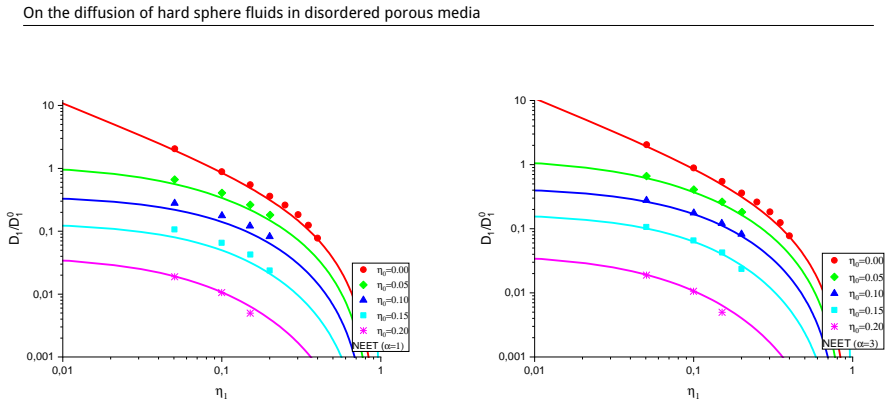
The central claim is that the earlier extended Enskog treatment overestimates self-diffusion because it represents the matrix only as infinitely massive scatterers; it does not account for the volume made unavailable when mobile fluid particles are trapped by immobile matrix particles. The fix is to replace the contact values $g_{11}(\sigma_{11})$ and $g_{10}(\sigma_{10})$ by effective functions $G_{11}$ and $G_{10}$ built from scaled-particle-theory expressions, multiplied by the porosity ratio $\phi_0/\phi$, and then to replace that multiplier by the Fermi-like expression (3.1), $[1+(\phi/\phi_0-1)\exp(\alpha(\eta_0-\eta_0^*))]^{-1}$. With $\alpha=3$ and $\eta_0^*=0.4$, equation (2.11) reproduces the simulation data [12] for $\tau=1$ across all studied fluid and matrix packing fractions, which the paper reports as the best agreement between theory and simulation. The new functions are explicitly not contact values of pair distribution functions; they are effective inputs carrying the free-volume and trapping physics.
Load-bearing premise
The load-bearing premise is that one fixed Fermi-like factor, with $\alpha=3$ and $\eta_0^*=0.4$ chosen by hand after inspecting the simulation data, captures the trapping physics of hard-sphere fluids in any disordered hard-sphere matrix; the paper tests it only for equal-sized particles and matrix packing fractions up to 0.2.
Editorial extensions
If this is right
- With $\alpha=3$ and $\eta_0^*=0.4$, equation (2.11) matches the simulated self-diffusion of [12] for equal-sized hard spheres at all the matrix and fluid packing fractions shown.
- At small matrix packing fraction the Fermi multiplier is essentially unity, so the new theory continuously reduces to the standard Enskog result for bulk hard spheres, and at $\eta_0=\eta_0^*$ it reduces to the authors' previous extended Enskog theory.
- Because $\alpha$ is the explicit control on the influence of matrix packing, comparing the theory with simulation at one matrix density effectively fixes the strength of matrix-induced slowing for other densities.
- The separate effective functions $G_{10}$ and $G_{11}$ let the theory attribute deviations to fluid-matrix versus fluid-fluid trapping, and the paper states that above $\eta_0^*$ percolation makes diffusion anomalous so the present description applies below that threshold.
Reading between the lines
- An inference not drawn in the paper: if this Fermi ansatz is a true free-volume effect, the fitted parameters $\alpha$ and $\eta_0^*$ should vary smoothly with the size ratio $\tau$; measuring them at $\tau\neq1$ would be a direct test.
- The same Fermi-like multiplier could be applied to other Enskog-level transport coefficients of confined fluids, such as shear viscosity or thermal conductivity, which the paper does not compute, yielding a full transport description from the same two parameters.
- The interpolation between the bulk limit and the saturated porosity limit has the same shape as saturation laws familiar from adsorption phenomena, which suggests that $\alpha$ might be derivable from a thermodynamic argument rather than treated as adjustable; the paper does not attempt such a derivation.
- A further consequence of the paper's own logic is that in very dense matrices the theory should break down near $\eta_0^*$ because the trapped-fluid fraction itself becomes a collective, percolation-controlled quantity; simulations scanning $\eta_0$ up to that threshold would map where the Fermi fit begins to fail.
Signed reviews
Editorial analysis
A structured set of objections, weighed in public.
Referee Report
Summary. The manuscript proposes a new extended Enskog theory (NEET) for the self-diffusion coefficient of a hard-sphere fluid in a disordered hard-sphere matrix. The key ingredient is the replacement of the porosity ratio φ0/φ, which multiplies the modified contact values G10 and G11, by a Fermi-like function of the matrix packing fraction η0 with two adjustable parameters α and η0* (Eq. 3.1). The authors report that with α=3 and η0*=0.4 the theoretical prediction is in the best agreement with the simulation data of Ref. [12] for all considered values of the fluid packing fraction η1 and matrix packing fraction η0 at size ratio τ=1.
Significance. If the central claim held, the paper would offer a simple semi-empirical extension of Enskog theory for diffusion in model porous media, and it would be a useful reference for follow-up work. The manuscript is clearly structured and connects to the authors' earlier developments in scaled particle theory and Enskog theory. However, the claimed agreement is not reproducible from the printed equations: at η0=0.2 the proposed multiplier is far smaller than φ0/φ, moving the theory in the wrong direction. The two-parameter fit to a single data set also limits the significance of the reported agreement.
major comments (2)
- [Section 3, Eqs. (3.1), (3.4), (3.5), (2.11)] At τ=1 and η0=0.2, Eq. (2.6) gives φ0/φ≈9.64. The multiplier in Eq. (3.1) for η0=0.2<η0*=0.4 is about 3.76 for α=1 and 1.97 for α=3, i.e., smaller than φ0/φ by factors of 2.6 and 4.9, respectively. Since this multiplier is common to G10 and G11 in Eqs. (3.4)–(3.5), the NEET self-diffusion coefficient from Eq. (2.11) is larger than the EET value by the inverse factors at all η1. The paper states that the original EET at η0=0.2 is in 'more or less correct agreement' with simulation (Section 3, discussion of Fig. 1a). The NEET curves in Fig. 2 therefore cannot also agree with simulation at η0=0.2. Either the figure was generated from a different expression than the one printed, or the text description is in error. This contradiction directly undermines the central claim of the paper.
- [Section 3, Eq. (3.1)] The two parameters α and η0* are not derived or independently motivated: α is called a 'fitting parameter' in Section 3, and η0* is fixed by inspecting Fig. 1a to align the theoretical curves with the simulation data of Ref. [12]. The paper reports no out-of-sample test of the resulting theory, for example on different size ratios τ, different matrix structures, or densities outside the fitted range. Thus the 'best agreement' is a demonstration of interpolation within the fitted data set, not a falsifiable prediction of the proposed theory.
minor comments (4)
- [Figure 2 caption] The caption states that G10 and G11 are given by expressions (3.2) and (3.3), but those equations are limiting forms of the multiplier, not the full functions. The correct references should be Eqs. (3.4) and (3.5).
- [Section 3, first paragraph] The phrase 'slightly reestimates the value of D1' appears to be a typo; the intended verb is likely 'underestimates' or 'overestimates'. The direction of the deviation matters for the motivation of the modification, so it should be stated clearly.
- [Section 2, Eq. (2.3)] The notation 2πσ^2_{11} in the prefactor is unusual for a binary-mixture expression; please clarify whether σ11 denotes σ1 and make the notation consistent with the rest of the paper.
- [Section 3, text near Eq. (3.1)] There are minor language issues, such as 'Fermi-like for dependence on η0', that could be polished.
Circularity Check
The Fermi-like multiplier (3.1) that defines NEET is tuned to the very simulation data it is claimed to reproduce: α is declared a fitting parameter and η*0 is fixed to 0.4 after inspecting Fig. 1a, so the 'best agreement' is partly a fit rather than a prediction.
-
fitted input called prediction
[Section 3, Eq. (3.1) and Figs. 2a/2b; Conclusions, last paragraph]
"where we have introduced the parameter 𝛼. We consider this parameter as the fitting parameter. It makes it possible to control the role of the packing fraction of matrix particles 𝜂0 in order to improve the agreement between theoretical description and computer simulation data. ... to reach an agreement with computer simulation data, it is possible to fix 𝜂∗0 = 0.4. ... The Fermi-like form (3.1) has two additional parameters, 𝛼 and 𝜂∗0, which can be considered as adjustables."
Equation (3.1) replaces the porosity ratio φ0/φ by a Fermi-like multiplier inside G10 and G11, and this multiplier is the only new ingredient distinguishing NEET from the earlier EET. The two parameters are not derived: α is explicitly called a fitting parameter, and η*0 is set to 0.4 after looking at Fig. 1a 'to reach an agreement with computer simulation data'. The comparison in Fig. 2 is then made against the same computer-simulation data [12] used to guess α=1 and to tune α=3. Hence the claimed 'best agreement between theoretical prediction results and computer simulation data' is in part manufactured by adjusting the ansatz to the target dataset; no out-of-sample test at other size ratios or untested densities is reported.
full rationale
The central construction is not definitionally circular: the porosity coefficients φ0, φ, φ*, the SPT-based contact values, and the Enskog collision structure in Section 2 are independently motivated and reduce correctly to bulk Enskog theory at η0=0. However, the new element that produces the 'best agreement' — the Fermi-like replacement (3.1) — is openly fitted. The paper itself labels α a fitting parameter and says η*0 is fixed 'to reach an agreement with computer simulation data'; the Conclusions call both 'adjustables'. Because the same simulation data [12] are used both to select these parameters and as the target of the subsequent comparison, the agreement cannot count as a parameter-free prediction. This warrants a 6, 'partial circularity', rather than higher: the porosity/SPT input and Enskog structure retain independent content, and the Fermi-like form has an analogy argument [16], but the quantitative match is engineered. Separately, and not counted in the circularity score, the reviewer's arithmetic check at η0=0.2 is an apparent internal inconsistency of Eq. (3.1) with the described behaviour; this is a correctness matter rather than a circularity matter. No load-bearing self-citation chain or imported uniqueness theorem was found; self-citations to [10] supply the prior EET framework but are not used to forbid alternatives.
Assumptions & free parameters
free parameters (2)
- alpha (alpha) =
3 (also tested 1)
- eta*_0 =
0.4
assumptions (4)
- domain assumption Hard-sphere fluid in a hard-sphere matrix is modeled as a binary hard-sphere mixture with the matrix component infinitely massive (Enskog mixture treatment).
- domain assumption SPT2 expressions (1.4)-(1.5) are accurate contact values for the fluid-fluid and fluid-matrix pair distribution functions.
- ad hoc to paper The effective collision frequencies scale with the modified functions G10 and G11 given by (2.9)-(2.10) and the Fermi-like multiplier (3.1) replaces phi_0/phi.
- standard math Enskog theory assumptions hold: instantaneous binary collisions, molecular chaos, Einstein relation D = kT/xi.
Cite this review
Pith. "Pith review of On the diffusion of hard sphere fluids in disordered porous media: New extended Enskog theory description." pith.science (2026). https://pith.science/paper/JD7Y4O22
@misc{pith2026250613483,
  author       = {Pith},
  title        = {Pith review of: On the diffusion of hard sphere fluids in disordered porous media: New extended Enskog theory description},
  year         = {2026},
  howpublished = {\url{https://pith.science/paper/JD7Y4O22}},
  note         = {Machine review of arXiv:2506.13483}
}
read the original abstract
We proposed a new extended version of Enskog theory for the description of the self-diffusion coefficient of a colloidal hard-sphere fluid adsorbed in a matrix of disordered hard-sphere obstacles. In a considered approach instead of contact values of the fluid-fluid and fluid-matrix pair distribution functions, we introduced by input the new functions that include the dependence on the fraction of the volume free from matrix particles and from fluid particles trapped by matrix particles. It is shown that the introduction of this free volume fraction by the Fermi-like distribution leads to the best agreement between theoretical predictions and computer simulation results [Chang R., Jagannathan K., Yethiraj A., Phys. Rev. E, 2004, 69, 051101].
Figures

Reference graph
Works this paper leans on
-
[10]
Holovko M. F., Korvatska M. Ya., Condens. Matter Phys., 2020,23, 23605, doi:10.5488/CMP.23.23605
-
[12]
Chang R., Jagannathan K., Yethiraj A., Phys. Rev. E, 2004,69, 051101, doi:10.1103/PhysRevE.69.051101
-
[1]
Madden W. G., Glandt E. D., J. Stat. Phys., 1988,51, 537, doi:10.1007/BF01028471
-
[2]
Holovko M., Dong W., J. Phys. Chem. B, 2009,113, 6360, doi:10.1021/jp809706n. 23605-7 M. F. Holovko, M. Ya. Korvatska
-
[3]
Reiss H., Frisch H. L., Lebowitz J. L., J. Chem. Phys., 1959,31, 369, doi:10.1063/1.1730361
-
[4]
Chen W., Dong W., Holovko M., Chen X. S., J. Phys. Chem. B, 2010,114, 1225, doi:10.1021/jp9106603
-
[5]
Patsahan T., Holovko M., Dong W., J. Chem. Phys., 2011,134, 074503, doi:10.1063/1.3532546
-
[6]
Chem., 2013,85, 115, doi:10.1351/PAC-CON-12-05-06
Holovko M., Patsahan T., Dong W., Pure Appl. Chem., 2013,85, 115, doi:10.1351/PAC-CON-12-05-06
Show all 20 references
-
[7]
Matter Phys., 2012,15, 23607, doi:10.5488/CMP.15.23607
Holovko M., Patsahan T., Dong W., Condens. Matter Phys., 2012,15, 23607, doi:10.5488/CMP.15.23607
2012 doi
-
[8]
Matter Phys., 2017,20, 33602, doi:10.5488/CMP.20.33602
Holovko M., Patsahan T., Dong W., Condens. Matter Phys., 2017,20, 33602, doi:10.5488/CMP.20.33602
2017 doi
-
[9]
V., Holovko M., Patsahan T., Cummings P
Kalyuzhnyi Yu. V., Holovko M., Patsahan T., Cummings P. T., J. Phys. Chem. Lett., 2014,5, 4260, doi:10.1021/jz502135f
2014 doi
-
[11]
Resibois P., de Leener M., Classical Kinetic Theory of Fluids, Wiley, New York, 1977
1977
-
[13]
Phys.: Condens
Kurzidim J., Coslovich D., Kahl G., J. Phys.: Condens. Matter, 2011,23, 234122, doi:10.1088/0953-8984/23/23/234122
2011 doi
-
[14]
Enskog D., K. Sven. Vetenskapsakad. Handl., 1922,63, 1, 1–44, (in German)
1922
-
[15]
R., Holovko M
Yukhnovskii I. R., Holovko M. F., Statistical Theory of Classical Equilibrium Systems, Naukova Dumka, Kyiv, 1980, (in Russian)
1980
-
[16]
Bokun G., di Caprio D., Holovko M., Vikhrenko V., J. Mol. Liq., 2018,270, 183, doi:10.1016/j.molliq.2018.03.123
2018 doi
-
[17]
(Eds.), Fractals and Disordered Systems, Springer, Berlin, Heidelberg, 1991, doi:10.1007/978-3-642-51435-7
Bunde A., Havlin S. (Eds.), Fractals and Disordered Systems, Springer, Berlin, Heidelberg, 1991, doi:10.1007/978-3-642-51435-7
1991 doi
-
[18]
P., Yip S., Molecular Hydrodynamics, Dover, New York, 1980
Boon J. P., Yip S., Molecular Hydrodynamics, Dover, New York, 1980
1980
-
[19]
Gotze W., Sjogren L., Rep. Prog. Phys., 1992,55, 241, doi:10.1088/0034-4885/55/3/001
1992 doi
-
[20]
плин-плин
Holovko M. F., Korvatska M. Ya., Condens. Matter Phys., 2021,24, 33605, doi:10.5488/CMP.24.33605. Про дифузiю твердокулькового плину в невпорядкованих пористих середовищах: нова розширена теорiя Енскога М. Головко, М. Корвацька Iнститут фiзики конденсованих систем Нацiональної...
2021 doi
Reviewed August 15, 2026 · model on record in the stance chip above.
Discussion (0). Continue with ORCID to comment.