REVIEW 3 major objections 6 minor 68 references
Micro-macro Gaussian Splatting with Enhanced Scalability for Unconstrained Scene Reconstruction
T0 review · 3 major / 6 minor · reviewed 2026-08-15 · deepseek-v4-flash
Pith's one-line read SMW-GS reports up to 3.55 dB PSNR gains on large-scale unconstrained scenes by splitting appearance into global, refined, and intrinsic components with supervision-aware camera partitioning.
desk verdict A strong, empirically impressive 3DGS-in-the-wild paper with a real scalability story, undercut by an overclaimed 'provable' supervision guarantee that the algorithm doesn't actually deliver. read the letter →
The pith
A machine-rendered reading of the paper's core claim, the machinery that carries it, and where it could break.
The reading
What carries the argument
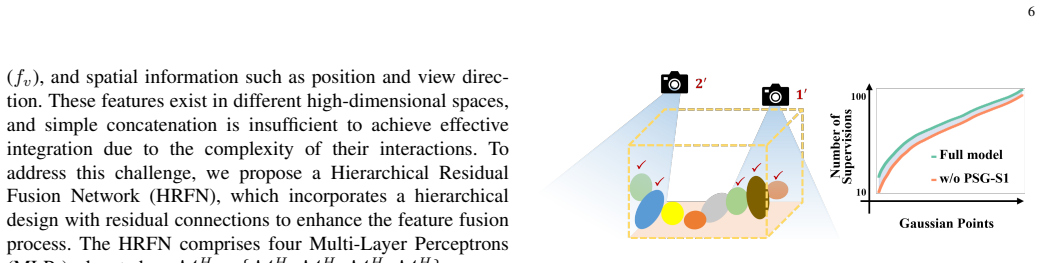
The load-bearing machinery is Micro-macro Wavelet-based Sampling (MWS), which projects each 3D Gaussian into a narrow conical frustum, with jittered micro offsets for fine textures, and into a broader frustum, for regional effects such as highlights; it applies a one-level discrete wavelet transform to the feature map so sampling touches low- and high-frequency bands at multiple resolutions. The sampled features are fused by a Hierarchical Residual Fusion Network (HRFN). For scalability, Point-Statistics-Guided (PSG) Camera Partitioning computes how many training cameras see each Gaussian, sets a supervision threshold $\tau = \kappa \bar{c}$, and greedily assigns cameras to blocks until that threshold is met, then adds content-critical cameras detected by an SSIM-difference test. Rotational Block Training alternates blocks across GPUs so the shared appearance network sees the whole dataset. These mechanisms carry the argument by turning per-point appearance variation into per-Gaussian multi-scale sampling, and by converting large-scene partitioning from a geometric heuristic into a supervision-driven assignment.
What would settle it
Run Stage 1 on a low-density block, record the visible-camera count for every Gaussian point at termination, and count how many points still fall below the threshold $\tau$; any nonzero count would refute the claimed supervision lower bound and the explanation for the reported boundary-region improvements.
Extended reading notes
Core claim
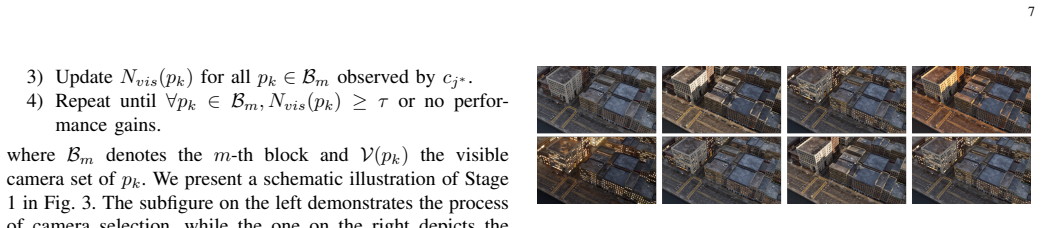
The central claim is that appearance variation in unconstrained scenes—lighting changes, shadows, highlights, tone shifts—is better modeled by decomposing each Gaussian's color prediction into global, refined, and intrinsic components, where the refined component comes from sampling the reference image's feature map at both micro and macro scales and in the wavelet domain. The paper further claims that this per-Gaussian appearance disentanglement can be carried into the divide-and-conquer setting of large-scale reconstruction: a Point-Statistics-Guided camera partition plus rotational block training keeps every Gaussian sufficiently supervised, and the result is sharper, more consistent rendering at block boundaries and across the whole scene. Reported evidence includes consistent PSNR, SSIM, and LPIPS improvements over in-the-wild and large-scale baselines, with the largest margins on large urban scenes and on synthetic scenes rendered under eight different appearance conditions.
Load-bearing premise
The load-bearing premise is that the Stage-1 greedy camera-assignment loop really gives every Gaussian point the promised minimum number of visible cameras when it stops, since the loop terminates on 'no performance gains' rather than on a check that each point has reached the threshold.
Editorial extensions
If this is right
- Large urban scenes with changing daylight or weather reconstruct at higher fidelity than earlier Gaussian-splatting methods, with the largest reported gains on scenes where appearance varies most.
- Block-boundary artifacts diminish because boundary Gaussians receive visible cameras from neighboring blocks, as shown in the qualitative boundary comparisons.
- Appearance transfer and scene-level relighting become practical: swapping the global feature while keeping intrinsic features changes lighting without retraining geometry.
- Rendering stays real-time and storage shrinks, since appearance is compressed into the disentanglement network rather than stored per Gaussian.
- The method inherits the real-time rendering and compact storage of its anchor-based Gaussian backbone while adding multi-scale appearance sampling.
Reading between the lines
- Beyond the paper, the same per-point visibility count could drive camera assignment in other block-based radiance-field or splatting pipelines, since it only needs a reconstructed point cloud and camera poses.
- Beyond the paper, the wavelet stage suggests a testable extension: deeper or learned wavelet decompositions might improve detail further, though the paper's $M=1$ result hints at a plateau on classical scenes.
- Beyond the paper, the synthetic benchmark with eight appearance conditions offers a controlled arena where future appearance-disentanglement methods can be compared independently of real-data noise.
- Beyond the paper, the demonstrated day-to-dusk manipulation implies that region-specific appearance editing could be automated with semantic maps, a step the paper does not take.
Signed reviews
Editorial analysis
A structured set of objections, weighed in public.
Referee Report
Summary. This manuscript presents SMW-GS, a 3D Gaussian Splatting method for unconstrained scene reconstruction. The method decomposes per-Gaussian appearance into global, refined, and intrinsic components; introduces micro-macro projection with jittered conical frustums and wavelet-based sampling; fuses these signals through a Hierarchical Residual Fusion Network; and scales to large scenes via Point-Statistics-Guided camera partitioning and rotational block training. The paper reports consistent PSNR/SSIM/LPIPS gains over prior in-the-wild and large-scale baselines on three Phototourism scenes, four real large-scale scenes (Mill-19 and UrbanScene3D), and four MatrixCity blocks, with particularly large gains on the synthetic appearance-variation blocks. It also provides ablations of the decoupling module, wavelet dimension, sampling count, and partitioning strategy.
Significance. If the reported results are robust, this is a solid contribution to unconstrained and large-scale 3D reconstruction: it extends Gaussian-level appearance disentanglement into divide-and-conquer training, introduces a multi-scale wavelet-based sampling mechanism, and contributes a new synthetic benchmark with multiple appearance conditions. The experimental gains are large and consistent across several datasets, which supports the core claim that the method is competitive. However, the 'provable supervision lower bound' claim is not actually established, and several hyperparameters are tuned on the same test sets used in the main tables, so the significance as stated exceeds what the current evidence demonstrates.
major comments (3)
- [Sec. IV-D (Stage 1)] The sentence 'The combined strategy ensures provable supervision lower bounds through Stage 1's τ-enforced assignment' is not supported by the algorithm description. For a point p_k with total visible camera set satisfying |V(p_k)| < τ, the compensation mechanism assigns every camera in V(p_k), leaving N_vis(p_k) = |V(p_k)| < τ; since τ = κ c̄ with κ ∈ (0,1), such points are not excluded by construction. The greedy loop can also stop at 'no performance gains' with no formal definition of that condition, so there is no proof that the loop only terminates after all points reach τ. Because the boundary-consistency gains (Fig. 7, Fig. 12) and the scalability comparison (Tab. IX) are explicitly attributed to this supervision guarantee, the authors should either prove a valid guarantee (e.g., every Gaussian receives all of its visible cameras) or reframe the scheme as a heuristic and report the empirical distribution of N_vis(p_k) after Stage 1.
- [Sec. V-D, Tabs. VII–IX] The choices of wavelet level M, frustum sample count k_s, and block grid are made on the same test sets that are reported in the main results. Tabs. VII and VIII tune M and k_s on Brandenburg Gate, Sacre Coeur, and Trevi Fountain, which are exactly the three scenes in Tab. I; Tab. IX selects the {3,2} grid using Rubble and MatrixCity blocks A*/E*, which also appear in Tabs. III and V. This test-set selection makes the reported improvements optimistic and weakens the claim that the method 'consistently outperforms' across datasets. I recommend either fixing hyperparameters a priori, tuning on a separate validation split, or showing that nearby hyperparameter choices give similar results.
- [Sec. V-A, Tables III and V] All quantitative tables report single runs without error bars or significance tests. On Sci-Art the LPIPS value (0.147) is identical to Momentum-GS and the SSIM gap is only 0.005, so the text's claim of 'significantly outperforming' the previous best is not statistically supported for this scene. Adding repeated runs with standard deviations or at least documenting the number of seeds would make the central claim testable.
minor comments (6)
- [Sec. VI] The statement that 'its training and rendering remain slower than state-of-the-art methods' appears to contradict Sec. IV-D's 'real-time' claim and Tab. II's 'nearly 1.5 times faster' statement; please clarify the regime (classical vs. large-scale, training vs. rendering).
- [Sec. V-B] The values of the frustum radii r_dot and R_dot_max, the number of block-grid cells M×N used in the main experiments, and the rotation interval N_iter are not reported; please add them for reproducibility.
- [Table III] The baseline name 'WildGaussian' should be 'WildGaussians' for consistency with the text.
- [Fig. 12] The right panel lacks a colorbar and a description of how 'normalized per-point increase' is computed, making the claim about boundary supervision difficult to verify.
- [Related work] The claim of 'the first integration of frequency domain data into 3DGS appearance representation' is strong; please qualify it (e.g., 'to our knowledge') and cite any prior wavelet-based 3DGS works if they exist.
- [Sec. IV-D] The abstract says 'optimally assigns camera views'; since Stage 1 is a greedy heuristic, please replace 'optimally' with a more precise description.
Circularity Check
No significant circularity: the reported gains are evaluated on fixed external benchmarks and the method's components are specified independently of the target metrics.
full rationale
The paper's central claims are supported by a self-contained derivation chain rather than by definitional equivalences or self-citation. The appearance decomposition, Micro-macro Projection, Wavelet-based Sampling, and HRFN are each specified with explicit equations (for example, Eq. 4-7), and the large-scale partitioning strategy is described as an algorithmic procedure in Sec. IV-D. The reported PSNR/SSIM/LPIPS results are measured on fixed external test sets (Phototourism, Mill-19, UrbanScene3D, and the MatrixCity benchmark), so no predicted quantity is defined by the method itself. The self-citation of the authors' earlier MW-GS paper [17] is a disclosed predecessor disclosure and is not used as evidence for the new scalability or boundary-consistency claims; the current paper provides its own equations, ablations, and comparisons. The main weakness noted by the skeptical reader is that the 'provable supervision lower bound' in Sec. IV-D is not actually guaranteed, because Stage 1 can terminate on 'no performance gains' before every point reaches the threshold tau, and points whose total visible camera set is smaller than tau cannot reach it. That is a correctness and soundness gap in a heuristic, not a circularity: the supervision threshold is not the evaluation metric, and the conclusion of superior reconstruction quality is not assumed as an input to the derivation. No fitted parameter is renamed as a prediction, no uniqueness theorem is imported from the authors' own prior work, and no known result is merely renamed. Accordingly, the circularity score is 0.
Assumptions & free parameters
free parameters (7)
- Wavelet downsampling levels M =
1
- Samples per frustum cross-section k_s =
1
- Block grid size =
{3,2} on Rubble and MatrixCity blocks
- Supervision threshold control kappa =
not specified
- Content-relevance threshold eta =
not specified
- Frustum radii r_dot and R_dot_max =
not specified
- Loss weights lambda_proj and lambda_vol =
0.01, 0.01
assumptions (4)
- domain assumption The COLMAP point cloud is a complete geometric prior for partitioning and supervision counting.
- domain assumption A per-image global embedding plus 2D CNN feature maps projected through frustums can represent per-point appearance changes.
- ad hoc to paper The three-way decomposition into global, refined, and intrinsic appearance is a valid factorization.
- domain assumption Discrete Wavelet Transform sub-bands preserve the information needed for appearance sampling.
invented entities (1)
-
Global/refined/intrinsic appearance components
Cite this review
Pith. "Pith review of Micro-macro Gaussian Splatting with Enhanced Scalability for Unconstrained Scene Reconstruction." pith.science (2026). https://pith.science/paper/63ZY2D5I
@misc{pith2026250613516,
  author       = {Pith},
  title        = {Pith review of: Micro-macro Gaussian Splatting with Enhanced Scalability for Unconstrained Scene Reconstruction},
  year         = {2026},
  howpublished = {\url{https://pith.science/paper/63ZY2D5I}},
  note         = {Machine review of arXiv:2506.13516}
}
read the original abstract
Reconstructing 3D scenes from unconstrained image collections poses significant challenges due to variations in appearance. In this paper, we propose Scalable Micro-macro Wavelet-based Gaussian Splatting (SMW-GS), a novel method that enhances 3D reconstruction across diverse scales by decomposing scene representations into global, refined, and intrinsic components. SMW-GS incorporates the following innovations: Micro-macro Projection, which enables Gaussian points to sample multi-scale details with improved diversity; and Wavelet-based Sampling, which refines feature representations using frequency-domain information to better capture complex scene appearances. To achieve scalability, we further propose a large-scale scene promotion strategy, which optimally assigns camera views to scene partitions by maximizing their contributions to Gaussian points, achieving consistent and high-quality reconstructions even in expansive environments. Extensive experiments demonstrate that SMW-GS significantly outperforms existing methods in both reconstruction quality and scalability, particularly excelling in large-scale urban environments with challenging illumination variations. Project is available at https://github.com/Kidleyh/SMW-GS.
Figures


Figures from the paper (12 more)


Reference graph
Works this paper leans on
-
[1]
Nerf: Representing scenes as neural radiance fields for view synthesis,
B. Mildenhall, P. P. Srinivasan, M. Tancik, J. T. Barron, R. Ramamoorthi, and R. Ng, “Nerf: Representing scenes as neural radiance fields for view synthesis,”Communications of the ACM, vol. 65, no. 1, pp. 99–106, 2021
2021
-
[2]
Block-nerf: Scalable large scene neural view synthesis,
M. Tancik, V . Casser, X. Yan, S. Pradhan, B. Mildenhall, P. P. Srinivasan, J. T. Barron, and H. Kretzschmar, “Block-nerf: Scalable large scene neural view synthesis,” inProceedings of the IEEE/CVF Conference on Computer Vision and Pattern Recognition, 2022, pp. 8248–8258
2022
-
[3]
Imface++: A sophisticated nonlinear 3d morphable face model with implicit neural representations,
M. Zheng, H. Zhang, H. Yang, L. Chen, and D. Huang, “Imface++: A sophisticated nonlinear 3d morphable face model with implicit neural representations,”IEEE Transactions on Pattern Analysis and Machine Intelligence, vol. 47, no. 2, pp. 994–1012, 2025
work page 2025
-
[4]
Giganticnvs: Gigapixel large-scale neural rendering with implicit meta-deformed manifold,
G. Wang, J. Zhang, K. Zhang, R. Huang, and L. Fang, “Giganticnvs: Gigapixel large-scale neural rendering with implicit meta-deformed manifold,”IEEE Transactions on Pattern Analysis and Machine Intelli- gence, vol. 46, no. 1, pp. 338–353, 2024
work page 2024
-
[5]
3d gaussian splatting for real-time radiance field rendering,
B. Kerbl, G. Kopanas, T. Leimkuehler, and G. Drettakis, “3d gaussian splatting for real-time radiance field rendering,”ACM Transactions on Graphics (TOG), vol. 42, no. 4, pp. 1–14, 2023
work page 2023
-
[6]
Scaffold-gs: Structured 3d gaussians for view-adaptive rendering,
T. Lu, M. Yu, L. Xu, Y . Xiangli, L. Wang, D. Lin, and B. Dai, “Scaffold-gs: Structured 3d gaussians for view-adaptive rendering,” in Proceedings of the IEEE/CVF Conference on Computer Vision and Pattern Recognition, 2024, pp. 20 654–20 664
2024
-
[7]
B. Zhou, S. Zheng, H. Tu, R. Shao, B. Liu, S. Zhang, L. Nie, and Y . Liu, “Gps-gaussian+: Generalizable pixel-wise 3d gaussian splatting for real- time human-scene rendering from sparse views,”IEEE Transactions on Pattern Analysis and Machine Intelligence, pp. 1–16, 2025
work page 2025
-
[8]
Deferredgs: Decoupled and relightable gaussian splatting with deferred shading,
T. Wu, J.-M. Sun, Y .-K. Lai, Y . Ma, L. Kobbelt, and L. Gao, “Deferredgs: Decoupled and relightable gaussian splatting with deferred shading,” IEEE Transactions on Pattern Analysis and Machine Intelligence, pp. 1–13, 2025
2025
Show all 68 references
-
[9]
Instant gaussian splatting generation for high-quality and real-time facial asset rendering,
D. Qin, H. Lin, Q. Zhang, K. Qiao, L. Zhang, J. Saito, Z. Zhao, J. Yu, L. Xu, and T. Komura, “Instant gaussian splatting generation for high-quality and real-time facial asset rendering,”IEEE Transactions on Pattern Analysis and Machine Intelligence, pp. 1–15, 2025
2025
-
[10]
Gaussnav: Gaussian splatting for visual navigation,
X. Lei, M. Wang, W. Zhou, and H. Li, “Gaussnav: Gaussian splatting for visual navigation,”IEEE Transactions on Pattern Analysis and Machine Intelligence, vol. 47, no. 5, pp. 4108–4121, 2025
2025
-
[11]
Cross-ray neural radiance fields for novel-view synthesis from unconstrained image collections,
Y . Yang, S. Zhang, Z. Huang, Y . Zhang, and M. Tan, “Cross-ray neural radiance fields for novel-view synthesis from unconstrained image collections,” inProceedings of the IEEE/CVF International Conference on Computer Vision, 2023, pp. 15 901–15 911
2023
-
[12]
Nerf in the wild: Neural radiance fields for unconstrained photo collections,
R. Martin-Brualla, N. Radwan, M. S. Sajjadi, J. T. Barron, A. Doso- vitskiy, and D. Duckworth, “Nerf in the wild: Neural radiance fields for unconstrained photo collections,” inProceedings of the IEEE/CVF conference on computer vision and pattern recognition, 2021, pp. 7210– 7219
2021
-
[13]
Hallucinated neural radiance fields in the wild,
X. Chen, Q. Zhang, X. Li, Y . Chen, Y . Feng, X. Wang, and J. Wang, “Hallucinated neural radiance fields in the wild,” inProceedings of the IEEE/CVF Conference on Computer Vision and Pattern Recognition, 2022, pp. 12 943–12 952
2022
-
[14]
Swag: Splatting in the wild images with appearance-conditioned gaus- sians,
H. Dahmani, M. Bennehar, N. Piasco, L. Roldao, and D. Tsishkou, “Swag: Splatting in the wild images with appearance-conditioned gaus- sians,”arXiv preprint arXiv:2403.10427, 2024
2024 arXiv
-
[15]
Wildgaussians: 3d gaussian splatting in the wild,
J. Kulhanek, S. Peng, Z. Kukelova, M. Pollefeys, and T. Sattler, “Wildgaussians: 3d gaussian splatting in the wild,”arXiv preprint arXiv:2407.08447, 2024
2024 arXiv
-
[16]
Gaussian in the wild: 3d gaussian splatting for unconstrained image collections,
D. Zhang, C. Wang, W. Wang, P. Li, M. Qin, and H. Wang, “Gaussian in the wild: 3d gaussian splatting for unconstrained image collections,” arXiv preprint arXiv:2403.15704, 2024
2024 arXiv
-
[17]
Micro-macro wavelet-based gaussian splatting for 3d reconstruction from unconstrained images,
Y . Li, C. Lv, H. Yang, and D. Huang, “Micro-macro wavelet-based gaussian splatting for 3d reconstruction from unconstrained images,” Proceedings of the AAAI Conference on Artificial Intelligence, vol. 39, no. 5, pp. 5057–5065, Apr. 2025
2025
-
[18]
Pixel2mesh++: Multi-view 3d mesh generation via deformation,
C. Wen, Y . Zhang, Z. Li, and Y . Fu, “Pixel2mesh++: Multi-view 3d mesh generation via deformation,” inProceedings of the IEEE/CVF international conference on computer vision, 2019, pp. 1042–1051
2019
-
[19]
Recovering 3d human mesh from monocular images: A survey,
Y . Tian, H. Zhang, Y . Liu, and L. Wang, “Recovering 3d human mesh from monocular images: A survey,”IEEE Transactions on Pattern Analysis and Machine Intelligence, vol. 45, no. 12, pp. 15 406–15 425, 2023
2023
-
[20]
Facescape: 3d facial dataset and benchmark for single-view 3d face reconstruction,
H. Zhu, H. Yang, L. Guo, Y . Zhang, Y . Wang, M. Huang, M. Wu, Q. Shen, R. Yang, and X. Cao, “Facescape: 3d facial dataset and benchmark for single-view 3d face reconstruction,”IEEE Transactions on Pattern Analysis and Machine Intelligence, vol. 45, no. 12, pp. 14 528–14 545, 2023
2023
-
[21]
Pointnet: Deep learning on point sets for 3d classification and segmentation,
C. R. Qi, H. Su, K. Mo, and L. J. Guibas, “Pointnet: Deep learning on point sets for 3d classification and segmentation,” inProceedings of the IEEE conference on computer vision and pattern recognition, 2017, pp. 652–660
2017
-
[22]
Pointnet++: Deep hierarchical feature learning on point sets in a metric space,
C. R. Qi, L. Yi, H. Su, and L. J. Guibas, “Pointnet++: Deep hierarchical feature learning on point sets in a metric space,”Advances in neural information processing systems, vol. 30, 2017
2017
-
[23]
Pv-rcnn: Point-voxel feature set abstraction for 3d object detection,
S. Shi, C. Guo, L. Jiang, Z. Wang, J. Shi, X. Wang, and H. Li, “Pv-rcnn: Point-voxel feature set abstraction for 3d object detection,” inProceedings of the IEEE/CVF conference on computer vision and pattern recognition, 2020, pp. 10 529–10 538
2020
-
[24]
Gigamvs: A benchmark for ultra-large- scale gigapixel-level 3d reconstruction,
J. Zhang, J. Zhang, S. Mao, M. Ji, G. Wang, Z. Chen, T. Zhang, X. Yuan, Q. Dai, and L. Fang, “Gigamvs: A benchmark for ultra-large- scale gigapixel-level 3d reconstruction,”IEEE Transactions on Pattern Analysis and Machine Intelligence, vol. 44, no. 11, pp. 7534–7550, 2022
2022
-
[25]
V oxgraf: Fast 3d-aware image synthesis with sparse voxel grids,
K. Schwarz, A. Sauer, M. Niemeyer, Y . Liao, and A. Geiger, “V oxgraf: Fast 3d-aware image synthesis with sparse voxel grids,”Advances in Neural Information Processing Systems, vol. 35, pp. 33 999–34 011, 2022
2022
-
[26]
3d shapenets: A deep representation for volumetric shapes,
Z. Wu, S. Song, A. Khosla, F. Yu, L. Zhang, X. Tang, and J. Xiao, “3d shapenets: A deep representation for volumetric shapes,” inProceedings of the IEEE conference on computer vision and pattern recognition, 2015, pp. 1912–1920
2015
-
[27]
Mip-nerf 360: Unbounded anti-aliased neural radiance fields,
J. T. Barron, B. Mildenhall, D. Verbin, P. P. Srinivasan, and P. Hedman, “Mip-nerf 360: Unbounded anti-aliased neural radiance fields,” inPro- ceedings of the IEEE/CVF conference on computer vision and pattern recognition, 2022, pp. 5470–5479
2022
-
[28]
Tri- miprf: Tri-mip representation for efficient anti-aliasing neural radiance fields,
W. Hu, Y . Wang, L. Ma, B. Yang, L. Gao, X. Liu, and Y . Ma, “Tri- miprf: Tri-mip representation for efficient anti-aliasing neural radiance fields,” inProceedings of the IEEE/CVF International Conference on Computer Vision, 2023, pp. 19 774–19 783
2023
-
[29]
Mobilenerf: Exploiting the polygon rasterization pipeline for efficient neural field rendering on mobile architectures,
Z. Chen, T. Funkhouser, P. Hedman, and A. Tagliasacchi, “Mobilenerf: Exploiting the polygon rasterization pipeline for efficient neural field rendering on mobile architectures,” inProceedings of the IEEE/CVF Conference on Computer Vision and Pattern Recognition, 2023, pp. 16 5...
2023
-
[30]
Merf: Memory-efficient radiance fields for real-time view synthesis in unbounded scenes,
C. Reiser, R. Szeliski, D. Verbin, P. Srinivasan, B. Mildenhall, A. Geiger, J. Barron, and P. Hedman, “Merf: Memory-efficient radiance fields for real-time view synthesis in unbounded scenes,”ACM Transactions on Graphics (TOG), vol. 42, no. 4, pp. 1–12, 2023
2023
-
[31]
Instant neural graphics primitives with a multiresolution hash encoding,
T. M ¨uller, A. Evans, C. Schied, and A. Keller, “Instant neural graphics primitives with a multiresolution hash encoding,”ACM transactions on graphics (TOG), vol. 41, no. 4, pp. 1–15, 2022
2022
-
[32]
Tensorf: Tensorial radiance fields,
A. Chen, Z. Xu, A. Geiger, J. Yu, and H. Su, “Tensorf: Tensorial radiance fields,” inEuropean conference on computer vision. Springer, 2022, pp. 333–350
2022
-
[33]
Compact 3d gaussian representation for radiance field,
J. C. Lee, D. Rho, X. Sun, J. H. Ko, and E. Park, “Compact 3d gaussian representation for radiance field,” inProceedings of the IEEE/CVF Conference on Computer Vision and Pattern Recognition, 2024, pp. 21 719–21 728
2024
-
[34]
2d gaussian splatting for geometrically accurate radiance fields,
B. Huang, Z. Yu, A. Chen, A. Geiger, and S. Gao, “2d gaussian splatting for geometrically accurate radiance fields,” inACM SIGGRAPH 2024 Conference Papers, 2024, pp. 1–11
2024
-
[35]
Phys- gaussian: Physics-integrated 3d gaussians for generative dynamics,
T. Xie, Z. Zong, Y . Qiu, X. Li, Y . Feng, Y . Yang, and C. Jiang, “Phys- gaussian: Physics-integrated 3d gaussians for generative dynamics,” in Proceedings of the IEEE/CVF Conference on Computer Vision and Pattern Recognition, 2024, pp. 4389–4398
2024
-
[36]
Language embedded 3d gaussians for open-vocabulary scene understanding,
J.-C. Shi, M. Wang, H.-B. Duan, and S.-H. Guan, “Language embedded 3d gaussians for open-vocabulary scene understanding,” inProceedings of the IEEE/CVF Conference on Computer Vision and Pattern Recogni- tion, 2024, pp. 5333–5343
2024
-
[37]
Langsplat: 3d language gaussian splatting,
M. Qin, W. Li, J. Zhou, H. Wang, and H. Pfister, “Langsplat: 3d language gaussian splatting,” inProceedings of the IEEE/CVF Conference on Computer Vision and Pattern Recognition, 2024, pp. 20 051–20 060
2024
-
[38]
Driv- inggaussian: Composite gaussian splatting for surrounding dynamic au- tonomous driving scenes,
X. Zhou, Z. Lin, X. Shan, Y . Wang, D. Sun, and M.-H. Yang, “Driv- inggaussian: Composite gaussian splatting for surrounding dynamic au- tonomous driving scenes,” inProceedings of the IEEE/CVF Conference on Computer Vision and Pattern Recognition, 2024, pp. 21 634–21 643
2024
-
[39]
Street gaussians for modeling dynamic urban scenes,
Y . Yan, H. Lin, C. Zhou, W. Wang, H. Sun, K. Zhan, X. Lang, X. Zhou, and S. Peng, “Street gaussians for modeling dynamic urban scenes,” arXiv preprint arXiv:2401.01339, 2024
2024 arXiv
-
[40]
Hugs: Holistic urban 3d scene understanding via gaussian splatting,
H. Zhou, J. Shao, L. Xu, D. Bai, W. Qiu, B. Liu, Y . Wang, A. Geiger, and Y . Liao, “Hugs: Holistic urban 3d scene understanding via gaussian splatting,” inProceedings of the IEEE/CVF Conference on Computer Vision and Pattern Recognition, 2024, pp. 21 336–21 345. 18
2024
-
[41]
Text-to-3d using gaussian splatting,
Z. Chen, F. Wang, Y . Wang, and H. Liu, “Text-to-3d using gaussian splatting,” inProceedings of the IEEE/CVF Conference on Computer Vision and Pattern Recognition, 2024, pp. 21 401–21 412
2024
-
[42]
Luciddreamer: Domain-free generation of 3d gaussian splatting scenes,
J. Chung, S. Lee, H. Nam, J. Lee, and K. M. Lee, “Luciddreamer: Domain-free generation of 3d gaussian splatting scenes,”arXiv preprint arXiv:2311.13384, 2023
2023 arXiv
-
[43]
Gaussianeditor: Swift and controllable 3d editing with gaussian splatting,
Y . Chen, Z. Chen, C. Zhang, F. Wang, X. Yang, Y . Wang, Z. Cai, L. Yang, H. Liu, and G. Lin, “Gaussianeditor: Swift and controllable 3d editing with gaussian splatting,” inProceedings of the IEEE/CVF Conference on Computer Vision and Pattern Recognition, 2024, pp. 21 476–21 485
2024
-
[44]
Gaussianeditor: Editing 3d gaussians delicately with text instructions,
J. Wang, J. Fang, X. Zhang, L. Xie, and Q. Tian, “Gaussianeditor: Editing 3d gaussians delicately with text instructions,” inProceedings of the IEEE/CVF Conference on Computer Vision and Pattern Recognition, 2024, pp. 20 902–20 911
2024
-
[45]
Feature 3dgs: Supercharging 3d gaussian splatting to enable distilled feature fields,
S. Zhou, H. Chang, S. Jiang, Z. Fan, Z. Zhu, D. Xu, P. Chari, S. You, Z. Wang, and A. Kadambi, “Feature 3dgs: Supercharging 3d gaussian splatting to enable distilled feature fields,” inProceedings of the IEEE/CVF Conference on Computer Vision and Pattern Recognition, 2024, pp....
2024
-
[46]
Photo tourism: exploring photo collections in 3d,
N. Snavely, S. M. Seitz, and R. Szeliski, “Photo tourism: exploring photo collections in 3d,” inACM siggraph 2006 papers, 2006, pp. 835–846
2006
-
[47]
We-gs: An in-the-wild efficient 3d gaus- sian representation for unconstrained photo collections,
Y . Wang, J. Wang, and Y . Qi, “We-gs: An in-the-wild efficient 3d gaus- sian representation for unconstrained photo collections,”arXiv preprint arXiv:2406.02407, 2024
2024 arXiv
-
[48]
Wild-gs: Real-time novel view synthesis from unconstrained photo collections,
J. Xu, Y . Mei, and V . M. Patel, “Wild-gs: Real-time novel view synthesis from unconstrained photo collections,”arXiv preprint arXiv:2406.10373, 2024
2024 arXiv
-
[49]
Mega-nerf: Scalable construction of large-scale nerfs for virtual fly-throughs,
H. Turki, D. Ramanan, and M. Satyanarayanan, “Mega-nerf: Scalable construction of large-scale nerfs for virtual fly-throughs,” inProceedings of the IEEE/CVF Conference on Computer Vision and Pattern Recogni- tion, 2022, pp. 12 922–12 931
2022
-
[50]
Switch-nerf: Learning scene decomposition with mixture of experts for large-scale neural radiance fields,
M. Zhenxing and D. Xu, “Switch-nerf: Learning scene decomposition with mixture of experts for large-scale neural radiance fields,” inThe Eleventh International Conference on Learning Representations, 2022
2022
-
[51]
Grid-guided neural radiance fields for large urban scenes,
L. Xu, Y . Xiangli, S. Peng, X. Pan, N. Zhao, C. Theobalt, B. Dai, and D. Lin, “Grid-guided neural radiance fields for large urban scenes,” inProceedings of the IEEE/CVF Conference on Computer Vision and Pattern Recognition, 2023, pp. 8296–8306
2023
-
[52]
Vastgaussian: Vast 3d gaussians for large scene reconstruction,
J. Lin, Z. Li, X. Tang, J. Liu, S. Liu, J. Liu, Y . Lu, X. Wu, S. Xu, Y . Yan et al., “Vastgaussian: Vast 3d gaussians for large scene reconstruction,” inProceedings of the IEEE/CVF Conference on Computer Vision and Pattern Recognition, 2024, pp. 5166–5175
2024
-
[53]
Citygaussian: Real-time high-quality large-scale scene rendering with gaussians,
Y . Liu, C. Luo, L. Fan, N. Wang, J. Peng, and Z. Zhang, “Citygaussian: Real-time high-quality large-scale scene rendering with gaussians,” in European Conference on Computer Vision. Springer, 2024, pp. 265– 282
2024
-
[54]
Dogs: Distributed-oriented gaussian splatting for large-scale 3d reconstruction via gaussian consensus,
Y . Chen and G. H. Lee, “Dogs: Distributed-oriented gaussian splatting for large-scale 3d reconstruction via gaussian consensus,”Advances in Neural Information Processing Systems, vol. 37, pp. 34 487–34 512, 2024
2024
-
[55]
Momentum-gs: Momentum gaussian self-distillation for high-quality large scene reconstruction,
J. Fan, W. Li, Y . Han, and Y . Tang, “Momentum-gs: Momentum gaussian self-distillation for high-quality large scene reconstruction,” arXiv preprint arXiv:2412.04887, 2024
2024 arXiv
-
[56]
Ewa volume splatting,
M. Zwicker, H. Pfister, J. Van Baar, and M. Gross, “Ewa volume splatting,” inProceedings Visualization, 2001. VIS’01.IEEE, 2001, pp. 29–538
2001
-
[57]
Daubechies,Ten lectures on wavelets
I. Daubechies,Ten lectures on wavelets. Houthalen-Helchteren: SIAM, 1992
1992
-
[58]
Strang and T
G. Strang and T. Nguyen, Eds.,Wavelets and filter banks. Wellesley: SIAM, 1996
1996
-
[59]
Local relation learn- ing for face forgery detection,
S. Chen, T. Yao, Y . Chen, S. Ding, J. Li, and R. Ji, “Local relation learn- ing for face forgery detection,” inProceedings of the AAAI Conference on Artificial Intelligence, vol. 35, no. 2, 2021, pp. 1081–1088
2021
-
[60]
Sar image segmentation based on convolutional-wavelet neural network and markov random field,
Y . Duan, F. Liu, L. Jiao, P. Zhao, and L. Zhang, “Sar image segmentation based on convolutional-wavelet neural network and markov random field,”Pattern Recognition, vol. 64, pp. 255–267, 2017
2017
-
[61]
Wavelet-enhanced weakly super- vised local feature learning for face forgery detection,
J. Li, H. Xie, L. Yu, and Y . Zhang, “Wavelet-enhanced weakly super- vised local feature learning for face forgery detection,” inProceedings of the 30th ACM International Conference on Multimedia, 2022, pp. 1299–1308
2022
-
[62]
Pyramidal parametrics,
L. Williams, “Pyramidal parametrics,” inProceedings of the 10th annual conference on Computer graphics and interactive techniques, 1983, pp. 1–11
1983
-
[63]
Stochastic sampling in computer graphics,
R. L. Cook, “Stochastic sampling in computer graphics,”ACM Trans- actions on Graphics (TOG), vol. 5, no. 1, pp. 51–72, 1986
1986
-
[64]
Mixture of volumetric primitives for efficient neural render- ing,
S. Lombardi, T. Simon, G. Schwartz, M. Zollhoefer, Y . Sheikh, and J. Saragih, “Mixture of volumetric primitives for efficient neural render- ing,”ACM Transactions on Graphics (ToG), vol. 40, no. 4, pp. 1–13, 2021
2021
-
[65]
Image quality assessment: from error visibility to structural similarity,
Z. Wang, A. C. Bovik, H. R. Sheikh, and E. P. Simoncelli, “Image quality assessment: from error visibility to structural similarity,”IEEE transactions on image processing, vol. 13, no. 4, pp. 600–612, 2004
2004
-
[66]
The unreasonable effectiveness of deep features as a perceptual metric,
R. Zhang, P. Isola, A. A. Efros, E. Shechtman, and O. Wang, “The unreasonable effectiveness of deep features as a perceptual metric,” in Proceedings of the IEEE conference on computer vision and pattern recognition, 2018, pp. 586–595
2018
-
[67]
Capturing, reconstructing, and simulating: the urbanscene3d dataset,
L. Lin, Y . Liu, Y . Hu, X. Yan, K. Xie, and H. Huang, “Capturing, reconstructing, and simulating: the urbanscene3d dataset,” inEuropean Conference on Computer Vision. Springer, 2022, pp. 93–109
2022
-
[68]
Matrixcity: A large-scale city dataset for city-scale neural rendering and beyond,
Y . Li, L. Jiang, L. Xu, Y . Xiangli, Z. Wang, D. Lin, and B. Dai, “Matrixcity: A large-scale city dataset for city-scale neural rendering and beyond,” inProceedings of the IEEE/CVF International Conference on Computer Vision, 2023, pp. 3205–3215
2023
Reviewed August 15, 2026 · model on record in the stance chip above.
Discussion (0). Continue with ORCID to comment.