Quantum algorithm for solving generalized eigenvalue problems with application to the Schr\"odinger equation
Pith reviewed 2026-05-22 13:28 UTC · model grok-4.3
The pith
A quantum algorithm estimates eigenvalues by locating minima in the singular value spectrum of parameterized matrix families.
A machine-rendered reading of the paper's core claim, the machinery that carries it, and where it could break.
Core claim
The authors claim that eigenvalues of a parameterized matrix family can be identified by using quantum amplitude amplification and phase estimation to minimize the singular value spectrum, with the minimum reaching zero precisely at eigenvalue locations. Applied to the Schrödinger equation, this yields a quantum collocation algorithm whose fault-tolerant resource costs scale as the square root of N rather than linearly for certain potentials, while bypassing the numerical issues of inverting the overlap matrix in the generalized eigenvalue problem.
What carries the argument
Quantum amplitude amplification combined with phase estimation applied to the singular value spectrum of a parameterized matrix family to detect exact zero minima.
If this is right
- The quantum collocation method achieves up to square-root scaling in problem size N for well-behaved potentials.
- The algorithm avoids numerical instability by scanning the parameter instead of inverting a matrix.
- It supports extraction of multiple excited-state energies in systems with dense spectra.
- The approach may apply to high-dimensional molecular simulations in photodynamics and quasi-continuum regimes.
Where Pith is reading between the lines
- The same singular-value minimization strategy could extend to other parameterized linear algebra tasks in quantum chemistry beyond the Schrödinger equation.
- Avoiding inversion may reduce error accumulation when the overlap matrix is ill-conditioned.
- Small-scale numerical tests on toy molecular potentials could directly check whether the quantum overhead remains favorable.
Load-bearing premise
The parameterized matrix family arising from the pseudospectral collocation method can be prepared and manipulated on a quantum computer so that amplitude amplification and phase estimation locate the singular value minima accurately and with acceptable overhead.
What would settle it
Implementation on a small test instance of the Schrödinger equation where the observed runtime exceeds the claimed square-root scaling or the recovered eigenvalues deviate from known classical values by more than the expected precision.
Figures




read the original abstract
Accurate computation of multiple eigenvalues of quantum Hamiltonians is essential in quantum chemistry, materials science, and molecular spectroscopy. Estimating excited-state energies is challenging for classical algorithms due to exponential scaling with system size, posing an even harder problem than ground-state calculations. We present a quantum algorithm for estimating eigenvalues and singular values of parameterized matrix families, including solving generalized eigenvalue problems that frequently arise in quantum simulations. Our method uses quantum amplitude amplification and phase estimation to identify matrix eigenvalues by locating minima in the singular value spectrum. We demonstrate our algorithm by proposing a quantum-computing formulation of the pseudospectral collocation method for the Schr\"odinger equation. We estimate fault-tolerant quantum resource requirements for the quantum collocation method, showing favorable scaling in the size of the problem $N$ (up to $\widetilde{\mathcal{O}}(\sqrt{N})$) compared to classical implementations with $\widetilde{\mathcal{O}}(N)$, for certain well-behaved potentials. Additionally, unlike the standard collocation method, which results in a generalized eigenvalue problem requiring matrix inversion, our algorithm circumvents the associated numerical instability by scanning a parameterized matrix family and detecting eigenvalues through singular value minimization. This approach is particularly effective when multiple eigenvalues are needed or when the generalized eigenvalue problem involves a high condition number. In the fault-tolerant era, our method may thus be useful for simulating high-dimensional molecular systems with dense spectra involving highly excited states, such as those encountered in molecular photodynamics or quasi-continuum regimes in many-body and solid-state systems.
Editorial analysis
A structured set of objections, weighed in public.
Referee Report
Summary. The paper introduces a quantum algorithm for solving generalized eigenvalue problems by locating minima in the singular value spectrum of parameterized matrix families using amplitude amplification and phase estimation. It applies this framework to a quantum version of the pseudospectral collocation method for the Schrödinger equation, estimating fault-tolerant resource requirements and claiming up to ~O(sqrt(N)) scaling for well-behaved potentials compared to classical ~O(N). The method avoids matrix inversion to improve numerical stability for multiple eigenvalues.
Significance. If the central claims regarding efficient quantum implementation hold, this work could provide a useful tool for computing excited states in high-dimensional quantum systems where classical methods struggle with dense spectra. The avoidance of generalized eigenvalue problem instabilities is a notable strength. Credit is due for framing the approach around standard quantum primitives and providing resource estimates, though the practical advantage hinges on operator implementation costs.
major comments (1)
- [Abstract and quantum collocation formulation] The favorable scaling claim of ~O(sqrt(N)) relies on the assumption that the unitary or block-encoding for the parameterized matrix family (incorporating differential operators and potential multiplication) can be implemented with polylog(N) gate cost. For the pseudospectral collocation on an N-point grid, the multiplication by a general potential typically incurs costs that may not be polylogarithmic without additional structure, which could undermine the reported advantage over classical O(N). A detailed complexity analysis or explicit circuit construction for the operator is required to substantiate this.
minor comments (1)
- [Abstract] The abstract mentions 'estimating fault-tolerant quantum resource requirements' but does not specify the model (e.g., gate count, depth, or number of qubits) or provide concrete numbers; including a brief summary of these estimates would improve clarity.
Simulated Author's Rebuttal
We thank the referee for their careful reading of the manuscript and for the constructive comment on the complexity assumptions underlying our scaling claims. We address this point directly below and have revised the manuscript to strengthen the discussion of operator implementations and resource estimates.
read point-by-point responses
-
Referee: [Abstract and quantum collocation formulation] The favorable scaling claim of ~O(sqrt(N)) relies on the assumption that the unitary or block-encoding for the parameterized matrix family (incorporating differential operators and potential multiplication) can be implemented with polylog(N) gate cost. For the pseudospectral collocation on an N-point grid, the multiplication by a general potential typically incurs costs that may not be polylogarithmic without additional structure, which could undermine the reported advantage over classical O(N). A detailed complexity analysis or explicit circuit construction for the operator is required to substantiate this.
Authors: We agree that the reported scaling advantage is conditional on efficient implementation of the block-encoding or unitary for the parameterized family. The manuscript explicitly qualifies the O(sqrt(N)) claim as holding 'for certain well-behaved potentials,' where the potential multiplication operator admits a polylog(N) implementation (e.g., via low-degree polynomial approximations, smooth functions amenable to quantum arithmetic, or structured potentials such as harmonic oscillators). The differential operators in the pseudospectral collocation are handled via quantum Fourier transforms or equivalent techniques that are known to be polylogarithmic. We have revised the manuscript to include an expanded complexity analysis section that spells out these assumptions, cites standard results on efficient quantum implementations of multiplication and differentiation operators on grids, and clarifies the conditions under which the advantage holds versus cases with unstructured potentials. While a fully explicit gate-by-gate circuit for an arbitrary potential is outside the scope of the present work, the revised text outlines the high-level construction and resource counting used in our fault-tolerant estimates. revision: yes
Circularity Check
No circularity in the quantum algorithm derivation
full rationale
The paper constructs a quantum algorithm for generalized eigenvalue problems by directly applying standard primitives (amplitude amplification and phase estimation) to locate singular-value minima in a parameterized matrix family obtained from the pseudospectral collocation discretization of the Schrödinger equation. Resource estimates yielding O(sqrt(N)) scaling for well-behaved potentials follow from the assumed efficient block-encoding of the differential and multiplication operators, which is an external implementability assumption rather than a self-referential definition or fitted parameter. No load-bearing step reduces by construction to the inputs via self-definition, renaming of known results, or self-citation chains; the formulation is self-contained against external quantum and numerical benchmarks.
Axiom & Free-Parameter Ledger
axioms (1)
- domain assumption The parameterized matrix family corresponding to the pseudospectral collocation discretization can be efficiently implemented on a quantum computer.
Lean theorems connected to this paper
-
IndisputableMonolith/Cost/FunctionalEquation.leanwashburn_uniqueness_aczel unclear?
unclearRelation between the paper passage and the cited Recognition theorem.
Our method uses quantum amplitude amplification and phase estimation to identify matrix eigenvalues by locating minima in the singular value spectrum... quantum collocation method... Õ(√N) ... compared to classical Õ(N)
-
IndisputableMonolith/Foundation/AlexanderDuality.leanalexander_duality_circle_linking unclear?
unclearRelation between the paper passage and the cited Recognition theorem.
Corollary 2... rectangular matrices... singular values in region [σ0 − ε, σ0 + ε] with Õ(J ζ √(N K)/ε) calls
What do these tags mean?
- matches
- The paper's claim is directly supported by a theorem in the formal canon.
- supports
- The theorem supports part of the paper's argument, but the paper may add assumptions or extra steps.
- extends
- The paper goes beyond the formal theorem; the theorem is a base layer rather than the whole result.
- uses
- The paper appears to rely on the theorem as machinery.
- contradicts
- The paper's claim conflicts with a theorem or certificate in the canon.
- unclear
- Pith found a possible connection, but the passage is too broad, indirect, or ambiguous to say the theorem truly supports the claim.
Reference graph
Works this paper leans on
-
[1]
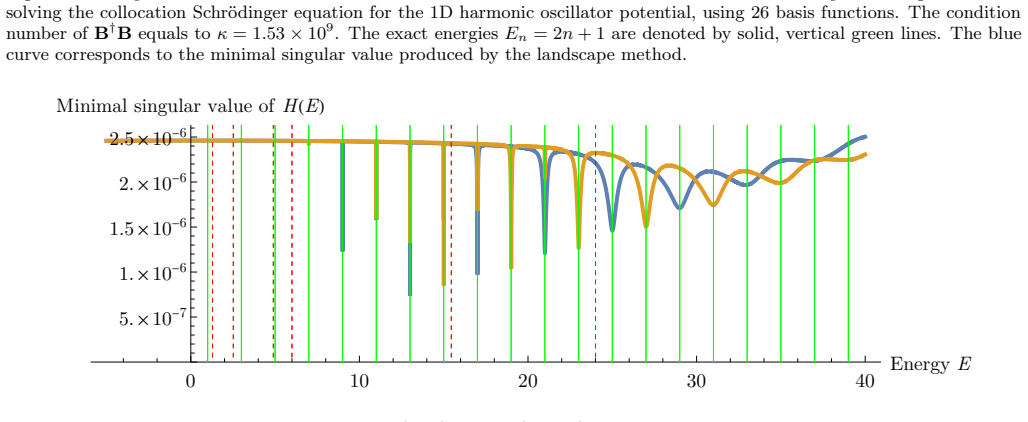
× 10-6 2.5 × 10⁻⁶ Minimal singular value ofH (E) Figure 4. The same setup as in Fig. 3 with 35 (blue) and 36 (orange) basis functions. The condition numbers respectively 1.21 × 10¹⁶ and 5.47 × 10¹⁶. Two different sets of basis functions are combined to account for the parity of the solutions to the Schrödinger equation. by the following formula VM(x) = De...
-
[2]
Comparison of the matrix inverse method described in Sec
× 10-6 3.5 × 10⁻⁶ Minimal singular value ofH (E) Figure 5. Comparison of the matrix inverse method described in Sec. IIIB with the classical landscape scanning method for solving the collocation Schrödinger equation for the 1D Morse potential, given by Eq. (34), using 35 basis functions, with the condition number ofB†B equal to 1.23 × 10¹⁶. The curves hav...
-
[3]
Quantum-random oracle model (QROM) imple- menting matrix elements of B and B′′ in block- encoding can be implemented with quantum arith- metic. For instance, for the collocation matrix ele- ments Bij we have the following representation: Bij = Ce −(βi−γj)2 , (37) for some constants β and γ and a normalization constant C. Similarly, alsoB′′ has a compact f...
-
[4]
We also note that the matrices B′′ and VdiagB are expected to share many common non-zero elements
The leading contribution to Mmax is expected to come from the potential energy function andB′′, as due to the normalization of the wavefunctions, the max-norm of matrix B is independent of its size N, i.e., ||B||max = O(1). We also note that the matrices B′′ and VdiagB are expected to share many common non-zero elements. This is most ev- ident when Gaussi...
-
[5]
For equal-width distributed Gaussian basis func- tions, since bothB and B′′ are circulant matrices, it suffices to encode a single column for each matrix with QROM to reduce the T-gate cost greatly
-
[6]
If the potentialˆV is given in a functional form, the cost of block-encoding it scales asO(polylog(N/ε)) via quantum arithmetic [71]
-
[7]
Gaussian basis functions are localized in space, leading to logarithmic sparsity of the residue ma- trix M(α), in which cased = O(log N)
-
[8]
The max-norm Mmax of B is independent of the number of basis functions as we increase the di- mensionality of the matrices. What is more, the norm of the second derivative matrixB′′ will not grow as we go to higher dimensions in the spatial sense of the Schrödinger equation. With the above assumptions, the quantum landscape scanning complexity is compared...
-
[9]
The widths of the minima depend on the number of basis functions
Because we aim to measure at least one grid pointα capturing the corresponding minimum, the choice of grid must be adjusted accordingly. The widths of the minima depend on the number of basis functions. To successfully find the energies using both landscape methods, it might be necessary to adaptively choose precisionε of singular values, i.e., the number...
-
[10]
M. A. Nielsen and I. L. Chuang,Quantum Computation and Quantum Information: 10th Anniversary Edition (Cambridge University Press, 2010)
work page 2010
-
[11]
S.Lee, J.Lee, H.Zhai, Y.Tong, A.M.Dalzell, A.Kumar, P. Helms, J. Gray, Z.-H. Cui, W. Liu, M. Kastoryano, R.Babbush, J.Preskill, D.R.Reichman, E.T.Campbell, E. F. Valeev, L. Lin, and G. K.-L. Chan, Evaluating the evidence for exponential quantum advantage in ground- state quantum chemistry, Nature Communications 14, 10.1038/s41467-023-37587-6 (2023)
-
[12]
Y. Su, D. W. Berry, N. Wiebe, N. Rubin, and R. Bab- bush, Fault-tolerant quantum simulations of chemistry in first quantization, PRX Quantum2, 040332 (2021)
work page 2021
-
[13]
R. Babbush, C. Gidney, D. W. Berry, N. Wiebe, J. Mc- Clean, A. Paler, A. Fowler, and H. Neven, Encoding elec- tronic spectra in quantum circuits with linear t complex- ity, Phys. Rev. X8, 041015 (2018)
work page 2018
-
[14]
J. Lee, D. W. Berry, C. Gidney, W. J. Huggins, J. R. Mc- Clean, N. Wiebe, and R. Babbush, Even more efficient quantum computations of chemistry through tensor hy- percontraction, PRX Quantum2, 030305 (2021)
work page 2021
-
[15]
V. von Burg, G. H. Low, T. Häner, D. S. Steiger, M. Rei- her, M. Roetteler, and M. Troyer, Quantum computing enhanced computational catalysis, Phys. Rev. Res. 3, 033055 (2021)
work page 2021
-
[16]
K. Deka and E. Zak, Simultaneously optimizing sym- metry shifts and tensor factorizations for cost-efficient fault-tolerant quantum simulations of electronic hamil- tonians, Journal of Chemical Theory and Computation 21, 4458–4465 (2025)
work page 2025
-
[17]
P. Richerme, M. C. Revelle, C. G. Yale, D. Lobser, A. D. Burch, S. M. Clark, D. Saha, M. A. Lopez-Ruiz, A. Dwivedi, J. M. Smith, S. A. Norrell, A. Sabry, and S. S. Iyengar, Quantum computation of hydrogen bond dynamics and vibrational spectra, The Journal of Phys- ical Chemistry Letters14, 7256–7263 (2023)
work page 2023
-
[18]
L. A. Mariano, V. H. A. Nguyen, J. B. Petersen, M. Björnsson, J. Bendix, G. R. Eaton, S. S. Eaton, and A. Lunghi, The role of electronic excited states in the spin-lattice relaxation of spin-1/2 molecules, Science Ad- vances 11, 10.1126/sciadv.adr0168 (2025)
-
[19]
P. R. Bunker, P. Jensen, and C. Jungen, Molecular symmetry and spectroscopy, Physics Today52, 63–64 (1999)
work page 1999
-
[20]
C. Kittel and P. B. Kahn, Quantum theory of solids, American Journal of Physics33, 517–518 (1965)
work page 1965
-
[21]
B. M. Weight, X. Li, and Y. Zhang, Theory and mod- eling of light-matter interactions in chemistry: current and future, Physical Chemistry Chemical Physics 25, 31554–31577 (2023)
work page 2023
-
[22]
S. Mukherjee, M. Pinheiro, B. Demoulin, and M. Bar- batti, Simulations of molecular photodynamics in long timescales, Philosophical Transactions of the Royal Soci- ety A: Mathematical, Physical and Engineering Sciences 380, 10.1098/rsta.2020.0382 (2022)
-
[23]
A. C. Peet and W. Yang, The collocation method for calculating vibrational bound states of molecular sys- tems—with application to ar–hcl, The Journal of Chem- ical Physics 90, 1746–1751 (1989)
work page 1989
-
[24]
T. Helgaker, P. Jørgensen, and J. Olsen, Molecular Electronic-Structure Theory (John Wiley & Sons, Ltd, 2000)
work page 2000
-
[25]
T. Carrington, Perspective: Computing (ro-)vibrational spectra of molecules with more than four atoms, The Journal of Chemical Physics 146, 10.1063/1.4979117 (2017). 17
- [26]
-
[27]
J. Brown and T. Carrington, Using an iterative eigen- solver to compute vibrational energies with phase- spaced localized basis functions, The Journal of Chemical Physics 143, 10.1063/1.4926805 (2015)
-
[28]
B. Hashemi, Y. Nakatsukasa, and L. N. Trefethen, Rect- angulareigenvalueproblems,AdvancesinComputational Mathematics 48, 10.1007/s10444-022-09994-8 (2022)
-
[29]
W. H. Press, S. A. Teukolsky, W. T. Vetterling, and B. P. Flannery,Numerical Recipes 3rd Edition: The Art of Sci- entific Computing, 3rd ed. (Cambridge University Press, USA, 2007)
work page 2007
-
[30]
B. Ford and G. Hall, The generalized eigenvalue problem in quantum chemistry, Computer Physics Communica- tions 8, 337–348 (1974)
work page 1974
-
[31]
G. Dusson, M.-S. Dupuy, and I.-M. Lygatsika, A poste- riori error estimates for schrödinger operators discretized with linear combinations of atomic orbitals (2024)
work page 2024
- [32]
-
[33]
G. Avila and T. Carrington, Nonproduct quadrature grids for solving the vibrational schrödinger equation, J. Chem. Phys. 131, 174103 (2009)
work page 2009
-
[34]
B. Poirier and J. C. Light, Efficient distributed gaussian basis for rovibrational spectroscopy calculations, The Journal of Chemical Physics113, 211–217 (2000)
work page 2000
-
[35]
G. Richings, I. Polyak, K. Spinlove, G. Worth, I. Burghardt, and B. Lasorne, Quantum dynamics sim- ulations using gaussian wavepackets: the vmcg method, International Reviews in Physical Chemistry34, 269–308 (2015)
work page 2015
-
[36]
I. Burghardt, K. Giri, and G. A. Worth, Multi- mode quantum dynamics using gaussian wavepackets: The gaussian-based multiconfiguration time-dependent hartree (g-mctdh) method applied to the absorption spectrum of pyrazine, The Journal of Chemical Physics 129, 10.1063/1.2996349 (2008)
-
[37]
S. Manzhos, M. Ihara, and T. Carrington, Using colloca- tion to solve the schrödinger equation, Journal of Chem- ical Theory and Computation19, 1641–1656 (2023)
work page 2023
-
[38]
E. J. Zak and T. Carrington, Using collocation and a hierarchical basis to solve the vibrational schrödinger equation, The Journal of Chemical Physics 150, 10.1063/1.5096169 (2019)
-
[39]
T. Carrington, Using collocation to study the vibrational dynamics of molecules, Spectrochimica Acta Part A: Molecular and Biomolecular Spectroscopy 248, 119158 (2021)
work page 2021
-
[40]
J. Simmons and T. Carrington, Computing vibrational spectra using a new collocation method with a pruned basis and more points than basis functions: Avoid- ing quadrature, The Journal of Chemical Physics158, 10.1063/5.0146703 (2023)
-
[41]
S. Jin, S. Wu, G. Zhou, Y. Li, L. Li, B. Li, and X. Wang, A query-based quantum eigensolver, Quantum Engineer- ing 2, 10.1002/que2.49 (2020)
-
[42]
Y. Chen, A. Gilyén, and R. de Wolf, A quantum speed- up for approximating the top eigenvectors of a matrix (2024)
work page 2024
-
[43]
A. Kerzner, V. Gheorghiu, M. Mosca, T. Guilbaud, F. Carminati, F. Fracas, and L. Dellantonio, A square- root speedup for finding the smallest eigenvalue, Quan- tum Science and Technology9, 045025 (2024)
work page 2024
-
[44]
C. Shao, Computing eigenvalues of diagonalizable ma- trices on a quantum computer, ACM Transactions on Quantum Computing 3, 1–20 (2022)
work page 2022
-
[45]
G. H. Low and Y. Su, Quantum eigenvalue processing, in 2024 IEEE 65th Annual Symposium on Foundations of Computer Science (FOCS)(IEEE, 2024) p. 1051–1062
work page 2024
-
[46]
Z. Ding, H. Li, L. Lin, H. Ni, L. Ying, and R. Zhang, Quantum multiple eigenvalue gaussian filtered search: an efficient and versatile quantum phase estimation method, Quantum 8, 1487 (2024)
work page 2024
-
[47]
Z. Zimborás, B. Koczor, Z. Holmes, E.-M. Borrelli, A. Gi- lyén, H.-Y. Huang, Z. Cai, A. Acín, L. Aolita, L. Banchi, F.G.S.L.Brandão, D.Cavalcanti, T.Cubitt, S.N.Filip- pov, G. García-Pérez, J. Goold, O. Kálmán, E. Kyoseva, M. A. C. Rossi, B. Sokolov, I. Tavernelli, and S. Man- iscalco, Myths around quantum computation before full fault tolerance: What no-...
work page 2025
- [48]
-
[49]
Hogben,Handbook of Linear Algebra(Chapman and Hall/CRC, 2013)
L. Hogben,Handbook of Linear Algebra(Chapman and Hall/CRC, 2013)
work page 2013
-
[50]
In this case,N is the larger of the two dimensions
-
[51]
Later on, we generalize this problem also to singular val- ues
-
[52]
For normal matrices, ε-pseudospectrum are the regions ±ε around their spectrum; therefore, this notion is aligned with our goal of finding numbers close to the exact eigenvalues
-
[53]
More specifically, for each register, with the highest prob- ability, the outcome will be the true eigenvalueλ. How- ever, there will also be a small irrelevant part|g⟩, that will eventually not contribute much to the final estima- tion of the eigenvalue|η⟩ = √1 − γ |λ⟩ + γ P i |gi⟩, as the coefficient γ ≈ 0
-
[54]
G. H. Low and I. L. Chuang, Optimal hamiltonian sim- ulation by quantum signal processing, Physical Review Letters 118, 10.1103/physrevlett.118.010501 (2017)
- [55]
-
[56]
In the above, we disregard the registers related to the QPE, as these do not change the value of the character- istic function qubit
-
[57]
In principle, due to the not-exact accuracy of QPE, the median qubit will also contain contributions from other states, but we drop this for clarity
-
[58]
M. Cardona and M. L. W. Thewalt, Isotope effects on theopticalspectraofsemiconductors,ReviewsofModern Physics 77, 1173 (2005)
work page 2005
-
[59]
Kittel, Introduction to Solid State Physics, 8th ed
C. Kittel, Introduction to Solid State Physics, 8th ed. (Wiley, 2004)
work page 2004
-
[60]
R.M.Nieminen,Electronicstructurecalculationsforma- terials design, Journal of Physics: Condensed Matter14, 2859 (2002)
work page 2002
-
[61]
Boys, Proceedings of the Royal Society of London
S. Boys, Proceedings of the Royal Society of London. A. Mathematical and Physical Sciences 309, 195–208 18 (1969)
work page 1969
-
[62]
G.AvilaandT.Carrington,Amulti-dimensionalsmolyak collocationmethodincurvilinearcoordinatesforcomput- ing vibrational spectra, The Journal of Chemical Physics 143, 10.1063/1.4936294 (2015)
-
[63]
R. B. Lehoucq, D. C. Sorensen, and C. Yang,ARPACK Users’ Guide: Solution of Large-Scale Eigenvalue Prob- lems with Implicitly Restarted Arnoldi Methods(Society for Industrial and Applied Mathematics, 1998)
work page 1998
-
[64]
M. Myllykoski and C. C. Kjelgaard Mikkelsen, Task- based, gpu-accelerated and robust library for solv- ing dense nonsymmetric eigenvalue problems, Concur- rency and Computation: Practice and Experience 33, 10.1002/cpe.5915 (2020)
-
[65]
A. W. Harrow, A. Hassidim, and S. Lloyd, Quantum al- gorithm for linear systems of equations, Physical Review Letters 103, 10.1103/physrevlett.103.150502 (2009)
- [66]
-
[67]
To avoid obfuscation by too many parameters, we also assume the number of grid points in the spatial coordi- nate M is proportional to N, i.e., M = O(N ), making the ratio of the dimensions of the initial matricesB and B′′ constant
-
[68]
This assumption is valid for localized basis sets, such as the Gaussian basis
-
[69]
V. V. Williams, Y. Xu, Z. Xu, and R. Zhou, New bounds for matrix multiplication: from alpha to omega (2023)
work page 2023
-
[70]
J. Alman and V. V. Williams, A refined laser method and faster matrix multiplication, TheoretiCSV olume 3, 10.46298/theoretics.24.21 (2024)
-
[71]
Y. Saad and M. H. Schultz, Gmres: A generalized min- imal residual algorithm for solving nonsymmetric linear systems, SIAM Journal on Scientific and Statistical Com- puting 7, 856–869 (1986)
work page 1986
-
[72]
C.Musco, C.Musco,andA.Sidford,Stabilityofthelanc- zos method for matrix function approximation (2017)
work page 2017
-
[73]
Note that we neglect the dependence of the Krylov space size on the number of eigenvalues requested, which is often logarithmic [62]
-
[74]
Lord, Matrix computations, 3rd edition, by g
N. Lord, Matrix computations, 3rd edition, by g. h. golub and c. f. van loan. pp. 694. 1996. isbn 0 8018 5414 8, 0 8018 5413 x. (johns hopkins university press)., The Math- ematical Gazette 83, 556–557 (1999)
work page 1996
-
[75]
Thus, quantum advantage can be searched already for low J’s
Forhigher-ordertruncations, thecomplexitiesoftheclas- sical and quantum algorithms both grow linearly inJ. Thus, quantum advantage can be searched already for low J’s
-
[76]
In the case of vanishing derivative of the singular value dependenceontheparameter α, K mightbeproportional to roots of1/ε, making this dependence better from the quantum computing perspective
-
[77]
C. Sünderhauf, E. Campbell, and J. Camps, Block- encoding structured matrices for data input in quantum computing, Quantum 8, 1226 (2024)
work page 2024
-
[78]
P. Mukhopadhyay, T. F. Stetina, and N. Wiebe, Quan- tum simulation of the first-quantized pauli-fierz hamilto- nian, PRX Quantum5, 010345 (2024)
work page 2024
-
[79]
Quantum arithmetic with the quantum Fourier transform
L. Ruiz-Perez and J. C. Garcia-Escartin, Quantum arith- metic with the quantum fourier transform, Quantum Information Processing 16, 10.1007/s11128-017-1603-1 (2017)
- [80]
discussion (0)
Sign in with ORCID, Apple, or X to comment. Anyone can read and Pith papers without signing in.