REVIEW 4 major objections 6 minor 118 references
Quantized local reduced-order modeling in time (ql-ROM)
T0 review · 4 major / 6 minor · reviewed 2026-08-15 · deepseek-v4-flash
Pith's one-line read This paper claims that partitioning a chaotic attractor into clusters and building a centroid-centered POD-Galerkin reduced-order model in each cluster yields numerically stable models that predict further ahead and reproduce long-term…
desk verdict A clean and clearly presented local-ROM idea with genuine promise, but test-set leakage and an unquantified hard switch make the evaluation weaker than the claims; still worth peer review. read the letter →
The pith
A machine-rendered reading of the paper's core claim, the machinery that carries it, and where it could break.
The reading
What carries the argument
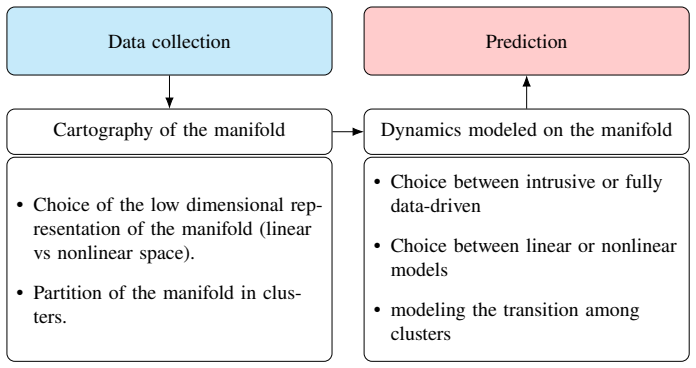
The load-bearing construction is the quantized local reduced-order model itself: K-means partitions the snapshots into $K$ clusters, each with a centroid $\boldsymbol{c}_k$; the fluctuations around the centroid feed a per-cluster POD basis; and Galerkin projection yields $K$ low-dimensional systems $\frac{d\boldsymbol{a}_k}{dt} + \boldsymbol{B}_k \boldsymbol{a}_k + \boldsymbol{N}_k(\boldsymbol{a}_k, \boldsymbol{c}_k) + \boldsymbol{f}_k = \mathbf{0}$. The piece that stitches the local models together is the change-of-basis map $\boldsymbol{a}_j = \boldsymbol{U}_j^{H} \boldsymbol{U}_i \boldsymbol{a}_i + \boldsymbol{U}_j^{H}(\boldsymbol{c}_i - \boldsymbol{c}_j)$, applied when the nearest-centroid assignment switches from cluster $i$ to cluster $j$. This map converts the reduced coordinates from the outgoing cluster's basis to the incoming cluster's basis, and every matrix in it is precomputed offline. The number of clusters $K$ is selected with a BIC elbow and the number of modes $r$ by test-set reconstruction error, so the method remains a standard intrusive POD-Galerkin workflow with clustering inserted as a preprocessing step.
What would settle it
Hold the number of modes $r$ fixed on a chaotic test case, sweep the number of clusters $K$ from 1 to well past the BIC elbow, and measure the prediction horizon and cluster-affiliation statistics. If the ql-ROM's advantage over the g-ROM does not grow up to the elbow and then degrade, cluster geometry is not the operative mechanism; if the trajectory begins to chatter at cluster boundaries for large $K$, the switching map is the weak point.
Extended reading notes
Core claim
The central discovery is that the heterogeneity of the attractor, not just its dimension, is what defeats global intrusive reduced-order models, and that local modeling around cluster centroids removes much of that difficulty. The authors demonstrate this on the Kuramoto-Sivashinsky equation and on two-dimensional Kolmogorov flow, covering bursting, chaotic, quasiperiodic, and turbulent regimes. In the KS bursting case, a global model with nine modes is unstable while the quantized local model with nine modes is stable and accurate, and in the KS chaotic case the local model extends the prediction horizon by roughly a factor of two while avoiding the high-wavenumber aliasing that contaminates the global model's energy spectrum. For Kolmogorov flow, the local model captures the spatial energy spectrum and the cluster-visit statistics that the global model misses. The claim is that these advantages come with essentially no extra online cost, because at each time step only the local model of the currently active cluster is integrated.
Load-bearing premise
The method stands or falls on the assumption that K-means with Euclidean distance splits the high-dimensional attractor into regions where a low-dimensional linear model around the cluster center is sufficient, and that switching abruptly between these models at cluster boundaries does not corrupt the trajectory.
Editorial extensions
If this is right
- A ql-ROM with the same number of retained modes as a g-ROM can remain stable and accurate in regimes where the g-ROM diverges, as in the bursting KS case with nine modes.
- Short-term prediction horizons increase by roughly a factor of three in the bursting KS regime and roughly a factor of two in the chaotic KS regime relative to the global model.
- Long-term statistics improve: the ql-ROM reproduces cluster-affiliation probabilities, kinetic-energy probability distributions, and spatial energy spectra, whereas the g-ROM shows spectral aliasing at high wavenumbers.
- The online computational cost stays nearly identical to a global ROM, since only the active cluster's $r$-dimensional system is integrated and each switch costs one matrix-vector product plus a shift.
- The method remains intrusive and interpretable, because each local model is a standard Galerkin projection of the governing equations with clustering changing only the reference mean and basis.
Reading between the lines
- Beyond the paper: the quantization idea should transfer to non-intrusive learners such as reservoir computers or neural-ODE models, whose global latent models often struggle with multi-modal attractors; the clustering and switching machinery does not depend on the local model being a Galerkin projection.
- Beyond the paper: the hard nearest-centroid switch is the most fragile piece, and a natural extension is a soft or probabilistic mixture of local models near cluster boundaries to remove the non-differentiability the authors mention in passing.
- Beyond the paper: because the change-of-basis map is linear and precomputed, the method is naturally compatible with ensemble data assimilation; cluster affiliation could act as a categorical observation with local updates per cluster.
- Beyond the paper: the claim of consistent superiority could be probed by comparing a ql-ROM with a g-ROM that is given the same total number of parameters, including the centroid terms, to isolate whether the gain comes from local linearity or from having more parameters overall.
Signed reviews
Editorial analysis
A structured set of objections, weighed in public.
Referee Report
Summary. The manuscript proposes quantized local reduced-order models (ql-ROMs) for spatiotemporally chaotic PDEs. The method partitions snapshot data into K clusters via k-means, constructs a centroid-centered local POD-Galerkin ROM for each cluster, and integrates whichever local model corresponds to the nearest centroid, transforming coordinates at cluster switches by Eq. (14). The approach is tested on the Kuramoto-Sivashinsky equation (bursting and chaotic regimes) and two-dimensional Kolmogorov flow (quasiperiodic and turbulent regimes), reporting improvements over global POD-Galerkin ROMs in numerical stability, short-term prediction horizon, and long-term statistics such as energy spectra and probability distributions, at equal online dimension r.
Significance. The proposed framework is simple, physically interpretable, and combines data-driven phase-space partitioning with intrusive projection, so if the reported gains hold under a clean evaluation protocol it would be a useful addition to the local-ROM literature. The paper covers four regimes across two PDEs, compares against a natural global-ROM baseline, and provides a clear algorithmic description (Algorithm 1) with precomputed transition maps. The diagnostic breadth (prediction horizon, spectra, PDFs, cluster-affiliation statistics) is a genuine strength. However, the manuscript does not provide code or data, and the evaluation currently relies on test-set-based hyperparameter selection and on a single realization per regime, both of which limit the strength of the central claim until addressed.
major comments (4)
- [§2.3, Eq. (16) and §4.1--§4.2] The number of modes r is selected using reconstruction error on the test dataset: Section 2.3 states that 'the number of modes r is selected for the root mean squared error (16) of the test dataset', and Section 4.2 repeats this for r = 100 and r = 400. The same test dataset is then used to report the prediction horizons and errors, e.g., Eq. (21) and Eq. (22) and Figure 9. This is a test-set leakage: r is a hyperparameter chosen to fit the test snapshots, so the reported out-of-sample improvements are optimistically biased and do not support the claim of a controlled comparison. Please select r (and K, where relevant) using only training or validation data, and report all evaluation metrics on a held-out test interval that was not used for any model choice; alternatively, provide a sensitivity analysis showing that the reported conclusions are stable over a range of r.
- [§2.2.1, Eq. (14), Algorithm 1, and footnote] The hard nearest-centroid switch induced by Eq. (14) is the central mechanism, but its effect on trajectory continuity is not analyzed. If the state before a switch is c_i + U_i a_i, then after applying Eq. (14) the reconstructed physical state is c_j + U_j U_j^H (c_i - c_j + U_i a_i), so the physical trajectory jumps by (I - U_j U_j^H)(c_j - c_i - U_i a_i), which is generally nonzero when the local POD subspaces differ. The footnote only states that the solution may be non-differentiable and defers smoothing to future work, but the reported prediction-horizon gains are measured on trajectories that include these jumps. Without an estimate of the jump magnitude or a sensitivity test, it is unclear whether the switch is a minor bookkeeping operation or a hidden source of error. Please quantify the switching error (e.g., accumulate ||u_r(t+) - u_r(t-)|| at every switch, report the number and timing of switches, and test a short-overlap or hysteresis variant) and present it separately from the local-model error.
- [§4.1, §4.2] The claim that ql-ROMs 'significantly and consistently outperform' g-ROMs is supported by a single test realization per regime. For chaotic systems, prediction horizons and long-time statistics fluctuate across initial conditions and test intervals, so the reported factors of 2--3 in prediction horizon, and the qualitative spectrum and PDF comparisons, may not be systematic. Please report results from multiple initial conditions or multiple disjoint test windows, and provide a variability measure such as the standard deviation or interquartile range of T_ph (Eq. (21)) and of the error metrics, so that the consistency claim can be assessed statistically.
- [§2.3 and Figure 6(a) caption] The hyperparameter-selection protocol is not consistently described. Section 2.3 says r is selected from the reconstruction error of the test dataset, while the caption of Figure 6 states that the basis and centroids were constructed using only the training dataset and that the MSE is evaluated on the test dataset. Please clarify in the text whether the reconstruction-error curves in Figures 6(a) and 8(a) are computed on training, validation, or test data, and ensure that the procedure used to choose r and K is compatible with the out-of-sample evaluation protocol required for the prediction metrics.
minor comments (6)
- [§2.3] In the sentence 'the second termo of (18)', 'termo' should be 'term'.
- [§2.2.1, Algorithm 1] Equation (15) uses beta_v(u_r(t)) for the reconstruction, while Algorithm 1 uses beta_c(t) during integration; please align the notation and clarify how beta_c is evaluated during prediction when the time index refers to the reduced trajectory.
- [Eq. (16)] Equation (16) is called 'root mean squared error' but defines a pointwise residual vector; consider defining a scalar RMSE and reserving r_m for the residual vector to avoid confusion.
- [Figures 8(b) and 13] The vertical axes in these figures are labeled with values but not with the quantity, which appears to be Delta BIC / Delta K; please add explicit axis labels.
- [General] The paper does not state whether code or data will be made available; for a computational physics journal, please add a data and code availability statement.
- [§5, Conclusions] The sentence 'The ql-ROMs significantly and consistently outperforms g-ROMs' has a subject-verb agreement error; it should be 'outperform'.
Circularity Check
No significant circularity: local models are trained on data and evaluated by autonomous integration on held-out intervals; self-citations and test-set hyperparameter selection are not load-bearing.
full rationale
The derivation is not circular. The local POD-Galerkin bases (Eqs. 10-11) are fit to training snapshots within each K-means cluster; the transition map (Eq. 14) is an orthogonal projection plus centroid shift, computed offline; the reported quantities (prediction horizon (21), energy spectra, and PDFs) are produced by time integration of the reduced ODEs (13), not by reading off fitted values. The main hyperparameters r and K are selected from test-set reconstruction error (16) and BIC (17)-(18); this is a model-selection concern, not a self-definitional reduction, because the reported forecast errors and statistics are not equal to the reconstruction error by construction. Self-citations (e.g., Refs. 74, 75, 87) supply a BIC expression and a deferred smoothing idea; neither is load-bearing for the central stability, horizon, or spectral claims. The footnote in Sec. 2.2.1 acknowledges non-differentiability at cluster switches and defers smoothing; this is an unquantified robustness limitation, not a circularity. No step reduces Eq. X to Eq. Y by definition.
Assumptions & free parameters
free parameters (2)
- r (number of POD modes per cluster) =
10 (KS bursting), 30 (KS chaotic), 100 (Kolmogorov Re=20), 400 (Kolmogorov Re=42)
- K (number of clusters) =
6 (KS bursting), 10 (KS chaotic), 10 (Kolmogorov Re=20), 20 (Kolmogorov Re=42)
assumptions (6)
- domain assumption Dissipative PDE solutions converge to a lower-dimensional manifold (manifold hypothesis).
- domain assumption K-means with Euclidean distance yields meaningful clusters of the high-dimensional spectral state space.
- domain assumption Within each cluster, the dynamics of fluctuations around the centroid are well described by a low-dimensional linear subspace plus the projected nonlinearity; the Galerkin projection (13) is a valid reduced model.
- domain assumption The nearest-centroid switching with the change-of-basis (14) yields a trajectory that follows the attractor; differentiability at cluster boundaries is not required for the reported metrics.
- domain assumption Training and test datasets are statistically stationary and drawn from the same attractor, so test intervals are representative.
- standard math BIC with the authors' formula (18) is a valid model-selection criterion for K-means.
Cite this review
Pith. "Pith review of Quantized local reduced-order modeling in time (ql-ROM)." pith.science (2026). https://pith.science/paper/J67DVWTC
@misc{pith2026250613738,
  author       = {Pith},
  title        = {Pith review of: Quantized local reduced-order modeling in time (ql-ROM)},
  year         = {2026},
  howpublished = {\url{https://pith.science/paper/J67DVWTC}},
  note         = {Machine review of arXiv:2506.13738}
}
read the original abstract
Spatiotemporally chaotic systems, such as the solutions of some nonlinear partial differential equations, are dynamical systems that evolve toward a lower dimensional manifold. This manifold has an intricate geometry with heterogeneous density, which makes the design of a single (global) nonlinear reduced-order model (ROM) challenging. In this paper, we turn this around. Instead of modeling the manifold with one single model, we partition the manifold into clusters within which the dynamics are locally modeled. This results in a quantized local reduced-order model (ql-ROM), which consists of (i) quantizing the manifold via unsupervised clustering; (ii) constructing intrusive ROMs for each cluster; and (iii) seamlessly patch the local models with a change of basis and assignment functions. We test the method on two nonlinear partial differential equations, i.e., the Kuramoto-Sivashinsky and 2D Navier-Stokes equations (Kolmogorov flow), across bursting, chaotic, quasiperiodic, and turbulent regimes. The local models are built via Galerkin projection onto the local principal directions, which are centered on the cluster centroids. The dynamics are modeled by switching a local ROM based on the cluster proximity. The proposed ql-ROM framework has three advantages over global ROMs (g-ROMs): (i) numerical stability, (ii) improved short-term prediction accuracy in time, and (iii) accurate prediction of long-term statistics, such as energy spectra and probability distributions. The computational overhead is minimal with respect to g-ROMs. The proposed framework retains the interpretability and simplicity of intrusive projection-based ROMs, whilst overcoming their limitations in modeling complex, high-dimensional, nonlinear dynamics.
Figures


Figures from the paper (10 more)


Reference graph
Works this paper leans on
-
[1]
Lumley, and Gal Berkooz
Philip Holmes, John L. Lumley, and Gal Berkooz. Turbulence, Coherent Struc- tures, Dynamical Systems and Symmetry. Cambridge University Press, October
-
[2]
Stephen B. Pope. Turbulent Flows. Cambridge University Press, August 2000. ISBN 9780511840531. doi: 10.1017/cbo9780511840531
-
[3]
Strogatz, M
S. Strogatz, M. Friedman, A. J. Mallinckrodt, and S. McKay. Nonlinear dynamics and chaos: with applications to physics, biology, chemistry, and engineering. Computers Phys., 8(5):532–532, 1994
1994
-
[4]
Charles Fefferman, Sanjoy Mitter, and Hariharan Narayanan. Testing the mani- fold hypothesis.Journal of the American Mathematical Society, 29(4):983–1049, February 2016. ISSN 1088-6834. doi: 10.1090/jams/852
doi:10.1090/jams/852 2016
-
[5]
R. Noack, B, K. Afanasiev, M. Morzy´nski, G. Tadmor, and F. Thiele. A hierarchy of low-dimensional models for the transient and post-transient cylinder wake.J. Fluid Mech., 497:335–363, 2003. doi: 10.1017/S0022112003006694
-
[6]
Rowley, Tim Colonius, and Richard M
Clarence W. Rowley, Tim Colonius, and Richard M. Murray. Model reduction for compressible flows using pod and galerkin projection.Physica D: Nonlinear Phenomena, 189(1–2):115–129, February 2004. ISSN 0167-2789. doi: 10. 1016/j.physd.2003.03.001. 27
2004
-
[7]
NOACK, PAUL PAPAS, and PETER A
BERND R. NOACK, PAUL PAPAS, and PETER A. MONKEWITZ. The need for a pressure-term representation in empirical galerkin models of incompressible shear flows. Journal of Fluid Mechanics , 523:339–365, 2005. doi: 10.1017/ S0022112004002149
2005
-
[8]
Racca, N
A. Racca, N. A. K. Doan, and L. Magri. Predicting turbulent dynamics with the convolutional autoencoder echo state network. J. Fluid Mech., 975, November
Show all 118 references
-
[9]
Taira, S
K. Taira, S. L. Brunton, S. T. Dawson, C. W. Rowley, T. Colonius, B. J. McKeon, O. T. Schmidt, S. Gordeyev, V. Theofilis, and L. S. Ukeiley. Modal analysis of fluid flows: An overview. AIAA J., pages 4013–4041, 2017
2017
-
[10]
ALEXANDRE BARBAGALLO, DENIS SIPP, and PETER J. SCHMID. Closed- loop control of an open cavity flow using reduced-order models. Journal of Fluid Mechanics, 641:1–50, November 2009. ISSN 1469-7645. doi: 10.1017/ s0022112009991418
2009
-
[11]
Brunton and Bernd R
Steven L. Brunton and Bernd R. Noack. Closed-loop turbulence control: Progress and challenges. Applied Mechanics Reviews, 67(5), aug 2015. doi: 10.1115/1. 4031175
2015 doi
-
[12]
C. W. Rowley and S. T.M. Dawson. Model reduction for flow analysis and control. Annu. Rev. Fluid Mech. , 49(1):387–417, jan 2017. doi: 10.1146/ annurev-fluid-010816-060042
2017
-
[13]
Hemati, Steven L
Kunihiko Taira, Maziar S. Hemati, Steven L. Brunton, Yiyang Sun, Karthik Duraisamy, Shervin Bagheri, Scott T. M. Dawson, and Chi-An Yeh. Modal analysis of fluid flows: Applications and outlook. AIAA Journal, 58(3):998– 1022, March 2020. ISSN 1533-385X. doi: 10.2514/1.j058462
2020 doi
-
[14]
Sequential data assimilation with a nonlinear quasi-geostrophic model using monte carlo methods to forecast error statistics
Geir Evensen. Sequential data assimilation with a nonlinear quasi-geostrophic model using monte carlo methods to forecast error statistics. Journal of Geo- physical Research: Oceans, 99(C5):10143–10162, May 1994. ISSN 0148-0227. doi: 10.1029/94jc00572
1994 doi
-
[15]
N ´ovoa and L
A. N ´ovoa and L. Magri. Real-time thermoacoustic data assimilation. Journal of Fluid Mechanics, 948, September 2022. ISSN 1469-7645. doi: 10.1017/jfm. 2022.653
2022 doi
-
[16]
Dawson, and Luca Magri
Andrea N ´ovoa, Nicolas Noiray, James R. Dawson, and Luca Magri. A real- time digital twin of azimuthal thermoacoustic instabilities. Journal of Fluid Mechanics, 1001, December 2024. ISSN 1469-7645. doi: 10.1017/jfm.2024. 1052
2024 doi
-
[17]
Slotnick, Abdollah Khodadoust, Juan J
Jeffrey P. Slotnick, Abdollah Khodadoust, Juan J. Alonso, David L. Darmofal, William D. Gropp, Edward J. Lurie, and Dimitri J. Mavriplis. CFD vision 2030 study: A path to revolutionary computational aerosciences. Technical Report NASA/CR-2014-218178, NASA, 2014. URL https://nt...
2014
-
[18]
Turbulence statistics in fully devel- oped channel flow at low reynolds number
John Kim, Parviz Moin, and Robert Moser. Turbulence statistics in fully devel- oped channel flow at low reynolds number. Journal of Fluid Mechanics , 177: 133–166, April 1987. ISSN 1469-7645. doi: 10.1017/s0022112087000892
1987 doi
-
[19]
Quarteroni, G
A. Quarteroni, G. Rozza, and A. Manzoni. Certified reduced basis approximation for parametrized partial differential equations and applications.Int. J. Ind. Math., 1(1), jun 2011. doi: 10.1186/2190-5983-1-3
2011 doi
-
[20]
Farzamnik, A
E. Farzamnik, A. Ianiro, S. Discetti, N. Deng, K. Oberleithner, B.R. Noack, and V. Guerrero. From snapshots to manifolds – a tale of shear flows.J. Fluid Mech., 955, jan 2023. doi: 10.1017/jfm.2022.1039
2023
-
[21]
P. G. Papaioannou, R. T., I. G. Kevrekidis, and C. Siettos. Time-series forecast- ing using manifold learning, radial basis function interpolation, and geometric harmonics. Chaos, 32(8), aug 2022. doi: 10.1063/5.0094887
2022 doi
-
[22]
Buzzicotti, F
M. Buzzicotti, F. Bonaccorso, P. Clark Di Leoni, and L. Biferale. Reconstruction of turbulent data with deep generative models for semantic inpainting from turb- rot database. Physical Review Fluids, 6(5), 2021. doi: 10.1103/PhysRevFluids. 6.050503
2021 doi
-
[23]
Data-driven prediction and control of extreme events in a chaotic flow
Alberto Racca and Luca Magri. Data-driven prediction and control of extreme events in a chaotic flow. Phys. Rev. Fluids, 7(10):104402, October 2022. ISSN 2469-990X. doi: 10.1103/physrevfluids.7.104402
2022 doi
-
[24]
A survey of projection-based model reduction methods for parametric dynamical systems
Peter Benner, Serkan Gugercin, and Karen Willcox. A survey of projection-based model reduction methods for parametric dynamical systems. SIAM Review, 57 (4):483–531, January 2015. ISSN 1095-7200. doi: 10.1137/130932715
2015 doi
-
[25]
Brunton, Bernd R
Steven L. Brunton, Bernd R. Noack, and Petros Koumoutsakos. Machine learning for fluid mechanics.Annual Review of Fluid Mechanics, 52(1):477–508, January
-
[26]
Peter J. Schmid. Dynamic mode decomposition and its variants. Annual Review of Fluid Mechanics , 54(1):225–254, January 2022. ISSN 1545-4479. doi: 10.1146/annurev-fluid-030121-015835
2022 doi
-
[27]
A critical-layer framework for turbulent pipe flow
Beverley J McKeon and Ati S Sharma. A critical-layer framework for turbulent pipe flow. Journal of Fluid Mechanics , 658:336–382, 2010. doi: 10.1017/ S002211201000176X
2010
-
[28]
Amplification of coherent structures in channel flows
Yongyun Hwang and Carlo Cossu. Amplification of coherent structures in channel flows. Journal of Fluid Mechanics , 664:51–73, 2010. doi: 10.1017/S0022112010003629
2010 doi
-
[29]
Towne, O
A. Towne, O. T. Schmidt, and T. Colonius. Spectral proper orthogonal decompo- sition and its relationship to dynamic mode decomposition and resolvent analysis. J. Fluid Mech., 847:821–867, 2018. 29
2018
-
[30]
Baddoo, Richard Semaan, Steven L
Benjamin Herrmann, Peter J. Baddoo, Richard Semaan, Steven L. Brunton, and Beverley J. McKeon. Data-driven resolvent analysis.Journal of Fluid Mechanics, 918, May 2021. ISSN 1469-7645. doi: 10.1017/jfm.2021.337
2021 doi
-
[31]
Ai feynman: A physics-inspired method for symbolic regression
Silviu-Marian Udrescu and Max Tegmark. Ai feynman: A physics-inspired method for symbolic regression. Science Advances, 6(16), April 2020. ISSN 2375-2548. doi: 10.1126/sciadv.aay2631
2020 doi
-
[32]
S. L. Brunton, J. L. Proctor, and J. N. Kutz. Discovering governing equations from data by sparse identification of nonlinear dynamical systems. Proc. Natl. Acad. Sci., 113(15):3932–3937, March 2016. ISSN 1091-6490. doi: 10.1073/ pnas.1517384113
2016
-
[33]
Loiseau, B
J.-C. Loiseau, B. R. Noack, and S. L. Brunton. Sparse reduced-order modelling: sensor-based dynamics to full-state estimation. J. Fluid Mech. , 844:459–490, April 2018. ISSN 1469-7645. doi: 10.1017/jfm.2018.147
2018 doi
-
[34]
Raissi, P
M. Raissi, P. Perdikaris, and G.E. Karniadakis. Physics-informed neural net- works: A deep learning framework for solving forward and inverse prob- lems involving nonlinear partial differential equations. Journal of Com- putational Physics , 378:686–707, February 2019. ISSN 00...
2019 doi
-
[35]
J. G. R. von Saldern, J. M. Reumsch¨ ussel, T. L. Kaiser, M. Sieber, and K. Oberleithner. Mean flow data assimilation based on physics-informed neu- ral networks. Phys. Fluids , 115129, 2022. doi: 10.1063/5.0116218. URL http://arxiv.org/abs/2208.03109
2022 arXiv
-
[36]
Long short-term memory
Sepp Hochreiter and J¨ urgen Schmidhuber. Long short-term memory. Neural Computation, 9(8):1735–1780, November 1997. ISSN 1530-888X. doi: 10. 1162/neco.1997.9.8.1735
1997
-
[37]
Curriculum learning for data-driven modeling of dy- namical systems
Michele Alessandro Bucci, Onofrio Semeraro, Alexandre Allauzen, Sergio Chib- baro, and Lionel Mathelin. Curriculum learning for data-driven modeling of dy- namical systems. The European Physical Journal E, 46(3), March 2023. ISSN 1292-895X. doi: 10.1140/epje/s10189-023-00269-8
2023 doi
-
[38]
Gomez, Lukasz Kaiser, and Illia Polosukhin
Ashish Vaswani, Noam Shazeer, Niki Parmar, Jakob Uszkoreit, Llion Jones, Aidan N. Gomez, Lukasz Kaiser, and Illia Polosukhin. Attention is all you need, 2017
2017
-
[39]
N. A. K. Doan, W. Polifke, and L. Magri. Short- and long-term predictions of chaotic flows and extreme events: a physics-constrained reservoir computing approach. Proceedings of the Royal Society A: Mathematical, Physical and Engineering Sciences, 477(2253):20210135, September...
2021
-
[40]
¨Ozalp, G
E. ¨Ozalp, G. Margazoglou, and L. Magri. Reconstruction, forecasting, and stability of chaotic dynamics from partial data. Chaos, 33(9), September 2023. ISSN 1089-7682. doi: 10.1063/5.0159479. 30
2023 doi
-
[41]
Deterministic nonperiodic flow
Edward N Lorenz. Deterministic nonperiodic flow. Journal of the Atmospheric Sciences, 20(2):130–141, 1963. doi: 10.1175/1520-0469(1963)020⟨0130:DNF⟩ 2.0.CO;2
1963 doi
-
[42]
S. L. Brunton, B. R. Noack, and P. Koumoutsakos. Machine learning for fluid mechanics. Annu. Rev. Fluid Mech., 52:477–508, 2020
2020
-
[43]
Pod-galerkin reduced order methods for cfd using finite volume discreti- sation: vortex shedding around a circular cylinder
Giovanni Stabile, Saddam Hijazi, Andrea Mola, Stefano Lorenzi, and Gianluigi Rozza. Pod-galerkin reduced order methods for cfd using finite volume discreti- sation: vortex shedding around a circular cylinder. Communications in Applied and Industrial Mathematics, 8(1):210–236, ...
2017 doi
-
[44]
N. Deng, B. R. Noack, M. Morzy ´nski, and L. R. Pastur. Low-order model for successive bifurcations of the fluidic pinball. J. Fluid Mech., 884:A37, 2020
2020
-
[45]
Sanderse
B. Sanderse. Non-linearly stable reduced-order models for incompressible flow with energy-conserving finite volume methods. Journal of Compu- tational Physics , 421:109736, November 2020. ISSN 0021-9991. doi: 10.1016/j.jcp.2020.109736
2020
-
[46]
Turbulence modeling in the age of data
Karthik Duraisamy, Gianluca Iaccarino, and Heng Xiao. Turbulence modeling in the age of data. Annual Review of Fluid Mechanics, 51(1):357–377, January
-
[47]
Xiao and P
H. Xiao and P. Cinnella. Quantification of model uncertainty in RANS simulations: A review. Prog. Aerosp. Sci. , 108:1–31, jul 2019. doi: 10.1016/j.paerosci.2018.10.001
2019 doi
-
[48]
Structural sensitivity of the first instability of the cylinder wake
Flavio Giannetti and Paolo Luchini. Structural sensitivity of the first instability of the cylinder wake. Journal of Fluid Mechanics , 581:167–197, May 2007. ISSN 1469-7645. doi: 10.1017/s0022112007005654
2007 doi
-
[49]
Cinnella, P
P. Cinnella, P. M. Congedo, V. Pediroda, and L. Parussini. Sensitivity analysis of dense gas flow simulations to thermodynamic uncertainties. Phys. Fluids, 23 (11), nov 2011. doi: 10.1063/1.3657080
2011 doi
-
[50]
Efficient non-linear model reduction via a least-squares petrov–galerkin projection and compressive tensor approximations
Kevin Carlberg, Charbel Bou-Mosleh, and Charbel Farhat. Efficient non-linear model reduction via a least-squares petrov–galerkin projection and compressive tensor approximations. International Journal for Numerical Methods in Engi- neering, 86(2):155–181, 2011. doi: 10.1002/nme.3072
2011 doi
-
[51]
Carlberg
Kookjin Lee and Kevin T. Carlberg. Model reduction of dynamical systems on nonlinear manifolds using deep convolutional autoencoders. Journal of Computational Physics , 404:108973, March 2020. ISSN 0021-9991. doi: 10.1016/j.jcp.2019.108973
2020
-
[52]
Interpolation method for adapting reduced- order models and application to aeroelasticity
David Amsallem and Charbel Farhat. Interpolation method for adapting reduced- order models and application to aeroelasticity. AIAA Journal, 46(7):1803–1813,
-
[53]
Nandakishore Kambhatla and Todd K. Leen. Dimension reduction by local principal component analysis. Neural Computation, 9(7):1493–1516, October
-
[54]
Roweis and Lawrence K
Sam T. Roweis and Lawrence K. Saul. Nonlinear dimensionality reduction by locally linear embedding. Science, 290(5500):2323–2326, December 2000. ISSN 1095-9203. doi: 10.1126/science.290.5500.2323
-
[55]
Sutherland, and Alessandro Parente
Kamila Zdyba l, Giuseppe D’ Alessio, Antonio Attili, Axel Coussement, James C. Sutherland, and Alessandro Parente. Local manifold learning and its link to domain-based physics knowledge. Applications in Energy and Combustion Sci- ence, 14:100131, June 2023. ISSN 2666-352X. doi...
2023 doi
-
[56]
Modified kernel principal com- ponent analysis based on local structure analysis and its application to nonlinear process fault diagnosis
Xiaogang Deng, Xuemin Tian, and Sheng Chen. Modified kernel principal com- ponent analysis based on local structure analysis and its application to nonlinear process fault diagnosis. Chemometrics and Intelligent Laboratory Systems, 127: 195–209, August 2013. ISSN 0169-7439. do...
2013 doi
-
[57]
Local proper generalized decomposition
Alberto Bad ´ıas, David Gonz ´alez, Iciar Alfaro, Francisco Chinesta, and Elias Cueto. Local proper generalized decomposition. International Journal for Nu- merical Methods in Engineering, 112(12):1715–1732, June 2017. ISSN 1097-
2017
-
[58]
Corigliano, M
A. Corigliano, M. Dossi, and S. Mariani. Model order reduction and domain decomposition strategies for the solution of the dynamic elastic–plastic structural problem. Computer Methods in Applied Mechanics and Engineering, 290:127– 155, June 2015. ISSN 0045-7825. doi: 10.1016/j...
2015 doi
-
[59]
Global and local pod models for the prediction of compressible flows with dg methods
Andrea Ferrero, Angelo Iollo, and Francesco Larocca. Global and local pod models for the prediction of compressible flows with dg methods. International Journal for Numerical Methods in Engineering, 116(5):332–357, August 2018. ISSN 1097-0207. doi: 10.1002/nme.5927
2018 doi
-
[60]
A zonal galerkin-free pod model for incompressible flows
Michel Bergmann, Andrea Ferrero, Angelo Iollo, Edoardo Lombardi, Angela Scardigli, and Haysam Telib. A zonal galerkin-free pod model for incompressible flows. Journal of Computational Physics , 352:301–325, January 2018. ISSN 0021-9991. doi: 10.1016/j.jcp.2017.10.001
2018 doi
-
[61]
Space-local reduced- order bases for accelerating reduced-order models through sparsity.International Journal for Numerical Methods in Engineering , 124(7):1646–1671, December
Spenser Anderson, Cristina White, and Charbel Farhat. Space-local reduced- order bases for accelerating reduced-order models through sparsity.International Journal for Numerical Methods in Engineering , 124(7):1646–1671, December
-
[62]
Ricardo Constante-Amores, Alec J
C. Ricardo Constante-Amores, Alec J. Linot, and Michael D. Graham. Data- driven prediction of large-scale spatiotemporal chaos with distributed low- dimensional models, 2024. 32
2024
-
[63]
Ahmed and Omer San
Shady E. Ahmed and Omer San. Breaking the kolmogorov barrier in model reduction of fluid flows. Fluids, 5(1):26, February 2020. ISSN 2311-5521. doi: 10.3390/fluids5010026
2020 doi
-
[64]
Temporal localized nonlinear model reduction with a priori error estimate
Saifon Chaturantabut. Temporal localized nonlinear model reduction with a priori error estimate. Applied Numerical Mathematics, 119:225–238, September
-
[65]
Noack, Luc Pastur, Guy Y
Nan Deng, Bernd R. Noack, Luc Pastur, Guy Y. Cornejo Maceda, and Chang Hou. Cluster globally, model locally: Clusterwise modeling of nonlinear dy- namics. Acta Mechanica Sinica , pages –, 2024. doi: https://doi.org/10.1007/ s10409-024-24545-x
2024
-
[66]
Zahr, and Charbel Farhat
David Amsallem, Matthew J. Zahr, and Charbel Farhat. Nonlinear model order reduction based on local reduced-order bases.International Journal for Numeri- cal Methods in Engineering, 92(10):891–916, June 2012. ISSN 1097-0207. doi: 10.1002/nme.4371
2012 doi
-
[67]
Adaptive h-refinement for reduced-order models
Kevin Carlberg. Adaptive h-refinement for reduced-order models. International Journal for Numerical Methods in Engineering , 102(5):1192–1210, November
-
[68]
A local rom for rayleigh–b´enard bifurcation problems
Jes´ us Cort´es, Henar Herrero, and Francisco Pla. A local rom for rayleigh–b´enard bifurcation problems. Computer Methods in Applied Mechanics and Engineer- ing, 425:116949, May 2024. ISSN 0045-7825. doi: 10.1016/j.cma.2024.116949
2024
-
[69]
A localized reduced-order modeling approach for pdes with bifurcating solutions
Martin Hess, Alessandro Alla, Annalisa Quaini, Gianluigi Rozza, and Max Gun- zburger. A localized reduced-order modeling approach for pdes with bifurcating solutions. Computer Methods in Applied Mechanics and Engineering , 351: 379–403, July 2019. ISSN 0045-7825. doi: 10.1016/...
2019 doi
-
[70]
Predictive reduced order modeling of chaotic multi-scale problems using adaptively sampled projections
Cheng Huang and Karthik Duraisamy. Predictive reduced order modeling of chaotic multi-scale problems using adaptively sampled projections. Journal of Computational Physics , 491:112356, October 2023. ISSN 0021-9991. doi: 10.1016/j.jcp.2023.112356
2023
-
[71]
Localized discrete empirical interpolation method
Benjamin Peherstorfer, Daniel Butnaru, Karen Willcox, and Hans-Joachim Bun- gartz. Localized discrete empirical interpolation method. SIAM Journal on Scientific Computing, 36(1):A168–A192, January 2014. ISSN 1095-7197. doi: 10.1137/130924408
2014 doi
-
[72]
Numerical approxima- tion of parametrized problems in cardiac electrophysiology by a local reduced basis method
Stefano Pagani, Andrea Manzoni, and Alfio Quarteroni. Numerical approxima- tion of parametrized problems in cardiac electrophysiology by a local reduced basis method. Computer Methods in Applied Mechanics and Engineering, 340: 530–558, October 2018. ISSN 0045-7825. doi: 10.101...
2018 doi
-
[73]
Daniel Floryan and Michael D. Graham. Data-driven discovery of intrinsic dynamics. Nature Machine Intelligence , 4(12):1113–1120, December 2022. ISSN 2522-5839. doi: 10.1038/s42256-022-00575-4. 33
2022 doi
-
[74]
Colanera, J
A. Colanera, J. M. Reumsch¨ ussel, J. P. Beuth, M. Chiatto, L. de Luca, and K. Oberleithner. Extended cluster-based network modeling for coherent struc- tures in turbulent flows. Theoretical and Computational Fluid Dynamics, 39(1), October 2024. ISSN 1432-2250. doi: 10.1007/s0...
2024 doi
-
[75]
Computing distances and means on manifolds with a metric-constrained eikonal approach, 2024
Daniel Kelshaw and Luca Magri. Computing distances and means on manifolds with a metric-constrained eikonal approach, 2024
2024
-
[76]
Steinhaus et al
H. Steinhaus et al. Sur la division des corps mat ´eriels en parties. Bull. Acad. Polon. Sci, 1(804):801, 1956
1956
-
[77]
J. B. MacQueen. Some methods for classification and analysis of multivariate observations. 1:281–297, 1967
1967
-
[78]
S. P. Lloyd. Least squares quantization in pcm. IEEE Trans. Inf. Theory, 28(2): 129 – 137, 1982. doi: 10.1109/TIT.1982.1056489
1982
-
[79]
Arthur and S
D. Arthur and S. Vassilvitskii. K-means++: The advantages of careful seeding. In Proceedings of the Eighteenth Annual ACM-SIAM Symposium on Discrete Algorithms, page 1027–1035, USA, 2007. Society for Industrial and Applied Mathematics. ISBN 9780898716245
2007
-
[80]
Christopher M. Bishop. Pattern recognition and machine learning, 2019
2019
-
[81]
Theoretical Analysis of the k-Means Algorithm – A Survey , pages 81–116
Johannes Bl ¨omer, Christiane Lammersen, Melanie Schmidt, and Christian Sohler. Theoretical Analysis of the k-Means Algorithm – A Survey , pages 81–116. Springer International Publishing, Cham, 2016. doi: 10.1007/ 978-3-319-49487-6 3
2016
-
[82]
A. K. Jain, M. N. Murty, and P. J. Flynn. Data clustering: a review. ACM Computing Surveys, 31(3):264–323, September 1999. ISSN 1557-7341. doi: 10.1145/331499.331504
1999
-
[83]
M. E. J. Newman. Modularity and community structure in networks.Proceedings of the National Academy of Sciences , 103(23):8577–8582, June 2006. ISSN 1091-6490. doi: 10.1073/pnas.0601602103
2006 doi
-
[84]
A density- based algorithm for discovering clusters in large spatial databases with noise
Martin Ester, Hans-Peter Kriegel, J ¨org Sander, and Xiaowei Xu. A density- based algorithm for discovering clusters in large spatial databases with noise. In Knowledge Discovery and Data Mining , 1996. URL https://api. semanticscholar.org/CorpusID:355163
1996
-
[85]
The proper orthogonal decomposition in the analysis of turbulent flows
G Berkooz, P Holmes, and J L Lumley. The proper orthogonal decomposition in the analysis of turbulent flows. Annual Review of Fluid Mechanics , 25(1): 539–575, January 1993. ISSN 1545-4479. doi: 10.1146/annurev.fl.25.010193. 002543
1993 doi
-
[86]
H. Li, D. Fernex, R. Semaan, J. Tan, M. Morzy ´nski, and B. R. Noack. Cluster- based network model. J. Fluid Mech., 906, 2021. 34
2021
-
[87]
Antonio Colanera, Nan Deng, Matteo Chiatto, Luigi de Luca, and Bernd R. Noack. Orbital cluster-based network modelling, 2024
2024
-
[88]
X-means: Extending k-means with efficient estimation of the number of clusters
Dan Pelleg and Andrew Moore. X-means: Extending k-means with efficient estimation of the number of clusters. Machine Learning, p, 01 2002
2002
-
[89]
Estimating the dimension of a model
Gideon Schwarz. Estimating the dimension of a model. The Annals of Statistics, 6(2):461–464, 1978
1978
-
[90]
Priestley
M.B. Priestley. Spectral Analysis and Time Series. Number v. 1-2 in Probability and mathematical statistics : A series of monographs and textbooks. Academic Press, 1981. URL https://books.google.it/books?id=RVTYvwEACAAJ
1981
-
[91]
Information criteria and statistical modeling, 2008
Sadanori Konishi. Information criteria and statistical modeling, 2008. Includes bibliographical references (p. [255]-267) and index
2008
-
[92]
‘all models are wrong...’: an introduction to model uncertainty
Ernst Wit, Edwin van den Heuvel, and Jan-Willem Romeijn. ‘all models are wrong...’: an introduction to model uncertainty. Statistica Neerlandica, 66(3): 217–236, jul 2012. doi: 10.1111/j.1467-9574.2012.00530.x
2012
-
[93]
Diffusion-induced chaos in reaction systems
Yoshiki Kuramoto. Diffusion-induced chaos in reaction systems. Progress of Theoretical Physics Supplement , 64:346–367, 1978. ISSN 0375-9687. doi: 10.1143/ptps.64.346
1978 doi
-
[94]
Sivashinsky
G.I. Sivashinsky. Nonlinear analysis of hydrodynamic instability in laminar flames—i. derivation of basic equations. Acta Astronautica, 4(11–12):1177– 1206, November 1977. ISSN 0094-5765. doi: 10.1016/0094-5765(77)90096-0
1977 doi
-
[95]
Hyman and Basil Nicolaenko
James M. Hyman and Basil Nicolaenko. The kuramoto-sivashinsky equation: A bridge between pde’s and dynamical systems.Physica D: Nonlinear Phenomena, 18(1–3):113–126, January 1986. ISSN 0167-2789. doi: 10.1016/0167-2789(86) 90166-1
1986 doi
-
[96]
Fylladitakis
Emmanouil D. Fylladitakis. Kolmogorov flow: Seven decades of history.Journal of Applied Mathematics and Physics, 06(11):2227–2263, 2018. ISSN 2327-4379. doi: 10.4236/jamp.2018.611187
2018
-
[97]
Platt, L
N. Platt, L. Sirovich, and N. Fitzmaurice. An investigation of chaotic kolmogorov flows. Physics of Fluids A: Fluid Dynamics , 3(4):681–696, April 1991. ISSN 0899-8213. doi: 10.1063/1.858074
1991 doi
-
[98]
Noack, Laurent Cordier, Andreas Spohn, Marc Segond, Markus Abel, Guillaume Daviller, Jan ¨Osth, Siniˇsa Krajnovi´c, Robert K
Eurika Kaiser, Bernd R. Noack, Laurent Cordier, Andreas Spohn, Marc Segond, Markus Abel, Guillaume Daviller, Jan ¨Osth, Siniˇsa Krajnovi´c, Robert K. Niven, and et al. Cluster-based reduced-order modelling of a mixing layer. J. Fluid Mech., 754:365–414, 2014. doi: 10.1017/jfm.2014.355
2014 doi
-
[99]
C. Hou, N. Deng, and B. R. Noack. Trajectory-optimized cluster-based network model for the sphere wake. Phys. Fluids, 34(8), aug 2022. doi: 10.1063/5. 0098655. 35
2022 doi
-
[100]
Vlachas, J
P.R. Vlachas, J. Pathak, B.R. Hunt, T.P. Sapsis, M. Girvan, E. Ott, and P. Koumoutsakos. Backpropagation algorithms and reservoir computing in recurrent neural networks for the forecasting of complex spatiotemporal dy- namics. Neural Networks, 126:191–217, June 2020. ISSN 0893...
2020 doi
-
[101]
David W. Scott. Multivariate Density Estimation: Theory, Practice, and Vi- sualization. Wiley, August 1992. ISBN 9780470316849. doi: 10.1002/ 9780470316849
1992
-
[102]
Yousuff Hussaini, and Thomas A
Claudio Canuto, Alfio Quarteroni, M. Yousuff Hussaini, and Thomas A. Zang. Spectral Methods: Evolution to Complex Geometries and Applications to Fluid Dynamics. Springer Berlin Heidelberg, 2007. ISBN 9783540307280. doi: 10.1007/978-3-540-30728-0
2007 doi
-
[103]
Cox and P.C
S.M. Cox and P.C. Matthews. Exponential time differencing for stiff systems. Journal of Computational Physics , 176(2):430–455, March 2002. ISSN 0021-
2002
-
[104]
Sanjiva K. Lele. Compact finite difference schemes with spectral-like resolution. Journal of Computational Physics, 103(1):16–42, November 1992. ISSN 0021-
1992
-
[105]
Yousuff Hussaini, Alfio Quarteroni, and Thomas A
Claudio Canuto, M. Yousuff Hussaini, Alfio Quarteroni, and Thomas A. Zang. Spectral Methods in Fluid Dynamics. Springer Berlin Heidelberg, 1988. ISBN 9783642841088. doi: 10.1007/978-3-642-84108-8
1988 doi
-
[106]
An efficient multivariate random field generator using the fast fourier transform
Feng Ruan and Dennis McLaughlin. An efficient multivariate random field generator using the fast fourier transform. Advances in Water Resources, 21(5): 385–399, April 1998. ISSN 0309-1708. doi: 10.1016/s0309-1708(96)00064-4. 36
1998 doi
-
[116]
doi: 10.1016/0021-9991(92)90324-r
-
[207]
doi: 10.1002/nme.5578
- [1996]
- [1997]
-
[2008]
doi: 10.2514/1.34373. 31
- [2014]
- [2017]
-
[2019]
doi: 10.1146/annurev-fluid-010518-040547
ISSN 1545-4479. doi: 10.1146/annurev-fluid-010518-040547
-
[2020]
doi: 10.1146/annurev-fluid-010719-060214
ISSN 1545-4479. doi: 10.1146/annurev-fluid-010719-060214
- [2022]
- [2023]
-
[9991]
doi: 10.1006/jcph.2002.6995
2002
Reviewed August 15, 2026 · model on record in the stance chip above.
Discussion (0). Continue with ORCID to comment.