Evolution of charge correlations in the hole-doped kagome superconductor CsV_(3-x)Ti_xSb₅
Pith reviewed 2026-05-19 09:01 UTC · model grok-4.3
The pith
Hole doping via Ti on V sites in CsV3Sb5 suppresses competing charge supercells in the first dome and eliminates charge correlations in the second while superconductivity stays conventional.
A machine-rendered reading of the paper's core claim, the machinery that carries it, and where it could break.
Core claim
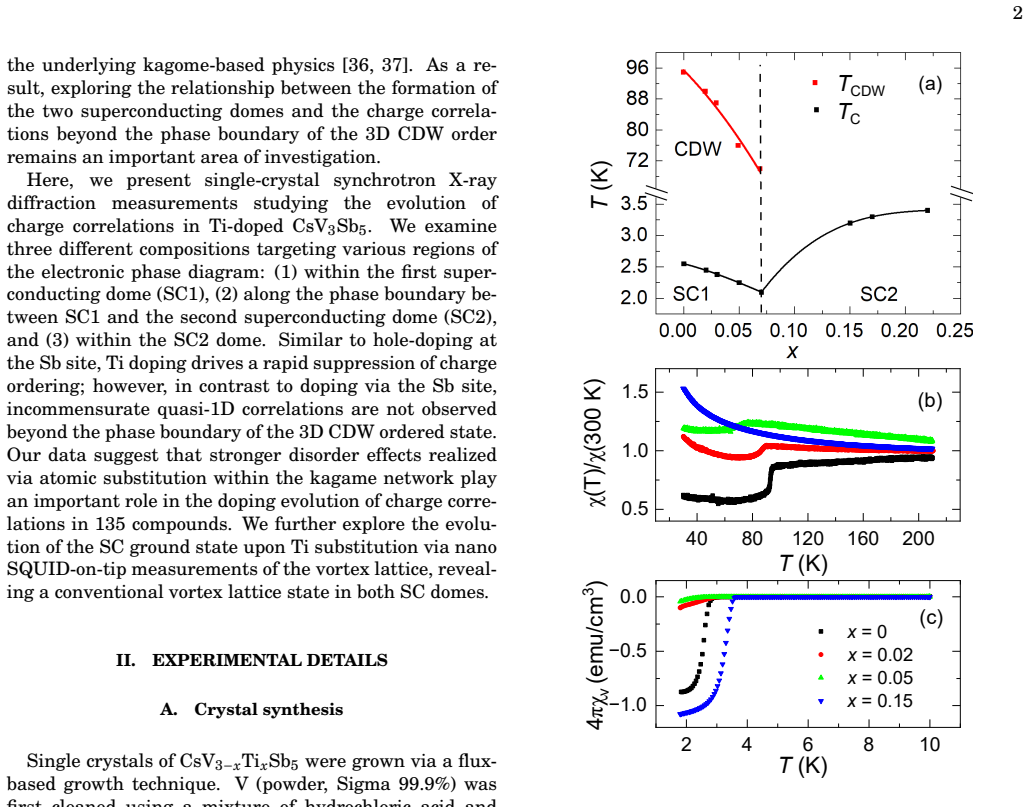
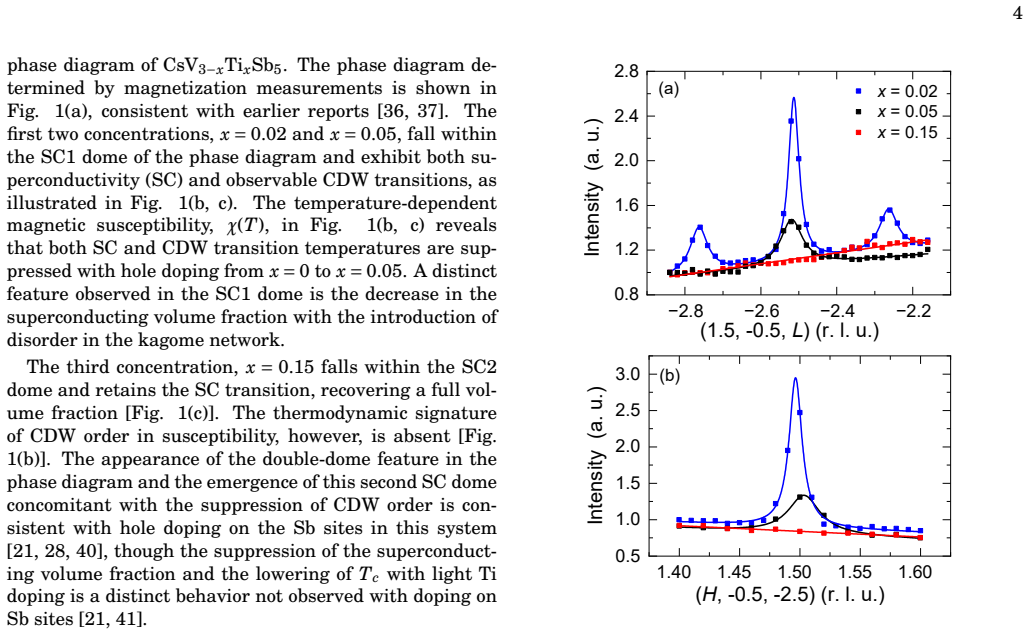
While the superconducting phase remains conventional and unchanged across the phase diagram as viewed via the vortex structure, the nature of charge correlations evolves with hole doping: competing 2×2×2 and 2×2×4 supercells within the charge density wave state are suppressed rapidly with Ti substitution in the first dome, and no charge correlations are detected in the second superconducting dome.
What carries the argument
Competing 2×2×2 and 2×2×4 supercells in the charge density wave state, detected via synchrotron x-ray diffraction and suppressed by hole doping on the V sites.
If this is right
- Charge density wave order is highly sensitive to whether hole doping occurs on the vanadium or antimony sites.
- Superconductivity can exist without detectable charge correlations in the higher-doping dome.
- The disorder potential from V-site substitution differs from Sb-site substitution and alters the evolution of electronic orders.
- The two superconducting domes are separated by a region where charge order is suppressed but superconductivity persists.
Where Pith is reading between the lines
- The decoupling of charge order from superconductivity in the second dome may imply that pairing in that region does not rely on fluctuations from the suppressed CDW.
- Similar suppression of charge correlations might occur under applied pressure, offering a disorder-free way to reach the second dome.
- The rapid suppression of competing supercells suggests that even small amounts of V-site disorder can destabilize the 2×2×4 structure preferentially.
Load-bearing premise
The diffraction peaks arise solely from bulk charge density wave order and are not significantly affected by surface effects or dopant-induced disorder gradients.
What would settle it
Observation of charge correlation peaks persisting or reappearing in the second superconducting dome using a bulk-sensitive probe such as neutron diffraction would contradict the reported absence of charge correlations.
Figures



read the original abstract
The interplay between superconductivity and charge correlations in the kagome metal CsV$_3$Sb$_5$ can be tuned by external perturbations such as doping or pressure. Here we present a study of charge correlations and superconductivity upon hole doping via Ti substitution on the V kagome sites in CsV$_{3-x}$Ti$_x$Sb$_5$ via synchrotron x-ray diffraction and scanning SQUID measurements. While the superconducting phase, as viewed via the vortex structure, remains conventional and unchanged across the phase diagram, the nature of charge correlations evolves as a function of hole-doping from the first superconducting dome into the second superconducting dome. For Ti doping in the first superconducting dome, competing $2\times 2 \times 2$ and $2\times 2 \times 4$ supercells form within the charge density wave state and are suppressed rapidly with carrier substitution. In the second superconducting dome, no charge correlations are detected. Comparing these results to those observed for CsV$_3$Sb$_{5-x}$Sn$_x$ suggests important differences between hole doping via chemical substitution on the V and Sb sites, particularly in the disorder potential associated with each dopant.
Editorial analysis
A structured set of objections, weighed in public.
Referee Report
Summary. The paper reports synchrotron x-ray diffraction and scanning SQUID measurements on hole-doped CsV_{3-x}Ti_x Sb_5, claiming that the superconducting vortex structure remains conventional across the phase diagram while charge correlations evolve: competing 2×2×2 and 2×2×4 supercells in the first superconducting dome are rapidly suppressed with Ti doping, and no charge correlations are detected in the second dome. This is contrasted with prior Sn-doping results to highlight differences in disorder potential between V-site and Sb-site substitution.
Significance. If the central claims hold, the work provides evidence for site-specific doping effects on the competition between charge order and superconductivity in kagome metals, clarifying how different disorder landscapes can suppress CDW order and stabilize a second superconducting dome. The combination of diffraction and local vortex imaging is a strength, as is the direct comparison to Sn-doped analogs.
major comments (1)
- [Synchrotron x-ray diffraction results] Results on synchrotron XRD in the second dome (x above the threshold separating the domes): the interpretation that absence of 2×2×2 and 2×2×4 superlattice peaks implies complete suppression of charge correlations is load-bearing for the claimed evolution. Without reported detection limits, rocking-curve widths, or analysis of possible Ti-induced disorder broadening, this does not rule out short-range or fluctuating order, weakening the contrast to the first dome and to Sn doping.
minor comments (2)
- [Abstract and Methods] The abstract and methods would benefit from explicit statement of the Ti concentrations corresponding to the first and second domes and the precise doping threshold where peaks disappear.
- [Figures] Figure captions for the diffraction data should include error bars or noise levels to allow assessment of peak absence.
Simulated Author's Rebuttal
We thank the referee for their careful review and constructive feedback on our manuscript. The comment raises an important point regarding the interpretation of the synchrotron XRD data in the second superconducting dome. We address this below and have revised the manuscript to incorporate additional quantitative details on measurement sensitivity.
read point-by-point responses
-
Referee: Results on synchrotron XRD in the second dome (x above the threshold separating the domes): the interpretation that absence of 2×2×2 and 2×2×4 superlattice peaks implies complete suppression of charge correlations is load-bearing for the claimed evolution. Without reported detection limits, rocking-curve widths, or analysis of possible Ti-induced disorder broadening, this does not rule out short-range or fluctuating order, weakening the contrast to the first dome and to Sn doping.
Authors: We agree that explicit quantification of the detection limits strengthens the claim. In the revised manuscript, we have added a dedicated paragraph in the Methods and Results sections reporting the minimum detectable superlattice peak intensity (approximately 0.1% of the main Bragg peak intensity based on our counting statistics and background levels), typical rocking-curve widths (FWHM ~0.02° in the doped samples), and an assessment of possible Ti-induced disorder broadening. We note that the same experimental setup readily detects the 2×2×2 and 2×2×4 peaks in the first dome at comparable doping levels, providing an internal benchmark for sensitivity. While we cannot exclude extremely short-range or fluctuating correlations below this threshold, the absence of any detectable signal, together with the conventional vortex lattice observed by scanning SQUID, supports our interpretation of suppressed charge order in the second dome. We have also expanded the discussion comparing to Sn doping to emphasize the site-specific disorder effects. revision: yes
Circularity Check
No circularity: purely observational experimental results
full rationale
The manuscript reports direct synchrotron XRD measurements of superlattice peaks and scanning SQUID vortex imaging across Ti doping levels. Claims about suppression of 2×2×2 and 2×2×4 correlations in the first dome and their absence in the second dome follow immediately from the presence or absence of observed diffraction intensity; no equations, fitted parameters, or predictions are derived. Comparisons to prior Sn-doping work are external benchmarks, not self-referential. The derivation chain contains no self-definitional steps, fitted-input predictions, or load-bearing self-citations.
Axiom & Free-Parameter Ledger
axioms (1)
- domain assumption Diffraction peaks at 2x2x2 and 2x2x4 positions indicate charge density wave supercells rather than other structural or magnetic modulations.
Lean theorems connected to this paper
-
IndisputableMonolith/Foundation/RealityFromDistinction.leanreality_from_one_distinction unclear?
unclearRelation between the paper passage and the cited Recognition theorem.
For Ti doping in the first superconducting dome, competing 2×2×2 and 2×2×4 supercells form within the charge density wave state and are suppressed rapidly with carrier substitution. In the second superconducting dome, no charge correlations are detected.
What do these tags mean?
- matches
- The paper's claim is directly supported by a theorem in the formal canon.
- supports
- The theorem supports part of the paper's argument, but the paper may add assumptions or extra steps.
- extends
- The paper goes beyond the formal theorem; the theorem is a base layer rather than the whole result.
- uses
- The paper appears to rely on the theorem as machinery.
- contradicts
- The paper's claim conflicts with a theorem or certificate in the canon.
- unclear
- Pith found a possible connection, but the passage is too broad, indirect, or ambiguous to say the theorem truly supports the claim.
Reference graph
Works this paper leans on
-
[1]
B. R. Ortiz, L. C. Gomes, J. R. Morey, M. Winiarski, M. Bor- delon, J. S. Mangum, I. W. H. Oswald, J. A. Rodriguez- Rivera, J. R. Neilson, S. D. Wilson, E. Ertekin, T. M. Mc- Queen, and E. S. Toberer, Phys. Rev. Mater. 3, 094407 (2019)
work page 2019
-
[2]
B. R. Ortiz, S. M. L. Teicher, Y. Hu, J. L. Zuo, P. M. Sarte, E. C. Schueller, A. M. M. Abeykoon, M. J. Krogstad, S. Rosenkranz, R. Osborn, R. Seshadri, L. Balents, J. He, and S. D. Wilson, Phys. Rev. Lett.125, 247002 (2020)
work page 2020
-
[3]
S. D. Wilson and B. R. Ortiz, Nat. Rev. Mater.9, 420 (2024)
work page 2024
-
[4]
B. R. Ortiz, P. M. Sarte, E. M. Kenney, M. J. Graf, S. M. L. Teicher, R. Seshadri, and S. D. Wilson, Phys. Rev. Mater.5, 034801 (2021)
work page 2021
-
[5]
Q. Yin, Z. Tu, C. Gong, Y. Fu, S. Yan, and H. Lei, Chin. Phys. Lett. 38, 037403 (2021)
work page 2021
-
[6]
L. Kautzsch, B. R. Ortiz, K. Mallayya, J. Plumb, G. Pokharel, J. P. C. Ruff, Z. Islam, E.-A. Kim, R. Seshadri, and S. D. Wilson, Phys. Rev. Mater.7, 024806 (2023)
work page 2023
-
[7]
B. R. Ortiz, A. N. Capa Salinas, M. J. Knudtson, P. M. Sarte, G. Pokahrel, and S. D. Wilson, Phys. Rev. Mater.7, 014801 (2023)
work page 2023
-
[8]
Y.-X. Jiang, J.-X. Yin, M. M. Denner, N. Shumiya, B. R. Or- tiz, G. Xu, Z. Guguchia, J. He, M. S. Hossain, X. Liu, J. Ruff, L. Kautzsch, S. S. Zhang, G. Chang, I. Belopolski, Q. Zhang, T. A. Cochran, D. Multer, M. Litskevich, Z.-J. Cheng, X. P. Yang, Z. Wang, R. Thomale, T. Neupert, S. D. Wilson, and M. Z. Hasan, Nat. Mater. 20, 1353 (2021)
work page 2021
-
[9]
C. Mielke, 3rd, D. Das, J.-X. Yin, H. Liu, R. Gupta, Y.-X. Jiang, M. Medarde, X. Wu, H. C. Lei, J. Chang, P. Dai, Q. Si, H. Miao, R. Thomale, T. Neupert, Y. Shi, R. Khasanov, M. Z. Hasan, H. Luetkens, and Z. Guguchia, Nature 602, 245 (2022)
work page 2022
-
[10]
X. Feng, K. Jiang, Z. Wang, and J. Hu, Sci. Bull. 66, 1384 (2021)
work page 2021
-
[11]
Y. Wu, Q. Wang, X. Zhou, J. Wang, P. Dong, J. He, Y. Ding, B. Teng, Y. Zhang, Y. Li, C. Zhao, H. Zhang, J. Liu, Y. Qi, K. Watanabe, T. Taniguchi, and J. Li, npj Quantum Mater. 7, 105 (2022)
work page 2022
-
[12]
C. Guo, C. Putzke, S. Konyzheva, X. Huang, M. Gutierrez- Amigo, I. Errea, D. Chen, M. G. Vergniory, C. Felser, M. H. Fischer, T. Neupert, and P. J. W. Moll, Nature 611, 461 (2022)
work page 2022
-
[13]
H. Chen, H. Yang, B. Hu, Z. Zhao, J. Yuan, Y. Xing, G. Qian, Z. Huang, G. Li, Y. Ye, S. Ma, S. Ni, H. Zhang, Q. Yin, C. Gong, Z. Tu, H. Lei, H. Tan, S. Zhou, C. Shen, X. Dong, B. Yan, Z. Wang, and H.-J. Gao, Nature599, 222 (2021)
work page 2021
-
[14]
J. Ge, P. Wang, Y. Xing, Q. Yin, A. Wang, J. Shen, H. Lei, Z. Wang, and J. Wang, Phys. Rev. X14, 021025 (2024)
work page 2024
- [15]
-
[16]
Y. Xu, Z. Ni, Y. Liu, B. R. Ortiz, Q. Deng, S. D. Wilson, B. Yan, L. Balents, and L. Wu, Nat. Phys.18, 1470 (2022)
work page 2022
-
[17]
S. D. Wilson and B. R. Ortiz, Nature Reviews Materials 9, 420 (2024)
work page 2024
- [18]
- [19]
-
[20]
T. Neupert, M. M. Denner, J.-X. Yin, R. Thomale, and M. Z. Hasan, Nat. Phys. 18, 137 (2022)
work page 2022
-
[21]
Y. M. Oey, B. R. Ortiz, F. Kaboudvand, J. Frassineti, E. Gar- cia, R. Cong, S. Sanna, V. F. Mitrovi´c, R. Seshadri, and S. D. Wilson, Phys. Rev. Mater.6, L041801 (2022)
work page 2022
-
[22]
K. Y. Chen, N. N. Wang, Q. W. Yin, Y. H. Gu, K. Jiang, Z. J. Tu, C. S. Gong, Y. Uwatoko, J. P. Sun, H. C. Lei, J. P. Hu, and J.-G. Cheng, Phys. Rev. Lett.126, 247001 (2021)
work page 2021
-
[23]
B. R. Ortiz, S. M. L. Teicher, L. Kautzsch, P. M. Sarte, N. Ratcliff, J. Harter, J. P. C. Ruff, R. Seshadri, and S. D. Wilson, Phys. Rev. X 11, 041030 (2021)
work page 2021
-
[24]
Y. Hu, X. Wu, B. R. Ortiz, X. Han, N. C. Plumb, S. D. Wil- son, A. P. Schnyder, and M. Shi, Phys. Rev. B106, L241106 (2022)
work page 2022
- [25]
-
[26]
Q. Xiao, Y. Lin, Q. Li, X. Zheng, S. Francoual, C. Plueck- thun, W. Xia, Q. Qiu, S. Zhang, Y. Guo, J. Feng, and Y. Peng, Phys. Rev. Res. 5, L012032 (2023)
work page 2023
- [27]
-
[28]
L. Kautzsch, Y. M. Oey, H. Li, Z. Ren, B. R. Ortiz, G. Pokharel, R. Seshadri, J. Ruff, T. Kongruengkit, J. W. Harter, Z. Wang, I. Zeljkovic, and S. D. Wilson, Npj Quan- tum Mater. 8, 37 (2023)
work page 2023
-
[29]
J. Hou, K. Y. Chen, J. P. Sun, Z. Zhao, Y. H. Zhang, P. F. Shan, N. N. Wang, H. Zhang, K. Zhu, Y. Uwatoko, H. Chen, H. T. Yang, X. L. Dong, H.-J. Gao, and J.-G. Cheng, Phys. Rev. B 107, 144502 (2023)
work page 2023
-
[30]
A. A. Tsirlin, B. R. Ortiz, M. Dressel, S. D. Wilson, S. Win- nerl, and E. Uykur, Phys. Rev. B107, 174107 (2023)
work page 2023
-
[31]
X. Chen, X. Zhan, X. Wang, J. Deng, X.-B. Liu, X. Chen, J.- G. Guo, and X. Chen, Chin. Phys. Lett. 38, 057402 (2021)
work page 2021
-
[32]
H. Yang, Z. Huang, Y. Zhang, Z. Zhao, J. Shi, H. Luo, L. Zhao, G. Qian, H. Tan, B. Hu, K. Zhu, Z. Lu, H. Zhang, J. Sun, J. Cheng, C. Shen, X. Lin, B. Yan, X. Zhou, Z. Wang, S. J. Pennycook, H. Chen, X. Dong, W. Zhou, and H.-J. Gao, Sci. Bull. 67, 2176 (2022)
work page 2022
- [33]
- [34]
-
[35]
X. Y. Feng, Z. Zhao, J. Luo, J. Yang, A. F. Fang, H. T. Yang, H. J. Gao, R. Zhou, and G.-q. Zheng, npj Quantum Mater.8, 23 (2023)
work page 2023
-
[36]
Y. Liu, Y. Wang, Y. Cai, Z. Hao, X.-M. Ma, L. Wang, C. Liu, J. Chen, L. Zhou, J. Wang, S. Wang, H. He, Y. Liu, S. Cui, B. Huang, J. Wang, C. Chen, and J.-W. Mei, Phys. Rev. Mater. 7, 064801 (2023)
work page 2023
-
[37]
H. Yang, Z. Huang, Y. Zhang, Z. Zhao, J. Shi, H. Luo, L. Zhao, G. Qian, H. Tan, B. Hu, et al. , Science Bulletin 67, 2176 (2022)
work page 2022
-
[38]
M. Könnecke, F. A. Akeroyd, H. J. Bernstein, A. S. Brewster, S. I. Campbell, B. Clausen, S. Cottrell, J. U. Hoffmann, P. R. Jemian, D. Männicke, R. Osborn, P. F. Peterson, T. Richter, J. Suzuki, B. Watts, E. Wintersberger, and J. Wuttke, J. Appl. Crystallogr. 48, 301 (2015)
work page 2015
- [39]
-
[40]
A. N. Capa Salinas, B. R. Ortiz, C. Bales, J. Frassineti, V. F. Mitrovi´c, and S. D. Wilson, Front. Electron. Mater.3 (2023)
work page 2023
-
[41]
M. Kang, S. Fang, J. Yoo, B. R. Ortiz, Y. M. Oey, J. Choi, S. H. Ryu, J. Kim, C. Jozwiak, A. Bostwick, E. Rotenberg, E. Kaxiras, J. G. Checkelsky, S. D. Wilson, J.-H. Park, and R. Comin, Nat. Mater. 22, 186 (2023)
work page 2023
-
[42]
L. Kautzsch, B. R. Ortiz, K. Mallayya, J. Plumb, G. Pokharel, J. P. Ruff, Z. Islam, E.-A. Kim, R. Seshadri, and S. D. Wilson, Physical Review Materials 7, 024806 (2023)
work page 2023
-
[43]
H. Li, G. Fabbris, A. Said, J. Sun, Y.-X. Jiang, J.-X. Yin, Y.- Y. Pai, S. Yoon, A. R. Lupini, C. S. Nelson, et al. , Nature communications 13, 6348 (2022)
work page 2022
-
[44]
H. Li, G. Fabbris, A. H. Said, J. P. Sun, Y.-X. Jiang, J.-X. Yin, Y.-Y. Pai, S. Yoon, A. R. Lupini, C. S. Nelson, Q. W. Yin, C. S. Gong, Z. J. Tu, H. C. Lei, J.-G. Cheng, M. Z. Hasan, Z. Wang, B. Yan, R. Thomale, H. N. Lee, and H. Miao, Nat. Commun. 13, 1 (2022)
work page 2022
-
[45]
M. Y. Jeong, H.-J. Yang, H. S. Kim, Y. B. Kim, S. Lee, and M. J. Han, Phys. Rev. B105, 235145 (2022)
work page 2022
-
[46]
H. Li, X. Liu, Y. B. Kim, and H.-Y. Kee, Phys. Rev. B 108, 075102 (2023)
work page 2023
-
[47]
M. Alkorta, M. Gutierrez-Amigo, C. Guo, P. J. W. Moll, M. G. Vergniory, and I. Errea, Symmetry-broken charge- ordered ground state in csv 3sb5 kagome metal (2025), arXiv:2505.19686 [cond-mat.mtrl-sci]
-
[48]
F. Stier, A.-A. Haghighirad, G. Garbarino, S. Mishra, N. Stilkerich, D. Chen, C. Shekhar, T. Lacmann, C. Felser, T. Ritschel, J. Geck, and M. Le Tacon, Phys. Rev. Lett.133, 236503 (2024)
work page 2024
discussion (0)
Sign in with ORCID, Apple, or X to comment. Anyone can read and Pith papers without signing in.